The God Who Dwells With Us
Have you ever found yourself in a moment so desperate, so uncertain, that you longed for a sign that God was truly with you? Today’s readings invite us to trust not only that He is near—but that He is actively working to heal, protect, and fulfill His promises to us. Whether we’re wandering in the wilderness like Jacob, hiding in the shadow of God’s wings like the psalmist, or reaching out to Jesus through pain like the hemorrhaging woman, these Scriptures remind us of one truth: “I am with you… I will never leave you” (Genesis 28:15).
In the ancient world, divine encounters often happened in dreams or through sacred places, as we see in Genesis 28, when Jacob beholds the ladder stretching between heaven and earth. This moment at Bethel becomes a turning point in salvation history—a covenantal reassurance that God dwells not only in the heavens but descends into our reality. The Responsorial Psalm echoes this with the assurance of protection for those who abide in God’s shelter. Ancient Israel would have known the dangerous terrain of life—wild beasts, enemy nations, famine—and Psalm 91 becomes a song of refuge, a reminder that those who “cling” to God are never truly alone.
That same covenantal nearness of God takes flesh in The Gospel of Matthew, where Jesus walks among the people, responding not to perfection but to faith. A grieving father, a suffering woman—both dare to believe that God can restore what is lost. And Jesus does not delay. He hears, sees, touches, and raises. The God who stood beside Jacob in a dream now walks beside the brokenhearted, healing and restoring. Today’s readings ask us: Do we dare to believe that God is with us even now, in our pain, in our waiting, in our journey?
First Reading – Genesis 28:10–22
When Heaven Touches Earth
The Book of Genesis is not just a story of origins—it’s a revelation of covenant. Today’s passage drops us into the life of Jacob, the younger son of Isaac, who—having deceived his father and stolen his brother Esau’s blessing—is now fleeing for his life. Alone, uncertain, and exiled from his family, Jacob encounters the living God in a moment of deep vulnerability. The story of Jacob’s dream at Bethel marks one of the most powerful theophanies in the Old Testament. It is here that God confirms His covenantal promise made to Abraham and Isaac, now extended to Jacob. In Jewish tradition, this dream underscores God’s sovereignty over heaven and earth, and in Christian tradition, it prefigures Christ as the true ladder between God and humanity (cf. John 1:51). Within the context of today’s readings, this moment reveals a God who comes to us not when we are strong, but when we are most lost—and who transforms ordinary ground into sacred space.
Genesis 28:10-22
New American Bible (Revised Edition)
10 Jacob departed from Beer-sheba and proceeded toward Haran. 11 When he came upon a certain place, he stopped there for the night, since the sun had already set. Taking one of the stones at the place, he put it under his head and lay down in that place. 12 Then he had a dream: a stairway rested on the ground, with its top reaching to the heavens; and God’s angels were going up and down on it. 13 And there was the Lord standing beside him and saying: I am the Lord, the God of Abraham your father and the God of Isaac; the land on which you are lying I will give to you and your descendants. 14 Your descendants will be like the dust of the earth, and through them you will spread to the west and the east, to the north and the south. In you and your descendants all the families of the earth will find blessing. 15 I am with you and will protect you wherever you go, and bring you back to this land. I will never leave you until I have done what I promised you.
16 When Jacob awoke from his sleep, he said, “Truly, the Lord is in this place and I did not know it!” 17 He was afraid and said: “How awesome this place is! This is nothing else but the house of God, the gateway to heaven!” 18 Early the next morning Jacob took the stone that he had put under his head, set it up as a sacred pillar, and poured oil on top of it. 19 He named that place Bethel, whereas the former name of the town had been Luz.
20 Jacob then made this vow: “If God will be with me and protect me on this journey I am making and give me food to eat and clothes to wear, 21 and I come back safely to my father’s house, the Lord will be my God. 22 This stone that I have set up as a sacred pillar will be the house of God. Of everything you give me, I will return a tenth part to you without fail.”
Detailed Exegesis
Verse 10 – “Jacob departed from Beer-sheba and proceeded toward Haran.”
Jacob is on a journey that begins in exile and fear. Beer-sheba was the southernmost town in the land of promise; Haran lies far to the north. The physical journey mirrors his interior condition: Jacob is displaced, wandering, and unsure of what awaits.
Verse 11 – “When he came upon a certain place, he stopped there for the night, since the sun had already set. Taking one of the stones at the place, he put it under his head and lay down in that place.”
The “certain place” is unnamed at first—ordinary and unremarkable. Yet it will become Bethel, the “house of God.” Jacob’s use of a stone for a pillow emphasizes his poverty and vulnerability. God often meets us not in comfort, but in desolation.
Verse 12 – “Then he had a dream: a stairway rested on the ground, with its top reaching to the heavens; and God’s angels were going up and down on it.”
This is a mystical vision. The stairway, or ladder, becomes a symbol of divine communication. The activity of angels ascending and descending highlights God’s involvement in human affairs. Early Church Fathers, like St. Irenaeus, saw this as a foreshadowing of the Incarnation, when heaven and earth would be bridged by Christ.
Verse 13 – “And there was the Lord standing beside him and saying: I am the Lord, the God of Abraham your father and the God of Isaac; the land on which you are lying I will give to you and your descendants.”
God identifies Himself as the same God of Abraham and Isaac, showing continuity in the covenant. Despite Jacob’s past deceit, God initiates the encounter. This highlights divine mercy: “I am the Lord… I will give…”—not based on merit, but on promise.
Verse 14 – “Your descendants will be like the dust of the earth, and through them you will spread to the west and the east, to the north and the south. In you and your descendants all the families of the earth will find blessing.”
This reiterates the Abrahamic promise found in Genesis 12. The universal dimension—“all the families of the earth”—prefigures the mission of the Church to bless all nations through Christ, a descendant of Jacob (cf. Matthew 1:2).
Verse 15 – “I am with you and will protect you wherever you go, and bring you back to this land. I will never leave you until I have done what I promised you.”
This verse is the heart of the reading. God pledges presence, protection, and fidelity. It echoes through Scripture and culminates in Christ’s words: “I am with you always, until the end of the age” (Matthew 28:20).
Verse 16 – “When Jacob awoke from his sleep, he said, ‘Truly, the Lord is in this place and I did not know it!’”
Jacob’s astonishment speaks to all of us. How often is God present, working in our lives, yet we remain unaware? His awakening is both physical and spiritual.
Verse 17 – “He was afraid and said: ‘How awesome this place is! This is nothing else but the house of God, the gateway to heaven!’”
The word “awesome” reflects holy fear, not terror. Jacob realizes he has been touched by the sacred. The location becomes a threshold between earth and eternity—a foreshadowing of every church, every altar, every moment of divine encounter.
Verse 18 – “Early the next morning Jacob took the stone that he had put under his head, set it up as a sacred pillar, and poured oil on top of it.”
Jacob anoints the stone, consecrating it as a holy place. This anointing prefigures sacramental acts, especially the dedication of altars and sacred spaces in Christian liturgy.
Verse 19 – “He named that place Bethel, whereas the former name of the town had been Luz.”
By naming the place “Bethel”—House of God—Jacob gives new identity to an old town. In God’s presence, what was once ordinary becomes holy.
Verse 20 – “Jacob then made this vow: ‘If God will be with me and protect me on this journey I am making and give me food to eat and clothes to wear,’”
Jacob responds with a vow of faith, conditional and still growing. He is just beginning his spiritual journey, and yet God welcomes his hesitant trust.
Verse 21 – “and I come back safely to my father’s house, the Lord will be my God.”
This marks a personal turning point. The God of Abraham and Isaac will now become the God of Jacob. The covenant becomes personal.
Verse 22 – “This stone that I have set up as a sacred pillar will be the house of God. Of everything you give me, I will return a tenth part to you without fail.”
Jacob promises to tithe—a gesture of gratitude and future commitment. Worship follows encounter, and generosity follows grace.
Teachings
This passage is foundational to the Church’s understanding of God’s covenant fidelity. The Catechism of the Catholic Church teaches: “God chose Abraham and made a covenant with him and his descendants. By the covenant, God formed his people and revealed his law to them through Moses. Through the prophets, he prepared them to accept the salvation destined for all humanity” (CCC 72). Jacob’s vision is a key moment in this unfolding plan. The Catechism also affirms: “From the beginning until the fullness of time, God speaks to man in many ways: through creation, through the prophets, and finally in His Son” (CCC 65). Jacob’s dream is a clear sign that divine revelation is personal, progressive, and grounded in love. St. Augustine reflects this beautifully when he writes, “God loves each of us as if there were only one of us”—reminding us that Jacob’s encounter is not just historical, but deeply human.
Historically, Bethel became one of the key worship centers in Israel. But more profoundly, this event foreshadows Christ, the true “gate of heaven.” Jesus Himself references this scene when He says to Nathanael: “You will see heaven opened and the angels of God ascending and descending on the Son of Man” (John 1:51). In Christ, the ladder between heaven and earth is no longer symbolic—it is incarnate. The Church Fathers saw Jacob’s ladder as an icon of the Church herself, extending from earth to heaven, filled with angelic and human liturgy, binding the visible and invisible realms.
St. Bernard of Clairvaux, in his Sermons on the Song of Songs, interprets the ladder as the way of humility that leads to God: “The ladder is humility, and the sides are repentance and the love of God.” Jacob’s climb begins in humility—sleeping with a stone, afraid and alone—and ends in the promise of transformation. In the spiritual life, it is often in our weakest places that God gives us the clearest vision of Himself. The Catechism confirms: “Only faith can embrace the mysterious ways of God’s almighty power… in the weakness of the cross” (CCC 268). Jacob’s dream, then, is not just mystical—it is deeply Eucharistic, where heaven touches earth through humility, sacrifice, and divine love.
Reflection
How often do we miss the sacredness of the “certain places” in our lives? This reading invites us to reflect on how God meets us in the ordinary—in the journey, in the struggle, even in our mistakes. Like Jacob, we may not feel worthy or ready, but God’s promises are not limited by our past. Do you trust that God is truly with you? Have you ever anointed a place in your life—physically or spiritually—as holy ground? Take time today to remember a moment when you felt God’s nearness. Ask Him to open your eyes like Jacob, to see that He is standing beside you, even when you do not know it. And then, like Jacob, let us vow to respond—not with fear, but with gratitude and worship.
Responsorial Psalm – Psalm 91:1–4, 14–15
Sheltered Beneath His Wings
Psalm 91 is one of the most beloved prayers of protection in the Psalter, often called the “Soldier’s Psalm” or “Psalm of Refuge.” Traditionally attributed to Moses or David, it holds a special place in the liturgy and Christian devotional life for its vivid imagery of divine shelter and angelic guardianship. In ancient Israel, where dangers abounded—from wild beasts to invading armies to deadly plagues—this psalm served as a bold proclamation of trust in God’s power to shield and deliver. It is often prayed during Compline (night prayer) in the Liturgy of the Hours, particularly invoking God’s protection through the night. Within the flow of today’s readings, Psalm 91 becomes the song of Jacob’s dream and the quiet prayer behind the faith of the hemorrhaging woman. It’s the whispered cry of those who dwell in the shadow of the Almighty, believing that even in darkness and uncertainty, God is near.
Psalm 91:1-4, 14-15
New American Bible (Revised Edition)
Security Under God’s Protection
1 You who dwell in the shelter of the Most High,
who abide in the shade of the Almighty,
2 Say to the Lord, “My refuge and fortress,
my God in whom I trust.”
3 He will rescue you from the fowler’s snare,
from the destroying plague,
4 He will shelter you with his pinions,
and under his wings you may take refuge;
his faithfulness is a protecting shield.
14 Because he clings to me I will deliver him;
because he knows my name I will set him on high.
15 He will call upon me and I will answer;
I will be with him in distress;
I will deliver him and give him honor.
Detailed Exegesis
Verse 1 – “You who dwell in the shelter of the Most High, who abide in the shade of the Almighty,”
This opening sets the tone of intimacy and security. The Hebrew word for “shelter” (סֵ֣תֶר, seter) implies a secret place—a hidden refuge. “Most High” (El Elyon) and “Almighty” (El Shaddai) are titles of majesty, reinforcing that this is no ordinary protector. To “abide” in God’s shade suggests a permanent dwelling, not a temporary hiding.
Verse 2 – “Say to the Lord, ‘My refuge and fortress, my God in whom I trust.’”
Here, the psalmist moves from descriptive to declarative. The repetition of possessives—“my refuge… my God”—expresses a personal relationship. God is not only mighty but mine. The image of a fortress reminds us of fortified cities in ancient Israel, where people would flee in times of danger. This verse is a call to place one’s total trust in God, echoing Jacob’s vow in Genesis 28.
Verse 3 – “He will rescue you from the fowler’s snare, from the destroying plague,”
The “fowler’s snare” refers to traps set by hunters—symbolic of hidden dangers or spiritual attacks. The “destroying plague” would have evoked real fear for ancient audiences, familiar with diseases that swept through communities. God is portrayed as one who sees what we cannot, guarding us from both visible and invisible threats.
Verse 4 – “He will shelter you with his pinions, and under his wings you may take refuge; his faithfulness is a protecting shield.”
This is one of the most tender images in Scripture. Like a mother bird shielding her young, God’s protection is nurturing and close. “Pinions” are the outer feathers that provide lift and strength in flight. The image suggests not just hiding under God’s wings, but eventually being lifted by them. His “faithfulness”—‘emet’ in Hebrew—is a shield, reminding us that His promises are not just comforting words but armor in the battle.
Verse 14 – “Because he clings to me I will deliver him; because he knows my name I will set him on high.”
Now God speaks directly. The condition for deliverance is not perfection but clinging. The Hebrew verb used here (חָשַׁק, ḥāšaq) implies passionate attachment. To “know His name” is to know His character and trust in His revealed identity—just as Jacob came to know God personally at Bethel.
Verse 15 – “He will call upon me and I will answer; I will be with him in distress; I will deliver him and give him honor.”
The promise is intimate: “I will answer… I will be with him”. Not only does God rescue, but He honors the one who clings to Him. This verse echoes God’s covenantal language throughout salvation history. It also finds fulfillment in The Gospel of Matthew, when Jesus responds to the cries of the official and the woman with healing and restoration.
Teachings
The Catechism of the Catholic Church confirms the powerful truth behind this psalm: “By his providence God protects and governs all things which he has made” (CCC 302). This divine governance is not abstract—it is protective, faithful, and deeply personal. The psalm reveals a God who not only reigns from heaven but shelters His people with wings of mercy and strength. This promise of presence is at the core of the Christian life. CCC 2090 teaches: “When God reveals himself and calls him, man must respond with obedience of faith… trusting in the truth of what God has revealed.” The psalmist models this kind of obedient trust through every line.
St. Teresa of Ávila wrote often about divine refuge. In her Way of Perfection, she says, “Let nothing disturb you… God alone suffices.” Her mystical life was rooted in the truth of Psalm 91—that when God is our dwelling place, we are never truly shaken. Similarly, St. John Chrysostom preached: “Though a thousand fall at your side, the evil will not touch you. Not because you are sinless, but because you are in the arms of a sinless God.” This highlights the Catholic understanding that it is not our merit, but God’s mercy, that saves.
Throughout history, Psalm 91 has been a spiritual shield. During times of plague, priests and monks recited it as they ministered to the sick. In World War I, soldiers carried it in their pockets. Even today, many Catholics pray it before travel, during illness, or in moments of spiritual warfare. Its words are not magical incantations, but declarations of covenantal trust. We cling to God because He has already clung to us through the Incarnation. Christ, the Word made flesh, fulfills every promise in this psalm—not only delivering from evil but transforming suffering into grace.
Reflection
What does it mean for you to “dwell in the shelter of the Most High”? This psalm invites us into a life of radical trust, not in our circumstances, but in the God who covers us with His wings. In moments of anxiety, temptation, or fear, we are called to cling—not to comfort, not to control—but to Him. Do you know His name? Do you cry out to Him in distress, believing that He will answer? Let this psalm become your prayer today. Repeat its verses slowly. Claim them. And when danger feels near—whether physical, emotional, or spiritual—remember: “I will be with him in distress; I will deliver him and give him honor.” Trust not in your own strength, but in the faithfulness of the One who shelters you.
Holy Gospel – Matthew 9:18–26
Faith That Reaches for the Impossible
The Gospel of Matthew was written for a Jewish-Christian audience to reveal Jesus as the promised Messiah and new Moses—He who fulfills the Law, embodies the Kingdom, and brings divine authority to the margins. In today’s passage, we encounter two miraculous healings: a synagogue official’s daughter who has died, and a woman who has suffered for twelve years from chronic bleeding. These stories are nested together, a common structure in Mark and Matthew, showing how Jesus responds to both the powerful and the outcast. In the cultural context of first-century Judea, both situations were marked by ritual impurity and social exclusion—death and hemorrhage made one “unclean” under Mosaic law (cf. Leviticus 15:25–30). Yet Jesus enters these places of impurity not to be defiled, but to restore life. In the context of today’s readings, this Gospel scene is the living manifestation of what Jacob dreamed at Bethel: the Lord standing beside His people, bringing heaven to earth.
Matthew 9:18-26
New American Bible (Revised Edition)
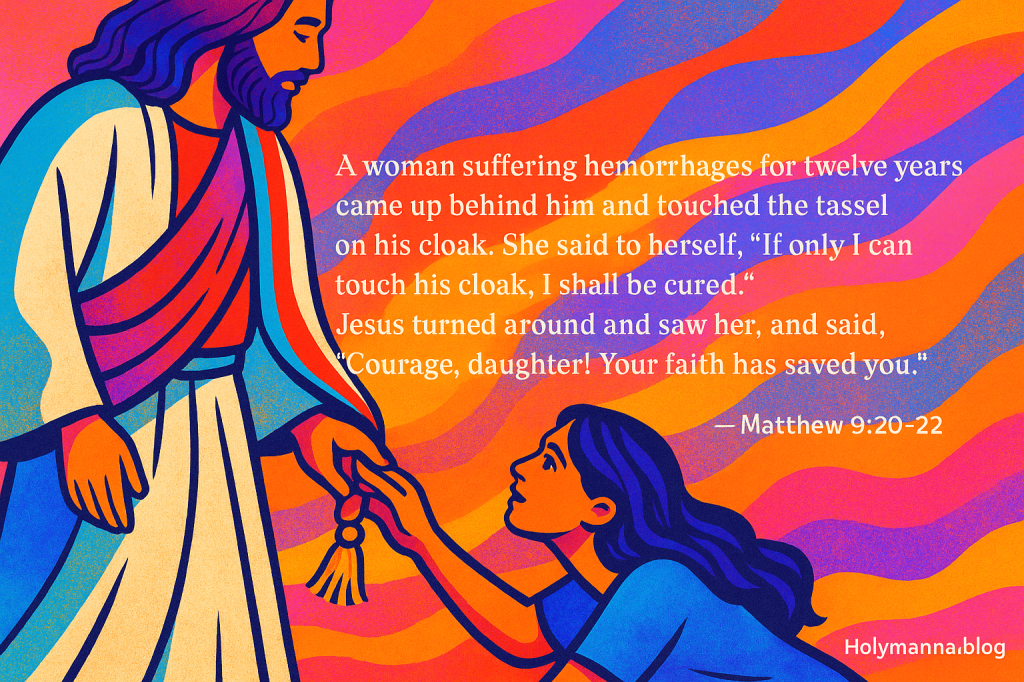
The Official’s Daughter and the Woman with a Hemorrhage. 18 While he was saying these things to them, an official came forward, knelt down before him, and said, “My daughter has just died. But come, lay your hand on her, and she will live.” 19 Jesus rose and followed him, and so did his disciples. 20 A woman suffering hemorrhages for twelve years came up behind him and touched the tassel on his cloak. 21 She said to herself, “If only I can touch his cloak, I shall be cured.” 22 Jesus turned around and saw her, and said, “Courage, daughter! Your faith has saved you.” And from that hour the woman was cured.
23 When Jesus arrived at the official’s house and saw the flute players and the crowd who were making a commotion, 24 he said, “Go away! The girl is not dead but sleeping.” And they ridiculed him. 25 When the crowd was put out, he came and took her by the hand, and the little girl arose. 26 And news of this spread throughout all that land.
Detailed Exegesis
Verse 18 – “While he was saying these things to them, an official came forward, knelt down before him, and said, ‘My daughter has just died. But come, lay your hand on her, and she will live.’”
This act of kneeling is significant. The official—likely a synagogue leader—comes not with pride but with desperation and reverence. His daughter is dead, yet his faith is bold. He believes Jesus can restore what no one else can.
Verse 19 – “Jesus rose and followed him, and so did his disciples.”
Jesus responds immediately. There is no delay. His rising and following show that divine compassion is not abstract—it moves. Jesus is not only the object of faith, but also the one who walks with us in grief and urgency.
Verse 20 – “A woman suffering hemorrhages for twelve years came up behind him and touched the tassel on his cloak.”
This woman is anonymous, isolated, and ritually unclean. For twelve years, she would have been excluded from worship and social contact. Her reaching out is both a physical act and a profound spiritual risk. Touching a rabbi would normally bring shame. Instead, her touch brings healing.
Verse 21 – “She said to herself, ‘If only I can touch his cloak, I shall be cured.’”
Her interior dialogue reveals a heart full of faith. She does not demand attention; she believes in the mere contact of grace. The “tassel” she touches likely refers to the tzitzit, the ritual fringe worn by observant Jews—a symbol of God’s commandments (cf. Numbers 15:38–39). Her faith transforms a symbol of law into a channel of mercy.
Verse 22 – “Jesus turned around and saw her, and said, ‘Courage, daughter! Your faith has saved you.’ And from that hour the woman was cured.”
Jesus could have allowed the healing to happen quietly, but He chooses to affirm her publicly. “Courage, daughter” is deeply tender; He claims her as family. Her healing is not just physical—it’s a restoration of dignity and communion. Jesus reveals that faith is not superstition, but relationship.
Verse 23 – “When Jesus arrived at the official’s house and saw the flute players and the crowd who were making a commotion,”
In Jewish mourning customs, flute players and wailers were often hired to publicly lament the dead. This noisy crowd represents resignation and despair. The contrast between the commotion and Jesus’ calm is striking.
Verse 24 – “He said, ‘Go away! The girl is not dead but sleeping.’ And they ridiculed him.”
Jesus speaks with divine authority. To Him, death is not the final word. “Sleeping” is a metaphor used throughout Scripture to describe those who await resurrection (cf. 1 Thessalonians 4:13–14). The ridicule He receives is the mockery of unbelief—a response that has not changed in any age.
Verse 25 – “When the crowd was put out, he came and took her by the hand, and the little girl arose.”
Jesus clears the room, creating a space for divine encounter. His touch, once again, bridges heaven and earth. The word “arose” (egeiro) is used elsewhere in the New Testament to describe resurrection. This is not mere revival—it is a sign of the new life He offers.
Verse 26 – “And news of this spread throughout all that land.”
Jesus’ miracles are not performed for fame, but they cannot remain hidden. When death is defeated, the world takes notice. The Good News spreads—because it is impossible not to share what love has restored.
Teachings
The Catechism of the Catholic Church teaches that “the miracles of Jesus are signs of the Kingdom of God already present on earth… They attest that the Father has sent Him” (CCC 547). These two miracles in Matthew 9 reveal not only Jesus’ divine power but also His desire to heal what is hidden and raise what is lost. They fulfill Isaiah’s prophecy: “He took our infirmities and bore our diseases” (Matthew 8:17, cf. Isaiah 53:4). Through these acts, Jesus draws near to human suffering and transforms it, showing that the Kingdom of God is not a distant reality, but one that touches real wounds and resurrects real lives.
Faith plays a central role in this passage. CCC 2610 says: “Jesus is as saddened by the ‘lack of faith’ of his own neighbors and the ‘little faith’ of his own disciples as he is struck with admiration at the ‘great faith’ of the centurion and the Canaanite woman.” Here, too, He honors the unnamed woman and the bold official—not for their knowledge or status, but for their trust. Their belief precedes the miracle. The Church teaches that faith is both a gift and a human response: “Faith is a personal act—the free response of the human person to the initiative of God who reveals Himself” (CCC 166). That initiative—God revealing Himself—is exactly what happens in this Gospel.
St. John Paul II, reflecting on the healing of the hemorrhaging woman, wrote: “This woman’s touch was different. It was a touch of faith. And Jesus felt it. Amid the press of the crowd, He knew that one heart had touched His with hope.” (Homily, July 2, 1995). This scene reminds us that the Incarnation is not theory—it is encounter. Every sacrament, every prayer, every act of humble trust is a reaching out to touch the hem of Christ’s garment. And He always turns, always sees, always responds with love.
Reflection
Where do you need healing today? What area of your life feels “dead,” like the little girl, or “unclean,” like the hemorrhaging woman? This Gospel invites us to act in faith—to kneel, to reach, to believe. Jesus does not wait for perfect words or flawless conditions. He responds to hearts that trust. Are you willing to let Him take you by the hand? Let your prayer today be as simple and bold as theirs: “If only I can touch His cloak…” And when you do—whether in Eucharistic Adoration, in the confessional, or in a moment of silent surrender—believe that He sees you and says, “Courage, daughter… your faith has saved you.”
Heaven Reaches Down
Today’s readings are woven together by a single, soul-stirring thread: God is not far off—He is here, near, and moving toward us with love. From Jacob’s dream of the ladder stretching between heaven and earth, to the Psalmist’s cry of trust under the wings of the Almighty, to the Gospel scenes where Jesus heals with a word, a touch, and a look of compassion—God’s desire is unmistakable: “I am with you… I will never leave you” (Genesis 28:15). The God of Abraham, Isaac, and Jacob becomes the God of you and me—the One who walks into our sickness, sorrow, and uncertainty, and makes ordinary ground holy.
Jacob did not expect to encounter God in the wilderness, and yet he awakened to say, “Truly, the Lord is in this place and I did not know it!” (Genesis 28:16). The woman with the hemorrhage reached out from her place of isolation and was embraced as a daughter. The grieving father dared to believe death did not have the final word. What would change in your life if you truly believed that God was already present, already working, already drawing near to you—even now?
Let today be an invitation to open your eyes, your heart, and your hands to the God who draws near. Make your prayer bold. Make your faith tangible. Cling to Him, call upon His name, and believe that His promises are for you. Wherever you are, whatever you’re facing—God is with you. Will you dare to reach for Him today?
Engage with Us!
We’d love to hear how God is speaking to your heart through today’s readings. Share your thoughts, experiences, or prayers in the comments below. Your witness may be the encouragement someone else needs today!
Reflection Questions
First Reading – Genesis 28:10–22
Have you ever encountered God in an unexpected place or moment, like Jacob did? What “stones” in your life might God be turning into sacred pillars?
Responsorial Psalm – Psalm 91:1–4, 14–15
What does it mean for you personally to “dwell in the shelter of the Most High”? In what areas of your life do you need to entrust yourself more fully to God’s protection?
Holy Gospel – Matthew 9:18–26
Where in your life do you need to reach out in faith like the hemorrhaging woman? What “dead” situation are you asking Jesus to raise and restore?
Let’s walk in trust today, confident that the Lord is with us in every trial and every triumph. May we do all things with faith, hope, and the merciful love that Jesus has poured out for us. Amen.
Follow us on Instagram and Facebook for more insights and reflections on living a faith-filled life.


Leave a Reply