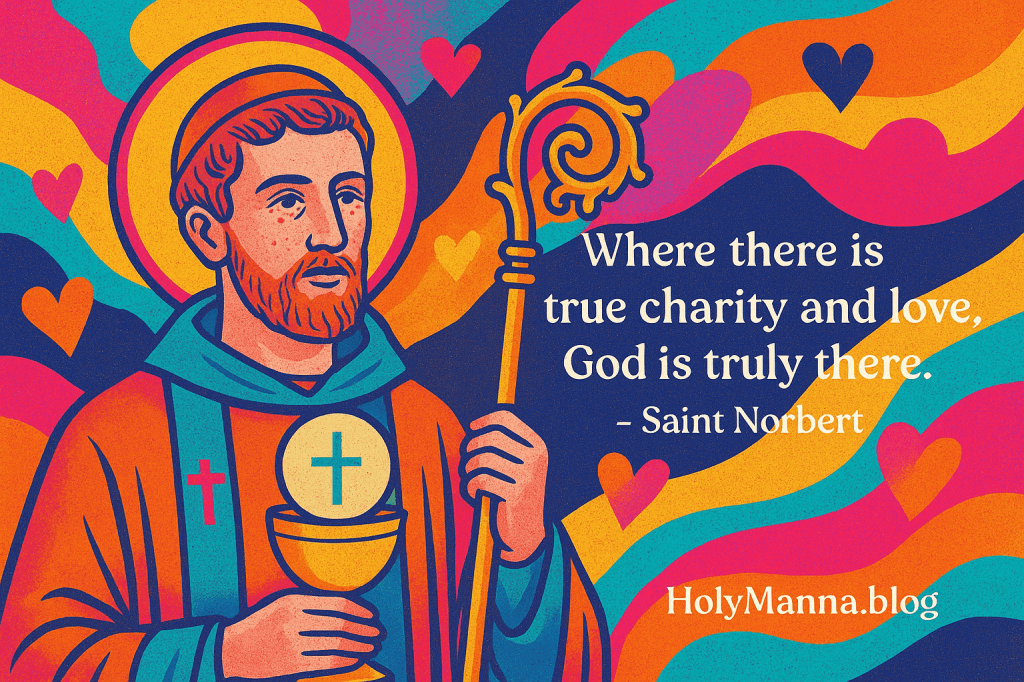
A Flame Ignited by Lightning
Saint Norbert of Xanten, born around 1080 in what is now western Germany, was destined for a life of prestige. He came from a noble family closely tied to the imperial court, and early on, he was immersed in the politics, luxury, and cultural refinement of the time. His father, Heribert, ensured he had a place among the high elite, and Norbert rose quickly as a favored courtier of Emperor Henry IV. Although he received minor orders and held ecclesiastical benefices, his heart was far from the spirit of the Gospel. For many years, he lived in spiritual lukewarmness—enjoying power and wealth without understanding their purpose in God’s design.
Everything changed in 1115. While traveling near the town of Vreden, Norbert was caught in a violent thunderstorm. A bolt of lightning struck perilously close, hurling him from his horse and leaving him unconscious. This wasn’t merely a brush with death—it was a divine wake-up call. As he lay on the ground, vulnerable and broken, God entered his heart with power. Upon regaining consciousness, Norbert cried out in repentance and surrendered his life to Christ. This event became the defining moment of his life.
Norbert returned to Xanten a different man. He renounced his worldly comforts, resigned his courtly privileges, and distributed his riches to the poor. At the age of 35, he was ordained a priest and adopted a life of radical poverty and penance. What made Norbert extraordinary wasn’t just his transformation—but his unwavering resolve to bring that same renewal to the Church, especially among the clergy. In an age plagued by clerical corruption, laxity, and indifference, Norbert set out on foot—barefoot and humble—to preach the Gospel and call both priests and laypeople to holiness. His message was simple yet bold: “Repent, and return to Christ in the Eucharist!”
In 1120, he founded the Order of Prémontré in the valley of Prémontré in France, forming a community of priests who would live in common, follow the Rule of St. Augustine, and dedicate themselves to preaching, teaching, and reverent liturgical life. These were not monks hidden away in cloisters—they were mission-driven canons regular, burning with apostolic zeal. To this day, the Norbertines continue his legacy of communal prayer, Eucharistic worship, and pastoral ministry.
The Eucharistic Wonderworker
Saint Norbert was no ordinary preacher. His words, rooted in penance and the love of Christ, stirred hearts wherever he went. But it was not only his preaching that moved the crowds—it was also the miracles that accompanied his ministry. These miracles weren’t spectacles for show—they were divine confirmations of a man whose soul was wholly united to Christ, especially in the Holy Eucharist.
Perhaps the most emblematic of his Eucharistic faith occurred during a celebration of Holy Mass. A large spider fell into the chalice containing the Precious Blood. In that era, such a spider was believed to be venomous and potentially fatal. The faithful gasped. Yet Norbert, with serene faith in the Real Presence of Christ, refused to spill the consecrated contents. He reverently consumed the chalice to completion—spider and all—trusting that Jesus, truly present in the Eucharist, would protect him. And He did. Norbert remained completely unharmed. This act of fearless devotion deeply moved his listeners and converted skeptics on the spot. It was as if God used even a tiny spider to manifest the power and mystery of His love in the Blessed Sacrament.
Norbert also performed many exorcisms during his missions. Possessed individuals were brought to him, and through prayer, fasting, and invocation of Jesus’ name, he would drive out the demons. One such case involved a woman tormented by evil spirits for years. After praying over her and blessing her with the sign of the cross, the woman was immediately freed. The evil presence fled, and she wept with joy, proclaiming God’s mercy.
Wherever Norbert went, healings followed. The blind regained sight, the crippled walked, and hardened hearts softened. These signs were not about Norbert—they were about Christ working through a man totally surrendered to His will.
Thorns on the Path
While Saint Norbert’s miracles were awe-inspiring, his journey was also one of bitter opposition and grueling trials. Reform is rarely welcomed—especially by those who benefit from the status quo. Norbert’s call to repentance and clerical discipline drew admiration from the faithful but hostility from many in power.
In 1126, the Holy Roman Emperor Lothair III named him Archbishop of Magdeburg, a diocese riddled with moral decay and clerical corruption. From the start, Norbert faced resistance. Upon arrival, the cathedral clergy—fearing the changes he would bring—locked the doors of the cathedral in his face. They hoped to humiliate and dissuade him. But Norbert was unfazed. With gentle firmness, he won over even the hardest of hearts. Through personal example, tireless pastoral work, and unwavering charity, he restored the dignity of the priesthood in his see.
His reforms included re-establishing liturgical norms, demanding celibacy among clergy, eliminating simony, and re-centering parish life on the Eucharist. These efforts did not go unchallenged. He was accused of arrogance, fanaticism, and even heresy. Yet he bore these slanders with patience, following the teaching of Matthew 5:10: “Blessed are those who are persecuted for righteousness’ sake, for theirs is the kingdom of heaven.”
Norbert’s personal sacrifices were equally profound. He fasted rigorously, walked barefoot even in harsh winters, and slept on the ground. Despite physical exhaustion, he traveled long distances to preach in remote villages, strengthening the faith of the simple and challenging the complacency of the powerful. Though he was never physically martyred, Norbert lived a life of white martyrdom—a daily dying to self in order to live fully for Christ.
The Light That Did Not Go Out
Saint Norbert’s earthly mission ended on June 6, 1134. His body, worn by penance and service, finally gave way, and he passed into eternal life in Magdeburg. But death did not diminish his influence. In fact, it magnified it.
Miracles began to be reported almost immediately at his tomb. Sick pilgrims flocked to Magdeburg and later to Strahov Abbey in Prague, where his relics were eventually transferred. Many were healed of paralysis, blindness, fevers, and other afflictions after invoking his intercession. In one famous case, a deaf-mute child was brought to the tomb and, after a night of prayer, was able to speak for the first time.
His relics became a powerful sign of hope, and devotion to Saint Norbert spread across Europe. Churches were built in his honor, and his legacy lived on in the work of the Norbertine canons, who preserved his spirit of Eucharistic reverence and reform. His canonization in 1582 by Pope Gregory XIII was a formal acknowledgment of what the faithful had already long believed—this was a saint who changed the Church from within, and continues to do so.
Even today, the Norbertine order thrives in monasteries around the world. Their white habits, symbolizing purity, are a living reminder of Norbert’s passion for holiness and the radiance of Christ’s real presence among His people. Wherever the Norbertines minister—whether in schools, parishes, or contemplative communities—the fire of Norbert still burns.
The Eucharistic Saint for Our Times
Saint Norbert’s story could not be more relevant to us today. In a world often tempted by comfort, distraction, and compromise, he shows us the joy of choosing the narrow path. In a Church that continues to seek renewal and fidelity, he shows us how to walk in holiness through reform—not rebellion—and through love, not legalism.
Are you willing to leave behind what is comfortable to follow the call of Christ more radically?
Do you recognize the Real Presence of Jesus in the Eucharist, and does that belief shape how you live and love?
Will you stand firm in faith even when it’s inconvenient, unpopular, or painful?
Saint Norbert’s life is a testimony that God can do incredible things with one heart fully surrendered to Him. He is proof that it is never too late to change, never too late to lead, and never too late to become a saint.
Engage with Us!
What does Saint Norbert’s journey say to you today? We invite you to share your reflections in the comments. Let’s build each other up in holiness.
Reflection Questions:
- Have I ever experienced a moment of sudden conversion or spiritual awakening like Saint Norbert? What did I do with it?
- How can I deepen my reverence and devotion to the Holy Eucharist in my daily life?
- Am I willing to endure hardship or criticism to speak the truth and live authentically as a Catholic?
Let us encourage one another to live with boldness, compassion, and joy—doing everything with love, just as Jesus did.
Saint Norbert, pray for us! ⚡️
Follow us on Instagram and Facebook for more insights and reflections on living a faith-filled life.


Leave a Reply