✨ A Torch Lit in Gaul
Saint Hilary of Arles is one of the Church’s lesser-known but deeply inspiring figures. Born into wealth and prestige in the waning days of the Roman Empire, Hilary rejected the privileges of noble life and embraced the rigors of monastic poverty and pastoral service. Named bishop of Arles at a remarkably young age, he quickly became known for his zealous reform, personal austerity, and unwavering love for the poor. His passionate character sometimes led to ecclesiastical tension—most notably with Pope Saint Leo the Great—but Hilary’s humility and obedience to Rome ultimately revealed the sanctity of his soul.
Though not a martyr in the traditional sense, Saint Hilary poured himself out completely for the Church. His feast day, celebrated on May 5, invites us to reflect on the power of youthful zeal, the grace of humility, and the quiet heroism of those who remain faithful amid trials. His life is a radiant example of how sanctity is not measured by age or acclaim but by fidelity to Christ.
🕊 From Privilege to Poverty
Born around the year 403 in northern Gaul, likely in or near what is now Lyon, Hilary grew up in a world of Roman luxury and classical education. His family was noble, well-educated, and immersed in the political and intellectual currents of the time. Hilary was a gifted student and had every opportunity to climb the social ladder. But something stirred within him—something divine. God was calling him to more than comfort and status.
The great turning point in his life came when he encountered Saint Honoratus, the holy founder of the monastic community on the island of Lérins. Captivated by the simplicity, discipline, and holiness of monastic life, Hilary made a radical decision: he left everything behind to join the monks. His relatives were shocked. His friends were baffled. But Hilary had discovered a treasure buried in the field, and he sold all he had to possess it.
In the monastery, Hilary embraced prayer, fasting, manual labor, and silence. It wasn’t long before his talents and holiness were recognized. When Honoratus was appointed bishop of Arles, Hilary accompanied him and soon succeeded him in the episcopate at the astonishing age of 29. As bishop, Hilary became a tireless servant of the Church: reforming lax clergy, promoting monastic life, defending orthodoxy, and feeding the poor. He also wrote theological works and organized synods to ensure sound doctrine and discipline.
Yet, for all his talents and virtues, Hilary would learn a deeper lesson through suffering—a lesson that would refine his sanctity like gold in the fire.
🌟 A Life Without Spectacle
Unlike many saints, Hilary is not remembered for extraordinary miracles or spectacular healings. But perhaps that is exactly what makes him so relevant to us today. The miracle of Saint Hilary’s life was not found in dramatic signs, but in the quiet, daily sacrifices made out of love for Christ.
He lived an intensely austere life, refusing luxuries and comforts even as a bishop. His home was modest, his meals frugal, and his clothing simple. He gave liberally to the poor, often depriving himself in order to clothe and feed others. In a world where bishops could easily be swept up in politics or vanity, Hilary stood apart—a shepherd who truly smelled like his sheep.
His miracles were those of conversion, charity, and courage. By preaching the truth without fear, confronting corruption within the Church, and living what he taught, Hilary transformed lives. People came to repentance. Priests reformed their conduct. Monasteries multiplied. The Gospel took root.
“You are the light of the world. A city set on a hill cannot be hidden” (Matthew 5:14). Saint Hilary’s hidden miracles are a light for us—reminding us that sainthood is not about attention, but intention.
⚔️ Fire in His Bones
Hilary’s passion for reform and monastic discipline often put him at odds with others. He was outspoken, intense, and unafraid to confront what he saw as wrongdoing. These qualities, while rooted in virtue, sometimes led to friction—especially when Hilary tried to assert authority over neighboring dioceses.
This led to a significant conflict with Pope Saint Leo the Great, who felt Hilary had exceeded his jurisdiction. Pope Leo, defending the primacy of Rome, stripped Hilary of his rights to appoint bishops in certain areas and even summoned him to Rome for correction. Many in Hilary’s position might have responded with resentment or rebellion. But Hilary chose the path of obedience. He humbly accepted Rome’s decision, setting aside his own vision for the good of the Church’s unity.
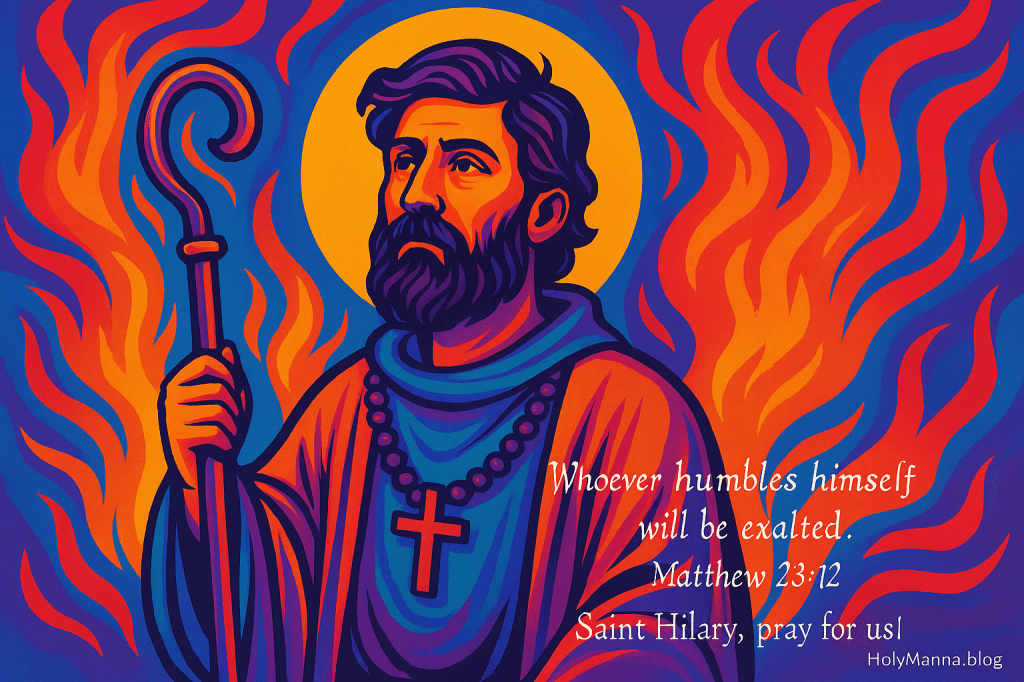
This act of humility is one of the most powerful moments in his life. Hilary showed that true leadership in the Church is not about control, but service. It is not about power, but peace. “Whoever humbles himself will be exalted” (Matthew 23:12). Hilary’s humility in the face of ecclesial discipline reminds us that sanctity is revealed not only in action, but in submission to divine authority.
He continued to serve faithfully in Arles until his death in 449, a man worn out not by martyrdom in blood, but by the white martyrdom of self-denial and sacrificial love.
🌟 Seeds that Blossomed
Though no sensational miracles are recorded after his death, Saint Hilary’s legacy bore abundant fruit in the generations that followed. His tomb in Arles became a site of pilgrimage, especially for monks, priests, and bishops seeking his intercession for humility and strength in their vocations.
He was venerated for his unwavering love of the Church, his zeal for monastic reform, and his courage in facing conflict with grace. Though misunderstood in his own lifetime, the Church eventually recognized the depth of his holiness and declared him a saint. His relics were honored, and his example celebrated especially in southern France, where many monastic communities trace their inspiration to his leadership.
His life became a quiet miracle—a testimony to the enduring power of fidelity, humility, and trust in God. “Well done, good and faithful servant” (Matthew 25:21). These are the words the Church echoes over Hilary’s life.
🔍 Let Zeal Be Tempered by Love
Saint Hilary of Arles calls out to all of us—especially the young, the passionate, the reformers at heart. He reminds us that holiness is not a sprint but a pilgrimage. It begins in the fire of conversion, is tested in the crucible of conflict, and finds its peace in surrender to God’s will.
Are you someone who burns with passion for justice, truth, or renewal? Hilary was, too. But he learned that zeal without humility can wound, and correction humbly received can sanctify. He invites us to live with passion but to clothe that passion in prayer and patience.
Do you sometimes feel like your efforts are misunderstood or unappreciated? So did Hilary. But he teaches us that God sees, and that the harvest of holiness often comes after the seed dies in the ground.
What would it look like to serve with the same devotion in your parish, workplace, or family? How can we, like Hilary, be “bishops” of our own hearts—ruling not with pride, but with mercy?
💬 Engage with Us!
Share your thoughts below!
- What part of Saint Hilary’s life touched you most?
- Have you ever experienced zeal that needed to be tempered by humility?
- How can you serve your community today with the same love Saint Hilary had for his flock?
Let’s grow together in holiness and courage. And may we, like Saint Hilary, do everything with love—for the glory of God and the salvation of souls.
Saint Hilary, pray for us! 🙏
Follow us on Instagram and Facebook for more insights and reflections on living a faith-filled life.


Leave a comment