Truth, Deceit, and the Hunger for What Lasts
We all wear faces. Some are masks we put on to fit in. Others are born of deep prayer and grace, like the face of Stephen—glowing like an angel’s, even as lies swirled around him. Today’s readings invite us to reflect on what happens when truth confronts falsehood, and when spiritual hunger meets the Bread of Life Himself. They call us to examine our desires, our courage in witnessing to Christ, and the way we receive God’s Word—whether with integrity or with self-serving motives.
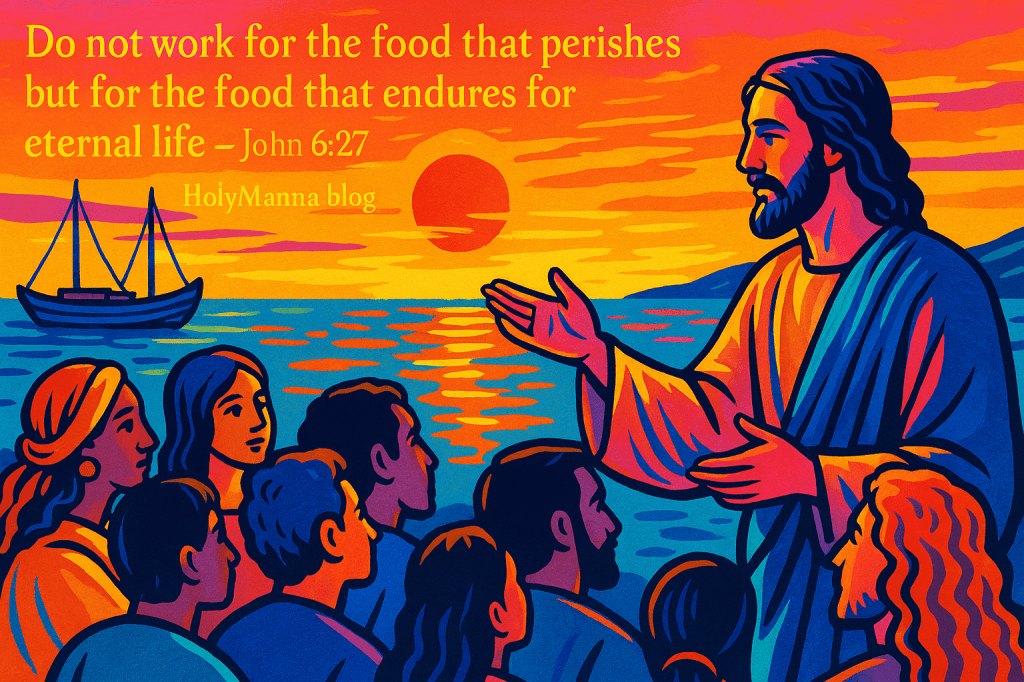
In Acts of the Apostles, we encounter Stephen, the Church’s first martyr, falsely accused and dragged before the Sanhedrin. His only “crime” is bearing bold witness to Jesus, performing wonders, and speaking with Spirit-filled wisdom. His face reflects a heavenly reality, in stark contrast to the deceit of his accusers. Psalm 119 complements this scene beautifully. Here, the psalmist clings to God’s law despite opposition, seeking understanding and deliverance from lies. Finally, in The Gospel of John, Jesus confronts a crowd more interested in another free meal than in the miracle of eternal life He offers. His response cuts to the heart: “Do not work for food that perishes but for the food that endures for eternal life”.
Culturally, the early Church was swimming against the tide of both Jewish expectations and Roman oppression. Speaking out in Jesus’ name could get you arrested—or killed. The Sanhedrin clung to tradition and control, while Jesus offered transformation and truth. And so, a tension arises: Are we seeking God with sincere hearts, or are we comfortable with half-truths and superficial faith? Today’s readings challenge us to look at our own faces—do they reflect fear, falsehood, or faith? What do we truly hunger for in the depths of our soul?
First Reading – Acts 6:8–15
The Face of Truth in a World of Falsehood
The Acts of the Apostles is more than a historical account of the early Church—it is a testimony of courage, transformation, and unwavering faith in the risen Christ. Written by St. Luke, this book continues the narrative of the Gospel of Luke, tracing the explosive growth of Christianity through the power of the Holy Spirit. Today’s reading introduces us to St. Stephen, the first martyr, whose life was so full of grace that even his enemies were silenced by the wisdom of the Spirit in him. The Church at this time was navigating growing pains—internally with its expanding community, and externally under the scrutiny and hostility of religious authorities. Stephen’s story, situated in this crucible of tension, mirrors today’s theme: when confronted with truth, the world often responds with deceit. Yet even in the midst of lies and injustice, the face of one who truly follows Christ shines with heavenly peace.
Acts 6:8-15
New American Bible (Revised Edition)
Accusation Against Stephen. 8 Now Stephen, filled with grace and power, was working great wonders and signs among the people. 9 Certain members of the so-called Synagogue of Freedmen, Cyrenians, and Alexandrians, and people from Cilicia and Asia, came forward and debated with Stephen, 10 but they could not withstand the wisdom and the spirit with which he spoke. 11 Then they instigated some men to say, “We have heard him speaking blasphemous words against Moses and God.” 12 They stirred up the people, the elders, and the scribes, accosted him, seized him, and brought him before the Sanhedrin. 13 They presented false witnesses who testified, “This man never stops saying things against [this] holy place and the law. 14 For we have heard him claim that this Jesus the Nazorean will destroy this place and change the customs that Moses handed down to us.” 15 All those who sat in the Sanhedrin looked intently at him and saw that his face was like the face of an angel.
Detailed Exegesis
Verse 8 – “Now Stephen, filled with grace and power, was working great wonders and signs among the people.”
Stephen’s authority comes not from himself but from the Holy Spirit. He is described much like Jesus—full of grace and power, performing signs among the people. This verse establishes him as a Spirit-empowered witness, echoing the Church’s teaching that “by Baptism, they share in the priesthood of Christ” (Catechism, 1268).
Verse 9 – “Certain members of the so-called Synagogue of Freedmen, Cyrenians, and Alexandrians, and people from Cilicia and Asia, came forward and debated with Stephen.”
Stephen’s preaching draws attention, especially from Greek-speaking Jews from diaspora communities. Their debate with him shows that the early Church was not a passive movement; it actively engaged diverse cultures and philosophies, much like evangelization efforts today.
Verse 10 – “But they could not withstand the wisdom and the spirit with which he spoke.”
Here we see divine wisdom overpowering human argument. This echoes Jesus’ promise in The Gospel of Luke 21:15: “I will give you a mouth and wisdom which none of your adversaries will be able to withstand or contradict.” Stephen is a living fulfillment of this promise.
Verse 11 – “Then they instigated some men to say, ‘We have heard him speaking blasphemous words against Moses and God.’”
Unable to defeat him with logic, his opponents resort to lies—a tactic frequently used throughout salvation history, from the trial of Susanna to the condemnation of Jesus. False testimony is a recurring weapon against the truth.
Verse 12 – “They stirred up the people, the elders, and the scribes, accosted him, seized him, and brought him before the Sanhedrin.”
This shows how quickly public opinion can be manipulated when fear and jealousy take root. The very leaders entrusted with guiding God’s people are now accomplices in a smear campaign, echoing the trial of Jesus.
Verse 13 – “They presented false witnesses who testified, ‘This man never stops saying things against this holy place and the law.’”
This accusation frames Stephen as a threat to the Temple and Mosaic Law. The irony is that Stephen wasn’t attacking them—he was proclaiming their fulfillment in Christ. The Temple was sacred, but Jesus had become the new Temple.
Verse 14 – “For we have heard him claim that this Jesus the Nazorean will destroy this place and change the customs that Moses handed down to us.”
They twist Stephen’s theology, just as Jesus’ words were twisted at His own trial (cf. Matthew 26:61). Jesus never called for the Temple’s destruction in a literal sense but prophesied its fall and pointed to His body as the new Temple.
Verse 15 – “All those who sat in the Sanhedrin looked intently at him and saw that his face was like the face of an angel.”
In the midst of slander and hatred, Stephen’s face radiates serenity. This recalls Exodus 34:29, where Moses’ face shines after encountering God. Stephen, like Moses, becomes a radiant bearer of divine truth—but unlike Moses, he is now reflecting the glory of the risen Christ.
Teachings
The Catechism of the Catholic Church affirms that Christians are called to bear witness to Christ in all circumstances, especially when it is costly: “Martyrdom is the supreme witness given to the truth of the faith: it means bearing witness even unto death” (CCC 2473). Stephen is not merely a tragic figure; he is a model of what it means to proclaim the Gospel without fear, rooted in divine wisdom and love.
St. Augustine reflects on the radiant holiness of the martyrs in his Sermons: “The martyrs were bound, imprisoned, scourged, racked, burned, rent, butchered—and they multiplied.” Stephen’s face “like the face of an angel” isn’t a poetic flourish; it’s a sign that heaven’s peace can dwell even in the heart of conflict. This radiant countenance is a visual testimony of grace amid trial, a lesson the early Church deeply internalized.
Historically, Stephen’s trial marks the beginning of open persecution against the Christian community in Jerusalem. His death, recounted in the next chapter, will trigger the scattering of believers—and ironically, the spreading of the Gospel beyond Jerusalem. What man intended for harm, God used for mission. This moment is pivotal in Church history, reinforcing that truth cannot be silenced—even by death.
Reflection
Stephen’s courage challenges us to ask: Am I willing to stand for truth, even when it costs me? In our daily lives, this may not mean martyrdom, but it does call for integrity when it’s easier to compromise, honesty when others lie, and faith when we’re misunderstood. Stephen shows us what it means to speak truth with love and let the Holy Spirit shine through our demeanor.
In a world where deceit often masquerades as wisdom and falsehood can go viral faster than truth, we need spiritual discernment. Like Stephen, we must seek to be “filled with grace and power”, grounded not in our own strength but in God’s Word and sacraments. Are we cultivating a prayer life that allows our faces—and lives—to reflect Christ?
Finally, let us remember that the fruit of truth-telling is not always immediate applause. Sometimes, it is suffering. Yet as Jesus reminds us, “Blessed are those who are persecuted for the sake of righteousness, for theirs is the kingdom of heaven”. What would it look like for your life to radiate the peace of an angel even in moments of conflict?
Responsorial Psalm – Psalm 119:23–24, 26–27, 29–30
A Heart Anchored in the Law of the Lord
Psalm 119 is the longest chapter in all of Scripture and a profound meditation on God’s law, precepts, and commandments. Every line of this psalm is a heartfelt cry to live according to divine truth. Written in the form of an acrostic poem, Psalm 119 uses the Hebrew alphabet to structure its verses, emphasizing the fullness and completeness of God’s Word. Today’s selected verses flow from the perspective of someone surrounded by deceit, yet firmly rooted in the statutes of the Lord. In the broader biblical and liturgical context, these verses act as a spiritual response to the First Reading from Acts, where Stephen faces false accusations but remains steadfast. This psalm gives us a glimpse into the interior life of the faithful soul—one who longs not for fleeting approval or security, but for wisdom and integrity that flow from the Word of God.
Psalm 119:23-24, 26-27, 29-30
New American Bible (Revised Edition)
23 Though princes meet and talk against me,
your servant meditates on your statutes.
24 Your testimonies are my delight;
they are my counselors.
26 I disclosed my ways and you answered me;
teach me your statutes.
27 Make me understand the way of your precepts;
I will ponder your wondrous deeds.
29 Lead me from the way of deceit;
favor me with your law.
30 The way of loyalty I have chosen;
I have kept your judgments.
Detailed Exegesis
Verse 23 – “Though princes meet and talk against me, your servant meditates on your statutes.”
Even when powerful people slander or plot against him, the psalmist remains unmoved, anchoring himself in God’s law. This posture echoes Stephen’s own in Acts 6, as he faces accusations not with anxiety but with a heart fixed on the divine. Meditation on God’s statutes provides inner peace and clarity amid turmoil.
Verse 24 – “Your testimonies are my delight; they are my counselors.”
The psalmist delights in the testimonies of the Lord—His revealed truth, His deeds, His covenant promises. These are not merely rules but counselors, sources of divine guidance. To delight in the Word is to internalize it until it shapes one’s mind and heart, forming a lens for moral and spiritual discernment.
Verse 26 – “I disclosed my ways and you answered me; teach me your statutes.”
This verse expresses a posture of humility and relationship. The psalmist opens his heart to God—his “ways,” meaning his struggles, sins, or desires—and God responds. From this encounter flows a deeper desire to be taught. Confession and instruction go hand in hand in the spiritual life.
Verse 27 – “Make me understand the way of your precepts; I will ponder your wondrous deeds.”
Understanding God’s ways is not merely intellectual but relational. The psalmist longs not just to know the rules, but to comprehend the heart behind them. In doing so, he commits to reflecting on God’s wonders—His acts in history, creation, and personal transformation.
Verse 29 – “Lead me from the way of deceit; favor me with your law.”
The contrast is clear: there is a “way of deceit,” and there is God’s law. The psalmist actively prays to be drawn away from lies—both external deception and the self-deception that sin fosters. The “favor” of the law is not burden but blessing, a grace that sets one free.
Verse 30 – “The way of loyalty I have chosen; I have kept your judgments.”
This final verse is a declaration of fidelity. Choosing the way of loyalty involves a firm decision of the will, echoing the covenantal language of the Old Testament. “Judgments” here are God’s decisions and ordinances, which the faithful are called not only to know but to keep, to obey in love.
Teachings
The Catechism of the Catholic Church reminds us that God’s law is not arbitrary but an expression of His wisdom and love: “Law is a rule of conduct enacted by competent authority for the sake of the common good. The moral law is the work of divine Wisdom” (CCC 1951). The psalmist’s delight in God’s law reflects this truth: obedience is not drudgery, but union with God’s will.
St. Jerome, in his writings, once said: “Ignorance of Scripture is ignorance of Christ.” When the psalmist says, “teach me your statutes”, he is not merely seeking moral rules but Christ Himself—the living Word. As Christians, we understand the fullness of God’s statutes through Jesus, who fulfills the law in perfect love and truth.
This psalm also reflects the Church’s liturgical spirituality. In the Liturgy of the Hours, Psalm 119 is prayed across multiple hours of the day, signifying the Church’s desire to be steeped in God’s Word continually. Monastic communities have long made this psalm a central part of their prayer life, a reminder that true renewal comes not from external success or political power, but from the inward formation of the heart by divine truth.
Reflection
When deceit surrounds us—whether in media, relationships, or even in our own rationalizations—do we turn to God’s Word as our counselor? This psalm reminds us that peace and clarity come not from control or vindication but from trusting in God’s precepts and choosing the way of loyalty. How often do we pause to meditate on His statutes rather than react to the noise around us?
Let us strive to cultivate a heart like the psalmist’s: humble, teachable, and anchored in truth. Begin and end your day with a verse from Scripture. Ask the Holy Spirit to teach you, especially when life feels confusing or heavy. And when tempted to compromise or speak falsely, pray with confidence: “Lead me from the way of deceit; favor me with your law.”
In a world obsessed with self-expression and endless opinion, the psalm offers a different path—the path of listening, learning, and living from the eternal Word. What would it look like to let God’s testimonies be your delight and your daily counselor?
Holy Gospel – John 6:22–29
Hunger That Leads to Heaven
The Gospel of John is often called the most theological of the four Gospels, filled with signs, “I AM” statements, and long discourses that reveal Jesus’ divine identity. Today’s passage introduces the Bread of Life Discourse, one of the most profound revelations of Christ’s true presence and mission. Set immediately after the miracle of the multiplication of the loaves, this scene draws a crowd that seeks Jesus across the sea—not because they recognize Him as the Messiah, but because they want more bread. In this cultural context, bread was life itself: the essential food for survival, often associated with divine provision. Think of manna in the desert during the Exodus. By invoking this imagery, Jesus draws the crowd—and us—into a deeper hunger, one that no earthly food can satisfy. This Gospel aligns with our theme by contrasting superficial seeking with authentic belief, and by revealing how easily people can miss divine truth when focused on worldly gain.
John 6:22-29
New American Bible (Revised Edition)
The Bread of Life Discourse. 22 The next day, the crowd that remained across the sea saw that there had been only one boat there, and that Jesus had not gone along with his disciples in the boat, but only his disciples had left. 23 Other boats came from Tiberias near the place where they had eaten the bread when the Lord gave thanks. 24 When the crowd saw that neither Jesus nor his disciples were there, they themselves got into boats and came to Capernaum looking for Jesus. 25 And when they found him across the sea they said to him, “Rabbi, when did you get here?” 26 Jesus answered them and said, “Amen, amen, I say to you, you are looking for me not because you saw signs but because you ate the loaves and were filled. 27 Do not work for food that perishes but for the food that endures for eternal life, which the Son of Man will give you. For on him the Father, God, has set his seal.” 28 So they said to him, “What can we do to accomplish the works of God?” 29 Jesus answered and said to them, “This is the work of God, that you believe in the one he sent.”
Detailed Exegesis
Verse 22 – “The next day, the crowd that remained across the sea saw that there had been only one boat there, and that Jesus had not gone along with his disciples in the boat, but only his disciples had left.”
The crowd is confused. They knew only one boat had departed, and Jesus hadn’t been in it. Their curiosity builds. This sets the stage for their search—not driven by faith, but by signs and wonder.
Verse 23 – “Other boats came from Tiberias near the place where they had eaten the bread when the Lord gave thanks.”
This recalls the miraculous feeding. The reference to Jesus “giving thanks” uses the verb eucharisteō, foreshadowing the Eucharist. The crowd is not seeking Christ for who He is, but for what He gave.
Verse 24 – “When the crowd saw that neither Jesus nor his disciples were there, they themselves got into boats and came to Capernaum looking for Jesus.”
Their pursuit seems commendable at first glance. But as Jesus will reveal, their motives are shallow. They seek satisfaction, not salvation.
Verse 25 – “And when they found him across the sea they said to him, ‘Rabbi, when did you get here?’”
They’re puzzled, not realizing Jesus had walked on water the night before. Their question is polite but superficial—focused on logistics, not spiritual insight.
Verse 26 – “Jesus answered them and said, ‘Amen, amen, I say to you, you are looking for me not because you saw signs but because you ate the loaves and were filled.’”
Jesus reads their hearts. He reveals their true motivation: material satisfaction. This verse is a warning to all who treat faith as a means to worldly comfort. The repetition of “Amen, amen” signals a solemn truth.
Verse 27 – “Do not work for food that perishes but for the food that endures for eternal life, which the Son of Man will give you. For on him the Father, God, has set his seal.”
Jesus redirects their hunger toward something lasting. The “seal” refers to divine authority and identity. In ancient times, seals authenticated documents—Jesus is authenticated by the Father as the true Giver of eternal nourishment.
Verse 28 – “So they said to him, ‘What can we do to accomplish the works of God?’”
Still thinking in legalistic terms, the crowd wants a checklist. Their understanding of religion is transactional—what do we do to earn God’s favor?
Verse 29 – “Jesus answered and said to them, ‘This is the work of God, that you believe in the one he sent.’”
Faith, not works alone, is the foundation. Belief in Jesus is the “work” God desires. It’s not passive, but a living, trusting relationship with the One sent by the Father. This verse anticipates the Eucharist and eternal life, offered only through faith in Christ.
Teachings
The Catechism of the Catholic Church teaches that faith is both a gift and a response: “By faith, man completely submits his intellect and his will to God” (CCC 143). Jesus is calling the crowd—and us—not just to admire or seek Him for blessings, but to surrender in belief. He is the food that endures, and this belief is not abstract; it leads us to communion with Him, especially through the Eucharist.
St. John Chrysostom, commenting on this passage, writes: “It is as if Christ is saying: You seek Me for the loaves, not for the doctrine.” The saint warns that miracles are not ends in themselves but signs pointing to deeper truths. When we seek God only for what He can give us materially, we risk missing the true miracle: God offering Himself.
Historically, this Gospel passage has prepared Christians for understanding the Real Presence of Christ in the Eucharist. The Church Fathers saw John 6 as foundational for Eucharistic theology. St. Ignatius of Antioch called the Eucharist “the medicine of immortality”, and Jesus’ teaching here lays the groundwork for that sacramental truth. The call to believe in the One whom God has sent is not an invitation to abstract ideas, but to an incarnate, Eucharistic encounter with the living Lord.
Reflection
This Gospel stirs a powerful question: Why am I seeking Jesus? Like the crowd, we may chase after Him when we feel empty or desperate—but are we hungry for the bread that perishes, or for the Bread of Life? Our Lord invites us to move beyond surface-level desires and embrace a faith that satisfies eternally. What kind of “food” am I working for in my daily life—success, security, approval, or holiness?
To respond to Jesus’ invitation, we must shift from a transactional mindset to a relational one. Begin each day with a prayer of surrender: “Lord, I believe in You. Increase my faith.” Let the Eucharist be not just a Sunday obligation but the source and summit of your week. Feed your soul with Scripture and silence as often as you feed your body. Are you allowing Jesus to nourish your interior life, or are you settling for crumbs of comfort?
The work of God is not measured in productivity or external results—it begins with believing in Christ and allowing that belief to transform your life. Let today’s Gospel realign your hunger. What would change if you began to seek not what Jesus can give, but Jesus Himself?
Called to Shine, Called to Believe
Today’s readings form a luminous tapestry, revealing the inner strength of those who live by truth, the joy of those who meditate on God’s Word, and the eternal promise awaiting those who truly believe. We see Stephen, radiant with grace in the face of lies, unmoved by hatred because his heart belongs to heaven. We hear the psalmist, choosing loyalty amid opposition, crying out for understanding and deliverance from deceit. And we meet a crowd who chased after Jesus for bread, only to be invited to a deeper hunger—one that can only be filled by faith in the One whom the Father has sent.
Together, these passages challenge us to examine the motives of our hearts. Are we standing firm in the truth, even when it costs us comfort or approval? Do we meditate on God’s statutes not as cold commandments but as living words that guide us through confusion and temptation? And most importantly, are we seeking Jesus for who He is, or only for what He can give us? “This is the work of God, that you believe in the one he sent.” That belief is not passive—it demands our minds, our hearts, our decisions, our loyalty, and our hunger.
Let today be a turning point. Ask the Holy Spirit to reveal any ways you’ve compromised truth for convenience. Let the Scriptures become your counselors, as they were for the psalmist. And when you go to Mass or Eucharistic Adoration, come not as a consumer, but as a lover of Christ—ready to receive the Bread that never perishes. Will you allow your life to shine like Stephen’s, reflecting the peace of one who knows the Bread of Life? Will you choose today to believe more deeply, love more fully, and live more faithfully?
Engage with Us!
We’d love to hear how today’s readings touched your heart. What stood out to you? How is God speaking to you through the story of Stephen, the psalmist’s prayer, or Jesus’ call to believe? Share your thoughts, questions, and experiences in the comments below. Your reflection might be the encouragement someone else needs today!
Reflection Questions
First Reading – Acts 6:8–15
Have I ever faced opposition or misunderstanding because of my faith? How did I respond? Do I radiate peace and courage like Stephen when challenged by falsehood or injustice?
Responsorial Psalm – Psalm 119:23–24, 26–27, 29–30
What are the “ways of deceit” that tempt me most? Do I turn to God’s Word regularly for guidance and comfort? How can I grow in delighting in His law and living by it more faithfully?
Holy Gospel – John 6:22–29
Am I seeking Jesus for who He truly is, or for what He can give me? What does it mean to “work for the food that endures for eternal life” in my everyday choices and habits?
Stay rooted in God’s Word, choose truth over comfort, and believe deeply in the One the Father has sent. Let your life be nourished by eternal Bread, and let everything you do be filled with the love and mercy Jesus has shown us. Go forth with faith, and shine His light into the world!
Follow us on Instagram and Facebook for more insights and reflections on living a faith-filled life.


Leave a Reply