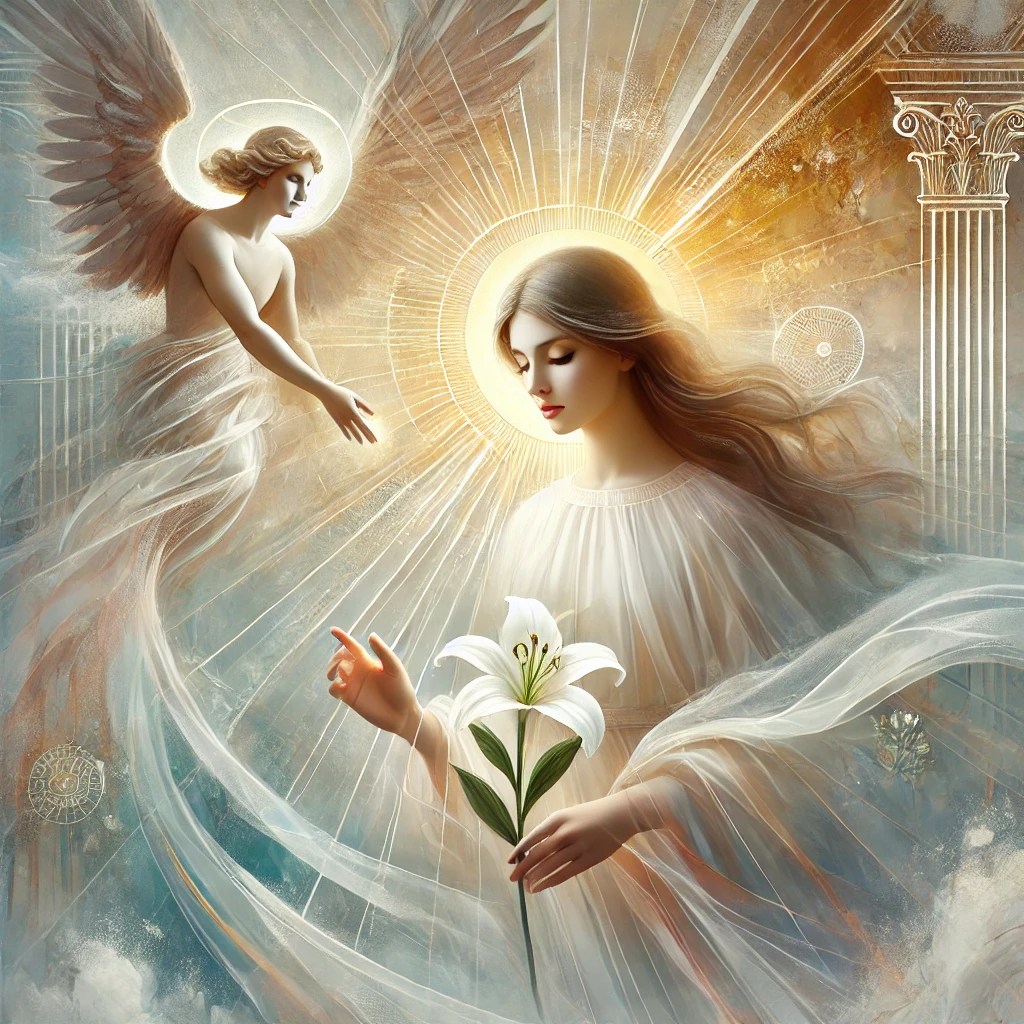
A Call to Trust and Rejoice
Have you ever paused to marvel at the extraordinary ways God enters into our lives, weaving His plans into the fabric of human history? Today’s readings beckon us to reflect on the profound mystery of God’s presence—how He desires not only to dwell among us but to work through our faith and obedience to accomplish His will.
From the jubilant prophecy of Zechariah, promising that God will choose Jerusalem and unite many nations, to the heroic faith of Judith, who became an instrument of God’s deliverance, we see a God who intimately involves Himself in the lives of His people. These texts set the stage for the ultimate act of divine intimacy revealed in The Gospel of Luke: the Annunciation, where Mary’s humble “yes” brings the Word made flesh into the world.
Understanding the cultural and religious context of these readings enhances their depth. Zechariah speaks to the post-exilic Israelites, weary yet hopeful, as God assures them of restoration and a new covenant that includes all nations. Similarly, Judith, a heroine of Israel, represents the power of faith in overcoming oppression, pointing forward to the Virgin Mary, whose trust in God ushers in the salvation of all humanity.
Together, these passages invite us to rejoice, to trust in God’s promises, and to open our hearts to His transformative presence. How will you welcome God into your life today?
First Reading – Zechariah 2:14-17
God’s Promise to Dwell Among His People
The Book of Zechariah is a powerful work of prophetic hope, written during a pivotal time in Israel’s history. The Israelites had returned to Judah after decades of Babylonian exile and were undertaking the monumental task of rebuilding the Temple. While their physical labor was demanding, the spiritual renewal required to restore their relationship with God was even more significant. Zechariah’s visions and prophecies provided a sense of encouragement and a call to faithfulness, assuring the people that God’s covenant was not forgotten.
This passage specifically highlights God’s promise to dwell among His people once more, extending this blessing to all nations. This promise would have resonated deeply with the Israelites, who longed for the presence of God that they had known in the Tabernacle and Temple before the exile. For us today, this reading points to the fulfillment of God’s presence through the Incarnation of Christ, where God literally came to dwell among us. It reminds us of the universal nature of His kingdom and His desire to unite all people under His love.
Zechariah 2:14-17
New Revised Standard Version Catholic Edition
14 Sing and rejoice, O daughter Zion! For lo, I will come and dwell in your midst, says the Lord. 15 Many nations shall join themselves to the Lord on that day, and shall be my people; and I will dwell in your midst. And you shall know that the Lord of hosts has sent me to you. 16 The Lord will inherit Judah as his portion in the holy land, and will again choose Jerusalem.
17 Be silent, all people, before the Lord; for he has roused himself from his holy dwelling.
Detailed Exegesis
Verse 14:
“Sing and rejoice, O daughter Zion! For lo, I will come and dwell in your midst, says the Lord.”
This verse bursts with joy and anticipation, calling the people of Jerusalem—personified as “daughter Zion”—to celebrate. The promise of God dwelling in their midst is a reaffirmation of the covenant made long ago, bringing to mind the days when God’s presence was visibly manifest in the Tabernacle (cf. Exodus 40:34). Zechariah’s call to rejoice also prefigures the coming of the Messiah, whose Incarnation is the ultimate fulfillment of God’s dwelling among His people. This verse invites us to reflect on the joy of knowing God is near and actively working in our lives.
Verse 15:
“Many nations shall join themselves to the Lord on that day, and shall be my people; and I will dwell in your midst. And you shall know that the Lord of hosts has sent me to you.”
Here, the vision expands beyond Israel, revealing God’s universal plan of salvation. The phrase “on that day” is often used in prophetic literature to refer to a future time of divine intervention, pointing here to the messianic age when God’s kingdom will extend to all nations. This is a significant theological development, showing that God’s love and mercy are not limited to Israel but are intended for all people. This verse also reflects the mission of the Church, which is called to bring the Gospel to the ends of the earth (cf. CCC 849-856).
Verse 16:
“The Lord will inherit Judah as his portion in the holy land, and will again choose Jerusalem.”
This verse highlights the special role of Judah and Jerusalem in God’s salvific plan. To “inherit” Judah implies a deep relationship, as God claims His people as His own. The reference to choosing Jerusalem again reassures the people that despite their past failures and the destruction of the city during the exile, God remains faithful. This verse reminds us of the constancy of God’s love and His willingness to restore what has been broken, both in history and in our personal lives.
Verse 17:
“Be silent, all people, before the Lord; for he has roused himself from his holy dwelling.”
The reading concludes with a profound call to reverence. Silence before the Lord signifies awe, humility, and readiness to witness His mighty works. The imagery of God rousing Himself suggests an impending divine action, pointing forward to the Incarnation when God would enter human history in a definitive and personal way. For us, this verse calls us to take moments of stillness and reverence in our daily lives to recognize God’s presence and prepare our hearts for His coming.
Teachings
The promise of God dwelling among His people is a cornerstone of the Catholic faith, fulfilled in the person of Jesus Christ. The Catechism of the Catholic Church teaches that this divine plan unfolds through history, ultimately culminating in the establishment of God’s kingdom on earth as it is in heaven (CCC 2806). Zechariah’s vision aligns with the Church’s understanding of the universal call to salvation (CCC 761-762), as God desires to unite all nations as His people.
St. Augustine reflects on this longing for divine intimacy, teaching that “our hearts are restless until they rest in You, O Lord.” Zechariah’s prophecy assures us that this restlessness is answered by God’s desire to dwell with us, giving us peace and purpose. Furthermore, the Church Fathers saw the fulfillment of Zechariah’s prophecy in Mary’s fiat and the Incarnation, where God not only dwelt among His people but became one of us to redeem the world.
Reflection
This reading offers us a profound invitation to open our hearts to God’s presence. Just as the Israelites were called to rejoice and prepare for God’s dwelling, we too are invited to recognize the ways He is already present in our lives and make room for Him to enter more fully.
- Do we create time for silence and stillness in our lives to encounter God’s presence?
- Are we willing to trust in His promises, even when they seem distant or unfulfilled?
Consider taking time today to reflect on areas of your life where you need to invite God to dwell more deeply. It might be in a difficult relationship, a personal struggle, or a place of uncertainty. Trust that, just as He chose to dwell with His people in the past, He desires to be with you now, bringing restoration, joy, and peace. How will you prepare your heart to welcome Him this Advent season?
Responsorial Psalm – Judith 13:18-19
“Blessed is the One Who Trusts in God’s Power”
The Book of Judith is a fascinating narrative filled with drama, faith, and divine intervention. Set during a time of great oppression, it tells the story of Judith, a courageous woman whose faith in God empowers her to save her people from destruction. In today’s Psalm, we hear Uzziah’s words of praise for Judith after her heroic act of cutting off the head of Holofernes, the enemy commander threatening Israel. These verses celebrate God’s providence and His ability to work through those who trust Him completely.
This passage resonates with today’s theme of God’s presence and power dwelling among His people. Judith’s unwavering faith mirrors Mary’s trust at the Annunciation. Both women exemplify what it means to say “yes” to God and allow His plans to unfold through their lives.
Judith 13:18-19
New Revised Standard Version Catholic Edition
18 Then Uzziah said to her, “O daughter, you are blessed by the Most High God above all other women on earth; and blessed be the Lord God, who created the heavens and the earth, who has guided you to cut off the head of the leader of our enemies. 19 Your praise will never depart from the hearts of those who remember the power of God.
Detailed Exegesis
Verse 18:
“Then Uzziah said to her, ‘O daughter, you are blessed by the Most High God above all other women on earth; and blessed be the Lord God, who created the heavens and the earth, who has guided you to cut off the head of the leader of our enemies.’”
Uzziah’s words are both a personal commendation of Judith’s courage and an acknowledgment of God’s power at work through her. The phrase “blessed by the Most High God above all other women” foreshadows the angel Gabriel’s greeting to Mary in Luke 1:28: “Hail, favored one!” Both Judith and Mary are praised for their faith and obedience, which become instruments of salvation for others. The reference to God as Creator reminds us that His sovereignty extends over all creation, reinforcing the idea that nothing is impossible for Him.
Verse 19:
“Your praise will never depart from the hearts of those who remember the power of God.”
This verse shifts the focus from Judith’s actions to the enduring legacy of God’s intervention. Judith’s story is a testament to the power of God working through human faith and courage. The phrase “remember the power of God” encourages future generations to recount and reflect on His mighty deeds. In the Church’s liturgical life, the stories of figures like Judith and Mary inspire us to trust in God’s providence and to recognize His action in our own lives.
Teachings
The Catechism of the Catholic Church highlights the role of women like Judith and Mary in salvation history. CCC 148 states that “Mary’s faith never wavered,” a quality mirrored in Judith’s unwavering trust in God’s plan. Both women exemplify the Church’s teaching on the “obedience of faith” (CCC 143), where human cooperation with divine grace allows God’s will to unfold in extraordinary ways.
St. John Paul II, in his Apostolic Letter Mulieris Dignitatem, emphasizes the dignity and vocation of women as revealed in figures like Judith and Mary. Their faith and courage remind us of the vital role that women play in God’s redemptive plan, serving as models of holiness and strength.
Reflection
This Psalm invites us to reflect on how God can work through our faith, no matter how challenging our circumstances may be. Judith’s story reminds us that courage is not the absence of fear but the presence of trust in God’s power.
- Are there situations in your life where you feel called to act courageously in faith?
- How can you rely on God’s strength to face challenges that feel overwhelming?
Take time today to reflect on the examples of Judith and Mary. Both trusted in God’s promises and acted with boldness and humility. Consider how you can cultivate this kind of trust in your own life. Whether it’s through prayer, Scripture reading, or seeking the sacraments, allow God’s power to guide you in becoming an instrument of His grace. How will you remember the power of God in your life today?
Holy Gospel – Luke 1:26-38
The Yes That Changed the World
The Gospel of Luke offers a profound and intimate account of the Incarnation, beginning with the Annunciation. This moment is the turning point of salvation history, when the angel Gabriel announces God’s plan to Mary, and her humble yet courageous “yes” sets God’s redemptive work into motion.
At the time of this event, Mary was a young woman living in Nazareth, an insignificant village in Galilee. The angel Gabriel’s announcement comes to her in the quiet simplicity of her life, emphasizing that God often chooses the lowly and humble for His greatest works. By addressing Mary as “favored one” and revealing her pivotal role in salvation, Gabriel honors her faith and purity, qualities that make her the ideal vessel for the Word made flesh. This passage connects beautifully to today’s theme, as it emphasizes God’s desire to dwell among His people and the trust and obedience required for His plans to be fulfilled.
Luke 1:26-38
New Revised Standard Version Catholic Edition
The Birth of Jesus Foretold
26 In the sixth month the angel Gabriel was sent by God to a town in Galilee called Nazareth, 27 to a virgin engaged to a man whose name was Joseph, of the house of David. The virgin’s name was Mary. 28 And he came to her and said, “Greetings, favored one! The Lord is with you.” 29 But she was much perplexed by his words and pondered what sort of greeting this might be. 30 The angel said to her, “Do not be afraid, Mary, for you have found favor with God. 31 And now, you will conceive in your womb and bear a son, and you will name him Jesus. 32 He will be great, and will be called the Son of the Most High, and the Lord God will give to him the throne of his ancestor David. 33 He will reign over the house of Jacob forever, and of his kingdom there will be no end.” 34 Mary said to the angel, “How can this be, since I am a virgin?” 35 The angel said to her, “The Holy Spirit will come upon you, and the power of the Most High will overshadow you; therefore the child to be born will be holy; he will be called Son of God. 36 And now, your relative Elizabeth in her old age has also conceived a son; and this is the sixth month for her who was said to be barren. 37 For nothing will be impossible with God.” 38 Then Mary said, “Here am I, the servant of the Lord; let it be with me according to your word.” Then the angel departed from her.
Detailed Exegesis
Verse 26-27:
“In the sixth month the angel Gabriel was sent by God to a town in Galilee called Nazareth, to a virgin engaged to a man whose name was Joseph, of the house of David. The virgin’s name was Mary.”
This opening situates the event within a specific time (“in the sixth month” of Elizabeth’s pregnancy) and place (Nazareth, a small village in Galilee). Gabriel’s appearance in this humble setting highlights God’s pattern of working through the ordinary to accomplish the extraordinary. The mention of Mary’s virginity and Joseph’s Davidic lineage connects this moment to Old Testament prophecies, such as Isaiah 7:14, foretelling the birth of the Messiah.
Verse 28:
“And he came to her and said, ‘Greetings, favored one! The Lord is with you.’”
Gabriel’s greeting is extraordinary, as the term “favored one” (Greek: kecharitomene) signifies that Mary is uniquely graced by God. The declaration “The Lord is with you” reassures her of God’s presence, preparing her for the incredible mission she is about to undertake. This salutation affirms her special role in God’s salvific plan and her unique relationship with Him.
Verse 29:
“But she was much perplexed by his words and pondered what sort of greeting this might be.”
Mary’s response reveals her humility and contemplative nature. Her perplexity does not arise from doubt but from awe and a desire to understand what God is asking of her. This attitude of openness and reflection exemplifies a heart prepared to receive God’s word.
Verse 30-31:
“The angel said to her, ‘Do not be afraid, Mary, for you have found favor with God. And now, you will conceive in your womb and bear a son, and you will name him Jesus.’”
Gabriel reassures Mary, addressing her by name and emphasizing her unique favor with God. The name “Jesus,” meaning “God saves,” encapsulates the mission of the child she is to bear. This moment reveals God’s plan of salvation unfolding through her willingness to accept His will.
Verse 32-33:
“He will be great, and will be called the Son of the Most High, and the Lord God will give to him the throne of his ancestor David. He will reign over the house of Jacob forever, and of his kingdom there will be no end.”
These verses reveal the divine identity and eternal reign of Jesus. By linking Him to David, Gabriel connects this moment to God’s covenantal promises in the Old Testament, affirming Jesus as the fulfillment of Israel’s messianic hope. The eternal nature of His kingdom points to the divine, transcendent nature of His mission.
Verse 34:
“Mary said to the angel, ‘How can this be, since I am a virgin?’”
Mary’s question reflects her innocence and desire to understand the divine mystery. Unlike Zechariah’s doubt in Luke 1:18, Mary’s inquiry arises from faith, as she seeks clarity rather than proof. Her response allows Gabriel to reveal the miraculous nature of her child’s conception.
Verse 35:
“The angel said to her, ‘The Holy Spirit will come upon you, and the power of the Most High will overshadow you; therefore the child to be born will be holy; he will be called Son of God.’”
Gabriel explains that Jesus’ conception will be a work of the Holy Spirit, emphasizing His divine origin. The term “overshadow” recalls the Shekinah glory of God that rested on the Tabernacle (Exodus 40:35), signifying Mary’s womb as the new dwelling place of God.
Verse 36-37:
“And now, your relative Elizabeth in her old age has also conceived a son; and this is the sixth month for her who was said to be barren. For nothing will be impossible with God.”
Gabriel points to Elizabeth’s miraculous pregnancy as evidence of God’s power. His words challenge Mary—and us—to trust in God’s ability to accomplish the impossible, reinforcing the theme of divine omnipotence and faith.
Verse 38:
“Then Mary said, ‘Here am I, the servant of the Lord; let it be with me according to your word.’ Then the angel departed from her.”
Mary’s fiat is an act of total surrender and trust. By identifying herself as the servant of the Lord, she models perfect discipleship. Her “yes” brings about the Incarnation, initiating God’s plan of salvation in a profound way.
Teachings
The Annunciation encapsulates the core mystery of the Christian faith: the Incarnation, where God becomes man to save humanity. The Catechism of the Catholic Church teaches that Mary’s fiat is the moment when salvation history reaches its fulfillment (CCC 484-485). As the Theotokos (Mother of God), Mary’s role is unique and essential to God’s redemptive plan (CCC 495).
St. John Paul II, in his encyclical Redemptoris Mater, reflects on Mary’s “yes” as a moment of profound trust and self-gift. He writes that her response to Gabriel exemplifies the “obedience of faith” (CCC 143), where human freedom is perfectly aligned with divine will. Mary’s fiat is the model for every believer’s response to God’s call.
Additionally, the Church Fathers often emphasized the parallels between Mary and Eve. While Eve’s disobedience led to the fall, Mary’s obedience ushered in redemption. This typology underscores her role as the “New Eve,” whose faith and humility reversed the effects of sin.
Reflection
The Annunciation invites us to reflect on our own openness to God’s plans. Like Mary, we are often called to say “yes” to God in ways that challenge our understanding and require deep trust. Her fiat reminds us that surrendering to God’s will is not a loss of freedom but a participation in His divine purpose.
- Are there areas in your life where God is calling you to trust Him more deeply?
- How can you respond to His invitations with faith and courage, even when His plans seem mysterious or daunting?
Take a moment today to consider how you might echo Mary’s “yes” in your own life. Perhaps it’s through an act of service, a step toward reconciliation, or simply taking time to pray and listen to God’s voice. Her example teaches us that even in our humility and limitations, God can accomplish extraordinary things.
Pray for the grace to respond to God’s call with the same humility and trust as Mary. Let her fiat inspire you to embrace the unknown with confidence, knowing that His plans are always for your good. What will your ‘yes’ to God look like today? How will you allow His will to unfold in your life?
Living Our Yes: Welcoming God Into Our Lives
Today’s readings beautifully intertwine to reveal a central truth: God desires to dwell among His people, transforming their lives through faith and obedience. From the joyous promise in Zechariah, where God proclaims His intention to unite all nations and dwell in their midst, to the heroic faith of Judith, who trusted in God’s power to deliver her people, we see the unfolding of His plan to be with us. This promise reaches its fulfillment in the Gospel of Luke, where Mary’s humble “yes” brings forth the Incarnation—the moment when God physically comes to dwell with humanity in the person of Jesus Christ.
Each reading invites us to reflect on how we welcome God into our lives. Like the Israelites rebuilding Jerusalem, we are called to prepare a dwelling place for Him in our hearts. Like Judith, we are challenged to trust in His power to work through us, no matter how overwhelming our circumstances may seem. And like Mary, we are invited to respond with faith and surrender, allowing God’s will to unfold in ways that transcend our understanding.
The message is clear: God’s presence is transformative, but it requires our cooperation. He longs to dwell with us, to guide us, and to bring us into deeper communion with Him. All He asks is our trust, our willingness to say, “Here am I, the servant of the Lord.”
This Advent season, let us prepare our hearts to receive Him, not just as an abstract idea, but as the living and active God who desires to dwell within us. Through prayer, acts of love, and moments of silence, we can create space for Him to transform our lives.
Say “yes” to His call today. Trust that He can work through your faith, no matter how small it may feel. Rejoice in His promises, for they are true. And know that when you invite Him to dwell in your midst, His presence will bring joy, peace, and purpose beyond anything you can imagine.
How will you live your “yes” to God this week?
Engage with Us!
We would love to hear your thoughts on today’s readings! How do they resonate with you? Share your reflections in the comments and join the conversation. Your insights might inspire someone else on their faith journey! Here are some questions to get you started:
- First Reading (Zechariah 2:14-17): How do you rejoice in the promise of God’s presence in your life? Are there areas where you need to trust more deeply in His plans for restoration?
- Responsorial Psalm (Judith 13:18-19): Judith trusted in God’s power to deliver her people. What challenges in your life require you to lean on God’s strength? How can you bring His power into your daily struggles?
- Holy Gospel (Luke 1:26-38): Mary’s fiat was an act of trust and surrender. Are you open to God’s will in your life? What might be holding you back from saying “yes” to His call?
Let us encourage one another to live lives of faith, trusting in God’s promises and embracing His presence. May we do everything with the love and mercy Jesus taught us, bringing His light into the world. Together, let us prepare our hearts this Advent season to receive Him fully, rejoicing in His plan for our lives!
Follow us on Instagram and Facebook for more insights and reflections on living a faith-filled life.

 Holy Manna!
Leave a comment