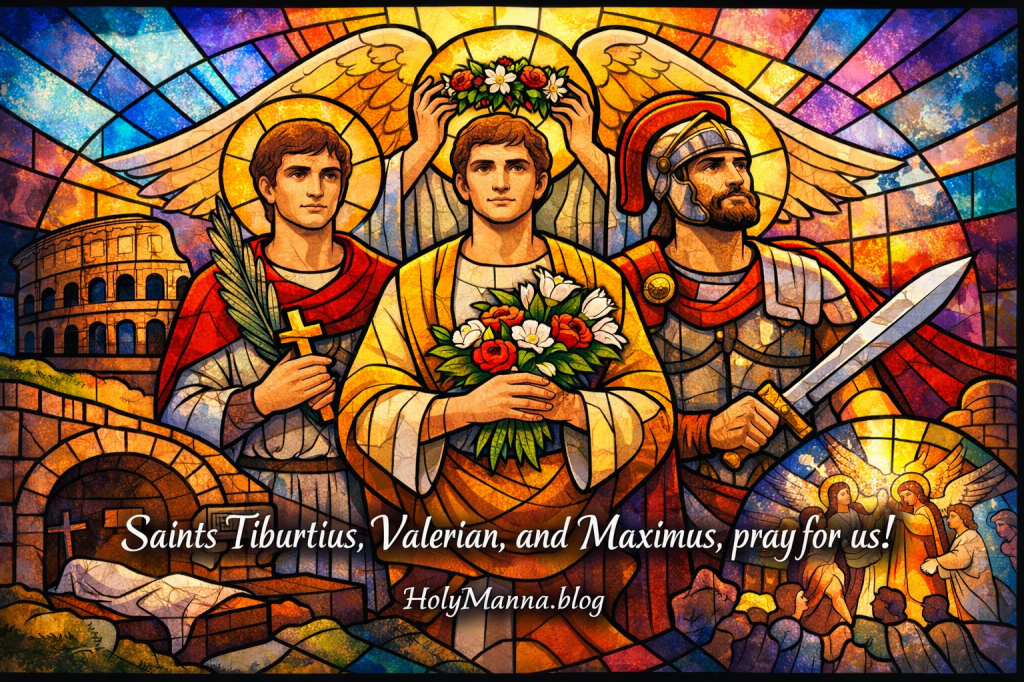
Mercy in the Shadow of Martyrdom
Saints Tiburtius, Valerian, and Maximus stand among the early Roman martyrs whose witness still speaks with quiet force. The Church honors them on April 14, and their memory has endured because they were remembered as men who chose Christ when the cost was everything. Their story has long been connected with Saint Cecilia, one of the most beloved martyrs of the early Church, and through that connection their names have echoed through Catholic devotion for centuries.
What makes these saints so compelling is not worldly power or public fame. It is the way grace reached into ordinary human bonds and transformed them. Valerian is remembered in Catholic tradition as the husband of Saint Cecilia. Tiburtius is remembered as Valerian’s brother. Maximus is remembered as the officer or official who was drawn to the faith by the courage of Christian martyrs. Together they are revered for conversion, courage, mercy, and martyrdom.
The Church has preserved them as real Roman martyrs, even though not every detail of their story can be historically verified in the same way. That balance matters. Catholic tradition does not flatten everything into dry facts, but it also does not ask the faithful to pretend every later legend is equally certain. The heart of their witness remains clear. These were men who encountered Christ and did not turn back.
A Household Touched by Grace
Much about the earliest years of these saints has not come down with certainty. What Catholic tradition hands on is centered more on their conversion and witness than on childhood details. Valerian and Tiburtius were associated with Rome, and tradition remembers them as men of standing who were drawn into the mystery of Christ through the witness of Saint Cecilia. Valerian, in particular, is remembered as the man Cecilia married, only to discover that her heart had already been wholly given to the Lord.
That moment is one of the striking turning points in their story. Instead of responding with anger or pride, Valerian is said to have listened. He was directed toward Christian instruction and baptism, traditionally through Pope Urban. This is one of the most beautiful features of the story. Grace did not enter through force. It entered through truth, purity, and the quiet courage of a holy woman.
Tiburtius followed after his brother, and his own conversion is remembered as sincere and wholehearted. Once they embraced the faith, they did not remain half-committed believers. They became men of action. They cared for Christians suffering persecution and are especially remembered for burying the dead, even when doing so exposed them to danger. That detail matters deeply in Catholic life. The Catechism teaches that care for the dead belongs to the dignity owed to the human person, and the burial of the dead has always been cherished by the Church as a corporal work of mercy.
Maximus enters the story differently. He is remembered not as a family member, but as a man standing on the side of imperial power. Yet the witness of holiness broke through his defenses. In that way, his life became a reminder that no heart is beyond the reach of grace.
Courage That Became a Work of Mercy
These saints are remembered most of all for what they did after conversion. They did not merely admire the Christian faith. They lived it. Valerian and Tiburtius are especially known for burying persecuted Christians and honoring the bodies of martyrs. In a world where the empire tried to shame and erase the faithful, these men answered with reverence and mercy.
That is one reason their witness still matters. It is easy to think holiness must look dramatic to be real. Their example says otherwise. Holiness often begins with mercy. It begins with honoring Christ in the vulnerable, the rejected, and the forgotten. These saints did not become memorable because they seized power. They became memorable because they loved Christ enough to serve His people even when that service was dangerous.
The Church teaches in CCC 2473 that “Martyrdom is the supreme witness given to the truth of the faith.” That truth shines in them. Before they were martyrs, they were men practicing costly charity. Before they died for Christ, they learned how to live for Him.
Catholic tradition also preserves several miraculous signs connected with their lives. After Valerian’s baptism, tradition says he received a heavenly sign confirming the holiness of Cecilia’s consecration. Another well-known tradition says an angel presented crowns of lilies and roses, symbolizing purity and divine favor. Tiburtius too is associated in tradition with extraordinary signs after his conversion. These stories belong to the ancient devotional tradition surrounding the saints and have deeply shaped Catholic imagination, though they cannot all be historically verified with certainty.
The Trial of Faith and the Crown of Martyrdom
The path of these saints did not stay hidden for long. Their works of mercy made them visible. Their faith made them dangerous in the eyes of a pagan world. Eventually, Valerian and Tiburtius were arrested because of their Christian witness and their care for the persecuted faithful.
Catholic tradition presents them as steadfast under pressure. They were ordered to sacrifice to false gods and refused. They chose fidelity to Christ over safety, status, and survival. That refusal was not stubbornness for its own sake. It was the fruit of conversion. Once they had come to know the Lord, they could not act as though Caesar or idols held the final claim on their souls.
Maximus, according to the traditional account, was deeply moved by the courage he saw in them. He is remembered as the official who witnessed their peace and constancy in the face of death. Tradition says that as Valerian and Tiburtius faced martyrdom, Maximus saw a heavenly vision in which angels received their souls. That vision led him to profess faith in Christ openly. This miracle story has long been handed down in Catholic tradition, but it cannot be historically verified with certainty.
After his conversion, Maximus himself suffered for the faith and was also crowned with martyrdom. That part of the story has always carried a special force. The persecutor’s side lost a man to grace. The machinery of death could not keep one soul from awakening to the truth.
Their martyrdom matters because it reveals what the Gospel can do in a human life. It can turn a husband into a confessor of the faith. It can turn a brother into a witness of mercy. It can turn an official of the state into a martyr for Christ.
Memory, Relics, and the Echo of Their Witness
After their deaths, the Church did not forget them. Their ancient cult in Rome is one of the strongest signs of their historical reality. They were associated with the cemetery of Praetextatus on the Via Appia, and their names were preserved in early Christian memory. Pilgrims knew their resting place. Roman Christians honored them. Their witness became part of the living memory of the Church.
Later tradition holds that their relics were transferred and associated with the Basilica of Saint Cecilia in Trastevere, further deepening their place in Roman Catholic devotion. That connection with Cecilia helped preserve their names across centuries, especially in liturgical and devotional life.
As for miracles after death, their posthumous impact is seen first in the endurance of their cult. Their memory did not vanish. Churches, pilgrims, and generations of the faithful kept returning to their names. Their association with Saint Cecilia also gave them a place in sacred art, Christian storytelling, and Roman devotion. Reports of favors and intercession have circulated through devotional tradition, but specific miracle accounts after death are not preserved with the same clarity as those attached to more widely documented saints. The Church’s certainty rests above all on their martyrdom, ancient veneration, and place in the life of Rome.
Their cultural impact may seem quiet compared to more universally known saints, but it is real. They helped embody a specifically Roman Christian memory. They belong to the world of the catacombs, the martyrs, the early Church, and the brave hidden fidelity that shaped Catholic identity long before Christianity held social power.
What These Martyrs Still Teach the Heart
These saints teach that conversion is never merely private. Once Christ takes hold of a soul, everything begins to change. Relationships change. Priorities change. The meaning of courage changes. Valerian and Tiburtius show that mercy is not softness. Sometimes mercy is dangerous. Sometimes it costs comfort, reputation, or safety. Yet that is exactly the kind of mercy Christ lived.
They also teach that holiness can spread through witness. Cecilia’s faith touched Valerian. Valerian’s conversion touched Tiburtius. The courage of the martyrs touched Maximus. That is how grace often moves. One faithful soul becomes the occasion for another soul’s awakening.
For readers today, these saints offer a needed challenge. Modern life is full of smaller idolatries. Comfort can become an idol. Approval can become an idol. Fear can become an idol. These martyrs invite the faithful to ask whether love for Christ actually governs daily life, or whether faith has been pushed to the margins.
Their example can be lived in practical ways. Honor the dead and pray for them. Practice works of mercy even when no one notices. Defend the dignity of the vulnerable. Stay faithful to Christ when the culture rewards compromise. Speak truth with charity. Live with the kind of conviction that helps others believe holiness is still possible.
Where is Christ asking for courage right now? What hidden work of mercy has been delayed out of fear or inconvenience? Whose path to God might depend on one quiet act of faithfulness?
Engage With Us!
Share thoughts and reflections in the comments below. These early martyrs still have a way of speaking to the present moment, especially for anyone trying to live the faith with courage in a confused world.
- What stands out most in the witness of Saints Tiburtius, Valerian, and Maximus?
- How does their example of burying the dead as a work of mercy challenge the way mercy is understood today?
- Has there been a moment when someone else’s faith helped deepen trust in Christ?
- What does martyrdom teach about loving Jesus above comfort, status, or fear?
- How can the example of these saints inspire a more courageous Catholic life this week?
May the witness of Saints Tiburtius, Valerian, and Maximus stir deeper faith, stronger charity, and greater courage. May their memory remind every Christian that holiness is never wasted, mercy is never small, and fidelity to Christ is always worth the cost. Live with faith, and do everything with the love and mercy Jesus taught us.
Saints Tiburtius, Valerian, and Maximus, pray for us!
Follow us on YouTube, Instagram and Facebook for more insights and reflections on living a faith-filled life.

 Holy Manna!
Leave a comment