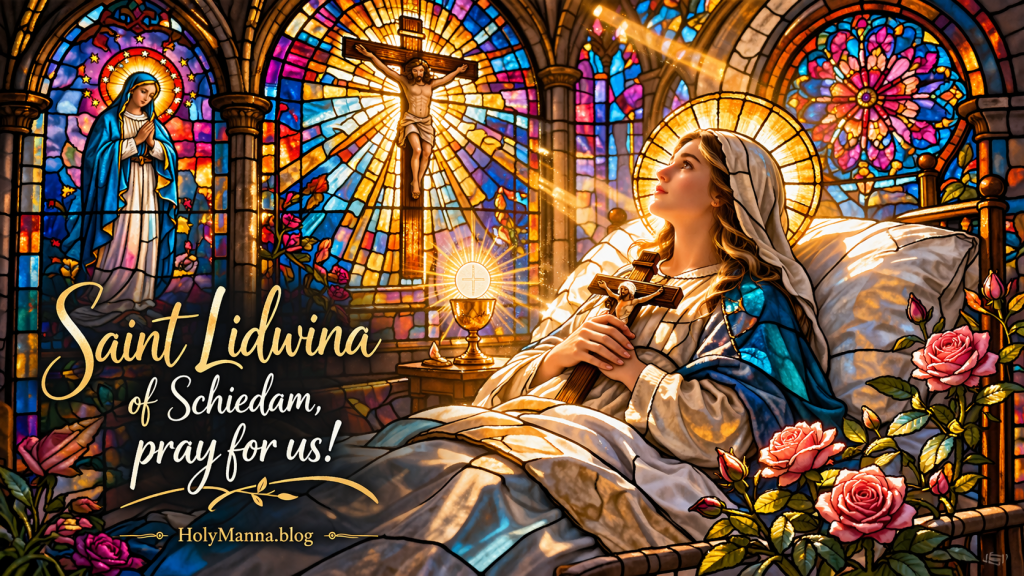
The Rose That Bloomed Through Suffering
Saint Lidwina of Schiedam is one of those saints who can stop a person in his tracks. She was not a queen, a great preacher, or a missionary who crossed oceans. She was a Dutch virgin, mystic, and holy sufferer whose life became a powerful witness to the mystery of the Cross. The Church remembers her because she endured long and terrible illness with heroic patience, deep love for Christ, and a soul turned completely toward heaven.
She is especially revered as a patroness of the sick, the chronically ill, and those who suffer in hidden ways. She is also remembered as a patron saint of ice skaters because the injury that changed her life began with a fall while skating. Yet her real greatness was not the accident itself. It was what grace did afterward. What looked like a life cut short became a life transformed. In Saint Lidwina, the Church sees the truth of CCC 618, which teaches that Christ invites His disciples to take up their cross and unite their sufferings to His. Her life became a living sermon on that mystery.
Saint Lidwina is revered because she shows that holiness does not depend on worldly strength, success, travel, or public influence. Sometimes holiness is forged in silence, in weakness, and in a room where almost nobody would think to look for glory. That is exactly where Christ often chooses to work.
The Girl From Schiedam Who Belonged to God
Lidwina was born in Schiedam in the Netherlands in 1380. Catholic tradition remembers her as coming from a poor family. Her father, Peter, had noble roots, but the household lived simply, and some accounts say he worked as a night watchman. She was one of nine children and the only daughter among her siblings. Even as a child, she stood out for her beauty, her seriousness, and her devotion.
From an early age she had a tender love for the Blessed Virgin Mary. Older Catholic sources remember her praying before an image of Our Lady in Schiedam, and tradition says that by the time she was still very young, she had already resolved to give herself wholly to God. That matters because Lidwina’s story is not the story of a girl who turned to God only after suffering came. It is the story of a soul already leaning toward heaven before the cross descended.
As she grew older, suitors reportedly sought her hand because of her beauty. Yet she desired virginity and a life belonging to Christ. That choice already revealed something important about her soul. She wanted God more than comfort, marriage, or earthly security. Then came the moment that changed everything.
As a teenager, while ice skating with friends, she fell violently and suffered a serious injury, commonly described in Catholic sources as a broken rib. What should have healed did not heal. Instead, her condition worsened. Infection, weakness, pain, and terrible physical decline followed. Over time, what began as one injury became a lifetime of extreme suffering.
At first, like many people would, she struggled deeply. The suffering was not romantic. It was ugly, painful, lonely, and humiliating. Yet through the help of her confessor, Father Jan Pot, and through meditation on the Passion of Christ, her soul deepened. She began to accept her suffering not as meaningless cruelty, but as something that could be offered to God. This was the great turning point of her life. Saint Lidwina became most known for redemptive suffering, for offering her pain for sinners, and for living in profound union with the suffering Christ.
The Bed of Pain That Became a Place of Grace
Lidwina’s illness lasted for decades. Catholic tradition remembers her as enduring severe pain, sores, fevers, weakness, and progressive bodily collapse. Some accounts say that for many years she could scarcely move. Others say that for the final stretch of her life she did not touch the ground at all. Her room became, in a sense, her whole world. Yet that little room also became a place of prayer, counsel, and grace.
This is why the Church still remembers her. She proves that a person can become spiritually fruitful even when physically broken. In her weakness, Christ’s strength became visible. This reflects the teaching of CCC 1521, which says that sickness can become a participation in the saving work of Jesus when it is united to His Passion.
Catholic sources also preserve many remarkable mystical events from her life. One well-known story says that a priest once brought her an unconsecrated host, perhaps to test her, and she immediately knew it was not the Blessed Sacrament. That story has long been treasured in Catholic tradition because it reveals her deep Eucharistic intimacy. Her love for the Holy Eucharist was not vague or sentimental. It was personal, reverent, and alive.
Other traditions say she received visions of heaven, hell, purgatory, and the Holy Land. Some accounts say she was accompanied by her guardian angel and was shown spiritual realities hidden from ordinary sight. One especially striking local tradition tells of a Eucharistic vision in which Christ appeared to her first as a crucified Child and then as a radiant Host marked with the five wounds. This story belongs to longstanding devotional tradition and cannot be independently verified.
Catholic tradition also says that for the last nineteen years of her life she lived without ordinary food and was sustained only by Holy Communion. This claim has been repeated for centuries in devotional accounts, but it cannot be independently verified.
Another tradition says that her room sometimes shone with a supernatural brightness so intense that people thought it was on fire. This also belongs to local devotional tradition and cannot be independently verified.
Her charity was just as important as her mystical experiences. Visitors came to her, and whatever help or gifts she received were reportedly shared with the poor. One local story says that the money given to her never seemed to run out when she gave it away to those in need. This story belongs to pious tradition and cannot be independently verified.
These stories matter because they reveal how Catholics came to understand her. She was not remembered merely as a sick woman who endured. She was remembered as a soul deeply united to Christ, nourished by the Eucharist, compassionate toward the poor, and spiritually fruitful even in weakness.
The Long Passion of a Soul United to Christ
Saint Lidwina was not a martyr in the technical sense. She was not executed by persecutors for confessing the faith. But her life had something deeply martyr-like about it. She lived a hidden white martyrdom, a daily dying to self over many long years. Her hardship was not a quick heroic moment. It was prolonged suffering that demanded patience every day.
That kind of suffering can be harder for many people to imagine than a single dramatic death. There was no cheering crowd, no public trial, no final speech before an executioner. There was simply pain, isolation, weakness, and the temptation to despair. Yet that is where her sanctity shines. She remained faithful. She continued to pray. She continued to love Christ. She continued to offer her suffering for the conversion of sinners and the relief of souls in purgatory.
Catholic sources describe how she meditated constantly on the Passion of the Lord. She learned to see her own pain inside His wounds. That is one reason her life has spoken so powerfully to the Church. It reflects the heart of Catholic spirituality. The Cross is not pointless. The Cross, united to Jesus, becomes fruitful.
One of the most moving traditions connected to her suffering is the vision of the rosebush. She was shown a rosebush and heard the words, “When this shall be in bloom, your suffering will be at an end.” Near death, she is said to have cried out, “I see the rose-bush in full bloom!” These are the most widely preserved sayings associated with her, and they capture the whole shape of her life. What seemed dead was preparing to flower. What seemed only painful was moving toward glory.
Near the end of her life, some Catholic accounts say she received a vision of Christ Himself coming to administer comfort to her soul before death. When she died on April 14, 1433, she died with a reputation for holiness already surrounding her.
The Saint Who Kept Working After Death
Saint Lidwina’s influence did not end when she died. In many ways, it spread more widely after her death than during her lifetime. Her grave quickly became a place of pilgrimage. A chapel was built over it soon afterward, and the faithful came seeking healing, intercession, and consolation.
Many stories of posthumous healings and favors became attached to her shrine. Pilgrims reported help through her intercession, especially in illnesses and afflictions. These reports helped establish her as a beloved saint among ordinary Catholics. The individual healing stories preserved in local devotion are part of her traditional cult, but many cannot now be independently verified.
Her memory was also preserved by important Catholic writers. Joannes Brugman wrote accounts of her life, and Thomas à Kempis helped transmit her story more broadly. That is a remarkable detail. Saint Lidwina was not just preserved in local folklore. She was remembered within the spiritual culture of the late medieval Church by men whose writing shaped Catholic devotion for generations.
Her relics also have a meaningful history. During periods of religious upheaval, especially around the time of the Reformation, her relics were moved for safety. They were taken to Brussels in the seventeenth century and later returned to Schiedam in the nineteenth century. Their return helped strengthen public devotion to her once again.
In 1890, Pope Leo XIII formally confirmed her longstanding cult. Many popular summaries simply say she was canonized, but the more precise Catholic language is that her ancient veneration was officially confirmed by the Church. That distinction matters because it shows how long and deeply the faithful had already honored her.
Her remains are now honored in the Basilica of Saint Lidwina and Our Lady of the Holy Rosary in Schiedam. She remains the patron saint of Schiedam, and her local cult is still alive. Her general feast is kept on April 14, though in Schiedam there has also been a local observance on June 14 connected to the return of her relics. Processions, liturgical celebrations, and continued pilgrimage testify that her memory is not dead history. It is living devotion.
Culturally, Saint Lidwina has become one of the Church’s most beloved saints of hidden suffering. Catholics turn to her when illness feels endless, when pain feels invisible, and when life seems reduced to limitation. Her witness says that none of those conditions can prevent sanctity. In fact, grace can transform them into the very place where sanctity begins to burn brightest.
What Saint Lidwina Teaches the Soul Today
Saint Lidwina’s life speaks with unusual force in an age that fears suffering, hides weakness, and often judges people by productivity. Her life reminds the world that human dignity does not disappear when strength disappears. A sick person is not spiritually useless. A suffering person is not forgotten by God. A hidden life can be immensely fruitful in the Kingdom of Heaven.
Her witness also corrects a common misunderstanding. Christianity does not teach that pain is good in itself. Pain is an evil that entered the world through sin. But Christianity does teach that Christ has entered suffering, transformed it, and made it a place where grace can work. That is why Saint Lidwina matters so much. She shows what it looks like when someone unites suffering to Jesus instead of surrendering to bitterness.
There is also something deeply comforting in her Eucharistic devotion. She clung to Christ in the Blessed Sacrament when everything else was stripped away. In a distracted and restless age, that is a needed lesson. The Eucharist is not a side devotion for the especially pious. The Eucharist is the heart of Christian life.
Her charity matters too. Though trapped in sickness, she still became a source of help for others. That is a good examination of conscience for any soul. Is suffering making the heart more closed, or is Christ using it to make the heart more merciful? Is weakness becoming an excuse for despair, or an opening for deeper trust? Is the soul learning to look at the Crucifix and say yes to God even there?
A Catholic trying to imitate Saint Lidwina does not need extraordinary visions. The real imitation begins in ordinary faithfulness. Pray with the suffering Christ. Receive the sacraments with reverence. Offer trials for others. Refuse bitterness. Stay close to Our Lady. Be patient with the sick. Visit those who are isolated. Learn to see hidden crosses as places where God may be doing His deepest work.
Saint Lidwina teaches that the rosebush still blooms. It blooms whenever suffering is united to love. It blooms whenever weakness is surrendered to grace. It blooms whenever a soul that feels forgotten discovers that Christ has been nearest all along.
Engage With Us!
Share your thoughts and reflections in the comments below. Saint Lidwina’s life raises powerful questions about suffering, holiness, and trust in God, and those questions are worth sitting with prayerfully.
- What stands out most about Saint Lidwina’s life and why does it speak so strongly to the heart?
- How does her example challenge the way suffering, weakness, and usefulness are often viewed in modern life?
- Is there a cross in life right now that Christ may be inviting the soul to unite more closely to His Passion?
- What practical step can be taken this week to show compassion to someone who is sick, lonely, or hidden from the world?
- How can deeper love for the Eucharist strengthen daily endurance, patience, and faith?
May Saint Lidwina of Schiedam pray for every soul that suffers in silence, and may her example encourage a life of steady faith, deep trust, and generous love. May everything be done with the love and mercy Jesus taught us.
Saint Lidwina of Schiedam, pray for us!
Follow us on YouTube, Instagram and Facebook for more insights and reflections on living a faith-filled life.

 Holy Manna!
Leave a comment