Tuesday of the Second Week of Easter – Lectionary: 268
When Easter Makes a People New
There are days in the Church’s liturgy when the readings do not simply sit beside one another. They lean into each other, like flames joining into one fire. Today is one of those days. The heart of these readings is the mystery of new life in the risen Christ. In the Acts of the Apostles, that new life appears in a community so transformed by grace that it becomes “of one heart and mind.” In Psalm 93, that same life is anchored in the majesty of the Lord who reigns forever. In the Gospel of John, Jesus reveals where this new life begins: not in human effort alone, not in religious curiosity alone, but in being born from above by the Holy Spirit and saved through the Son who is lifted up.
That is why the Church places these readings in Eastertide. The Resurrection is not treated as a distant doctrine or a poetic memory. It is presented as a living power that changes human beings from the inside out. The early Christians in Jerusalem did not become generous, united, and fearless by accident. They had encountered the risen Lord, received the apostolic witness, and begun to live as people who knew that death had been conquered. At the same time, the conversation with Nicodemus reminds every reader that this newness is not merely moral improvement. It is rebirth. The Church has always heard in this passage the deep echo of Baptism, the sacrament by which a soul is cleansed, renewed, and brought into the life of grace. What begins in the hidden work of the Spirit becomes visible in the public life of the Church.
There is also a larger backdrop holding these readings together. Israel had long waited for the day when God would fully reign, restore His people, and pour out His Spirit. Psalm 93 sings of that royal certainty. Jesus reveals that this reign will come through His being lifted up, just as the bronze serpent in the desert once became a sign of healing for the wounded. Then Acts shows what happens when that promise begins to flower in real human lives. A people once scattered by fear begins to live in communion. A world shaped by grasping and scarcity meets a kingdom shaped by trust and gift. That is the thread running through today’s readings: the risen Christ makes men and women new, and that newness creates a holy people whose lives bear witness that the Lord truly reigns.
First Reading – Acts 4:32-37
When the Risen Christ Teaches a Community How to Live
This reading opens a window into the earliest days of the Church in Jerusalem, when the apostles were preaching the Resurrection in the shadow of real opposition and the Christian community was still small enough to be known by its shared life. This comes just after the believers had prayed for boldness, and the Holy Spirit had filled them again for witness. Luke shows that Easter was not only something the apostles announced with their mouths. It was something the whole Church began to embody with its life. The Resurrection of Jesus was already reshaping human relationships, loosening the grip of possessions, and teaching believers to see one another not as strangers competing for security, but as members of one body. St. John Chrysostom noticed this exact point when he said, “Do you see that together with the grace of God they also contributed their part?”
That background matters. In the ancient world, wealth often reinforced social divisions, and status was guarded carefully. Yet here the Church appears as a new household formed by the Holy Spirit. The unity described in this reading is not political theory, and it is not forced collectivism. The Church has always held that private property is legitimate, while also insisting that material goods are to be used with charity and stewardship for the good of others. The Catechism of the Catholic Church teaches, “The right to private property, acquired by work or received from others by inheritance or gift, does not do away with the original gift of the earth to the whole of mankind.” It also says, “In his use of things man should regard the external goods he legitimately owns not merely as exclusive to himself but common to others also, in the sense that they can benefit others as well as himself.” CCC 2403-2404. Today’s theme comes into focus here: those who have been touched by the risen Christ begin to live as people reborn, generous, united, and free.
Acts 4:32-37 – New American Bible (Revised Edition)
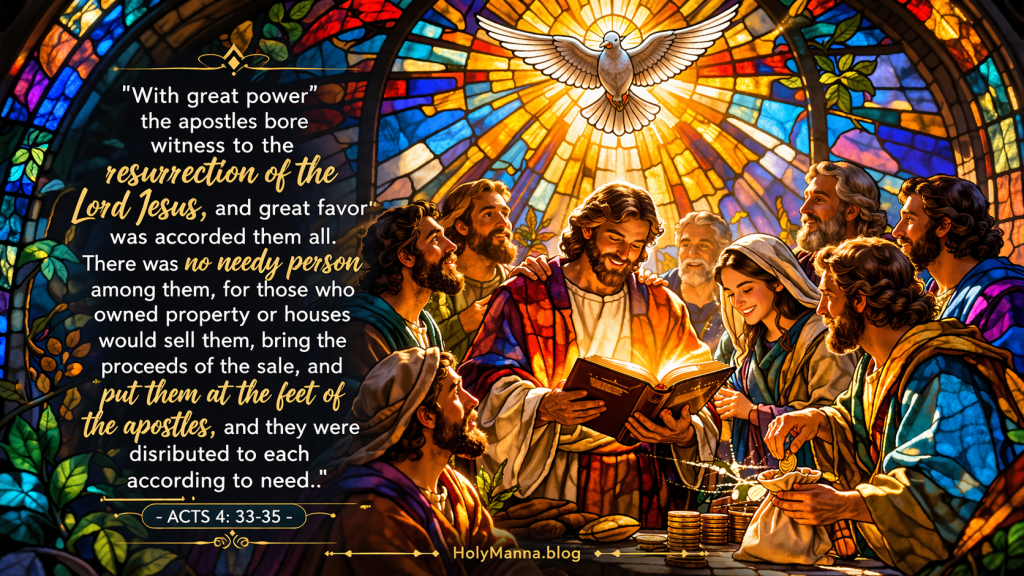
32 The community of believers was of one heart and mind, and no one claimed that any of his possessions was his own, but they had everything in common. 33 With great power the apostles bore witness to the resurrection of the Lord Jesus, and great favor was accorded them all. 34 There was no needy person among them, for those who owned property or houses would sell them, bring the proceeds of the sale, 35 and put them at the feet of the apostles, and they were distributed to each according to need.
36 Thus Joseph, also named by the apostles Barnabas (which is translated “son of encouragement”), a Levite, a Cypriot by birth, 37 sold a piece of property that he owned, then brought the money and put it at the feet of the apostles.
Detailed Exegesis
Verse 32. “The community of believers was of one heart and mind, and no one claimed that any of his possessions was his own, but they had everything in common.”
Luke begins with the interior before moving to the exterior. The first miracle is not economic. It is spiritual. The believers are “of one heart and mind” because grace has drawn them into a real communion. Their common life flows from their common faith. The sharing of possessions is the fruit of unity, not its replacement. St. John Chrysostom reflects on this line with remarkable insight: “In my opinion, the love begot the poverty, and then the poverty drew tight the cords of love.” He sees that their detachment from possessions was born from charity, and then deepened that charity even more.
Verse 33. “With great power the apostles bore witness to the resurrection of the Lord Jesus, and great favor was accorded them all.”
The apostles are not merely sharing ideas. They are bearing witness to an event they have seen and received. The Resurrection is the center of their preaching, and the grace surrounding the community confirms that the Gospel is not empty speech. Luke joins doctrine and life. The Church’s unity and generosity do not replace the proclamation of Christ risen. They confirm it. Chrysostom says the apostles rendered this testimony like men entrusted with a sacred deposit, almost as if they were paying a debt owed to the world. That is a deeply Catholic image. The faith is a treasure handed down, not reinvented.
Verse 34. “There was no needy person among them, for those who owned property or houses would sell them, bring the proceeds of the sale,”
This does not mean every Christian at every moment had to liquidate every possession. Luke is describing the striking generosity of a community transformed by grace. The point is that need was not ignored. Those with abundance responded to those in want. The Church sees here an early expression of the communion of saints lived in concrete form. The Catechism of the Catholic Church says of the first Christians, “They had everything in common.” Then it adds, “Everything the true Christian has is to be regarded as a good possessed in common with everyone else. All Christians should be ready and eager to come to the help of the needy . . . and of their neighbors in want.” CCC 952.
Verse 35. “and put them at the feet of the apostles, and they were distributed to each according to need.”
The image of laying gifts at the apostles’ feet reveals something important about the Church. Their generosity was not chaotic or self-directed. It was entrusted to apostolic authority. This was not random philanthropy. It was ecclesial charity. The apostles were responsible for distribution, which shows order, trust, and communion. Chrysostom calls this “a great mark of honor” because the offering was placed at the apostles’ feet, acknowledging the authority Christ had entrusted to them. This verse also shows the Church’s concern for justice. The needy are not pitied from afar. They are cared for within the household of faith.
Verse 36. “Thus Joseph, also named by the apostles Barnabas (which is translated ‘son of encouragement’), a Levite, a Cypriot by birth,”
Luke now gives a face to the teaching. Barnabas is introduced not only by his given name, Joseph, but by the name the apostles gave him: Barnabas, “son of encouragement.” That title matters. In the life of the Church, encouragement is not sentimental fluff. It is a real spiritual gift. Barnabas will later become one of the great bridge-builders of the apostolic age, especially in supporting Paul and helping open the Church’s mission to the Gentiles. Pope Benedict XVI said, “With immense generosity, he sold a field which belonged to him, and gave the money to the Apostles for the Church’s needs.” He also noted that Barnabas later vouched for the sincerity of Saul’s conversion. Luke is already showing what kind of man he was: generous, trusted, and able to strengthen others.
Verse 37. “sold a piece of property that he owned, then brought the money and put it at the feet of the apostles.”
Barnabas does not simply admire the common life. He enters it. He acts. His generosity is personal, concrete, and sacrificial. He does not cling to ownership as his identity. He places what he has at the service of Christ’s Body. This is one of the clearest signs that Easter has gone from idea to incarnation. A man who once held land now holds it loosely because he has found a greater inheritance. The Church does not present Barnabas as reckless, but as free. That freedom is what charity looks like when it has taken root.
Teachings
This passage teaches that the Resurrection creates a visible communion. The Church is not just a gathering of like-minded individuals. She is a body. The Catechism of the Catholic Church teaches, “Since all the faithful form one body, the good of each is communicated to the others…. We must therefore believe that there exists a communion of goods in the Church.” It then recalls the Jerusalem Church and says, “In the primitive community of Jerusalem, the disciples ‘devoted themselves to the apostles’ teaching and fellowship, to the breaking of the bread and the prayers.’ . . . Faith is a treasure of life which is enriched by being shared.” CCC 947, 949.
This reading also protects Catholic teaching from two opposite errors. On one side, it rejects greed, isolation, and the selfish use of material goods. On the other side, it does not abolish the legitimacy of ownership. Instead, it places ownership under the law of charity. The Catechism of the Catholic Church states, “The right to private property, acquired by work or received from others by inheritance or gift, does not do away with the original gift of the earth to the whole of mankind.” It continues, “The ownership of any property makes its holder a steward of Providence, with the task of making it fruitful and communicating its benefits to others.” CCC 2403-2404. That is exactly what Barnabas models. He remains a free man, but now uses his freedom as a steward, not as a hoarder.
The Fathers of the Church saw this passage as proof that grace changes not only worship but habits. St. John Chrysostom says, “Do you see that together with the grace of God they also contributed their part?” He refuses to let Christians use grace as an excuse for passivity. God acts first, but man must respond. He also says, “They first alienated their property, and so maintained the rest, on purpose that the maintenance might not come as of their own private means, but as of the common property.” In other words, their generosity was not designed to keep control while appearing generous. It was meant to place everything under the charity of Christ.
Barnabas also carries a lesson that stretches into Church history. Pope Benedict XVI describes him as one of the first to embrace Christianity after the Resurrection and highlights his immense generosity and later missionary importance. The Church remembers him not simply as a donor, but as a man whose encouragement strengthened the apostolic mission. That is important because the saints teach that generosity is not only financial. Some souls keep others alive by courage, patience, hospitality, and trust.
Reflection
This reading lands hard because it forces a simple question into the soul: what does Easter actually change? It is easy to say that Christ is risen and still live with a closed fist, a guarded heart, and a constant fear that there will never be enough. But the first Christians had begun to understand something that still has the power to reorder an entire life. If Christ has conquered death, then security cannot finally be found in money, property, reputation, or control. The soul that knows the risen Lord can begin to live with open hands.
That does not usually mean selling everything tomorrow morning. It does mean asking whether possessions are being treated as tools for love or as walls for self-protection. It means learning to notice need before being forced to notice it. It means supporting the Church’s mission with real sacrifice. It means caring for the poor, helping families in distress, and refusing to let comfort become an idol. It also means becoming a Barnabas in ordinary life. Encouragement is holy work. The family member who listens patiently, the friend who steadies a struggling soul, the parishioner who quietly helps without needing credit, and the believer who gives generously without drama all share in this same Easter spirit.
A good way to live this reading is to begin with one honest act of stewardship. Look at time, money, attention, and material goods and ask which part has been locked away from God. Then make one concrete offering. Support a need. Give something away. Help someone quietly. Make generosity costly enough that it becomes prayer. And then keep going.
Is the heart becoming more possessive or more free?
Is there real trust that the Lord can provide what is needed?
Who around you needs not only help, but encouragement?
What would it look like for the Resurrection to become visible in the way you handle money, hospitality, and mercy?
Responsorial Psalm – Psalm 93:1-2, 5
When the Soul Remembers That the Lord Still Reigns
This psalm sounds like a trumpet in the middle of a shaken world. While the First Reading showed what Easter looks like in the life of the Church, this responsorial psalm reveals why such a life is even possible. The community in Acts could live with open hands because they were learning to live under the reign of God. Psalm 93 is one of the great royal psalms of Israel, a sacred hymn that proclaims the kingship of the Lord over all creation. In a world where nations rose and fell, rulers boasted, and human power always seemed one crisis away from collapse, Israel sang of a throne older than history and stronger than chaos.
That is what makes this psalm so fitting for Easter. The Resurrection does not announce a vague spiritual comfort. It announces that Jesus Christ, crucified and risen, truly reigns. The Church hears this psalm now with even greater depth because the majesty of the Lord is no longer seen only in the language of creation and covenant, but in the victory of the risen Christ over sin and death. The same Lord who sits enthroned from of old is the one whom the apostles now preach with power. The same Lord whose decrees are firmly established is the one who tells Nicodemus that a man must be born from above. The theme ties together beautifully: the Lord reigns, His truth stands firm, and His holy life must now take shape in His people.
Psalm 93:1-2, 5 – New American Bible (Revised Edition)
God Is a Mighty King
1 The Lord is king, robed with majesty;
the Lord is robed, girded with might.
The world will surely stand in place,
never to be moved.
2 Your throne stands firm from of old;
you are from everlasting.5 Your decrees are firmly established;
holiness befits your house, Lord,
for all the length of days.
Detailed Exegesis
Verse 1. “The Lord is king, robed with majesty; the Lord is robed, girded with might. The world will surely stand in place, never to be moved.”
The psalm begins not with man, but with God. That alone is a correction to the restless heart. So much of human anxiety begins by looking first at circumstances, threats, politics, money, or instability. The psalmist does the opposite. He begins with the kingship of the Lord. To say “The Lord is king” is to confess that history is not ownerless and creation is not abandoned. God is not merely present as an observer. He reigns with majesty and strength.
The language of being robed and girded does not mean God needs clothing. It is poetic language that reveals His glory and power in a way human beings can grasp. Majesty is not just beauty here. It is sovereign splendor. Might is not brute force. It is the stable, ordering power of the Creator. The line about the world standing firm does not mean the world never experiences suffering, upheaval, or disaster. It means creation is not outside God’s rule. It is upheld by Him. The Church reads this with deep confidence because Christ’s Resurrection reveals that even death itself cannot overthrow the purposes of God.
This verse also teaches the soul how to pray. Before asking for anything, the believer is invited to adore. The Catechism of the Catholic Church says, “Adoration is the first act of the virtue of religion. To adore God is to acknowledge him as God, as the Creator and Savior, the Lord and Master of everything that exists, as infinite and merciful Love.” CCC 2096. That is exactly what this verse does. It places the soul on solid ground by placing God on His throne.
Verse 2. “Your throne stands firm from of old; you are from everlasting.”
The psalm now moves from the stability of the world to the eternity of God. Earthly rulers inherit power, lose power, and disappear into history. Their thrones are always temporary. But the throne of the Lord stands “from of old,” and the Lord Himself is “from everlasting.” The point is not simply that God is older than the world. It is that He is not contained by time at all. He does not become more secure when circumstances improve, nor less powerful when nations tremble.
That truth would have mattered deeply to Israel, and it matters just as much now. A passing age always tempts people to act as though the latest crisis is ultimate. The psalm refuses that lie. The Lord’s reign did not begin yesterday, and it will not end tomorrow. For the Christian, this verse shines even more brightly in the light of Easter. The One raised from the dead is not a new rival to worldly power. He is the eternal Son made flesh, now revealed in glory. The apostles preach the Resurrection with boldness because the throne behind their witness is eternal.
This verse also steadies the interior life. Many struggles in prayer come from treating God as though He were uncertain, distant, or reactive. But the psalm reminds the believer that God is never scrambling. He is never caught off guard. He is never improvising under pressure. His throne stands firm. That is why the Christian can remain faithful even when answers are delayed.
Verse 5. “Your decrees are firmly established; holiness befits your house, Lord, for all the length of days.”
The psalm closes by bringing together truth and holiness. God does not reign arbitrarily. His decrees are firmly established. His word is trustworthy. His judgments are not unstable. His commandments are not passing opinions. This matters because the Lord’s kingship is not only about power. It is about moral order, covenant faithfulness, and divine truth. The same God who rules creation also reveals how His people are to live.
Then the psalm reaches a sacred intimacy: “holiness befits your house, Lord.” The Lord’s house, in Israel’s immediate experience, meant the place of worship, the dwelling set apart for God’s presence. But the Church hears even more in these words. God’s house is holy because God is holy, and those who belong to Him are called to reflect that holiness. Easter does not only comfort the sinner. It sanctifies the sinner. The Church, as the household of God, must bear the beauty of holiness because she belongs to the King.
This is where today’s readings touch one another again. In Acts, the believers live as one body. In John, a man must be born from above. Here in the psalm, the throne, the decrees, and the holy house all stand together. The Christian life is not self-made spirituality. It is life lived under the reign of a holy God, according to His truth, within His household.
Teachings
This psalm teaches adoration, trust, and holiness. It reminds the believer that worship begins with God’s majesty, not with personal mood. That is why the Church has always understood adoration as foundational. The Catechism of the Catholic Church teaches, “Adoration is the first act of the virtue of religion. To adore God is to acknowledge him as God, as the Creator and Savior, the Lord and Master of everything that exists, as infinite and merciful Love.” CCC 2096. The psalmist is doing exactly that. He is not trying to convince himself that things will work out. He is declaring who God is.
This psalm also teaches that God’s truth is not fragile. The Catechism of the Catholic Church says, “The Old Testament attests that God is the source of all truth. His Word cannot deceive. His Law is truth. His ‘faithfulness endures to all generations.’” CCC 2465. When the psalm says, “Your decrees are firmly established,” it is proclaiming that divine revelation is not shifting sand. The soul does not need to invent meaning or negotiate with truth. God has spoken, and His word stands.
The final line also opens into the Church’s doctrine of holiness. God’s house is not holy because human beings are impressive. It is holy because God dwells there and sets His people apart. The Catechism of the Catholic Church teaches, “The Church . . . is held, as a matter of faith, to be unfailingly holy. This is because Christ, the Son of God, who with the Father and the Spirit is hailed as ‘alone holy,’ loved the Church as his Bride, giving himself up for her so as to sanctify her.” CCC 823. That teaching fits this psalm beautifully. Holiness befits the Lord’s house because the Lord Himself makes it holy.
The saints have long understood that the kingship of God is not cold or distant. It is deeply personal. St. Augustine, speaking of the psalms more broadly, often drew the soul back to this simple truth: the God who is praised in the psalm is not far away from the one who prays it. The Lord who reigns is also the Lord who saves. That is the Christian reading of this psalm in Eastertide. The King on the eternal throne is the crucified and risen Jesus Christ.
Reflection
This psalm speaks directly to a distracted and anxious age. It is hard to live like the Christians in Acts if the heart is secretly convinced that everything depends on human control. It is hard to be generous, steady, pure, and trusting when the soul feels as though the world is always on the verge of collapse. That is why the Church places this psalm on the lips of the faithful. Before doing anything, the heart must remember who reigns.
There is real freedom in that. The believer does not need to carry the weight of being lord of the future. That job is already taken. The Christian is called instead to live faithfully under the kingship of God. That means obeying His decrees even when culture rejects them. It means treating worship as holy, not casual. It means entering the church building, the home, and even daily work with a renewed sense that life belongs to the King.
A good way to pray this psalm is to let it challenge whatever has been ruling the heart lately. Sometimes that ruler is fear. Sometimes it is anger. Sometimes it is ambition, comfort, politics, lust, or the craving to control outcomes. This psalm quietly but firmly pushes all rivals off the throne. The Lord is king. Not fear. Not success. Not public opinion. Not the chaos of the age. The Lord.
That truth can become practical very quickly. Begin the day with an act of adoration. Spend a moment before God and name His majesty before naming personal problems. Treat His word as firmly established by actually obeying it. Let holiness befit His house by bringing reverence back into Mass, prayer, speech, and the ordinary habits of home. A soul that remembers who reigns begins to stand a little more firmly too.
What has been acting like a king in the heart lately?
Does daily life reflect trust in the Lord’s rule, or trust in human control?
Is God’s house approached with reverence, purity, and love?
What would change if this day truly began with the words, “The Lord is king”?
Holy Gospel – John 3:7-15
When Jesus Leads a Searching Soul Into the Mystery of New Birth
This Gospel continues the nighttime conversation between Jesus and Nicodemus, one of the most arresting encounters in the Gospel of John. Nicodemus is no careless skeptic. He is a Pharisee, a leader among the Jews, and as Jesus says, “the teacher of Israel.” He knows Scripture, tradition, and religious life. Yet even with all of that, he stands before Christ as a man who still does not understand the deepest things of God. That is part of what makes this passage so powerful. It shows that a person can be informed, respectable, and serious about religion, and still need to be remade from above.
The historical and religious background matters. The Jewish people were waiting for the fulfillment of God’s promises, for the renewal of Israel, and for the coming of the Kingdom. But Jesus reveals that entrance into that Kingdom is not secured by ancestry, status, or scholarship. A man must be born anew, or more precisely, born from above. The Church has always heard in this passage the deep mystery of Baptism and the life of the Holy Spirit. That makes this Gospel the inner key to today’s readings. In Acts, the Church lives with astonishing unity and generosity. In Psalm 93, the Lord reigns in majesty and holiness. Here in the Gospel, Jesus shows how human beings become capable of such a life at all. They must be reborn by grace, drawn into heavenly truth by the Son who descended from heaven, and healed by looking with faith upon the One who will be lifted up.
John 3:7-15 – New American Bible (Revised Edition)
7 Do not be amazed that I told you, ‘You must be born from above.’ 8 The wind blows where it wills, and you can hear the sound it makes, but you do not know where it comes from or where it goes; so it is with everyone who is born of the Spirit.” 9 Nicodemus answered and said to him, “How can this happen?” 10 Jesus answered and said to him, “You are the teacher of Israel and you do not understand this? 11 Amen, amen, I say to you, we speak of what we know and we testify to what we have seen, but you people do not accept our testimony. 12 If I tell you about earthly things and you do not believe, how will you believe if I tell you about heavenly things? 13 No one has gone up to heaven except the one who has come down from heaven, the Son of Man. 14 And just as Moses lifted up the serpent in the desert, so must the Son of Man be lifted up, 15 so that everyone who believes in him may have eternal life.”
Detailed Exegesis
Verse 7. “Do not be amazed that I told you, ‘You must be born from above.’”
Jesus begins by correcting Nicodemus’ astonishment. Nicodemus is still thinking in merely earthly categories, and Jesus is trying to lift his mind higher. The phrase “born from above” is essential. The Church does not read this as a poetic way of saying that a person should simply become nicer or more religious. Jesus is speaking about a true rebirth that comes from God. This is why the Church connects this teaching to Baptism, where divine life is truly given.
The Catechism of the Catholic Church teaches, “Holy Baptism is the basis of the whole Christian life, the gateway to life in the Spirit . . . Through Baptism we are freed from sin and reborn as sons of God.” CCC 1213. Jesus is telling Nicodemus that the Kingdom requires more than knowledge. It requires transformation.
Verse 8. “The wind blows where it wills, and you can hear the sound it makes, but you do not know where it comes from or where it goes; so it is with everyone who is born of the Spirit.”
Jesus uses the mystery of the wind to reveal the mystery of the Spirit. In both Hebrew and Greek, the words for spirit, breath, and wind are closely related. The point is not that the Spirit is irrational or chaotic. The point is that the Spirit cannot be reduced to human control. A man can hear the effects of the wind without mastering it. In the same way, the work of the Holy Spirit is real, powerful, and often hidden.
This verse guards the soul from pride. Grace is not a machine that can be managed. The Christian life is not built on personal mastery, but on surrender to the living God. At the same time, the Spirit’s action is not vague. The Church teaches that the Holy Spirit is truly at work in the sacraments and in the life of grace. The Catechism of the Catholic Church says, “The Holy Spirit is the living memory of the Church.” It also teaches, “Through his grace, the Holy Spirit is the first to awaken faith in us and to communicate to us the new life, which is to know the Father and the one whom he has sent, Jesus Christ.” CCC 1099, 684. The Spirit is free, but He is not absent. He is the divine breath who gives life.
Verse 9. “Nicodemus answered and said to him, ‘How can this happen?’”
This is an honest question, and that matters. Nicodemus is confused, but he is still listening. There is a humility in this line that should not be missed. He does not walk away offended. He asks. Many souls begin the real journey toward God only when they finally admit they do not understand. This verse reveals the poverty of spirit necessary for deeper faith.
Nicodemus also represents the limits of unaided human reason. Reason is good and necessary, but divine mysteries must be received as revelation. A man cannot climb into heaven by intellect alone. He must be taught by the One who comes from heaven.
Verse 10. “Jesus answered and said to him, ‘You are the teacher of Israel and you do not understand this?’”
Jesus’ response is sharp, but it is not cruel. It is a summons. Nicodemus, as a teacher of Israel, should have been prepared for God’s promise of interior renewal. The prophets had spoken of new hearts, clean water, and the Spirit of God renewing His people. Jesus is gently exposing the tragedy of religious learning without spiritual penetration.
This verse is a warning for every age. A person can know religious vocabulary, defend doctrine, teach others, and still fail to yield to the living reality of grace. The Lord is not impressed by knowledge that never becomes conversion. He wants truth to penetrate the heart.
Verse 11. “Amen, amen, I say to you, we speak of what we know and we testify to what we have seen, but you people do not accept our testimony.”
Jesus speaks here with divine authority. The double “Amen, amen” is solemn and weighty. He is not speculating. He is bearing witness. That language matters because testimony has already become a major theme in Easter. In the First Reading, the apostles bear witness to the Resurrection. Here Jesus reveals Himself as the first and ultimate witness, the One who speaks what He knows because He comes from the Father.
There is also sadness in this verse. Revelation can be rejected. Testimony can be heard but not received. The problem is not lack of divine truth. The problem is resistance in the human heart. This prepares the reader to understand why faith itself is a gift of grace. A man does not force his own rebirth. He must receive the testimony of Christ in humility.
Verse 12. “If I tell you about earthly things and you do not believe, how will you believe if I tell you about heavenly things?”
Jesus draws a distinction between earthly images and heavenly realities. He has been speaking in accessible language about birth, wind, and visible signs, but Nicodemus is still struggling. If even these entry points are refused, then how can deeper mysteries be received?
The Church sees in this a call to docility. Divine revelation does not flatter human autonomy. It asks for trust. The mysteries of grace, sacrament, and eternal life are above reason, though never against reason. A person must allow himself to be led by Christ rather than insisting on comprehension before surrender.
Verse 13. “No one has gone up to heaven except the one who has come down from heaven, the Son of Man.”
Here Jesus reveals why He alone can speak with full authority about heavenly realities. He does not merely teach about heaven as a prophet looking from below. He comes from above. He is the Son of Man who has descended from heaven. This is a profound declaration about His divine origin and unique authority.
The Church has always seen in this verse a strong witness to the mystery of the Incarnation. Jesus is not merely a teacher sent by God. He is the eternal Son made flesh. The Catechism of the Catholic Church teaches, “The Word became flesh to make us ‘partakers of the divine nature.’” It continues, “For the Son of God became man so that we might become God.” CCC 460. That is the astonishing logic of salvation. The One who comes down from heaven makes it possible for man to be raised toward heaven.
Verse 14. “And just as Moses lifted up the serpent in the desert, so must the Son of Man be lifted up,”
Jesus now interprets His coming Passion through the story of Israel in the wilderness. In the Book of Numbers, the people were bitten by serpents because of their sin, and God commanded Moses to lift up a bronze serpent so that those who looked upon it with faith might live. Jesus takes that image and applies it to Himself. The Son of Man must be lifted up.
In the Gospel of John, this lifting up has a double meaning. It points to the Cross, where Christ is physically raised up before the world, and it also points to His exaltation in glory. What looks like defeat becomes the very place of victory. The wounds of sin are healed by gazing upon the crucified Savior with faith.
This is one of the great Catholic readings of the Cross. Salvation is not abstract. It is cruciform. The healing of the soul comes through the Passion of Christ. St. Augustine beautifully saw in this image both likeness and reversal. The serpent was a sign of death, but in bronze it became an instrument of healing. Christ, though sinless, took on the likeness of sinful flesh so that by His Cross sinners might be healed.
Verse 15. “so that everyone who believes in him may have eternal life.”
This verse gives the purpose of the lifting up of Christ. The Cross is ordered toward life. Faith in Jesus is not a vague optimism or emotional attachment. It is the trusting surrender of the soul to the crucified and risen Son. Through that faith, eternal life begins even now and comes to fullness in heaven.
The Church never treats eternal life as merely endless duration. It is communion with God. It begins through grace and blossoms into glory. The Catechism of the Catholic Church teaches, “Grace is a participation in the life of God.” CCC 1997. That means eternal life starts before death whenever a soul truly receives the life of Christ. Jesus is telling Nicodemus, and every reader after him, that the road into that life passes through faith in the Son who is lifted up.
Teachings
This Gospel stands at the heart of Catholic teaching on regeneration, grace, the Holy Spirit, and the saving Cross of Christ. The Church hears in Jesus’ words a clear foundation for Baptism and the new life it brings. The Catechism of the Catholic Church teaches, “This bath is called enlightenment, because those who receive this catechetical instruction are enlightened in their understanding . . . Having received in Baptism the Word, ‘the true light that enlightens every man,’ the person baptized has been ‘enlightened,’ he becomes a ‘son of light,’ indeed, he becomes ‘light’ himself.” CCC 1216. This fits the Gospel perfectly. Nicodemus comes in the night, but Christ is leading him toward light.
The Church also teaches that this new birth is entirely grace before it ever becomes human achievement. The Catechism of the Catholic Church says, “The preparation of man for the reception of grace is already a work of grace.” It continues, “Grace is favor, the free and undeserved help that God gives us to respond to his call to become children of God.” CCC 2001, 1996. Nicodemus did not manufacture his own rebirth. He had to be led there by Christ.
The saints saw immense depth in this passage. St. Augustine wrote, “The Lord says to Nicodemus, ‘You must be born again.’ He says this because no one is born of his father and mother only, but he must also be born of God and the Church.” He also writes of Baptism, “The water is visible, but the Spirit is invisible. The visible washing cleanses the body, the invisible sanctification cleanses the soul.” That is classic Catholic realism. Grace is invisible, but it is given through visible signs established by Christ.
This Gospel also teaches the necessity of the Cross. Christianity is not an escape from suffering through positive thinking. It is healing through the crucified Lord. The Catechism of the Catholic Church teaches, “By his passion and death on the Cross Christ has given a new meaning to suffering: it can henceforth configure us to him and unite us with his redemptive Passion.” CCC 1505. The Son of Man must be lifted up because the deepest wound in man cannot be healed by advice alone. It must be healed by redemption.
Historically, this passage has shaped the Church’s preaching from the earliest centuries. Catechumens preparing for Baptism heard in it the promise of real rebirth. The Fathers returned to it constantly because it explained why Christianity was not merely moral reform or inherited custom. It was a supernatural new beginning. That is why this Gospel belongs so naturally in Eastertide. The Resurrection confirms that the One lifted up on the Cross is truly the Lord of life.
Reflection
This Gospel reaches into places that many people try to keep hidden. Nicodemus comes by night, and there is something painfully familiar about that. Plenty of souls live that way. They are sincere enough to seek Jesus, but still cautious, still confused, still carrying questions they do not know how to name. This Gospel is good news for them. Jesus does not mock a searching soul. He meets it. But He also refuses to let it stay shallow. He calls it into transformation.
That call still confronts daily life. It is possible to admire Jesus without surrendering to Him. It is possible to study the faith without allowing the Spirit to remake the heart. It is possible to remain stuck in old patterns while speaking fluent religious language. Jesus cuts through all of that with one line: “You must be born from above.” Not slightly adjusted. Not cosmetically improved. Made new.
That newness becomes practical in ordinary ways. It begins by returning seriously to Baptism, not as a childhood memory, but as a living identity. It means examining whether life actually reflects the grace once received. It means asking the Holy Spirit to expose whatever is still ruled by fear, lust, resentment, pride, or self-protection. It means looking steadily at the crucified Christ instead of running from the truth about sin. Souls are often healed only after they stop looking away.
A good way to pray with this Gospel is to place personal confusion beside Nicodemus’ question and let Jesus answer it in His own way. Bring Him the parts of life that feel dark, stubborn, or spiritually tired. Ask for the grace not merely to understand more, but to be changed. Then make one concrete response. Return to Confession. Pray with deeper honesty. Spend time before a crucifix. Live with greater reverence for Baptismal dignity. Stop treating grace like an idea and start receiving it as life.
What part of life still needs to be born from above?
Is Jesus being approached only as a teacher, or truly as the Son who came down from heaven?
What happens when the eyes of the heart finally stop avoiding the Cross?
How might daily life change if Baptism were remembered as the beginning of a real new creation?
Living Easter From the Inside Out
Today’s readings tell one beautiful story. The Lord who reigns in majesty is not distant from His people. He comes near. He speaks. He gives new birth. He draws men and women into a life they could never build on their own. In the Acts of the Apostles, that new life becomes visible in a community that is “of one heart and mind.” In Psalm 93, that life is anchored in the unshakable truth that the Lord is king and His holiness fills His house. In the Gospel of John, Jesus reveals the hidden beginning of it all: a soul must be born from above, touched by the Spirit, and healed by looking in faith upon the Son who is lifted up.
That is the real shape of Easter. It is not only the memory of an empty tomb. It is the beginning of a new creation in human hearts. The risen Christ does not simply ask for admiration. He gives transformation. He takes fearful people and teaches them trust. He takes possessive hearts and teaches them generosity. He takes confused souls and leads them into truth. He takes sinners wounded by the venom of the old life and offers healing through His Cross.
There is a lesson here that speaks plainly to daily life. A Christian who has been born from above should begin to look different. Not louder for the sake of attention. Not dramatic for the sake of image. Just different in the real places where holiness is tested. More honest. More generous. More reverent. More peaceful. More willing to surrender what cannot be kept in order to receive what cannot be lost. Easter should not remain a truth kept safely inside the mind. It should begin to shape the home, the parish, the schedule, the wallet, the speech, and the hidden habits of the heart.
So the invitation today is simple and serious. Let the Lord reign. Let the Spirit move. Let the Cross be looked upon without turning away. Let Baptismal grace become more than a distant memory. Return to prayer with greater honesty. Return to the sacraments with greater hunger. Return to charity with greater courage. The same Christ who raised up the early Church in power and communion is still raising souls now. He still makes all things new.
What would change if this day were truly lived as someone born from above?
Where is the Lord asking for deeper trust, deeper surrender, and deeper love?
Stay close to Him there. That is where Easter becomes real.
Engage with Us!
Share your reflections in the comments below. What stood out most in today’s readings? What challenged the heart, stirred conviction, or brought peace? This is one of the beautiful things about walking with the Word of God in the heart of the Church. The same readings can meet different souls in different places, yet always lead back to the same Lord who makes all things new.
- In the First Reading from Acts 4:32-37, what does it mean to become “of one heart and mind” in daily life? Is there a place where generosity, encouragement, or trust needs to grow more deeply?
- In the Responsorial Psalm from Psalm 93:1-2, 5, what helps the heart remember that the Lord truly reigns, especially in moments of stress, uncertainty, or fear? How can greater reverence for God’s holiness shape prayer, worship, and life at home?
- In the Holy Gospel from John 3:7-15, what part of life still needs to be “born from above”? What does it look like to stop resisting grace and to look with greater faith upon Jesus lifted up on the Cross?
- Looking at all three readings together, where is the Lord calling for deeper conversion right now? How is the Holy Spirit inviting a more generous, holy, and faith-filled way of living this Easter season?
Keep pressing forward in faith. Stay close to the sacraments, stay close to prayer, and do everything with the love and mercy Jesus taught us. The world does not need colder hearts or louder opinions. It needs souls made new by grace, steady in truth, generous in charity, and alive with the mercy of Christ.
Sacred Heart of Jesus, we trust in You!
Immaculate Heart of Mary, pray for us!
Saint Michael the Archangel, defend us in battle!
Follow us on YouTube, Instagram and Facebook for more insights and reflections on living a faith-filled life.

 Holy Manna!
Leave a comment