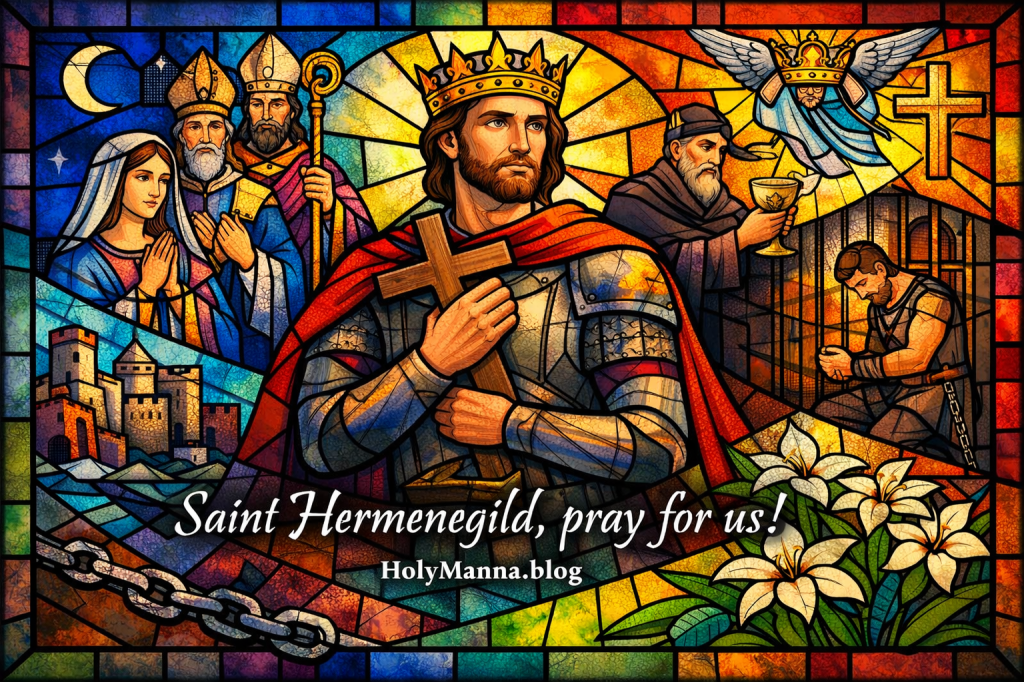
The Prince Who Chose Heaven Over a Throne
Saint Hermenegild is remembered in Catholic tradition as a prince, a convert, and a martyr. He was born into the royal Visigothic family of Spain, surrounded by power, ambition, and the religious confusion of his age. Yet the Church reveres him not because he ruled, but because he refused to betray the Catholic faith when the cost became unbearable.
His life stands out because it brings together so many things that still touch the heart today: family conflict, political pressure, doctrinal confusion, and the temptation to compromise for the sake of peace. Saint Hermenegild chose a better peace. He chose the peace that comes from remaining faithful to Christ and His Church. That is why his story continues to shine across the centuries.
In the light of The Catechism, his witness is easy to understand. Martyrdom is described in CCC 2473 as “the supreme witness given to the truth of the faith.” Saint Hermenegild gave exactly that kind of witness.
A Prince Formed in a Divided Kingdom
Hermenegild was the son of King Leovigild, the Arian ruler of the Visigoths in Spain. He grew up in a royal household shaped by rank, military strength, and political calculation. He was also the brother of Reccared, who would later play a major role in the Catholic future of Spain. Though older Catholic sources are not perfectly uniform on every family detail, they agree on the heart of his early life. He was raised in a powerful kingdom where Arianism held influence at court, while Catholicism remained the faith of many others.
A major turning point came when he married Ingundis, a Catholic Frankish princess. Her faith was not a polite detail in the background of royal marriage. It became one of the great instruments of grace in Hermenegild’s life. Along with the influence of Saint Leander of Seville, her witness helped draw him toward the fullness of the Catholic faith.
His conversion was not just emotional or private. It was doctrinal, sacramental, and costly. He came to see that the truth of Christ could not be bent to fit political convenience. That conviction would eventually cost him everything the world said he should protect.
Saint Hermenegild is most known for this steadfast conversion and for the courage that flowed from it. He is remembered above all as the prince who refused communion with Arianism and accepted death rather than betray the Catholic faith.
The Hidden Greatness of His Life
Some saints are remembered for preaching to crowds, founding religious orders, or leaving behind volumes of writings. Saint Hermenegild is remembered in a quieter but no less powerful way. His greatness appeared in fidelity. His life became important because he stood firm in a moment when compromise would have been easier, safer, and more profitable.
The oldest Catholic sources do not preserve a long list of public miracles performed by Hermenegild during his lifetime. That is worth noting because it tells the story honestly. His importance does not rest on dramatic wonderworking during his earthly life. It rests on the miracle of perseverance. Grace strengthened him to hold fast to truth in the face of enormous pressure.
That alone makes him a saint worth remembering and imitating. There is something deeply moving about a man whose holiness was shown not by spectacle, but by refusing to surrender when it would have been so easy to do so. Many Catholics know that kind of battle. It happens in the office, in the family, in friendships, in marriage, and in moments when truth suddenly becomes expensive.
Saint Gregory the Great later spoke of Hermenegild in a way that captures this mystery beautifully, saying that he “began then to be truly a king.” The world thought he lost everything. The Church saw that he had finally gained what mattered most.
Conflict, Betrayal, and the Test of Faith
Hermenegild’s conversion did not remain hidden inside the walls of the palace. It immediately created tension in a kingdom divided by doctrine. His stepmother, Goswintha, strongly opposed the Catholic faith of Ingundis and is remembered for her harsh treatment of her. The conflict that began in the household soon widened into political and religious struggle.
As relations with his father worsened, Hermenegild withdrew to the south. In time, he resisted his father openly, and the conflict took on the shape of rebellion as well as religious dispute. The politics of this period were tangled, and Catholic tradition does not canonize every political decision he made. What the Church does honor is the faith that guided him when the final test came.
After a siege and defeat, Hermenegild was captured. He was stripped of royal honors and cast into prison. His wife fled with their son and later died in exile. The prince who once stood close to power found himself abandoned, humiliated, and chained. Yet this was the hour in which his soul shone most clearly.
The defining moment came at Easter. An Arian bishop was sent to him in prison with an offer of pardon and reconciliation, but only if he would receive Holy Communion from Arian hands. Hermenegild refused. He would not pretend unity where there was no unity in truth. He would not treat the Blessed Sacrament as a political gesture. He would not deny the faith for the sake of survival.
For that refusal, he was put to death, traditionally by beheading, on Easter in the year 585. That is why the Church venerates him as a martyr. He did not simply die during political conflict. He died because he would not betray Catholic truth at the altar.
The Crown That Followed His Death
The strongest Catholic sources focus first on Hermenegild’s martyrdom and on the witness it gave to the whole Church. Later Catholic devotional tradition also preserves stories of extraordinary signs connected to his death.
One tradition says that on the night of his martyrdom, a bright light streamed from his prison cell, signaling that the martyr had received his heavenly crown. Another tradition says that King Leovigild later witnessed miracles connected with his son and was shaken with remorse before his own death. These stories have long been cherished in Catholic devotion, but they cannot be historically verified with the same certainty as the core account of his martyrdom.
What can be seen clearly is the immense impact of his witness after death. Catholic tradition closely connects the blood of Saint Hermenegild with the later conversion of his brother Reccared and the Catholic restoration of Visigothic Spain. In time, Reccared renounced Arianism, and the kingdom moved into Catholic unity. From the Church’s point of view, Hermenegild’s death was not a wasted tragedy. It became part of the mysterious way God brought a people back to the truth.
His legacy also lived on in the Church’s worship and memory. His feast came to be honored in Spain, and his name remained treasured in Catholic tradition as a royal martyr. Later devotional custom also associated him with Seville, with converts, and with the Spanish monarchy. Some traditions invoke his patronage against drought, floods, and storms. These later associations show how deeply his cult took root in Catholic life.
No firmly authenticated personal sayings of Saint Hermenegild survive in the major Catholic records in the same way they do for certain other saints. Yet the Church has preserved something even more important than a collection of words. She has preserved the meaning of his life. In the language of Catholic prayer, he is the saint who valued the kingdom of heaven more than an earthly throne.
What Saint Hermenegild Teaches the Soul
Saint Hermenegild is a saint for times of pressure. He speaks especially to Catholics who feel squeezed between love and truth, between loyalty and conscience, between family peace and fidelity to Christ. His life reminds the faithful that truth is not cruelty, and compromise is not always charity.
He also teaches that holiness often grows in hidden places. Not every saint is asked to do spectacular things. Some are asked to stand firm. Some are asked to suffer. Some are asked to lose what the world says is essential so they can cling more deeply to what is eternal.
Where is the pressure to soften the truth just to keep everyone comfortable? Where has fear of conflict become stronger than love for Christ? What earthly crown still seems too precious to surrender?
His witness offers a practical path for Catholic life today. Stay close to the sacraments. Learn the faith deeply enough to recognize error. Honor Christ in public and in private. Refuse to make peace with falsehood. Stand firm without becoming harsh. Love truth without losing tenderness. Accept that real fidelity may cost something, but never forget that grace supplies what courage alone cannot.
Saint Hermenegild shows that the soul becomes most royal when it kneels before Christ without compromise.
Engage with Us!
Share your thoughts and reflections in the comments below. Saint Hermenegild’s story reaches into real life because it shows what faith looks like when comfort, power, and family expectations all pull in the wrong direction.
- What part of Saint Hermenegild’s witness stands out most strongly?
- Have there been moments when staying faithful to Christ created tension in family, work, or friendships?
- What does it mean to value the kingdom of heaven more than an earthly throne in daily life?
- How can Catholic spouses, friends, and mentors help one another remain faithful the way Ingundis and Saint Leander helped Hermenegild?
- What practical step can be taken this week to choose truth over comfort?
May Saint Hermenegild pray for every heart that wants to remain faithful under pressure. May his example strengthen souls to live with courage, suffer with hope, and do everything with the love and mercy Jesus taught us.
Saint Hermenegild, pray for us!
Follow us on YouTube, Instagram and Facebook for more insights and reflections on living a faith-filled life.

 Holy Manna!
Leave a comment