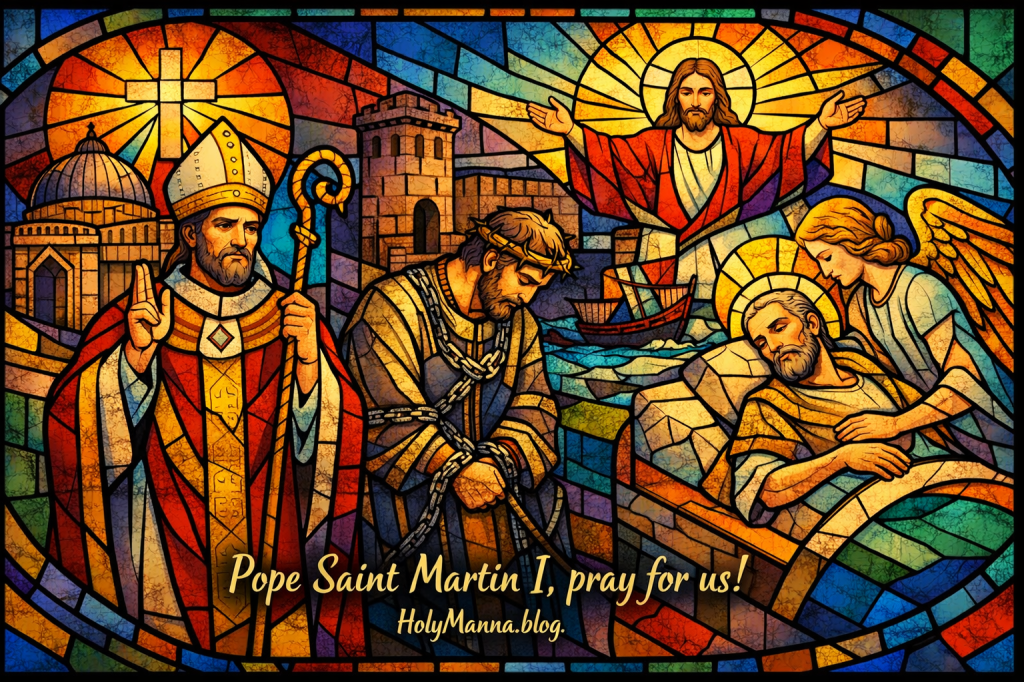
Crowned by Chains, Not by Comfort
Pope Saint Martin I stands in Christian memory as one of those rare saints whose greatness became most visible when everything earthly was taken away. He was a pope, a confessor of the faith, and a martyr. He is especially revered because he defended the truth about Jesus Christ at a moment when even emperors wanted the Church to stay quiet. Instead of bending to political pressure, he chose fidelity. Instead of protecting himself, he protected doctrine. Instead of seeking peace at any price, he suffered so that the truth about Christ would remain clear for generations to come.
He is remembered above all for standing against the heresy of Monothelitism, the false teaching that Christ had only one will. Pope Saint Martin I defended the Catholic faith that Jesus Christ is truly God and truly man, and therefore possesses both a divine will and a human will, in perfect harmony. That teaching matters deeply because it protects the mystery of the Incarnation. If Christ did not take on a real human will, then He did not take on the fullness of our humanity. The Church later expressed this clearly in The Catechism of the Catholic Church, CCC 475.
Pope Saint Martin I is revered because he suffered greatly for that truth. He did not die on a battlefield. He did not fall in some dramatic public execution. He died worn down by imprisonment, humiliation, exile, hunger, and mistreatment. That is why his witness is so moving. His martyrdom was slow, hidden, and deeply Christlike.
A Son of Todi Prepared for the Storm
Martin was born in Todi, in central Italy. The historical record about his childhood is limited, but Catholic tradition remembers him as a man of learning, discipline, and charity. He was educated in Rome and grew into a trusted servant of the Church. Long before he became pope, he had already proven himself capable of handling serious matters of doctrine and diplomacy.
One of the most important parts of his early life was his service as papal apocrisiarius in Constantinople. That role made him the pope’s representative at the imperial court. It was not a ceremonial assignment. It placed him close to the very heart of the theological and political struggle that would later define his papacy. He saw firsthand how emperors and court theologians tried to pressure the Church into compromise. He watched the confusion surrounding the doctrine of Christ spread through the Christian world. This was not just an abstract issue for him. It was a wound in the Body of Christ.
His faith deepened not through a dramatic conversion story, but through steady fidelity in service to the Church. Some saints are remembered for a moment of sudden change. Pope Saint Martin I is remembered for the kind of holiness that grows through obedience, clarity, and courage. He was formed by prayer, study, and ecclesial service. By the time he was elected pope in 649, he was already a man ready to suffer for the truth.
He is most known for defending the fullness of Christ’s humanity and divinity. In that sense, his whole life points toward one great mission. He was raised up in a time of confusion so that the Church would have a shepherd willing to speak clearly.
The Pope Who Guarded the Mystery of Christ
Soon after his election, Pope Saint Martin I took a bold step. He was consecrated without waiting for imperial approval. That may seem like a technical detail, but in his time it was a striking statement. It showed that the Church’s authority in matters of faith did not come from an emperor. It came from Christ.
In 649 he convoked the Lateran Council, often called the Lateran Synod. There the bishops condemned the false teachings that had been spreading under imperial influence. They rejected both the Ecthesis and the Typus, imperial documents connected to the Monothelite controversy. Pope Saint Martin I and the bishops defended the Catholic teaching that Christ possesses two wills, divine and human, perfectly united in the one Person of the Word.
This is why his life still matters so much. He reminds the faithful that doctrine is not cold theory. Doctrine protects the face of Christ. It protects the truth of who Jesus is. If the Church loses clarity about Christ, then she loses clarity about salvation, grace, suffering, obedience, and redemption.
When it comes to miracles during his lifetime, the usual Roman Catholic accounts do not preserve one famous miracle story in the way that happens with many other saints. That absence is actually striking. His sanctity is remembered first through his courage, his teaching, and his willingness to suffer. Older Catholic tradition does say that many miracles were associated with him in life and after death, but the commonly repeated Roman accounts do not preserve a single universally verified lifetime miracle narrative in detail.
Still, his life was filled with signs of grace. One old Catholic account says that an imperial plot was formed to kill him during Holy Communion, but the plan failed. Whether one reads that as providential protection or simply as a failed conspiracy, it reveals the holiness and danger surrounding his witness. Another sign of sanctity appears in the way he refused to let violence be used in his defense. When imperial forces came for him, he did not stir the people to riot. He chose the peace of Christ over worldly resistance.
One brief saying connected with him from his exile letters has echoed through Catholic memory: “Why am I anxious? The Lord is near.” Those words capture the soul of the man. He did not place confidence in imperial favor, public reputation, or earthly safety. He placed it in the nearness of the Lord.
Bound, Humiliated, and Yet Unbroken
The emperor Constans II was not willing to tolerate Martin’s firmness. First, pressure was applied through the imperial exarch in Italy. Later, when Martin remained steadfast, he was arrested. By then he was already ill. He was seized in Rome, taken from the Lateran, and sent away under guard.
What followed was a long passion. He was transported to Constantinople, publicly humiliated, treated like a criminal, and accused under false political charges. These accusations tried to make him look like a rebel against the empire, but the deeper reason for his persecution was doctrinal. He had refused to betray the truth about Christ.
He was imprisoned under harsh conditions, deprived of comfort, weakened by suffering, and isolated. Catholic tradition remembers that he endured mockery, chains, and neglect. He was then condemned and exiled to Cherson, in the region of Crimea. There his suffering continued. He faced poverty, abandonment, and hunger. The pain was not only physical. It was also ecclesial and emotional. He was far from Rome, far from the Church he loved, and burdened by the knowledge that compromise and weakness had spread in many places.
One especially sorrowful detail is that another pope, Eugene I, was elected while Martin was still alive in exile. That fact makes his final years even more heartbreaking. He was not only persecuted by the empire. He was also left in a situation of profound loneliness. Yet even here, his witness shines. He did not answer with bitterness. He remained a suffering servant of Christ.
He died in exile in 655. The Church honors him as a martyr because he died as a consequence of his fidelity to the Catholic faith. His blood was not spilled in one sudden execution, but his life was poured out through suffering for the truth. In that sense, his martyrdom closely resembles the slow and hidden sacrifices that many faithful souls must endure.
The Saint the Church Later Vindicated
After his death, the importance of Pope Saint Martin I became even clearer. The truth for which he suffered was later solemnly upheld by the Third Council of Constantinople, the Sixth Ecumenical Council. What he defended in chains, the universal Church later proclaimed with authority. His witness was not a private theological opinion. It was the voice of a true shepherd defending the deposit of faith.
Older Catholic sources also say that many miracles were worked through his intercession after death and at his tomb. These traditions helped strengthen devotion to him, but the surviving Roman Catholic accounts do not preserve a single famous posthumous miracle story in full detail the way some saints’ traditions do. For that reason, the miracle traditions connected with his tomb and intercession should be received with reverence, while also acknowledging that the specific episodes cannot now be firmly verified.
His relics were later associated with Rome, especially the church of San Martino ai Monti. His memory lived on not only in relics and liturgy, but also in the Church’s doctrine and prayer. His surviving letters gave later generations a direct glimpse into the heart of a suffering pope. He was not remembered merely as a symbol. He was remembered as a real father of the Church who endured fear, weakness, and abandonment, yet remained faithful.
His feast is kept in the Roman calendar on April 13. Older calendars also remembered him on other dates. In both East and West, his witness made a lasting impression. He became a symbol of papal courage, doctrinal clarity, and the refusal to let political power define the content of the faith.
His cultural impact is perhaps quieter than that of more popular saints, but it is profound. He helped shape Catholic memory about the duty of Peter’s successor to guard the truth even when emperors, courts, and public opinion demand compromise. That is no small legacy. He reminds the Church that peace without truth is not peace at all.
What Pope Saint Martin I Still Teaches the Faithful
The life of Pope Saint Martin I speaks with unusual force to modern Catholics. Many live in a world that prizes comfort, avoids conflict, and treats truth as negotiable. His life cuts through all of that. He teaches that charity and clarity belong together. He teaches that truth is worth suffering for. He teaches that faithfulness may cost reputation, security, and even earthly freedom.
He also teaches something gentler and just as important. Holiness is not always dramatic in the outward sense. Sometimes holiness looks like remaining calm when falsely accused. Sometimes it looks like refusing to answer cruelty with cruelty. Sometimes it looks like enduring isolation without abandoning Christ.
For readers today, his example invites real examination. Is there a willingness to stand for truth when silence would be easier? Is there trust that Christ is near even when everything feels unstable? Is there a tendency to seek comfort more than faithfulness? Pope Saint Martin I calls the faithful to deeper courage.
A practical way to imitate him is to study the faith seriously and love it enough to defend it with patience. Another way is to speak clearly about Christ without becoming harsh. Another is to bear suffering without surrendering to self-pity. He shows that fidelity is not loud pride. Fidelity is quiet strength rooted in Christ.
His life also encourages prayer in seasons of confusion. When the Church seems wounded, when the culture grows hostile, when truth feels costly, his witness offers a path forward. Stay close to Christ. Stay close to the Church. Do not trade truth for approval. Do not trade doctrine for temporary peace. Do not be anxious. The Lord is near.
Engage with Us!
Share your thoughts and reflections in the comments below. This saint’s story carries a lot of weight, especially for anyone trying to stay faithful in a confused world.
- What part of Pope Saint Martin I’s story stands out most strongly, his doctrinal courage, his suffering in exile, or his quiet endurance?
- How does his defense of the truth about Jesus help deepen appreciation for the mystery of the Incarnation?
- Where might there be pressure to stay silent about the faith in daily life?
- What would it look like to imitate his courage with greater charity and peace?
- How can the words “Why am I anxious? The Lord is near” shape prayer this week?
May the witness of Pope Saint Martin I strengthen every heart to live with courage, love the truth without fear, and do everything with the love and mercy Jesus taught us.
Pope Saint Martin I, pray for us!
Follow us on YouTube, Instagram and Facebook for more insights and reflections on living a faith-filled life.

 Holy Manna!
Leave a comment