Monday of the Second Week of Easter – Lectionary: 267
From the Upper Room to the Human Heart
There is something deeply comforting about today’s readings because they show that Easter is not only about what happened to Jesus, but about what begins to happen in His people. The central theme binding these passages together is the new life that comes from the Holy Spirit, a life that turns fearful hearts into faithful witnesses. In Acts of the Apostles, the disciples are threatened, yet they do not retreat. They pray, they trust, and they are filled again with boldness. In Psalm 2, the nations rage and the powers of the world resist the Lord, yet God remains enthroned, and His Anointed One cannot be overthrown. In The Gospel of John, Jesus tells Nicodemus that no one can enter the Kingdom of God without being “born of water and Spirit”. Taken together, these readings reveal a powerful Easter truth: those who are reborn in Christ are no longer meant to live by fear, but by grace.
The setting matters. The Church is still in the earliest days after the Resurrection, when the memory of the Cross is fresh, the empty tomb is still changing everything, and the apostles are learning what it means to live as a people transformed by the risen Lord. This is also why the Church gives these readings during Eastertide. The season does not simply celebrate that Christ rose long ago. It teaches that His Resurrection now creates a new humanity through Baptism, through the gift of the Holy Spirit, and through the courage to remain faithful in a hostile world. Nicodemus, a serious and learned Pharisee, comes to Jesus at night, still searching. The apostles, by contrast, stand in the daylight of Pentecost-like boldness. One passage shows the mystery of conversion beginning. The other shows what that conversion looks like when grace matures.
There is also a quiet challenge running beneath the beauty of these texts. The world still rages. Human power still resists God. Hearts still struggle to understand heavenly things. Yet the answer is the same in every reading: the Lord reigns, the Spirit gives new birth, and the faithful must not be silent. That is what prepares the soul for today’s readings. Easter is not a sentimental season. It is a season of transformation. It is the season in which Christ teaches souls to be born from above and sends His Church into the world with holy boldness.
First Reading – Acts 4:23-31
The House That Learned to Shake with Holy Boldness
The first reading takes place just after Peter and John have been questioned and threatened by the Jewish authorities for preaching in the name of Jesus and for announcing His Resurrection. Saint Luke is showing the Church in her earliest public trial. The same priests, elders, temple officials, and Sadducees who opposed the apostolic preaching are still trying to silence it. Yet the young Church does not respond like a frightened movement trying to survive. She responds like the Body of Christ. She gathers, she prays, she interprets her suffering through Psalm 2, and she places everything under the sovereignty of God. That makes this reading a perfect fit for today’s Easter theme. The Gospel speaks of being born from above, and Acts shows what that new birth looks like in real life. Souls reborn by the Holy Spirit become a praying Church, a united Church, and a courageous Church. The temple guard, the Sadducean resistance to the Resurrection, and the naming of Herod and Pontius Pilate all place this scene in the concrete history of salvation, where the powers of earth rise up, yet Christ still reigns and His people keep speaking.
Acts 4:23-31 – New American Bible (Revised Edition)
Prayer of the Community. 23 After their release they went back to their own people and reported what the chief priests and elders had told them. 24 And when they heard it, they raised their voices to God with one accord and said, “Sovereign Lord, maker of heaven and earth and the sea and all that is in them, 25 you said by the holy Spirit through the mouth of our father David, your servant:
‘Why did the Gentiles rage
and the peoples entertain folly?
26 The kings of the earth took their stand
and the princes gathered together
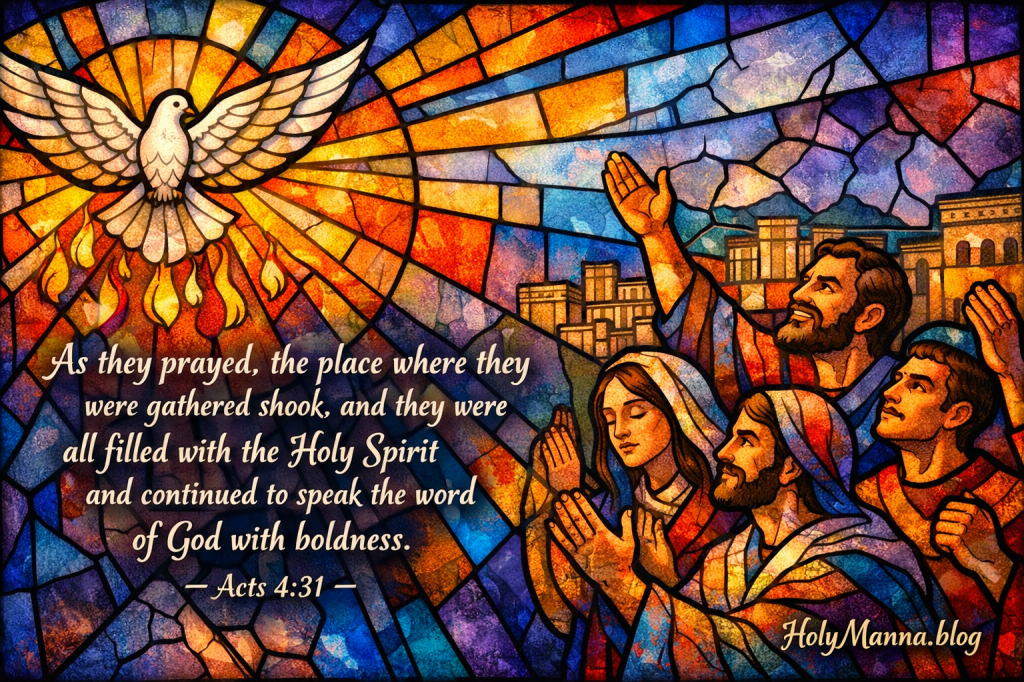
against the Lord and against his anointed.’27 Indeed they gathered in this city against your holy servant Jesus whom you anointed, Herod and Pontius Pilate, together with the Gentiles and the peoples of Israel, 28 to do what your hand and [your] will had long ago planned to take place. 29 And now, Lord, take note of their threats, and enable your servants to speak your word with all boldness, 30 as you stretch forth [your] hand to heal, and signs and wonders are done through the name of your holy servant Jesus.” 31 As they prayed, the place where they were gathered shook, and they were all filled with the holy Spirit and continued to speak the word of God with boldness.
Detailed Exegesis
Verse 23 “After their release they went back to their own people and reported what the chief priests and elders had told them.”
Peter and John do not go off on their own to process the threat privately. They return to the Church. That detail matters. Catholic life is never meant to be lived in isolation. The apostles belong to a people, a communion. In a moment of pressure, they instinctively return to the household of faith. This is already a witness to the Church’s apostolic and communal identity.
Verse 24 “And when they heard it, they raised their voices to God with one accord and said, ‘Sovereign Lord, maker of heaven and earth and the sea and all that is in them.’”
The first word of the Church under pressure is not complaint but worship. The believers begin by confessing God as Creator of all things. That is not filler. It is theological warfare. If God made heaven, earth, and sea, then the threats of rulers are already relativized. The Church prays with one accord, which is one of Luke’s favorite ways of describing the unity born from the Holy Spirit. Fear tries to scatter. Grace gathers.
Verse 25 “You said by the holy Spirit through the mouth of our father David, your servant: ‘Why did the Gentiles rage and the peoples entertain folly?’”
The Church reads her suffering through Scripture, and specifically through Psalm 2. She knows that the Holy Spirit spoke through David. This is a deeply Catholic way of reading the Bible. Sacred Scripture is not merely ancient religious literature. It is the living word inspired by the Spirit and fulfilled in Christ. What seems like confusion in the present is placed inside a pattern God had already revealed.
Verse 26 “The kings of the earth took their stand and the princes gathered together against the Lord and against his anointed.”
The word anointed points to the Messiah, to Christ Himself. The Church understands that the opposition faced by Peter and John is not simply personal hostility. It is part of the ongoing rebellion of the world against the reign of God and His Christ. Yet this verse also reveals something consoling. The enemies of God do not invent history. They only take their stand within a drama whose ending God already knows.
Verse 27 “Indeed they gathered in this city against your holy servant Jesus whom you anointed, Herod and Pontius Pilate, together with the Gentiles and the peoples of Israel.”
Now the prayer becomes concrete. The community names names. Herod, Pontius Pilate, Gentiles, and the peoples of Israel all appear together. Luke is showing the tragic breadth of human resistance to Christ. Jew and Gentile alike are implicated. The Church does not use this verse to assign collective blame to one people. Rather, she sees in the Passion the universal drama of sin. Christ was rejected in history, and that rejection exposed the sickness of the whole human race.
Verse 28 “To do what your hand and [your] will had long ago planned to take place.”
This is one of the most important lines in the passage. It does not mean God authored evil. It means that divine providence is so sovereign that even human rebellion cannot derail the plan of salvation. The Passion was not an accident. God permitted sinful acts and freely wove them into the redemption of the world. The Cross was history’s greatest crime, and at the same time the instrument of history’s salvation. That is the mystery of providence.
Verse 29 “And now, Lord, take note of their threats, and enable your servants to speak your word with all boldness.”
This is the heart of the prayer. The Church does not ask first for safety, revenge, or favorable circumstances. She asks for boldness. This is the mark of Easter faith. The apostles have passed through the fear of the Passion and now ask for the grace to keep witnessing. Pope Francis once pointed to this very verse and said that the Church asks “not to escape but to speak thy word with all boldness”. That is Christian courage.
Verse 30 “As you stretch forth [your] hand to heal, and signs and wonders are done through the name of your holy servant Jesus.”
The Church does not separate preaching from divine action. She asks for bold proclamation and for the Lord’s healing hand to confirm the Gospel. Signs and wonders are not spiritual entertainment. They serve the revelation of Jesus and the mercy of God. The same Lord who heals the crippled body also heals fearful hearts and strengthens the mission of the Church.
Verse 31 “As they prayed, the place where they were gathered shook, and they were all filled with the holy Spirit and continued to speak the word of God with boldness.”
The shaking of the place is a biblical sign of divine presence and divine response. It recalls moments when God manifests Himself with holy power. Luke presents this as a kind of fresh Pentecost. The prayer is answered immediately, not by removing the conflict, but by deepening the Spirit’s presence. The result is bold proclamation. Saint John Chrysostom, reflecting on this kind of apostolic prayer, observed that “when one is continuing in prayer… the Spirit draws near”. That is exactly what happens here.
Teachings
This reading reveals the inner pattern of the Church’s life. She hears the apostolic witness, gathers in communion, prays together, and is strengthened by the Holy Spirit for mission. The Catechism teaches this with remarkable clarity. In CCC 2623, the Church says of the first believers that “the Spirit… was also to form her in the life of prayer.” Then in CCC 2624 it adds, “This sequence is characteristic of the Church’s prayer.” That is exactly what appears in Acts 4. The Church is not improvising her identity. She is already living the pattern that will define Catholic life forever: apostolic faith, communion, prayer, and mission.
This passage also teaches a distinctly Catholic understanding of providence. Verse 28 can sound severe until it is read through the Church’s doctrine on the Passion. CCC 600 explains that in God’s eternal wisdom, He included human freedom in His saving plan, and “God permitted the acts that flowed from their blindness.” In other words, God remains sovereign without becoming the author of sin. This matters for daily life. Even now, persecution, injustice, suffering, and apparent setbacks do not mean that grace has lost control of the story.
The reading also teaches that bold witness belongs to the ordinary Christian vocation. CCC 2472 says, “Witness is an act of justice that establishes the truth.” Then it adds that Christians must show by word and life the new man put on in Baptism. That fits today’s wider theme beautifully, because the Gospel speaks of being born from above, and the first reading shows the baptized and Spirit-filled community living from that new life. In the same line, CCC 852 teaches, “The Holy Spirit is the protagonist” of the Church’s mission. The apostles are brave, but their bravery is not self-generated. It is the fruit of the Spirit.
The saints and pastors of the Church read this text in the same way. Pope Francis taught that the real lesson of this prayer is courage, and that the apostles ask not for escape, but for boldness. Saint John Chrysostom saw in this scene the secret of apostolic power, namely persevering prayer and charity, where the Spirit comes near and makes ordinary men able to face a hostile world. The Church has lived this passage again and again in history, from the age of the martyrs to every age of persecution, reform, renewal, and mission. Whenever the Church stops trying to preserve herself and starts asking for holy boldness, Acts 4 comes alive again.
Reflection
This reading speaks straight into ordinary Catholic life because threats do not always look dramatic. Sometimes they sound like mockery at work, pressure to stay silent, fear of losing approval, or the quiet temptation to keep faith private. The early Church shows a better way. She takes fear seriously, but she takes it to prayer. She does not deny the threat. She places it before God and asks for courage. That is still the road for faithful Catholics now. When the heart feels small, prayer enlarges it. When conviction feels weak, the Holy Spirit strengthens it. When the world sounds loud, the Church remembers who made heaven and earth.
A practical response begins with returning to the community of faith instead of retreating into isolation. It continues by praying with Scripture, especially the Psalms, until personal fear is absorbed into God’s larger story. It grows by asking not merely for relief, but for the grace to speak and live the truth with charity and strength. It deepens by remembering that the same Holy Spirit given to the apostles has been poured into the Church and into her sacramental life. The Christian does not need to invent courage from scratch. Courage is received.
When pressure rises, is the first instinct to panic, or to pray with the Church?
Is there a quiet place where the truth about Jesus has been softened out of fear of other people?
What would change if the daily prayer became, “Lord, give the grace to speak Your word with all boldness”?
Responsorial Psalm – Psalm 2:1-9, 11
The King the World Cannot Overthrow
Today’s Responsorial Psalm is not a quiet devotional poem. It is a royal and prophetic psalm, one that carries the sound of conflict, rebellion, judgment, and divine kingship. In its original setting, Psalm 2 likely stood close to the life of Israel’s monarchy and may have been used in connection with the enthronement of a Davidic king. Yet the Church has always understood that its deepest fulfillment is found in Christ, the true Anointed One, the Son installed forever by the Father. That is why this psalm fits today’s readings so perfectly. In the first reading, the early Church prays this very psalm after Peter and John are threatened. In the Gospel, Jesus speaks of the new birth that comes from water and Spirit. Together, these passages reveal that the Christian life unfolds in the tension between a rebellious world and the victorious reign of Christ. The nations may rage, rulers may resist, and hearts may tremble, but heaven is not unsettled. The Father has already established His King.
Psalm 2:1-9, 11 – New American Bible (Revised Edition)
A Psalm for a Royal Coronation
1 Why do the nations protest
and the peoples conspire in vain?
2 Kings on earth rise up
and princes plot together
against the Lord and against his anointed one:
3 “Let us break their shackles
and cast off their chains from us!”
4 The one enthroned in heaven laughs;
the Lord derides them,
5 Then he speaks to them in his anger,
in his wrath he terrifies them:
6 “I myself have installed my king
on Zion, my holy mountain.”
7 I will proclaim the decree of the Lord,
he said to me, “You are my son;
today I have begotten you.
8 Ask it of me,
and I will give you the nations as your inheritance,
and, as your possession, the ends of the earth.
9 With an iron rod you will shepherd them,
like a potter’s vessel you will shatter them.”11 Serve the Lord with fear;
exult with trembling,
Accept correction
lest he become angry and you perish along the way
when his anger suddenly blazes up.
Blessed are all who take refuge in him!
Detailed Exegesis
Verse 1 “Why do the nations protest and the peoples conspire in vain?”
The psalm opens with a question filled with holy astonishment. The nations rage, but their rebellion is described as vain from the very beginning. Human pride imagines itself powerful, but it is powerless before God’s sovereign will. The verse also reveals a pattern seen throughout salvation history. Fallen humanity resists divine rule because sin does not want to be healed. In the light of Easter, the Church hears this verse and recognizes the resistance shown to Christ, to His Gospel, and to His Church.
Verse 2 “Kings on earth rise up and princes plot together against the Lord and against his anointed one.”
The rebellion becomes more organized here. It is no longer just the noise of the crowd. It is political, public, and deliberate. The rulers of the earth take their stand against the Lord and against His anointed. In the Old Testament, the anointed one referred to the king chosen and consecrated by God. In the fullness of time, this title finds its true meaning in Jesus Christ. The early Christians saw this verse fulfilled in the coalition of Herod, Pontius Pilate, the Gentiles, and many among the people who rejected the Lord’s Messiah.
Verse 3 “Let us break their shackles and cast off their chains from us!”
This is the language of fallen freedom. The rebellious believe God’s law is a burden and His rule a prison. Sin always speaks this way. It treats obedience as slavery and rebellion as liberation. Yet the Christian faith reveals the opposite. God’s commands do not crush human freedom. They heal it. This verse exposes the lie at the center of sin, namely the belief that life becomes fuller when God is pushed away.
Verse 4 “The one enthroned in heaven laughs; the Lord derides them.”
This is not laughter born of cruelty. It is the divine response to the absurdity of created beings imagining they can overthrow their Creator. God is not anxious. He is not shaken by the plotting of nations. The verse teaches a profound spiritual lesson. What terrifies earth does not terrify heaven. The Christian soul often lives too close to the noise of the world. This verse lifts the gaze upward and reminds the faithful that God remains enthroned.
Verse 5 “Then he speaks to them in his anger, in his wrath he terrifies them.”
The psalm now turns from mockery to judgment. God’s anger in Scripture is not a loss of self-control. It is His holy opposition to evil. Divine wrath is the righteous response of the all-holy God to sin and rebellion. This verse should not be read as though God were unstable or petty. It should be read as a warning that evil is real, that rebellion matters, and that history is morally serious. The God of mercy is also the God of truth.
Verse 6 “I myself have installed my king on Zion, my holy mountain.”
This verse is the center of the psalm. The nations may conspire, but God has already acted. He has installed His king. Zion, the holy mountain, becomes the place of divine rule, covenant, and presence. For Israel, this was bound up with Jerusalem and the Davidic promise. For the Church, this finds its fulfillment in Christ, crucified and risen, enthroned not merely over one nation but over all creation. Easter reveals that Christ’s kingship is not symbolic or temporary. It is real, victorious, and everlasting.
Verse 7 “I will proclaim the decree of the Lord, he said to me, ‘You are my son; today I have begotten you.’”
This is one of the most important royal lines in the Psalter. In the Old Testament, it expressed the special filial relationship between God and the Davidic king. In the New Testament, the Church hears this verse in the light of Jesus, the eternal Son of the Father. The Resurrection manifests publicly what has always been true in eternity. Christ is not merely adopted into sonship. He is the Son. The Church hears in this verse the Father’s declaration over the risen Lord.
Verse 8 “Ask it of me, and I will give you the nations as your inheritance, and, as your possession, the ends of the earth.”
The scope widens from Israel to the world. The king’s inheritance is universal. This points beyond any merely earthly ruler and toward the Messiah whose reign extends to the ends of the earth. Here the psalm opens toward mission. If the nations belong to Christ, then the Church must carry His Gospel to the nations. The same Lord who reigns also sends. This verse stands close to the Great Commission, where the risen Jesus claims all authority and sends His disciples to make disciples of all nations.
Verse 9 “With an iron rod you will shepherd them, like a potter’s vessel you will shatter them.”
This verse joins kingship, justice, and shepherding. The iron rod is a sign of unbreakable authority. The imagery of shattering a potter’s vessel is severe, but it communicates the certainty of divine judgment and the fragility of all rebellion before Christ. The same Messiah who is meek and merciful is also the righteous judge. The Christian life loses its seriousness when Christ is reduced to a harmless religious figure. This verse reminds the faithful that the risen Lord reigns with justice and truth.
Verse 11 “Serve the Lord with fear; exult with trembling.”
The response demanded by the psalm is reverent worship. Fear here does not mean servile terror. It means holy awe, the kind of reverence that recognizes who God is and who man is before Him. To exult with trembling is one of the most beautiful biblical expressions of true religion. It is joy without presumption and reverence without despair. This is the posture of the saints. They rejoice in God, but they do not treat Him casually.
Teachings
This psalm teaches that history is not ultimately governed by the rage of nations but by the reign of God. That truth matters deeply in Eastertide. The Resurrection does not mean conflict has ended. It means Christ has already conquered in the midst of conflict. The apostles understood this clearly. In the first reading, they quote Psalm 2 to interpret the Passion and the persecution that followed. They do not read current events through fear. They read them through God’s word.
The psalm also teaches the Church how to understand Christ’s kingship. Jesus is not one ruler among many. He is the true Anointed One. The title Christ itself means Anointed. What was foreshadowed in the kings of Israel is fulfilled perfectly in Him. The Church proclaims Him as priest, prophet, and king. His kingship is not based on manipulation or violence, but on truth, sacrifice, and divine sonship. Still, it is no less real because it is exercised through the Cross. Easter reveals that the crucified one is also the enthroned one.
The Church’s teaching on Christ’s authority over history is beautifully expressed in CCC 450: “From the beginning of Christian history, the assertion of Christ’s lordship over the world and over history has also recognized that man should not render to any earthly power the absolute submission of his freedom, but only to God the Father and the Lord Jesus Christ.” That line fits Psalm 2 perfectly. Kings rise and princes plot, but they are not absolute. Christ alone is Lord.
This psalm also touches on worship, which is never merely private. In CCC 2105, the Church teaches: “The duty of offering God genuine worship concerns man both individually and socially.” Psalm 2 shows exactly that. Nations, rulers, and peoples are all summoned to recognize the Lord’s reign. Worship is not just a personal preference. It is the rightful response of creation to its Creator and King.
Saint Augustine saw this psalm as speaking in the voice of Christ and of the Church united to Him. That is a deeply helpful way to read it. The rage of the nations is not only something from the distant past. It continues whenever the world resists the Gospel, whenever power resents truth, and whenever the human heart tries to cast off the “chains” of God’s law. Yet the answer remains the same. God has installed His King. Christ will not be displaced. The saints understood this, and that is why they could remain calm in ages of chaos.
Reflection
This psalm speaks with surprising force to modern life because the world still treats God’s authority as something restrictive. So much of contemporary culture repeats the cry of verse 3 without realizing it. There is a constant temptation to believe that freedom means self-rule, self-definition, and escape from obedience. But the Psalm unmasks that lie. The soul does not become free by casting off God. The soul becomes free by taking refuge in Him.
This reading also teaches how to live when the world feels unstable. There are always new reasons to feel anxious. Nations rage. Leaders posture. systems shake. Public life becomes loud and exhausting. Yet Psalm 2 brings the heart back to reality. Heaven is not panicking. Christ is not losing His throne. The Father has not surrendered history to chaos. That truth does not remove suffering, but it gives the faithful a place to stand.
A practical way to live this psalm begins with learning reverence again. That means worshiping God seriously, praying with awe, and refusing to treat divine things casually. It also means examining where resistance to God still lives in the heart. Sometimes the nations rage in public. Sometimes the rebellion is hidden and interior. Pride, resentment, lust, bitterness, and self-will all whisper the same ancient line: “Let us break their shackles and cast off their chains from us!” The Christian life begins to mature when that lie is exposed and renounced.
This psalm also invites trust. Christ is King even when the headlines say otherwise. Christ is King when the Church is mocked. Christ is King when family life feels heavy. Christ is King when a soul feels tempted, tired, or forgotten. The right response is not denial. It is faithful refuge. The psalm ends not with panic, but with blessing for those who take shelter in the Lord.
Where is the heart still tempted to treat God’s law as a burden instead of a path to freedom?
What would it look like to rejoice before God with reverence, humility, and holy awe?
When the world feels loud and unstable, does the soul remember that Christ is already enthroned?
Holy Gospel – John 3:1-8
The Night Conversation That Opens the Door to New Life
Tonight’s Gospel feels intimate and searching. A Pharisee named Nicodemus comes quietly to Jesus under cover of darkness, carrying respect, curiosity, and confusion all at once. Saint John tells this story with great care. Nicodemus is not an ordinary passerby. He is a ruler of the Jews, a man formed by the law, tradition, and the hopes of Israel. He knows the signs matter. He knows Jesus cannot be dismissed lightly. Yet he still stands at the edge of mystery, trying to understand heavenly things with earthly categories. That is why this Gospel sits so beautifully inside today’s theme. The first reading shows a Church filled with the Holy Spirit and speaking boldly. The Psalm proclaims the victory of God’s Anointed King. The Gospel reveals where that bold new life begins. It begins in rebirth. It begins in the grace that comes from above. It begins in being born of water and Spirit.
There is also an important Easter setting behind this passage. During the Easter season, the Church has long lingered over readings tied to Baptism, new life, and the work of the Holy Spirit. In the early Church, the newly baptized were still being formed in the meaning of the sacraments they had just received at the Easter Vigil. This Gospel would have sounded especially powerful to them. The apostles in Acts are living what Nicodemus is only beginning to hear. The new birth Jesus describes is not a metaphor for vague spiritual improvement. It is the beginning of a new creation.
John 3:1-8 – New American Bible (Revised Edition)
Nicodemus. 1 Now there was a Pharisee named Nicodemus, a ruler of the Jews. 2 He came to Jesus at night and said to him, “Rabbi, we know that you are a teacher who has come from God, for no one can do these signs that you are doing unless God is with him.” 3 Jesus answered and said to him, “Amen, amen, I say to you, no one can see the kingdom of God without being born from above.” 4 Nicodemus said to him, “How can a person once grown old be born again? Surely he cannot reenter his mother’s womb and be born again, can he?” 5 Jesus answered, “Amen, amen, I say to you, no one can enter the kingdom of God without being born of water and Spirit. 6 What is born of flesh is flesh and what is born of spirit is spirit. 7 Do not be amazed that I told you, ‘You must be born from above.’ 8 The wind blows where it wills, and you can hear the sound it makes, but you do not know where it comes from or where it goes; so it is with everyone who is born of the Spirit.”
Detailed Exegesis
Verse 1 “Now there was a Pharisee named Nicodemus, a ruler of the Jews.”
Saint John introduces Nicodemus with precision. He is a Pharisee, which means he is deeply shaped by the religious life of Israel, serious about the law, and part of a movement that sought holiness through fidelity to God’s commands. He is also a ruler of the Jews, likely a member of the Sanhedrin, which gives him public standing and responsibility. This makes his approach to Jesus especially significant. He is not an outsider looking for novelty. He is a serious man drawn toward truth, even if he does not yet know how costly that truth will be.
Verse 2 “He came to Jesus at night and said to him, ‘Rabbi, we know that you are a teacher who has come from God, for no one can do these signs that you are doing unless God is with him.’”
The detail that Nicodemus comes at night matters. In The Gospel of John, darkness often carries symbolic weight. Night can point to fear, hesitation, and incomplete understanding. Nicodemus comes respectfully, calling Jesus Rabbi, and he admits that the signs point to God’s presence. Yet he still speaks cautiously. He says, “we know”, as if testing the ground, as if trying to approach Jesus without fully exposing his own heart. This is often how grace begins. A soul does not always arrive with clarity. Sometimes it arrives with honest uncertainty.
Verse 3 “Jesus answered and said to him, ‘Amen, amen, I say to you, no one can see the kingdom of God without being born from above.’”
Jesus goes straight to the heart of the matter. He does not linger on compliments or signs. He speaks of new birth. The phrase can also mean born again, but the fuller sense here is born from above. This is not about starting life over by human effort. It is about receiving a new life whose source is God Himself. To see the Kingdom, a man must be changed at the deepest level. Jesus is teaching that entry into God’s reign requires more than education, ancestry, or religious status. It requires grace.
Verse 4 “Nicodemus said to him, ‘How can a person once grown old be born again? Surely he cannot reenter his mother’s womb and be born again, can he?’”
Nicodemus responds in a very human way. He hears Jesus literally and remains trapped in earthly reasoning. His question is not foolish so much as limited. He is trying to understand supernatural rebirth with natural categories. This is one of Saint John’s recurring patterns. Jesus speaks from above, and His hearers often first understand from below. Nicodemus stands for every soul that senses there is more, yet still struggles to let go of what feels measurable and familiar.
Verse 5 “Jesus answered, ‘Amen, amen, I say to you, no one can enter the kingdom of God without being born of water and Spirit.’”
This is one of the clearest sacramental verses in the Gospel. The Church has always heard in “water and Spirit” a reference to Baptism. Jesus is not describing a merely symbolic interior change. He is speaking of the sacrament through which a person is cleansed, reborn, and given divine life by the Holy Spirit. Water is not incidental here. It is joined to the Spirit as the visible and invisible work of God in the sacrament. This verse is one of the great foundations for the Church’s teaching that Baptism is necessary as the ordinary means by which Christ gives the new birth.
Verse 6 “What is born of flesh is flesh and what is born of spirit is spirit.”
Jesus now draws the distinction clearly. Flesh gives natural life. Spirit gives supernatural life. Human birth is real and good, but it is not enough for entering the Kingdom. The Christian life cannot be produced by bloodline, effort, intelligence, or moral striving alone. It must be given. Grace is not self manufacture. It is divine gift. This verse also protects Catholic teaching from reductionism. Christianity is not simply about becoming nicer or more informed. It is about being recreated by God.
Verse 7 “Do not be amazed that I told you, ‘You must be born from above.’”
Jesus speaks with firmness and tenderness. He is telling Nicodemus not to stay trapped in amazement or resistance. The necessity remains. “You must” be born from above. Not perhaps. Not eventually if it feels meaningful. This rebirth is necessary because the Kingdom is not entered on human terms. It is received through divine initiative. Jesus is not offering a spiritual upgrade. He is announcing a new beginning.
Verse 8 “The wind blows where it wills, and you can hear the sound it makes, but you do not know where it comes from or where it goes; so it is with everyone who is born of the Spirit.”
Here Jesus uses a beautiful play on words, since spirit, wind, and breath are closely linked in biblical language. The movement of the Holy Spirit is real, powerful, and perceptible in its effects, even when it cannot be controlled or reduced to human calculation. A soul born of the Spirit carries this mark of divine freedom. The Spirit is not mechanical. He is Lord. He acts with wisdom, power, and mystery. This verse calls Nicodemus, and every reader, into reverent surrender before the hidden work of God.
Teachings
This Gospel stands at the heart of Catholic teaching on Baptism. The Church has never treated Jesus’ words about being born of water and Spirit as a vague image detached from sacramental life. The Catechism teaches in CCC 1215: “This sacrament is also called ‘the washing of regeneration and renewal by the Holy Spirit,’ for it signifies and actually brings about the birth of water and the Spirit without which no one ‘can enter the kingdom of God.’” That is the Church speaking with direct clarity. Baptism does not merely symbolize new life. It truly brings it about by the power of Christ.
That same teaching is deepened in CCC 1213: “Holy Baptism is the basis of the whole Christian life, the gateway to life in the Spirit, and the door which gives access to the other sacraments.” This is why the Gospel is so important during Eastertide. The Resurrection of Jesus is not only remembered. Its fruits are applied. Through Baptism, the death and rising of Christ are given to the believer personally. The new birth Jesus announces to Nicodemus is not an abstract doctrine. It is the beginning of sacramental life in Christ.
The Church also teaches the transforming effects of this sacrament with great beauty. In CCC 1265, it says: “Baptism not only purifies from all sins, but also makes the neophyte ‘a new creature,’ an adopted son of God, who has become a ‘partaker of the divine nature,’ member of Christ and coheir with him, and a temple of the Holy Spirit.” That single paragraph gathers much of what Jesus is saying in this Gospel. To be born from above is to be made new, adopted, incorporated into Christ, and indwelt by the Spirit.
The Fathers of the Church loved this passage because it reveals both the weakness of human understanding and the generosity of divine grace. Saint Cyril of Jerusalem, speaking to the newly baptized, gave one of the most beautiful lines in the Church’s tradition: “At the selfsame moment you died and were born; and the saving water was at once your grave and your mother.” That is pure Easter theology. In Baptism, the old man dies and a new man is born. The Church has long proclaimed this especially during the Easter season because the Easter Vigil was the great night of Baptism for catechumens in the ancient Church.
Saint Augustine also saw something deeply symbolic in Nicodemus arriving by night. He understood that Nicodemus was drawn to Christ, but had not yet fully stepped into the light. This is an important spiritual lesson. A soul can be sincere and still not yet surrendered. It can recognize signs and still resist their implications. Nicodemus is not mocked by Jesus. He is invited deeper. That gives hope to anyone still moving slowly toward the light.
This Gospel also belongs to today’s wider theme in a powerful way. In Acts, the apostles are filled with the Holy Spirit and speak with boldness. Here in John, Jesus reveals the source of that life. The Church’s courage is not merely institutional strength or personal grit. It is the fruit of souls reborn by water and Spirit. The boldness of the apostles begins in the new birth that Jesus describes to Nicodemus.
Reflection
This Gospel reaches into daily life because many souls live a little like Nicodemus. They respect Jesus. They are curious about Him. They may even admire His teaching and recognize signs of God at work. Yet they still keep part of the conversation in the dark. They want Christ near enough to inspire them, but not close enough to remake them. That is where this passage becomes piercing. Jesus does not offer Nicodemus a more interesting religious life. He offers him a new birth.
That same invitation stands before the Church now. Baptism can be treated like an old family memory, something that happened long ago and then faded into the background. But Jesus’ words do not allow that kind of forgetfulness. Baptism is the beginning of a whole new life. It means the old identity rooted in sin, fear, and self rule is no longer the deepest truth about the Christian. A baptized soul has been claimed by Christ, washed, marked, and filled with the promise of divine life.
A faithful response begins by remembering Baptism not as a past ceremony, but as a present identity. It continues by asking where earthly thinking still resists heavenly truth. It grows through surrender to the Holy Spirit, especially in prayer, repentance, and the sacramental life of the Church. It matures when a Christian stops asking only how little can change and begins asking how completely Christ wants to renew the heart.
This Gospel also invites trust in the hidden work of God. The Spirit often moves quietly before He moves visibly. He stirs the conscience, unsettles complacency, awakens hunger, and leads a soul step by step out of darkness. That means no sincere movement toward Christ should be despised. Nicodemus came by night, but he came. Grace often begins there.
Is there any part of the heart still approaching Jesus in the dark, cautiously and at a distance?
Is Baptism being remembered as a living identity, or only as something that happened long ago?
What would change if the soul truly believed that Christ does not merely improve lives, but makes them new from above?
When New Life Becomes a Bold Witness
Today’s readings come together like one beautiful movement of grace. In the Gospel, Jesus tells Nicodemus that a man must be born from above, born of water and Spirit, if he is to enter the Kingdom of God. In the Psalm, the world rages against the Lord and His Anointed, yet God remains enthroned and His King remains unshaken. In the first reading, that same divine life is already bearing fruit in the Church, as frightened disciples become a praying, united, and fearless people. What begins in hidden rebirth ends in public witness. What starts in the heart by grace becomes boldness in the world.
That is the great Easter message running through the whole day. The Resurrection of Jesus is not only a truth to admire. It is a life to receive. Christ does not merely ask for respect, interest, or distant admiration. He gives new birth. He pours out the Holy Spirit. He forms a people who no longer have to live under the rule of fear. Even when nations rage, even when hearts feel weak, even when the path forward is not fully clear, the Lord is still King, and His grace is still at work.
There is a quiet invitation in these readings for every soul. Come out of the dark like Nicodemus and speak honestly to Jesus. Return to prayer like the apostles and ask for courage instead of comfort. Take refuge in the Lord like the Psalm teaches and remember that heaven is never shaken by the chaos of earth. The Christian life is not about trying to look religious while staying unchanged. It is about letting Christ make the soul new, and then living like that new life is real.
This is a good day to begin again with simplicity and trust. Pray with more honesty. Listen to God’s word with more reverence. Remember Baptism with more gratitude. Ask the Holy Spirit for holy boldness in the ordinary places of life, in the home, at work, in friendship, in suffering, and in witness. The risen Jesus is still drawing hearts out of fear and into new life. The soul that lets Him work will not remain the same.
Engage with Us!
Readers are warmly invited to share their reflections in the comments below. What stood out most in today’s readings? What challenged the heart, strengthened hope, or stirred a deeper desire to follow Christ more faithfully?
- In the First Reading from Acts 4:23-31, what does the apostles’ bold prayer reveal about the kind of courage God wants to form in His people? When fear or pressure rises, is the instinct to retreat, or to turn to God with greater trust?
- In the Responsorial Psalm, Psalm 2:1-9, 11, what does it mean to take refuge in the Lord while living in a world that often resists His truth? Is there any area of life where God’s loving authority is still being treated as a burden instead of a blessing?
- In the Holy Gospel from John 3:1-8, what does Jesus’ call to be born of water and Spirit say about the reality of Baptism and the need for ongoing conversion? Is there any part of the heart still approaching Jesus from the shadows instead of stepping fully into His light?
May today’s readings encourage a deeper trust in the risen Christ, a greater openness to the Holy Spirit, and a stronger desire to live with courage, reverence, and joy. Let every word, every choice, and every act of daily life be shaped by the love and mercy Jesus taught, so that faith becomes not only something believed, but something beautifully lived.
Sacred Heart of Jesus, we trust in You!
Immaculate Heart of Mary, pray for us!
Saint Michael the Archangel, defend us in battle!
Follow us on YouTube, Instagram and Facebook for more insights and reflections on living a faith-filled life.

 Holy Manna!
Leave a comment