The Bishop Who Helped Teach Verona How to Belong to Christ
Saint Zeno of Verona stands in the Church’s memory as a strong and gentle shepherd, a bishop from the fourth century who helped lead Verona more deeply into the Catholic faith. He is remembered as the patron saint of Verona, a defender of orthodoxy against Arianism, a preacher of baptism and charity, and a fatherly pastor whose words still carry the warmth of the early Church. In a time when Christianity was growing but pagan practices still lingered, Saint Zeno helped form a people who were learning how to live as Christians not just in name, but in heart, worship, and daily life.
What makes him so compelling is that he does not come down to us as a distant legend wrapped only in mystery. He comes as a bishop who preached, taught, suffered with his people, and left behind sermons that still sound like a pastor trying to save souls. The Church reveres him because his life reflects what The Catechism teaches about holiness in the saints: that in them, God shows His presence and His power in a remarkable way for the good of His people, as seen in CCC 828. Saint Zeno matters because he reminds Catholics that truth, charity, perseverance, and reverence for the sacraments are never optional. They are part of the ordinary path to heaven.
A Shepherd from the Ancient Church
Much about Saint Zeno’s early life remains hidden in the shadows of history, and it is important not to pretend otherwise. Catholic tradition widely holds that he was of African origin, and many Catholic sources accept that as probable, but some details of his birthplace, family background, and youth are simply not known with certainty. What is known more firmly is that he became the eighth bishop of Verona and served in the later fourth century, usually around the years 362 to 380.
Even that uncertainty says something beautiful. The Church does not honor saints because every small detail of their biography has been preserved. The Church honors them because grace bore visible fruit in their lives. Saint Zeno’s life is one of those cases where the record is not full, but the holiness is clear. He appears in Catholic memory as a man formed by the apostolic faith, entrusted with the care of souls, and given the task of strengthening a local Church that still needed firm preaching and patient leadership.
He is most known for helping Verona grow into a truly Christian city. He preached against lingering paganism. He defended the divinity of Christ against Arian error. He instructed the newly baptized. He taught the faithful how to live with generosity toward the poor. He was not remembered mainly as a political figure or a public celebrity. He was remembered as a bishop who took the things of God seriously and wanted his people to do the same.
The Voice of a Father and the Work of a Pastor
Saint Zeno’s importance in Catholic tradition rests especially on his preaching. He left behind a substantial body of sermons, and through them the Church can still hear the heartbeat of a bishop who loved the Gospel, loved the liturgy, and loved his people enough to correct them. His sermons speak often about baptism, virtue, charity, greed, the Christian life, and the moral responsibilities of those who claim the name of Christ.
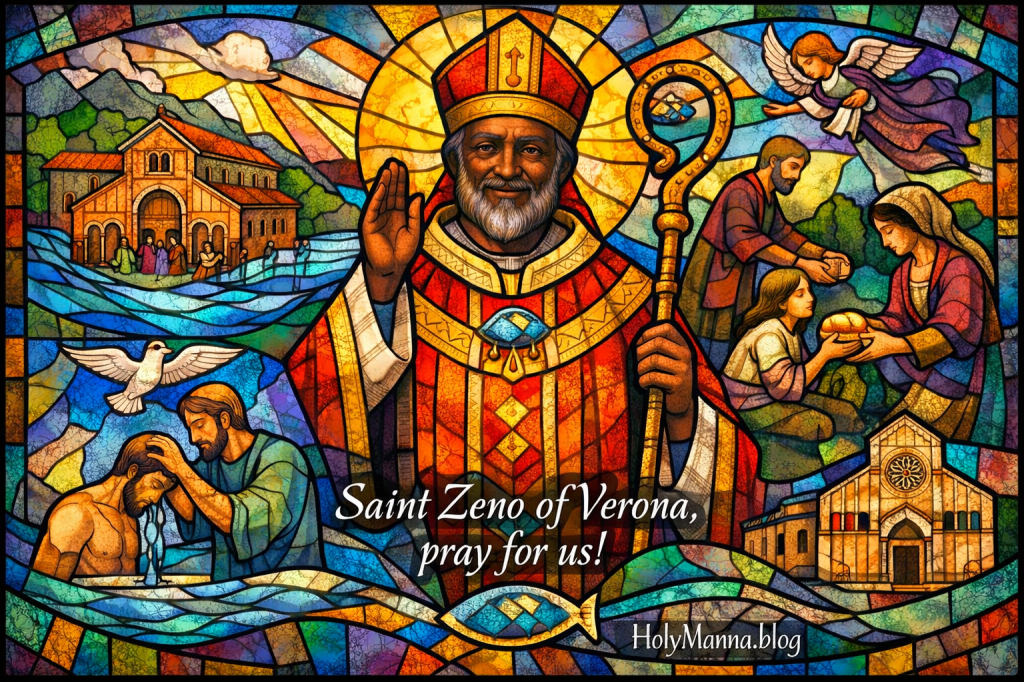
He seems to have had a special concern for those newly reborn in the faith. That alone makes him a powerful saint for today, because modern Catholics also live in a time when many need to rediscover what baptism really means. Saint Zeno preached not as though Christianity were a cultural label, but as though it were a total transformation of life. One line attributed to him captures that beautifully: “He who remembers that he has been reborn will always be happy…” That is not sentimental language. It is sacramental language. It reflects the truth of CCC 1213, which teaches that baptism is the foundation of the whole Christian life and the gateway to life in the Spirit.
He was also known for speaking boldly against greed and for urging generosity. In a world that often grows cold toward the poor, his words still cut straight to the conscience. One of his most memorable sayings is this: “Your houses are open to all wayfarers… Now our poor are ignorant of what it is to beg for food.” What a picture of Christian life. What a challenge to a comfortable age. Saint Zeno wanted a Christian city to look like the Gospel had actually taken root there.
Another line preserved from his preaching warns against the trap of covetousness: “It is not an isolated fault… to let oneself be ensnared by the shackles of covetousness.” He understood that greed is never just about money. It hardens the soul. It closes the hand. It turns the heart inward. Saint Zeno knew that a Christian who receives Christ in the sacraments must also learn to see Christ in the poor.
As for miracles during his lifetime, Catholic tradition does not preserve a long, firmly attested list of wonders worked by Saint Zeno while he was still alive in the way it does for some other saints. His greatness appears less in spectacular public miracles during life and more in the miracle of pastoral fatherhood, doctrinal clarity, sacramental preaching, and the conversion of souls. That is not a lesser holiness. In many ways it is the harder one to appreciate, because it asks the faithful to see grace at work in fidelity, not only in the extraordinary.
Trials, Confusion, and the Crown of a Confessor
Saint Zeno lived during a time of real struggle for the Church. Christianity had emerged from persecution, but peace did not mean ease. Error still threatened the faithful, especially through Arianism, which denied the full divinity of Christ. Pagan customs still lingered. Many people may have accepted Christianity outwardly while still carrying old ways of thinking. A bishop in that age needed courage, patience, and clarity, and Saint Zeno seems to have possessed all three.
He also appears to have lived with personal simplicity and even poverty. Older Catholic tradition remembers him as a bishop of humility and detachment, one who gave himself to the care of his flock rather than to worldly comfort. This matters because the Church has always recognized that holiness is proven not only by what a saint says, but by the shape of his life.
There is also an important historical point to make. Some older liturgical traditions referred to Saint Zeno as a martyr, and the Roman Martyrology once reflected that older memory. However, most Catholic scholars believe he was more likely a confessor than a martyr, meaning that he suffered for the faith, defended it, and lived heroically, but was probably not killed in a formal martyrdom. That distinction is worth keeping, not because it diminishes him, but because truth matters. Saint Zeno does not need a dramatic death to be glorious. His glory is that he spent himself for Christ and His Church.
Wonders at His Tomb and a City That Never Forgot Him
If the records of miracles during his lifetime are limited, the traditions surrounding Saint Zeno after his death are much richer. The best known miracle associated with him comes from Saint Gregory the Great. In the year 589, when the Adige River flooded Verona, the people fled for safety into the church dedicated to Saint Zeno. The waters rose high, even up to the windows, yet they did not enter the church, and the people inside remained unharmed as they prayed. This miracle became one of the great signs of Saint Zeno’s heavenly protection and helped deepen devotion to him in Verona for generations.
Other miracle stories also became attached to his name in local Catholic tradition. One tradition tells of the daughter of Emperor Gallienus being freed from demonic affliction through Saint Zeno’s intercession. Another tells of a cart driver rescued from the waters of the Adige. These stories live on in the sacred art and devotional memory of Verona. They belong to the saint’s living cult and show how deeply the faithful came to trust his prayers. They cannot all be verified with the same historical strength as the flood miracle recorded by Saint Gregory the Great.
After his death, which is usually placed around the year 380 on April 12, devotion to Saint Zeno grew rapidly. A church was built over his burial place, and later a grander basilica arose to honor him and preserve his relics. The translation of his relics on May 21, 807 became so important that in Verona the local celebration eventually came to center on that date. The Basilica of San Zeno became one of the treasures of Catholic Italy and a living sign that a holy bishop can continue to father a city long after death.
His cultural impact is impossible to miss. He is not just remembered in dusty texts. He is woven into Verona’s identity. He is its patron. He is celebrated in liturgy, in civic memory, in sacred art, and in the devotion of the faithful. His image, especially the beloved laughing image of Saint Zeno, gives a sense of pastoral warmth that fits what the Church remembers about him. Even in modern times, his relics have been carefully honored and studied under Church authority, showing that devotion to him is not a relic of the past, but something still alive.
He is also associated with fishermen and with a fish symbol, often shown on his pastoral staff. Some see this as a sign connected to the river near Verona. Others see in it the richer Christian symbolism of a bishop who became a fisher of souls. Either way, the image fits. Saint Zeno helped draw a people out of the waters of confusion and into the life of Christ.
What Saint Zeno Teaches the Church Today
Saint Zeno’s life offers a deeply practical witness for Catholics trying to live faithfully in a confused age. He teaches that truth matters. Charity matters. Baptism matters. Sound doctrine matters. Care for the poor matters. The saints never separate these things, even though modern people often try to.
He also reminds the faithful that the Church is built by patient shepherding. Not every saint is remembered for dramatic adventures or public confrontations. Some saints build the Kingdom by preaching the truth year after year, correcting error, strengthening the weak, and helping ordinary believers become saints. Saint Zeno did that. He helped shape a local Church through word, sacrament, discipline, and love.
There is also a challenge here for the soul. Are Christian homes truly open to others? Do Catholics remember the grace of baptism as a present reality, or only as something that happened long ago? Is there generosity toward the poor, or only vague good intentions? Saint Zeno’s life presses these questions gently but firmly.
A Catholic today can imitate Saint Zeno by returning to the sacraments with seriousness, by learning the faith well enough to resist confusion, by making the home more hospitable, by giving more generously, and by remembering that holiness is not built on emotion alone. It is built on fidelity. That is part of the wisdom of CCC 1822-1829, where charity is presented not as a passing feeling but as the theological virtue by which God is loved above all things and neighbor is loved for love of Him.
Saint Zeno is also a good companion for anyone doing quiet work in the Church. Priests, catechists, parents, teachers, and parish volunteers can all see something of themselves in his life. Much of what he did was the kind of work that does not always make history books shine. Yet it helped form souls for eternity. That is never small.
Engage With Us!
Readers are invited to share their thoughts and reflections in the comments below. Saint Zeno may not be as famous as some of the better-known saints, but his life speaks powerfully to anyone who wants to live the Catholic faith with conviction, generosity, and steadiness.
- What stands out most in Saint Zeno’s life: his preaching, his defense of truth, or his care for the poor?
- How can baptism become a more conscious and joyful part of daily Christian life?
- Is there a practical way to make home, parish, or personal life more open and welcoming to those in need?
- What errors or confusions in the modern world require the same kind of calm courage Saint Zeno showed in his own time?
- Which virtue in Saint Zeno’s life feels most necessary right now: charity, fidelity, humility, or perseverance?
May Saint Zeno of Verona intercede for every soul seeking to live the faith with courage and peace. May his example help Christians hold fast to truth, love the poor with sincerity, and remain close to Jesus Christ in the sacraments. Let every part of life be lived with the love, mercy, and faithfulness that Our Lord taught and entrusted to His Church.
Saint Zeno of Verona, pray for us!
Follow us on YouTube, Instagram and Facebook for more insights and reflections on living a faith-filled life.

 Holy Manna!
Leave a comment