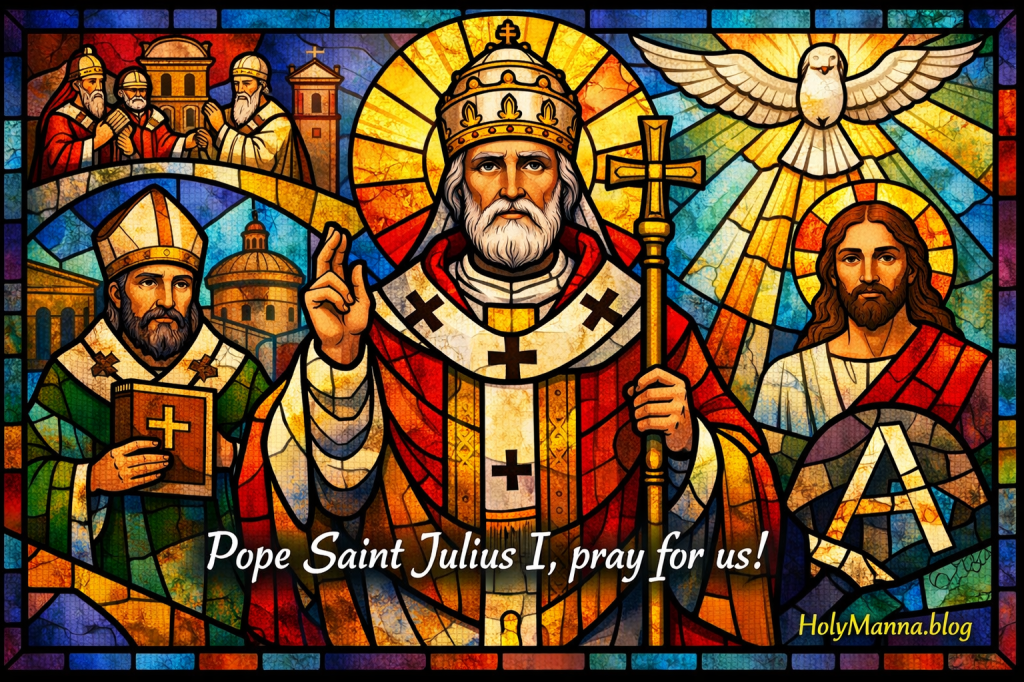
The Pope Who Stood Firm When the World Was Shaking
Pope Saint Julius I stands among those early saints whose greatness was not built on dramatic legends or colorful speeches, but on steady courage when the truth of the faith was under attack. He reigned as Pope from A.D. 337 to 352, during one of the most dangerous doctrinal crises in the history of the Church. He is revered above all for defending the true divinity of Jesus Christ during the Arian controversy and for standing by Saint Athanasius when many others gave in to pressure, confusion, or fear.
That matters deeply because the fight in Julius’s time was not over a small theological detail. It was about whether Jesus Christ is truly God, equal to the Father, as the Church professes. The Catholic faith teaches that Christ is true God and true man, not a creature and not somehow less than the Father, as the Arians falsely claimed. The Catechism teaches this clearly in CCC 464-469. Pope Saint Julius I helped protect that truth when the Church needed clarity, courage, and a shepherd who would not bend.
He is also remembered for strengthening the role of the See of Rome in guarding unity and justice within the Church. In a time of chaos, exile, false accusations, and political manipulation, Julius acted like a true father. That is why he remains so revered in Christian tradition.
A Roman Son in the Service of Christ
The details of Pope Saint Julius I’s early life are sparse, as is often the case with many early popes. Catholic tradition holds that he was a Roman by birth and the son of a man named Rusticus. Beyond that, the historical record does not preserve the kind of detailed childhood stories that later saints sometimes have. There is no dramatic conversion account handed down in the major Catholic sources, and that silence itself says something important. The Church does not honor him because of a romantic biography. She honors him because of the holiness shown in his office, his fidelity, and his defense of truth.
He was elected Pope on February 6, 337, after the death of Pope Mark and a vacancy of several months. He took up the Chair of Peter at a moment when the peace of the Church was already under strain. The Council of Nicaea had condemned Arianism, but the controversy had not disappeared. In many ways, it was getting worse. Bishops were being deposed, political forces were interfering in Church life, and the faithful needed strong leadership.
What Julius is most known for is simple and enormous at the same time. He defended Nicene orthodoxy. He supported Saint Athanasius of Alexandria. He refused to let false charges and political games replace truth and justice. He helped show that Rome had a real responsibility to hear appeals and guard communion in the Church.
When Holiness Looked Like Courage
The life of Pope Saint Julius I reminds the faithful that sanctity does not always look dramatic from the outside. Sometimes holiness looks like holding the line when almost everyone else wants peace at any price.
During his pontificate, Saint Athanasius, the great defender of Christ’s divinity, had been driven from his see by enemies aligned with Arian error. Those opponents tried to justify Athanasius’s removal and expected Rome to accept their judgment. Julius did not simply rubber stamp their claims. He examined the matter carefully, heard the case, and convened a synod in Rome around A.D. 340 or 341. That gathering cleared Athanasius and also vindicated Marcellus of Ancyra after review.
This was one of the defining acts of his life. Julius showed that truth could not be decided by pressure, popularity, or political convenience. The Church had to judge according to justice and apostolic faith.
One of the most memorable statements associated with him comes from his letter to the Eastern bishops. He wrote, “This is the custom, that we should be written to first, so that from here what is just may be defined.” Those words are striking because they show a pope who understood his office as a service to truth and unity, not a ceremonial title.
Pope Julius I is also remembered for his work in Rome itself. Catholic tradition credits him with building or restoring important churches, including the titular church associated with him that later became Santa Maria in Trastevere. He also built cemetery churches outside the city. These works mattered because the faith is not only defended in documents and councils. It is also lived in worship, memory, and the visible life of the Christian people.
As for miracles during his lifetime, the major Catholic historical sources do not preserve a stable tradition of miraculous signs performed by Pope Saint Julius I. That does not diminish his sanctity. It simply means he is remembered more for heroic fidelity, sound judgment, and steadfast leadership than for wonder-working. His life teaches that grace often appears through courage, patience, and faithfulness to duty.
Trials Without Bloodshed
Pope Saint Julius I was not a martyr in the strict sense, but he lived through a period of intense ecclesial struggle. The hardships he faced were real. He had to govern the Church while major bishops were being exiled, while false doctrine was spreading, and while powerful men tried to twist the faith for political ends.
That kind of suffering can be harder to recognize because it does not always end in a dramatic execution. Yet it is a real form of witness. Julius endured the burden of being a public defender of the truth while others tried to isolate or discredit the orthodox. He had to make difficult judgments and bear the consequences. He had to support faithful bishops when doing so made him a target of criticism.
There are no trustworthy Catholic accounts of miraculous escapes or spectacular divine interventions in his personal struggles. What remains instead is something quieter and, in many ways, more relatable. He persevered. He remained faithful. He did not surrender the truth in order to make conflict disappear. In an age that often treats peace as more important than truth, that witness still speaks.
A Legacy That Outlived His Years
Pope Saint Julius I died on April 12, 352, and the Church honors him on that day each year. He was first buried in the Catacomb of Calepodius on the Via Aurelia. Later tradition holds that his relics were transferred to Santa Maria in Trastevere, one of the churches associated with his memory. That connection gives him a lasting place in the devotional and architectural life of Rome.
His impact after death is less about miraculous legends and more about enduring ecclesial memory. The Church remembered him as a saint very early. He was honored because he had defended the true faith when it mattered most. He became part of the living memory of the Church as a pope who stood with Saint Athanasius and refused to let Arian confusion define Christian belief.
There are no major, well-attested miracle stories after his death preserved in the principal Catholic sources commonly used for his life. Because of that, no miracle tales can be confidently repeated as part of his established cult. Some later popular claims have attached themselves to his name, especially the claim that he formally fixed December 25 as the date of Christmas, but that tradition is not secure and cannot be treated as certain history. It is not a miracle story, and it should be handled with care.
Still, his legacy is powerful. He helped strengthen awareness of the Roman See’s role in settling grave disputes. He supported the orthodox during the Arian crisis. He helped preserve the faith that every Catholic still professes in the Creed. He also lived at a time when the Christian memory of martyrs, feast days, and sacred places in Rome was becoming more visible and organized. In that sense, his influence reaches beyond one controversy. He helped steady the Church in a fragile age.
His cultural impact is especially seen in Rome, where the churches associated with his name became part of the living story of Catholic worship. Pilgrims and faithful Christians continue to encounter the legacy of those early popes not only in books, but in the sacred spaces they helped shape.
What Pope Saint Julius I Teaches the Church Today
Pope Saint Julius I teaches that fidelity is not always flashy. Sometimes it is patient. Sometimes it is administrative. Sometimes it looks like reading the evidence carefully, defending an innocent man, protecting the truth, and refusing to be manipulated by the spirit of the age.
That lesson is deeply needed now. Every generation faces pressure to soften, blur, or compromise what the Church teaches. Pope Saint Julius I shows that real charity never means surrendering truth. Real unity is not built on pretending error does not matter. Real love for the Church means guarding what has been handed down from the Apostles.
His life also reminds the faithful that sanctity can be lived through vocation and responsibility. Not everyone is called to die a martyr’s death. Not everyone is given miracle stories. But everyone is called to be faithful in the place God has assigned. Julius was faithful as pope. He used his office to protect Christ’s flock.
Where in life is there a temptation to stay quiet when the truth should be spoken with charity and courage?
Is faith being lived as something sentimental, or as something worth defending even when it is costly?
What would it look like to be as steady in daily duties as Pope Saint Julius I was in the crises of the Church?
A practical way to imitate him is to grow in love for the Creed, study the truth of who Jesus is, and remain loyal to the teaching Church even when the world mocks clarity. Another way is to defend others when they are treated unjustly, especially when doing so brings inconvenience or criticism. Julius stood by Athanasius when that was not easy. Faithful Catholics are called to do the same in their own state of life by standing with truth and with those who suffer for it.
Engage with Us!
Share your thoughts and reflections in the comments below. What stands out most from the life of Pope Saint Julius I?
- Why do you think God raises up saints like Julius in times of confusion and division?
- What does his defense of Saint Athanasius teach about loyalty, justice, and courage?
- How can the example of Pope Saint Julius I help Catholics remain faithful when truth becomes unpopular?
- What part of his life challenges personal faith the most right now?
May the example of Pope Saint Julius I encourage hearts to stand firm in the truth, love the Church more deeply, and live each day with the faith, mercy, and steadfast love Jesus taught.
Pope Saint Julius I, pray for us!
Follow us on YouTube, Instagram and Facebook for more insights and reflections on living a faith-filled life.

 Holy Manna!
Leave a comment