Sunday of Divine Mercy – Lectionary: 43
Mercy Enters the Room
There is something deeply human about these readings for the Sunday of Divine Mercy. They begin where so many souls actually live, not in triumph, but in need. The disciples are gathered behind locked doors. Thomas struggles to believe. The first Christians are learning how to live as one body. Saint Peter speaks to believers who rejoice, even while suffering trials. Running through all of it is one radiant thread: God’s mercy does not remain an idea. It comes near in the risen Jesus, heals fear, creates communion, and gives wounded people a living hope.
That is why this Sunday fits so perfectly within the Octave of Easter. In the Roman Catholic tradition, Divine Mercy Sunday is not a separate message from Easter, but the full flowering of Easter itself. The Church places before the faithful the pierced yet glorified Christ, the One who steps into the midst of frightened men and says “Peace be with you”. From His sacred wounds comes not condemnation, but mission, forgiveness, and new life. This is also why the Gospel is so central to the feast. The risen Lord breathes the Holy Spirit upon the Apostles and entrusts them with the forgiveness of sins, revealing that divine mercy is not vague sentiment, but something real, sacramental, and entrusted to the Church for the salvation of souls.
The other readings widen that same mystery. In Acts 2:42-47, mercy becomes visible in the life of the early Church, where believers devote themselves to the Apostles’ teaching, to the breaking of the bread, to prayer, and to a sincere sharing of life. In Psalm 118, the Church sings with Easter joy that “his mercy endures forever”, because the rejected stone has become the cornerstone. In 1 Peter 1:3-9, mercy becomes a “living hope” that can survive suffering, testing, and the long road of faith. Together, these readings show that divine mercy is not only about being forgiven after falling. It is also about being remade into a people who live differently because Christ is truly risen.
This is the great invitation of today’s liturgy. It asks readers to see mercy not as weakness, but as the power of the Resurrection entering real human lives. Fearful hearts become bold witnesses. Doubting hearts become worshiping hearts. Isolated people become a communion. Suffering believers become men and women of hope. How often does the heart still live behind locked doors, even after hearing that Christ is risen? Today’s readings answer that question with both tenderness and strength. The risen Jesus still comes into closed rooms. He still shows His wounds. He still speaks peace. He still gathers His people into a life where mercy is received, believed, and lived.
First Reading: Acts 2:42-47
Mercy turns a crowd into a family
The first reading opens a window into one of the most beautiful scenes in all of Scripture. Pentecost has already happened. The Holy Spirit has descended. Saint Peter has preached Christ crucified and risen. Thousands have been baptized in Jerusalem, and now the Church is no longer only a promise. She is alive, visible, and growing. This passage shows what happens when the mercy of the risen Jesus does not stay in the heart as a private comfort, but begins to shape an entire people.
That setting matters. Jerusalem was the center of Jewish worship, the city of the Temple, sacrifice, pilgrimage, and covenant memory. The first Christians were not trying to invent a new religion out of thin air. They were Jews who had come to believe that Jesus of Nazareth is the promised Messiah, the risen Lord, and the fulfillment of Israel’s hope. That is why they still gather in the temple area while also breaking bread in their homes. The Church is in her earliest days, standing in continuity with the Old Covenant while already living the new life of the New Covenant in Christ.
This reading fits the theme of Divine Mercy Sunday with remarkable clarity. The Gospel shows mercy entering a locked room and breathing peace upon fearful disciples. Acts 2 shows what that mercy produces after it is received. It produces a Church rooted in apostolic truth, Eucharistic worship, prayer, generosity, and joy. Mercy is not just something the disciples experience. Mercy becomes the atmosphere of their life together.
Acts 2:42-47New American Bible (Revised Edition)
42 They devoted themselves to the teaching of the apostles and to the communal life, to the breaking of the bread and to the prayers. 43 Awe came upon everyone, and many wonders and signs were done through the apostles. 44 All who believed were together and had all things in common; 45 they would sell their property and possessions and divide them among all according to each one’s need. 46 Every day they devoted themselves to meeting together in the temple area and to breaking bread in their homes. They ate their meals with exultation and sincerity of heart, 47 praising God and enjoying favor with all the people. And every day the Lord added to their number those who were being saved.
Detailed Exegesis
Verse 42: “They devoted themselves to the teaching of the apostles and to the communal life, to the breaking of the bread and to the prayers.”
This verse gives the Church’s first great portrait of Christian life, and it remains just as decisive now as it was then. The believers devote themselves to the Apostles’ teaching, which means the faith is not self-made. Christianity begins by receiving what Christ entrusted to the Apostles. Divine mercy never asks a soul to invent truth for itself. It draws the soul into the truth handed on by those who saw the risen Lord.
The verse also speaks of communal life, or fellowship. This is not casual socializing. It is a new communion born from baptism and sustained by grace. Then comes the breaking of the bread, which the Church has always recognized as a Eucharistic expression, not merely an ordinary meal. Finally, the prayers show that this community is not fueled by activism alone. It lives before God, in worship, dependence, and praise. In one verse, Saint Luke shows doctrine, communion, sacrament, and prayer. That is the pattern of a healthy Church in every age.
Verse 43: “Awe came upon everyone, and many wonders and signs were done through the apostles.”
The first response to the Church’s life is awe. That is an important word. The early Christians did not treat grace as ordinary. They knew they were standing inside something holy. The risen Christ was still acting in history through the ministry of His Apostles. The signs and wonders were not spiritual entertainment. They confirmed that the Lord who had ascended was still present and powerful in His Body, the Church.
This verse also reminds readers that true mercy awakens reverence. It does not flatten the sacred. Divine mercy is tender, but it is never casual. When Christ heals, forgives, and gathers His people, the right response is wonder. The Church is most convincing when she does not merely talk about God, but visibly manifests His action.
Verse 44: “All who believed were together and had all things in common.”
This is one of the clearest signs that grace had truly changed them. Faith brought them together. In a city filled with different backgrounds, languages, and social levels, belief in Christ created a deeper unity than natural preference ever could. They were together because they now belonged to the same Lord.
Having all things in common does not mean the abolition of personal responsibility or the creation of some forced system. It means that Christian charity had become concrete. Possessions were no longer guarded with panic, because the brethren were no longer seen as strangers. Divine mercy loosens the grip of selfishness. It teaches a person that whatever has been received from God is meant to serve love.
Verse 45: “They would sell their property and possessions and divide them among all according to each one’s need.”
Here the charity of the early Church becomes even more striking. These believers do not admire generosity in theory. They act. They sell, divide, and provide. This was not reckless emotion. It was the fruit of hearts converted by the Resurrection. When Christ’s mercy becomes real, neighbor is no longer an interruption. Neighbor becomes a responsibility given by God.
This verse also shows that Christian charity is attentive to actual need. The Church is not called to vague good intentions. She is called to mercy that notices hunger, poverty, loneliness, and hardship. The pattern is deeply biblical. The God who had shown mercy to Israel now forms a people who must reflect His mercy to one another. In this way, the life of the Church becomes an argument for the truth of the Gospel.
Verse 46: “Every day they devoted themselves to meeting together in the temple area and to breaking bread in their homes. They ate their meals with exultation and sincerity of heart.”
This verse is full of warmth. The early Christians are not occasional believers. Their devotion is daily. They meet in the temple area, which shows continuity with Israel’s worship, and they break bread in their homes, which shows the intimate, domestic life of the new Christian community. The Church lives both publicly and personally. She worships God openly and she sanctifies the home.
The phrase about exultation and sincerity of heart is especially beautiful. Their joy is not superficial excitement. It is the gladness of people who know they have been rescued. Their sincerity means there is no double-heartedness, no spiritual performance, no hidden agenda. The mercy of God has made them simple again. It has restored a kind of spiritual honesty. This is what Easter joy looks like when it settles into ordinary meals, ordinary houses, and ordinary days.
Verse 47: “Praising God and enjoying favor with all the people. And every day the Lord added to their number those who were being saved.”
The passage ends where all true Christian life ends, in praise. The community does not congratulate itself for being generous or organized. It praises God. That keeps everything rightly ordered. Mercy begins in God, not in human virtue. The Church flourishes when she remembers that she is first a people who have received.
Then comes one last important line. The Lord added to their number. The growth of the Church is ultimately the work of God. Evangelization matters. Preaching matters. Witness matters. But conversion is grace. Salvation is grace. The Church does not manufacture life. She receives it from her risen Lord. That final line also ties this reading directly to Divine Mercy Sunday. The same Jesus who breathes peace upon the Apostles is now drawing souls into His saving communion through the life of His Church.
Teachings
This reading is one of the clearest summaries of what the Church is meant to be. It is not an impossible dream placed in Scripture only to make ordinary Catholics feel inadequate. It is a living pattern. Whenever the Church is faithful, she returns to this rhythm of apostolic teaching, Eucharistic worship, prayer, communion, and charity.
The Catechism speaks directly to the phrase “breaking of the bread” in a way that helps illuminate this passage: CCC 1329 teaches, “The Breaking of Bread, because Jesus used this rite, part of a Jewish meal, when as master of the table he blessed and distributed the bread, above all at the Last Supper. It is by this action that his disciples will recognize him after his Resurrection, and it is this expression that the first Christians will use to designate their Eucharistic assemblies. By doing so they signify that all who eat the one broken bread, Christ, enter into communion with him and form but one body in him.” That is exactly what is unfolding in Acts 2. The Eucharist is not an ornament of Christian life. It is its center.
The Catechism also teaches that the goods of the Church are meant to be shared. Speaking of the early Church, CCC 949 says, “In the primitive community of Jerusalem the disciples devoted themselves to the apostles’ teaching and fellowship, to the breaking of bread and the prayers. Communion in the faith. The faith of the faithful is the faith of the Church received from the apostles, a treasure of life which is enriched by being shared.” The Church is never meant to hoard grace. She shares the faith, and because she shares the faith, she also learns to share life.
There is also a strong link here to the mystery of Divine Mercy itself. The Gospel for today shows the risen Christ giving peace, the Holy Spirit, and the authority to forgive sins. The first reading shows the social fruit of that mercy. A forgiven people becomes a merciful people. A reconciled people becomes a generous people. A Eucharistic people becomes a unified people. Divine mercy is never trapped in the confessional or in private devotion. It spreads outward into homes, friendships, parish life, and care for the poor.
Saint John Chrysostom, preaching on Acts of the Apostles, saw in this passage a direct challenge to Christian selfishness. He marveled that the first believers treated possessions as tools for love rather than personal trophies. In his mind, this was not an optional extra for unusually holy people. It was the ordinary logic of the Gospel. When Christ truly becomes everything, things stop being everything. That remains a hard but healing word for a world trained to build identity around comfort, ownership, and control.
Historically, this passage also matters because it shows the Church before worldly power, before institutions became elaborate, and before Christianity had social privilege. What gave the early Church credibility was not prestige. It was holiness. It was joy. It was shared life. It was the visible difference made by the Resurrection. That is one reason this reading still feels so fresh. It speaks to every age when believers need to remember what matters most.
Reflection
This first reading asks a very simple but searching question. What does mercy look like once it is received? The answer is not complicated, though it is demanding. Mercy makes a Catholic more faithful to the Apostles’ teaching. Mercy makes prayer less optional. Mercy draws the soul toward the Eucharist. Mercy softens the heart toward the needs of others. Mercy turns faith from a private label into a shared life.
That has very practical consequences. A Catholic who wants to live this reading well should begin with devotion to the Apostles’ teaching, which means serious fidelity to Scripture, the Church’s doctrine, and the truth handed on through the ages. The next step is a deeper love for the Eucharist, not as habit alone, but as the living center of the week. Then comes prayer, not only in crisis, but daily. Then comes charity, especially when it costs something real. A parish becomes more like Acts 2 when its members stop asking only what they prefer and begin asking what love requires.
This reading also reaches into family life. The early Christians broke bread in their homes with exultation and sincerity of heart. That means the Christian home should not be a place where faith disappears once Mass is over. It should be a place where meals are grateful, speech is cleaner, forgiveness is quicker, and Christ is welcome. Homes do not need to be impressive to become holy. They need sincerity, prayer, and room for mercy.
There is also a personal challenge hidden in the beauty of this passage. It is possible to admire the early Church while resisting the same conversion in daily life. It is possible to love the idea of Christian community while withholding time, money, patience, or vulnerability. It is possible to attend Mass and still remain fiercely private, guarded, and self-protective. This reading gently but firmly calls that bluff. The risen Christ did not save isolated consumers. He formed a people.
Does daily life show devotion to the Apostles’ teaching, or only passing interest in religious things? Does the Eucharist shape the week, or is it treated as one obligation among many? Is there real generosity toward those in need, or only good intentions? Would anyone looking at the home, the parish, or the friendships see even a faint echo of the joy and sincerity described in Acts 2:42-47?*
The good news is that this passage is not just an ideal to admire. It is an invitation. The same Holy Spirit who formed the first Christians has not grown weak. The same risen Christ still pours mercy into His Church. The same Lord still adds to the number of those being saved. When Catholics return to truth, prayer, the Eucharist, and sacrificial charity, the beauty of the early Church does not remain trapped in the past. It begins to live again.
Responsorial Psalm: Psalm 118:1-4, 13-15, 22-24
The mercy that outlives fear
The responsorial psalm for this Sunday does not sound like a whisper from the sidelines. It sounds like the Church standing up after the shock of Calvary and singing with tears still in her eyes. Psalm 118 is a hymn of thanksgiving, deeply rooted in the worship of Israel, and long associated with deliverance, covenant fidelity, and public praise in the presence of God’s people. It belongs to the great Hallel psalms, the songs of praise connected with the great feasts of Israel, and it is especially fitting in the Passover season. That makes it especially beautiful for the Easter Octave and for the Sunday of Divine Mercy.
The Church places this psalm on the lips of the faithful because it captures the whole movement of the Paschal Mystery. There is pressure, rejection, and danger. Then comes rescue, joy, and astonishment at what God has done. The line “his mercy endures forever” is not just a devotional refrain. It is the heartbeat of the entire psalm. It teaches the soul to interpret everything through the faithfulness of God. The same mercy that raised Jesus from the dead is the mercy that steadies the frightened disciple, restores the sinner, and gathers the Church into praise. That is why this psalm fits today’s theme so well. Divine mercy is not fragile. It endures. It outlasts fear, failure, and even death itself.
Psalm 118:1-4, 13-15, 22-24 – New American Bible (Revised Edition)
Hymn of Thanksgiving
1 Give thanks to the Lord, for he is good,
his mercy endures forever.
2 Let Israel say:
his mercy endures forever.
3 Let the house of Aaron say,
his mercy endures forever.
4 Let those who fear the Lord say,
his mercy endures forever.13 I was hard pressed and falling,
but the Lord came to my help.
14 The Lord, my strength and might,
has become my savior.15 The joyful shout of deliverance
is heard in the tents of the righteous:
“The Lord’s right hand works valiantly;22 The stone the builders rejected
has become the cornerstone.
23 By the Lord has this been done;
it is wonderful in our eyes.
24 This is the day the Lord has made;
let us rejoice in it and be glad.
Detailed Exegesis
Verse 1: “Give thanks to the Lord, for he is good, his mercy endures forever.”
The psalm begins where true prayer always begins, not with the self, but with God. Thanksgiving comes first because the believer is not standing on luck, circumstance, or personal strength. The believer stands on the goodness of the Lord. This verse also anchors everything that follows. God’s mercy is not temporary, moody, or selective. It endures. On Divine Mercy Sunday, that line becomes almost the Church’s answer to every wound. The Resurrection proves that God’s mercy is stronger than sin and stronger than the grave.
Verse 2: “Let Israel say: his mercy endures forever.”
This verse widens the song from one voice to the whole covenant people. Israel is called to remember together what God has done. Mercy is not only a private experience. It is part of the memory of God’s people. The history of salvation is a history of God remaining faithful even when His people are weak, wandering, or afraid. In the light of Easter, the Church hears this verse and knows that the new Israel, the Body of Christ, must also keep saying it. Mercy has to be proclaimed, not hidden.
Verse 3: “Let the house of Aaron say: his mercy endures forever.”
Now the psalm turns to the priestly house of Aaron. This is significant because worship is at the center of covenant life. The priests were entrusted with the public praise of God, the offering of sacrifice, and the care of sacred things. On a Christian reading, this verse reminds the Church that mercy and worship belong together. Divine mercy is not sentimental religion floating free from liturgy. It belongs in the sanctuary, in sacrifice fulfilled in Christ, and in the Church’s prayer. Today, the priesthood of the New Covenant stands in service to that same mystery of mercy, especially in the Eucharist and the forgiveness of sins.
Verse 4: “Let those who fear the Lord say: his mercy endures forever.”
The circle now expands beyond Israel and the priesthood to all who fear the Lord. In biblical language, the fear of the Lord does not mean servile panic. It means reverence, humility, and the recognition that God is God and man is not. This verse is a gentle reminder that mercy is not opposed to holy fear. In fact, the more a soul truly reveres God, the more astonishing His mercy becomes. The Church on Divine Mercy Sunday does not celebrate a softened God. She celebrates the all-holy God who chooses to draw near with compassion.
Verse 13: “I was hard pressed and falling, but the Lord came to my help.”
The psalm now becomes intensely personal. The singer is not speaking from comfort, but from distress. There was real danger here, real weakness, real pressure. This matters because Scripture never pretends that faith cancels struggle. The believer can be hard pressed. The believer can come close to falling. But the decisive point is this: the Lord came to help. That is the logic of mercy. God does not always spare His people from trial, but He does not abandon them in it. This line speaks directly to anyone whose spiritual life feels bruised, exhausted, or close to collapse.
Verse 14: “The Lord, my strength and might, has become my savior.”
This verse moves from rescue to confession. The psalmist does not merely say that God gave help. He says that the Lord Himself is strength, might, and salvation. The emphasis is deeply important. Salvation is not first a system or a technique. Salvation is personal because it comes from the living God. In the Easter light, the Church hears this verse and sees its fullest meaning in Jesus Christ. The Lord has become salvation not only by intervening from afar, but by entering history, suffering, dying, and rising for His people.
Verse 15: “The joyful shout of deliverance is heard in the tents of the righteous: ‘The Lord’s right hand works valiantly.’”
The rescue now overflows into celebration. The tents of the righteous are filled with joyful shouting because God’s saving power has been revealed. The image is domestic and communal. Deliverance is not only announced in a royal court or a temple sanctuary. It is heard in the places where people live. That fits beautifully with the first reading from Acts of the Apostles, where faith fills both the temple area and the home. Mercy is meant to echo in ordinary places. Families, parishes, and Christian friendships should sound different when they remember what God has done.
Verse 22: “The stone the builders rejected has become the cornerstone.”
This is one of the most important lines in the whole psalm, and one of the most important Old Testament verses in the whole New Testament. Jesus Himself applies this verse to Himself, and the Church has always seen it as a prophecy of the Paschal Mystery. The one rejected becomes the foundation. What men cast aside, God establishes. On Divine Mercy Sunday, this verse shines with special force. Christ was rejected, condemned, mocked, crucified, and buried. Yet the rejected one is now the cornerstone of the Church and the foundation of salvation. Mercy does not erase the wound. Mercy transforms the wound into the place where grace enters history.
Verse 23: “By the Lord has this been done; it is wonderful in our eyes.”
This verse protects the believer from spiritual pride. The great reversal belongs to God. The Resurrection is not a human achievement. The Church did not manufacture Easter faith by enthusiasm or mythmaking. God acted. That is why the proper response is wonder. This verse also teaches the soul to remain astonished by grace. When mercy becomes familiar, it begins to lose its power in the imagination. But when a Christian remembers that salvation is God’s work from beginning to end, holy wonder returns.
Verse 24: “This is the day the Lord has made; let us rejoice in it and be glad.”
This final verse is one of the Church’s great Easter cries. On one level, it refers to the day of victory and deliverance. On a deeper Christian level, it points to the day of the Resurrection, the new day opened by Christ, the beginning of the new creation. The Church does not rejoice because circumstances are always easy. She rejoices because the Lord has acted decisively in Christ. Divine Mercy Sunday belongs fully inside that joy. Mercy is not detached from Easter. Mercy is Easter made personal, sacramental, and near.
Teachings
The Church has long prayed Psalm 118 as an Easter psalm because it holds together thanksgiving, deliverance, rejection, and triumph in a way that reaches its fulfillment in Christ. The rejected stone becoming the cornerstone is not a poetic accident. It is one of the great biblical keys for understanding Jesus. He is rejected by the builders, yet established by the Father as the foundation of the Church. This is why the psalm belongs so naturally beside the Gospel of Thomas and the risen Christ showing His wounds. What looked like defeat has become the place of victory.
The Catechism teaches that Christ’s Passover stands at the heart of the Gospel and that the Church’s liturgy makes this mystery present to the faithful in every age. That matters here because Psalm 118 is not merely a memory of ancient Israel’s deliverance. In the Church, it becomes the prayer of the risen Christ and of His Body. The believer does not simply study this psalm from a distance. The believer enters it. The Church sings it because the Church lives from the same mercy it proclaims.
The Catechism also teaches that the Psalms remain a school of prayer for the People of God. In them, God’s Word becomes man’s prayer. That is exactly why this psalm speaks so powerfully on Divine Mercy Sunday. It teaches the heart how to respond to mercy. It does not remain at the level of analysis. It moves into thanksgiving, praise, trust, and wonder. The soul learns to say, with the whole Church, that mercy endures forever.
Saint Augustine saw the psalms as the voice of Christ and the voice of the Church joined together. That insight helps this Sunday come alive. When the Church sings “I was hard pressed and falling, but the Lord came to my help,” she sings with the memory of the Passion and the joy of the Resurrection. When she sings “The stone the builders rejected has become the cornerstone,” she is not speaking vaguely. She is speaking of Jesus. Augustine’s way of reading the psalms helps believers understand that Scripture is not a dead artifact. It is the living prayer of the Mystical Body.
Saint John Paul II frequently connected this psalm with Easter and Divine Mercy. The refrain “his mercy endures forever” belongs perfectly to this feast because it gathers the whole Paschal Mystery into one line. The Cross did not disprove mercy. The Cross revealed its cost. The Resurrection did not replace mercy with glory. The Resurrection showed that mercy had triumphed. That is why this psalm feels so strong, so bright, and so needed. It tells the truth about struggle, but it never lets struggle become the final word.
There is also a historical beauty here. These verses would have resonated deeply with Jewish worshipers who knew the language of temple praise, covenant thanksgiving, and public remembrance of God’s saving deeds. Then, after the Resurrection, the Church inherited and transfigured this song by hearing in it the voice of Christ Himself. What once celebrated God’s saving action in Israel now opens fully into the celebration of the new and eternal Passover in Jesus Christ.
Reflection
This psalm teaches the soul how to stand after being rescued. That is not always easy. Many people know how to cry out when life is hard, but they do not always know how to live as people who have received mercy. Psalm 118 shows the way. It teaches gratitude before complaint, praise before self-pity, and wonder before control. That is why it fits Divine Mercy Sunday so well. Mercy is not only something to ask for. Mercy is something to remember, proclaim, and celebrate.
A very practical way to live this psalm is to begin naming the mercies of God in ordinary life. That can mean thanking God for forgiveness received in confession, for strength to resist temptation, for patience in suffering, for the gift of the Eucharist, or even for the quiet help that arrives in a hard week. The psalmist does not deny that he was hard pressed. He simply refuses to forget who helped him. Gratitude is not denial. Gratitude is truth told in the presence of God.
This psalm also challenges the temptation to define life by rejection. Many people carry old wounds from betrayal, failure, humiliation, or spiritual disappointment. The line about the rejected stone speaks directly into that pain. In Christ, rejection does not have the final word. What men cast off, God can raise up. That does not make suffering pleasant, but it does mean suffering can be redeemed. The wounds of the risen Christ are proof that God knows how to turn what looked useless into a cornerstone.
There is a family lesson here as well. Verse 15 speaks of joyful deliverance being heard in the tents of the righteous. Christian homes should become places where mercy is remembered out loud. Children should hear thanksgiving. Spouses should hear forgiveness. Guests should sense peace. The home becomes stronger when it sounds less like a courtroom and more like a place where God’s faithfulness is actually believed.
Does the heart return often enough to thanksgiving, or does it dwell too long on fear and frustration? Is God remembered mainly in moments of pressure, or also in moments of peace? Where has rejection, disappointment, or old pain begun to speak louder than the mercy of God? What would change this week if the soul truly believed that his mercy endures forever?
This responsorial psalm does not merely decorate the liturgy. It tutors the heart. It teaches believers how to speak after Easter and how to live after mercy. It reminds the Church that the cornerstone was once rejected, that the day of salvation has already begun, and that the proper response to the risen Christ is not despair, but grateful joy. On this Sunday of Divine Mercy, that is exactly the song the soul needs.
Second Reading: Peter 1:3-9
A living hope for wounded hearts
The second reading comes from a letter traditionally received by the Church as the voice of Saint Peter speaking to Christians who were living under pressure, uncertainty, and suffering. These were believers trying to remain faithful in a world that did not always understand them, welcome them, or reward them. That makes this passage especially fitting for Divine Mercy Sunday. The risen Christ has already conquered death, but His people still have to walk through trials before the full glory is revealed.
That is what makes this reading so strong and so consoling. It does not speak like a sentimental Easter card. It speaks like a father in the faith who knows that Christians rejoice, suffer, hope, and persevere all at once. Saint Peter blesses God for a mercy already given, a hope already born, and an inheritance already prepared. Yet he also speaks honestly about fire, testing, and the unseen struggle of faith. On the Sunday of Divine Mercy, this reading teaches that mercy is not only the forgiveness of past sin. Mercy is also the gift of a future, the grace to endure the present, and the promise that suffering will not cancel the Resurrection.
1 Peter 1:3-9 – New American Bible (Revised Edition)
Blessing. 3 Blessed be the God and Father of our Lord Jesus Christ, who in his great mercy gave us a new birth to a living hope through the resurrection of Jesus Christ from the dead, 4 to an inheritance that is imperishable, undefiled, and unfading, kept in heaven for you 5 who by the power of God are safeguarded through faith, to a salvation that is ready to be revealed in the final time. 6 In this you rejoice, although now for a little while you may have to suffer through various trials, 7 so that the genuineness of your faith, more precious than gold that is perishable even though tested by fire, may prove to be for praise, glory, and honor at the revelation of Jesus Christ. 8 Although you have not seen him you love him; even though you do not see him now yet believe in him, you rejoice with an indescribable and glorious joy, 9 as you attain the goal of [your] faith, the salvation of your souls.
Detailed Exegesis
Verse 3: “Blessed be the God and Father of our Lord Jesus Christ, who in his great mercy gave us a new birth to a living hope through the resurrection of Jesus Christ from the dead.”
Saint Peter begins with blessing, not complaint. That is already a lesson. The Christian life begins by recognizing what God has done. The source of everything here is “his great mercy.” The new birth is not self-improvement. It is grace. It is God acting first. The Church sees in this language a deep connection to Baptism, because CCC 1213 teaches, “Through Baptism we are freed from sin and reborn as sons of God; we become members of Christ, are incorporated into the Church and made sharers in her mission.” This new birth is not into vague optimism, but into a “living hope” grounded in the actual Resurrection of Jesus Christ.
Verse 4: “To an inheritance that is imperishable, undefiled, and unfading, kept in heaven for you.”
Peter now lifts the eyes of suffering Christians toward what cannot be stolen, corrupted, or exhausted. Earthly things fade. Bodies weaken. Fortunes shift. Reputations disappear. But the inheritance promised in Christ does not decay. This verse is especially important in a culture that constantly teaches people to put their deepest confidence in what can be lost. Divine mercy gives something stronger. It gives a share in eternal life. The believer is not walking toward emptiness, but toward a prepared inheritance kept in heaven. That is why Christian hope can remain steady even when earthly life feels unstable.
Verse 5: “Who by the power of God are safeguarded through faith, to a salvation that is ready to be revealed in the final time.”
This verse keeps hope from becoming passive fantasy. The believer is safeguarded, but not apart from faith. God’s power and human response are joined. The Christian is kept by grace while truly living by faith. The salvation is already real, but it is also still awaiting full revelation. This is the tension of Christian life. The victory is won, yet the full unveiling remains ahead. The Catechism explains this beautifully in CCC 163: “Faith makes us taste in advance the light of the beatific vision, the goal of our journey here below.” That means the Christian already has a real share in eternal life, but not yet its full sight.
Verse 6: “In this you rejoice, although now for a little while you may have to suffer through various trials.”
This verse sounds like real Christianity. Joy and suffering are not presented as opposites. Peter says both are true. The believer rejoices, and the believer suffers. This is not hypocrisy. It is hope. The Resurrection of Christ gives a joy deep enough to survive present trials. The Catechism says in CCC 1818: “The virtue of hope responds to the aspiration to happiness which God has placed in the heart of every man; it keeps man from discouragement; it sustains him during times of abandonment.” Divine mercy does not pretend the trials are unreal. It simply refuses to let them become final.
Verse 7: “So that the genuineness of your faith, more precious than gold that is perishable even though tested by fire, may prove to be for praise, glory, and honor at the revelation of Jesus Christ.”
Peter now explains the purpose of trial. Fire reveals what is real. Gold is tested, and even gold perishes. Faith, however, is more precious still. Trials do not automatically destroy faith. By grace, they can purify it. This is one of the clearest biblical answers to the question of why faithful Christians still suffer. The Catechism acknowledges this mystery in CCC 164: “Even though enlightened by him in whom it believes, faith is often lived in darkness and can be put to the test.” The testing is painful, but it is not pointless. God is refining love, trust, and perseverance for the day of Christ’s revelation.
Verse 8: “Although you have not seen him you love him; even though you do not see him now yet believe in him, you rejoice with an indescribable and glorious joy.”
This verse fits the Sunday of Divine Mercy with almost startling beauty. Thomas saw and believed, but Peter is speaking to those who have not seen and yet love Christ. This is the ordinary holiness of the Church. Most believers do not receive dramatic visible proof. They love Christ through faith, Scripture, sacrament, prayer, and grace. This joy is not cheap emotion. It is the fruit of communion with the living Lord who is truly present, even though unseen.
Verse 9: “As you attain the goal of [your] faith, the salvation of your souls.”
Peter ends by naming the true goal. The goal is not comfort, success, admiration, or even relief from every earthly burden. The goal is salvation. This verse gathers the whole passage into one clear line. Mercy gives new birth. Hope sustains the journey. Faith endures the fire. Love clings to Christ unseen. And the end of it all is the salvation of the soul. In a distracted age, this verse restores perspective. The Christian life is not aimless. It is moving toward eternal union with God.
Teachings
This reading is one of the New Testament’s clearest proclamations that Christian hope is born from the Resurrection and sustained in the middle of suffering. It does not separate Easter from real life. It brings Easter directly into real life. That is why the Church reads this passage so fittingly on Divine Mercy Sunday. Mercy is not only Christ pardoning the sinner. Mercy is Christ giving the sinner a future, a new birth, and the strength to keep going until heaven.
The Catechism ties the language of new birth closely to Baptism. CCC 1213 teaches, “Holy Baptism is the basis of the whole Christian life, the gateway to life in the Spirit, and the door which gives access to the other sacraments. Through Baptism we are freed from sin and reborn as sons of God; we become members of Christ, are incorporated into the Church and made sharers in her mission.” That quote helps explain why Peter can speak so confidently about a new birth already given. The Christian is not merely inspired by Christ from the outside. The Christian has been sacramentally reborn into Christ’s life.
The Catechism also explains hope with remarkable clarity. CCC 1818 says, “The virtue of hope responds to the aspiration to happiness which God has placed in the heart of every man; it takes up the hopes that inspire men’s activities and purifies them so as to order them to the Kingdom of heaven; it keeps man from discouragement; it sustains him during times of abandonment; it opens up his heart in expectation of eternal beatitude.” That is almost a commentary on this entire reading. Peter is teaching Christians to live with their hearts lifted above passing discouragement toward an eternal inheritance.
The Church is also very realistic about the testing of faith. CCC 164 teaches, “Even though enlightened by him in whom it believes, faith is often lived in darkness and can be put to the test. The world we live in often seems very far from the one promised us by faith.” That is why this reading is so comforting. Peter is not embarrassed by the fact that believers suffer. He knows that faith can be costly. Yet he also knows that trials do not nullify the truth of the Resurrection. They become the place where hope matures.
Pope Benedict XVI drew special attention to this text when reflecting on Easter. He said, “As St Peter says, they were ‘born anew to a living hope through the resurrection of Jesus Christ from the dead’ (cf. 1 Pet 1:3). Indeed, the enthusiasm of faith, love for the community, the need to communicate the Good News was reborn within them. The Teacher is risen and with him all life is reborn.” That is the heartbeat of the passage. Resurrection does not merely prove that Jesus lives. It causes life to be reborn in His people.
Benedict XVI also spoke of Peter himself as a trustworthy witness to this mystery because he had known both weakness and mercy. Reflecting on 1 Peter 1:8-9, he said that Peter could describe true joy and indicate where it comes from, namely believing in and loving Christ “with our weak but sincere faith, notwithstanding our fragility.” That line lands with special force on Divine Mercy Sunday. The Christian does not need flawless emotional certainty before approaching Christ. What is needed is humble, sincere faith that clings to the risen Lord.
Reflection
This reading is a gift for anyone who knows what it feels like to believe and still struggle. It is a gift for the Catholic who goes to Mass with a tired heart, for the parent carrying quiet worries, for the person trying to stay faithful in a culture that laughs at holiness, and for the soul that wonders why the Christian life still includes fire after the Resurrection has already happened. Saint Peter answers with deep steadiness. The fire is real, but so is the inheritance. The tears are real, but so is the living hope. The struggle is real, but so is the mercy of God.
A very practical way to live this reading is to start by naming the difference between earthly hope and Christian hope. Earthly hope says things may get easier. Christian hope says Christ is risen, heaven is real, grace is present, and suffering will not have the last word. That difference matters. It changes the way trials are carried. It changes the way prayer is offered. It changes the way a Catholic endures uncertainty.
This reading also invites a serious examination of what is being treated as the true inheritance. If peace depends entirely on health, money, reputation, or control, then the soul will always be fragile. Peter points higher. The inheritance is imperishable. That means daily life should include habits that train the heart toward heaven. Frequent confession, reverent reception of the Eucharist, daily prayer, spiritual reading, and patient endurance of duty are not small things. They are the ordinary ways grace teaches the soul to live by living hope.
There is also a needed word here for those who feel ashamed of weak faith. Peter does not praise emotional perfection. He praises faith that remains through trial. The very man writing these words knew fear, failure, and tears. Yet he became a great witness of hope because he had first received mercy. That means a struggling Catholic does not have to despair over weakness. Weakness surrendered to Christ can become the place where faith is purified and strengthened.
What has been treated as the true inheritance lately, heaven or something that can fade? Has suffering made the heart more prayerful, or more closed in on itself? Is faith being measured by passing feelings, or by persevering trust in the risen Christ? What would change if daily life were lived with the conviction that mercy has already given a new birth to a living hope?
Saint Peter does not offer easy comfort. He offers something better. He offers the truth that the risen Christ gives new life, that trials can purify rather than destroy, and that unseen faith can still love Jesus with a real and glorious joy. On the Sunday of Divine Mercy, that is exactly the kind of hope wounded hearts need.
Holy Gospel: John 20:19-31
Mercy walks through locked doors
The Holy Gospel for the Sunday of Divine Mercy stands at the heart of the whole feast. The Church does not place this passage here by accident. This is the Gospel of the risen Jesus entering fear, showing His wounds, breathing the Holy Spirit upon the Apostles, and entrusting to the Church the authority to forgive sins. Then, one week later, it becomes the Gospel of Saint Thomas, the wounded disciple who moves from doubt to one of the most beautiful confessions in all of Scripture: “My Lord and my God!”
The setting is deeply important. It is the evening of the first day of the week, the very day of the Resurrection. The disciples are gathered behind locked doors in Jerusalem, still shaken by the Passion and afraid for their lives. They have heard rumors and testimonies of the risen Lord, but fear still grips the room. This moment belongs to the earliest days of the Church, when everything seems suspended between grief and glory. In that atmosphere, Jesus comes not as a memory, not as an idea, and not as a ghostly symbol, but truly risen in His glorified body. He comes bearing the wounds of His Passion, the peace of heaven, and the mission that will form the Church.
This Gospel fits today’s theme perfectly because Divine Mercy is not an idea floating above history. Divine Mercy has a face, a voice, and wounds. It is the mercy of Jesus Christ crucified and risen. The same Lord who was pierced now stands alive before His disciples and gives them peace, mission, the Holy Spirit, and the ministry of forgiveness. That is why this reading is one of the clearest Gospel foundations for the Church’s teaching on the Sacrament of Reconciliation. It is also why this Sunday is so personal. Every soul knows something about locked doors, fear, disappointment, doubt, and the need for mercy. The Gospel answers all of it by showing what kind of risen Lord Jesus is.
John 20:19-31 – New American Bible (Revised Edition)
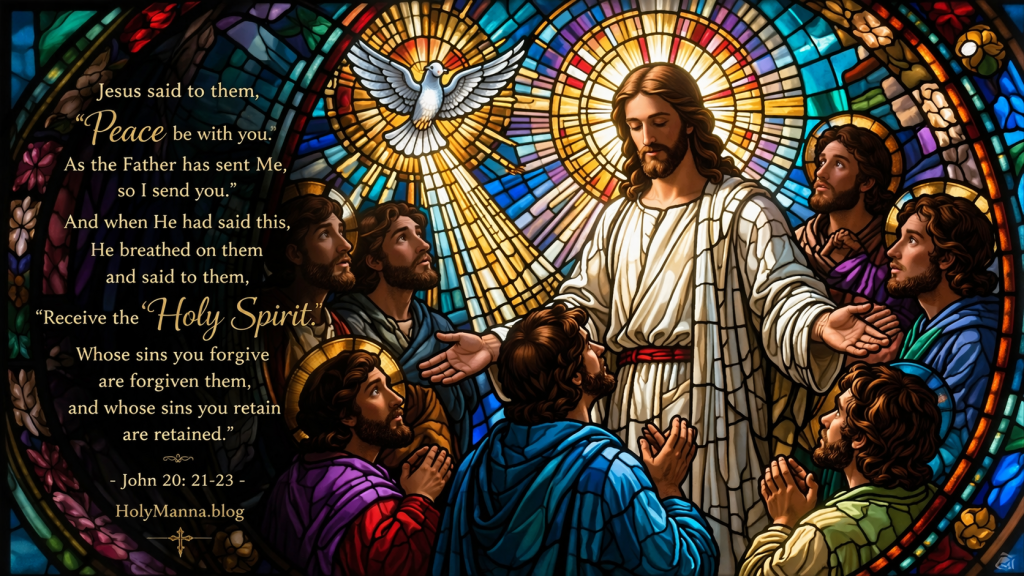
19 On the evening of that first day of the week, when the doors were locked, where the disciples were, for fear of the Jews, Jesus came and stood in their midst and said to them, “Peace be with you.” 20 When he had said this, he showed them his hands and his side. The disciples rejoiced when they saw the Lord. 21 [Jesus] said to them again, “Peace be with you. As the Father has sent me, so I send you.” 22 And when he had said this, he breathed on them and said to them, “Receive the holy Spirit. 23 Whose sins you forgive are forgiven them, and whose sins you retain are retained.”
Thomas. 24 Thomas, called Didymus, one of the Twelve, was not with them when Jesus came. 25 So the other disciples said to him, “We have seen the Lord.” But he said to them, “Unless I see the mark of the nails in his hands and put my finger into the nailmarks and put my hand into his side, I will not believe.” 26 Now a week later his disciples were again inside and Thomas was with them. Jesus came, although the doors were locked, and stood in their midst and said, “Peace be with you.” 27 Then he said to Thomas, “Put your finger here and see my hands, and bring your hand and put it into my side, and do not be unbelieving, but believe.” 28 Thomas answered and said to him, “My Lord and my God!” 29 Jesus said to him, “Have you come to believe because you have seen me? Blessed are those who have not seen and have believed.”
Conclusion. 30 Now Jesus did many other signs in the presence of [his] disciples that are not written in this book. 31 But these are written that you may [come to] believe that Jesus is the Messiah, the Son of God, and that through this belief you may have life in his name.
Detailed Exegesis
Verse 19: “On the evening of that first day of the week, when the doors were locked, where the disciples were, for fear of the Jews, Jesus came and stood in their midst and said to them, ‘Peace be with you.’”
Saint John begins with fear and closure. The disciples are not yet bold evangelists. They are hiding. The locked doors say something about their hearts as much as their location. Yet Jesus comes into that fear without violence and without reproach. His first words are peace. This is not a casual greeting. It is the peace won by His Cross and vindicated by His Resurrection. The risen Christ does not begin by scolding weak disciples. He begins by restoring them.
Verse 20: “When he had said this, he showed them his hands and his side. The disciples rejoiced when they saw the Lord.”
Jesus keeps His wounds. That matters enormously. The Resurrection does not erase the Passion. The glorified body of Christ still bears the marks of redemptive love. His hands and side prove identity, but they also reveal meaning. This is the same Jesus who was crucified. The disciples move from fear to joy because the wounds themselves have become signs of victory. In the light of Divine Mercy, this verse teaches that the wounds of Christ are not embarrassing remnants of suffering. They are the open doors through which mercy shines.
Verse 21: “Jesus said to them again, ‘Peace be with you. As the Father has sent me, so I send you.’”
Jesus repeats His gift of peace and then immediately joins it to mission. Peace is not given so that the disciples may remain safe and hidden. It is given so that they may be sent. The Son was sent by the Father to reveal mercy, save sinners, and gather a people. Now the Apostles are sent to continue Christ’s mission in the world. The Church is born from this sending. Divine Mercy is never meant to remain private. Those who receive peace from Christ are sent to carry His peace to others.
Verse 22: “And when he had said this, he breathed on them and said to them, ‘Receive the holy Spirit.’”
This is one of the richest verses in the whole Gospel. The breath of Jesus recalls Genesis, where God breathes life into man. Here the risen Christ breathes the Holy Spirit upon the Apostles, signaling a new creation. The Church begins to live by the breath of the risen Lord. This is not only comfort. It is empowerment. The mission Jesus gives cannot be fulfilled by human courage alone. It requires the Spirit of God. The new creation begins in this room, in this breath, in this gift.
Verse 23: “Whose sins you forgive are forgiven them, and whose sins you retain are retained.”
This is one of the clearest and most decisive texts for the Church’s teaching on sacramental forgiveness. Jesus does not merely tell the Apostles to announce that God forgives in general. He entrusts them with a real authority concerning sins. The distinction between forgiving and retaining shows that this is a genuine judicial and pastoral office, not a symbolic gesture. The risen Christ wills that His mercy reach souls through the ministry of the Church. Divine Mercy Sunday shines especially brightly here, because mercy becomes sacramental, concrete, and ecclesial.
Verse 24: “Thomas, called Didymus, one of the Twelve, was not with them when Jesus came.”
Thomas is introduced with quiet sadness. He is one of the Twelve, yet he was absent at that moment of grace. That detail is spiritually revealing. Separation from the gathered community often leaves the soul more vulnerable to confusion, sorrow, and unbelief. Thomas is not beyond the reach of mercy, but he is outside the room when the gift is given. The verse gently reminds the reader that grace is often received in communion with the Church.
Verse 25: “So the other disciples said to him, ‘We have seen the Lord.’ But he said to them, ‘Unless I see the mark of the nails in his hands and put my finger into the nailmarks and put my hand into his side, I will not believe.’”
Thomas does not accept secondhand testimony easily. His language is blunt, wounded, and deeply human. He is not content with vague encouragement. He wants contact with the Crucified. There is something tragic here, but also something honest. Thomas does not hide his struggle. He says it plainly. His condition for belief centers on the wounds, which is fitting, because the wounds are where divine mercy is most visibly revealed. Even in doubt, Thomas is still searching around the mystery of Christ’s Passion.
Verse 26: “Now a week later his disciples were again inside and Thomas was with them. Jesus came, although the doors were locked, and stood in their midst and said, ‘Peace be with you.’”
A week later means the eighth day, the Lord’s Day, the day of the Church’s gathered worship. Thomas is now with the others. Again the doors are locked, and again Jesus comes. His mercy is patient. He returns for the one who struggled. His first words are still peace. He does not arrive irritated by Thomas’s delay. The risen Lord comes with the same mercy the second time as the first. That is a powerful truth for anyone ashamed of needing repeated grace.
Verse 27: “Then he said to Thomas, ‘Put your finger here and see my hands, and bring your hand and put it into my side, and do not be unbelieving, but believe.’”
Jesus answers Thomas exactly at the point of his doubt. He does not crush him. He invites him. The words are tender, direct, and deeply personal. Jesus knows what Thomas said, even though He was not visibly present when Thomas said it. That alone reveals divine knowledge. Yet the greater beauty is the invitation itself. Christ lets Thomas come close to the wounds. Mercy does not shame the wounded disciple for struggling. Mercy draws him near to the very place where love suffered for him.
Verse 28: “Thomas answered and said to him, ‘My Lord and my God!’”
This is the climax of the passage. Thomas moves beyond mere acknowledgment that Jesus is alive. He confesses Jesus as Lord and God. This is adoration. This is faith ripened by mercy. The one who demanded proof now makes one of the highest Christological confessions in the New Testament. Thomas does not remain defined by his doubt. He becomes a witness to the divinity of Christ. The Gospel shows that divine mercy does not simply tolerate weakness. It transforms it into worship.
Verse 29: “Jesus said to him, ‘Have you come to believe because you have seen me? Blessed are those who have not seen and have believed.’”
Jesus gently lifts the Church’s eyes beyond Thomas to all future believers. This beatitude belongs to every Christian who lives by faith in the apostolic witness. Most believers will not place a hand in Christ’s side, yet they are not second-class disciples. They are blessed. This verse speaks directly to the whole Church after the Ascension, to every Catholic who receives Christ through Scripture, sacrament, grace, and the testimony handed down from the Apostles. Faith without sight is not lesser faith. It is the normal path of Christian discipleship.
Verse 30: “Now Jesus did many other signs in the presence of his disciples that are not written in this book.”
Saint John reminds the reader that the Gospel is selective. The signs recorded are not the whole of Jesus’ earthly and risen activity. This verse creates humility before revelation. The evangelist is not pretending to say everything. He is carefully giving what is needed for faith. It also hints at the abundance of Christ’s works. The Gospel is not sparse because Christ did little. It is focused because what is written is sufficient for salvation.
Verse 31: “But these are written that you may come to believe that Jesus is the Messiah, the Son of God, and that through this belief you may have life in his name.”
Saint John closes the passage by stating the purpose of the Gospel itself. The text is written for faith and life. Not mere information, but belief. Not mere admiration, but life in His name. This line ties everything together. The peace, the wounds, the Spirit, the forgiveness, and Thomas’s confession all move toward one end: that souls may believe in Jesus Christ and live. Divine Mercy Sunday echoes that same purpose. Mercy is given so that sinners may believe, be reconciled, and have life in Christ.
Teachings
This Gospel is one of the great biblical foundations for the Church’s understanding of mercy, mission, the Holy Spirit, apostolic authority, and the forgiveness of sins. It is impossible to read this passage seriously and conclude that the risen Christ intended His mercy to remain vague or invisible. He gave it shape in His Church. He gave it voice through the Apostles. He gave it sacramental force in the forgiveness of sins.
The Catechism speaks with great clarity here. CCC 976 teaches: “The Apostles and their successors carry out this ‘ministry of reconciliation’ not only by announcing God’s forgiveness to men merited for us by Christ, and calling them to conversion and faith, but also by communicating to them the forgiveness of sins in Baptism, and reconciling them with God and with the Church through the power of the keys, received from Christ.” That is a direct illumination of verse 23. Jesus did not leave the forgiveness of sins at the level of abstraction. He entrusted a real ministry of reconciliation to His Church.
The Catechism also explains the authority given to the Apostles in language that fits this Gospel perfectly. CCC 1441 says: “Only God forgives sins. Since he is the Son of God, Jesus says of himself, ‘The Son of man has authority on earth to forgive sins’ and exercises this divine power: ‘Your sins are forgiven.’ Further, by virtue of his divine authority he gives this power to men to exercise in his name.” That is precisely what the Church sees taking place in the Upper Room. The authority belongs to Christ first, but He truly shares it with those He sends.
The reality of this sacramental ministry is made even clearer in CCC 1461: “Since Christ entrusted to his apostles the ministry of reconciliation, bishops who are their successors, and priests, the bishops’ collaborators, continue to exercise this ministry. Indeed bishops and priests, by virtue of the sacrament of Holy Orders, have the power to forgive all sins ‘in the name of the Father, and of the Son, and of the Holy Spirit.’” Divine Mercy Sunday is therefore not merely a day to think warm thoughts about God’s kindness. It is a day to remember that Christ established a Church through which mercy is concretely given.
This Gospel is also deeply bound to the mystery of the new creation. Jesus breathes on the Apostles, and the Church hears an echo of the first creation in Genesis. The old world was wounded by sin, fear, and death. Now the risen Christ breathes forth the Spirit and begins the restoration of humanity in Himself. The Resurrection is not simply a private victory for Jesus. It is the dawn of a new order of grace, a new humanity, and a new people sent into the world.
Saint Gregory the Great gave one of the most famous reflections on Thomas. He wrote: “Thomas’ disbelief has done more for our faith than the faith of the other disciples. As he touched Christ and was won over to belief, every doubt of ours is cast aside and our faith is strengthened.” That insight is classic and deeply comforting. Thomas is not remembered so that Christians may mock him. He is remembered so that Christians may see how patiently Christ heals doubt and how powerfully that healing strengthens the whole Church.
Saint John Paul II saw this Gospel as the great scriptural heart of Divine Mercy Sunday. Reflecting on the risen Christ showing His hands and side, he taught that Jesus reveals mercy through the wounds of His Passion and pours it out upon humanity. That is why the feast is not sentimental. It is cruciform. Mercy flows from the pierced heart of the Savior. The peace He gives is the peace purchased by blood. The forgiveness He gives is the forgiveness won by sacrifice.
Historically, this Gospel became even more closely associated with Divine Mercy Sunday when Saint John Paul II established the title for the universal Church in connection with Saint Faustina. Yet the feast does not impose something foreign on the text. It simply brings out what was already there. The risen Jesus enters fear, shows the wounds of mercy, gives peace, pours out the Spirit, and grants the authority to forgive sins. The whole feast is already alive in this passage.
Reflection
This Gospel reaches the heart because it begins where many people secretly live. Behind locked doors. Behind old shame. Behind fear of the future. Behind disappointment with self, with others, or even with the slow pace of spiritual growth. The disciples know all of that, and Jesus does not wait until they become brave before He visits them. He comes into the room as it is. That is one of the most beautiful truths of Divine Mercy. Christ does not wait outside until the soul becomes impressive. He comes with peace into the actual mess.
That has real consequences for daily life. A Catholic who wants to live this Gospel well must stop treating fear as a permanent home. Fear may be felt, but it does not have to rule. The first step is to let Christ speak peace through prayer, through the Eucharist, and especially through confession. The same Lord who said “Whose sins you forgive are forgiven them” still desires to reconcile sinners through His Church. One of the clearest ways to honor Divine Mercy Sunday is to return honestly to the Sacrament of Reconciliation and let Christ open what sin and fear have locked shut.
Thomas also speaks to many souls. There are believers who still carry questions, disappointments, and interior resistance. This Gospel does not glorify doubt, but it does show that Christ can meet a doubting disciple without contempt. That should encourage honesty in prayer. The right response to doubt is not theatrical certainty, nor is it surrender to unbelief. The right response is to stay near the Church, remain in the room with the disciples, and bring the wound into the presence of Christ. Thomas was healed not by wandering farther away, but by meeting the risen Lord among the gathered disciples.
This Gospel also challenges Catholics not to treat mercy as passive comfort. Jesus gives peace, but He also sends. A soul that has received mercy must become more merciful. That can mean forgiving someone who does not deserve it, speaking peace instead of harshness in the home, showing patience with a struggling child, returning to prayer after failure, or refusing to define another person by his worst sin. Mercy received is meant to become mercy given.
The confession of Thomas also deserves to become a daily prayer. “My Lord and my God!” is not only the cry of a man in the Upper Room. It is the cry of the Church before the Eucharist, before suffering, before mystery, and before the hidden presence of Christ in ordinary life. It is a short prayer, but it contains adoration, surrender, and faith. It is a fitting prayer for anyone who wants to move from fear to worship.
What doors have been locked in the heart lately? Is there a fear, a shame, or an old wound that has been kept from Christ’s light? Has confession been treated as a burden, or as the risen Lord’s own gift of mercy? Does daily life reflect the peace of Christ, or the agitation of a heart still trying to save itself? Can the soul, like Thomas, fall before Jesus and truly say, “My Lord and my God!” with trust and love?
This Holy Gospel is the soul of the feast because it reveals exactly who Jesus is after the Resurrection. He is not less merciful now that He is risen. He is more visibly victorious in mercy. He still comes through locked doors. He still shows His wounds. He still speaks peace. He still gives the Holy Spirit. He still forgives sins through His Church. He still turns doubters into worshipers. And He still offers life in His name to every soul willing to believe.
Mercy That Still Finds the Heart
The readings for this Sunday of Divine Mercy come together like one beautiful story of what happens when the risen Jesus steps into a wounded world. In Acts of the Apostles, mercy becomes visible in the life of the Church. The believers gather around the Apostles’ teaching, the breaking of the bread, prayer, and generous love. In Psalm 118, the Church learns to sing that “his mercy endures forever”, even after struggle, rejection, and fear. In The First Letter of Peter, mercy becomes a living hope strong enough to endure trials and keep the soul fixed on an inheritance that will never fade. In The Gospel of John, mercy enters the locked room itself, speaks peace, shows the wounds of love, forgives sins, and turns a doubting disciple into a worshiper.
That is the great message of this day. Divine mercy is not sentimental, weak, or distant. It is the mercy of the crucified and risen Christ. It heals fear without pretending fear is small. It forgives sin without pretending sin is harmless. It gives peace without removing the call to mission. It meets the soul where it is, but it never leaves the soul there. Mercy brings sinners back to God, gathers believers into the Church, and teaches wounded hearts how to hope again.
This Sunday also leaves a clear invitation. Do not stay behind locked doors. Do not let shame, old sins, disappointments, or doubts speak louder than the voice of Jesus. Return to Him in prayer. Return to Him in the Eucharist. Return to Him in confession. Let His peace settle where fear has ruled. Let His wounds teach the heart that love has already paid the price. Let His mercy become more than a comforting thought. Let it become the way daily life is lived.
What would change if Christ’s mercy were trusted more deeply this week? What would happen if the heart stopped hiding and let the risen Lord truly enter the room? The Church’s answer today is full of hope. He still comes. He still speaks peace. He still forgives. He still strengthens faith. He still gathers His people. And He still gives life in His name to every soul willing to believe.
Engage with Us!
Readers are warmly invited to share their reflections in the comments below. What stood out most in these readings today? What part of the Sunday of Divine Mercy felt especially personal, convicting, or consoling?
- In the First Reading from Acts of the Apostles 2:42-47, what would need to change in daily life for the home, parish, or friendships to reflect more clearly the devotion, generosity, and joy of the early Church?
- In the Responsorial Psalm, Psalm 118:1-4, 13-15, 22-24, where has the mercy of God already carried the heart through pressure, weakness, or fear, and how can that mercy be remembered with greater gratitude?
- In the Second Reading from The First Letter of Peter 1:3-9, what trial or uncertainty is most in need of being surrendered to the living hope of the risen Christ?
- In the Holy Gospel from John 20:19-31, what locked door in the heart still needs to be opened to Jesus, and how is He inviting deeper trust through His peace, His wounds, and His mercy?
Keep walking in faith with courage and humility. Let every day be shaped by prayer, truth, repentance, charity, and hope. May each step forward be taken with the love and mercy that Jesus has shown, so that His peace is not only received, but also shared with a world that desperately needs Him.
Sacred Heart of Jesus, we trust in You!
Immaculate Heart of Mary, pray for us!
Saint Michael the Archangel, defend us in battle!
Follow us on YouTube, Instagram and Facebook for more insights and reflections on living a faith-filled life.

 Holy Manna!
Leave a comment