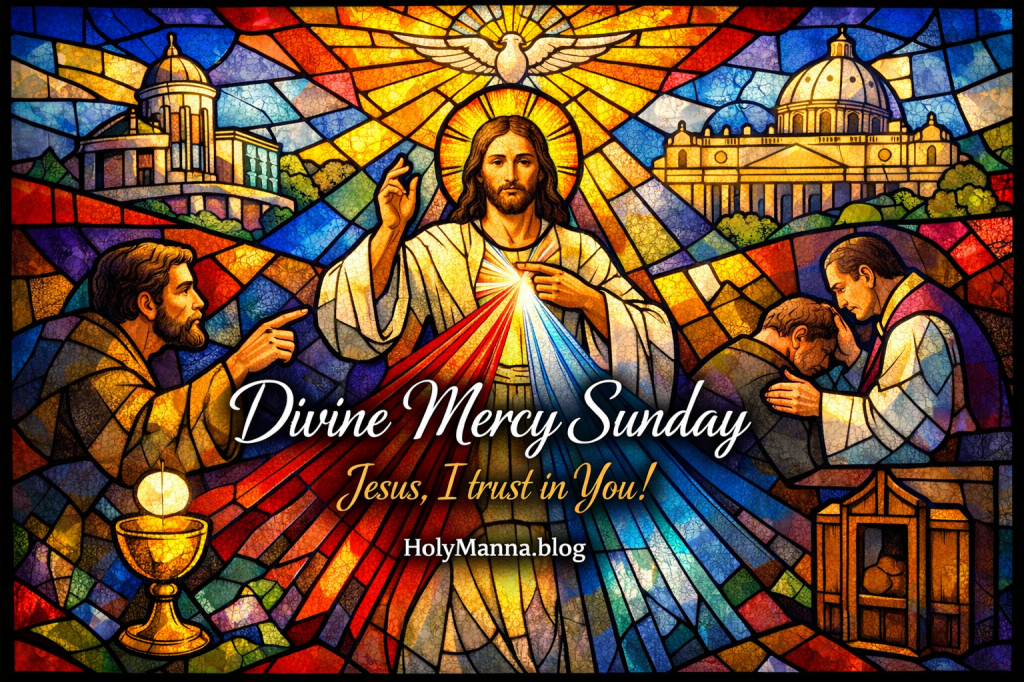
The Sunday of Mercy, the Day of New Beginnings
Divine Mercy Sunday stands like a bright door at the end of the Easter Octave. The Church celebrates it on the Second Sunday of Easter, and that timing matters. This feast does not pull attention away from the Resurrection. It shows what the Resurrection means for sinners, for doubters, for wounded hearts, and for a world that keeps trying to fix itself without grace. Divine Mercy Sunday tells the faithful that the risen Jesus returns first with peace, with pardon, and with the wounds that prove His love.
In Catholic tradition, this feast is deeply tied to the Gospel of Saint John, where Christ appears to the apostles in the locked room, breathes the Holy Spirit upon them, and gives them authority to forgive sins. The Church sees in that moment not only comfort, but mission. The risen Lord does not simply console the fearful. He restores them and sends them. That is why Divine Mercy Sunday belongs so naturally within Easter. It reveals the living heart of the Paschal Mystery. As Saint John Paul II taught, “Divine Mercy! This is the Easter gift that the Church receives from the risen Christ and offers to humanity.”
White Garments, Open Wounds, and the Story Behind the Feast
Long before the title Divine Mercy Sunday was officially given to this day, the Church already treasured this Sunday as the close of the Easter Octave. In the ancient Roman tradition it was associated with the newly baptized, who had received white garments at the Easter Vigil and wore them throughout the week. On this Sunday, they set those garments aside and stepped forward into daily Christian life. That older custom matters because it reveals the original character of the day. This was already a feast of rebirth, cleansing, and grace.
In the modern life of the Church, the feast is closely associated with Saint Faustina Kowalska, the humble Polish nun through whom the Lord stirred a renewed call to trust in His mercy. Her spiritual diary recorded repeated appeals to contemplate the mercy flowing from the Heart of Christ. Yet the Church is careful here, as she always should be. Saint Faustina’s experiences belong to the realm of private revelation, not public Revelation. The Church teaches in CCC 67 that private revelations do not complete Christ’s definitive Revelation, but may help the faithful live it more fully in a certain time. That distinction keeps everything properly ordered. Divine Mercy is not a novelty. It is the Gospel seen with fresh urgency.
The decisive moment in the Church’s liturgical life came in the Jubilee Year 2000, when Pope Saint John Paul II canonized Saint Faustina and established this Sunday in the universal Church as Divine Mercy Sunday. This was not the creation of a brand new theology. It was the Church giving a clearer name to a reality already shining from the wounds of the risen Christ. The timing also spoke powerfully to the modern age. After a century scarred by war, genocide, hatred, and ideological cruelty, the Church proclaimed again that mercy is not weakness. Mercy is the victorious love of God meeting the misery of man.
The Gospel at the Center of the Feast
The Gospel for Divine Mercy Sunday is John 20:19-31, and it is impossible to understand this feast without standing inside that room with the apostles. They are afraid. They are behind locked doors. They have failed. Peter has denied. Thomas doubts. The others have scattered. Yet Jesus comes anyway. He comes through their fear and into their shame. His first word is not accusation. His first word is peace.
Then He shows His hands and His side. This is one of the most moving truths in all of Scripture. The risen Christ keeps His wounds. Glory does not erase love’s scars. In fact, those wounds become the very proof of His identity and the channels of His mercy. The same Jesus who was crucified now stands alive before them, and the wounds are not signs of defeat. They are signs of victory, forgiveness, and faithful love.
Then comes the breath of the Holy Spirit and the gift of sacramental forgiveness: “Whose sins you forgive are forgiven them, and whose sins you retain are retained.” The Church has always seen in this moment the institution of the sacrament of Penance in its apostolic form. Divine Mercy Sunday is therefore not sentimental. It is sacramental. It is ecclesial. It is apostolic. Mercy is not simply a feeling that God has toward sinners. Mercy is something Christ actually does. He forgives. He restores. He gives peace. He reconciles through the Church He founded.
Thomas enters this Gospel as the one so many people understand. He wants proof. He refuses easy emotionalism. Yet when Christ invites him to touch the wounds, Thomas does not remain in his skepticism. He falls into adoration and cries out, “My Lord and my God!” That is the destination of Divine Mercy. It is not vague comfort. It is faith. It is surrender. It is worship.
Mercy at the Heart of Catholic Theology
Divine Mercy Sunday makes sense only from within the Church’s full teaching on sin, redemption, grace, and the sacraments. The Catechism teaches in CCC 1846 that the Gospel is the revelation in Jesus Christ of God’s mercy to sinners. That line alone is enough to show why this feast matters. Mercy is not a side theme in Catholicism. Mercy is at the center of salvation history because sin is real and love is greater.
Saint John Paul II gave the Church some of the clearest reflections on this mystery in Dives in Misericordia. He taught that the Paschal Mystery is the supreme revelation of mercy because the Cross and Resurrection show both the seriousness of sin and the greater power of divine love. Sin is not brushed aside. It is conquered through the sacrifice of Christ. Justice is not denied. It is fulfilled in a way only God could accomplish.
Pope Benedict XVI later spoke of mercy as the central nucleus of the Gospel message. That language is important because it protects the feast from misunderstanding. Mercy is not a soft excuse for sin. Mercy is not permission to remain unchanged. Mercy is the holy love of God that reaches into human misery in order to heal it, transform it, and restore communion. Pope Francis has preached this same truth with a pastoral warmth that has helped many souls. He often returned to the wounds of Christ on Divine Mercy Sunday, insisting that the Lord never grows tired of forgiving and that the confessional is not a chamber of humiliation, but a place of resurrection for the sinner who returns.
The feast also teaches something beautiful about the nature of the Church herself. The Church is not merely a gathering of the already strong. She is the place where mercy is preached, confessed, received, and lived. The Church exists to bring souls into contact with the crucified and risen Jesus, whose Heart still pours out grace through Baptism, the Eucharist, and Reconciliation. The blood and water flowing from His side have always been understood by the Church in relation to these mysteries. CCC 1225 and CCC 2669 point the faithful toward the saving power that flows from Christ’s pierced Heart.
The Devotions That Draw Souls Closer to Christ
Over time, the Church has warmly embraced several devotions associated with Divine Mercy Sunday. The most well known are the Divine Mercy image, the Chaplet of Divine Mercy, the novena leading up to the feast, and the prayerful remembrance of the Hour of Mercy at three o’clock in the afternoon.
The Divine Mercy image presents Christ with one hand raised in blessing and the other pointing toward His Heart, from which red and pale rays stream forth. Saint John Paul II explained that these rays recall the blood and water that flowed from the Lord’s side. The image is therefore not mere religious art. It is theological. It points to the Passion, to the sacraments, and to the inexhaustible mercy of God. The words commonly associated with the image, “Jesus, I trust in You,” contain the essence of the devotion. Trust is the posture of the Christian soul before mercy.
The Chaplet of Divine Mercy is another beloved prayer, and its language is unmistakably Catholic. It is addressed to the Father and offered through the sacrifice of the Son. The faithful pray, “For the sake of His sorrowful Passion, have mercy on us and on the whole world.” That prayer does not turn the soul inward. It teaches intercession. It trains the heart to plead for mercy not only for itself, but for the whole world.
The novena traditionally begins on Good Friday and leads the faithful through the sacred days toward Divine Mercy Sunday. In that sense, it is not separated from the Triduum. It rises from the Cross, waits through Holy Saturday, rejoices at Easter, and arrives at the Sunday where the wounds of the risen Christ are displayed as fountains of healing.
The Church has also attached indulgences to this feast. On Divine Mercy Sunday, the faithful may receive a plenary indulgence under the usual conditions of sacramental confession, Holy Communion, prayer for the intentions of the Holy Father, and detachment from all sin. This is not some strange extra feature added onto Catholic life. It is one more sign that the Church wants souls to approach this day through confession, Communion, prayer, and conversion. Even here the lesson remains the same. Divine Mercy Sunday leads the soul into the sacramental life of the Church.
Pilgrimage and the Geography of Mercy
Every great feast eventually shapes places as well as prayers. Divine Mercy Sunday has become deeply connected to several holy sites where the faithful gather in hope, repentance, and thanksgiving.
Kraków-Łagiewniki in Poland holds a special place because it is associated with Saint Faustina and the spread of the Divine Mercy message. Pilgrims come there seeking not novelty, but renewal. They come to pray, to confess, to attend Mass, and to place their wounds before the merciful Heart of Christ. Rome, too, has a strong connection to this devotion, especially through Santo Spirito in Sassia, which became a center of Divine Mercy spirituality. In the United States, the National Shrine of The Divine Mercy in Stockbridge, Massachusetts, has helped countless Catholics enter more deeply into the feast through Eucharistic devotion, confession, catechesis, and the Chaplet.
Pilgrimage matters because people need places that help the soul remember what is true. A pilgrimage is never just about travel. It is about conversion. It is about leaving behind the noise of ordinary life long enough to hear again the voice of Christ saying, “Peace be with you.” When pilgrims go to these shrines, they are really making an interior journey. They are walking toward the mercy of God with the honesty of beggars and the hope of beloved children.
How the World Has Learned to Celebrate This Feast
Divine Mercy Sunday is now celebrated across the Catholic world, and in many places it has become one of the most beloved Sundays of the year. Some parishes hold solemn holy hours with exposition of the Blessed Sacrament. Others gather the faithful for the Chaplet at three in the afternoon. Many churches schedule extra confessions in the days leading up to the feast because pastors understand what this day is meant to do. It is meant to bring sinners home.
In Poland, the feast carries a particularly deep resonance because of Saint Faustina, Saint John Paul II, and the spiritual history of a land tested by immense suffering. In Rome, the feast has often been marked by papal preaching that ties mercy directly to the wounds of Christ and the life of the Church. In many countries throughout Latin America, North America, Europe, Africa, and Asia, the celebration has taken root in parish life through prayer services, processions, Eucharistic adoration, confession, and catechesis centered on trust in Jesus and mercy toward neighbor.
Hymns, prayer cards, novenas, and processions have all helped shape the feast’s cultural life, but the most important thing remains the same everywhere. The feast calls people to move from fear to trust, from sin to confession, from isolation to communion, and from receiving mercy to practicing mercy. Where that happens, the feast is being celebrated well.
Why This Feast Matters Right Now
Divine Mercy Sunday feels almost painfully relevant in every age, but especially in a time marked by anxiety, cynicism, addiction, loneliness, and spiritual confusion. So many people either excuse sin or drown in shame. So many want healing without repentance, or truth without tenderness. This feast refuses both distortions. It says that sin is real, confession matters, repentance is necessary, and mercy is greater.
That is why this feast speaks so clearly to modern hearts. It tells the proud soul to kneel. It tells the despairing soul to get up. It tells the doubting soul to look at the wounds. It tells the wounded soul that Christ has not walked away. It tells the Church herself to remember what she is for.
The deeper lesson of Divine Mercy Sunday is that the Lord does not love from a distance. He loves through wounds. He saves through wounds. He returns with wounds. A Christian who understands that will begin to see his own life differently. Suffering no longer means abandonment. Failure no longer means the end. Sin no longer needs to be hidden forever. Everything can be brought into the light of Christ.
Living the Feast in Ordinary Life
The beauty of Divine Mercy Sunday is that it is both majestic and practical. It reaches into ordinary life. It teaches the faithful to go to confession honestly, to receive Holy Communion reverently, to pray with confidence, and to show mercy in concrete ways. A person who celebrates Divine Mercy Sunday well should leave the feast more ready to forgive, more willing to confess sin quickly, and more eager to see Christ in the suffering neighbor.
This feast also invites a particular kind of courage. Trust is not natural to wounded people. Trust has to be chosen again and again. That is why the simple prayer “Jesus, I trust in You” carries such power. It is not childish. It is deeply mature. It is the prayer of a soul that has stopped pretending to save itself.
Mercy should also reshape the way Christians treat others. A believer who has been forgiven much cannot remain hard, cold, and cruel. Divine Mercy Sunday should make Catholics more patient with weakness, more serious about charity, and more aware of the hidden suffering carried by others. Mercy does not erase truth. Mercy makes truth bearable because it carries the warmth of Christ’s love.
What locked door in the heart still needs to be opened to the risen Jesus? What wound has been hidden from Him? What person still needs forgiveness, patience, or compassion? These are the kinds of questions this feast presses gently into the soul.
The Feast That Teaches the Heart to Trust
In the end, Divine Mercy Sunday is about meeting the risen Jesus where the apostles met Him, in weakness, in fear, and in need. It is about hearing peace spoken over failure. It is about seeing the wounds that remain glorious forever. It is about confessing with Thomas, “My Lord and my God!” It is about believing that no sinner is beyond grace, no wound is beyond healing, and no darkness is stronger than the mercy that burst from the tomb with Christ on Easter morning.
This feast is one of the Church’s most tender reminders that the Lord’s mercy is not vague, not distant, and not exhausted. It is real. It is sacramental. It is crucified and risen. It is waiting in the confessional, at the altar, in the Scriptures, and in the pierced Heart of Jesus. That is why Divine Mercy Sunday remains such a gift to the Church. It teaches the faithful not merely to admire mercy, but to live inside it.
Engage with Us!
Share your thoughts and reflections in the comments below. This feast touches some of the deepest places in the Christian life, and honest reflection can help others draw closer to the Heart of Jesus.
- When hearing Christ say, “Peace be with you,” what part of life most needs that peace right now?
- What does Thomas’s journey from doubt to adoration reveal about the way Jesus meets struggling faith?
- How can trust in divine mercy change the way sin, failure, and shame are handled?
- What practical act of mercy can be offered this week to someone who is suffering, lonely, or difficult to love?
- How might a deeper return to confession and the Eucharist renew everyday Catholic life?
Keep walking in faith. Keep returning to the sacraments. Keep trusting the Heart of Jesus. Live with courage, forgive generously, and do everything with the love and mercy Jesus taught us.
Jesus, we trust in You!
Follow us on YouTube, Instagram and Facebook for more insights and reflections on living a faith-filled life.

 Holy Manna!
Leave a comment