The Bishop Who Would Not Be Silent
Saint Stanislaus of Kraków stands in Christian memory as one of those rare shepherds whose life became larger than his own century. He was a bishop, a martyr, and one of Poland’s great patron saints. He is revered because he loved Christ enough to defend truth even when doing so put him in direct conflict with royal power. In Roman Catholic tradition, he is remembered as a holy bishop who guarded the moral law, defended the innocent, and refused to let political fear silence the voice of the Church.
What makes Saint Stanislaus so powerful is that his story is not only about personal holiness. It is also about the public witness of a bishop who understood that God’s law applies to everyone, including kings. His martyrdom left a mark not only on the Church in Kraków, but on the spiritual imagination of an entire nation. For centuries, Catholics in Poland have looked to him as a sign that truth matters, conscience matters, and holiness sometimes demands courage that costs everything.
Roots in Faith and the Making of a Bishop
Saint Stanislaus was born around the year 1030 in Szczepanów, in southern Poland. Catholic tradition holds that he was born into a noble and faithful family, and that from an early age he was marked by seriousness, intelligence, and devotion. The details of his early life are not preserved with complete certainty, but the tradition surrounding him consistently presents him as a young man formed by prayer, discipline, and love for the Church.
He studied in cathedral schools in Poland, and according to long-standing tradition, he may also have continued his studies abroad. That detail cannot be verified with certainty, but it reflects how strongly later Catholic memory associated him with wisdom, learning, and preparation for leadership. What is clear is that he was ordained a priest, became known for his zeal and good judgment, and eventually served the Church in Kraków with such distinction that he was chosen to become bishop in 1072.
As bishop, Stanislaus did not live like a court politician. He lived like a pastor. He preached, guided souls, strengthened the life of the diocese, and served the poor. He is most known for being the bishop who confronted King Bolesław II over grave injustice and moral corruption. That is the central event for which he is remembered, but it only makes sense when seen against the whole of his life. He was not a man looking for conflict. He was a shepherd trying to be faithful.
A Shepherd Who Defended Truth and Worked Wonders
The life of Saint Stanislaus matters because it shows what the office of bishop is meant to be. A bishop is not simply an administrator or public figure. He is a guardian of souls, a teacher of truth, and a witness to Christ. Stanislaus became exactly that kind of shepherd. He helped strengthen the Church in Poland, and Catholic tradition remembers him as a man of prayer, charity, and moral seriousness.
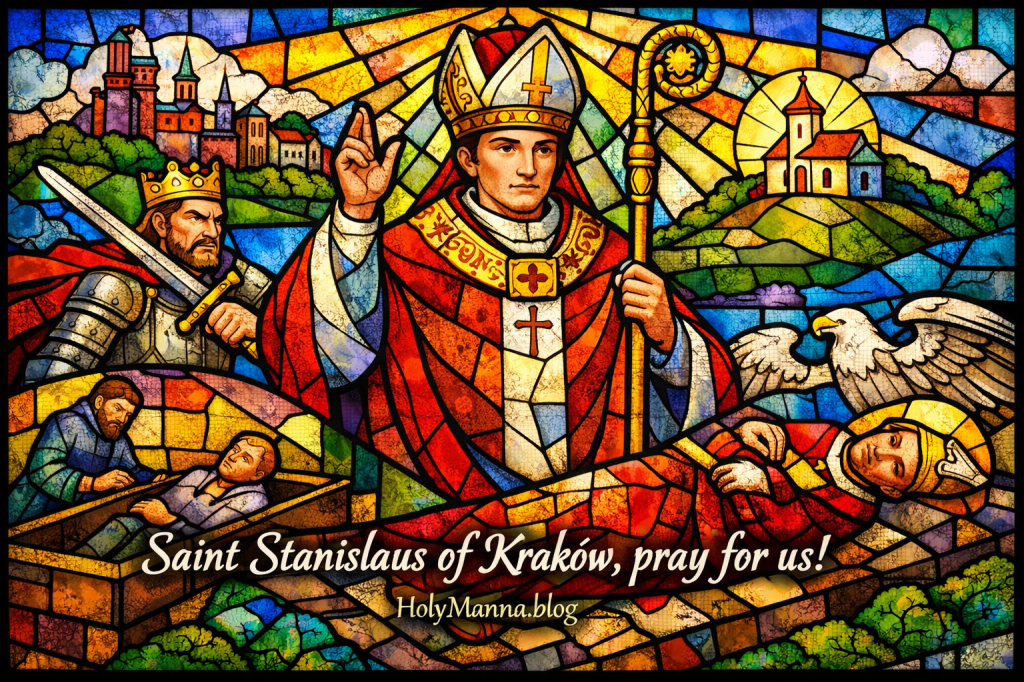
The most famous miracle associated with his lifetime is the story of Piotr, also called Piotrowin. According to Catholic tradition, Stanislaus had purchased land for the Church from a man named Piotr. After Piotr died, his relatives challenged the sale and accused the bishop of wrongdoing. The saint is said to have gone to the grave, prayed, and by God’s power brought the dead man back to life long enough for him to testify that the sale had been honest and valid. This miracle became one of the most enduring stories attached to Saint Stanislaus because it reveals the kind of confidence the Church saw in him: a bishop so committed to justice that even death itself was overcome to defend the truth. This story belongs to long-standing Catholic tradition, but it cannot be verified with complete historical certainty.
Even apart from that miracle, his life itself became a kind of sign. He showed compassion to the weak, seriousness toward sin, and fidelity to Christ in public life. He is worth remembering because he proves that holiness is not softness. True charity does not flatter evil. True mercy does not excuse injustice. Saint Stanislaus reminds the faithful that love sometimes requires correction, and that the shepherd who truly loves his flock must be willing to speak when silence would be easier.
The Cost of Conscience
The hardest chapter of Saint Stanislaus’s life came through his conflict with King Bolesław II. Catholic sources agree on the broad truth of the matter, even if every detail is not equally certain. The king had become known for cruelty, abuse of power, and grave moral disorder. Stanislaus admonished him, not as a rebel seeking political influence, but as a bishop responsible before God. He reportedly defended those who suffered under the king’s harsh rule and confronted the ruler over his wrongdoing.
At first, bishop and king had worked together. That makes the rupture even more tragic. Stanislaus had supported the life of the kingdom and the good of the Church, but he would not sacrifice truth for peace. When correction failed, he eventually excommunicated the king. That act was not a political maneuver. It was a spiritual judgment meant to call a sinner to repentance and protect the moral order of Christian life.
In 1079, while celebrating Mass at the church of Saint Michael on the Skałka in Kraków, Stanislaus was murdered. Catholic tradition holds that the king himself either ordered the killing or took part in it when others refused to strike the bishop. Tradition also says that the saint’s body was dismembered after his death. In this, the Church sees not just a crime, but martyrdom. Saint Stanislaus died because he would not betray his office or remain quiet in the face of evil.
His martyrdom matters because it shows what the Church means by witness. The Catechism teaches, “Martyrdom is the supreme witness given to the truth of the faith” CCC 2473. Saint Stanislaus did not die in battle with a sword in his hand. He died at the altar, as a bishop whose final testimony was fidelity to Christ and to the moral law.
Wonders, Relics, and the Making of a Nation’s Patron
The story of Saint Stanislaus did not end at his death. In many ways, it had only begun. Catholic tradition says that after his body was cut apart, the pieces miraculously came back together. Another ancient tradition says that eagles guarded his remains from desecration. These stories express how deeply the faithful saw his martyrdom as holy and protected by God. These details belong to long-standing Catholic tradition, but they cannot be verified with complete historical certainty.
What can be said with confidence is that devotion to him grew quickly. His relics were later transferred to Wawel Cathedral, where they became a center of prayer and veneration. Reports of healings and favors through his intercession spread among the faithful. Catholic memory consistently presents his tomb as a place where people sought help, healing, and courage. The stories of individual miracles after his death are not all historically verifiable in a strict sense, but they belong to the living tradition of his cult and to the faith of generations who believed they had received grace through his prayers.
He was canonized in 1253 by Pope Innocent IV, and from that point his place in the life of Poland became even more visible. Saint Stanislaus became one of the great heavenly patrons of the Polish people. His feast is celebrated on April 11 in the universal calendar, and in Poland his solemn observance has long been kept on May 8. The annual procession from Wawel to the Skałka became one of the great public acts of Catholic devotion in the nation. Polish kings traditionally honored him, and his memory became woven into the story of Poland itself.
His cultural and national impact is difficult to overstate. He came to symbolize not only personal holiness, but the moral unity of the nation. In later generations, Catholics saw in his body, which tradition says was miraculously made whole again, an image of Poland itself being brought back together after division. His witness strengthened the conviction that no ruler stands above God’s law. During times of foreign oppression and later under hostile regimes, devotion to Saint Stanislaus remained a source of identity, strength, and Catholic courage.
What Saint Stanislaus Still Teaches the Church
Saint Stanislaus speaks powerfully to modern Catholics because the temptation to stay quiet has never disappeared. It is always easier to soften the truth, avoid conflict, and keep the peace on the surface. His life reminds the faithful that peace without truth is fragile, and mercy without moral clarity becomes sentimentality.
His example challenges fathers, mothers, priests, bishops, teachers, and all the faithful. He teaches that holiness is not private escape. It is public fidelity. He shows that courage is not loudness. It is the willingness to do what is right when the cost is real. He reminds believers that love for neighbor includes defending the weak, correcting wrongdoing, and refusing to treat evil as normal.
For daily life, his witness can be lived in very concrete ways. Speak truth with charity in the home. Refuse gossip, dishonesty, and cowardice in the workplace. Defend the vulnerable even when it is inconvenient. Pray for priests and bishops to be holy and brave. Examine the conscience seriously and do not excuse sin in the name of comfort. Go to Confession. Return to the Eucharist with reverence. Build a life that does not bend every time the culture applies pressure.
Where has fear made silence seem easier than faithfulness? What would it look like to defend truth with both courage and charity? How might Christ be calling the heart to greater moral clarity, even in ordinary daily life?
Saint Stanislaus is not remembered because he won a worldly argument. He is remembered because he was faithful. That is the heart of sanctity. Not success. Not applause. Faithfulness.
Engage with Us!
Share your thoughts and reflections in the comments below. Saint Stanislaus’s story speaks to courage, conscience, and the cost of truth, and it would be beautiful to hear how his witness speaks to your own journey of faith.
- What part of Saint Stanislaus’s life stands out most strongly, his courage before the king, his care for the Church, or his witness in martyrdom?
- Have there been moments when speaking the truth felt costly? What helped, or what held the heart back?
- How can greater courage and moral clarity be lived out in family life, work, friendships, or parish life this week?
- What does Saint Stanislaus teach about the responsibility of Catholic leaders to defend truth with charity and firmness?
- How can prayer, the sacraments, and a well-formed conscience help build the kind of faith that remains steady under pressure?
May Saint Stanislaus intercede for every heart that longs to live with courage, purity, and fidelity. May his witness strengthen the resolve to live a life of faith and to do everything with the love and mercy Jesus taught us.
Saint Stanislaus of Kraków, pray for us!
Follow us on YouTube, Instagram and Facebook for more insights and reflections on living a faith-filled life.

 Holy Manna!
Leave a comment