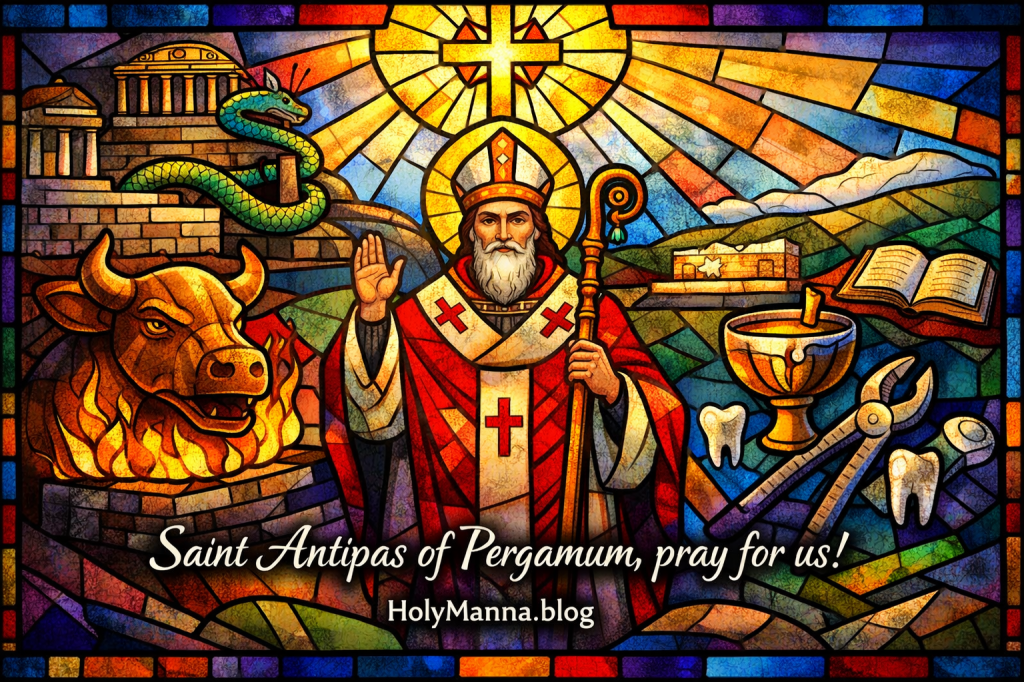
The Hidden Martyr Whose Name Was Written in Heaven
Saint Antipas of Pergamum is one of those saints whose earthly biography is mostly hidden, yet whose glory shines brightly because of one astonishing fact: Jesus Christ Himself names him in Sacred Scripture. In Revelation 2:13, the Lord speaks to the Church in Pergamum and says, “Antipas, my faithful witness, who was martyred among you.” That alone makes Saint Antipas unforgettable.
The Church reveres him as an early martyr, a man who held fast to Christ in a city where pagan worship and imperial cults pressed hard against the life of the Gospel. He is remembered in Christian tradition as a bishop of Pergamum and, according to ancient tradition, possibly a disciple of Saint John. While not every detail of that tradition can be historically confirmed, the heart of his witness is beyond doubt. He belonged to Christ, and he remained faithful even unto death.
Saint Antipas is especially revered as a martyr of courage, a shepherd who would not compromise, and a saint invoked in popular devotion against toothaches and dental suffering. His story matters because it reminds the Church that holiness is not measured by worldly fame. Sometimes holiness is measured by standing firm when the whole world seems to lean the other way.
The Quiet Beginnings of a Faithful Shepherd
Very little is known with certainty about the early life of Saint Antipas. Catholic tradition does not preserve clear details about his birthplace, family, youth, or the specific path by which he first came to the faith. That silence can feel surprising at first, but it also says something beautiful. The Church does not honor him because of noble origins, worldly accomplishments, or an impressive public story. The Church honors him because he was faithful to Jesus.
Ancient Christian tradition holds that Antipas may have been formed in the apostolic age and may have become a disciple of Saint John. Tradition also remembers him as bishop of Pergamum, a city named in The Book of Revelation as a place “where Satan’s throne is.” That phrase points to the deep paganism and emperor worship that shaped life there. If Antipas truly served as bishop in such a place, then his mission was not comfortable or easy. He would have had to strengthen believers, preach Christ clearly, and stand against a culture that demanded compromise.
What he is most known for is not a long list of achievements, but a single great act of perseverance. He stood with Christ when it was dangerous to do so. He became, in the words of Scripture, a faithful witness. That title alone tells the whole story.
A Life Remembered More for Fidelity Than Wonders
The life of Saint Antipas is important because it shows what Christian leadership looks like when the stakes are high. He is remembered as a shepherd who did not abandon the flock when pressure rose. In a world filled with idols, he remained loyal to the one true God. In a society where power and religion were twisted together, he kept his soul fixed on Christ.
There are no securely preserved miracle accounts from his lifetime in the way there are for some later saints. No ancient Catholic source gives a detailed list of healings or dramatic public wonders performed by him during his earthly ministry. That absence is worth noticing. It teaches that a saint’s greatness does not depend on how many extraordinary signs were seen around him. Sometimes the greatest miracle is steadfastness itself. Sometimes the clearest sign of grace is a man who refuses to betray the Lord.
That is why Saint Antipas should still be remembered and imitated. He represents the Christian who does not bend with the crowd. He shows that the Gospel is not only for easy seasons. It is for hostile cities, hostile cultures, and hostile hearts. He calls believers to be serious about discipleship, even when that discipleship costs something real.
The Fire of Trial and the Crown of Martyrdom
Saint Antipas lived in a city marked by pagan temples, political pressure, and emperor worship. Pergamum was not a neutral place. It was spiritually charged, and Christians there would have felt constant pressure to conform. The challenge was not simply private temptation. It was public religion, public loyalty, and public compromise.
Ancient tradition says that Antipas was arrested because of his Christian witness and refusal to offer sacrifice to pagan gods. He would not deny Christ. He would not pretend that Caesar or the gods of the empire deserved the worship owed to God alone. According to longstanding tradition, he was placed inside a heated bronze bull and killed for the faith. That detail comes from ancient tradition rather than from the brief biblical text itself, but it has been widely handed down in Christian memory.
Whether one focuses on the scriptural certainty or the traditional account of his death, the meaning remains the same. Antipas died because he belonged to Jesus. He did not save his life by cowardice. He gave his life in witness. This is exactly what The Catechism teaches about martyrdom as the highest form of witness to the truth of the faith. The martyr does not merely speak about Christ. The martyr proves by his death that Christ is worth more than life itself.
His martyrdom matters because it exposes the lie that faith is only a private feeling. For Saint Antipas, faith was allegiance. It was fidelity. It was love strong enough to endure persecution. The world may have seen defeat, but Heaven saw victory.
Oil, Healing, and a Memory That Refused to Die
After the death of Saint Antipas, devotion to him continued. Ancient Christian tradition says that miracles were reported at his tomb and that oil flowed from his relics or burial place. In the devotional life of the Church, flowing oil from the resting place of a saint was often taken as a sign of grace, healing, and heavenly favor. These miracle traditions belong to the ancient memory of the Church and helped preserve his veneration through the centuries.
Tradition also remembers that a church was built over his tomb, and his cult became especially ancient and strong in the Christian East. He continued to be commemorated liturgically, and his name lived on in the prayer of the Church long after the details of his earthly life had faded from common memory.
In popular devotion, Saint Antipas became especially known as a patron against toothache and dental pain. That detail may sound small at first, but it shows how deeply the communion of saints enters ordinary life. The Church does not only remember saints for grand theological moments. The Church also remembers them in suffering, illness, and the very practical hardships people carry every day.
His cultural impact is also tied to the fact that he appears in Sacred Scripture. Many saints are known through later biographies. Saint Antipas is known because the risen Christ spoke his name. That gave him a lasting place not only in liturgy and devotion, but in the imagination of Christians who read The Book of Revelation and wonder what it means to remain faithful in a corrupt age.
As for the posthumous miracle traditions, they are part of longstanding Christian devotion, though not every individual story can be historically verified in a modern sense. What can be said confidently is that the Church remembered him as a martyr whose relics became associated with grace, healing, and enduring veneration.
What Saint Antipas Teaches the Soul Today
Saint Antipas speaks powerfully to modern Christians because the pressure to compromise has not disappeared. It has simply changed its clothes. Many believers today may never face a bronze bull or a public execution, but they do face the steady pressure to be silent, to water down the truth, to keep faith private, or to pretend that Christ is only one option among many.
Saint Antipas reminds the soul that Jesus is not asking for polite admiration. He is asking for fidelity. He is asking for Christians who will stay close to Him when the cost rises. He is asking for men and women who would rather belong to Him than be applauded by the world.
There is also something deeply consoling in the hiddenness of this saint. So little is known about his personality, his daily habits, or his private life. Yet Christ knew him. Christ saw him. Christ named him. That is a powerful lesson for anyone who feels overlooked, forgotten, or unimpressive. The world may not remember every act of faithfulness, but Heaven does.
What does it mean to be faithful in a place that does not honor Christ? Saint Antipas answers that question with his life. It means holding fast to the name of Jesus. It means refusing false worship. It means choosing truth over comfort. It means trusting that no sacrifice made for Christ is ever wasted.
A practical way to imitate Saint Antipas is to begin with small acts of courage. Speak clearly about the faith when the moment calls for it. Refuse to cooperate with sin even when it costs approval. Pray for strength when the culture pushes in the wrong direction. Stay close to the sacraments. Read The Book of Revelation with reverence and hope. Remember that martyrdom begins long before death. It begins in daily fidelity.
Engage With Us!
Share your thoughts and reflections in the comments below. Saint Antipas may be a quiet figure in the history of the Church, but his witness still speaks with force. His life raises serious questions about courage, loyalty, and what it really means to belong to Christ.
- What stands out most about Saint Antipas and his witness to Jesus?
- How does his example challenge the way faith is lived in daily life?
- Have there been moments when staying faithful to Christ felt costly or uncomfortable?
- What does it mean to be a “faithful witness” in today’s world?
- How can greater courage, prayer, and perseverance be practiced this week?
May Saint Antipas of Pergamum intercede for every soul seeking courage. May his witness remind the faithful to hold fast to the name of Jesus with peace, strength, and conviction. Let every Christian live with the kind of faith that stays steady in trial, speaks truth with love, and does everything with the love and mercy Jesus taught us.
Saint Antipas of Pergamum, pray for us!
Follow us on YouTube, Instagram and Facebook for more insights and reflections on living a faith-filled life.

 Holy Manna!
Leave a comment