Saturday in the Octave of Easter – Lectionary: 266
From Empty Fear to Fearless Witness
There are moments in the Christian life when everything seems to hang in the balance. The heart has heard the news, but it is still learning how to live as though it is true. That is where today’s readings meet the Church: in the trembling, breathtaking aftermath of Easter, when the Resurrection is no longer only an event to be announced, but a reality that must remake human lives. The central theme uniting these readings is the transforming power of the risen Christ, who takes doubtful, ordinary, and once fearful people and turns them into bold witnesses who cannot remain silent.
The setting matters. The Church is still in the Octave of Easter, those eight days in which the liturgy lingers over the Resurrection as though the faithful must be taught to breathe its air slowly and deeply. In Acts 4:13-21, Peter and John stand before the religious authorities with a courage that would have seemed impossible only days earlier. In Psalm 118, the voice of thanksgiving rises from one who has passed through trial and now sings of deliverance: “I shall not die but live, and declare the deeds of the Lord.” In Mark 16:9-15, the Gospel does not hide the weakness of the first disciples. They struggle to believe even after hearing the testimony of Mary Magdalene and the others. Yet Christ comes to them anyway, rebukes their hardness of heart, and then sends them into the world with the astonishing command: “Go into the whole world and proclaim the gospel to every creature.”
Taken together, these readings show that Easter does not erase human weakness in an instant, but it does conquer it by grace. The apostles are not brave because they were naturally impressive men. They are brave because they have been with Jesus. The Church has always treasured this truth, because it is not only the story of the first disciples, but the pattern of every Christian life. The risen Lord still meets people in confusion, strengthens them in truth, and sends them out to speak what they have seen and heard. Today’s passages invite the faithful to look closely at that movement from unbelief to conviction, from rescue to praise, and from encounter to mission.
First Reading – Acts 4:13-21
When Ordinary Men Speak with Heaven’s Courage
The scene opens in Jerusalem, not long after the Resurrection and Ascension of the Lord’s saving work has begun to shake the city. Peter and John stand before the Sanhedrin, the same religious leadership that had opposed Jesus and handed Him over to death. This is not a casual conversation. This is a formal confrontation between the authorities of old covenant Israel and the first heralds of the risen Christ. The healed man is standing there as living evidence that something new has broken into history. A miracle has taken place, and everyone knows it.
That is what makes this reading so powerful in the light of today’s theme. In the Gospel, the disciples are still wrestling with unbelief and hesitation. Here in Acts, those same followers of Christ are no longer hiding. They are no longer paralyzed by fear. The Resurrection has begun to change them from within. These men are described as ordinary and uneducated, yet the leaders are astonished by their boldness. The deepest explanation is not natural talent, formal schooling, or political strength. It is this simple truth: they had been with Jesus. That is still the secret of Christian courage. The world is changed when ordinary people remain close to Christ and refuse to stop speaking His name.
Acts 4:13-21 – New American Bible (Revised Edition)
13 Observing the boldness of Peter and John and perceiving them to be uneducated, ordinary men, they were amazed, and they recognized them as the companions of Jesus. 14 Then when they saw the man who had been cured standing there with them, they could say nothing in reply. 15 So they ordered them to leave the Sanhedrin, and conferred with one another, saying, 16 “What are we to do with these men? Everyone living in Jerusalem knows that a remarkable sign was done through them, and we cannot deny it. 17 But so that it may not be spread any further among the people, let us give them a stern warning never again to speak to anyone in this name.”
18 So they called them back and ordered them not to speak or teach at all in the name of Jesus. 19 Peter and John, however, said to them in reply, “Whether it is right in the sight of God for us to obey you rather than God, you be the judges. 20 It is impossible for us not to speak about what we have seen and heard.” 21 After threatening them further, they released them, finding no way to punish them, on account of the people who were all praising God for what had happened.
Detailed Exegesis
Verse 13 – “Observing the boldness of Peter and John and perceiving them to be uneducated, ordinary men, they were amazed, and they recognized them as the companions of Jesus.”
This verse sets the tone for the whole passage. The Sanhedrin expects men like Peter and John to be intimidated, quiet, and easy to dismiss. Instead, they are bold. In the biblical sense, this boldness is not arrogance. It is spiritual courage, a holy freedom that comes from conviction and grace. The apostles are not impressive by worldly standards, but their closeness to Jesus has marked them so deeply that even their enemies can see it. The Church has always loved this detail because it reveals how sanctity works. A soul that abides in Christ begins to carry His presence into the world.
Verse 14 – “Then when they saw the man who had been cured standing there with them, they could say nothing in reply.”
The healed man becomes silent testimony. The miracle itself speaks. The authorities may reject the meaning of the sign, but they cannot deny the sign. This is often how God works. He gives visible evidence of His mercy, and that evidence confronts the human heart. In this moment, the Sanhedrin is not defeated by clever argument alone. It is confronted by reality. A man who had been broken is now whole. That is the kind of thing Christ does, and it is difficult to silence truth when it is standing right in front of you.
Verse 15 – “So they ordered them to leave the Sanhedrin, and conferred with one another.”
The authorities withdraw to deliberate because they know the situation is serious. This verse shows something very human and very tragic. Instead of receiving the sign with humility and asking whether God is truly at work, they retreat into calculation. This is the danger of a hardened heart. Once a person is more concerned with preserving control than with receiving truth, even miracles can be treated like problems to manage.
Verse 16 – “What are we to do with these men? Everyone living in Jerusalem knows that a remarkable sign was done through them, and we cannot deny it.”
This is one of the great moments of irony in Acts. The leaders admit the truth of the miracle, yet they do not surrender to the God who performed it. They can acknowledge the fact, but they refuse the faith it demands. The problem is not lack of evidence. The problem is resistance. This verse reminds the faithful that unbelief is not always caused by ignorance. Sometimes it is caused by pride, fear, and the refusal to let God overturn the plans of men.
Verse 17 – “But so that it may not be spread any further among the people, let us give them a stern warning never again to speak to anyone in this name.”
Here the opposition becomes explicit. The issue is not simply the miracle. The issue is the Name. In the biblical world, the name of Jesus is not a mere label. It carries His authority, His person, and His saving power. The leaders do not want the truth to spread because truth has consequences. If Jesus is truly risen and acting through His apostles, then everything must change. This verse reveals a pattern that continues throughout history. The world often tolerates vague spirituality, but it resists the concrete and saving name of Jesus Christ.
Verse 18 – “So they called them back and ordered them not to speak or teach at all in the name of Jesus.”
The command is absolute. The apostles are told to stop both speaking and teaching. In other words, they are being forbidden from public witness and doctrinal proclamation. This is an attempted silencing of the Church at its beginning. Yet it also shows why the apostolic mission is so important. Christianity is not meant to remain private, hidden, or merely interior. The faith is meant to be proclaimed. The truth about Christ must be spoken aloud because salvation has entered history, not just private opinion.
Verse 19 – “Peter and John, however, said to them in reply, ‘Whether it is right in the sight of God for us to obey you rather than God, you be the judges.’”
This is one of the clearest statements in the New Testament about the limits of human authority. Civil and religious authority have their place, and the Catholic tradition deeply respects legitimate authority. But no human authority can command disobedience to God. Peter and John do not answer with rage or rebellion for its own sake. They answer with calm moral clarity. God comes first. This verse has echoed through the lives of martyrs, confessors, missionaries, and faithful Catholics in every age who have had to choose truth over comfort.
Verse 20 – “It is impossible for us not to speak about what we have seen and heard.”
This is the beating heart of the passage. Christian witness is not mere argument. It is testimony. The apostles have seen and heard the risen Lord. They have encountered Him. Therefore silence would be a kind of betrayal. Real evangelization is born from encounter. When the heart has truly known Christ, it cannot remain locked up forever. This verse also explains why the Church is missionary by nature. She does not spread the Gospel because she enjoys winning debates. She proclaims Christ because He is alive, and His truth presses outward in love.
Verse 21 – “After threatening them further, they released them, finding no way to punish them, on account of the people who were all praising God for what had happened.”
The apostles are released, but the conflict is not over. Threats remain. Opposition remains. Yet so does praise. The people glorify God because His work has become visible. This closing verse shows that the mission of the Church moves forward even under pressure. God can use persecution, resistance, and public scrutiny to make His glory shine more clearly. The enemies of the Gospel try to contain it, but the truth keeps spreading because the risen Christ is still at work.
Teachings
This reading teaches that Christian witness is born from union with Jesus, strengthened by the Resurrection, and carried forward through obedience to God above every earthly pressure. Peter and John are not acting as self-made heroes. They are acting as men transformed by grace. The miracle in the chapter and the boldness in their speech both flow from Christ’s living power.
The Catechism speaks directly to this mission of witness in CCC 2472: “The duty of Christians to take part in the life of the Church impels them to act as witnesses of the Gospel and of the obligations that flow from it. This witness is a transmission of the faith in words and deeds.” That line fits this reading perfectly. Peter and John witness in words by defending the name of Jesus, and in deeds by standing beside the healed man whose restored life testifies to divine mercy.
The Catechism also teaches in CCC 905: “Lay people also fulfill their prophetic mission by evangelization, ‘that is, the proclamation of Christ by word and the testimony of life.’” This matters because Acts 4 is not only about apostles in the distant past. It reveals the pattern of the whole Church. Every Catholic, according to his vocation and state in life, is called to bear witness to Christ by speech, conduct, fidelity, and courage.
Saint John Chrysostom, preaching on the boldness of the apostles in Acts, marveled that the very men who once trembled now stood fearless before rulers. He saw in their courage the triumph of Christ’s power, not human strength. That is an important Catholic insight. The saints do not become bold because they stop being weak. They become bold because grace takes hold of their weakness and fills it with divine strength.
There is also a rich historical lesson here. The Sanhedrin had condemned Jesus, yet His saving work continues through His Body, the Church. Opposition to Christ did not end at Calvary, and opposition to His Church did not end in Jerusalem. The history of Christianity is full of believers who had to say, in one way or another, that obedience to God comes before obedience to worldly pressure. The martyrs of every age stand in continuity with Peter and John. They remind the faithful that witness is not a hobby. It is part of Christian identity.
This reading also sheds light on the day’s Easter setting. The Resurrection is not a private comfort. It is a public truth that changes human history. The apostles do not merely feel better after Easter. They speak differently, stand differently, suffer differently, and live differently. The same risen Lord who rebuked unbelief in the Gospel is already forming fearless witnesses in Acts.
Reflection
There is something deeply encouraging about this passage because it does not begin with polished saints. It begins with ordinary men who had once failed, once fled, and once misunderstood. Yet now they stand firm because Christ has changed them. That means this reading is not only about Peter and John. It is about every Catholic who has ever felt too small, too unprepared, too ordinary, or too afraid to speak clearly about the faith.
Daily life offers quieter versions of this same test. There are moments when the culture pressures believers to keep the name of Jesus hidden. There are situations at work, in family life, online, and among friends where silence feels safer than fidelity. This reading reminds the faithful that courage does not usually begin with dramatic heroism. It begins with staying close to Christ, telling the truth, and refusing to be ashamed of Him.
A practical path begins with prayer. A person who does not spend time with Jesus will eventually speak with the voice of the world. A second step is clarity. The apostles knew whom they served and why they could not remain silent. A third step is charity joined to courage. Peter and John do not become cruel because they are bold. Their firmness is clean, direct, and anchored in God.
It is worth asking a few honest questions before moving on. Can others tell that this life has been spent with Jesus? Is there any place where fear of people is stronger than obedience to God? What truth about Christ has been kept silent out of discomfort, embarrassment, or the desire to fit in? How might the risen Lord be asking for a more courageous witness today?
The beauty of this reading is that it does not end in defeat. Threats do not have the last word. God does. The same Lord who strengthened Peter and John still strengthens His people now. He still takes ordinary souls, fills them with grace, and makes them shine with a courage the world cannot explain.
Responsorial Psalm – Psalm 118:1, 14-21
The Song of a Heart That Has Passed Through the Night
The Church places Psalm 118 on the lips of the faithful during Easter because this is not just a song of gratitude. It is the cry of someone who has been pressed, chastened, and brought to the edge, yet has discovered that the Lord does not abandon His own. In ancient Israel, this psalm belonged to the great hymns of thanksgiving and was closely associated with liturgical worship, pilgrimage, and the joyful praise of God’s covenant mercy. It was part of the sacred memory of a people who knew what it meant to be rescued by the hand of the Lord. That is why it fits today’s readings so beautifully.
In the first reading, Peter and John stand under threat but remain fearless because the Lord is their strength. In the Gospel, the risen Christ comes to disciples who had been trapped in grief and unbelief, and He calls them into mission. This psalm becomes the bridge between those moments. It teaches the Church how to sing after deliverance. It teaches the believer how to remember that God’s mercy is greater than fear, suffering, and even death itself. During the Octave of Easter, these verses sound with even deeper force because the Church hears them in the light of the Resurrection. Christ has passed through suffering into glory, and now His people can say with greater fullness than Israel ever could that the Lord has become their savior.
Psalm 118:1, 14-21 – New American Bible (Revised Edition)
Hymn of Thanksgiving
1 Give thanks to the Lord, for he is good,
his mercy endures forever.14 The Lord, my strength and might,
has become my savior.15 The joyful shout of deliverance
is heard in the tents of the righteous:
“The Lord’s right hand works valiantly;
16 the Lord’s right hand is raised;
the Lord’s right hand works valiantly.”
17 I shall not die but live
and declare the deeds of the Lord.
18 The Lord chastised me harshly,
but did not hand me over to death.19 Open the gates of righteousness;
I will enter and thank the Lord.
20 This is the Lord’s own gate,
through it the righteous enter.
21 I thank you for you answered me;
you have been my savior.
Detailed Exegesis
Verse 1 – “Give thanks to the Lord, for he is good, his mercy endures forever.”
The psalm begins where all true worship begins, not with human effort, but with God’s goodness. Thanksgiving is the first response of faith because grace always comes first. The phrase about the Lord’s mercy enduring forever is one of the great refrains of biblical worship. It reminds the faithful that God’s covenant love is not fragile, passing, or dependent on changing human moods. In the Easter season, this opening line becomes almost like the heartbeat of the Church. Christ is risen, and therefore the mercy of the Lord has shown its power in the most definitive way.
Verse 14 – “The Lord, my strength and might, has become my savior.”
This verse moves from general praise into personal confession. The psalmist does not speak of God as a distant force, but as strength, song, and salvation. The believer is not merely admiring God from afar. The believer is leaning on Him. In the light of Easter, this line takes on enormous meaning. The Lord is not only the giver of help. He is salvation itself. The risen Christ is the living fulfillment of this verse. What had been sung in hope is now fulfilled in the Resurrection.
Verse 15 – “The joyful shout of deliverance is heard in the tents of the righteous: ‘The Lord’s right hand works valiantly.’”
The scene widens from the individual to the community. Deliverance is not hidden. It is heard. The tents of the righteous are filled with joy because God has acted. The right hand of the Lord symbolizes divine power, victory, and saving action. In Scripture, when the hand of the Lord is revealed, enemies are scattered and the faithful are upheld. This verse fits today’s theme because the joy of Easter cannot remain private. It becomes proclamation. The same truth that begins in the heart moves outward into the household, the assembly, and the world.
Verse 16 – “The Lord’s right hand is raised; the Lord’s right hand works valiantly.”
This repetition gives the verse a liturgical rhythm and a triumphant force. The psalmist lingers over the power of God because the soul that has been saved does not grow tired of praising the One who saved it. Repetition in biblical prayer is not empty. It is reverent. It allows the truth to sink deeper. In the Easter context, this verse echoes the Church’s confidence that Christ has conquered sin and death not by human force, but by the strong arm of God.
Verse 17 – “I shall not die but live and declare the deeds of the Lord.”
This is one of the great Easter verses in all the psalms. On the original level, it expresses the thanksgiving of one delivered from mortal danger. Yet in the liturgy, the Church hears more. She hears the victory of life over death, of praise over despair, and of mission over silence. The believer who has been saved must now declare the works of the Lord. That makes this verse especially fitting beside Acts 4. Peter and John live this line. They have been saved by Christ, and now they cannot stop speaking about what they have seen and heard.
Verse 18 – “The Lord chastised me harshly, but did not hand me over to death.”
This verse introduces a sober and necessary truth. The life of faith is not free from correction, suffering, or discipline. God’s people know trial. Yet divine chastening is not the same as abandonment. The Lord purifies, teaches, and humbles, but He does not cast off those He loves. This line helps the faithful understand suffering through a biblical lens. Hardship is not always a sign of divine absence. Sometimes it becomes the place where God strips away illusions and teaches deeper trust.
Verse 19 – “Open the gates of righteousness; I will enter and thank the Lord.”
The psalmist now approaches the sanctuary with the desire to enter into right worship. The gates of righteousness are not merely architectural. They symbolize access to the presence of God. After deliverance, the proper response is worship. The soul saved by God does not simply move on with life. It returns in gratitude. In the Church’s Easter prayer, this verse carries sacramental beauty. Christ has opened the way to the Father, and the faithful are invited to enter more deeply into praise, holiness, and communion.
Verse 20 – “This is the Lord’s own gate, through it the righteous enter.”
This verse deepens the previous one by making clear that entrance into God’s presence is not self-invented. There is a gate, and it belongs to the Lord. The righteous enter through the way God Himself provides. For Christians, this line naturally points toward Christ, who opens access to the Father. The Church has long read the psalms in the light of Christ, and this verse takes on a deeply Paschal tone. The way into life, righteousness, and communion with God has been opened by the risen Lord.
Verse 21 – “I thank you for you answered me; you have been my savior.”
The psalm closes this selection with gratitude that is both intimate and direct. The believer is not thanking an abstraction. The believer is speaking to the living God who hears, answers, and saves. This final verse gathers the entire movement of the psalm into one act of praise. Suffering did not have the final word. God did. Fear did not have the final word. God did. Death did not have the final word. God did. That is why this psalm belongs so naturally in the light of Easter morning.
Teachings
This psalm teaches that thanksgiving is not a shallow emotion reserved for easy days. It is the mature response of a heart that has seen the Lord’s mercy at work in suffering, correction, danger, and deliverance. The Church gives this psalm to her children during Easter because it forms them to see the Resurrection not only as a past event, but as the pattern of Christian life. The believer passes through trial, but not alone. The believer is corrected, but not abandoned. The believer is delivered, and therefore must become a witness.
The Catechism speaks beautifully to this spirit of thanksgiving in CCC 2648: “Every joy and suffering, every event and need can become the matter for thanksgiving, which, sharing in that of Christ, should fill one’s whole life: ‘Give thanks in all circumstances; for this is the will of God in Christ Jesus for you.’” That teaching fits Psalm 118 with remarkable precision. The psalm does not deny suffering. It transforms suffering into praise by placing it inside the faithfulness of God.
There is also an unmistakable Easter and liturgical dimension here. Psalm 118 was one of the great festal psalms of Israel, associated with worship and pilgrimage, and it was treasured by the early Church as a psalm of Christ’s victory. The same psalm later contains the words about the stone rejected by the builders becoming the cornerstone, words the Church has always heard in reference to Christ. That broader context helps explain why this psalm sounds so at home in Easter liturgy. It is a song of rejection turned to victory, suffering turned to praise, and near death turned to life.
Saint Augustine, in preaching on the psalms, often emphasized that the voice of the psalm is not only the voice of ancient Israel, but the voice of Christ and His Body, the Church. That insight matters here. When the Church sings, “I shall not die but live and declare the deeds of the Lord,” she hears not only the voice of the psalmist, but also the voice of Christ risen from the tomb and the voice of every Christian joined to Him in baptism. The psalm becomes both prayer and identity.
This reading also teaches something essential about righteousness. The gates of righteousness are not opened by human self-assertion. They are entered through worship, gratitude, and God’s mercy. In a culture that often thinks salvation is self-made, Psalm 118 calls the faithful back to a humbler truth. God is the rescuer. God is the strength. God is the savior. The proper response is thanksgiving, fidelity, and public praise.
Reflection
There is something deeply comforting about this psalm because it does not come from a life that has never suffered. It comes from a life that knows what it means to be tested. That is why it speaks so clearly to ordinary Catholic life. There are seasons when the heart feels pressured, confused, tired, or disappointed. There are times when prayer feels more like clinging than soaring. This psalm teaches that those moments are not outside the life of faith. They are often the very place where God teaches the soul to praise more honestly.
One practical lesson from this reading is that gratitude must become a discipline before it becomes a spontaneous song. The believer should make time to remember specific mercies. The Lord answered past prayers. The Lord preserved through old trials. The Lord carried burdens that once felt impossible. Remembering those deeds strengthens the heart against present fear. A second lesson is that suffering should not be wasted. The verse about chastisement reminds the faithful to ask what God may be purifying, deepening, or correcting in the middle of hardship. A third lesson is that gratitude should become public witness. The one who has been helped by God should not be ashamed to speak of His goodness.
This psalm also invites some honest prayer. Has gratitude become thinner than complaint? Has suffering been interpreted as abandonment instead of a place where God may still be at work? What deeds of the Lord need to be remembered and declared instead of forgotten? What gates of righteousness might need to be entered again through repentance, worship, and renewed trust?
The beauty of Psalm 118 is that it teaches the heart how to stand after the storm. It teaches the soul how to walk into the house of God with scars and still sing. It teaches the Church how to speak in the light of Easter. The Lord’s mercy endures forever, and because that is true, the faithful can rise each day and say with confidence that they will live, praise, and declare the deeds of the Lord.
Holy Gospel – Mark 16:9-15
From Unbelief to Mission in the Light of the Risen Christ
The Gospel for today places the reader in those raw and tender hours just after the Resurrection, when the news of Easter had begun to break into the world, but had not yet fully settled into the hearts of the disciples. The Church, still praying within the Octave of Easter, lingers over these resurrection appearances because they reveal something painfully honest and deeply consoling. The first followers of Jesus were not floating on easy certainty. They were mourning, weeping, confused, and slow to believe. That makes this passage profoundly human. It also makes the mercy of Christ shine even more brightly.
In the world of first century Judaism, testimony mattered, but so did credibility, memory, and communal recognition. That is part of what makes this Gospel so striking. The risen Lord chooses to appear first to Mary Magdalene, a woman once wounded by demonic oppression and now made new by grace. Then He is revealed again to disciples on the road, and still the others resist belief. Finally, He comes to the Eleven themselves and rebukes their hardness of heart before entrusting them with the universal mission of the Church. This is the heart of today’s theme. The risen Christ does not build His Church on naturally fearless men. He builds it by transforming wounded hearts, correcting unbelief, and sending ordinary disciples into the whole world with extraordinary truth.
Mark 16:9-15 – New American Bible (Revised Edition)
The Appearance to Mary Magdalene. 9 When he had risen, early on the first day of the week, he appeared first to Mary Magdalene, out of whom he had driven seven demons. 10 She went and told his companions who were mourning and weeping. 11 When they heard that he was alive and had been seen by her, they did not believe.
The Appearance to Two Disciples. 12 After this he appeared in another form to two of them walking along on their way to the country. 13 They returned and told the others; but they did not believe them either.
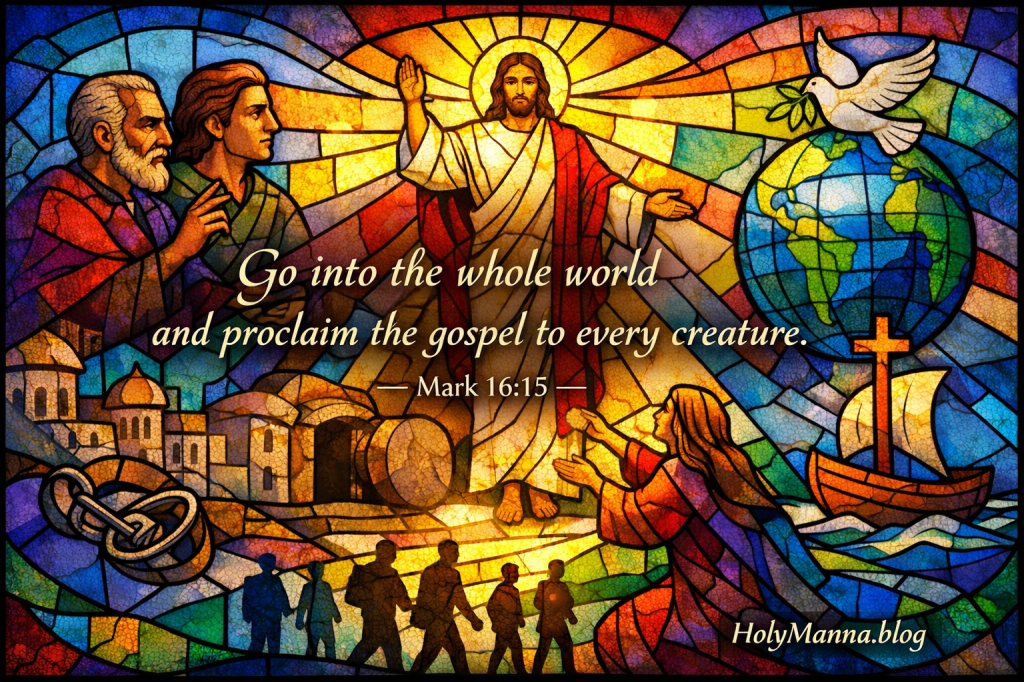
The Commissioning of the Eleven. 14 [But] later, as the eleven were at table, he appeared to them and rebuked them for their unbelief and hardness of heart because they had not believed those who saw him after he had been raised. 15 He said to them, “Go into the whole world and proclaim the gospel to every creature.
Detailed Exegesis
Verse 9 – “When he had risen, early on the first day of the week, he appeared first to Mary Magdalene, out of whom he had driven seven demons.”
This verse begins with both triumph and tenderness. Christ is risen, and the first appearance in this passage is given to Mary Magdalene. The mention that seven demons had been driven out of her recalls the depth of her former affliction and the greatness of the Lord’s mercy. In biblical language, the number seven often suggests fullness or completeness. Her past bondage had been grave, but Christ’s healing had been greater. The risen Lord appearing first to Mary Magdalene shows that grace does not merely restore the broken. Grace can also raise them up as chosen witnesses. Easter begins here with a quiet but profound lesson. Christ delights in lifting up the humbled and making the healed person a herald of divine mercy.
Verse 10 – “She went and told his companions who were mourning and weeping.”
Mary Magdalene does not keep the encounter to herself. She becomes a messenger. This is the first movement of evangelization in the passage. Encounter leads to proclamation. The disciples, however, are still described as mourning and weeping. The emotional atmosphere matters. These are not men casually ignoring good news. These are hearts still overshadowed by the trauma of the Passion. Their sorrow helps explain their hesitation, even if it does not excuse it. The verse reminds the faithful that grief can cloud the heart, and yet grace still presses forward through the witness of those who have seen the Lord.
Verse 11 – “When they heard that he was alive and had been seen by her, they did not believe.”
This verse is sobering because it shows that resurrection faith did not arise from wishful thinking. The disciples did not simply invent belief because they wanted comfort. In fact, they resisted the testimony that should have filled them with hope. Their unbelief becomes indirect evidence of how unexpected the Resurrection really was. It also reveals a spiritual condition that goes deeper than lack of information. The human heart can hear truth and still hesitate before surrendering to it. This is why faith is not merely data received. It is the heart opening to God.
Verse 12 – “After this he appeared in another form to two of them walking along on their way to the country.”
The risen Jesus appears again, now to two disciples on the road. The phrase about another form does not mean that Christ ceased to be Himself. Rather, it points to the transformed condition of His risen body and to the mystery that He is recognized according to His will. This verse recalls that the Resurrection is not a simple return to ordinary earthly life. Christ is truly risen, truly bodily, yet glorified. He is the same Lord, but now beyond the limitations of mortal existence. The Church hears in this verse an echo of the mystery that the disciples must be taught to see Him anew.
Verse 13 – “They returned and told the others; but they did not believe them either.”
The pattern repeats itself. Testimony is given, and unbelief remains. This repetition is important because it underscores the seriousness of the disciples’ resistance. Christ provides witness upon witness, and still the heart resists surrender. Yet there is also mercy hidden in this repetition. The Lord continues to pursue His own. He does not abandon the disciples because they are slow to believe. He keeps coming. That is one of the quiet glories of Easter. Christ is patient with weak disciples, but He does not leave them in their weakness.
Verse 14 – “[But] later, as the eleven were at table, he appeared to them and rebuked them for their unbelief and hardness of heart because they had not believed those who saw him after he had been raised.”
Now the risen Lord comes directly to the Eleven. The setting at table is fitting, because throughout the Gospel tradition table fellowship carries echoes of communion, revelation, and restored relationship. Jesus rebukes them, but the rebuke itself is merciful. He corrects them because He intends to restore and strengthen them. The phrase hardness of heart is especially important. In Scripture, hardness of heart points to spiritual resistance, a refusal to yield before the works of God. Jesus does not ignore this problem. He names it. Yet He names it not to crush them, but to heal them. The Lord’s correction is part of His love. He purifies the apostles so they can become trustworthy witnesses.
Verse 15 – “He said to them, ‘Go into the whole world and proclaim the gospel to every creature.’”
This final verse opens the horizon of the whole Church. The same disciples who had been mourning, doubting, and resisting belief are now sent on mission. That is the great turn of the passage. Christ does not wait for polished perfection before sending them. He rebukes, heals, commissions, and entrusts. The mission is universal. The Gospel is not for one tribe, one city, or one class of people. It is for the whole world and every creature. This verse stands as one of the clearest missionary commands in the New Testament. The Church exists to proclaim Christ, because the Resurrection is not a private comfort. It is the saving truth meant for all nations.
Teachings
This Gospel teaches that Easter faith is both a gift and a summons. The disciples do not arrive at resurrection faith by their own brilliance. Christ reveals Himself. Christ corrects them. Christ sends them. The initiative belongs to Him from beginning to end. That is why the Church has always taught that faith begins with grace and leads to mission.
The Catechism speaks directly to the reality of the Resurrection appearances in CCC 641: “Mary Magdalene and the holy women, who came to finish anointing the body of Jesus, which had been buried in haste because the sabbath began on the evening of Good Friday, were the first to encounter the Risen One. Thus the women were the first messengers of Christ’s Resurrection for the apostles themselves.” This teaching is essential for understanding verse 9. Mary Magdalene is not a decorative figure in the Easter story. She is entrusted with real witness. The Church honors that role because it reveals both the historical concreteness of the Resurrection and the generosity of Christ in choosing His witnesses.
The Catechism continues in CCC 643: “Given all these testimonies, Christ’s Resurrection cannot be interpreted as something outside the physical order, and it is impossible not to acknowledge it as an historical fact.” That line matters greatly in this passage because the disciples themselves resist belief. Their slowness to accept the testimony shows that the Resurrection was not treated by them as a poetic symbol or vague spiritual survival. It confronted them as a real and astonishing event that overturned their expectations.
This Gospel also speaks to the Church’s apostolic mission. In CCC 857, the Church teaches: “The Church is apostolic because she is founded on the apostles, in three ways: first, she was and remains built on ‘the foundation of the Apostles’, the witnesses chosen and sent on mission by Christ himself; second, with the help of the Spirit dwelling in her, the Church keeps and hands on the teaching, the ‘good deposit,’ the salutary words she has heard from the apostles; third, she continues to be taught, sanctified, and guided by the apostles until Christ’s return, through their successors in pastoral office: the college of bishops, ‘assisted by priests, in union with the successor of Peter, the Church’s supreme pastor.’” Verse 15 rests at the center of that teaching. Christ sends the apostles, and from that sending the Church’s missionary and apostolic identity unfolds through history.
The Gospel also touches the moral life of every Catholic. In CCC 1816, the Church teaches: “The disciple of Christ must not only keep the faith and live on it, but also profess it, confidently bear witness to it, and spread it.” That is the path from verse 14 to verse 15. Unbelief and fear must give way to witness. A Catholic is not called merely to admire the Resurrection in silence. A Catholic is called to profess Christ in life and speech.
Saint Gregory the Great, preaching on the Resurrection appearances, saw in Mary Magdalene the image of a soul transformed by love and mercy. His reflections help illuminate the passage because they show that the Lord often entrusts the deepest proclamation to the one who has been deeply healed. The Church has long recognized that the apostles themselves were schooled by their weakness. Their eventual courage makes it plain that the power of the Gospel comes from Christ, not from natural self-confidence.
Historically, this missionary command shaped the entire life of the early Church. From Jerusalem the Gospel moved outward through apostolic preaching, martyrdom, sacramental life, and the founding of Christian communities across the Roman world. The same command still resounds in every age. The Church is never allowed to become inward, self-protective, or merely sentimental. Easter always sends her outward.
Reflection
This Gospel is deeply comforting because it tells the truth about discipleship. The first followers of Jesus were not spiritual celebrities gliding effortlessly into Easter joy. They were grieving men with slow hearts, wounded memories, and difficulty believing what God had done. Yet Christ came to them anyway. He did not cast them aside for their weakness. He corrected them, stood before them, and entrusted them with the mission that would change the world.
That pattern still holds. Many souls know what it means to hear the truth of the faith and still wrestle with fear, hesitation, or spiritual dullness. Sometimes the heart is like the Eleven at table. It has heard testimony, but it is still holding back. This Gospel reminds the faithful that Jesus does not stop calling because a disciple is slow. He comes again. He speaks again. He heals what is hard. Then He sends.
The practical lesson is simple, but not easy. A disciple must first receive the risen Christ honestly. That means naming any unbelief, resistance, or hardness of heart in prayer instead of hiding it. A second step is to listen to the witnesses Christ has already placed in the Church, in Sacred Scripture, the saints, the sacraments, and the apostolic tradition. A third step is to speak. The Gospel cannot remain hidden in private devotion alone. The believer is called to witness in family life, work, friendship, suffering, and public fidelity.
This passage also invites honest questions that reach the soul. Where has grief, disappointment, or fear made the heart slower to believe what God has done? Has there been a quiet resistance to the Lord’s call because full surrender feels costly? What part of the Gospel has been admired from a distance instead of proclaimed with conviction? How might the risen Christ be moving this life from hesitation into mission?
The beauty of today’s Gospel is that it does not end with rebuke. It ends with sending. The risen Christ takes disciples who were once afraid and makes them apostles to the nations. That is still His way. He enters closed hearts, speaks peace and truth, and turns trembling believers into witnesses. Easter does not simply announce that Jesus lives. Easter announces that because He lives, weak people can be remade, and the world can be told.
When Easter Becomes a Way of Life
Today’s readings move like one beautiful story of grace. The Gospel begins with sorrow, hesitation, and hearts that struggle to believe. The first reading shows those same disciples standing with a courage that the world cannot explain. The psalm gives the Church the song that belongs between those two moments, the song of a soul that has suffered, been upheld by God, and now cannot help but give thanks. Taken together, these readings reveal the same central truth: the risen Jesus does not leave His people trapped in fear. He meets them, strengthens them, and sends them.
That is the great hope of Easter. Christ does not build His Church out of naturally fearless people. He builds it out of forgiven sinners, healed hearts, and ordinary disciples who have learned to stay close to Him. Mary Magdalene becomes a witness. Peter and John become bold before their enemies. The mourning disciples become men entrusted with the Gospel for the whole world. Everything changes because Jesus is truly alive.
That same pattern still unfolds in the life of the faithful now. The Lord still finds people in grief, confusion, weakness, and doubt. He still speaks peace. He still rebukes what is hard in the heart. He still teaches His people to praise Him after trial. And He still sends them into the world, not always to grand stages, but into homes, workplaces, friendships, parishes, and daily conversations where quiet fidelity can shine like a light.
The invitation at the end of today’s Mass is both simple and demanding. Stay near to Jesus. Let His Resurrection become more than a truth that is remembered and become a truth that shapes the whole life. Speak His name without shame. Give thanks in the middle of hardship. Refuse the kind of fear that makes faith go silent. Let the people around this life begin to recognize what the Sanhedrin recognized in the apostles, that this is someone who has been with Jesus.
What would change if Easter were lived not just as a season, but as the pattern of daily life? Where is the risen Christ asking for deeper trust, clearer witness, and more joyful gratitude? The road forward is not complicated, even if it is costly. Pray with honesty. Receive the sacraments with faith. Open Sacred Scripture with reverence. Speak the truth with charity. And when the moment comes to choose between comfort and fidelity, choose Christ.
That is how Easter keeps moving through the world. One faithful soul at a time. One act of courage at a time. One word of witness at a time. The tomb is empty, the Lord is risen, and that means no life given to Him is ever ordinary again.
Engage with Us!
Readers are invited to share their reflections in the comments below. What stood out most in today’s readings? What challenged the heart, offered comfort, or called for a deeper response to the risen Christ?
- In the First Reading from Acts 4:13-21, what part of Peter and John’s courage speaks most powerfully to daily life? Where might there be a need to obey God more boldly instead of giving in to fear, pressure, or silence?
- In the Responsorial Psalm, Psalm 118:1, 14-21, which verse feels most personal right now? How has the Lord shown His strength, mercy, or deliverance in the middle of hardship, correction, or waiting?
- In the Holy Gospel from Mark 16:9-15, what can be learned from the disciples’ struggle to believe and from Christ’s patience with them? Is there any place where the risen Jesus may be calling for deeper trust, greater openness, or a more courageous witness?
- Looking at all three readings together, how is the Lord inviting this life to move from fear into faith, from gratitude into praise, and from encounter into mission?
May today’s readings stir hearts to live with greater courage, deeper trust, and lasting gratitude. May every word, every choice, and every act be shaped by the love and mercy Jesus taught, so that daily life itself becomes a witness to the beauty of the Gospel.
Sacred Heart of Jesus, we trust in You!
Immaculate Heart of Mary, pray for us!
Saint Michael the Archangel, defend us in battle!
Follow us on YouTube, Instagram and Facebook for more insights and reflections on living a faith-filled life.

 Holy Manna!
Leave a comment