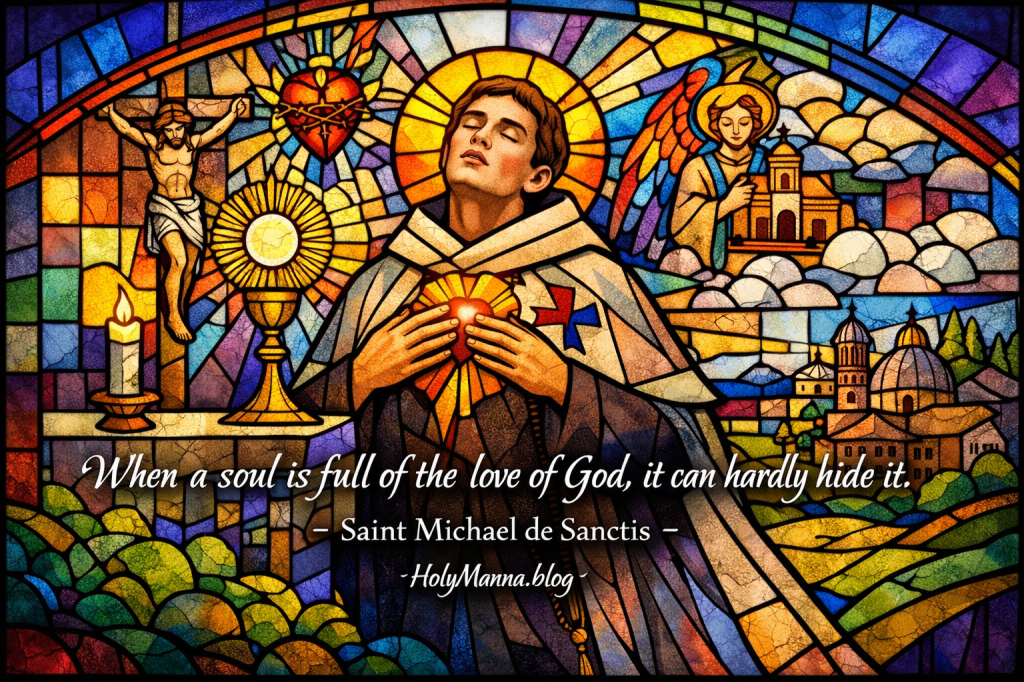
The Saint Whose Heart Burned Before the Eucharist
Saint Michael de Sanctis, also known as Saint Michael of the Saints, is one of those saints who makes the interior life feel startlingly real. He did not found a nation, conquer an empire, or leave behind shelves of famous books. What he did leave was something the Church never stops honoring: a life consumed by love for Jesus Christ, especially in the Holy Eucharist.
He is revered in Catholic tradition as a Spanish Discalced Trinitarian priest whose soul seemed to live very near the altar. He is remembered for deep prayer, severe penance, charity, preaching, mystical ecstasies, and an astonishing tenderness toward Christ present in the Blessed Sacrament. His life reminds the Church that holiness is not always loud. Sometimes it is hidden, burning, and almost unbearable in its love.
Born on 29 September 1591 in Vic, Catalonia, Michael came into a large and devout Catholic family. Catholic tradition holds that his parents, Enrique Argemir and Montserrat Mitjà, formed a home marked by prayer, the Rosary, the Gospel, and reverence for God. Even as a child, Michael showed signs that his heart was leaning somewhere beyond ordinary life. Stories preserved in Catholic tradition say that he slept under his bed, used a stone for a pillow, and tried to run off to live as a hermit. These details have the feel of holy childhood stories passed down because they revealed something true about the boy’s soul. He already wanted God more than comfort.
That does not mean his early life was easy. He lost both of his parents while still young, and relatives placed him into practical work. Commerce and worldly success clearly did not fit him. His heart was already elsewhere. What others may have seen as oddness, the Church would later recognize as the first stirrings of sanctity.
From Catalan Boy to Trinitarian Flame
At a very young age, Michael entered the Trinitarian world. He first joined the Calced Trinitarians and began novitiate in Zaragoza. Later, drawn by a deeper desire for poverty, penance, and radical fidelity, he entered the reform of the Discalced Trinitarians. There he took the name Michael de Sanctis.
This was not a dramatic conversion from sin in the way some saints experienced. His story is more like a steady intensification of grace. God took the longings already present in him and purified them. The desire for solitude became deeper prayer. The instinct for self-denial became disciplined penance. The attraction to holiness became total surrender.
He studied in several houses of the order, including Baeza and Salamanca, and was eventually ordained a priest. Catholic tradition remembers him not merely as a mystic but also as a faithful religious and apostolic priest. He preached, heard confessions, guided souls, and served his community. He was entrusted with leadership even while still young, eventually serving in Valladolid.
What was he most known for? Above all, Saint Michael de Sanctis is known for his overwhelming love for the Holy Eucharist. He is one of those saints whose whole life seems to circle the mystery of Christ truly present on the altar. Catholic accounts repeatedly describe him entering ecstasy during Mass, especially at the Consecration. That fact alone tells a great deal about him. The Eucharist was not a symbol to him. The Eucharist was Jesus, living and near.
A line attributed to him in Trinitarian tradition says, “Siempre estoy en oración,” or in English, “I am always in prayer.” Whether spoken in exactly that form or preserved as a summary of his spirit, the line fits the man completely.
When Prayer Overflowed Into Wonder
Saint Michael’s life includes extraordinary mystical events that Catholic tradition has long associated with him. The Church never asks the faithful to chase the marvelous for its own sake, but the lives of the saints often show what happens when divine love overflows beyond what seems ordinary.
The most famous grace linked to Saint Michael is the mystical exchange of hearts with Christ. In Trinitarian tradition, this is remembered as the defining moment of his spiritual life. The meaning is profoundly Catholic. The saint did not become less himself. He became more deeply united to Christ. This mystery calls to mind Saint Paul’s words, “It is no longer I who live, but Christ who lives in me” Gal 2:20. That is the heart of Michael de Sanctis. His soul became a dwelling place where the life of Jesus burned with unusual brightness.
Another striking story comes from Salamanca. During a theological lecture, he was reportedly so caught up in divine love that he cried out and was lifted from the ground in ecstasy. A witness is said to have remarked, “When a soul is full of the love of God, it can hardly hide it.” That sentence captures the whole saint. He was not performing for anyone. He was overtaken by the reality of God.
Catholic tradition also preserves the testimony that he would enter ecstasy at Mass, especially at the moment of consecration. For a Catholic soul, this matters deeply. It is one thing to say that the Eucharist is the source and summit of the Christian life, as The Catechism teaches in CCC 1324. It is another thing to see a saint whose body and soul seemed unable to remain untouched by that truth.
His miracles during life are not remembered mainly as public acts of healing like those of some saints. Instead, they are remembered as signs of mystical union, prophetic insight, and a life transformed by grace. He was also known for preaching that moved souls to conversion and for charity toward those around him. The miracle, in one sense, was Michael himself. God took a young friar and made him into a living witness that prayer is not an escape from reality, but entrance into its deepest center.
The Cross He Carried in Hidden Places
Saints are never made by sweetness alone. The Lord always gives them a share in His Cross. Saint Michael de Sanctis carried several crosses, many of them hidden.
He endured the pain of losing his parents while still a child. He lived with the tension of being obviously unsuited for the ordinary ambitions of the world. He embraced a life of rigorous penance that would seem severe even by older Catholic standards. He also faced misunderstanding and calumny. Catholic tradition records that he was falsely accused by some and even briefly imprisoned. That part of his story is worth remembering because mystical souls are often misunderstood. Holiness attracts reverence in some, but suspicion in others.
And yet he endured all of it with perseverance. There is no evidence that he built his identity around being mistreated. He simply kept turning toward Christ. That quiet endurance is part of what makes him compelling. He did not need to defend himself endlessly. He needed to remain faithful.
His death came early. He died in Valladolid on 10 April 1625 at about thirty-three years of age, the earthly age of Christ. Some Catholic accounts say he foresaw his death. Others note that he died after illness, likely typhoid fevers. Either way, the end of his earthly life matched the pattern of the rest of it. He burned quickly, intensely, and completely.
Saint Michael was not a martyr in the strict sense, because he was not killed by persecutors for the faith. But he lived something that the saints know well: the long martyrdom of self-gift. He died having poured himself out in prayer, penance, service, and love.
The Fire That Did Not Go Out
After his death, devotion to Saint Michael de Sanctis only grew. Catholic tradition says that the people of Valladolid honored him with great reverence, sensing that a holy priest had passed from among them. His relics came to be venerated, and his tomb in Valladolid remains an important site connected to his memory. His birth house in Vic also became tied to local devotion, and his native city continues to honor him publicly.
Pope Pius VI beatified him in 1779, and Pope Pius IX canonized him on 8 June 1862. That canonization did not create his sanctity. It confirmed what the faithful had long recognized.
Catholic sources also speak of miracles, favors, healings, and even apparitions attributed to his intercession after death. Many of these were said to be considered in the processes that led to his canonization. However, the surviving summary accounts do not always preserve each story in full detail. Because of that, the individual miracle stories after his death cannot all be retold in a fully verifiable way here. What can be said with confidence is that his cult grew because many Catholics believed they had received real help through his intercession.
There is also a longstanding tradition that his body was found incorrupt. This tradition belongs to his devotional legacy, but it cannot be fully verified here from the summary accounts alone.
His impact after death did not stay confined to monasteries. He became the patron saint of Vic, and the city still celebrates him with solemn religious festivities and public devotion. In Trinitarian spirituality, he remains a model of youthful holiness and is often honored as patron of Trinitarian youth. He is also invoked in some Catholic circles as an intercessor against tumors, cancers, and fevers.
That local and cultural legacy matters. The Church does not only remember saints in books. The Church remembers them in liturgy, feast days, processions, songs, relics, and family memory. Saint Michael de Sanctis still lives in that way, not as a dead historical figure, but as a living member of the Communion of Saints.
Why This Saint Still Matters Now
Saint Michael de Sanctis speaks powerfully to a restless age. The modern world trains the soul to scatter itself. Notifications, anxieties, ambitions, and appetites pull the heart in a hundred directions. His life says that the human heart was made for one center, Jesus Christ.
He also reminds the faithful that the Eucharist is not background scenery for Catholic life. The Eucharist is everything. When a saint faints, trembles, or enters ecstasy at the altar, it is not because he is being theatrical. It is because he sees more clearly than most people what is really there. Christ is present. Heaven touches earth. Redemption becomes sacramentally near.
His life also offers a needed correction to shallow ideas of holiness. Sanctity is not mere niceness. It is not spiritual aesthetics. It is not appearing devout. Holiness means giving Christ room to take over the heart. It means prayer when nobody sees. It means fidelity when misunderstood. It means penance that teaches the body not to rule the soul. It means loving the Church enough to live her mysteries seriously.
What would happen if daily Mass were treated not as an obligation to get through, but as the place where the heart learns how to belong entirely to Jesus? That is the kind of question Saint Michael forces into the open.
Readers today can imitate him in practical ways. Spend time in Eucharistic adoration. Go to confession regularly. Build real silence into the day. Pray the Rosary with attention. Fast with humility. Receive Holy Communion with reverence. Speak less about being spiritual and become more available to grace. None of that is flashy. All of it is powerful.
Saint Michael de Sanctis shows that the deepest saints are often the ones who let Christ remake them from the inside out.
Engage with Us!
Share your thoughts and reflections in the comments below. Saint Michael de Sanctis is the kind of saint who invites more than admiration. He invites examination of conscience, deeper Eucharistic love, and a more serious interior life.
- What part of Saint Michael de Sanctis’ life stands out most strongly, his Eucharistic devotion, his penance, his hidden suffering, or his mystical union with Christ?
- How does his love for the Blessed Sacrament challenge the way the soul approaches Mass and Holy Communion?
- Is there too much noise in daily life for real prayer, and what would need to change for the heart to become more recollected before God?
- What hidden cross might Christ be asking to carry with greater patience and trust?
- How can this week include one concrete act of deeper love for Jesus in the Eucharist?
Saint Michael de Sanctis proves that a life does not need to be long to become luminous. It needs to be surrendered. May his example move every heart to live with greater faith, greater purity, and greater hunger for Christ. May Jesus teach His people to do everything with the love and mercy He revealed to the world.
Saint Michael de Sanctis, pray for us!
Follow us on YouTube, Instagram and Facebook for more insights and reflections on living a faith-filled life.

 Holy Manna!
Leave a comment