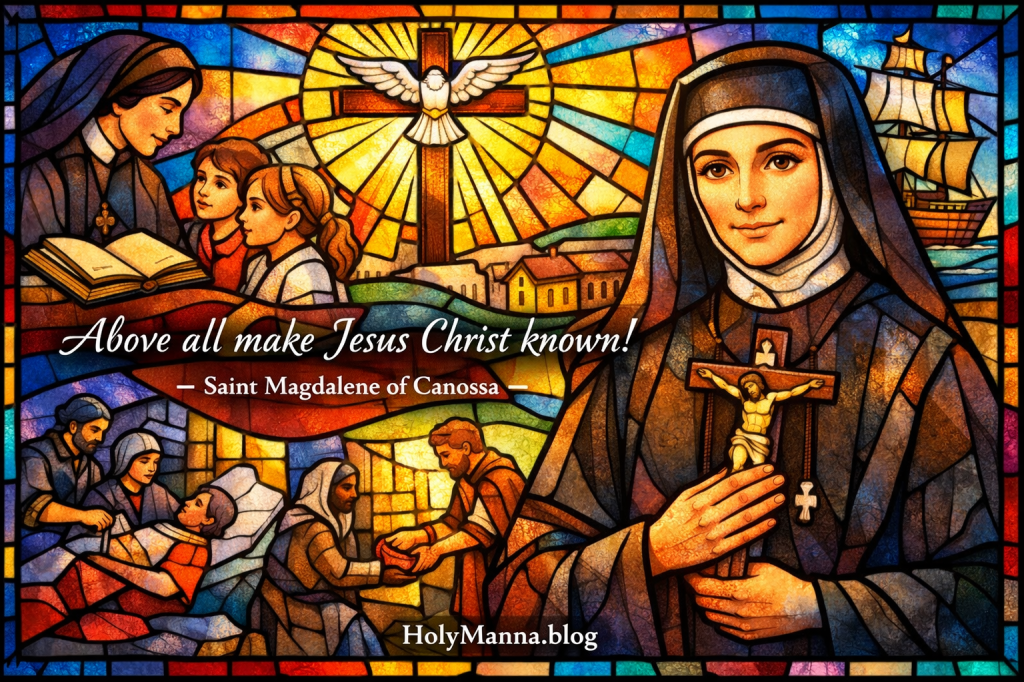
A Heart Set on Making Jesus Known
Saint Magdalene of Canossa is revered in the Roman Catholic Church as a virgin, a foundress, and a woman who allowed the love of Christ Crucified to reshape her whole life. Born into privilege, she became one of the great servants of the poor in modern Catholic history. The Church remembers her above all for founding the Canossian Family of Charity and for handing on a simple but blazing mission: “Above all make Jesus Christ known!” Her liturgical memorial is kept on April 10.
What makes her story so compelling is that she did not begin on the margins. She began in a palace. She could have lived and died as an admired noblewoman in Verona. Instead, grace pressed on her heart until she understood that Christian love could not remain comfortable. Saint John Paul II reflected on her life by saying that she realized she could not love her neighbor merely as a lady of status, while still enjoying the privileges of her class. She had to give not only her resources, but herself. That is why she is still cherished as a saint of active charity, Catholic education, catechesis, and love for the poorest of Christ’s little ones.
The Cross That Trained Her Heart
Magdalene Gabriella of the Marquises of Canossa was born in Verona on March 1, 1774, the third of six children in a noble and wealthy family. Her early years were marked by painful wounds. Her father died when she was still young. Her mother remarried. Illness, misunderstanding, and family sorrow shaped her childhood and adolescence. Catholic tradition presents these sufferings not as meaningless tragedies, but as the school in which the Lord prepared her heart. Even before she founded anything, she was already being taught how to cling to God when earthly security failed.
At seventeen, she felt drawn to consecrate herself totally to God and twice attempted the Carmelite life. Yet each time she returned home. The Church’s own accounts present this not as indecision, but as discernment. The Holy Spirit was guiding her away from the cloister and toward a different mission. She was being led to belong to Jesus Crucified in a way that would make her wholly available to the poor, the sick, the neglected, and those starved not only of bread, but also of instruction, dignity, and the Word of God.
For a time she remained in the Canossa household and accepted the burden of administering the family estate. That detail matters. Her sanctity did not begin in visible success. It began in obedience, hidden sacrifice, and a vocation carried in silence. While she fulfilled her daily responsibilities, the Lord widened her heart. The poor of Verona became impossible for her to ignore. The wounds left by political turmoil, poverty, and social instability stirred her deeply, and she began to understand that Christ was calling her out of comfort and into mission.
When a Palace Was No Longer Enough
In 1808, after recovering from serious illness and overcoming resistance from her family, Magdalene left the Canossa palace for good and moved into one of the poorest parts of Verona. There she began the work God had planted in her heart. From that moment, her life took on a prophetic clarity. She did not simply donate to the poor from a safe distance. She went to them. She lived among those who suffered. She let the Gospel become visible in works of mercy. Catholic sources remember this move as the great turning point of her vocation and the real beginning of the Canossian mission.
She is especially known for founding the Daughters of Charity and, later, helping begin the Sons of Charity. Her mission unfolded in very concrete ways. She established charity schools, promoted catechesis for all classes of people, cared for women in hospitals, formed teachers for rural areas, and organized spiritual exercises that helped renew Christian life in others. This combination is one of the most beautiful features of her legacy. She did not separate love of souls from love of bodies. She cared for the hungry, the sick, the ignorant, the abandoned, and the spiritually neglected, because she saw them all through the eyes of Christ.
A striking phrase tied to her spiritual vision captures the whole tone of her life: “Charity is like a blazing fire!” That image fits her perfectly. Her charity was not cold philanthropy. It was not social respectability dressed up in religious language. It was a living fire born from contemplation of Jesus Crucified and Risen. She wanted people not merely to survive, but to encounter the love of God.
A Saint of Mercy in Action
Saint Magdalene is important because she shows how deeply Catholic charity must reach. She did not stop at almsgiving. She taught. She formed consciences. She organized works of mercy. She strengthened the faith of the neglected. She understood that the poor need food, shelter, compassion, instruction, and the truth of the Gospel. In this, her life beautifully reflects The Catechism, which teaches that the works of mercy are actions by which Christians aid their neighbor in both spiritual and bodily necessities, including instructing, consoling, feeding, sheltering, and visiting the sick and imprisoned. CCC 2447 could almost be read as a summary of her apostolate.
Her work expanded beyond Verona into Venice, Milan, Bergamo, and Trent. Between 1819 and 1820, the Institute received ecclesiastical approval in the dioceses where the communities were present. Then, on December 23, 1828, Pope Leo XII approved the Rule of the Institute with the brief Si Nobis. Near the end of her life, the male branch she had long desired also began to take shape. On May 23, 1831, the first Oratory of the Sons of Charity opened in Venice for the Christian formation of boys and men. These milestones show that her mission was not a passing burst of generosity. It became a stable gift to the Church.
She also had an eye for the apostolate of the laity. Official Catholic and Canossian sources note that her charism did not end with two religious institutes. Lay people, too, found in her spirituality a way of living the faith and witnessing to charity in ordinary Christian life. That is one reason her legacy has endured so strongly. She founded a family, not just an organization.
The Quiet Miracle of a Holy Life
When speaking about miracles during her lifetime, care is needed. The major Catholic sources publicly available do not preserve a set of famous, well-documented miracle stories performed by Saint Magdalene in the way some saints are remembered for dramatic healings or supernatural signs. What they do preserve in a clear and trustworthy way is the miracle of a transformed life and a transformed city: a noblewoman who became poor with the poor, who built works of mercy, and who set countless others on fire with the love of Christ. That should not be treated as a lesser thing. In the life of the Church, holiness itself is the deepest sign of grace.
There is, however, no doubt that miracles were associated with her cause in the formal life of the Church. She was beatified on December 7, 1941 by Pope Pius XII and canonized on October 2, 1988 by Pope John Paul II. Because she was not a martyr, recognized miracles were required in the canonical process that led to these honors. Still, the specific miracle narratives themselves were not publicly detailed in the Catholic sources reviewed, so it would not be honest to invent them or pretend certainty where the available official material remains brief.
One of the most memorable sayings associated with her comes from Catholic tradition that preserves her spiritual boldness: “Because I was born a marchioness, can I not have the honor of serving Jesus Christ in His poor?” That line says everything. It reveals humility, courage, and a soul that had come to see worldly privilege as small compared with the privilege of serving Christ. Another treasured saying, preserved in the Canossian tradition, reminds her spiritual children that “The Institute belongs to God and Mary Most Holy.” These are not empty religious phrases. They are windows into the inner life of a woman who had surrendered herself completely to the Lord.
No Martyr’s Blood, but a Life Poured Out
Saint Magdalene of Canossa was not a martyr in the strict sense. She was not executed for the faith. Yet her life still bore the marks of a long martyrdom of charity. She endured family resistance, illness, misunderstanding, spiritual trials, and the burden of responsibility. She had to wait, discern, suffer delays, and watch God’s plans unfold slowly. She knew what it was to carry a call in her heart before anyone else could understand it.
That kind of suffering is easy to overlook, but it is deeply important for ordinary Christians. Not every saint dies in an arena. Some saints die after years of hidden fidelity, after carrying the cross in daily life, after choosing Christ again and again when the path is unclear. Magdalene’s hardships gave credibility to her mercy. She knew sorrow. She knew sacrifice. She knew what it cost to leave security behind. That is why her witness feels so real.
She died in Verona on April 10, 1835, surrounded by her spiritual daughters, on the Friday of Passion Week. Even the timing of her death seems fitting. Her whole life had been shaped by the Cross, and she departed this life during the Church’s solemn remembrance of the Lord’s Passion.
The Fire Kept Burning After Her Death
After her death, Saint Magdalene’s legacy did not fade. It spread. The Vatican biography notes that the Daughters of Charity traveled to the Far East in 1860, and the Canossian mission continued to grow across continents. Modern Canossian sources still speak of her charism as alive on the five continents, carried by sisters, priests, religious, and lay faithful who continue her work of education, evangelization, and mercy.
Her influence also reached other saints. Catholic sources note that Saint Josephine Bakhita entered the Institute of Saint Magdalene of Canossa and made her religious profession there. That alone says something beautiful about Magdalene’s spiritual motherhood. Her charism helped form another saint whose life would radiate hope to the whole Church.
In terms of veneration and ongoing celebration, the Church keeps her liturgical memorial on April 10, while the Canossian family also marks May 8 as a special day dedicated to their foundress. Recent Canossian celebrations, jubilee observances, and international gatherings show that she still has real cultural and spiritual impact in Catholic communities around the world. Her memory is not merely historical. It remains living, liturgical, and missionary.
As for pilgrimages and holy places, Verona remains central to her memory, since it is the city of her birth, her mission, and her death. Catholic sources also note that her earthly remains rest there. For the faithful, places like Verona matter not because saints become magical figures, but because the Church remembers that grace entered real streets, real homes, and real bodies. The saints remind the faithful that holiness is not abstract. It happens in history.
What Her Life Still Says to the Church
Saint Magdalene of Canossa speaks with unusual force to a world that often confuses comfort with blessing and sentiment with charity. She teaches that real love costs something. She teaches that Christian service must be rooted in Jesus Christ, not in vanity, guilt, or public image. She teaches that the poor are not projects. They are persons in whom Christ waits to be loved. Her life also shows that catechesis matters. Feeding the hungry is holy. Teaching the ignorant is holy. Visiting the sick is holy. Helping souls know Jesus is holy.
There is also something deeply encouraging in the way her vocation unfolded slowly. She did not understand everything at once. She tried one path, then another. She suffered setbacks. She waited. She carried hidden burdens. Yet grace was at work through all of it. That is a needed lesson for anyone who feels delayed, overlooked, or unsure of God’s timing. The Lord was not absent in her years of uncertainty. He was preparing her for fruitfulness.
Is there some comfortable corner of life that still has not been surrendered to Christ? Is there a person nearby who is hungry not only for help, but also for truth, dignity, and genuine Christian love? Is there a work of mercy that has been admired from a distance but not yet embraced personally? Saint Magdalene’s life presses those questions gently but firmly onto the heart.
A practical way to imitate her is to begin where she began, with Christ Crucified. Spend time before a crucifix. Pray slowly with Philippians 2:5-8 or Psalm 34. Ask for a heart that does not serve from above, but from within. Then choose one real act of mercy. Teach someone the faith. Visit someone who is lonely. Help a struggling family. Support a Catholic school or parish catechesis program. Offer patient love where it is hardest. This is how the fire spreads.
Engage with Us!
Share your thoughts and reflections in the comments below. Saint Magdalene of Canossa has a way of stirring the conscience and enlarging the heart, and it would be a blessing to hear how her witness speaks into daily life today.
- What part of Saint Magdalene’s story stands out the most, her noble birth, her hidden suffering, or her radical service to the poor?
- How does her example challenge the way charity is usually thought about in modern life?
- What is one corporal or spiritual work of mercy that could be practiced more faithfully this week?
- Why is it important that she wanted not only to help the poor materially, but also to make Jesus known to them?
- What would it look like to let charity become a blazing fire in ordinary family, parish, and work life?
Saint Magdalene reminds the faithful that holiness is not reserved for the dramatic or the famous. It is built in fidelity, charity, sacrifice, and love for Christ in the poor. May her witness encourage a life of faith that is warm, courageous, and deeply Catholic, and may every work, every word, and every sacrifice be offered with the love and mercy Jesus taught us.
Saint Magdalene of Canossa, pray for us!
Follow us on YouTube, Instagram and Facebook for more insights and reflections on living a faith-filled life.

 Holy Manna!
Leave a comment