Friday in the Octave of Easter – Lectionary: 265
Dawn on the Shore, Courage in the Court
There is something deeply beautiful about the way the Church places these readings together during the Octave of Easter. They carry the heart from the quiet light of dawn on the Sea of Tiberias to the tense air of judgment before the Sanhedrin, and in both places the same truth shines through: the risen Jesus Christ is the cornerstone, the Savior, and the source of the Church’s courage, fruitfulness, and joy. Easter is not only the memory of an empty tomb. Easter is the living power of Christ still revealing himself, still feeding his people, and still turning fearful disciples into bold witnesses.
That theme binds the whole day together: the risen Lord takes what seems weak, rejected, or empty, and fills it with divine life. In Acts of the Apostles, Peter stands before powerful religious leaders and proclaims with astonishing clarity that “there is no salvation through anyone else” and that the one they rejected has become the foundation of everything. In Psalm 118, the Church sings the words that help interpret both the Cross and the Resurrection: “The stone the builders rejected has become the cornerstone.” In The Gospel of John, the disciples labor through the night with empty nets until Jesus appears at dawn, and suddenly their failure gives way to abundance, recognition, and communion.
The historical setting makes these readings even richer. The apostles are still living in the shock and wonder of the Resurrection, but the world around them has not changed its mind about Jesus. The same authorities who opposed him now question his followers. The same city that witnessed his Passion now hears his name preached with power. This is what makes the Easter season so striking. The Resurrection does not remove conflict from the world overnight, but it does change everything from within. Men who once hid behind locked doors now speak openly. Fishermen who caught nothing on their own are gathered into a mission that will draw souls from every nation. The rejected stone is now the cornerstone of a new temple, a new people, and a new creation.
These readings also carry a deeply Catholic vision of the Church. The risen Christ does not leave his disciples scattered in private spiritual experiences. He gathers them, feeds them, sends them, and speaks through them. The breakfast by the sea is tender and intimate, but it is also a quiet preparation for mission. Peter’s speech before the Sanhedrin is bold and public, but it is rooted in the same encounter with the living Lord. This is how Easter works in the life of the Church. Christ first reveals himself, then he strengthens his people, and then he sends them out in his name.
Where does the risen Jesus stand on the shore of life today, waiting to be recognized? Where are the empty nets, the old fears, or the places of rejection that he is ready to transform? Today’s readings invite the heart to see that Easter is not a distant event from long ago. It is the living triumph of Christ, still calling, still feeding, still saving, and still making all things new.
First Reading – Acts 4:1-12
The Name That Cannot Be Silenced
The first reading opens in the tense, trembling days just after the Resurrection, when the apostles are no longer hiding behind locked doors but standing in public, preaching Jesus in the heart of Jerusalem. This is not happening in some distant village or in a quiet corner of the world. It is taking place in the holy city, near the Temple, before the same religious atmosphere that had recently condemned Christ. The priests, the captain of the temple guard, and the Sadducees are alarmed because Peter and John are not merely teaching morals or offering comfort. They are proclaiming something explosive: Jesus, who was crucified, is risen, and in his name the lame are healed and the dead are promised life.
That background matters. The Sadducees, unlike the Pharisees, denied the resurrection of the dead. So when Peter and John preach the Resurrection in Jesus, they are not simply sharing a spiritual opinion. They are confronting one of the central errors of the ruling class. Even more, they are declaring that the power at work in Israel is no longer centered in the Temple authorities who rejected Christ, but in the risen Lord himself. This is why the reading fits so perfectly into today’s Easter theme. The risen Jesus takes what the world rejects and makes it the cornerstone. He takes frightened men and makes them fearless witnesses. He takes a crippled man and makes him stand. He takes the shame of the Cross and reveals it as the road of salvation.
Acts 4:1-12 – New American Bible (Revised Edition)
1 While they were still speaking to the people, the priests, the captain of the temple guard, and the Sadducees confronted them, 2 disturbed that they were teaching the people and proclaiming in Jesus the resurrection of the dead. 3 They laid hands on them and put them in custody until the next day, since it was already evening. 4 But many of those who heard the word came to believe and [the] number of men grew to [about] five thousand.
Before the Sanhedrin. 5 On the next day, their leaders, elders, and scribes were assembled in Jerusalem, 6 with Annas the high priest, Caiaphas, John, Alexander, and all who were of the high-priestly class. 7 They brought them into their presence and questioned them, “By what power or by what name have you done this?” 8 Then Peter, filled with the holy Spirit, answered them, “Leaders of the people and elders: 9 If we are being examined today about a good deed done to a cripple, namely, by what means he was saved, 10 then all of you and all the people of Israel should know that it was in the name of Jesus Christ the Nazorean whom you crucified, whom God raised from the dead; in his name this man stands before you healed. 11 He is ‘the stone rejected by you, the builders, which has become the cornerstone.’ 12 There is no salvation through anyone else, nor is there any other name under heaven given to the human race by which we are to be saved.”
Detailed Exegesis
Verse 1 – “While they were still speaking to the people, the priests, the captain of the temple guard, and the Sadducees confronted them.”
Peter and John are interrupted in the middle of preaching. The Gospel always meets resistance when it begins to move from private devotion into public truth. The temple guard represents official religious authority, and the interruption shows that the apostolic message is already shaking the established order. The Church is born into conflict, not comfort. From the beginning, the proclamation of Christ demands a response.
Verse 2 – “Disturbed that they were teaching the people and proclaiming in Jesus the resurrection of the dead.”
The authorities are disturbed not simply because the apostles are popular, but because they are proclaiming resurrection in Jesus. This is crucial. The Resurrection is not an abstract doctrine floating in the air. It is a reality anchored in the person of Christ. Catholic faith is always personal before it is theoretical. The apostles do not preach ideas alone. They preach a living Lord. This verse also reveals the spiritual blindness of the Sadducees. They are disturbed by the very truth that should have filled them with hope.
Verse 3 – “They laid hands on them and put them in custody until the next day, since it was already evening.”
The hands of the authorities are used not to bless, but to restrain. Yet even imprisonment cannot imprison the Gospel. This verse shows the cost of apostolic witness. Faithfulness to Christ may bring opposition, inconvenience, or suffering. The apostles are not shocked by this. They are already beginning to share in the Passion of the Lord they preach.
Verse 4 – “But many of those who heard the word came to believe and the number of men grew to about five thousand.”
This is one of the most beautiful turns in the passage. Even as the apostles are arrested, the Church grows. God is not hindered by human resistance. In fact, persecution often becomes the soil in which faith deepens. The number rising to five thousand shows that the preaching of the apostles is not a passing movement. The risen Christ is gathering his people. The word bears fruit even while the messengers suffer.
Verse 5 – “On the next day, their leaders, elders, and scribes were assembled in Jerusalem.”
This is the formal setting of judgment. The leaders, elders, and scribes represent the religious establishment of Israel. Luke wants the reader to feel the weight of the moment. Peter and John are not facing a casual questioning. They are being drawn before those who carry institutional and spiritual authority. The same city that judged Jesus is now judging his apostles.
Verse 6 – “With Annas the high priest, Caiaphas, John, Alexander, and all who were of the high-priestly class.”
The naming of Annas and Caiaphas is especially striking. These are names tied to the trial of Jesus. The reading makes it clear that the apostles are now walking in the footsteps of their Master. The Cross has not ended hostility to Christ. Rather, the battle now continues through his Body, the Church. There is also a quiet irony here. Those with earthly authority are gathered in power, yet they stand spiritually powerless before fishermen filled with the Holy Spirit.
Verse 7 – “They brought them into their presence and questioned them, ‘By what power or by what name have you done this?’”
This question goes straight to the heart of the matter. The authorities understand that the healing of the crippled man is not denied. The miracle stands before them. So the issue becomes authority. By what power? By what name? In biblical thought, a name is never a mere label. It reveals authority, identity, and mission. The question is ultimately about whether Jesus truly acts with divine power. The whole reading turns on this point.
Verse 8 – “Then Peter, filled with the holy Spirit, answered them, ‘Leaders of the people and elders.’”
Everything changes with this phrase: filled with the Holy Spirit. Peter is not speaking from natural courage alone. This is the grace of Pentecost already at work. The man who once denied Jesus in fear now confesses him in public because the Spirit has transformed him. Peter addresses the leaders with respect, but not with fear. Catholic witness should learn from this balance. Truth does not need rudeness, and courage does not require contempt.
Verse 9 – “If we are being examined today about a good deed done to a cripple, namely, by what means he was saved.”
Peter exposes the absurdity of the trial. They are being questioned over an act of mercy. The healed man becomes a sign that the Gospel is not destructive but restorative. Peter also uses language of salvation here. The Greek idea behind being healed and being saved is closely connected. The miracle is more than physical help. It is a sign of the deeper salvation Jesus brings to the whole human person.
Verse 10 – “Then all of you and all the people of Israel should know that it was in the name of Jesus Christ the Nazorean whom you crucified, whom God raised from the dead; in his name this man stands before you healed.”
This is the beating heart of the passage. Peter names Jesus plainly. He does not avoid the scandal of Nazareth, the scandal of the Cross, or the glory of the Resurrection. He says, in effect, that the one they crucified is the one God vindicated. The healing is not magic, and it is not human skill. It is the power of the risen Christ. Peter’s proclamation also reveals the pattern of Christian truth: human rejection does not cancel divine election. Men crucified him. God raised him. The world condemned him. Heaven exalted him.
Verse 11 – “He is ‘the stone rejected by you, the builders, which has become the cornerstone.’”
Peter quotes Psalm 118, applying it directly to Jesus. This is a stunning accusation and a stunning hope. The leaders of Israel, who should have recognized the Messiah, rejected him. Yet God has made that rejected stone the cornerstone of the new temple, which is the Church. Christ is not one stone among many. He is the decisive stone on which everything rests. Without him, the structure collapses. With him, everything holds together.
Verse 12 – “There is no salvation through anyone else, nor is there any other name under heaven given to the human race by which we are to be saved.”
This is one of the clearest and strongest Christological statements in the New Testament. Peter does not present Jesus as one spiritual teacher among others. He proclaims him as the unique Savior of the world. Catholic teaching stands firmly on this truth. All salvation comes through Jesus Christ. This verse does not license arrogance. It demands humility, gratitude, and missionary zeal. If Christ alone saves, then his name must be proclaimed with love to every nation.
Teachings
This reading reveals the Church in her apostolic identity. She is not built on trends, popularity, or political approval. She is built on Christ the cornerstone and sent forth in the power of the Holy Spirit. The apostles preach in continuity with Israel’s Scriptures, but with the blazing clarity that comes only after Easter. What was hidden in figure is now revealed in fullness.
The Catechism of the Catholic Church teaches the uniqueness of Christ with remarkable clarity: CCC 432 says, “The name ‘Jesus’ signifies that the very name of God is present in the person of his Son, made man for the universal and definitive redemption from sins. It is the divine name that alone brings salvation, and henceforth all can invoke his name, for Jesus united himself to all men through his Incarnation, so that ‘there is no other name under heaven given among men by which we must be saved.’” This fits Acts 4:12 perfectly. Peter is not inventing a narrow doctrine. He is proclaiming the saving reality revealed by God himself.
The Catechism also teaches the centrality of the Resurrection in the apostolic preaching. CCC 638 says, “We bring you the good news that what God promised to the fathers, this day he has fulfilled to us their children by raising Jesus.” That is exactly what Peter is doing before the Sanhedrin. He is announcing that God has acted decisively in history. Christianity is not a philosophy stitched together by clever men. It is the proclamation of what God has done in Christ.
There is also a deeply ecclesial lesson here. CCC 857 teaches, “The Church is apostolic because she is founded on the apostles, in three ways: first, she was and remains built on ‘the foundation of the Apostles,’ the witnesses chosen and sent on mission by Christ himself; second, with the help of the Spirit dwelling in her, the Church keeps and hands on the teaching, the ‘good deposit,’ the salutary words she has heard from the apostles; third, she continues to be taught, sanctified, and guided by the apostles until Christ’s return, through their successors in pastoral office.” This reading is a living picture of that apostolic foundation.
St. John Chrysostom, preaching on this passage, admired the courage and spiritual clarity of Peter. He saw in Peter’s answer the work of grace, not human bravado. The apostle does not hide the truth to protect himself, nor does he lash out in bitterness. He speaks with conviction because the Holy Spirit has made him free. That is one of the great Easter miracles. The Resurrection does not merely prove that Jesus lives. It remakes human beings from the inside.
Historically, this moment marks one of the first direct confrontations between the apostolic Church and the authorities of Jerusalem after Pentecost. It sets the tone for much of Acts of the Apostles. The Church will preach Christ crucified and risen. The world will resist. The Gospel will still spread. That pattern has never really changed. Every generation of Christians must decide whether it will speak the holy name of Jesus boldly or keep it safely buried beneath social fear.
Reflection
This reading lands close to the heart because it shows what Easter does to ordinary people. Peter is not naturally fearless. He is the man who once denied the Lord three times. Yet here he stands before powerful men and speaks the truth without flinching. That should give tremendous hope. Holiness does not begin with having the perfect personality. It begins with surrendering to the Holy Spirit and letting Christ heal what fear has broken.
There is also a challenge here for daily life. It is easy to speak about faith when the room is friendly. It is much harder when the room is skeptical, irritated, or hostile. This reading invites the heart to ask whether silence has become a habit. It calls for a faith that is both charitable and clear. Jesus does not need vague admirers. He deserves witnesses.
A practical way to live this reading is to begin each day by consciously invoking the holy name of Jesus. His name is not decoration. It is strength, refuge, and salvation. Another step is to speak of him naturally in ordinary life, with family, friends, and coworkers, whenever the moment truly opens. A third step is to examine whether fear of rejection has become stronger than love of truth. Peter’s courage did not come from winning arguments. It came from knowing the risen Lord.
Where has fear made the heart quiet when it should have spoken the name of Jesus? What “crippled” place in life needs to be brought before Christ for healing? Is faith being lived as a private comfort, or as a public witness rooted in the Resurrection?
The first reading does not leave the soul sitting comfortably on the sidelines. It calls the soul into the courtroom with Peter. It asks whether the risen Christ is truly the cornerstone of life, or only one devotion among many. And it reminds the Church, in every age, that no prison, no tribunal, and no rejection can overcome the power of the name of Jesus Christ the Nazorean, whom men crucified and whom God raised from the dead.
Responsorial Psalm – Psalm 118:1-2, 4, 22-27
The Song of the Rejected Stone and the Dawn of Easter Joy
The Church places Psalm 118 on the lips of her children during Easter because this is not just a song of gratitude. It is a victory hymn, a procession psalm, and a prophecy fulfilled in Christ. In ancient Israel, this psalm belonged to the great Hallel collection, sung at major feasts such as Passover as the people remembered the mighty works of God. It carries the sound of pilgrims approaching the Temple, the memory of deliverance, and the grateful cry of a people who know that mercy, not human strength, is their hope. That is why it fits today’s readings so beautifully. In Acts of the Apostles, Peter stands before the leaders of Israel and declares that the stone they rejected has become the cornerstone. In The Gospel of John, the risen Jesus meets his disciples after a night of emptiness and fills their nets with abundance. This psalm becomes the bridge between those scenes. It teaches the heart to see that the God who was praised in the Temple has now revealed the fullness of his saving mercy in the risen Christ.
There is also a deep religious tenderness in the way the Church prays this psalm in the Octave of Easter. The lines about the cornerstone, salvation, blessing, and procession are no longer only temple memories from ancient Jerusalem. They have become the language of the Resurrection. The rejected one is Jesus. The day the Lord has made is Easter morning. The one who comes in the name of the Lord is Christ himself. The procession is the Church moving toward the heavenly sanctuary, praising the Lamb who was slain and now lives forever.
Psalm 118:1-2, 4, 22-27 – New American Bible (Revised Edition)
Hymn of Thanksgiving
1 Give thanks to the Lord, for he is good,
his mercy endures forever.
2 Let Israel say:
his mercy endures forever.4 Let those who fear the Lord say,
his mercy endures forever.22 The stone the builders rejected
has become the cornerstone.
23 By the Lord has this been done;
it is wonderful in our eyes.
24 This is the day the Lord has made;
let us rejoice in it and be glad.
25 Lord, grant salvation!
Lord, grant good fortune!26 Blessed is he
who comes in the name of the Lord.
We bless you from the house of the Lord.
27 The Lord is God and has enlightened us.
Join in procession with leafy branches
up to the horns of the altar.
Detailed Exegesis
Verse 1: “Give thanks to the Lord, for he is good, his mercy endures forever.”
This opening verse sets the tone for the whole psalm. Israel begins not with self-congratulation, but with thanksgiving. God’s goodness comes first. His mercy is not temporary, moody, or fragile. It endures forever. In Catholic life, this becomes one of the great foundations of prayer. The believer does not begin by measuring his own strength, but by remembering the unchanging goodness of God. In the light of Easter, this mercy is seen most clearly in the Passion, Death, and Resurrection of Jesus Christ. The empty tomb is not just a display of power. It is mercy made visible.
Verse 2: “Let Israel say: his mercy endures forever.”
The whole people are invited to speak. Praise is never meant to remain trapped inside private emotion. It becomes the shared voice of the covenant people. In the Church, this takes on even greater meaning. The new Israel, the Body of Christ, repeats this ancient refrain in every age. This verse reminds the soul that worship is ecclesial. The believer does not praise God alone as an isolated individual. He praises God as part of a people redeemed and gathered by grace.
Verse 4: “Let those who fear the Lord say: his mercy endures forever.”
Now the circle widens. Not only Israel by blood, but all who fear the Lord are summoned into praise. This verse quietly points forward to the universality of salvation. The God of Israel is preparing to draw all nations into his mercy. The Church hears in this line the widening mission of Christ, who gathers Jews and Gentiles into one people. The fear of the Lord here is not servile terror. It is reverent awe, the humble recognition that God is holy, sovereign, and worthy of worship.
Verse 22: “The stone the builders rejected has become the cornerstone.”
This is the great Christological line of the psalm, and the New Testament applies it directly to Jesus. The builders are those who should have recognized what God was doing, yet they rejected the very stone chosen by him. In the Passion, Christ was despised, condemned, and cast aside. Yet in the Resurrection, the Father revealed him as the cornerstone of the new and everlasting covenant. He is not an optional part of the structure. He is the one on whom the whole building rests. This verse speaks with special force in today’s liturgy because Peter quotes it in Acts 4. The rejected Jesus is now the foundation of the Church and the judge of history.
Verse 23: “By the Lord has this been done; it is wonderful in our eyes.”
The psalm does not attribute this reversal to human cleverness or political power. It is the Lord’s doing. That is essential. The Resurrection is not the disciples recovering from disappointment. It is God acting in history. The wonder of Easter lies precisely here. What no human being could accomplish, the Father has done in his Son. The Church still prays this verse because grace continues to work that way. Again and again, God takes what is weak, ignored, or shattered and makes it radiant with his purpose.
Verse 24: “This is the day the Lord has made; let us rejoice in it and be glad.”
In its original setting, this likely celebrated a feast day of deliverance and worship. In the Church, this verse reaches its fullest meaning in the Day of the Resurrection. Easter is not simply one more day on the calendar. It is the new day of creation, the dawn of redeemed humanity, the day on which death was conquered. Every Sunday participates in this mystery, which is why the Church gathers on the Lord’s Day with joy. Christian gladness is not shallow optimism. It is the sober, radiant joy of people who know that Christ has triumphed over sin and death.
Verse 25: “Lord, grant salvation! Lord, grant good fortune!”
This is a cry of supplication rising from within praise. Even while giving thanks, the people still ask for help. That is the rhythm of biblical prayer. Gratitude does not eliminate dependence. It deepens it. The phrase translated as “grant salvation” is the root behind the cry hosanna. The Church hears here both a plea and a prophecy. The people long for deliverance, and in Christ that deliverance has come. Yet the Church still prays these words because salvation must be received, lived, and brought to completion in every soul.
Verse 26: “Blessed is he who comes in the name of the Lord. We bless you from the house of the Lord.”
This verse would have been used in a liturgical setting to bless those entering in procession for worship. By the time of the New Testament, it had become closely associated with the Messiah. The crowds cried these words at the Lord’s entry into Jerusalem, and the Church continues to hear them in a Christ-centered way. Jesus is the one who comes in the name of the Lord, not merely as a messenger, but as the Son. This line also echoes in Catholic liturgy, especially in the Sanctus at Mass, where heaven and earth join in acclaiming the coming of Christ.
Verse 27: “The Lord is God and has enlightened us. Join in procession with leafy branches up to the horns of the altar.”
The psalm ends in light and procession. God has enlightened his people, not left them in darkness. Worship becomes movement toward the altar, toward sacrifice, toward communion with the living God. In ancient Israel, this carried the atmosphere of festival joy and sacred approach. In the light of Christ, the verse becomes even richer. The Church sees the true altar in the mystery of Christ’s sacrifice, made present in the Eucharist. The procession of the faithful now becomes the pilgrimage of the redeemed, moving toward the heavenly liturgy through the worship of the Church on earth.
Teachings
This psalm teaches the soul how to pray Easter. It begins with mercy, moves through rejection and reversal, and ends in joyful procession before God. That movement is the shape of the Paschal Mystery itself. Christ is rejected, then exalted. His people cry for salvation, then rejoice because the Lord has acted. What ancient Israel sang in hope, the Church now sings in fulfillment.
The Catechism teaches that the psalms hold a unique place in the life of prayer because they teach the people of God how to remember his mighty works and answer them with worship. CCC 2587 says, “The Psalter is the book in which the Word of God becomes man’s prayer. In the other books of the Old Testament, ‘the words proclaim [God’s] works and bring to light the mystery they contain.’ The words of the Psalmist, sung for God, both recount his saving deeds in the past, and extend them into the present. Finally, they announce and prophesy the fulfillment of salvation history in Christ.” That is exactly what happens here. Psalm 118 remembers God’s saving mercy in Israel, but it also extends that mercy into the present and announces its fulfillment in the risen Jesus.
The Church has always read the rejected stone as Christ. St. Augustine saw in this verse the mystery of the Passion and Resurrection, where the one cast aside by men is established by God as the head of the corner. He also saw in the cornerstone the union of two peoples, Jew and Gentile, joined together in Christ. That reading is especially fitting in Eastertide, because the Resurrection does not merely vindicate Jesus personally. It begins the gathering of a universal Church.
This psalm also has strong liturgical significance. Its language of blessing, procession, and the one who comes in the name of the Lord shaped both Jewish festal worship and Christian prayer. The Church hears its echoes in Palm Sunday, in Easter joy, and in the Mass itself. The line about the day the Lord has made has been loved for centuries in Christian preaching because it expresses the Church’s astonishment before the Resurrection. This is not just a good day. It is the day remade by divine victory.
Historically, the early Church prayed the psalms not as relics of an older covenant left behind, but as living words fulfilled in Christ. That remains a deeply Catholic instinct. The Old Testament is not discarded in the light of Easter. It is opened. The Church does not move past Psalm 118. She enters into it more deeply because Christ has shown its full face.
Reflection
This responsorial psalm speaks to daily life with surprising tenderness. It teaches the heart what to do when life feels uncertain, when people disappoint, when plans collapse, or when the soul is tempted to think that rejection means defeat. The psalm says otherwise. The rejected stone can become the cornerstone. What looks cast aside in the eyes of the world can become central in the hands of God. That is not only a truth about Christ. It is a pattern grace often writes into the lives of believers.
A simple way to live this psalm is to begin and end the day with thanksgiving, even before circumstances seem resolved. “His mercy endures forever” is not a line for perfect days only. It is a line for anxious days, tired days, and days when the heart is still waiting to understand what God is doing. Another way to live it is to bring rejected places to Christ. Old wounds, failures, humiliations, and seasons of disappointment can become places where the Lord builds something deeper than human success. The psalm also invites more intentional participation in the Church’s worship, because rejoicing in the day the Lord has made is not meant to remain a private feeling. It belongs in the assembly of the faithful, especially in the Eucharistic life of the Church.
What part of life feels rejected or unfinished, and might actually be a place where God is laying a cornerstone? Does prayer begin with thanksgiving, or only with anxiety and requests? Has Easter joy become a lived reality, or has it remained only a beautiful idea?
Psalm 118 teaches the soul to sing before it fully sees, to praise before every answer arrives, and to walk in procession toward the altar with confidence that the Lord is good. In the bright light of Easter, that song becomes even stronger. The stone was rejected. The tomb was sealed. The night was real. But the Lord has acted, and it is wonderful in the eyes of the Church.
Holy Gospel – John 21:1-14
At Daybreak, the Risen Lord Stands on the Shore
There is something deeply human and deeply holy about this Gospel. After the terror of the Passion and the wonder of the Resurrection appearances, the scene shifts away from Jerusalem and returns to Galilee, to the Sea of Tiberias, to boats and nets and the familiar work of fishermen. It is as if the Lord meets his disciples in the place where their ordinary lives had once unfolded before everything changed. That matters. The risen Christ does not only appear in moments of obvious glory. He steps into the tired places, the empty places, and the familiar places. He comes at dawn, when men are weary, when the night has yielded nothing, and when hearts are still learning how to live after Easter.
This Gospel fits today’s theme with remarkable beauty. In the first reading, Peter boldly proclaims before the Sanhedrin that Jesus Christ, once rejected, now stands as the only Savior. In Psalm 118, the rejected stone becomes the cornerstone, and the Church rejoices in the day the Lord has made. Here in The Gospel of John, that same risen Jesus reveals what his saving presence looks like in the life of the Church. He turns empty labor into abundance. He draws recognition out of confusion. He feeds his disciples and gathers them into communion. The Church has always loved this passage because it is not only a resurrection appearance. It is a picture of Christian life itself. Apart from Christ, the nets come up empty. With Christ, the catch is overflowing, the fire is warm, and the soul finally knows who stands on the shore.
John 21:1-14 – New American Bible (Revised Edition)
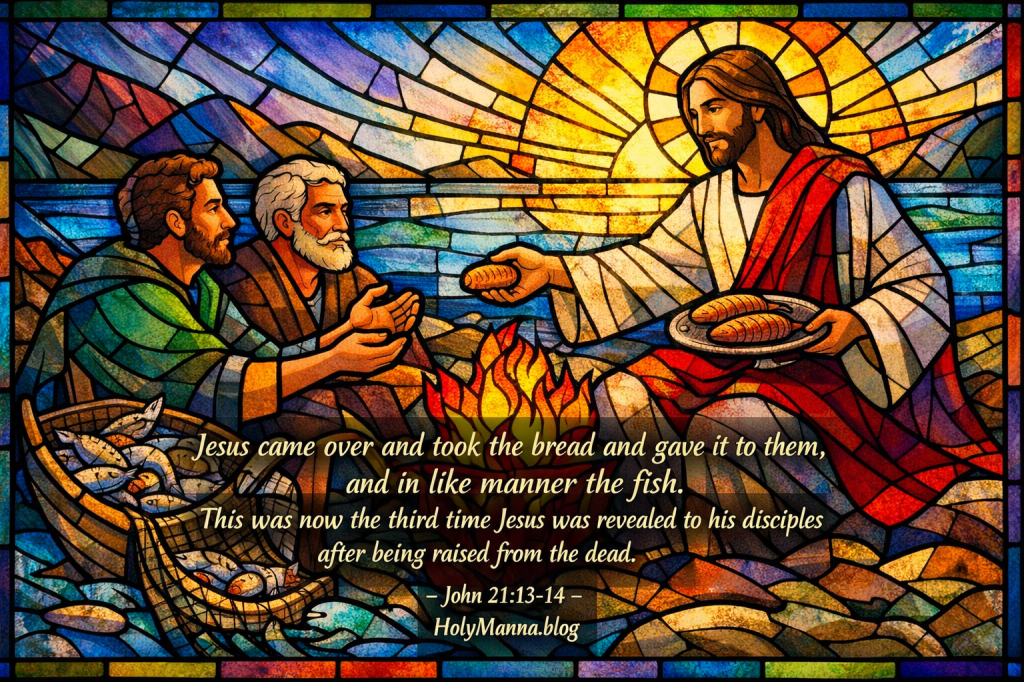
The Appearance to the Seven Disciples. 1 After this, Jesus revealed himself again to his disciples at the Sea of Tiberias. He revealed himself in this way. 2 Together were Simon Peter, Thomas called Didymus, Nathanael from Cana in Galilee, Zebedee’s sons, and two others of his disciples. 3 Simon Peter said to them, “I am going fishing.” They said to him, “We also will come with you.” So they went out and got into the boat, but that night they caught nothing. 4 When it was already dawn, Jesus was standing on the shore; but the disciples did not realize that it was Jesus. 5 Jesus said to them, “Children, have you caught anything to eat?” They answered him, “No.” 6 So he said to them, “Cast the net over the right side of the boat and you will find something.” So they cast it, and were not able to pull it in because of the number of fish. 7 So the disciple whom Jesus loved said to Peter, “It is the Lord.” When Simon Peter heard that it was the Lord, he tucked in his garment, for he was lightly clad, and jumped into the sea. 8 The other disciples came in the boat, for they were not far from shore, only about a hundred yards, dragging the net with the fish. 9 When they climbed out on shore, they saw a charcoal fire with fish on it and bread. 10 Jesus said to them, “Bring some of the fish you just caught.” 11 So Simon Peter went over and dragged the net ashore full of one hundred fifty-three large fish. Even though there were so many, the net was not torn. 12 Jesus said to them, “Come, have breakfast.” And none of the disciples dared to ask him, “Who are you?” because they realized it was the Lord. 13 Jesus came over and took the bread and gave it to them, and in like manner the fish. 14 This was now the third time Jesus was revealed to his disciples after being raised from the dead.
Detailed Exegesis
Verse 1: “After this, Jesus revealed himself again to his disciples at the Sea of Tiberias. He revealed himself in this way.”
John begins by stressing revelation. Jesus is not discovered by human effort alone. He makes himself known. The Resurrection is not something the disciples invented or slowly talked themselves into believing. It is the action of the living Christ, who chooses to reveal himself. The mention of the Sea of Tiberias places the scene in Galilee, where so much of the Lord’s public ministry began. This return to Galilee carries the feel of a new beginning. The risen Christ is gathering his disciples again, not merely for comfort, but for mission.
Verse 2: “Together were Simon Peter, Thomas called Didymus, Nathanael from Cana in Galilee, Zebedee’s sons, and two others of his disciples.”
The naming of the disciples gives the scene a concrete, almost family-like feel. These are not abstract symbols floating through a religious story. These are particular men, each carrying his own history. Peter carries the memory of denial. Thomas carries the memory of doubt. Nathanael carries the memory of that first encounter under the fig tree. The sons of Zebedee carry their own zeal and ambition. The risen Lord gathers them all together. This is already a quiet image of the Church, where grace does not erase personality or history, but gathers wounded people into communion.
Verse 3: “Simon Peter said to them, ‘I am going fishing.’ They said to him, ‘We also will come with you.’ So they went out and got into the boat, but that night they caught nothing.”
Peter returns to what he knows. Fishing is familiar, practical, and ordinary. Yet the night yields nothing. The emptiness is spiritual as well as literal. In the tradition of the Church, this fruitless labor has often been read as a sign that human effort, even honest effort, bears no lasting fruit without Christ. The disciples are active, skilled, and willing, but the net is empty. This verse speaks gently but clearly to every soul tempted to rely on sheer effort, strategy, or experience while forgetting dependence on the Lord.
Verse 4: “When it was already dawn, Jesus was standing on the shore; but the disciples did not realize that it was Jesus.”
Dawn is one of the great Easter images. Darkness is passing, light is arriving, and Jesus stands at the edge of the disciples’ confusion. Yet they do not recognize him at first. This, too, is part of the Resurrection narratives. The risen Christ is the same Lord, yet now he belongs fully to the new life of glory. Recognition comes by grace. The soul often experiences something similar. Christ may be near long before he is clearly recognized. He can stand on the shore of a weary life while the heart still struggles to see.
Verse 5: “Jesus said to them, ‘Children, have you caught anything to eat?’ They answered him, ‘No.’”
The risen Lord addresses them with tenderness. He does not begin with rebuke. He begins with a question that draws their poverty into the open. Their answer is brief and painful: no. There is humility in that moment. The truth has to be spoken before the miracle can be received. Many spiritual breakthroughs begin there. The soul stops pretending that the nets are full and admits the emptiness to Christ.
Verse 6: “So he said to them, ‘Cast the net over the right side of the boat and you will find something.’ So they cast it, and were not able to pull it in because of the number of fish.”
This is the turning point. The same men, the same boat, the same sea, and the same nets now produce abundance, because obedience has entered the scene. The miracle reveals that fruitfulness comes from listening to Christ. The detail about the right side has long invited spiritual reflection in the Church. At the very least, it underscores that the decisive factor is not technique, but obedience to the Lord’s word. The Church’s mission has always lived by this law. She bears fruit when she follows Christ, not when she merely trusts her own instincts.
Verse 7: “So the disciple whom Jesus loved said to Peter, ‘It is the Lord.’ When Simon Peter heard that it was the Lord, he tucked in his garment, for he was lightly clad, and jumped into the sea.”
John recognizes first, and Peter responds first. That pattern is beautiful. Love sees, and love also rushes forward. The beloved disciple’s contemplative insight and Peter’s impulsive zeal belong together in the life of the Church. Peter’s jump into the sea is not polished or restrained. It is the action of a man who cannot remain in the boat once he knows Jesus is near. The scene also hints at Peter’s deep longing for restoration. He had failed the Lord publicly. Now he cannot get to him quickly enough.
Verse 8: “The other disciples came in the boat, for they were not far from shore, only about a hundred yards, dragging the net with the fish.”
The others remain faithful to the task. Peter’s leap is dramatic, but the boat still has to come in, and the catch still has to be brought ashore. The Gospel quietly honors both kinds of discipleship. Some rush forward with visible fervor. Others persevere in steady labor. Both are needed. The image of the disciples dragging the net toward shore has often been read as a symbol of the Church’s mission of drawing souls toward Christ.
Verse 9: “When they climbed out on shore, they saw a charcoal fire with fish on it and bread.”
This verse is filled with tenderness and memory. Jesus already has fish and bread prepared. The disciples are not feeding him first. He is feeding them. There is also a striking detail here: the charcoal fire. John mentions charcoal only in very charged moments. Peter had once stood by a charcoal fire during his denial. Now the risen Jesus prepares another charcoal fire, not to humiliate Peter, but to begin healing him. Even before the later dialogue of love and mission, this fire already signals mercy. The Lord does not erase Peter’s past. He redeems it.
Verse 10: “Jesus said to them, ‘Bring some of the fish you just caught.’”
The Lord, who already has food prepared, still asks the disciples to bring what they have received through obedience. This is a beautiful picture of grace and cooperation. Christ is the source of the gift, yet he allows his disciples to share in the work. He dignifies their labor by drawing it into his own providence. That rhythm belongs to the whole Christian life. God does not need human help in the strict sense, but in his love he chooses to involve his people in his work.
Verse 11: “So Simon Peter went over and dragged the net ashore full of one hundred fifty-three large fish. Even though there were so many, the net was not torn.”
The specific number has fascinated Christians for centuries. Many Fathers of the Church saw symbolic meaning here. St. Augustine linked the number to fullness and spiritual perfection, and he saw the unbroken net as a sign of the unity of the Church brought safely to its fulfillment. Whether one presses the symbolism far or not, the point is clear enough. The catch is abundant, and the net holds. This is no meager success. It is a sign of the superabundant fruitfulness the risen Christ gives to his Church. The unbroken net also suggests that true catholicity is not chaos. Christ gathers many without destroying unity.
Verse 12: “Jesus said to them, ‘Come, have breakfast.’ And none of the disciples dared to ask him, ‘Who are you?’ because they realized it was the Lord.”
There is extraordinary gentleness here. The risen Lord invites tired men to breakfast. Resurrection glory does not make him distant or cold. He remains personal, attentive, and near. At the same time, there is a reverent mystery. They know it is Jesus, yet the experience is so holy that ordinary questioning falls silent. This is not uncertainty in the modern skeptical sense. It is awe. The disciples are before the same Lord they knew before, but now in the majesty of risen life.
Verse 13: “Jesus came over and took the bread and gave it to them, and in like manner the fish.”
The action echoes other scenes in John’s Gospel, especially the feeding of the multitude and the Eucharistic atmosphere surrounding the bread given by Christ. This is not presented as the institution of the Eucharist, yet the Church naturally hears Eucharistic resonance in the gesture. The risen Jesus feeds his own. He does not merely instruct them. He gives himself as the source of their strength. The Christian life cannot be sustained by ideas alone. It depends on receiving from Christ.
Verse 14: “This was now the third time Jesus was revealed to his disciples after being raised from the dead.”
John closes by emphasizing continuity and reality. This is not an isolated emotional moment. The risen Christ has repeatedly manifested himself. The Resurrection is not fantasy, not projection, and not wishful thinking. It is a real event that produced real encounters with the living Jesus. The repetition also deepens the disciples’ formation. The Lord is patiently schooling them into Easter faith, just as he patiently schools the Church in every age.
Teachings
This Gospel reveals the risen Jesus in a way that is both glorious and deeply intimate. He is no ghost, no memory, and no symbolic idea kept alive by the emotions of the disciples. He stands on the shore in a real body, speaks real words, prepares real food, and shares a real meal. That matters because the Christian faith stands on the truth that Christ truly rose from the dead. The Resurrection is not spiritual poetry. It is the victory of the crucified Lord in history. The Catechism teaches this plainly in CCC 645: “By means of touch and the sharing of a meal, the risen Jesus establishes direct contact with his disciples. He invites them in this way to recognize that he is not a ghost and above all to verify that the risen body in which he appears to them is the same body that had been tortured and crucified, for it still bears the tracesof his Passion.” That truth matters tremendously in John 21. The Lord who stands on the shore is the same Jesus who hung upon the Cross. The hands that broke bread are the same hands once pierced. The one who now feeds his disciples is the one who first loved them unto death.
This Gospel also teaches the absolute necessity of grace. The disciples worked through the night and caught nothing. Then, at the word of Jesus, the same net suddenly overflows. The lesson is not subtle. Human effort, even sincere effort, cannot bear supernatural fruit apart from Christ. The Church has always heard an echo here of the Lord’s teaching in The Gospel of John: “Apart from me you can do nothing.” The risen Christ is not an optional help added onto an already self-sufficient life. He is the source of fruitfulness itself. This is why The Catechism says in CCC 2074: “Jesus says: ‘I am the vine, you are the branches. He who abides in me, and I in him, he it is that bears much fruit, for apart from me you can do nothing.’” The Christian life falls apart when it becomes mere effort management instead of communion with the living Christ.
The Fathers of the Church loved this passage because it reveals not only personal spirituality, but the mystery of the Church. St. Augustine saw the great catch of fish as an image of the Church gathered by Christ after the Resurrection. Reflecting on the number and the unbroken net, he wrote that this miracle points toward the fullness of the saints gathered without division: “The net was not broken, because in that supreme peace of the saints there will be no schisms.” Augustine saw something deeply consoling here. The Church in history may endure conflict, scandal, weakness, and strain, but the final work of Christ will not fail. He will gather his own, and the net will hold.
St. Gregory the Great also drew out the missionary meaning of this scene. The disciples are fishermen again, but now their work points beyond fish to souls. Their labor becomes a sign of apostolic mission. The Church goes out into the deep of the world, not trusting her own skill alone, but relying on the word of the risen Lord. This is one of the great Catholic instincts that flows from the Gospel. Evangelization is never just marketing, charisma, or strategy. It is obedience to Christ. Without him, the Church toils in the dark. With him, she draws in abundance that she could never produce by herself.
There is also a quiet Eucharistic tenderness in this passage. The Gospel does not describe the Last Supper again, and it should not be forced into something it does not explicitly say. Still, the Church naturally hears a sacred resonance when Jesus takes bread and gives it to his disciples. The Catechism teaches in CCC 1324: “The Eucharist is ‘the source and summit of the Christian life.’” That truth helps illuminate the scene. Before the apostles are fully sent, they are fed. Before mission comes communion. Before public witness comes receiving from the Lord’s hand. Catholic life always dies when this order is reversed.
This Gospel also prepares the heart for Peter’s restoration and mission, which unfolds in the verses that follow. Even here, before the threefold confession of love, Peter is already being drawn back by mercy. The charcoal fire matters. The breakfast matters. The tenderness matters. Christ does not restore Peter with cold efficiency. He restores him personally. This is how the Lord so often heals. He returns to the place of shame, not to crush the sinner, but to redeem the memory with grace.
Historically, this passage became a beloved witness in the Church’s proclamation of the bodily Resurrection. The early Christians did not preach a merely interior survival of Jesus’ message. They preached the living Christ who was seen, heard, and encountered by his disciples after rising from the dead. This is why Easter joy has substance. It is not built on mood. It is built on fact, encounter, and revelation.
Reflection
This Gospel reaches right into ordinary life because almost everyone knows what it feels like to fish all night and come up empty. There are seasons when work feels fruitless, prayer feels dry, relationships feel strained, and the heart quietly wonders whether anything is changing at all. That is why this scene is so comforting. The risen Jesus does not wait for the disciples to become impressive before he comes near. He meets them in the middle of their tiredness, their confusion, and their empty nets.
There is a lesson here about honesty before God. When Jesus asks, “Have you caught anything to eat?” the disciples answer with a simple no. That small reply carries real spiritual wisdom. The soul begins to change when it stops pretending before Christ. There is no need to impress the Lord with strength that does not exist. He already sees the empty nets. What he desires is trust, obedience, and openness to his word.
A practical way to live this Gospel is to begin the day by consciously placing every task into the hands of Jesus. Work, family life, conversations, temptations, disappointments, and responsibilities can all become a kind of net cast at his command rather than through mere self-reliance. Another step is to learn to recognize the Lord at the shoreline moments of life. Sometimes he is not first noticed in dramatic signs, but in a providential word, a moment of conviction in prayer, the wisdom of Scripture, the sacraments, or the quiet nudge to obey when results seem unlikely. A third step is to remember that Christian strength is nourished, not manufactured. The disciples had to come to shore and receive breakfast from Jesus. The soul still has to do the same through prayer, worship, and the sacramental life of the Church.
This Gospel also invites a serious examination of what “fruitfulness” really means. The world often defines a fruitful life by visibility, applause, numbers, and measurable success. Christ often works more quietly. Fruitfulness can look like fidelity in a hard marriage, perseverance in hidden prayer, patience in suffering, self-control in temptation, or courage in speaking the truth with love. Empty nets in the eyes of the world may not be empty in the eyes of God. The key question is not whether life feels impressive, but whether it is being lived in obedience to Christ.
There is also deep consolation here for anyone carrying old failure. Peter is in this scene, and that means denial is in the background even before it is named. Yet Jesus still calls, still feeds, and still draws Peter close. Failure is not the final word when it is surrendered to the risen Lord. Shame says to stay in the boat or drift farther out. Christ stands on the shore and calls his own back to himself.
Where have the nets of daily life felt empty lately? Has work, prayer, or service slowly become something done without consciously depending on Christ? Is the heart willing to obey the Lord even when his direction seems simple, hidden, or unexpected? Can the soul receive the tenderness of Jesus, or does it still keep him at a distance because of old wounds and failures?
This Gospel leaves the reader with one of the most beautiful images in all of Eastertide: the risen Jesus at daybreak, a fire already burning, bread already prepared, and weary disciples being invited to come and eat. That is the heart of the Christian life. Christ is alive. Christ is near. Christ still speaks. Christ still feeds. And when life is lived close to him, even the longest night does not end in emptiness.
From Empty Nets to Unshakable Witness
Taken together, today’s readings tell one beautiful Easter story. The risen Jesus Christ is alive, and because he is alive, everything changes. The frightened can become fearless. The rejected can become foundational. The empty can become overflowing. On the shore, the disciples learn that without Jesus they can do nothing, but with him even a night of failure can give way to abundance. In the psalm, the Church sings that the stone once cast aside has become the cornerstone. In Acts of the Apostles, Peter stands before the very men who should have recognized the Messiah and boldly proclaims that salvation is found in no one else but Jesus Christ.
That is the heart of the day. Easter is not just a comforting memory. It is the living triumph of Christ still at work in his Church. The Lord still stands on the shore of ordinary life. He still calls his people to trust him when their efforts feel empty. He still feeds those who come to him hungry. He still takes weak disciples and makes them brave. He still turns the shame of rejection into the strength of witness. And he still gathers his Church around himself as the one true cornerstone that will never fail.
There is also a tender challenge running through all three readings. The soul cannot remain neutral before the risen Jesus. Peter and John do not hide his name. The psalm does not whisper its praise. The disciples do not stay in the boat once they know it is the Lord. Easter calls for response. It calls for trust, gratitude, courage, and deeper surrender. It asks whether life is still being lived by personal strength alone, or whether everything is being placed into the hands of Christ.
So this is a good day to begin again with simplicity. Speak the holy name of Jesus with reverence and confidence. Bring the empty nets to him without pretending they are full. Thank God for his mercy before every answer is visible. Return to prayer with honesty. Return to the sacraments with hunger. Return to daily duties with fresh trust that the risen Lord is not distant, but near.
Where is Jesus asking for deeper trust today? What part of life needs to be placed again under his lordship? What fear needs to give way to witness?
The Church’s answer today is clear and full of hope. Christ is risen. Christ is the cornerstone. Christ is the one Savior of the world. And for the soul willing to listen, obey, and come close, the dawn is never empty.
Engage with Us!
Readers are warmly invited to share their reflections in the comments below. What stood out most in today’s readings? What verse stayed with the heart? What truth felt especially personal today? The beauty of the Word of God is that it speaks to each soul with both tenderness and power, and faithful conversation can help that Word sink even deeper.
- In the First Reading from Acts 4:1-12, what part of Peter’s boldness speaks most strongly to the heart? Is there a place in daily life where greater courage is needed to speak the name of Jesus with clarity and love?
- In the Responsorial Psalm, Psalm 118, what does it mean personally that the stone the builders rejected has become the cornerstone? Has God ever brought grace, strength, or unexpected good out of a season of rejection, disappointment, or struggle?
- In the Holy Gospel from John 21:1-14, where do the “empty nets” appear in life right now? What might it look like to trust the voice of Jesus more deeply and let him lead those tired or fruitless places into something new?
May today’s readings remain close to the heart long after the day is over. May the risen Jesus strengthen faith, deepen trust, and fill every ordinary task with his grace. Let everything be done with the love, mercy, and truth he has taught, so that daily life may become a quiet witness to his Resurrection.
Sacred Heart of Jesus, we trust in You!
Immaculate Heart of Mary, pray for us!
Saint Michael the Archangel, defend us in battle!
Follow us on YouTube, Instagram and Facebook for more insights and reflections on living a faith-filled life.

 Holy Manna!
Leave a comment