A Quiet Shepherd in the Dawn of the Church
Saint Liborius of Le Mans is one of those saints whose life feels almost hidden behind the veil of time, yet whose legacy shines with surprising strength. He is revered as an early bishop of Le Mans in fourth-century Gaul, a faithful pastor, a man of charity, and a saint whose memory became a source of healing, unity, and devotion far beyond the place where he lived. Though the historical record about him is limited, the Church has preserved what matters most. He was remembered as a holy bishop, a steady servant of Christ, and a man whose care for souls left such a deep impression that the faithful continued to invoke him long after his death.
Saint Liborius is especially known for his connection to the healing of stone-related illnesses, especially kidney stones and gallstones. He is also known for something even more remarkable. Though he served in Le Mans, he later became the beloved patron of Paderborn in Germany after his relics were transferred there. In this way, his life became a bridge between peoples, dioceses, and nations. His memory speaks to the Catholic heart because it reminds the faithful that holiness does not depend on fame. Sometimes the saints who say the least to history say the most to the Church.
Hidden Beginnings, Lasting Grace
Very little certain information survives about the early life of Saint Liborius. Catholic sources do not preserve a trustworthy account of his birthplace, family background, childhood, or the details of his formation. That silence can feel frustrating at first, but it also teaches something important. The Church does not honor Saint Liborius because of worldly prestige, dramatic self-promotion, or a carefully preserved biography. The Church honors him because of holiness, fidelity, and the fruits of his pastoral life.
What is traditionally remembered is that Liborius lived in the late Roman world and became one of the earliest bishops of Le Mans. Some Catholic sources number him as the second bishop of the city, while others call him the fourth. That difference comes from the difficulty comes from the difficulty of reconstructing the earliest episcopal lists. Still, the constant tradition is clear. He belonged to the first generations of bishops who helped establish the Church in that region.
He is traditionally said to have become bishop around the year 348 and to have governed the diocese for forty-nine years. Catholic tradition also remembers him as a bishop who ordained many priests and deacons, strengthened the local Church, and devoted himself to works of mercy. In a time when Christianity was still settling into the life of the Roman world, a bishop’s work involved much more than preaching. He had to build up the Church’s visible life through worship, teaching, discipline, and care for the poor. This is part of what Saint Liborius is most known for. He was not merely an administrator. He was a father to a growing Christian people.
Tradition also links him with Saint Martin of Tours, one of the great bishops of Gaul. Some Catholic sources preserve the memory of a friendship between them and even say that Saint Martin stood by Liborius at the end of his life. That detail cannot be proven with certainty, but it reflects how the Church remembered Liborius: as a bishop of real spiritual stature, worthy of being numbered among the holy pastors of the age.
The Bishop Who Healed More Than Bodies
Saint Liborius is remembered not only for governing a diocese but for living as a true shepherd of souls. He stands as a witness to the kind of episcopal holiness that often goes unnoticed by the world but never goes unnoticed by God. He served steadily, patiently, and fruitfully. He built up the Church where he had been planted.
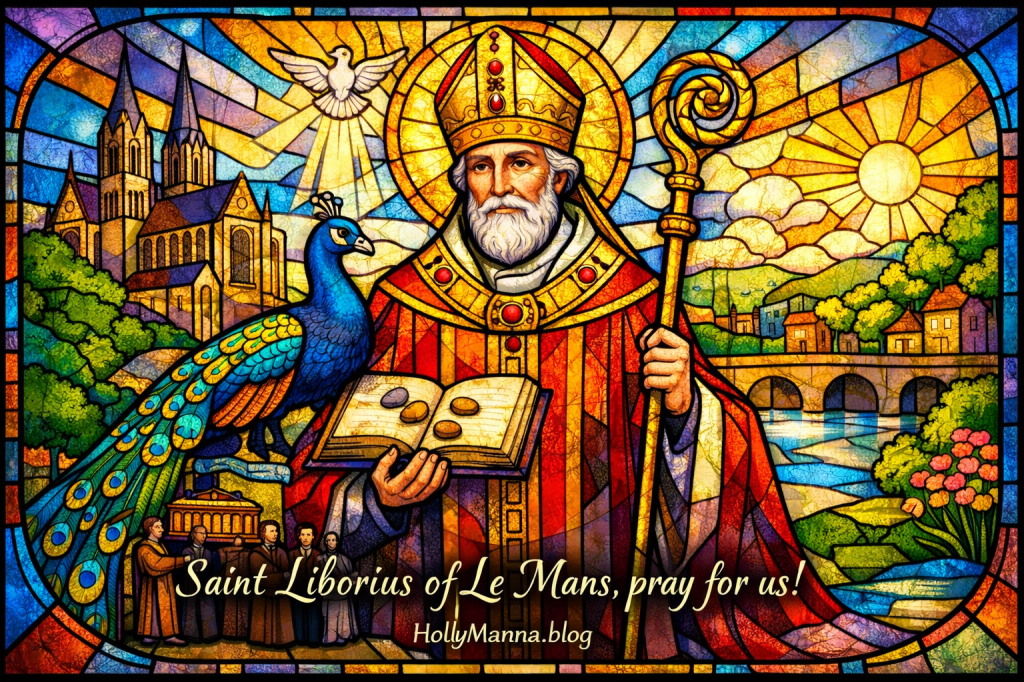
Catholic tradition especially remembers him for healings associated with those suffering from stone ailments. This is why Christian art often shows him with small stones resting on a book. The image may seem unusual at first, but it points to the tenderness of Catholic devotion. The faithful came to know him as an intercessor in a very specific human suffering. He was not remembered only in grand theological terms. He was remembered in pain, in prayer, in weakness, and in hope.
That detail matters because it reflects something profoundly Catholic. The saints are not distant religious symbols. They are living members of the Body of Christ, united with the Church in glory, and their intercession reaches into the ordinary wounds of human life. The Catechism teaches that the saints continue to care for the Church and intercede for the faithful before God, as seen in CCC 956. Saint Liborius became one of those beloved heavenly friends whose name was spoken by the sick and the suffering with trust.
He should be remembered and imitated because he shows the beauty of hidden faithfulness. Not every saint leaves behind dramatic speeches or volumes of writing. Some leave behind the example of perseverance, the memory of pastoral charity, and a legacy of peace. Saint Liborius shows that a life rooted in Christ can keep bearing fruit for centuries.
The Weight of the Crozier
Unlike many saints, Saint Liborius is not remembered as a martyr, and Catholic tradition does not preserve a dramatic story of imprisonment or execution for the faith. There is no verified account of martyrdom attached to his name. Yet this does not mean his life was easy or without hardship.
He lived during a period when the Church in Gaul was still taking shape. To be a bishop in those early centuries meant carrying immense spiritual and practical burdens. The faithful needed instruction. The poor needed care. Clergy needed formation. Christian worship had to be established and guarded. A bishop had to hold a flock together in a world that was changing politically, socially, and spiritually. That kind of hidden endurance is its own kind of martyrdom of love. It is the daily offering of self for Christ and His people.
There is also another hardship in Saint Liborius’ story, though it comes after his death. Much of the detailed history of his life has been lost. In a strange way, even his memory endured a kind of trial. Yet the Church kept his name, his feast, his relics, and his intercession alive. That too is a kind of victory. The world may forget details, but the communion of saints does not forget holiness.
Fragrance, Healing, and a Peacock on the Road
After Saint Liborius’ death, devotion to him did not fade. It grew. Catholic tradition holds that miracles and signs were reported at his tomb. The faithful continued to love and venerate him, convinced that his intercession did not end with earthly death. This is one of the clearest themes in his legacy. Saint Liborius remained a shepherd to the faithful even after he entered eternal life.
One of the most important moments in his posthumous story came in the year 836, when his relics were transferred from Le Mans to Paderborn. This was not treated as a mere political exchange or an ecclesiastical formality. It was received as a sacred event. Tradition says that when his relics were raised, a wonderful fragrance filled the church. In Catholic tradition, such a fragrance has often been associated with holiness and divine favor. This story has been preserved in connection with the translation of his relics. It belongs to the tradition of his cult, though the event cannot be verified with the kind of historical precision modern readers often expect.
The same translation was also associated with reports of healings and other wonders along the way. The faithful believed that God was honoring His servant and using the occasion to strengthen belief in the communion of saints. These miracle stories belong to the living Catholic memory surrounding Saint Liborius, even when every detail cannot be historically verified.
Then there is the famous peacock story, one of the most striking and beloved traditions connected with him. According to the legend, a peacock accompanied the procession carrying Saint Liborius’ relics from Le Mans to Paderborn and guided the travelers to their destination. In some versions, the bird died once the journey was complete. This story cannot be historically verified, but it became so deeply rooted in Catholic devotion that the peacock remains one of Saint Liborius’ most recognizable symbols. The story cannot be verified.
His relics became central to the spiritual life of Paderborn, where he eventually came to be honored as patron of the cathedral, the city, and the archdiocese. This is one of the most surprising facts about him. A bishop from France, whose earthly ministry was in Le Mans, became one of the most beloved saints of a German Catholic city he never visited in life. That alone tells the story of how the communion of saints transcends geography.
His impact reached far beyond private devotion. The bond created by the gift of his relics became a lasting friendship between Le Mans and Paderborn. This friendship endured across centuries and even through times of war. In this sense, Saint Liborius became more than a patron of healing. He became a patron of unity, peace, and Christian fraternity.
His cultural impact remains visible above all in the great Libori celebration in Paderborn, one of the oldest and largest religious folk festivals in Germany. The feast unites liturgy, public devotion, civic celebration, and memory. Pilgrims and visitors gather around the relics, processions, and public witness of faith. In Le Mans as well, his memory remains alive through churches, fraternity groups, and pilgrim devotion. Saint Liborius did not merely leave behind a feast day. He left behind a living tradition.
What Saint Liborius Still Teaches the Church
Saint Liborius teaches that holiness does not need spectacle. The world often looks for dramatic personalities, unforgettable slogans, and public greatness. The Church looks for fidelity. Saint Liborius reminds the faithful that a soul rooted in Christ can become a blessing for generations even when history preserves only a few details.
He also teaches the importance of quiet pastoral charity. He was remembered as a bishop who cared for the Church through worship, teaching, and mercy. That is still the pattern of authentic Christian life. Love God. Serve His people. Remain faithful in the place where Providence has planted you. Trust that grace is at work even when the fruits are not immediately visible.
His story also invites reflection on the communion of saints. Catholics do not honor saints as dead heroes from a distant past. Catholics honor them as living members of Christ’s Body who continue to intercede for the faithful. Saint Liborius became a source of comfort for the sick, the suffering, and the faithful who needed a heavenly patron. His life reminds the Church that grace continues beyond the grave, and that God delights in working through His saints.
There is another lesson here too. Saint Liborius became a bridge between peoples. In a world often wounded by division, suspicion, and pride, his legacy shows that holiness creates communion. A bishop in Gaul became a beloved patron in Germany. Relics became the foundation of friendship. Devotion became a path toward peace. That is deeply Catholic. Christ does not merely save individuals. He gathers a people.
For daily life, this means choosing faithfulness in ordinary duties, showing compassion toward those who suffer, praying with confidence for the sick, and becoming a source of peace in the relationships God has entrusted to us. It means accepting that some of the most fruitful lives are the least flashy. It means believing that God can make a quiet life shine across centuries.
Is there a hidden place in life where greater faithfulness is needed? Is there someone suffering right now who needs prayer, patience, or practical charity? Is there a broken relationship that could become a place of healing through humility and grace? Saint Liborius gently invites the faithful to answer those questions with courage.
Engage With Us!
Share your thoughts and reflections in the comments below. Saint Liborius may not be one of the most famous saints in popular conversation, but his story has a quiet strength that stays with the soul.
- What stands out most in Saint Liborius’ life and legacy: his hidden faithfulness, his association with healing, or his role as a bridge between peoples?
- How can a Christian practice quiet perseverance in daily life without seeking praise or recognition?
- What does Saint Liborius teach about trusting the intercession of the saints in moments of sickness or suffering?
- How can friendship, charity, and fidelity become a witness to Christ in families, parishes, and communities today?
- What part of Saint Liborius’ story challenges the heart to live more deeply for Jesus and His Church?
May Saint Liborius inspire a life of steady faith, generous charity, and deep trust in the mercy of God. May his example help the faithful remember that even a hidden life can become radiant in Christ. Live with courage, love with patience, and do everything with the love and mercy Jesus taught us.
Saint Liborius of Le Mans, pray for us!
Follow us on YouTube, Instagram and Facebook for more insights and reflections on living a faith-filled life.

 Holy Manna!
Leave a comment