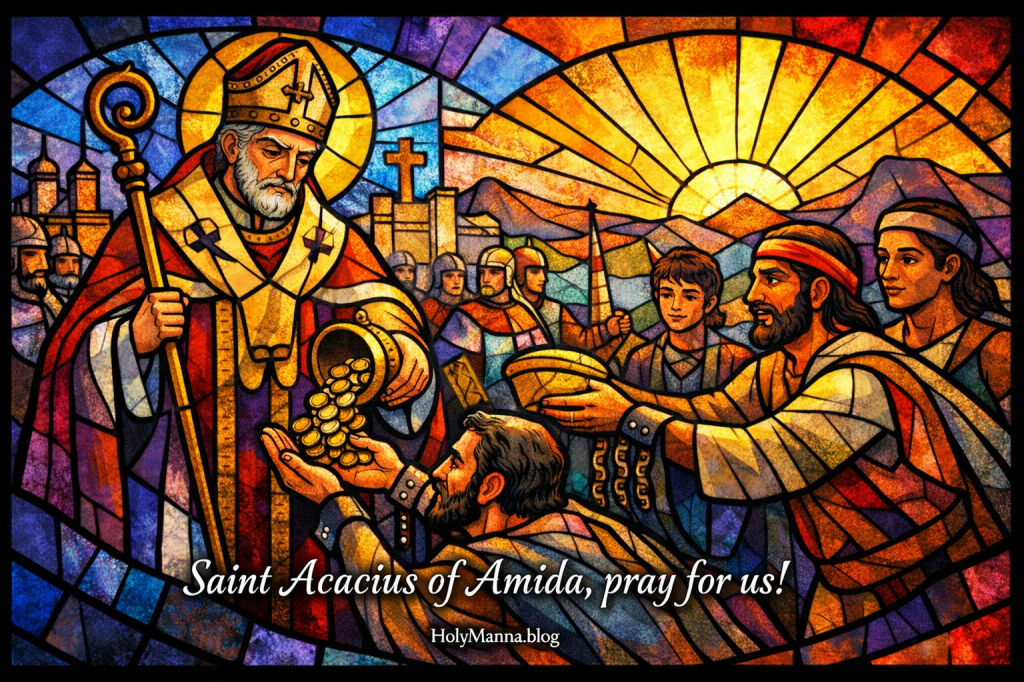
The Bishop Who Turned Sacred Silver into Mercy
Saint Acacius of Amida is one of those saints whose life comes down through history almost like a flash of Gospel light in a dark time. He was a bishop in the early fifth century in Amida, a city in Mesopotamia, and the Church remembers him on April 9 in the Roman Martyrology. He is revered not because a long record of sermons, travels, or writings survived, but because one act of Christian charity burned his name into the memory of the Church.
What made him unforgettable was simple and astonishing at the same time. During a time of war between the Roman Empire and Persia, thousands of Persian prisoners were left to suffer in misery. Acacius looked at those enemy captives and saw not political problems, but human beings made in the image of God. That is why he is still remembered. He chose mercy over fear, love over calculation, and the dignity of suffering men over the beauty of costly church vessels.
In that sense, Saint Acacius stands as a deeply Catholic witness. The Church has always taught that love of God and love of neighbor belong together. The Catechism teaches that the works of mercy include feeding the hungry and helping those in bodily need, and that earthly goods must be used with justice and charity, as seen in CCC 2447 and CCC 2402-2406. Saint Acacius did not merely teach those truths. He lived them in a way no one could ignore.
The Hidden Years of a Frontier Bishop
The early life of Saint Acacius is mostly hidden from history. Catholic sources do not preserve reliable details about his childhood, family background, or the path by which he first entered the clergy. There is no well attested story of a dramatic conversion, no long biography of his youth, and no surviving body of spiritual writings that fills in those missing years.
What is known with confidence is that he became bishop of Amida and served the Church during the reign of Emperor Theodosius II. His life unfolded in a dangerous border world shaped by imperial tensions, shifting loyalties, and recurring violence. That setting matters, because it helps explain the greatness of what he later did. His holiness did not grow in comfort. It matured in a place where fear, war, and revenge could easily harden the human heart.
Even though the details of his early formation are not preserved, his later actions reveal the kind of man he had become. He was a bishop who believed the treasures of the Church existed for the glory of God and the salvation of souls. He also understood that the poor, the hungry, and even the enemy could not be pushed aside when mercy was required. That deep pastoral instinct was not accidental. It was the fruit of a soul formed by Christ.
When Sacred Vessels Became Bread and Freedom
The central event of Saint Acacius’s life is preserved in Socrates Scholasticus, Ecclesiastical History. During the Roman Persian conflict, around seven thousand Persian captives had fallen into Roman hands. They were suffering terribly from neglect and deprivation. Acacius saw the crisis and gathered his clergy. Then he spoke the words that have echoed through Catholic memory ever since: “Our God, my brethren, needs neither dishes nor cups.”
That line says everything about him. It was not irreverence. It was not contempt for sacred things. It was a profoundly Christian act of right order. Acacius understood that God is worshiped in truth, and that worship can never become an excuse to ignore human misery. So he had the church’s gold and silver vessels melted down, sold them, and used the money to ransom the captives, feed them, care for them, and send them home with provisions.
This is what Saint Acacius is most known for, and rightly so. He did not simply give from excess. He gave what others would have been afraid to touch. He did not reserve compassion for his own people. He extended it to foreign prisoners who belonged to a hostile power. This is one of the most striking parts of his story. He loved men who could easily have been treated as enemies only.
Catholic sources do not preserve miracle stories in the usual supernatural sense during his lifetime. There are no reliable accounts of healings, visions, or dramatic wonders attached to him. Yet his life still contains something marvelous. His mercy itself feels like a miracle of grace. In a brutal age, he acted with the heart of Christ. In a world trained to count cost and loyalty, he counted souls.
That is one reason he should still be remembered and imitated. Saint Acacius shows that holiness is not always loud. Sometimes it looks like a bishop taking sacred wealth and turning it into bread, freedom, and human dignity.
The Cost of Charity in a Violent World
Saint Acacius was not a martyr in the strict sense, and Catholic tradition does not record that he died by execution for the faith. Still, he lived under real hardship. He served in a time of conflict, uncertainty, and pressure, and his greatest recorded act required immense courage. A bishop who sold precious church vessels in the middle of war was not acting in a safe or ordinary way. He was risking criticism, misunderstanding, and perhaps political backlash.
There is something deeply moving about that. Some saints face lions, prisons, and swords. Others face the harder test of making a costly decision for the sake of mercy when many would have preferred caution. Saint Acacius endured that test. He refused to let fear dictate what charity required.
Later tradition also says that his mercy made such an impression on the Persian king that it helped soften hostility toward Christians for a time. That tradition cannot be fully verified in all its later details, but the ancient account does preserve that the Persian ruler was deeply moved by Acacius’s conduct and desired to meet him. Even if every later embellishment cannot be confirmed, the heart of the story remains clear. Christian charity crossed enemy lines and forced even powerful rulers to take notice.
So while he did not wear the martyr’s crown, he carried a shepherd’s burden. He stood in the gap for suffering people and paid a real price in faith, courage, and reputation. That kind of endurance belongs to the long history of saints who bore the Cross in forms the world often overlooks.
The Saint Whose Memory Became His Miracle
After Saint Acacius’s death, Catholic tradition does not preserve a developed collection of posthumous miracles. No strong Roman Catholic source provides a broad cycle of healings at his tomb, dramatic relic stories, or a major pilgrimage tradition centered on his shrine. If such stories ever existed locally, they do not stand out in the surviving Catholic record with the same clarity as the great deed of his life.
That does not make his legacy smaller. In some ways, it makes it purer. His lasting impact after death is the endurance of his witness. The Church never forgot what he did. His memory remained alive in liturgical tradition, especially through the Roman Martyrology, and in the historical witness of Socrates Scholasticus. His sanctity was carried forward by the strength of one act that so perfectly reflected the mercy of Christ.
There is also a wider cultural and spiritual impact in the way Catholic tradition has remembered him. Saint Acacius became a living example of how the Church understands the purpose of material goods. He reminds every generation that sacred beauty is good, but human beings matter more. He reminds bishops, priests, and lay faithful alike that Christian charity must not stop at tribal boundaries. The poor are not only those who belong to one’s own circle. The wounded neighbor may be a stranger, an outsider, or even an enemy.
As for miracle stories after death that cannot be verified, none stood out in the Catholic sources connected to him. It is better to say that plainly than to decorate his life with legends that do not belong to him. The truth is already strong enough. His legacy is not built on stories piled up around his grave. It is built on the fact that the Church still remembers a bishop who loved like Christ when it would have been easier not to.
A Lesson in Mercy for the Present Age
Saint Acacius feels especially relevant in a time when so much energy is spent defending comfort, territory, and image. His life asks a hard question. What would happen if Christians really believed that love of neighbor comes before attachment to possessions, prestige, and appearances?
His example invites a serious examination of conscience. It is easy to admire charity in theory. It is harder to let mercy become costly. Saint Acacius did not solve a problem with words alone. He gave up something precious for people who were suffering. That is why his witness lands so powerfully. It is concrete. It is sacrificial. It is unmistakably Christian.
Readers today can apply his example in ordinary life by asking where comfort has begun to outrank compassion. Some may be called to give money more generously. Others may need to give time, patience, hospitality, or forgiveness. Some may need to look again at people they have quietly written off. Saint Acacius teaches that mercy grows when the heart stops asking, “What do they deserve?” and starts asking, “What does love require?”
He also teaches the importance of seeing Christ in every person. This is the heart of the corporal works of mercy and one of the clearest threads running through Catholic moral teaching. The saint’s action makes sense only if every human life bears God given dignity. If that truth is forgotten, charity becomes selective. If that truth is embraced, mercy becomes possible even across old divisions.
What is being held too tightly when Christ is asking for generosity? Who has been treated as distant or undeserving when the Gospel is calling for mercy? How might a life of real charity begin in small choices today?
Saint Acacius may not have left books behind, but he left something just as memorable. He left an image of the Church at her best. She is most beautiful not only when her chalices shine, but when her love shines brighter still.
Engage With Us!
Share your thoughts and reflections in the comments below. Saint Acacius of Amida leaves behind a simple story, but it presses on the conscience in a powerful way.
- What part of Saint Acacius’s story speaks most strongly to the heart?
- How does his mercy toward enemy captives challenge the way other people are usually judged?
- What is one concrete way charity can become more sacrificial in daily life this week?
- How does Saint Acacius help deepen the understanding of the corporal works of mercy?
- What would it look like to trust God enough to let generosity cost something real?
May the witness of Saint Acacius encourage a life of deeper faith, steadier courage, and wider mercy. May everything be done with the love and compassion Jesus taught, so that even ordinary choices become offerings of grace in a world that desperately needs His light.
Saint Acacius of Amida, pray for us!
Follow us on YouTube, Instagram and Facebook for more insights and reflections on living a faith-filled life.

 Holy Manna!
Leave a comment