Thursday in the Octave of Easter – Lectionary: 264
When the Risen Lord Stands in the Midst
There are moments in the Easter season when the Church does not simply ask the faithful to remember that Christ rose from the dead. She asks them to stand still long enough to see what that Resurrection changes. Today’s readings gather around one radiant truth: the risen Jesus comes into the middle of human fear, guilt, confusion, and weakness, and He turns all of it into an invitation to peace, repentance, and witness.
That is why these passages belong so beautifully together in the Octave of Easter. The Church celebrates these eight days as one great solemn day of resurrection joy, lingering over the victory of Christ as if refusing to move on too quickly. In the streets and porticoes of Jerusalem, in the shadow of the Temple, and in the frightened rooms where the disciples still struggle to understand what has happened, the same message begins to unfold. The crucified Jesus is alive. The one rejected by men has been glorified by the Father. The one whose hands and feet still bear the marks of the Passion now stands alive in the midst of His people, speaking “Peace be with you” and opening their minds to understand the Scriptures.
There is also a deeply Jewish and covenantal background woven through the day’s readings. In Acts 3:11-26, Peter preaches not as the founder of a new religion, but as a faithful son of Israel proclaiming that the God of Abraham, Isaac, and Jacob has fulfilled His promises in Jesus. Moses, the prophets, and the covenant with Abraham all point toward this moment. Then Psalm 8 lifts the heart higher, reminding the faithful of the glory and dignity God intended for man from the beginning. Finally, in Luke 24:35-48, the risen Christ shows that the whole story of salvation, from the Law to the Prophets to the Psalms, finds its meaning in His suffering, death, and Resurrection. The Church wants her children to see that Easter is not a break in God’s plan. Easter is its fulfillment.
The central theme, then, is simple and powerful: the risen Christ reveals Himself as the fulfillment of God’s promises and sends His people out as witnesses of repentance and mercy. Peter announces that healing comes not by human power, but by faith in the name of Jesus. The psalm recalls the glory of man under God’s loving care. The Gospel shows that Christ’s risen body is real, His peace is real, and His mission is real. Everything moves toward conversion. Everything moves toward forgiveness. Everything moves toward witness.
This makes today’s readings feel especially close to the heart. They are not meant only for those first disciples in Jerusalem. They are meant for every soul that still carries fear, every sinner who wonders whether mercy is possible, and every believer who needs the Lord to open the Scriptures again. What happens when the risen Jesus steps into the room where fear has been living for too long? What happens when His wounds become the proof not of defeat, but of victory? Today’s readings invite the faithful to listen closely, because the answer is nothing less than the beginning of a new creation.
First Reading – Acts 3:11-26
At Solomon’s Portico, wonder becomes a call to repentance
The scene opens in the courts of the Temple, just after Peter and John have healed the man who had been lame from birth. The miracle has shaken the crowd. People rush together in amazement at Solomon’s Portico, a covered area along the eastern side of the Temple complex where many gathered for teaching and prayer. This setting matters. Peter is not speaking in some hidden corner. He is preaching in the heart of Jewish religious life, in the very city where Jesus was rejected, condemned, and crucified not long before. The same Jerusalem that witnessed His Passion is now hearing the first bold public proclamation that He is risen and glorified.
This reading fits perfectly within today’s Easter theme. The risen Christ does not remain a private consolation for a few grieving disciples. He begins to reorder the world. Through His apostles, He turns astonishment into faith, guilt into repentance, and wounded lives into living signs of divine mercy. Peter refuses to let the crowd stop at the miracle itself. He directs every eye to Jesus. The healing of the crippled man is not the final point. It is a doorway into the truth that the crucified Jesus is the Holy and Righteous One, the Author of life, and the fulfillment of everything God promised through Moses, the prophets, and the covenant with Abraham.
Acts 3:11-26 – New American Bible (Revised Edition)
Peter’s Speech. 11 As he clung to Peter and John, all the people hurried in amazement toward them in the portico called “Solomon’s Portico.” 12 When Peter saw this, he addressed the people, “You Israelites, why are you amazed at this, and why do you look so intently at us as if we had made him walk by our own power or piety? 13 The God of Abraham, [the God] of Isaac, and [the God] of Jacob, the God of our ancestors, has glorified his servant Jesus whom you handed over and denied in Pilate’s presence, when he had decided to release him. 14 You denied the Holy and Righteous One and asked that a murderer be released to you. 15 The author of life you put to death, but God raised him from the dead; of this we are witnesses. 16 And by faith in his name, this man, whom you see and know, his name has made strong, and the faith that comes through it has given him this perfect health, in the presence of all of you. 17 Now I know, brothers, that you acted out of ignorance, just as your leaders did; 18 but God has thus brought to fulfillment what he had announced beforehand through the mouth of all the prophets, that his Messiah would suffer. 19 Repent, therefore, and be converted, that your sins may be wiped away, 20 and that the Lord may grant you times of refreshment and send you the Messiah already appointed for you, Jesus, 21 whom heaven must receive until the times of universal restoration of which God spoke through the mouth of his holy prophets from of old. 22 For Moses said:
‘A prophet like me will the Lord, your God, raise up for you
from among your own kinsmen;
to him you shall listen in all that he may say to you.
23 Everyone who does not listen to that prophet
will be cut off from the people.’24 Moreover, all the prophets who spoke, from Samuel and those afterwards, also announced these days. 25 You are the children of the prophets and of the covenant that God made with your ancestors when he said to Abraham, ‘In your offspring all the families of the earth shall be blessed.’ 26 For you first, God raised up his servant and sent him to bless you by turning each of you from your evil ways.”
Detailed Exegesis
Verse 11 – “As he clung to Peter and John, all the people hurried in amazement toward them in the portico called ‘Solomon’s Portico.’”
The healed man clings to Peter and John because he knows, with the simple gratitude of a heart just changed, that something divine has happened. His clinging is almost sacramental in its symbolism. A man who once sat helpless at the gate is now standing, moving, and holding fast to those through whom Christ acted. The people gather in amazement, but amazement alone is not yet faith. Throughout salvation history, signs are meant to lead beyond wonder into conversion. The crowd sees a changed body. Peter will invite them to see the risen Lord behind that change.
Verse 12 – “When Peter saw this, he addressed the people, ‘You Israelites, why are you amazed at this, and why do you look so intently at us as if we had made him walk by our own power or piety?’”
Peter begins with holy humility. He refuses to become the center of attention. This is the mark of true apostolic ministry. The Church never heals, teaches, sanctifies, or saves by her own independent strength. Everything is Christ’s gift. Peter knows that if the crowd remains fascinated with apostolic power, they will miss the Lord Himself. This verse also teaches that holiness is never self-generated. Even the apostles are instruments. Grace always comes first.
Verse 13 – “The God of Abraham, [the God] of Isaac, and [the God] of Jacob, the God of our ancestors, has glorified his servant Jesus whom you handed over and denied in Pilate’s presence, when he had decided to release him.”
Peter roots the Gospel in Israel’s history. He does not preach Jesus as a break from the covenant, but as its fulfillment. The God of the patriarchs is the God who has glorified Jesus. The title “his servant” recalls the Servant Songs of Isaiah, especially the suffering servant who is rejected and yet vindicated by God. Peter also speaks with direct honesty. The people handed Jesus over and denied Him. The Resurrection does not erase the truth of sin. It reveals that God’s mercy is greater than sin.
Verse 14 – “You denied the Holy and Righteous One and asked that a murderer be released to you.”
Peter deepens the contrast. Jesus is the Holy and Righteous One, yet the crowd preferred Barabbas. This is not merely a historical accusation aimed at one moment in Jerusalem. It is a mirror held up to every sinful heart. Sin always prefers what is disordered to what is holy. Sin chooses false freedom over true righteousness. Peter is not humiliating the crowd for sport. He is exposing the tragedy of sin so that grace can heal it.
Verse 15 – “The author of life you put to death, but God raised him from the dead; of this we are witnesses.”
This is one of the most striking lines in the Acts of the Apostles. Jesus is the Author of life, yet He was put to death. The paradox cuts to the core of Easter. Life Himself entered death so that death might be conquered from within. Peter immediately proclaims the Resurrection as historical fact. “God raised him from the dead” is not poetry. It is apostolic testimony. Then Peter adds the vital phrase, “of this we are witnesses.” Christianity is built on witness, not myth. The apostles saw the risen Christ and were sent to proclaim Him.
Verse 16 – “And by faith in his name, this man, whom you see and know, his name has made strong, and the faith that comes through it has given him this perfect health, in the presence of all of you.”
Peter makes the meaning of the miracle unmistakable. The healing happened through faith in the name of Jesus. In biblical language, the name expresses the person and power of the one named. The apostles did not use Jesus like a formula. They acted in communion with the living Lord. The healing is public, visible, and undeniable. The crowd knows the man. This is not rumor. This is evidence that the risen Christ is actively at work.
Verse 17 – “Now I know, brothers, that you acted out of ignorance, just as your leaders did.”
Peter’s tone shifts here from accusation to mercy. He still tells the truth, but he speaks as a brother. Ignorance does not make sin good, but it does open a path for compassion and repentance. Peter is following the heart of Christ, who prayed from the Cross for those who did not know what they were doing. The apostolic preaching of the Church is never meant to crush. It is meant to awaken conscience and then lead it toward forgiveness.
Verse 18 – “But God has thus brought to fulfillment what he had announced beforehand through the mouth of all the prophets, that his Messiah would suffer.”
This verse is a turning point. What looked like defeat was actually the fulfillment of prophecy. The suffering Messiah was not a contradiction of God’s plan. He was its center. Peter teaches the crowd how to read the Passion rightly. Jesus was not overtaken by events. God brought His saving design to fulfillment through the Messiah’s suffering. The Cross was not an accident. It was the obedient offering through which redemption entered history.
Verse 19 – “Repent, therefore, and be converted, that your sins may be wiped away.”
Now the sermon reaches its urgent appeal. Repentance is not mere regret. Conversion is not a passing emotional response. Peter calls for a real turning of the heart and life toward God. The phrase “wiped away” evokes the image of a record being erased or a stain being removed. This is not shallow reassurance. It is a promise that sin can truly be forgiven. The risen Christ does not merely inspire better behavior. He removes guilt and restores communion.
Verse 20 – “And that the Lord may grant you times of refreshment and send you the Messiah already appointed for you, Jesus,”
Repentance leads not to misery but to refreshment. The language suggests relief, restoration, and the cooling mercy of God after the heat of sin and judgment. Peter is showing the crowd that conversion is not a loss of life but the recovery of life. Jesus is already appointed for them. He is not a stranger imposed from outside their story. He is the Messiah given by God for their blessing.
Verse 21 – “Whom heaven must receive until the times of universal restoration of which God spoke through the mouth of his holy prophets from of old.”
Peter now opens the horizon beyond the present moment. Christ has ascended and is received into heaven, yet His saving work is moving history toward its full restoration. This verse points to the great Catholic hope that all things will be brought into their proper order in Christ. The Resurrection has begun the renewal of the world, but its fullness still lies ahead. The Church lives in this tension, already redeemed and yet still awaiting the completion of God’s plan.
Verse 22 – “For Moses said: ‘A prophet like me will the Lord, your God, raise up for you from among your own kinsmen; to him you shall listen in all that he may say to you.’”
Peter quotes Deuteronomy and identifies Jesus as the prophet greater than Moses. This matters deeply for a Jewish audience. Moses was the mediator of the covenant, the lawgiver, and the leader of God’s people. To say that Jesus is the prophet like Moses is to say that He comes with divine authority and covenantal significance. Yet Jesus is more than another prophet. He is the fulfillment toward whom Moses himself pointed.
Verse 23 – “Everyone who does not listen to that prophet will be cut off from the people.”
This is a sober warning. Covenant fidelity always requires obedience. Peter is not presenting Jesus as one spiritual option among many. To reject Him is to reject the one sent by God. This verse reminds the reader that the Gospel is a matter of eternal consequence. Grace is freely offered, but it must be received. Refusal hardens the heart and separates the soul from the life of God.
Verse 24 – “Moreover, all the prophets who spoke, from Samuel and those afterwards, also announced these days.”
Peter expands the testimony beyond Moses. From Samuel onward, the entire prophetic tradition points toward the days now unfolding. Easter is not an isolated marvel. It is the climax of salvation history. The prophets spoke of judgment, restoration, covenant renewal, and the coming reign of God. Peter is saying that those promised realities have begun in Christ.
Verse 25 – “You are the children of the prophets and of the covenant that God made with your ancestors when he said to Abraham, ‘In your offspring all the families of the earth shall be blessed.’”
This is a deeply tender verse. Peter reminds the crowd of their dignity and inheritance. They are children of the prophets and heirs of the covenant. Even after their sin, he still addresses them through the language of belonging. Then he quotes the promise to Abraham, showing that God’s plan always included blessing for all nations. Israel’s election was never meant to end in itself. It was meant to open outward toward universal salvation.
Verse 26 – “For you first, God raised up his servant and sent him to bless you by turning each of you from your evil ways.”
Peter ends not with condemnation but with blessing. God sent His Servant first to Israel, not to flatter sin, but to turn hearts away from evil. That is the shape of divine blessing. It is not mere comfort. It is conversion. God blesses by rescuing people from the ways that destroy them. This is still how Christ blesses souls. He comes not simply to affirm, but to transform.
Teachings
This reading reveals the heart of apostolic preaching. Peter announces the Resurrection, interprets the Passion through the prophets, calls sinners to repentance, and proclaims Jesus as the fulfillment of the covenant. That pattern still belongs to the Church. The Gospel is never reduced to vague inspiration. It is the proclamation that Jesus Christ truly died, truly rose, and now offers forgiveness and new life.
The Catechism speaks clearly about the historical reality and saving purpose of the Resurrection: “The Resurrection of Jesus is the crowning truth of our faith in Christ, a faith believed and lived as the central truth by the first Christian community.” CCC 638. That is exactly what appears in Peter’s sermon. He does not preach a moral philosophy. He preaches the crowning truth.
The reading also teaches that God’s providence can bring salvation even through human sin without ever excusing that sin. The Catechism says: “To God, all moments of time are present in their immediacy. When therefore he establishes his eternal plan of ‘predestination’, he includes in it each person’s free response to his grace.” CCC 600. Peter holds those truths together. The people truly sinned in rejecting Christ, and yet God truly fulfilled what He had foretold through the prophets.
The call to repentance in verse 19 stands at the center of the passage. The Catechism teaches: “Jesus’ call to conversion and penance, like that of the prophets before him, does not aim first at outward works, ‘sackcloth and ashes,’ fasting and mortification, but at the conversion of the heart, interior conversion.” CCC 1430. Peter is preaching that same interior conversion. The risen Christ does not seek superficial religious reaction. He seeks hearts turned back to God.
The reading also sheds light on the Church’s understanding of Israel, the covenant, and responsibility for Christ’s Passion. The Church firmly rejects any false idea of collective inherited guilt against the Jewish people. The Catechism says: “Still less can we extend responsibility for the trial of Jesus to the Jews in Jerusalem as a whole, despite the outcry of a manipulated crowd and the global reproaches contained in the apostles’ calls to conversion after Pentecost.” CCC 597. Peter’s words must therefore be read as a merciful call to repentance within salvation history, not as a weapon for hatred. At the same time, The Catechism goes deeper and turns the accusation toward every sinner: “The Church does not hesitate to impute to Christians the gravest responsibility for the torments inflicted upon Jesus.” CCC 598. That makes Peter’s sermon painfully personal. Every sin prefers Barabbas to Christ. Every conversion is a return to the One once denied.
Saint John Chrysostom, reflecting on this scene, admired Peter’s humility and pastoral wisdom. He noted that Peter did not claim the healing as his own achievement, but immediately directed the people to Christ. He also saw that Peter wounds only in order to heal. He accuses, then consoles. He exposes guilt, then offers repentance. That remains a model for Catholic preaching. Truth and mercy must never be torn apart.
There is also a powerful historical significance in Peter’s use of the title “servant” for Jesus. In the Temple precincts, before a Jewish audience formed by the Scriptures, Peter proclaims that Jesus is the Servant of the Lord spoken of by Isaiah. This connects the Passion to the whole mystery of redemptive suffering. Christ suffers not as a victim of chaos but as the obedient Servant whose humiliation leads to glorification. The early Church did not invent this reading after the fact. It received it from the risen Lord Himself, who opened the minds of the disciples to understand the Scriptures.
Finally, the promise that all families of the earth will be blessed through Abraham’s offspring shows the missionary horizon already present here. Easter begins in Jerusalem, but it is not meant to remain there. The blessing moves outward to the nations. The Church’s mission to preach repentance and forgiveness to all peoples is already glowing within Peter’s words at Solomon’s Portico.
Reflection
This reading reaches into ordinary life with surprising force. It reminds the soul that God often uses moments of visible brokenness to open hearts to deeper truth. The crowd noticed the healed man because his need had once been impossible to ignore. Many people only begin to seek Christ seriously when something lame in life is suddenly exposed. It may be an addiction, an old resentment, a hidden compromise, a fear that has grown too familiar, or a wound that no amount of distraction can heal. In those moments, the Lord does not merely want attention. He wants conversion.
Peter also teaches a hard but freeing lesson about pride. The apostles did not act by their own power or piety. That truth can humble a soul in the best possible way. Holiness is not a personal performance. Grace is not a trophy for the naturally disciplined. Everything begins with Christ. That means there is no reason for vanity when something good happens, and no reason for despair when weakness is discovered. The Christian life is lived by dependence, not by self-invention.
The reading also shows that repentance is not a threat hanging over life. It is the doorway into refreshment. Many people hear the word repentance and imagine scolding, shame, or loss. Peter presents it as the road to mercy, cleansing, and blessing. God blesses by turning people away from evil ways because sin always promises life and then drains it away. Conversion may wound pride, but it restores peace.
A few concrete steps rise naturally from this passage. It helps to ask the Lord for honesty about the places where evil has become too normal. It helps to return to the sacrament of Confession with trust, not with dread. It helps to speak the name of Jesus in prayer with real faith, remembering that His name is not a decoration but a living power. It helps to read the Old Testament with fresh eyes, asking how the promises to Abraham, Moses, and the prophets are fulfilled in Christ. It also helps to remember that every blessing from God is meant to turn the soul more fully away from sin and toward holiness.
Where has amazement stopped short of conversion? Where has the soul admired Jesus without surrendering to Him? What evil way still needs to be named so that it can finally be left behind? Peter’s sermon does not leave room for spectators. The risen Christ is alive, and His blessing still comes in the same form. He turns hearts from sin, wipes away guilt, and makes broken lives into witnesses.
Responsorial Psalm – Psalm 8:2, 5-9
The glory of man finds its true meaning in the risen Christ
After Peter’s bold sermon in the Temple, the Church gives Psalm 8 as a prayer of wonder. That is fitting, because Easter does not only tell the faithful that Jesus rose from the dead. Easter also reveals what His Resurrection means for humanity itself. Psalm 8 is one of the great hymns of creation in the Old Testament. Traditionally associated with David, it lifts the heart from the smallness of man to the majesty of God, and then back again to the astonishing dignity God has given to man within creation. In the religious world of ancient Israel, this psalm would have been prayed as a song of praise before the Creator who made the heavens, the earth, and man’s place within them.
That background matters for today’s theme. In the First Reading, Peter calls Jesus the “Author of life”. In the Gospel, the risen Lord stands bodily before His disciples, showing them that death has not won. Then the psalm steps in almost like a holy pause and asks what man really is in God’s eyes. The answer is breathtaking. Man is weak and small, and yet crowned with glory and honor. The Church has always seen in this psalm both the dignity of the human person and its fullest fulfillment in Christ, the perfect Man, who restores what sin wounded and raises human nature toward its true destiny.
Psalm 8:2, 5-9 – New American Bible (Revised Edition)
2 O Lord, our Lord,
how awesome is your name through all the earth!I will sing of your majesty above the heavens
5 What is man that you are mindful of him,
and a son of man that you care for him?
6 Yet you have made him little less than a god,
crowned him with glory and honor.
7 You have given him rule over the works of your hands,
put all things at his feet:
8 All sheep and oxen,
even the beasts of the field,
9 The birds of the air, the fish of the sea,
and whatever swims the paths of the seas.
Detailed Exegesis
Verse 2 – “O Lord, our Lord, how awesome is your name through all the earth! I will sing of your majesty above the heavens.”
The psalm begins not with man, but with God. That is the right order of all worship and all theology. The sacred author is overwhelmed by the majesty of the Lord whose name fills the earth and whose glory rises above the heavens. In biblical language, the name of God is not a mere label. It reveals His presence, His authority, and His holiness. The psalmist stands before a world that is full of signs of God’s greatness and responds in adoration. This verse prepares the soul to see that any dignity man possesses is not self-created. It is received from the Lord whose majesty is beyond all creation.
Verse 5 – “What is man that you are mindful of him, and a son of man that you care for him?”
This verse expresses holy astonishment. The psalmist looks at the vastness of creation and then asks why God should care for man at all. It is not a question of despair, but of wonder. Man is small in comparison with the heavens, and yet God is mindful of him. God does not merely notice mankind from afar. He cares. He remembers. He watches over. This verse protects the soul from two opposite errors. It rejects pride, because man is not the center of the universe by his own greatness. It also rejects despair, because man is not forgotten or meaningless. He is held in the loving attention of God.
Verse 6 – “Yet you have made him little less than a god, crowned him with glory and honor.”
Here the psalm becomes even more startling. The phrase translated in many versions as “little less than a god” speaks of the exalted dignity given to man by the Creator. The Church does not read this as a denial of the infinite distance between God and man. Rather, it points to the truth that man is made in the image and likeness of God and given a share in reflecting His goodness, reason, and rule. To be crowned with glory and honor means that human life is not cheap. Every person bears a created dignity that comes from God. In the light of Easter, this verse becomes even richer, because Christ has taken human nature to Himself and glorified it through His Resurrection.
Verse 7 – “You have given him rule over the works of your hands, put all things at his feet:”
This verse recalls the creation account in Genesis, where man is entrusted with dominion over the earth. That dominion is not permission for abuse or selfish mastery. It is a vocation of stewardship under God. The world belongs to the Lord, but man is invited to share in governing it wisely and gratefully. Sin distorts this vocation. Instead of stewarding creation, fallen man often exploits it, fears it, or worships it. In Christ, the true image of the Father, dominion is restored to its proper form. He rules not through selfish grasping, but through obedient love.
Verse 8 – “All sheep and oxen, even the beasts of the field,”
The psalm now names the created world under man’s care. Sheep and oxen represent the domestic creatures that sustain human life. The beasts of the field represent the untamed world beyond the settled places of man. This naming of creatures gives the verse a grounded, earthy beauty. Human dignity is not abstract. It is lived out in real relation to the created order. God has placed man within a world that is meant to be received with gratitude and governed with responsibility.
Verse 9 – “The birds of the air, the fish of the sea, and whatever swims the paths of the seas.”
The scope widens further. The birds and the fish complete the picture of creation’s breadth. The psalmist sees man’s vocation stretching from land to sky to sea. Yet the deeper point is not that man is powerful in himself. The deeper point is that all of this rule is derivative. It is given by God. The verse carries an echo of wonder that should remain in every Christian heart. The world is a gift, and man’s place within it is a gift. In the light of the Resurrection, the faithful can also hear an even deeper fulfillment, because all things will finally be brought under Christ, and in Him creation itself will be set in right order.
Teachings
Psalm 8 teaches the greatness of God and the dignity of man in a way that prepares the soul for the mystery of Christ. The psalm begins with divine majesty and then marvels that the Creator would care for man at all. This is the proper foundation for Catholic anthropology. Man can only be understood rightly in relation to God. When that order is forgotten, human dignity is either inflated into pride or reduced into meaninglessness.
The Catechism speaks directly to this truth: “Of all visible creatures only man is ‘able to know and love his creator’. He is ‘the only creature on earth that God has willed for its own sake’, and he alone is called to share, by knowledge and love, in God’s own life. It was for this end that he was created, and this is the fundamental reason for his dignity.” CCC 356. That teaching shines directly through this psalm. Man matters because God wills him, knows him, and calls him.
The psalm also reflects the doctrine of man created in God’s image. The Catechism says: “Being in the image of God the human individual possesses the dignity of a person, who is not just something, but someone.” CCC 357. This becomes especially important in a world that often measures human worth by usefulness, beauty, strength, status, or productivity. Psalm 8 says none of those things are the root of human dignity. Glory and honor are bestowed by God, not manufactured by culture.
The Church also reads this psalm through Christ. The Letter to the Hebrews applies Psalm 8 to Jesus, who for a little while accepted lowliness and suffering, and is now crowned with glory. This Christological reading is profoundly important. The psalm is not only about Adam’s original dignity. It is about Christ as the New Adam. Saint Augustine saw in this psalm the mystery of Christ who took on the weakness of man in order to raise man into glory. The humiliation of the Passion and the triumph of the Resurrection reveal that true glory is found not in self-assertion, but in obedient love.
Saint John Paul II reflected beautifully on this psalm and saw in it both wonder at creation and wonder at man’s place within it. He emphasized that man’s greatness is real, but always dependent. Human dignity does not rival God’s majesty. It reflects it. This matters deeply for Easter. The risen Jesus does not abolish human nature. He perfects it. He shows what humanity looks like when fully surrendered to the Father and victorious over sin and death.
There is also an important moral teaching here about stewardship. The dominion spoken of in Psalm 8 must never be misunderstood as domination without accountability. The Catechism teaches: “Man’s dominion over inanimate and other living beings granted by the Creator is not absolute; it is limited by concern for the quality of life of his neighbor, including generations to come; it requires a religious respect for the integrity of creation.” CCC 2415. The psalm therefore calls the faithful to gratitude, humility, and responsibility. Creation is not a toy. It is entrusted to man as a gift under God.
Finally, this psalm harmonizes beautifully with today’s Easter readings because it reminds the faithful what is at stake in redemption. Christ did not rise only to prove His power. He rose to restore fallen man. The One whom Peter calls the “Author of life” raises human nature from humiliation toward glory. The One who appears bodily in the Gospel reveals that man’s destiny is not annihilation, but transfiguration in God.
Reflection
This psalm invites the heart to recover wonder. Modern life can make people feel either inflated or invisible. Some are tempted to act as though man is sovereign and answerable to no one. Others live as though their lives hardly matter at all. Psalm 8 cuts through both illusions with clean and beautiful truth. God is immense, holy, and majestic beyond all telling. Man is small, and yet deeply loved. That is not an insult to human dignity. That is its foundation.
There is also something deeply healing in the psalm’s question, “What is man that you are mindful of him?” Every serious soul has asked that question in one form or another. Why would God care? Why would He bother with weakness, failure, old sins, or confused hearts? Easter answers that question by pointing to Christ. God cares enough to become man, to suffer, to die, and to rise. The Resurrection is the final proof that the human person is not disposable.
This reading also encourages a more reverent way of living in the world. It calls for gratitude when looking at the sky, the sea, the fields, or even the ordinary rhythms of work and home. It calls for a deeper respect for one’s own life and for the lives of others. It calls for rejecting the habit of treating people as objects, numbers, or problems. It also calls for remembering that true glory is found in living under God’s rule, not in escaping it.
A few practical steps grow naturally from this psalm. It helps to begin the day with praise before rushing into tasks. It helps to thank God for the gift of being alive, even on difficult days. It helps to speak and act toward others with greater reverence, especially when they are weak, elderly, burdensome, or overlooked. It helps to remember that the body is not meaningless, because Christ rose bodily and has lifted human nature into glory. It also helps to spend time in creation with a prayerful heart, not merely as an escape, but as a way of remembering the majesty of the Creator.
Where has wonder faded into routine? Where has human dignity been forgotten, either in the way others are treated or in the way the soul thinks about itself? What would change if life were lived with the quiet conviction that God is truly mindful of man? In the light of Easter, this psalm becomes more than a song of creation. It becomes a song of redemption. The risen Christ reveals that the glory and honor spoken of here were never meant to end in dust. They were meant to lead the human heart all the way back to God.
Holy Gospel – Luke 24:35-48
The risen Jesus steps into fear, reveals His wounds, and sends His friends into the world
The Gospel opens in the trembling afterglow of Easter evening. The two disciples who had walked with Jesus on the road to Emmaus have returned to Jerusalem, breathless with wonder, telling the others how the Lord was made known to them in the breaking of the bread. That detail matters. The Church is already being taught how to recognize the risen Christ through both the Scriptures and the breaking of the bread, a pattern that will shape Catholic life forever. The setting is Jerusalem, the holy city where the Passover has just unfolded, where the Cross still casts its shadow, and where frightened disciples are trying to make sense of rumors that sound too good to be true.
This Gospel stands at the very heart of today’s theme. In the First Reading, Peter preaches that the crucified Jesus has been glorified and that repentance and mercy are now offered in His name. In Psalm 8, the faithful marvel at the dignity God has given to man. Here, in Luke 24:35-48, those truths come together in the person of the risen Christ. The same Jesus who was crucified now stands bodily among His disciples. He is not a memory. He is not a symbol. He is not a ghostly idea of survival after death. He is the living Lord, still bearing the marks of His Passion, still speaking peace, still opening the Scriptures, and still sending His Church into the world. This moment is not only a consolation scene. It is the birth of apostolic witness.
Luke 24:35-48 – New American Bible (Revised Edition)
35 Then the two recounted what had taken place on the way and how he was made known to them in the breaking of the bread.
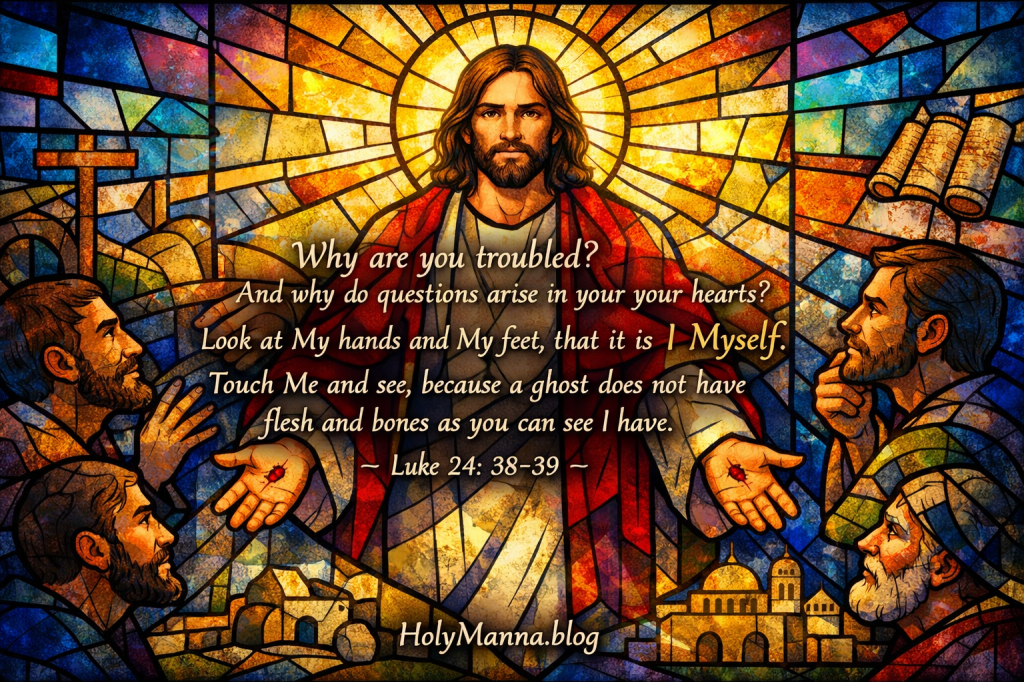
The Appearance to the Disciples in Jerusalem. 36 While they were still speaking about this, he stood in their midst and said to them, “Peace be with you.” 37 But they were startled and terrified and thought that they were seeing a ghost. 38 Then he said to them, “Why are you troubled? And why do questions arise in your hearts? 39 Look at my hands and my feet, that it is I myself. Touch me and see, because a ghost does not have flesh and bones as you can see I have.” 40 And as he said this, he showed them his hands and his feet. 41 While they were still incredulous for joy and were amazed, he asked them, “Have you anything here to eat?” 42 They gave him a piece of baked fish; 43 he took it and ate it in front of them.
44 He said to them, “These are my words that I spoke to you while I was still with you, that everything written about me in the law of Moses and in the prophets and psalms must be fulfilled.” 45 Then he opened their minds to understand the scriptures. 46 And he said to them, “Thus it is written that the Messiah would suffer and rise from the dead on the third day 47 and that repentance, for the forgiveness of sins, would be preached in his name to all the nations, beginning from Jerusalem. 48 You are witnesses of these things.
Detailed Exegesis
Verse 35 – “Then the two recounted what had taken place on the way and how he was made known to them in the breaking of the bread.”
The Gospel begins with testimony. The disciples from Emmaus do not keep the encounter to themselves. They return and recount what happened. The risen Christ is already forming a people of witness. The phrase “made known to them in the breaking of the bread” carries enormous weight in Catholic tradition. It points toward the Eucharistic life of the Church, where Christ is truly present and recognized by faith. Even before Jesus appears in this room, the Gospel reminds the reader that He is known through Word and sacrament.
Verse 36 – “While they were still speaking about this, he stood in their midst and said to them, ‘Peace be with you.’”
Jesus appears suddenly, not because He is unreal, but because His risen body is glorified and no longer bound in the old earthly way. His first word is peace. This is not a casual greeting. It is the gift won by the Cross. The disciples are gathered in fear, shame, confusion, and disbelief, and Jesus steps directly into that troubled space with divine peace. He does not begin with reproach. He begins with reconciliation. The risen Christ still meets souls this way.
Verse 37 – “But they were startled and terrified and thought that they were seeing a ghost.”
The disciples do not respond with calm confidence. They are frightened. That detail gives the account its realism. The Resurrection was not easy for them to accept. Their fear shows that they were not gullible men eager to believe anything. They truly struggled with what they were seeing. This also reveals how far beyond ordinary expectation the Resurrection was. Even those who loved Jesus did not naturally imagine this outcome.
Verse 38 – “Then he said to them, ‘Why are you troubled? And why do questions arise in your hearts?’”
Jesus gently exposes the inner state of the disciples. Trouble and questioning have taken root within them. He is not condemning honest struggle, but drawing it into the light. The risen Lord addresses not only what they see, but what is happening within their hearts. This remains a beautiful pattern of grace. Christ does not only solve external confusion. He heals interior unrest.
Verse 39 – “Look at my hands and my feet, that it is I myself. Touch me and see, because a ghost does not have flesh and bones as you can see I have.”
Here the Gospel becomes unmistakably concrete. Jesus insists on continuity between the crucified Lord and the risen Lord. The hands and feet still bear the marks of crucifixion. He says plainly that He has flesh and bones. This verse is one of the strongest biblical witnesses against any attempt to reduce the Resurrection to a spiritual symbol or inward experience. The body that died is now alive, glorified, and real. Christ’s identity is continuous. It is truly He Himself.
Verse 40 – “And as he said this, he showed them his hands and his feet.”
Jesus confirms His words by showing His wounds. He does not hide the scars of the Passion. In the mystery of the Resurrection, the wounds are no longer signs of defeat. They are trophies of love, proof of identity, and medicine for unbelief. The disciples need to see that the risen Christ is the same Lord who suffered for them. The scars remain, but death no longer reigns.
Verse 41 – “While they were still incredulous for joy and were amazed, he asked them, ‘Have you anything here to eat?’”
This is one of the most human and tender lines in the Resurrection narratives. The disciples are caught in a strange state that Scripture describes beautifully as being “incredulous for joy.” The joy is so great that it is almost difficult to believe. Jesus then asks for food, not because He needs to prove Himself by some theatrical act, but because He meets them in ordinary human reality. He takes their stunned hearts seriously and patiently leads them deeper into faith.
Verse 42 – “They gave him a piece of baked fish;”
The detail is simple and earthy. A piece of baked fish is placed before the risen Lord. That small detail strengthens the credibility of the account. The Resurrection is not presented in dreamy abstraction. It unfolds in a room, among friends, with a real meal. Christianity is a religion of the Word made flesh, and the Resurrection keeps that fleshly realism before the reader.
Verse 43 – “He took it and ate it in front of them.”
Jesus eats before them to show that He is not a ghost. At the same time, the Church understands that His risen life does not depend on food in the way earthly life does. This action is a merciful condescension to the weakness of the disciples. He gives them sensible proof suited to their fear. He meets them where they are. There is also something deeply beautiful here. The risen Jesus still shares table fellowship with His own. Communion with Him has not ended. It has deepened.
Verse 44 – “He said to them, ‘These are my words that I spoke to you while I was still with you, that everything written about me in the law of Moses and in the prophets and psalms must be fulfilled.’”
Jesus now interprets His Passion and Resurrection through the whole sweep of Israel’s Scriptures. The Law, the Prophets, and the Psalms together represent the full witness of the Old Testament. He had spoken of these things before, but now, in the light of Easter, their meaning can finally be grasped. This verse teaches that the Resurrection is not detached from the history of salvation. It is the fulfillment of God’s long-promised plan.
Verse 45 – “Then he opened their minds to understand the scriptures.”
This is one of the most precious lines in all of Easter. Understanding is not achieved by human cleverness alone. Christ Himself opens the mind. The Scriptures are not a puzzle mastered merely by technique. They are understood fully only in the light of the risen Lord. This is why the Church reads the Old Testament through Christ and why Catholic interpretation always depends on receiving the Word within the living faith of the Church.
Verse 46 – “And he said to them, ‘Thus it is written that the Messiah would suffer and rise from the dead on the third day”
Jesus summarizes the heart of the Gospel. The Messiah must suffer and rise. The Cross and Resurrection belong together. There is no Easter without Good Friday, and no Good Friday without Easter’s vindication. The phrase “on the third day” places the Resurrection firmly within the scriptural pattern of God’s saving action. The suffering Messiah is not an embarrassment to the faith. He is its center.
Verse 47 – “And that repentance, for the forgiveness of sins, would be preached in his name to all the nations, beginning from Jerusalem.”
Now the mission of the Church is named. The Gospel is not only the announcement that Jesus rose. It is the proclamation of repentance and forgiveness in His name. This verse reveals the heart of apostolic ministry and the sacramental life that will grow from it. The risen Christ sends His Church to preach conversion and mercy to all nations. It begins in Jerusalem, the very place of rejection and crucifixion, which already shows the wideness of divine mercy. Grace begins where sin seemed to triumph.
Verse 48 – “You are witnesses of these things.”
This final line gives the disciples their new identity. They are witnesses. They are not merely private believers who had a moving experience. They are chosen to testify to what they have seen and heard. The Church is born from this witness. Apostolic faith is handed on because real men encountered the risen Christ and were sent to proclaim Him. This verse also reaches into every age, because the whole Church lives from the testimony of the apostles and is called to echo it in every generation.
Teachings
This Gospel teaches first that the Resurrection is real, bodily, and continuous with the crucified Lord. Jesus is not a memory returning to comfort grieving friends. He is the same Lord who suffered, died, and now stands alive in glory, still bearing the marks of His Passion. The Catechism states, “By means of touch and the sharing of a meal, the risen Jesus establishes direct contact with his disciples.” CCC 645. The same teaching explains that He does this so the disciples will know that He is not a ghost and that the risen body is the very body that was crucified, still bearing the traces of the Passion. This matters deeply for Catholic faith because it means redemption does not discard the body. Christ saves the whole person. He does not abandon human nature. He raises it.
This Gospel also teaches that Easter does not cancel Good Friday. It glorifies it. Jesus keeps His wounds. He does not return polished, distant, and unmarked. He comes back with pierced hands and feet. Saint Augustine saw a great mercy in that. He preached, “He kept the scars, that they might be touched by the doubting Apostle, and the wounds of his heart be healed.” The visible wounds of Christ heal the invisible wounds of unbelief. That is still true. The Passion is not an embarrassing prelude left behind once the Resurrection arrives. The wounds remain because love remains. The sacrifice remains. Mercy remains.
The Gospel also teaches that Christ Himself is the key to Scripture. The disciples had heard the words before. They had lived beside Jesus. They knew the sacred texts of Israel. Yet they still could not see the full pattern until the risen Lord opened their minds. The Catechism says, “If the Scriptures are not to remain a dead letter, Christ, the eternal Word of the living God, must, through the Holy Spirit, ‘open [our] minds to understand the Scriptures.’” CCC 108. This is one of the great Catholic principles for reading the Bible. Scripture is not mastered by technique alone. It is received in the light of Christ, within the Church, through grace.
Then the Gospel moves from revelation to mission. Jesus does not only prove that He is alive. He commissions His disciples to preach “repentance, for the forgiveness of sins” in His name to all nations. That mission is not a temporary assignment for one generation. It becomes the living work of the Church. The Catechism says, “After his Resurrection, Christ sent his apostles ‘so that repentance and forgiveness of sins should be preached in his name to all nations.’” CCC 981. It then teaches that the apostles and their successors carry out this ministry of reconciliation by announcing forgiveness, calling people to conversion, and communicating that forgiveness through the sacraments entrusted to the Church. This means the Gospel is not only information about Jesus. It is the living announcement of mercy, still active in Baptism, Confession, and the whole sacramental life of the Church.
There is also something beautifully apostolic in the final line, “You are witnesses of these things.” The Church is not built on vague spiritual impressions. She is built on witness. The apostles saw, touched, heard, and ate with the risen Lord. Their testimony became the foundation of the Church’s preaching. That is why Catholic faith is both deeply spiritual and stubbornly historical. It rests on divine revelation given in real history, guarded in the apostolic Church, and handed on faithfully through the centuries. The risen Christ still forms witnesses, but He does so by first giving peace, then opening the Scriptures, and finally sending His people into the world with a message of mercy.
Reflection
This Gospel reaches straight into the rooms people try to keep shut. It speaks to fear, to shame, to doubt, and to the tired heart that wants to believe but still trembles. The disciples are not fearless saints when Jesus appears. They are startled, troubled, and slow to understand. Yet Christ comes anyway. He stands in their midst and says “Peace be with you.” That is the first comfort of this passage. The Lord does not wait for perfect faith before drawing near. He comes precisely where faith is weak and wounded.
There is a needed lesson here for daily life. Many people imagine that doubt or fear disqualifies them from encountering Christ. This Gospel shows the opposite. Trouble in the heart is not meant to become a permanent home. It is meant to be brought into the presence of Jesus. He does not flatter confusion, but He does not despise it either. He answers it. He speaks peace. He shows His wounds. He gives reasons for trust. The soul that is honest before Him is already on the road to healing.
The wounds of Christ also teach something essential about suffering. The risen Lord still bears them, but now they are full of glory. That means the faithful do not need to hide every scar, every grief, or every memory of costly love as though healed life must look untouched. In Christ, wounds can be transfigured. They do not have to define a person by shame. They can become places where grace has entered, where mercy has triumphed, and where compassion for others has deepened. What old wound has been treated only as damage, when Christ may want to transform it into a place of testimony?
This Gospel also invites a more Catholic way of approaching Scripture. Jesus opens the minds of the disciples so they can understand. That means the Bible should not be treated like a private code book or a collection of isolated inspirational lines. It should be read prayerfully, humbly, and with the Church. A practical step would be to read the daily Gospel slowly before Mass or later in the day, asking Christ to do exactly what He did for the disciples: open the mind and heart. Another step would be to return more intentionally to the sacramental life, especially Confession, because the Gospel’s great mission is repentance and the forgiveness of sins, and the Church still carries that ministry by Christ’s command.
There is one more challenge hidden in this passage. Jesus does not say only, “Look at me.” He says, in effect, “Now go and bear witness.” A Christian cannot stay forever in the locked room. Peace is given so that witness can begin. That witness may not always look dramatic. It may take the form of speaking honestly about Christ, returning to Sunday Mass with greater fidelity, asking forgiveness in a broken relationship, refusing an old sin, teaching children the faith, or simply living with a steadier hope in a frightened world. Where is Christ asking for witness instead of silence? Where has fear been allowed to speak louder than the Resurrection? What would change if His greeting, “Peace be with you,” were received as something meant for today and not only for that first Easter night?
This Gospel leaves the reader with a simple but demanding truth. The risen Jesus is real. His peace is real. His wounds are real. His Church’s mission to preach repentance and forgiveness is real. The only fitting response is to let Him stand in the middle of life as it truly is, and then to follow where He sends.
When Peace Becomes a Mission
Today’s readings come together like three windows opening onto the same Easter mystery. In the Temple, Peter stands before a stunned crowd and refuses to let them stop at the miracle. He leads them straight to Jesus, the Holy and Righteous One, the Author of life, the One they rejected and the Father glorified. In Psalm 8, the heart lifts in wonder at the dignity God has given to man, a dignity not invented by the world, but bestowed by the Creator. Then, in the Gospel, the risen Christ Himself steps into the middle of fear, shows His wounded hands and feet, opens the Scriptures, and sends His disciples out as witnesses of repentance and forgiveness.
That is the thread holding the day together. Easter is not only the announcement that Jesus is alive. Easter is the moment when everything begins to make sense in His light. Sin is named honestly, but mercy is offered freely. Human weakness is not denied, but it is no longer the end of the story. The wounds of Christ remain, yet now they shine with victory. The Scriptures that once seemed mysterious are opened. The frightened disciples who once hid behind locked doors are given peace and then sent into the world.
There is something deeply encouraging in that pattern. The Lord does not wait for perfect people before He begins His work. He meets the guilty crowd through Peter’s preaching. He meets fearful disciples in a locked room. He meets weak and wondering hearts with truth, mercy, and peace. That means no life is too tangled for His grace. No past is too heavy for His forgiveness. No fear is too stubborn for His presence. The risen Jesus still comes into the middle of real life and does what only He can do. He heals, He restores, and He sends.
The call now is simple, but it is not small. Stay close to the risen Christ. Let His Word open the mind. Let His mercy cleanse what needs to be confessed. Let His peace settle what has been restless for too long. Then do not keep that gift locked away. Carry it into daily life. Bring it into prayer, into work, into family life, into suffering, into conversations that matter, and into the quiet choices no one else sees. Where is the Lord asking for deeper repentance, steadier trust, and clearer witness today? Easter has already begun the answer. Christ is risen, and because He is risen, the faithful can rise too.
Engage with Us!
Share your reflections in the comments below. What stood out most in today’s readings? What challenged the heart, strengthened hope, or called for deeper trust in the risen Jesus? This is a beautiful place to slow down, listen again, and encourage one another in faith.
- First Reading, Acts 3:11-26: Where has the Lord been calling for real repentance and conversion? What part of Peter’s preaching stood out most, especially his call to turn back to God so that sins may be wiped away? How might Jesus be trying to bless life right now by turning the heart away from an old sinful pattern or a familiar compromise?
- Responsorial Psalm, Psalm 8:2, 5-9: What does this psalm reveal about human dignity and God’s care? In what moments has it been hardest to believe that God is truly mindful of the human person? How might daily life change if it were lived with deeper gratitude for the glory and purpose God has given to every soul?
- Holy Gospel, Luke 24:35-48: What part of the Gospel speaks most deeply to the heart: Christ’s greeting of peace, His wounded hands and feet, His opening of the Scriptures, or His command to be witnesses? Where is fear still trying to keep the soul locked away, and how is the risen Jesus inviting deeper peace, stronger faith, and more courageous witness?
Keep walking with confidence and humility. Let the peace of the risen Christ shape every word, every choice, and every relationship. Live the faith with conviction, and do everything with the love, mercy, and tenderness Jesus taught us.
Sacred Heart of Jesus, we trust in You!
Immaculate Heart of Mary, pray for us!
Saint Michael the Archangel, defend us in battle!
Follow us on YouTube, Instagram and Facebook for more insights and reflections on living a faith-filled life.

 Holy Manna!
Leave a comment