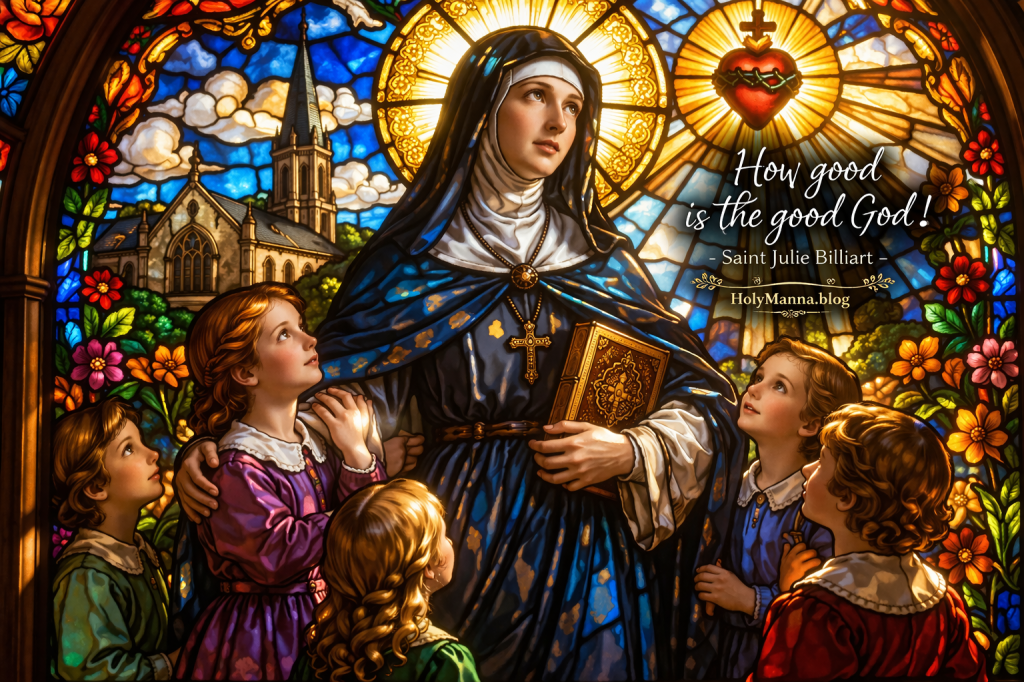
The Saint Who Never Stopped Saying God Is Good
Saint Julie Billiart stands as one of those saints whose life feels almost impossible at first glance. She was a poor village girl, a bedridden sufferer, a woman hunted during the French Revolution, a foundress, a teacher of the poor, and a soul so full of trust that her name is still tied to one unforgettable line: “How good is the good God!” She is revered in Catholic tradition because she showed that holiness is not reserved for the strong, the educated, or the comfortable. Holiness belongs to the one who gives everything to God.
She is remembered above all as the foundress of the Sisters of Notre Dame de Namur, a congregation devoted especially to the Christian education of girls and the poor. Her life became a living testimony that suffering does not cancel a vocation. In the Lord’s hands, suffering can purify it, strengthen it, and send it farther than anyone imagined. Saint Julie matters because she believed that every child deserved to know the love of God, and she spent her life making that truth visible.
A Child Formed by Faith and Fire
Saint Julie Billiart was born Marie Rose Julie Billiart on July 12, 1751, in Cuvilly, France. She came from a hardworking family of modest means, and from an early age she showed unusual piety, intelligence, and love for the faith. As a child, she learned the catechism with remarkable eagerness and began teaching other children what she had learned. Even in those early years, there was already something apostolic about her. She did not keep the faith to herself.
Her family life was not easy. Financial hardship touched the home, and Julie helped support the family through labor and practical work. Yet the burdens of life did not harden her heart. They seemed to make it more available to God. From her youth, she was drawn to prayer, to the Eucharist, and to teaching others about Christ. She was known locally for her holiness long before she founded anything, and some even called her the saint of Cuvilly.
The deepening of her faith did not come through one dramatic conversion in the usual sense, because she had loved God from childhood. Instead, her life shows a continual deepening of surrender. She did not have to be pulled out of a sinful public life like Saint Augustine or Saint Mary of Egypt. Her path was quieter and just as demanding. It was the path of fidelity, hidden sacrifice, and increasing dependence on grace.
What she became most known for began to take shape very early. She loved the poor. She loved the Church. She loved teaching the faith. She trusted in the goodness of God with a simplicity that was stronger than philosophy and more durable than comfort.
From a Sickbed to a Mission for Souls
A terrible shock changed the course of Julie’s life. After violence connected to an attack on her father, she gradually lost the use of her legs. She would remain paralyzed for about twenty-two years. For most people, that would have ended any dream of active mission. For Julie, it became the furnace in which God prepared her.
During those long years of paralysis, she did not become spiritually passive. She prayed deeply, received Holy Communion whenever possible, offered suffering to God, and continued teaching children from her bed. In a Catholic age that understood suffering through the lens of the Cross, Julie’s hidden life became a participation in the sufferings of Christ. Her patience was not empty endurance. It was a fruitful union with the Lord.
She also lived through the violence and instability of the French Revolution. Because of her loyalty to the Catholic Church and to faithful priests, she was forced into hiding and moved from place to place. Her life during these years was marked by danger, uncertainty, and exhaustion. Yet this same period became one of the most important in her spiritual mission. It was during this time that she formed a deep friendship with Françoise Blin de Bourdon, who would become one of her great collaborators in the work God was preparing.
Catholic tradition associated with her congregation also preserves a striking mystical grace from her time in Compiègne. Julie saw women gathered around the Cross and heard the words: “These are the daughters that I will give you in an Institute, which will be marked by my cross.” This experience shaped the future of her vocation. Later, when meeting some of the first sisters, she reportedly told them, “I saw you at Compiègne.”
In 1804, that mission took visible form with the foundation of the Sisters of Notre Dame. The congregation was established for the Christian education of girls and for the formation of teachers, especially for places where the poor had little access to faithful instruction. This mattered enormously in post-revolutionary France, where so much had been shattered. Julie did not merely want children to learn letters and numbers. She wanted them formed for life, for virtue, and for God.
Then came the best known miracle of her lifetime. After a novena to the Sacred Heart, Julie was instructed by a priest to stand and take steps in honor of the Heart of Jesus. On June 1, 1804, after more than two decades of paralysis, she was healed. The woman who had lived from a bed now stood, walked, traveled, and founded houses. It was not just a healing. It was a release into mission.
This miracle stands at the center of her life because it revealed both divine power and divine timing. God had not forgotten her during those silent years. He had been forming her. When the time came, He gave her back her strength for the sake of souls.
Crosses Without Martyrdom
Saint Julie Billiart was not a martyr in the strict sense, because she was not killed for the faith. Yet her life was filled with real hardships, and those hardships matter because they reveal the kind of holiness she lived.
She knew poverty. She knew physical suffering. She knew fear during political persecution. She knew what it was to live dependent on others. She knew misunderstanding and ecclesial conflict. One of the hardest trials of her later years came after the foundation of her congregation, when disputes with church authorities in Amiens made it necessary for her to leave. For a foundress, that kind of suffering can feel like having the ground taken out from beneath one’s feet.
Yet Julie endured these trials with remarkable freedom and confidence. One of her sayings from this painful time captures her spirit beautifully: “Today here, tomorrow elsewhere, the whole earth is the Lord’s, and all should be the same to Sisters of Notre Dame, who have the happiness of following their divine Master.” That is not the language of bitterness. That is the language of a woman who had learned to belong to Christ more than to any place.
There were also moments of divine protection in her life. During the Revolution, she escaped danger while in hiding, including the well-known account that she was transported hidden in a hay cart. That story fits the broader Catholic memory of a woman preserved by Providence for a mission the Church would later recognize as holy. It is part of her life story in Catholic retellings, though the finer details are not always equally documented in every source.
Her entire life teaches something important. A saint does not need a dramatic martyrdom to live heroic holiness. Sometimes the martyrdom is interior. Sometimes it is the daily surrender of pride, comfort, plans, and security. Julie lived that kind of white martyrdom with courage.
A Legacy That Spread Across the World
Saint Julie’s influence did not end when she died on April 8, 1816. Catholic devotion to her continued, and her congregation grew well beyond what anyone in her little French village could have imagined. After her death, the Sisters of Notre Dame de Namur expanded across countries and continents, carrying forward her mission of education, evangelization, and service to the poor.
Two major miracle stories are especially important in her official path to sainthood. One involved the healing of Homer Rhodius in 1919. He was suffering from severe renal disease and was reportedly near death. After prayers through the intercession of Blessed Julie and the use of a relic, he recovered in a way that was considered extraordinary. Another miracle involved Otacilio Ribeiro da Silva in Brazil in 1950. He reportedly suffered from a serious tumor that could not be successfully treated surgically. After a novena and prayers for Blessed Julie’s intercession, the tumor disappeared. These miracles became central in the Church’s recognition of her sanctity.
Other stories of favor and healing have naturally grown around her memory through the life of the congregation and Catholic devotion, as often happens with beloved saints. Not every such account can be verified to the same degree, and when that is the case, it is best to receive them cautiously and with reverence. The Church’s own official recognition rests especially on the miracles examined in her cause.
Her veneration also took concrete form in places tied to her life. Her birthplace in Cuvilly remains associated with her memory, and Namur in Belgium became the enduring center of her congregation. Her tomb there remains an important place of remembrance for the Sisters of Notre Dame and for those devoted to her spiritual legacy.
Her cultural and Catholic impact is especially clear in education. Schools, ministries, and communities shaped by her congregation helped form generations of Catholics. Her influence reached beyond France and Belgium into the United States and many other parts of the world. Through the sisters she formed, her charism entered classrooms, chapels, orphanages, and missions. Her legacy became not just personal but institutional, and yet it never lost the warmth of her original spirit.
She was beatified in 1906 and canonized in 1969. The Church did not honor her because she built an impressive organization. The Church honored her because her life radiated heroic virtue, trust in God, and fruitful love for souls.
What Her Life Still Says to the Church
Saint Julie Billiart speaks clearly to the modern Catholic heart. She reminds the faithful that suffering is not wasted when united to Christ. She reminds teachers, parents, catechists, and religious that the work of forming souls is one of the most urgent works in the Church. She reminds anyone who feels overlooked, weak, or delayed that God can do extraordinary things through a hidden life.
Her most famous saying still lands with force because it came from lived experience: “How good is the good God!” That line sounds simple, but it is not shallow. It came from a woman who had every worldly reason to become discouraged. Instead, she kept praising the goodness of God. That is one of the clearest signs of sanctity.
She also left behind other words worth remembering. “You know that desires are not enough; action is needed.” That is a needed correction for every Catholic tempted to admire holiness without practicing it. She also said, “We exist only for the poor, only for the poor, absolutely only for the poor.” In those words, her mission becomes unmistakably Catholic. Love of God overflows into love of neighbor, especially the one most neglected.
What would change if life were approached with Julie’s confidence in the goodness of God? What hidden suffering might become fruitful if it were offered more consciously to Jesus? What child, student, friend, or family member needs to be taught the faith with more patience and love?
Her life invites ordinary Catholics to do very practical things. Pray with more trust. Teach the faith clearly. Love the poor concretely. Stay faithful to the Church when times are confusing. Refuse self-pity. Offer suffering to Christ. Begin where Providence has placed the soul, and let God decide how far the mission should go.
Saint Julie is worth remembering because she lived the truth taught in The Catechism of the Catholic Church, that the human person finds fulfillment in communion with God and in a life shaped by grace. She did not chase greatness. She surrendered to God. That is why her life became great.
Engage with Us!
Share your thoughts and reflections in the comments below. Saint Julie Billiart’s life has a way of reaching the heart, especially for anyone who has ever felt limited by suffering, disappointment, or delay. Her story invites a deeper trust in God and a more generous love for others.
- What part of Saint Julie Billiart’s life speaks most powerfully to the heart right now?
- How does her trust in God’s goodness challenge the way suffering is viewed?
- What practical step can be taken this week to teach the faith more lovingly in the home, parish, or daily life?
- Where might God be asking for greater trust instead of fear?
- How can Saint Julie’s love for the poor shape daily choices and priorities?
May Saint Julie Billiart inspire a life of deep trust, joyful endurance, and faithful service. May everything be done with the love and mercy Jesus taught, and may the goodness of God be proclaimed with both words and life.
Saint Julie Billiart, pray for us!
Follow us on YouTube, Instagram and Facebook for more insights and reflections on living a faith-filled life.

 Holy Manna!
Leave a comment