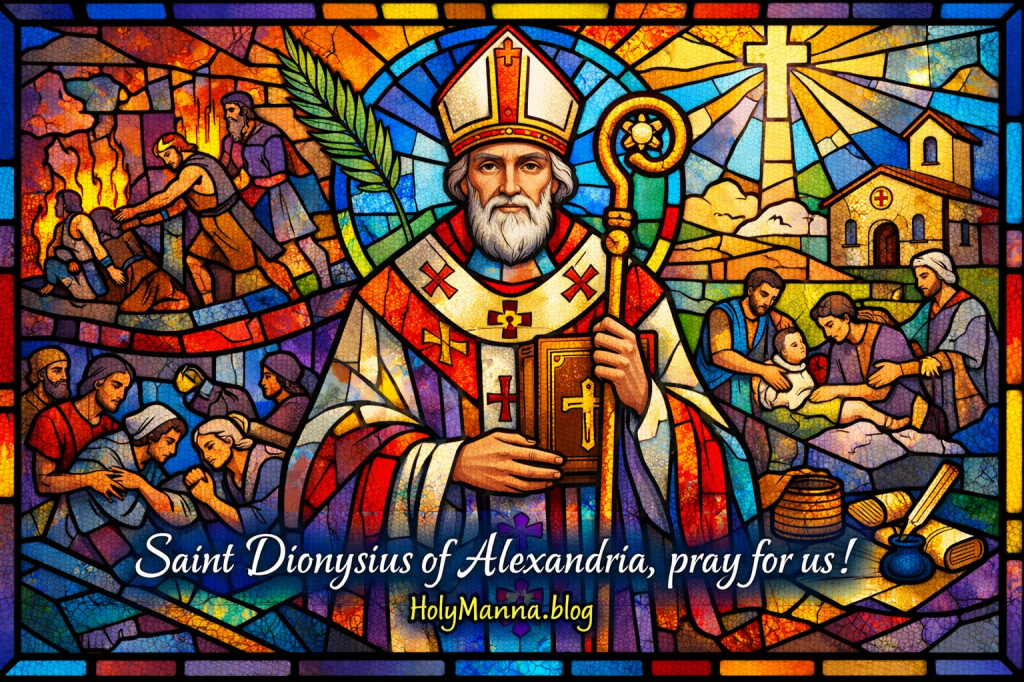
The Great Bishop Who Guarded Truth and Mercy
Saint Dionysius of Alexandria, also known as Dionysius the Great, stands among the most important bishops of the third century. Catholic tradition remembers him as a wise pastor, a defender of truth, a healer of division, and a man who led the Church through persecution, plague, confusion, and doctrinal conflict. He is revered not because he sought greatness, but because he remained faithful when the Church around him was under enormous pressure.
He lived in one of the most intellectually important cities in the ancient world, and he used both learning and holiness in service of Christ. He is especially remembered for protecting the unity of the Church, clarifying doctrine when error threatened the faithful, and showing mercy to Christians who had fallen during persecution and longed to return. In him, the Church sees a bishop who loved truth without becoming harsh, and who loved mercy without weakening the faith.
From Pagan Roots to Christian Wisdom
Saint Dionysius was born in Alexandria, likely around the end of the second century, into a pagan family of some standing. He did not grow up in the Christian faith, which makes his later devotion all the more striking. At some point in his early life, he came to believe in Christ and entered deeply into the life of the Church. His conversion was not shallow or emotional only. It became intellectual, spiritual, and pastoral.
He studied under the great Origen, one of the most influential Christian teachers of the early Church, and later became associated with the famous catechetical school of Alexandria. Catholic tradition preserves an unusual detail from his life. When he was troubled about reading the writings of heretics and unbelievers, he believed he received divine reassurance that such study could serve the truth if done rightly. That insight helped shape the kind of bishop he became. He was not afraid to confront error directly, because he trusted that truth belongs to God.
This early formation explains much of what he became known for. He was not merely a pious man. He was a deeply formed Catholic teacher who understood that the faith must be defended with both charity and clarity.
The Bishop Who Held Fast to the Church
When Dionysius became bishop of Alexandria, he did not inherit a peaceful Church. He stepped into a storm. His years as bishop were marked by mob violence, imperial persecution, disease, schism, and serious theological disputes. Yet this is exactly where his holiness became visible.
He is most known for three great strengths. He defended the unity of the Church when schism threatened to tear believers apart. He protected sound doctrine when confusion spread. And he cared for souls with real pastoral tenderness, especially those who had failed under fear and wanted to return to Christ.
When the Novatian schism arose, Dionysius supported the legitimate authority of Pope Cornelius and worked for communion rather than division. He understood that defending the Church was not only about winning arguments. It was about preserving the Body of Christ from being torn apart. One of the most powerful lines associated with him reflects that spirit: “Nevertheless the truth is to be prized and reverenced above all things else.” That sentence captures his entire approach. Truth mattered. But so did reverence, humility, and fidelity to the Church.
He also wrote words that reveal his hatred of schism and his love for ecclesial unity. He taught that it would be better to suffer greatly than to divide the Church of God. That is a deeply Catholic instinct. The Church is not a human club that can be broken and remade at will. She is Christ’s Body, and to wound her is no small thing.
Signs of Providence in His Life
Saint Dionysius is not remembered in Catholic tradition as a wonderworker in the way some saints are. There is no large body of famous healing miracles attached to his name during his lifetime. Still, his life contains remarkable moments of providence that show God’s hand at work.
One of the most striking events came during the Decian persecution. Dionysius was taken into custody, and the situation appeared grave. Yet word of his arrest reached people gathered at a wedding feast, and a crowd rushed out and secured his release. It was an extraordinary escape, and Catholic sources remember it as one of the most dramatic moments of his life.
Another remarkable sign came during exile. When he was sent away to harsh regions under persecution, he did not treat exile as defeat. He continued preaching, guiding the faithful, and bearing witness to Christ. He even wrote that in one place of exile a considerable church gathered around him, and some who had once worshiped idols turned to the true God. That missionary fruit in the middle of suffering is one of the clearest signs of grace in his life.
His life also bore another kind of miracle, the quieter kind that often goes unnoticed. During plague and social collapse, Christians under his care tended the sick and buried the dead while others fled. Dionysius praised that courage. In a world ruled by fear, Christian charity became a visible sign of divine life. Sometimes the most powerful miracle is not spectacle, but a people transformed by Christ into sacrificial love.
Fire, Exile, and the Weight of Leadership
The hardships of Saint Dionysius were severe. He lived during the persecutions under Decius and Valerian, two of the most brutal periods for the early Church. Christians were imprisoned, tortured, pressured to renounce the faith, or killed. Dionysius himself was forced into hiding, captured, and later exiled.
He also had to lead during internal crises. Some Christians had lapsed under pressure and offered sacrifice to pagan gods. Others insisted that such people should never be restored. Dionysius took the more merciful and deeply Catholic path. He did not excuse sin, but neither did he close the door to repentance. He understood that Christ came not to crush the weak but to restore the repentant.
He also faced doctrinal controversy. In fighting false teachings like Sabellianism, some of his expressions were later judged in need of clarification. What makes him admirable is not that he never needed to refine a phrase, but that he responded with humility and fidelity. He clarified his teaching and reaffirmed the eternal divinity of the Son. That humility is part of his greatness. A lesser man might have clung to pride. Dionysius chose truth.
He was not a martyr in the strict sense, because he did not die by execution for the faith. But he is honored as a confessor, which means one who suffered for Christ and remained steadfast. That witness mattered greatly in the early Church and still matters now.
What Followed After His Death
After his death, Saint Dionysius did not become the center of a large miracle cult in the way some later saints did. The main Catholic sources do not preserve many well-attested stories of posthumous healings, relic miracles, or major pilgrimages tied to his tomb. Because of that, it would be dishonest to invent such stories or exaggerate what survives.
What can be said with confidence is that his impact after death was profound. His letters continued to be quoted and preserved by major figures such as Eusebius and Saint Athanasius. His theological clarifications helped later Catholics understand the mysteries of the Trinity more clearly. His witness shaped how the Church remembered the persecution of Alexandria, the treatment of the lapsed, and the importance of unity with the See of Rome.
He also left a liturgical mark. He is remembered as the first bishop known to send annual festal letters announcing the date of Easter and the season of fasting that prepared for it. That may sound small at first, but it reveals something beautiful. Dionysius was not only a crisis manager. He was a shepherd who understood the rhythm of the Church’s life and wanted the faithful to be united in worship.
There are no famous posthumous miracle stories from Catholic sources that can be confidently repeated as historical fact. If local stories once existed, they are not well preserved in the main accounts that remain. So his enduring impact comes less from legendary marvels and more from the living memory of his holiness, his writings, and his courage. In truth, that is miracle enough for many saints of the early Church.
Why This Saint Still Matters
Saint Dionysius matters because he shows what holiness looks like when life becomes messy, dangerous, and complicated. He was not remembered for dramatic simplicity. He was remembered for faithful endurance. He held together truth and mercy in an age that tried to separate them.
Modern believers need saints like this. It is easy to become harsh in the name of orthodoxy. It is also easy to become vague in the name of compassion. Dionysius did neither. He loved the truth and defended it. He loved wounded sinners and sought their restoration. He loved the Church enough to suffer for her unity.
One of his most moving lines expresses his humility before God’s truth: “Nevertheless the truth is to be prized and reverenced above all things else.” Another tradition preserves his willingness to revise his thinking when reason and Scripture demanded it. That is not weakness. That is Christian maturity.
Learning to Live Like Saint Dionysius
The life of Saint Dionysius invites Catholics to become steadier, humbler, and braver. His example teaches that faithfulness is not only about grand public moments. It is also about how a soul responds when pressure rises, relationships strain, and truth becomes costly.
His life encourages deeper trust in the Church, especially when the Church passes through confusion or suffering. He shows that unity is precious and worth defending. He shows that mercy must remain open to the repentant. He shows that doctrine is not cold or abstract when it protects the truth about Christ. And he shows that suffering, when accepted with fidelity, can become fruitful beyond what anyone sees at the time.
Is there a place in life where truth has been avoided because it felt uncomfortable?
Is there someone who needs mercy, patience, or a path back after failure?
Is there a temptation to choose pride over humility when corrected?
Saint Dionysius speaks to all of that. He reminds the faithful to stay close to Christ, stay close to the Church, and stay close to the truth even when the cost is real.
Engage With Us!
Share your thoughts and reflections in the comments below. Saint Dionysius of Alexandria is not one of the most famous saints in popular devotion, but his life has a lot to say to Catholics trying to be faithful in difficult times.
- What stands out most about Saint Dionysius: his defense of truth, his mercy toward the fallen, or his love for Church unity?
- How can more patience and humility change the way hard conversations about the faith are handled?
- Where is Christ inviting deeper courage in the middle of confusion, suffering, or spiritual pressure?
- What does Saint Dionysius teach about staying faithful when both the world and even fellow believers feel unstable?
- How can daily life reflect both conviction and compassion in a more clearly Catholic way?
May the example of Saint Dionysius encourage a life of steady faith, humble obedience, and courageous charity. May every word, decision, and sacrifice be offered with the love and mercy Jesus taught, so that truth is never separated from holiness and mercy is never separated from the Cross.
Saint Dionysius of Alexandria, pray for us!
Follow us on YouTube, Instagram and Facebook for more insights and reflections on living a faith-filled life.

 Holy Manna!
Leave a comment