Wednesday in the Octave of Easter – Lectionary: 263
When the Risen Lord Draws Near
Easter does not leave people where it finds them. That is the thread running through today’s readings. In Acts 3:1-10, a man who has spent his life at the gate is lifted to his feet. In Psalm 105, God’s people are told to remember the mighty deeds of the Lord and rejoice in his covenant faithfulness. In Luke 24:13-35, two disciples who walk away from Jerusalem in sorrow find their hearts set ablaze when the risen Jesus comes near. The central theme uniting these passages is simple and powerful: the risen Christ meets human weakness, opens blind hearts, and raises his people into praise, worship, and witness.
That theme fits the spirit of the Octave of Easter perfectly. The Church does not treat Easter as a single morning that passes quickly. She lingers in it for eight days, almost as if one great Sunday is still unfolding. These readings come from that living joy. They show what the Resurrection does in real time. It is not only a truth to be believed, but a power that changes the way men walk, pray, understand Scripture, and recognize God at work. The world after Easter is the same world on the surface, but nothing is truly the same anymore.
There is also a beautiful historical unity in these readings. The first Christians were still deeply rooted in the worshiping life of Israel. Peter and John go up to the temple at the hour of prayer, showing that the Church was born from the fulfillment of God’s promises, not from their rejection. The psalm reaches back to Abraham and the covenant, reminding readers that the God who acted in the Resurrection is the same God who has always been faithful. Then the Gospel reveals how those promises are finally understood: Christ opens the Scriptures and is made known in the breaking of the bread. The whole day’s liturgy moves like a quiet procession from promise, to fulfillment, to mission.
Taken together, today’s readings invite the soul to see Easter as more than a memory. They reveal a Lord who still comes alongside the discouraged, still strengthens the helpless, and still turns those who recognize him into joyful witnesses. The crippled beggar begins to walk and praise God. The disciples of Emmaus turn around and hurry back to Jerusalem. That is what happens when Jesus truly enters a life. He does not merely comfort for a moment. He restores, enlightens, and sends.
First Reading – Acts 3:1-10
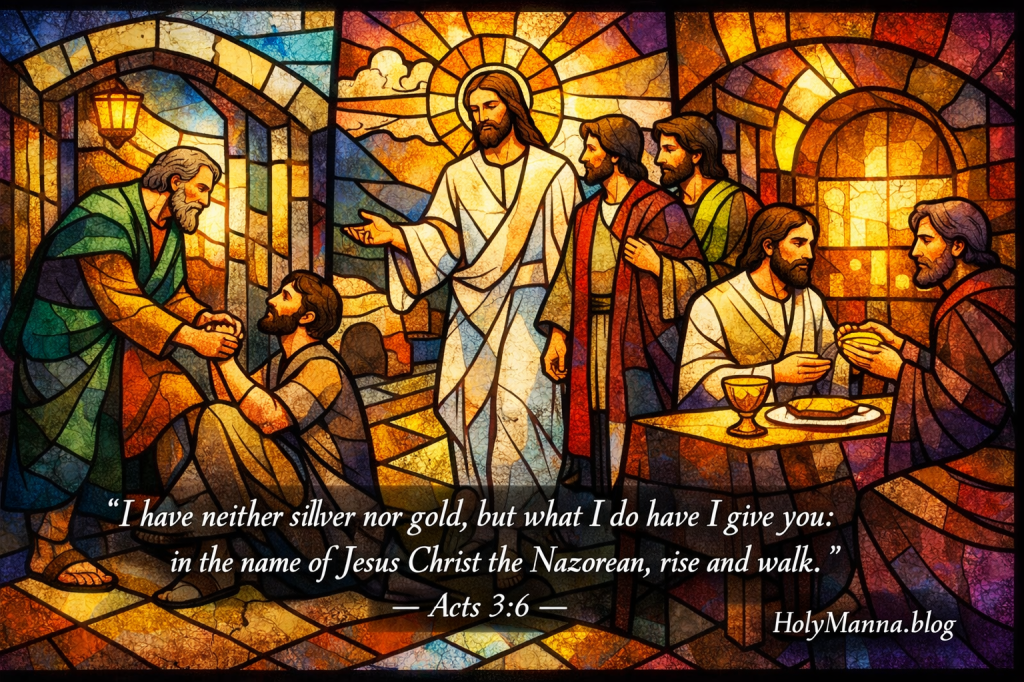
At the Beautiful Gate, Easter walks into a broken life
The first reading takes place in the first days of the Church’s public life after the Resurrection. The Acts of the Apostles, written as the second volume of Saint Luke’s work, shows how the saving work of Jesus continues in the apostolic Church through the power of the Holy Spirit. Peter and John are still going up to the temple at the three o’clock hour of prayer, which was the ninth hour in Jewish reckoning. That detail roots this scene in the daily worship of Israel and shows that the first Christians understood themselves as living in the fulfillment of God’s promises, not outside them. The crippled beggar is laid at the Beautiful Gate, a place where worshippers pass by in large numbers, hoping to receive mercy in the form of alms. Instead, he receives something far greater: the healing power of the risen Christ. This fits today’s Easter theme perfectly. Jesus meets human weakness, raises what has been cast down, and turns need into praise. The man at the gate asks for survival, but Christ gives him restoration, dignity, worship, and witness.
Acts 3:1-10 – New American Bible (Revised Edition)
Cure of a Crippled Beggar. 1 Now Peter and John were going up to the temple area for the three o’clock hour of prayer. 2 And a man crippled from birth was carried and placed at the gate of the temple called “the Beautiful Gate” every day to beg for alms from the people who entered the temple. 3 When he saw Peter and John about to go into the temple, he asked for alms. 4 But Peter looked intently at him, as did John, and said, “Look at us.” 5 He paid attention to them, expecting to receive something from them. 6 Peter said, “I have neither silver nor gold, but what I do have I give you: in the name of Jesus Christ the Nazorean, [rise and] walk.” 7 Then Peter took him by the right hand and raised him up, and immediately his feet and ankles grew strong. 8 He leaped up, stood, and walked around, and went into the temple with them, walking and jumping and praising God. 9 When all the people saw him walking and praising God, 10 they recognized him as the one who used to sit begging at the Beautiful Gate of the temple, and they were filled with amazement and astonishment at what had happened to him.
Detailed Exegesis
Verse 1 – “Now Peter and John were going up to the temple area for the three o’clock hour of prayer.”
This verse quietly says a great deal. Peter and John are apostles of the risen Lord, yet they are still marked by the rhythm of prayer. The Church is born in worship, not in activism alone. The hour matters too, because the ninth hour was a fixed time of prayer and sacrifice. Saint Luke wants readers to see that the apostolic age is not a rejection of Israel’s worship, but its fulfillment in Christ. The same God who formed Israel is now revealing the power of the Resurrection through the apostles.
Verse 2 – “And a man crippled from birth was carried and placed at the gate of the temple called ‘the Beautiful Gate’ every day to beg for alms from the people who entered the temple.”
The man’s condition is not temporary. He has been crippled from birth, and he is dependent on others even to reach the place where he begs. He lives at the threshold of worship, close to the temple but unable to enter it in fullness as a strong and free participant. There is something deeply symbolic here. Sin and suffering leave fallen humanity near the things of God, but unable to heal itself. Luke also emphasizes that this was a daily pattern. His misery had become routine. Many souls know that feeling. They learn how to survive at the edge of hope.
Verse 3 – “When he saw Peter and John about to go into the temple, he asked for alms.”
The beggar asks for what he thinks is realistic. He does not ask for healing because he likely no longer expects that kind of mercy. This is often how spiritual poverty works. A soul can grow so accustomed to woundedness that it asks God for something smaller than grace. The man’s request is humble, but limited. He wants a little relief, while Christ is preparing to give him a new life. This verse exposes the narrowness of human expectation when it is not yet stretched by faith.
Verse 4 – “But Peter looked intently at him, as did John, and said, ‘Look at us.’”
Before the healing comes the gaze. Peter and John do not pass him by. They do not toss him a coin without relationship. They stop, look, and invite him to look back. This is profoundly Christian. The Church does not truly imitate Christ when she treats suffering people as interruptions. She must look at them. Grace does not erase the person. Grace addresses the person.
Verse 5 – “He paid attention to them, expecting to receive something from them.”
The man responds, but his expectation is still small. He is ready for charity, not for resurrection. That tension gives the moment its spiritual beauty. God often begins with the little opening a person can manage. He meets a soul where it is, even if that soul still cannot imagine the full scale of divine mercy. The beggar’s attention becomes the first act of readiness. Sometimes grace begins with nothing more dramatic than finally looking up.
Verse 6 – “Peter said, ‘I have neither silver nor gold, but what I do have I give you: in the name of Jesus Christ the Nazorean, [rise and] walk.’”
This is the heart of the passage. Peter does not deny the value of almsgiving, but he reveals that the Church’s deepest treasure is not material wealth. Her treasure is the living name of Jesus. The Catechism of the Catholic Church teaches in CCC 434, “Jesus’ Resurrection glorifies the name of the Saviour God.” That is why Peter heals in the name of Jesus. He is not using a formula or performing a private act of power. He is acting as an apostle of the risen Lord. Saint John Chrysostom noticed Peter’s humility here. Peter does not boast. He simply gives what he has received.
Verse 7 – “Then Peter took him by the right hand and raised him up, and immediately his feet and ankles grew strong.”
The miracle is spoken, but it is also enacted. Peter takes the man by the hand and raises him up. Saint John Chrysostom saw in this gesture an image of the Resurrection itself. The healing is immediate, but it is not impersonal. The apostolic hand becomes a sign of Christ’s own saving action. This is how the Church works. Christ continues his healing and saving work through visible, embodied means. He does not save souls as abstractions. He raises persons.
Verse 8 – “He leaped up, stood, and walked around, and went into the temple with them, walking and jumping and praising God.”
The miracle is complete and unmistakable. The man does not merely stand. He leaps. He does not merely recover movement. He enters the temple praising God. This matters. His healing is ordered toward worship. The true goal is not simply improved physical function, but restored communion with God. A healed life is meant to become a praising life.
Verse 9 – “When all the people saw him walking and praising God,”
Now the sign becomes public witness. The crowd sees not only a healed body, but public praise. The miracle points beyond itself. Catholic faith never treats miracles as spectacles for curiosity. Their purpose is to reveal the presence and action of God. The healed man becomes a living testimony that Easter is not an idea. The risen Christ is acting in history through his Church.
Verse 10 – “they recognized him as the one who used to sit begging at the Beautiful Gate of the temple, and they were filled with amazement and astonishment at what had happened to him.”
Recognition is essential here. The people know this man. They know his old condition. That is why their amazement is so strong. Christian witness is often most powerful when those around a person can say, truthfully, that something real has changed. The Church’s mission is apostolic and public. She does not hide Christ’s works. The miracle opens the way for Peter’s preaching, because signs in Acts are never ends in themselves. They prepare hearts to hear the Gospel of the risen Jesus.
Teachings
One of the great teachings in this reading is that the Church’s true wealth is Jesus Christ himself. Peter’s words are as sharp and beautiful now as they were that day at the gate. The Catechism of the Catholic Church teaches in CCC 432, “The name ‘Jesus’ signifies that the very name of God is present in the person of his Son.” It also teaches in CCC 434, “Jesus’ Resurrection glorifies the name of the Saviour God.” That is why Peter heals in the name of Jesus. He is proclaiming that the crucified one is alive, exalted, and still acting. The power is not Peter’s. The power belongs to the risen Lord, whose name now shines with Easter glory.
This reading also teaches that Christ continues his healing work through the Church. The Catechism of the Catholic Church says in CCC 1507, “The risen Lord renews this mission and commissions his disciples to continue it by their own authority but in his name.” It goes on to say, “In his name they will lay their hands on the sick, and they will recover.” The miracle at the Beautiful Gate is not a random wonder. It is a sign that Christ’s compassion has not ended with the Ascension. The risen Jesus still reaches the sick, the poor, and the broken through the apostolic ministry of his Church.
There is also a sacramental instinct in this passage. Peter speaks, touches, lifts, and the man is strengthened. Catholic life is never merely interior. God uses matter, gesture, voice, and human instruments. The Catechism of the Catholic Church teaches in CCC 1421, “The Lord Jesus Christ, physician of our souls and bodies, who forgave the sins of the paralytic and restored him to bodily health, has willed that his Church continue, in the power of the Holy Spirit, his work of healing and salvation.” This helps explain why the Church has always treasured concrete signs of grace, from the laying on of hands to the sacraments of healing.
Saint John Chrysostom saw something especially profound in Peter’s gesture. In his homily on this passage, he wrote, “This act made manifest the Resurrection, for it was an image of the Resurrection.” That line is worth carrying through the whole Easter season. The man is not only cured. He is raised. His body becomes a small icon of what Easter means for the whole human person. Christ did not rise from the dead so that people could merely cope better. He rose to raise them.
This passage also reveals something about the mission of the Church in history. One of the first public acts of the apostles after Pentecost is not a political speech or an organizational plan. It is mercy in the name of Jesus. Then that mercy opens the door for proclamation. The Church heals, proclaims, and suffers for the truth. That pattern has not changed. Wherever the risen Christ is truly preached, he continues to strengthen the weak and summon the world to faith.
Reflection
This reading reaches straight into daily life because most people know what it means to live at some kind of gate. Some stand at the gate of discouragement. Some stand at the gate of old sin. Some stand at the gate of fear, grief, loneliness, or spiritual exhaustion. It is possible to sit near holy things and still feel stuck. That is why this passage is so consoling. The risen Jesus is not offended by weakness. He comes to the weak through his Church and speaks a stronger word than the one the world expects.
There is also a practical challenge here. Peter does not give the man what he first asks for. He gives him what he most needs. That can be uncomfortable, because modern life trains people to settle for immediate relief. Christ wants more than symptom management. He wants healing that leads to worship. He wants a soul that has been bowed down to stand, walk, and praise God.
A good way to live this reading is to begin with honest prayer. Bring the real wound to Christ instead of hiding it behind routine. Stay faithful to daily prayer, as Peter and John were faithful to the hour of prayer. Ask boldly in the holy name of Jesus. Receive the sacraments seriously, especially Confession and the Eucharist, because the Church still carries Christ’s healing presence. Then imitate Peter’s gaze in ordinary life. Notice the person others pass by. Look with reverence, not annoyance. Offer not just convenience, but Christian charity joined to truth and hope.
Where has life become so routine that the soul has stopped asking Christ for real healing?
What small thing has been asked of God when he may be offering something much greater?
Who is sitting at the gate nearby, waiting not only for help, but to be truly seen?
This first reading leaves the heart with a simple Easter conviction. The risen Jesus still raises people. He still strengthens what has been weak from birth. He still turns beggars into worshippers. And when that happens, the only fitting response is the one given by the healed man himself: to enter the house of God walking, leaping, and praising him.
Responsorial Psalm – Psalm 105:1-4, 6-9
The Church sings because God never forgets his promises
After the healing at the Beautiful Gate, the liturgy does not rush forward as if the miracle can be understood on its own. It pauses and teaches the heart how to respond. That is what the responsorial psalm does. Psalm 105 is a song of remembrance, praise, and covenant faithfulness. It comes from the prayer of Israel and recalls the mighty deeds of the Lord, especially his promises to Abraham and his descendants. In the life of ancient Israel, this kind of psalm formed the people to remember that they were not self-made, self-saved, or forgotten. They belonged to a God who had acted in history and who remained faithful across generations.
That is why this psalm fits today’s Easter theme so beautifully. In the first reading, the crippled man is lifted up in the name of Jesus. In the Gospel, the disciples on the road to Emmaus slowly come to see that the risen Lord has fulfilled all that the Scriptures foretold. This psalm gives the Church the proper response to both scenes: remember, praise, seek, and rejoice. Easter is not a break from God’s covenant. Easter is the blazing fulfillment of it. The God who remembered Abraham has now revealed the fullness of his fidelity in the Resurrection of Jesus Christ.
Psalm 105:1-4, 6-9 – New American Bible (Revised Edition)
God’s Fidelity to the Promise
1 Give thanks to the Lord, invoke his name;
make known among the peoples his deeds!
2 Sing praise to him, play music;
proclaim all his wondrous deeds!
3 Glory in his holy name;
let hearts that seek the Lord rejoice!
4 Seek out the Lord and his might;
constantly seek his face.6 You descendants of Abraham his servant,
offspring of Jacob the chosen one!7 He the Lord, is our God
whose judgments reach through all the earth.
8 He remembers forever his covenant,
the word he commanded for a thousand generations,
9 Which he made with Abraham,
and swore to Isaac,
Detailed Exegesis
Verse 1 – “Give thanks to the Lord, invoke his name; make known among the peoples his deeds!”
This opening verse is full of movement. It begins with thanksgiving, which is always the right response to God’s saving action. It then calls the people to invoke his name, which means more than merely pronouncing divine titles. In biblical faith, to invoke the name of the Lord is to call upon him in trust, reverence, and worship. Then the verse turns outward: “make known among the peoples his deeds!” True gratitude never stays locked inside. It becomes proclamation. This is already preparing the Church for the apostolic witness in Acts. Peter heals in the name of Jesus, and the crowd is brought face to face with the mighty deeds of God. A grateful people becomes an evangelizing people.
Verse 2 – “Sing praise to him, play music; proclaim all his wondrous deeds!”
This verse reveals the joy of biblical worship. Praise is not treated as a private mood but as something voiced, sung, and shared. Music is part of how the people of God remember rightly. In Israel’s liturgical life, song helped carry the memory of God’s actions from one generation to another. The psalm does not speak of vague spirituality. It speaks of God’s actual deeds, his concrete interventions in history. For the Christian, this reaches its fullness in Christ. The wondrous deeds of God now include the Passion, Resurrection, and the saving works that continue in the life of the Church. Easter is too large to whisper about casually. It calls for proclamation.
Verse 3 – “Glory in his holy name; let hearts that seek the Lord rejoice!”
Here the psalm turns inward toward the heart. To glory in God’s holy name is to find one’s honor, confidence, and joy in him rather than in personal strength, wealth, or success. The world teaches people to glory in themselves. The psalm teaches the opposite. It teaches holy dependence. Then comes a beautiful promise: those who seek the Lord can rejoice. That is important, because the verse does not say only those who have already mastered everything may rejoice. It says those who seek him may rejoice. Even the searching heart can be glad, because the God it seeks is faithful. This fits the disciples on the road to Emmaus. Their hearts are wounded and confused, yet the Lord is already drawing near to them.
Verse 4 – “Seek out the Lord and his might; constantly seek his face.”
This verse gives the soul a rule of life. Seeking the Lord is not presented as a one-time emotional moment. It is a constant posture. To seek his might means to depend on his strength rather than one’s own. To seek his face is even more intimate. In Scripture, the face of God signifies his presence, favor, and closeness. The psalm is not calling for abstract religion. It is calling for communion. That longing is fulfilled most deeply in Christ, who reveals the face of the Father. During Easter, this verse sounds almost like an invitation to Emmaus. Keep seeking. Keep walking. Keep listening. The risen Lord is nearer than he first appears.
Verse 6 – “You descendants of Abraham his servant, offspring of Jacob the chosen one!”
This verse grounds praise in identity. Israel is reminded that she is not just a scattered people with a religious memory. She is the chosen people of the covenant. Abraham and Jacob are named because God’s saving work unfolds through real history, real persons, and real promises. In the liturgy of Easter, the Church hears this verse not as a museum piece, but as part of her own inheritance. Through Christ, the faithful are brought into the fulfillment of the promises made to Abraham. The God of Easter is the God of the covenant. He is not inventing a new story. He is bringing the old one to its divine fulfillment.
Verse 7 – “He the Lord, is our God whose judgments reach through all the earth.”
This verse declares both intimacy and sovereignty. “He the Lord, is our God” is the language of belonging. The covenant is personal. The Lord is not distant or indifferent. At the same time, his judgments reach through all the earth. His authority is universal. This matters because the Resurrection is not a local religious event with narrow importance. It is the decisive act of the Lord of all history. The God who heals one beggar and walks with two disciples is also the judge and ruler of the whole world. His saving work is intimate, but never small.
Verse 8 – “He remembers forever his covenant, the word he commanded for a thousand generations,”
This is one of the great lines of the psalm and one of the great lines for Easter. God remembers forever. In Scripture, divine remembrance is not passive recollection. When God remembers, he acts in fidelity. He does not lose sight of his promises or grow weary of his people. Human beings forget, drift, and betray. God remains faithful. This verse explains why Easter happened at all. The Passion and Resurrection are not accidents of history. They are the fulfillment of God’s covenant word. In Christ, the Father shows that he has remembered his promise completely and forever.
Verse 9 – “Which he made with Abraham, and swore to Isaac,”
The psalm ends this portion by returning to the patriarchs. Abraham and Isaac represent the deep roots of salvation history. God’s oath was not vague. It was personal, deliberate, and enduring. By naming them, the psalm reminds the faithful that divine salvation unfolds through generations and that God’s fidelity outlasts human lifetimes. Easter is the flowering of a promise planted long before Bethlehem. What was sworn in the age of the patriarchs begins to shine in full brilliance in the risen Christ.
Teachings
This responsorial psalm teaches that praise is not an optional ornament of faith. Praise is the fitting response to the God who acts, saves, remembers, and remains faithful. The Catechism of the Catholic Church says in CCC 2639, “Praise is the form of prayer which recognizes most immediately that God is God. It lauds God for his own sake and gives him glory, quite beyond what he does, but simply because HE IS.” That truth rests at the center of Psalm 105. Israel praises not because everything has always been easy, but because the Lord is the Lord, and because his deeds reveal his unchanging fidelity.
The psalm also teaches the Church how to remember. Biblical memory is not nostalgia. It is living gratitude that interprets the present through the mighty deeds of God. The Catechism of the Catholic Church says in CCC 2585, “From afar, the psalms both promise and proclaim the coming of Christ.” That line matters greatly here. The psalm remembers Abraham, Jacob, covenant, and promise. The Church sings it after the Resurrection because she knows those promises now converge in Jesus. What Israel sang in hope, the Church now sings in the light of fulfillment.
There is also a strong lesson here about the prayer of the Psalms themselves. The Catechism of the Catholic Church says in CCC 2587, “The Psalter is the masterwork of prayer in the Old Testament.” It goes on to show that the psalms express both the works of God and the response of the human heart. That is exactly what happens in this reading. God acts in covenant faithfulness, and the people are taught to thank, proclaim, seek, and rejoice. This is why the psalms remain central in the Church’s prayer, especially in the liturgy. They train the soul to speak with God using words the Holy Spirit himself has shaped in salvation history.
Saint Augustine often taught that when the Church prays the psalms, Christ and his Body are speaking together. That insight opens this psalm in a powerful way. The Church is not merely studying old Hebrew poetry. She is entering into the prayer of the people of God fulfilled in Christ. When the faithful sing of covenant, promise, and mighty deeds, they are not reaching backward only. They are standing in the living stream of salvation history.
This psalm also carries historical weight in the Easter season. The first Christians did not believe they had discovered a new god or abandoned the God of their fathers. They believed that the God of Abraham had acted decisively in Jesus Christ. That is why a psalm like this belongs so naturally in the Easter liturgy. It reminds the Church that the empty tomb is the triumph of divine fidelity. God has done exactly what he promised, though in a way more glorious than anyone expected.
Reflection
This psalm speaks with quiet strength to daily life because people are often forgetful in all the wrong ways. They remember insults, disappointments, and fears with painful clarity, but they forget the deeds of God. The psalm calls the soul back to reality. The Lord has acted. The Lord is faithful. The Lord remembers his covenant. That means no Christian life should be lived as if everything depends on human strength, human planning, or human mood.
A simple way to live this psalm is to practice holy remembrance. Take time each day to recall where God has been faithful, even in hidden ways. Thank him by name. Speak of his deeds instead of only speaking of personal anxieties. Seek his face in prayer before seeking lesser comforts. Sing if possible, even if quietly and imperfectly. The psalms were given to be prayed, not merely admired. They help reorder the heart so that praise becomes more natural than complaint.
This reading also asks something deeper. It asks whether the heart is still seeking the Lord or merely seeking relief. There is a difference. Relief can make a day easier. The Lord gives himself. The psalm insists that the seeking heart can rejoice because it is moving toward a faithful God, not toward silence or emptiness.
What mighty deeds of God have been forgotten because the heart has become too busy or too discouraged to remember?
Does prayer begin with anxiety, or does it begin with thanksgiving and praise?
What would change if each day were lived with the conviction that God truly remembers his covenant forever?
The responsorial psalm leaves the soul standing in a place of confidence. The risen Christ has not appeared in a world abandoned by God. He has appeared in the very world God has loved, guided, and remembered from the beginning. That is why the Church sings. That is why she seeks. That is why hearts that truly seek the Lord can rejoice.
Holy Gospel – Luke 24:13-35
On the road of sorrow, the risen Jesus opens the Scriptures and breaks the bread
The Gospel for today gives one of the most beloved Resurrection scenes in all of Scripture. The road to Emmaus unfolds on Easter Sunday itself, while confusion still hangs over Jerusalem and the disciples are trying to make sense of a world that no longer feels stable. In the first century, a journey on foot gave plenty of space for grief, argument, memory, and fear. That is exactly where the risen Jesus chooses to meet these two disciples. He does not first appear in triumph before a crowd. He comes quietly alongside discouraged men who are walking away from the center of the story.
This passage is especially important in Catholic life because it shows, with remarkable beauty, the pattern of how the risen Lord still meets his people. He opens the Scriptures, warms the heart, enters the home, takes bread, blesses it, breaks it, and gives it. Then the disciples recognize him and are sent back as witnesses. That movement fits perfectly with today’s theme. In the first reading, the crippled man is raised in the name of Jesus and enters the temple praising God. Here, two wounded disciples are raised interiorly. Their hope is restored, their eyes are opened, and they return at once to Jerusalem. Easter does not merely prove that Jesus is alive. Easter shows that the risen Christ still comes near, teaches, feeds, and sends.
Luke 24:13-35 – New American Bible (Revised Edition)
13 Now that very day two of them were going to a village seven miles from Jerusalem called Emmaus, 14 and they were conversing about all the things that had occurred. 15 And it happened that while they were conversing and debating, Jesus himself drew near and walked with them, 16 but their eyes were prevented from recognizing him. 17 He asked them, “What are you discussing as you walk along?” They stopped, looking downcast. 18 One of them, named Cleopas, said to him in reply, “Are you the only visitor to Jerusalem who does not know of the things that have taken place there in these days?” 19 And he replied to them, “What sort of things?” They said to him, “The things that happened to Jesus the Nazarene, who was a prophet mighty in deed and word before God and all the people, 20 how our chief priests and rulers both handed him over to a sentence of death and crucified him. 21 But we were hoping that he would be the one to redeem Israel; and besides all this, it is now the third day since this took place. 22 Some women from our group, however, have astounded us: they were at the tomb early in the morning 23 and did not find his body; they came back and reported that they had indeed seen a vision of angels who announced that he was alive. 24 Then some of those with us went to the tomb and found things just as the women had described, but him they did not see.” 25 And he said to them, “Oh, how foolish you are! How slow of heart to believe all that the prophets spoke! 26 Was it not necessary that the Messiah should suffer these things and enter into his glory?” 27 Then beginning with Moses and all the prophets, he interpreted to them what referred to him in all the scriptures. 28 As they approached the village to which they were going, he gave the impression that he was going on farther. 29 But they urged him, “Stay with us, for it is nearly evening and the day is almost over.” So he went in to stay with them. 30 And it happened that, while he was with them at table, he took bread, said the blessing, broke it, and gave it to them. 31 With that their eyes were opened and they recognized him, but he vanished from their sight. 32 Then they said to each other, “Were not our hearts burning [within us] while he spoke to us on the way and opened the scriptures to us?” 33 So they set out at once and returned to Jerusalem where they found gathered together the eleven and those with them 34 who were saying, “The Lord has truly been raised and has appeared to Simon!” 35 Then the two recounted what had taken place on the way and how he was made known to them in the breaking of the bread.
Detailed Exegesis
Verse 13 – “Now that very day two of them were going to a village seven miles from Jerusalem called Emmaus,”
Saint Luke begins by stressing the timing. This is still Easter Day. The Resurrection has already happened, but its meaning has not yet fully entered the hearts of these disciples. They are moving away from Jerusalem, the city where the Lord suffered, died, and rose. Spiritually, this suggests retreat, disappointment, and confusion. Emmaus becomes the road of wounded believers.
Verse 14 – “and they were conversing about all the things that had occurred.”
They are talking, but their conversation has not yet become faith. They are trying to interpret recent events by human reasoning alone. This is often how grief works. The mind circles around the facts, but the heart remains unable to see what God is doing.
Verse 15 – “And it happened that while they were conversing and debating, Jesus himself drew near and walked with them.”
This verse is full of tenderness. Jesus does not wait for them to find the right conclusions before approaching. He comes near while they are still confused. That is a deeply consoling truth. The risen Lord does not only meet souls when they are strong. He enters their questions and walks beside them.
Verse 16 – “but their eyes were prevented from recognizing him.”
Their blindness is not merely physical. It is spiritual. They see a man, but they do not yet see the Lord. This verse shows that recognition of Christ is ultimately a grace. Human eyes alone are not enough. The heart must be opened by God.
Verse 17 – “He asked them, ‘What are you discussing as you walk along?’ They stopped, looking downcast.”
Jesus draws out their sorrow with a question. He knows what has happened, yet he invites them to speak. That is the way of the divine Teacher. He allows the heart to reveal itself. Their downcast faces show that their hopes have collapsed.
Verse 18 – “One of them, named Cleopas, said to him in reply, ‘Are you the only visitor to Jerusalem who does not know of the things that have taken place there in these days?’”
The irony is sharp and almost painful. Cleopas thinks Jesus is the only one who does not know, when in truth Jesus is the only one who fully does know. This is a classic Gospel reversal. Human certainty often hides spiritual blindness.
Verse 19 – “And he replied to them, ‘What sort of things?’ They said to him, ‘The things that happened to Jesus the Nazarene, who was a prophet mighty in deed and word before God and all the people,’”
Jesus invites them to name their understanding. They speak reverently, but incompletely. They call him a prophet mighty in deed and word, which is true, but not enough. They have not yet reached the full confession of who he is.
Verse 20 – “how our chief priests and rulers both handed him over to a sentence of death and crucified him.”
The disciples know the facts of the Passion. They know the injustice, the sentence, and the crucifixion. Yet they are still seeing these events only through the lens of loss. Without the light of faith, the Cross remains scandal and defeat.
Verse 21 – “But we were hoping that he would be the one to redeem Israel; and besides all this, it is now the third day since this took place.”
This is one of the saddest lines in the Gospel: “But we were hoping.” Their hope has shifted into the past tense. They expected redemption, but they expected it in a form they could understand. This verse reveals how easily the human heart can misread the ways of God when the Messiah refuses worldly categories.
Verse 22 – “Some women from our group, however, have astounded us: they were at the tomb early in the morning”
Now the first cracks of grace appear. The testimony of the women has disturbed their despair. Even in sorrow, Easter news is already pressing against unbelief. Saint Luke also honors the witness of the women, whose faithfulness becomes part of the Church’s first proclamation.
Verse 23 – “and did not find his body; they came back and reported that they had indeed seen a vision of angels who announced that he was alive.”
They repeat the message accurately, yet still without surrendering to it. They know the report, but they do not yet live from it. This verse reminds the reader that hearing the truth is not the same as embracing it.
Verse 24 – “Then some of those with us went to the tomb and found things just as the women had described, but him they did not see.”
Evidence has accumulated, but they are still unsteady. The empty tomb, by itself, does not create full faith. It points beyond itself. Faith must be formed by divine revelation, not by fragments of evidence alone.
Verse 25 – “And he said to them, ‘Oh, how foolish you are! How slow of heart to believe all that the prophets spoke!’”
Jesus now corrects them, but his rebuke is medicinal, not cruel. Their problem is not a lack of intelligence. It is slowness of heart. In biblical language, the heart is the center of the person. Their deepest interior response has not yet caught up with God’s word.
Verse 26 – “Was it not necessary that the Messiah should suffer these things and enter into his glory?”
This verse is crucial. The suffering of Christ was not meaningless tragedy. It belonged to the saving plan of God. The Cross was not an interruption of the mission. It was the road to glory. Easter cannot be understood apart from Calvary.
Verse 27 – “Then beginning with Moses and all the prophets, he interpreted to them what referred to him in all the scriptures.”
Here the risen Lord becomes the divine interpreter of the Bible. He shows that the Scriptures converge on him. This is one of the clearest foundations for the Catholic conviction that the Old and New Testaments form one unified revelation fulfilled in Christ. The Bible becomes fully intelligible when read in the light of the Paschal Mystery.
Verse 28 – “As they approached the village to which they were going, he gave the impression that he was going on farther.”
Jesus does not force himself upon them. He invites desire. He awakens a deeper request. Grace does not destroy freedom. The Lord wants to be welcomed, not merely noticed.
Verse 29 – “But they urged him, ‘Stay with us, for it is nearly evening and the day is almost over.’ So he went in to stay with them.”
This is one of the most beautiful prayers in Scripture: “Stay with us.” The disciples still do not fully know him, but they already want his presence. This is often how grace matures. The soul first desires Christ before it fully recognizes him.
Verse 30 – “And it happened that, while he was with them at table, he took bread, said the blessing, broke it, and gave it to them.”
The language here is unmistakably Eucharistic. The actions echo the Last Supper and anticipate the Church’s sacramental life. The risen Lord is not only explaining the Scriptures. He is preparing to reveal himself in the breaking of the bread.
Verse 31 – “With that their eyes were opened and they recognized him, but he vanished from their sight.”
Their recognition is given at the moment of breaking bread. Then Jesus vanishes from ordinary sight, not because he has abandoned them, but because he is teaching them a new mode of presence. The Church will know him now in the sacramental mystery.
Verse 32 – “Then they said to each other, ‘Were not our hearts burning [within us] while he spoke to us on the way and opened the scriptures to us?’”
Now they understand what had been happening within them. Christ’s word had already begun lighting the fire before their eyes were opened at table. The burning heart and the opened eyes belong together. Scripture and sacrament are not rivals. They are joined in Christ.
Verse 33 – “So they set out at once and returned to Jerusalem where they found gathered together the eleven and those with them”
Their direction changes immediately. They had been leaving in sorrow. Now they return in urgency. True encounter with the risen Jesus reverses spiritual retreat. Grace sends people back into the communion of the Church.
Verse 34 – “who were saying, ‘The Lord has truly been raised and has appeared to Simon!’”
The Resurrection is not a private vision. It is proclaimed within the apostolic community. This matters greatly in Catholic life. The truth of Easter is received within the communion of witnesses, not as an isolated personal invention.
Verse 35 – “Then the two recounted what had taken place on the way and how he was made known to them in the breaking of the bread.”
The story ends with witness. They tell both parts of the encounter: the road and the table, the Scriptures and the breaking of the bread. This verse quietly holds together the whole Catholic shape of discipleship. Christ is made known in the word rightly opened and in the Eucharistic breaking of the bread.
Teachings
This Gospel is one of the clearest biblical foundations for the Catholic understanding of the unity of Scripture and Eucharist. The risen Jesus first opens the Scriptures and then is made known in the breaking of the bread. The Catechism of the Catholic Church teaches in CCC 1347, “Is this not the same movement as the Paschal meal of the risen Jesus with his disciples? Walking with them he explained the Scriptures to them; sitting with them at table, he took bread, blessed and broke it, and gave it to them.” That line is deeply important because it shows that Emmaus is not only a Resurrection story. It is also a window into the pattern of the Mass.
The Catechism of the Catholic Church also teaches in CCC 1329, “The Breaking of Bread, because Jesus used this rite, part of a Jewish meal, when as master of the table he blessed and distributed the bread, above all at the Last Supper. It is by this action that his disciples will recognize him after his Resurrection, and it is this expression that the first Christians will use to designate their Eucharistic assemblies.” That means the Church has always seen Emmaus as more than a pleasant supper scene. It is Eucharistic revelation. Christ makes himself known in a sacramental act that becomes central to Christian worship.
This passage also illuminates how Catholics read the Bible. The Catechism of the Catholic Church says in CCC 1094, “It is on this harmony of the two Testaments that the Paschal catechesis of the Lord is built, and then that of the Apostles and the Fathers of the Church. This catechesis unveils what lay hidden under the letter of the Old Testament: the mystery of Christ.” That is exactly what happens on the road. Jesus teaches that Moses and the prophets point toward him. Scripture is not a collection of disconnected religious texts. It is one divine story that reaches its center in Christ crucified and risen.
There is also a rich teaching here about the transformation of the heart. The disciples are not condemned for sorrow, but they are corrected for unbelief. Christ heals their slowness of heart by teaching them patiently and then feeding them. The Christian life still follows that same path. The Lord forms the heart by truth and communion. Saint Augustine saw in this Gospel the shape of the Church’s pilgrimage: Christ is near even when he is not yet recognized, and he leads the soul from confusion into understanding. The Fathers loved this passage because it shows that the risen life is not built on emotion alone. It is built on divine revelation, sacramental encounter, and communion with the apostolic Church.
Historically, this Gospel has also shaped the Church’s liturgical and spiritual imagination for centuries. Countless homilies, Eucharistic meditations, and missionary reflections return to Emmaus because it captures the whole Christian journey in one scene. There is departure, sorrow, instruction, invitation, table fellowship, recognition, and mission. That is why it remains so beloved. It feels deeply human, and at the same time unmistakably divine.
Reflection
This Gospel speaks powerfully to ordinary life because many souls know what it means to walk an Emmaus road. There are days when faith feels clouded, prayers feel unanswered, and hope slips quietly into the past tense. The heart may still talk about Jesus, but inwardly it has become tired. This Gospel offers great comfort because it shows that the risen Lord is especially close in such moments. He is not absent from the road of confusion. He is on it.
There is a practical wisdom here for daily life. First, stay on the road with Christ in the Scriptures. Read them prayerfully, not as a detached observer, but as a disciple asking the Lord to interpret life through his word. Second, ask him sincerely to remain: “Stay with us.” That prayer still belongs on Catholic lips, especially in the evening, in times of grief, and before the Eucharist. Third, remain close to the breaking of the bread. Go to Mass with expectation. The same Jesus who walked with the disciples still gives himself to his people.
This Gospel also challenges modern habits of isolation. The disciples do not keep their experience to themselves. They return to Jerusalem. They go back to the apostolic community. That is a needed lesson. Faith is not meant to be self-contained, private, or cut off from the Church. The risen Christ leads his people back into communion, witness, and mission.
Where has hope quietly slipped into the past tense, as if Christ had failed to act?
Has the heart become slow to believe what God has spoken?
When approaching the Eucharist, is there a real expectation that the risen Jesus still makes himself known in the breaking of the bread?
The road to Emmaus ends where every faithful Easter journey should end: with hearts burning, eyes opened, and feet moving back toward the Church. The risen Jesus still does that. He still meets the discouraged, opens the Scriptures, breaks the bread, and turns wounded travelers into witnesses.
Rise, Remember, and Return to the Lord
Today’s readings move like one beautiful Easter story. At the temple gate, a man who had known only dependence is raised up in the name of Jesus and enters praising God. In Psalm 105, the Church is taught to remember that the Lord never forgets his covenant and never fails his people. On the road to Emmaus, two disciples who thought hope was over discover that the risen Christ has been walking beside them all along, opening the Scriptures and making himself known in the breaking of the bread. Taken together, these readings proclaim one clear and life-giving truth: the risen Jesus still comes near to the weak, the confused, and the disappointed, and when he comes, he does not leave them as he found them.
That is the quiet power of Easter. It is not only the memory of an empty tomb. It is the living presence of Christ acting now. He still raises what has been crippled. He still fulfills every promise of God. He still takes hearts that have grown slow, tired, or burdened and sets them on fire again. He still draws his people into worship, into the truth of Scripture, and into communion with himself. The Christian life is never meant to remain at the gate, never meant to stay on the road of disappointment, and never meant to forget the mighty deeds of God. It is meant to be lifted up, filled with praise, and sent back into the world as witness.
The invitation for today is both simple and deep. Ask the Lord for more than small relief. Ask him for resurrection grace. Remember his faithfulness instead of feeding old discouragements. Stay close to the Scriptures, where he still speaks. Stay close to the Eucharist, where he still gives himself. Stay close to the Church, where the risen Christ still gathers his people and sends them out in hope. Easter is not over. The Lord is still drawing near. The only real question is whether the heart is ready to look up, recognize him, and rise.
Engage with Us!
Share your reflections in the comments below. These Easter readings speak to wounded places, searching hearts, and quiet hopes that may have grown tired. A thoughtful reflection might help another soul see how the risen Jesus is still moving today.
- In the First Reading from Acts 3:1-10, where might life feel stuck at the gate, asking God for something small when he may want to give something far greater? How might the Lord be inviting a deeper trust in the holy name of Jesus?
- In the Responsorial Psalm from Psalm 105:1-4, 6-9, what mighty deeds of God deserve to be remembered with more gratitude? How can daily life make more room for praise, thanksgiving, and a living confidence in God’s covenant faithfulness?
- In the Holy Gospel from Luke 24:13-35, what part of life feels like an Emmaus road right now? How might Jesus be opening the Scriptures, warming the heart, and making himself known in the breaking of the bread?
- Looking at all three readings together, where is the risen Christ calling for a response today: to rise, to remember, or to return? What would it look like to live this Easter week with greater faith, greater hope, and greater love?
Keep walking with Christ, even when the road feels long. Keep seeking his face, even when understanding comes slowly. And let every step of life be shaped by the love, mercy, and truth that Jesus taught, so that the world may see not only words of faith, but a life transformed by the risen Lord.
Sacred Heart of Jesus, we trust in You!
Immaculate Heart of Mary, pray for us!
Saint Michael the Archangel, defend us in battle!
Follow us on YouTube, Instagram and Facebook for more insights and reflections on living a faith-filled life.

 Holy Manna!
Leave a comment