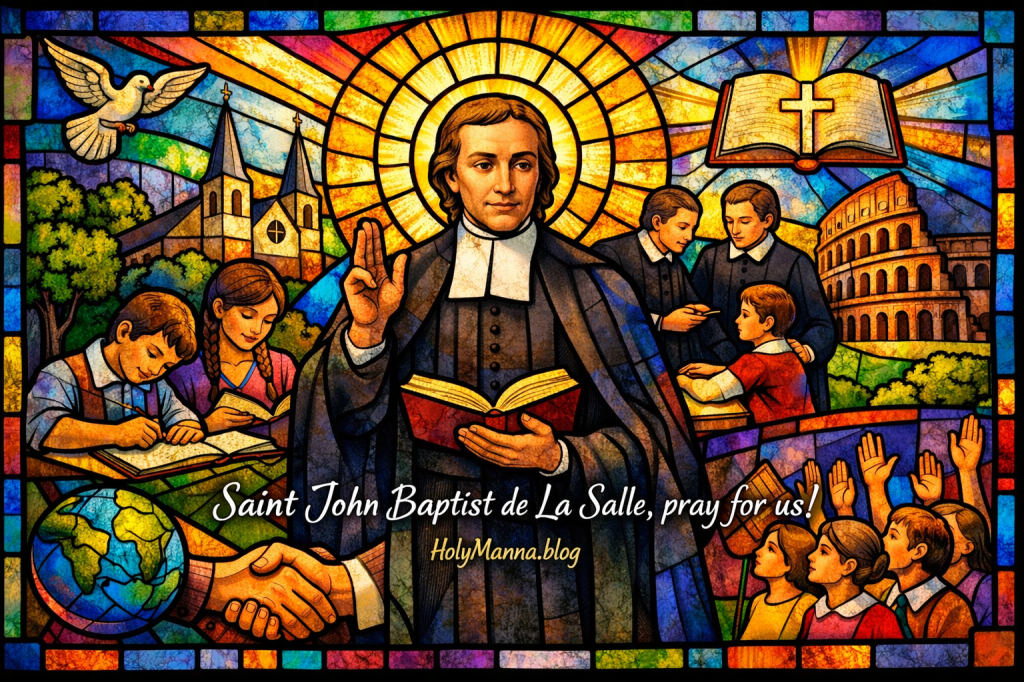
The Priest Who Made the Classroom a Mission
Saint John Baptist de La Salle is one of the Church’s great saints of education, but calling him only an educator does not go far enough. He was a French priest, founder, spiritual writer, and father of a movement that changed Catholic education for the poor. He is revered because he saw that teaching children was not simply a practical task. It was a sacred calling. He believed that when a child is taught with truth, discipline, tenderness, and faith, that child is being led toward Christ.
He is best known as the founder of the Institute of the Brothers of the Christian Schools, often called the Christian Brothers. Through that mission, he helped shape a new way of educating children, especially poor boys who otherwise would have been neglected. The Church later honored him as the patron saint of teachers and educators because his life showed that the classroom can become a place of holiness, charity, and salvation.
Saint John Baptist de La Salle remains deeply loved in Catholic tradition because he did not chase comfort, status, or applause. He gave up privilege in order to serve souls. He left behind wealth so others could have instruction. He helped form teachers not just to explain lessons, but to form Christian hearts. In a world that often treats education as a business, his witness reminds the Church that education is also a work of mercy.
Born Into Privilege, Led Into Providence
John Baptist de La Salle was born in Reims, France, on April 30, 1651, into a respected and well-off Catholic family. From a young age, he received the kind of formation that prepared him for a life of learning and responsibility. He was intelligent, disciplined, and serious about his faith. He became a canon of Reims Cathedral while still very young, studied in Paris, and was eventually ordained a priest.
His early life did not include a dramatic conversion from sin in the way some saints experienced. His story was more subtle and, in many ways, more familiar. God led him little by little. After the death of his parents, he had to return home and care for his younger siblings while continuing his education. That season of duty and sacrifice helped mature him. He was learning how to give his life away before he even understood the full mission God had in mind.
The great turning point came when he became involved with efforts to open schools for poor boys. What began as a temporary act of charity slowly became the center of his priestly vocation. He met teachers who were poorly formed, unstable, and in need of direction. He saw children who were being left behind. And he began to understand that this was not somebody else’s mission. It was his.
What he is most known for is not merely starting schools. He helped transform Catholic education by insisting that poor children deserved real formation, that teachers needed training, that instruction should be organized and serious, and that Christian education should shape the soul as well as the mind. In many ways, he helped the Church see the school as an apostolate.
When Teaching Became a Sacred Work
The life of Saint John Baptist de La Salle is important because it shows what happens when a man allows God to overturn his plans. He could have remained a respected priest with comfort and security. Instead, he chose a path that brought misunderstanding, poverty, and struggle. He welcomed teachers into his home, formed them, prayed with them, and slowly built a religious community centered on the Christian education of the young.
One of the most remarkable things about him was his vision for the Brothers. He did not found a community of priests. He founded a community of consecrated laymen whose whole mission would be teaching. That was something new and bold in the life of the Church. He saw that their witness would be powerful precisely because their whole lives would be directed toward this service.
Catholic tradition remembers him as a pioneer because he promoted free schools for the poor, taught students in the common language rather than only in Latin, grouped students according to learning level, and developed serious teacher formation. These were practical reforms, but they were also spiritual reforms. He understood that chaos in the classroom could wound souls, while order, charity, and truth could help souls grow.
As for miracles during his lifetime, the most reliable Catholic accounts do not focus on dramatic public wonders in the way they do for some saints. There are no famous lifetime miracle stories firmly established in the central accounts of his life in the same way as the posthumous miracles recognized for his canonization. Instead, the great wonder of his earthly life was the work of grace in and through him. Schools were opened. Teachers were formed. Poor children were given dignity. A mission that looked fragile and unlikely survived repeated attacks. In that sense, his whole life became a living testimony to divine providence.
His spirit can be heard in the words attributed to him: “Often remind yourself that you are in the presence of God.” That line says a great deal about his holiness. He wanted Christian educators to live with recollection, reverence, and constant awareness that God was near. He also taught, “This work of teaching is one of the most important in the Church.” That is not pride. It is a profoundly Catholic conviction that forming souls matters eternally.
The Cost of Fidelity
Saint John Baptist de La Salle did not become a saint through easy success. He paid dearly for his fidelity. His choice to live closely with schoolmasters scandalized some of his social circle. His family resisted the direction of his life. His decision to renounce wealth and use his resources for the poor cost him social standing and personal security. There were lawsuits, criticism, and deep misunderstanding.
He also faced opposition from outside the family. Some educators resented his schools. Some churchmen did not know what to make of this new kind of religious institute. The work itself was unstable and exhausting. The men he was forming were not polished or naturally suited to religious life. The mission was fragile, and its future often seemed uncertain.
One of the most moving moments in his life came in 1691, when he and two companions made what became known as the Heroic Vow. They promised to remain united in the work of the schools even if only the three of them remained and they had to beg for bread. That was not the language of a man building a human project. That was the language of total abandonment to God.
His sufferings were not only external. There were times of discouragement, illness, and inner trial. Near the end of his life, exhausted and burdened, he withdrew for a time. Yet even then, obedience brought him back. When the Brothers called him to return, he answered with humility. There was no martyrdom in the bloody sense for Saint John Baptist de La Salle, but there was a real white martyrdom in his life. He died to status, to comfort, to personal control, and to the life he once expected for himself. That, too, is a kind of martyrdom, and the Church remembers it.
His final surrender was beautiful. His last recorded words are remembered as “Yes, I adore God guiding me in all the events of my life.” That is the voice of a saint who had learned to trust God not only in consolations, but also in trials.
The Miracles That Followed Him Into Eternity
After his death on Good Friday, April 7, 1719, devotion to Saint John Baptist de La Salle continued to grow. The Church eventually examined miracles attributed to his intercession in the process that led to his beatification and canonization.
Among the cures accepted in his cause was the healing of Vittoria Ferry, a nurse from Orléans who had suffered gravely for years and was reportedly restored after invoking his intercession. Another accepted case involved Brother Adelminiamo, who was described as suffering from progressive multiple sclerosis and was reportedly cured after prayer at De La Salle’s tomb. A third miracle involved an eleven-year-old boy named Stefano de Suzanne, who suffered from severe rickets and was said to have been healed after a novena seeking De La Salle’s intercession.
For canonization, two additional cures were recognized. One involved Leopoldo Tayac, a student suffering from a severe illness involving the lungs and brain, who reportedly recovered completely after communal prayer. Another involved Brother Netelmo in Canada, who suffered from paralysis and was said to have been suddenly restored to movement and health. These miracles were accepted by the Church in the process of recognizing his sanctity.
Beyond these officially recognized miracles, many members of the faithful have long spoken of favors received through his intercession, especially in matters concerning schools, teachers, students, and difficult educational works. Specific stories outside the formal canonization process are not all historically verified in the same way as the miracles officially recognized by the Church.
His relics also became part of his continuing veneration. Though they suffered danger and desecration during the upheaval of the French Revolution, they were preserved and eventually brought to Rome, where they are honored today. That survival itself feels almost symbolic. The world tried to scatter what he built, yet the Church continued to gather and preserve his memory.
His impact after death has been enormous. The Institute he founded spread across the world, and his name became associated with Catholic schools, universities, and educational works on multiple continents. He was canonized in 1900, and in 1950 Pope Pius XII declared him the patron saint of teachers and educators. His memorial is kept on April 7, and within the Lasallian family he is also celebrated with great love as Founder.
A surprising fact about his legacy is just how global it became. What began as an act of charity for poor boys in France became a worldwide educational mission. That kind of fruit does not happen through human talent alone. It speaks to a charism the Church recognized as truly given by God.
What This Saint Teaches the Church Today
Saint John Baptist de La Salle speaks clearly to modern Catholics because his life touches so many ordinary realities. He speaks to teachers, certainly, but also to parents, catechists, mentors, pastors, and anyone entrusted with helping another soul grow. The Church teaches that parents have the first responsibility for the education of their children, especially in the faith, as seen in CCC 2223 and CCC 2226. De La Salle’s life fits beautifully into that Catholic vision. He did not replace the family. He helped the Church serve the family by forming schools and teachers who could lead children toward truth.
His life also teaches that holiness is not reserved for the dramatic. Sometimes sanctity looks like patience in the classroom. Sometimes it looks like discipline, preparation, sacrifice, and the refusal to give up on souls. Sometimes it looks like building structures that allow grace to reach people who might otherwise be forgotten.
There is also a powerful lesson here about presence. Saint John Baptist de La Salle wanted people to remember that they stood before God in every moment. That means work is not secular ground for a Christian. It can become holy ground. A classroom can become holy ground. A dining table can become holy ground. A parish hall, a confirmation classroom, a nursery, or a workplace can become holy ground when charity and truth are offered there for Christ.
Where is God asking for greater patience, discipline, and generosity in daily life? That is one of the clearest questions this saint places before the heart. He reminds the faithful that love is not always loud. Sometimes love looks like teaching one child to read. Sometimes it looks like correcting gently. Sometimes it looks like staying faithful when the work feels unnoticed.
To imitate him, it helps to begin simply. Take work seriously as a vocation. Treat the young with reverence. Be patient with slow growth. Stay close to prayer. Remember the presence of God. And never assume that a hidden act of formation is small in the eyes of heaven.
Engage with Us!
Share your thoughts and reflections in the comments below. Saint John Baptist de La Salle has a way of speaking not only to teachers, but to anyone who has ever tried to guide, encourage, or form another person in the faith.
- What part of Saint John Baptist de La Salle’s life stands out most strongly, his sacrifice of wealth, his perseverance through trials, or his love for the education of the poor?
- How can daily work become a place of holiness and service to Christ rather than just a task to get through?
- Who in life has helped form the mind or soul in a way that reflected the love of God?
- What would it look like to live more consciously in the presence of God each day, especially while serving others?
May Saint John Baptist de La Salle inspire a life of faith, courage, patience, and humble service. May his example help the faithful remember that even the most ordinary duties can become holy when offered to God. And may every step of life be lived with the love and mercy Jesus taught us.
Saint John Baptist de La Salle, pray for us!
Follow us on YouTube, Instagram and Facebook for more insights and reflections on living a faith-filled life.

 Holy Manna!
Leave a comment