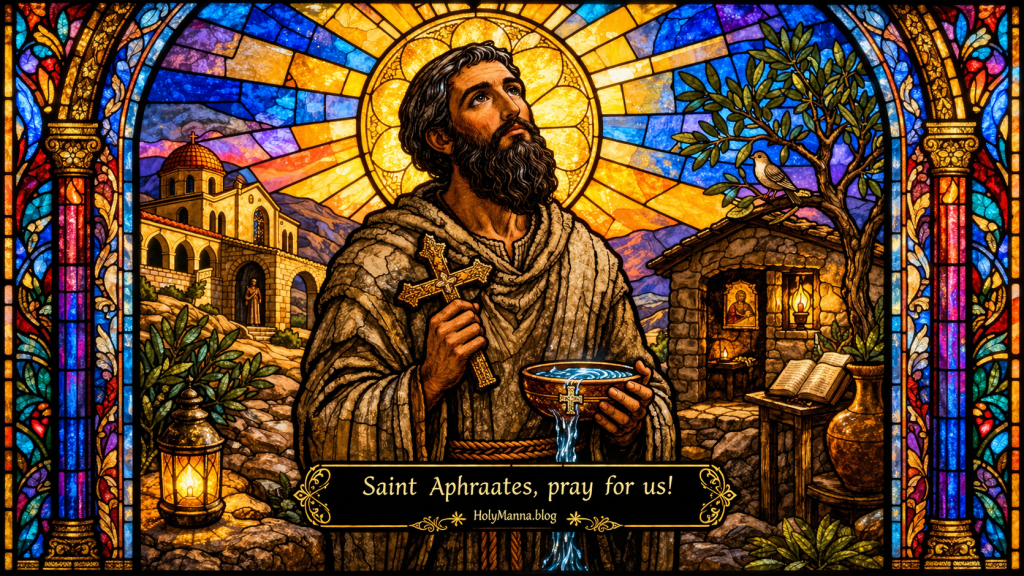
The Hermit Who Walked Out of Silence
Saint Aphraates is one of those saints who feels almost hidden at first glance. He does not stand in Catholic memory as a king, a bishop with a grand cathedral, or a martyr whose death shook an empire. He is remembered instead as a holy hermit, a man of prayer, fasting, poverty, and astonishing courage. In the Roman Catholic tradition, the Saint Aphraates honored on April 7 is the anchorite who defended the Catholic faith in Syria during the troubled years of the Arian crisis.
He is revered because he shows something the Church has always known to be true. A saint does not need worldly power to change the world. Sometimes the holiest man in a city is the one living in a rough cell with almost nothing, speaking little, praying much, and stepping forward only when truth and charity demand it. Saint Aphraates is remembered for his miracles, his deep ascetic life, and his fearless defense of the faithful when the Church was under attack. In him, the Church sees a witness to what The Catechism teaches so clearly, that the saints manifest in their lives the holiness of Christ and continue to build up the Church by their example and intercession, as seen in CCC 828 and CCC 956.
There is also some historical confusion between this Saint Aphraates and Aphraates the Persian Sage, the great Syriac Christian writer. Catholic scholarship recognizes that the names have often been blended. For this feast, though, the focus belongs to the saint honored on April 7, the Persian-born hermit and defender of Catholic orthodoxy.
From Persia to the Desert of God
Catholic tradition presents Aphraates as a man born in Persia into a distinguished family that was still living in pagan idolatry. He came from privilege, but he did not cling to it. Grace touched his life, and he embraced Christ. That alone is already a powerful beginning. He was not born into comfort only to remain there. He was born into one world and then called by God into another.
After his conversion, he left behind the honors and advantages of his homeland and made his way to Edessa in Mesopotamia. That move was not just a change of geography. It was a turning of the soul. He wanted God more than reputation, more than comfort, more than the praise of men. He first enclosed himself in a little cell outside the city, giving himself to prayer, penance, and contemplation. Later he moved near Antioch in Syria, where he continued the same life of radical simplicity.
The descriptions of his daily life are striking. He ate very little, often taking only bread after sunset. In old age he added a few herbs. He slept on a mat laid over bare ground. He wore one rough garment for years. This was not misery for the sake of misery. It was the discipline of a man who wanted every part of his life to belong to God. His poverty was not theatrical. It was the fruit of love. He is most known for precisely this union of deep asceticism and public courage. He was a hermit, but not an escapist. He withdrew from the world so that he could belong more fully to Christ, and when the Church needed him, he did not remain hidden.
One of the most memorable stories from his life captures that spirit perfectly. When someone tried to give him a new garment, he refused it and said, “I have one that I have worn these sixteen years; and I am not willing to have two at the same time.” Those words reveal more than simplicity. They reveal freedom. Aphraates was not mastered by possessions because he had already given his heart away.
When the Desert Spoke to an Empire
Saint Aphraates lived during one of the great doctrinal battles of the early Church. The Arian heresy was spreading confusion about the person of Christ, denying the full divinity of the Son. This was not a small theological argument. It cut to the very center of the Gospel. If Christ is not truly God, then the Cross is not the saving act of God Himself entering human suffering. If Christ is not truly God, then the Church’s worship, hope, and sacramental life collapse into something less than the faith handed down by the Apostles.
During the reign of Emperor Valens, who favored the Arians, faithful Catholics suffered greatly. Saint Meletius of Antioch was exiled, and the orthodox were harassed and oppressed. Aphraates, though a hermit by vocation, did not stay silent. He left the quiet of his cell and went out to support the persecuted faithful, standing with men like Flavian and Diodorus in defense of true Catholic teaching.
This is one of the reasons he should still be remembered. He teaches that silence is holy, but silence is not always the same thing as faithfulness. There are moments when love for God requires a public witness. There are times when prayer leads a man not away from the battle, but straight into it.
The most famous moment of his public witness came when Emperor Valens saw him hurrying along and demanded to know where he was going. Aphraates answered simply, “To pray for the prosperity of your reign.” It was a remarkable response. He did not speak with flattery. He did not speak with fear. He spoke with truth and calm. When Valens pressed him for leaving the seclusion proper to a monk, Aphraates answered in substance that if a maiden sees her father’s house on fire, she does not stay quietly in her chamber. She runs to put out the flames. In the same way, he could not remain hidden while the house of God was being torn apart by heresy and persecution.
There is something deeply Catholic in that image. Contemplation and action are not enemies. The saints teach that the soul formed in prayer is often the very soul best prepared to act with courage.
Signs of Mercy and Power
Saint Aphraates was remembered not only for holiness of life, but also for miracles. Catholic tradition says he worked cures through oil and water over which he made the sign of the cross. One of the most often repeated stories says that even one of the emperor’s horses was healed after drinking water blessed in this way. That detail may sound small at first, but it carries real significance. It connects Aphraates to the Church’s ancient confidence in sacramentals, those sacred signs that dispose the faithful to receive grace and sanctify the circumstances of life, as taught in CCC 1667.
These miracles were not magic tricks. They were not displays meant to make Aphraates famous. They were signs of the mercy and power of Christ. In the Gospels, the Lord’s miracles reveal both His compassion and His identity. The Church sees something similar in the saints. God sometimes grants signs through them so that hearts may be strengthened, the suffering may be consoled, and the truth of the faith may shine more clearly. That is why the Roman Martyrology remembers Aphraates as one who defended the Catholic faith by miracles.
Another dramatic event in his life is remembered in Catholic tradition as a sign of divine vindication. After one of the emperor’s officials insulted and threatened him, the man soon afterward fell into scalding bath water and died. The story is preserved in hagiographical tradition not as a spectacle, but as a warning. God is not mocked, and those who strike at His servants may find themselves judged in ways they did not expect. Still, the greater emphasis in Aphraates’ life falls on healing, holiness, and steadfastness.
Not a Martyr, But a Man Who Carried the Cross
Saint Aphraates is not remembered as a martyr in the strict sense. He did not seal his witness by shedding his blood. But that does not mean his life was free of suffering. The hardships he endured were real. He embraced a severe life of fasting and poverty. He lived through the theological turmoil of the fourth century. He stepped into danger when powerful men opposed the Catholic faith. He accepted misunderstanding, threats, and the burden of public witness, though he would likely have preferred the hiddenness of his cell.
This kind of suffering matters. The Church honors not only those who die for Christ, but also those who live every day for Him under the weight of trial, deprivation, and fidelity. Aphraates carried the Cross in the desert, in the city, and in the moment of confrontation. He teaches that martyrdom is not the only form of heroic sanctity. Sometimes sanctity looks like remaining faithful in obscurity for years, then speaking one brave sentence when the truth is under attack.
In that sense, he belongs beside all those saints who remind the faithful that perseverance is holy. The Christian life is not built only on dramatic endings. It is also built on daily renunciation, daily prayer, daily patience, and daily obedience.
The Saint Whose Voice Still Carries
After the death of Valens and the return of peace, Aphraates went back to his life of solitude. That detail is beautiful. He did not seek public relevance for its own sake. He stepped out when charity demanded it, and when the crisis passed, he returned to hiddenness. That alone says much about his purity of heart. He was not trying to build a name for himself. He was trying to be faithful.
After his death, his legacy lived on in the memory of the Church. Early Christian testimony speaks of his continued power with God and the confidence believers had in his intercession. While the Catholic sources do not preserve a large body of detailed posthumous miracle stories attached to his tomb in the way they do for some later saints, they do preserve something important. They preserve the conviction that he remained a powerful intercessor after death. That is not a small thing. It reflects the ancient Catholic instinct that the saints do not stop loving the Church when earthly life ends. Their charity is perfected in heaven.
His veneration also endured liturgically. In the Roman Catholic tradition he is remembered on April 7. In some Eastern traditions he has also been honored on January 29. His cultural impact may not be as broad or as visible as some of the more famous saints, but his witness has lasted for centuries. That quiet endurance suits him. He was never a saint of noise. He was a saint of depth.
No major pilgrimage tradition or widely documented shrine connected to him appears prominently in the Catholic sources usually consulted for his life. If such traditions once existed locally, they are not strongly preserved in the standard accounts. So the most honest conclusion is that his posthumous impact has been chiefly spiritual and liturgical rather than national or cultural on a large scale.
Why Saint Aphraates Still Matters
Saint Aphraates matters because the modern world has not outgrown any of the temptations he faced. The world still prizes comfort, recognition, and status. The Church still passes through seasons of confusion, pressure, and compromise. Christians still need examples of men who know how to pray deeply, live simply, and speak clearly when truth is threatened.
His life also offers a needed correction. It is easy to imagine holiness as either fully hidden or fully public. Aphraates shows another way. A saint can live in silence for years and still be ready to defend the faith when the moment comes. A saint can practice real poverty and still possess immense spiritual authority. A saint can be gentle, prayerful, and detached, while also being strong enough to stand before an emperor without fear.
His life also speaks to the Church’s understanding of holiness in The Catechism. The saints are not distant museum pieces. They are living examples of what grace can do in an ordinary human life completely surrendered to Christ, as seen in CCC 2013. Aphraates did not begin as a Christian celebrity. He began as a man who said yes to grace, renounced what could not save him, and built his whole life around God.
Learning to Live Like This Saint
There is a very practical lesson here for everyday Catholic life. Most people are not called to live in a desert cell or to confront an emperor. But everyone is called to cultivate an interior life that does not depend on constant noise. Everyone is called to give up the small comforts that keep the soul soft and distracted. Everyone is called to speak the truth with charity when silence becomes cowardice.
Saint Aphraates invites the faithful to examine what they cling to. He wore one garment for years because he had learned not to live for possession or appearance. That does not mean every Christian must imitate him literally. It does mean every Christian should ask whether comfort has become a master.
He also invites the faithful to rediscover the power of prayer. His courage in public did not come from self-confidence. It came from a life steeped in God. That is always how Christian courage works. A soul that kneels before God can stand before men.
He invites readers to think seriously about the relationship between faith and action. It is not enough to have correct opinions if they never shape conduct. It is not enough to love the Church privately while refusing to suffer for her publicly. Aphraates teaches that love for Christ and love for His Church must be concrete.
What would it look like to build a life that is quiet enough to hear God and strong enough to obey Him?
What comfort, habit, or fear may be keeping the soul from greater freedom?
When truth is under pressure, does faith remain hidden when it should be spoken?
These are not small questions. They are the kind of questions saints leave behind.
Engage with Us!
Share your thoughts and reflections in the comments below. Saint Aphraates may not be one of the most famous saints in the calendar, but his life has a powerful way of searching the heart and strengthening the soul.
- What stands out most in Saint Aphraates’ life: his poverty, his miracles, or his courage in defending the faith?
- How can a deeper life of prayer help strengthen daily faithfulness in ordinary life?
- Is there an area of life where greater simplicity could make more room for God?
- What does Saint Aphraates teach about knowing when to remain hidden and when to speak boldly?
- How can his witness help Catholics remain calm, faithful, and charitable during times of confusion in the Church and the world?
May the example of Saint Aphraates encourage a life of prayer, courage, simplicity, and fidelity. May his witness remind every heart that holiness is never wasted, even when it is hidden from the world. Live a life of faith, and do everything with the love and mercy Jesus taught us.
Saint Aphraates, pray for us!
Follow us on YouTube, Instagram and Facebook for more insights and reflections on living a faith-filled life.

 Holy Manna!
Leave a comment