Tuesday in the Octave of Easter – Lectionary: 262
When the Risen Lord Calls a Name and Changes a Heart
There are mornings in the Christian life when everything still feels dark, even though the Resurrection has already happened. That is the atmosphere of today’s readings. The tomb is empty, but Mary Magdalene is still weeping. Peter is preaching, but the crowd is still carrying the weight of what they have done. Psalm 33 rises in the middle of it all like a steady lamp, reminding the soul that the Lord is faithful, merciful, and worthy of hope. The central theme tying these readings together is this: the Risen Jesus meets wounded hearts with truth and mercy, then sends them out transformed. He does not leave people trapped in grief, guilt, or confusion. He calls them into repentance, faith, and witness.
The Church places these readings in the Octave of Easter to show that Easter is not just one holy day remembered and then left behind. It is one great feast stretched across eight days, as if the Church is saying that the Resurrection is too large for a single morning. In that light, today’s passages fit together beautifully. The Gospel from John 20:11-18 shows the intimate and personal side of Easter, where the Lord speaks one name, “Mary!”, and sorrow begins to give way to recognition. The First Reading from Acts 2:36-41 shows the public and ecclesial side of Easter, where Peter proclaims the risen Christ so boldly that thousands are “cut to the heart” and ask what they must do. The same Jesus who consoles Mary also convicts the crowd. The same Resurrection that dries tears also awakens repentance.
There is also an important historical and spiritual backdrop running beneath all three readings. Mary Magdalene stands at the tomb as one of the first witnesses to the Resurrection, and Peter stands before Israel as one of the first heralds of what that Resurrection means for the world. The Church, from the very beginning, understood that the risen Christ does not simply offer private comfort. He founds a people. He gathers a Church. He calls sinners to repentance and opens the way to new life through Baptism and the gift of the Holy Spirit. That is why Acts and John belong together here. One reading shows the moment the disciple recognizes the Lord. The other shows what happens when that recognition becomes proclamation.
Today’s readings prepare the heart to ask a serious question. What happens when the Lord stops being an idea and becomes the One who speaks directly to the soul? For Mary, that moment comes in a garden. For the crowd in Jerusalem, it comes through Peter’s preaching. For the Church now, it comes every time the word of God breaks through distraction and reaches the heart. Easter is not only the announcement that Jesus is alive. Easter is the moment that changes everything because the living Christ still calls, still forgives, still gathers, and still sends.
First Reading – Acts 2:36-41
The Day Easter Broke Open the Human Heart
The First Reading takes place just after Pentecost, in the holy aftermath of the Lord’s Resurrection and Ascension. Jerusalem is crowded with pilgrims, still echoing with the memory of Passover, and now shaken by the descent of the Holy Spirit upon the Apostles. Peter, the same man who once trembled before a servant girl, now stands with apostolic courage and preaches Jesus Christ crucified and risen. This moment matters deeply because it shows what Easter does in the real world. The Resurrection is not treated as a private consolation or a beautiful idea. It is proclaimed publicly, with authority, and it demands a response.
That is why this reading fits so naturally into today’s theme. In the Gospel, Mary Magdalene hears the risen Lord call her by name and her grief is transformed into witness. Here in Acts, Peter addresses the crowd, and their hearts are pierced by the truth. The risen Christ is still acting, still calling, and still converting souls. The same Jesus who meets Mary personally now confronts Israel through Peter’s preaching. The Church is born in that encounter between divine truth and wounded human hearts. This is the beginning of the great apostolic mission, where repentance, Baptism, forgiveness, and the gift of the Holy Spirit are preached not as optional devotions, but as the path into new life.
Acts 2:36-41 – New American Bible (Revised Edition)
36 Therefore let the whole house of Israel know for certain that God has made him both Lord and Messiah, this Jesus whom you crucified.”
37 Now when they heard this, they were cut to the heart, and they asked Peter and the other apostles, “What are we to do, my brothers?” 38 Peter [said] to them, “Repent and be baptized, every one of you, in the name of Jesus Christ for the forgiveness of your sins; and you will receive the gift of the holy Spirit. 39 For the promise is made to you and to your children and to all those far off, whomever the Lord our God will call.” 40 He testified with many other arguments, and was exhorting them, “Save yourselves from this corrupt generation.” 41 Those who accepted his message were baptized, and about three thousand persons were added that day.
Detailed Exegesis
Verse 36 – “Therefore let the whole house of Israel know for certain that God has made him both Lord and Messiah, this Jesus whom you crucified.”
Peter brings his sermon to a sharp and unforgettable conclusion. He addresses “the whole house of Israel” because this is not merely a message for a few pious listeners. It is a proclamation to God’s covenant people. Peter declares with certainty that Jesus is both Lord and Messiah. In Catholic understanding, this means that Jesus is not only the long-awaited Anointed One, but also the divine Son who shares the authority of God Himself. Peter does not soften the truth when he says, “this Jesus whom you crucified.” He is not trying to humiliate the crowd for its own sake. He is naming sin honestly so that mercy can be received truthfully. Real conversion begins when guilt is no longer hidden behind excuses.
Verse 37 – “Now when they heard this, they were cut to the heart, and they asked Peter and the other apostles, ‘What are we to do, my brothers?’”
This is one of the most beautiful descriptions of grace in all of Acts of the Apostles. The crowd is “cut to the heart”, which means the word of God has broken through their defenses. This is not despair. It is compunction. It is the sorrow that opens the door to repentance. They do not run away from Peter. They ask, “What are we to do?” That question reveals the beginning of conversion. A heart touched by grace no longer asks how to justify itself. It asks how to return to God. The address “my brothers” also matters. Even in their guilt, they are not treated as outcasts without hope. The apostolic preaching wounds in order to heal.
Verse 38 – “Peter [said] to them, ‘Repent and be baptized, every one of you, in the name of Jesus Christ for the forgiveness of your sins; and you will receive the gift of the holy Spirit.’”
Peter’s answer is direct, sacramental, and unmistakably Catholic. First comes repentance. The sinner must turn away from sin and turn back toward God. Then comes Baptism, not as an empty symbol, but as the sacramental entry into Christ’s saving death and Resurrection. Peter teaches that Baptism is ordered toward “the forgiveness of your sins” and the reception of “the gift of the holy Spirit.” This verse stands at the heart of the Church’s understanding of Christian initiation. God does not leave repentant sinners in a vague emotional state. He gives them a real means of cleansing, rebirth, and incorporation into the Body of Christ. The crowd asks what to do, and Peter points them to conversion and sacramental grace.
Verse 39 – “For the promise is made to you and to your children and to all those far off, whomever the Lord our God will call.”
Peter widens the horizon. The promise is not restricted to one narrow circle. It is for the people standing before him, for their children, and for “all those far off.” In the immediate sense, this includes Jews scattered abroad. In the fuller light of the Gospel, it opens toward the Gentiles and toward all future generations. This is the expansive mercy of God already moving through the newborn Church. The initiative still belongs to the Lord, for Peter says, “whomever the Lord our God will call.” Salvation is never a human project. It begins in God’s gracious call. Yet that call truly reaches history, families, nations, and generations.
Verse 40 – “He testified with many other arguments, and was exhorting them, ‘Save yourselves from this corrupt generation.’”
Luke gives only a summary of Peter’s preaching. The Apostle continues testifying and exhorting. This shows that evangelization is not casual or careless. Peter presses the matter because eternal realities are at stake. His warning about “this corrupt generation” echoes the biblical language used for a people who resist God, harden their hearts, and prefer rebellion to covenant fidelity. Peter is not teaching self-salvation, as if human beings could rescue themselves apart from grace. Rather, he is urging them to separate themselves from the unbelief and moral corruption of a world that has rejected the Messiah. To follow Christ means leaving behind the spirit of the age.
Verse 41 – “Those who accepted his message were baptized, and about three thousand persons were added that day.”
The fruit of apostolic preaching appears immediately. Those who accept the message are baptized. Faith leads to sacrament, and sacrament leads to incorporation into the visible community of believers. The number, “about three thousand persons,” is astonishing and deeply symbolic. At Sinai, Israel received the Law and covenant identity. Here, through the preaching of the risen Christ and the gift of the Holy Spirit, a new people begins to emerge in fullness. The Church grows not by marketing or force, but by the power of truth, grace, and sacramental life. Easter has become mission. The pierced Heart of Christ is already drawing multitudes into communion.
Teachings
This reading gives a clear glimpse into the Church’s faith about Jesus, conversion, Baptism, and the Holy Spirit. Peter declares that Jesus is both Lord and Messiah. The Church teaches in The Catechism of the Catholic Church that “the title ‘Lord’ indicates divine sovereignty” and that “to confess or invoke Jesus as Lord is to believe in his divinity” CCC 446. Peter is not simply saying that Jesus is a great prophet vindicated after death. He is proclaiming the crucified and risen Jesus as the divine Lord who now reigns in glory.
The command to repent is equally central. Conversion is not a side note in Christianity. It is the doorway into life. The Catechism says, “Jesus’ call to conversion and penance, like that of the prophets before him, does not aim first at outward works” and “it is a radical reorientation of our whole life” CCC 1430. That is exactly what the crowd begins to experience when they are cut to the heart. True repentance is not just regret over consequences. It is a turning of the whole person back toward God.
Peter’s call to Baptism is one of the clearest biblical witnesses to the Church’s sacramental life. The Catechism teaches, “Holy Baptism is the basis of the whole Christian life, the gateway to life in the Spirit” CCC 1213. It also says, “By Baptism all sins are forgiven, original sin and all personal sins” CCC 1263. This is why Peter speaks so plainly. He does not tell the crowd merely to feel sorry or to think differently. He tells them to enter sacramentally into Christ. Easter grace must be received.
The promise of the Holy Spirit also matters profoundly. The Christian life is not sustained by human willpower alone. God gives His own Spirit to dwell in the baptized soul. The Catechism says, “The Holy Spirit marks us with the seal of the Lord” CCC 698. This means the converted life is not just a moral reset. It is the beginning of a new creation in grace.
The Fathers of the Church saw in this passage the birth of a new humanity through apostolic preaching. Saint John Chrysostom marveled at Peter’s transformation and at the power of grace working through him. He wrote, “Observe the power of the Spirit” when preaching on this scene. That short line says a great deal. The timid disciple has become a fearless shepherd because the Holy Spirit has made him new. Saint Augustine also reflected often on the need for the heart to be wounded by truth so that it may be healed by charity. The crowd in Jerusalem is not destroyed by Peter’s sermon. It is awakened.
There is also a striking biblical contrast hidden in the number three thousand. In Exodus, after Israel’s idolatry with the golden calf, about three thousand fell under judgment. Here in Acts, about three thousand are added through Baptism and the preaching of Christ. The old wound of sin is answered by the new gift of grace. The law exposed transgression, but the risen Christ pours out mercy and gathers a people into His Church. That is not an accident of numbers. It is one more sign that the New Covenant has truly dawned.
Reflection
This reading speaks with real force to daily life because it shows how God changes a person from the inside out. So many people want comfort without conversion, peace without repentance, and spirituality without surrender. Peter offers none of that. He tells the truth plainly, and by grace that truth cuts the heart open. That is still how the Lord works. He names sin not to shame the sinner into hopelessness, but to lead the sinner into mercy.
There is something deeply personal hidden inside this public sermon. Every soul eventually has to face the same question the crowd asks: “What are we to do?” That question rises when conscience wakes up, when excuses begin to fall apart, and when the light of Christ reveals what has been hidden. The right response is not panic. The right response is repentance, confession of sin, renewed fidelity to Baptism, and openness to the Holy Spirit.
In practical daily life, this reading invites a few concrete steps. A good place to begin is honest examination of conscience. The heart cannot be healed if it refuses to be pierced by truth. Another step is to remember one’s Baptism, not as a distant family memory, but as the foundation of Christian identity. The baptized soul belongs to Christ. A third step is to resist the spirit of “this corrupt generation” by refusing the habits, entertainments, compromises, and moral laziness that make sin seem normal. The Christian is called to live differently, not arrogantly, but clearly.
This reading also calls for courage. Peter preached in public what many would have preferred to keep quiet. Faithful Catholics in every age are asked to do something similar. The world still needs witnesses who speak clearly about Jesus, sin, mercy, repentance, and new life. Soft words that never challenge the conscience do not save. The truth spoken in charity does.
Where has the word of God been trying to cut through resistance, denial, or spiritual numbness? What sins have been explained away instead of repented of? How might daily life change if Baptism were treated not as a past event, but as a living identity? What habits belong to Christ, and what habits still belong to a corrupt generation?
The beauty of this reading is that it does not end with guilt. It ends with people entering the Church. It ends with sinners washed clean. It ends with the Holy Spirit given. That is the hope of Easter. When the heart is pierced by truth, it can finally be filled with grace.
Responsorial Psalm – Psalm 33:4-5, 18-20, 22
The Steady Mercy of God in a Shaken World
The Responsorial Psalm today sounds like the voice of a soul learning how to breathe again after being overwhelmed. In the First Reading, Peter’s preaching cuts hearts open. In the Gospel, Mary Magdalene stands outside the tomb weeping. Between those two moments, the Church gives her children Psalm 33 as a prayer of trust. It is as if the liturgy pauses and says that when the heart is pierced by truth or heavy with sorrow, it must learn to wait for the Lord with confidence. This psalm is not sentimental. It comes from the prayer of Israel, from a people who knew famine, danger, national uncertainty, and the long discipline of hoping in God when visible circumstances looked grim.
That background matters. The psalms were the prayer book of ancient Israel, sung in worship and carried in memory through seasons of joy and affliction. They taught God’s people how to speak honestly before the Lord. Psalm 33 is a hymn of praise rooted in confidence that God’s word is true, His justice is real, and His mercy surrounds the earth. In the light of Easter, the Church hears this psalm with even greater depth. The upright word of the Lord has now been vindicated in the Resurrection. The God whose eye is upon those who fear Him has not abandoned His people in death. He has raised His Son, and in doing so He has shown that hope in Him is never wasted. That is why this psalm fits today’s theme so beautifully. The risen Christ heals the heart, but the soul must learn to rest beneath His gaze.
Psalm 33:4-5, 18-20, 22 – New American Bible (Revised Edition)
4 For the Lord’s word is upright;
all his works are trustworthy.
5 He loves justice and right.
The earth is full of the mercy of the Lord.18 Behold, the eye of the Lord is upon those who fear him,
upon those who count on his mercy,
19 To deliver their soul from death,
and to keep them alive through famine.20 Our soul waits for the Lord,
he is our help and shield.22 May your mercy, Lord, be upon us;
as we put our hope in you.
Detailed Exegesis
Verse 4 – “For the Lord’s word is upright; all his works are trustworthy.”
This verse begins with the character of God Himself. His word is upright because it is morally straight, true, and without deceit. His works are trustworthy because God never acts in contradiction to His own goodness. For Israel, this meant that the covenant God could be relied upon even when His timing was mysterious. For the Christian, this verse shines with Easter light. The promises spoken through the Law, the Prophets, and the psalms have not failed. God has done exactly what He promised, even if He did it in a way that surpassed human expectations. The Resurrection proves that God’s word does not collapse under the weight of suffering or death.
Verse 5 – “He loves justice and right. The earth is full of the mercy of the Lord.”
Justice and mercy are not enemies in God. He loves what is right, and He fills the earth with mercy. That matters because many people imagine mercy as God lowering His standards or ignoring evil. Scripture presents something much deeper. God’s mercy is holy. It does not deny justice. It heals what sin has broken and restores right order. In today’s readings, Peter’s hearers are confronted with justice when they are told what they have done to Christ. Yet the same God who exposes guilt also offers forgiveness and the gift of the Holy Spirit. The earth is full of His mercy precisely because He does not abandon sinners to ruin.
Verse 18 – “Behold, the eye of the Lord is upon those who fear him, upon those who count on his mercy,”
The fear of the Lord here is not servile terror. It is reverence, awe, and filial dependence before the living God. The faithful soul knows that God is not casual, and therefore does not treat Him casually. Yet this reverent fear stands side by side with trust, because the verse also speaks of those who count on His mercy. That pairing is deeply Catholic. The believer does not choose between holy fear and confident hope. Both belong together. The eye of the Lord resting upon His people is an image of providence. God is not absent, distracted, or indifferent. He sees, He knows, and He watches over those who place themselves in His hands.
Verse 19 – “To deliver their soul from death, and to keep them alive through famine.”
In its original setting, this verse speaks to real danger, even bodily danger. Israel knew hunger, war, and fragility. The psalmist confesses that God is able to preserve life when earthly security fails. In the fuller Christian sense, this verse opens toward the greatest deliverance of all, rescue from the death brought by sin. Easter does not erase earthly suffering overnight, but it reveals that death itself does not get the final word. God delivers in ways deeper than immediate comfort. He sustains His people through deprivation, testing, and grief, and finally He leads them toward eternal life. The soul that hopes in Him is never abandoned to ultimate ruin.
Verse 20 – “Our soul waits for the Lord, he is our help and shield.”
This is the posture of faithful endurance. The psalm does not say that the soul controls the outcome or solves every problem. It says the soul waits. Waiting in Scripture is not passive resignation. It is active trust. It is the decision to remain turned toward God when the answer has not yet fully appeared. The Lord is called both help and shield. He strengthens from within and protects from without. In today’s Gospel, Mary Magdalene has not yet recognized Jesus, but the hidden truth is that even in her tears the Lord is already near. That is often how waiting feels in the spiritual life. God is present before the soul knows how to name His presence.
Verse 22 – “May your mercy, Lord, be upon us; as we put our hope in you.”
The psalm ends not with self-confidence, but with supplication. The people ask for mercy while at the same time professing hope. This is the proper shape of prayer. Mercy is received as gift, and hope is offered as response. The verse teaches that Christian confidence is never prideful. The believer does not demand blessings as if entitled to them. The believer asks, trusts, waits, and rests in the goodness of God. This final line gathers the whole psalm into one movement of the heart. The soul looks upward and says that everything depends on the mercy of the Lord.
Teachings
This psalm teaches the soul to see the world through the lens of divine providence. It does not pretend that life is easy. It does not deny fear, danger, or lack. Instead, it places all of those realities beneath the steady gaze of God. That is why the Church treasures the psalms so deeply. They teach believers not only what to think about God, but how to speak to Him in the middle of real life.
The Catechism speaks directly to the truth contained in this psalm when it says, “God, ‘He who is’, revealed himself to Israel as the one ‘abounding in steadfast love and faithfulness’” CCC 214. That line fits Psalm 33 beautifully. The psalm praises a God whose word is upright, whose works are trustworthy, and whose mercy fills the earth. The Lord is not unreliable. He is not one thing in promise and another in action. He is faithful in who He is.
The same truth appears in the Church’s teaching on providence. The Catechism says, “The witness of Scripture is unanimous that the solicitude of divine providence is concrete and immediate; God cares for all, from the least things to the great events of the world and its history” CCC 303. That is almost a commentary on verses 18 through 20. The eye of the Lord is upon those who fear Him. He delivers from death. He keeps alive through famine. He is help and shield. The God of the psalm is not a distant architect who leaves creation to fend for itself. He is actively attentive.
This psalm also belongs deeply to the virtue of hope. The Catechism teaches, “Hope is the theological virtue by which we desire the kingdom of heaven and eternal life as our happiness, placing our trust in Christ’s promises” CCC 1817. That is what the psalm trains the heart to do. Hope is not vague optimism. It is trust in the promises of God. In the Easter season, that trust becomes even more radiant because Christ’s Resurrection is the great proof that the Father keeps His word.
The saints understood this interior posture well. Saint Augustine wrote, “You have made us for yourself, O Lord, and our heart is restless until it rests in you.” That line from Confessions could easily stand beside verse 20, “Our soul waits for the Lord.” The waiting soul is restless until it finds its shelter in God. The psalm does not ask the heart to shut down desire. It teaches the heart where desire finally belongs.
There is also a liturgical wisdom in placing this psalm during the Octave of Easter. The Church is not merely celebrating that Jesus rose long ago. She is teaching her children how to live after hearing that news. Peter’s preaching in Acts brings conviction. Mary Magdalene’s encounter in John brings recognition and mission. Psalm 33 teaches what the soul must do in between. It must trust that the Lord is faithful, that His mercy is real, and that His eye remains upon those who hope in Him.
Reflection
This psalm meets ordinary life with surprising tenderness because most people know what it feels like to live somewhere between grief and hope. There are seasons when the heart has heard the truth, but still feels shaken. There are moments when the Lord is near, but the eyes do not yet recognize Him clearly. In those moments, Psalm 33 becomes a school of trust.
A practical way to live this psalm is to begin by slowing down and naming where trust has been replaced by panic. The soul often says it believes in God while living as if everything depends on personal control. This psalm gently but firmly calls the heart back. The Lord’s word is upright. His works are trustworthy. That means His promises are steadier than moods, headlines, fears, and shifting circumstances.
Another concrete step is to practice holy remembrance. The psalm speaks as though the believer has reasons to trust because the believer does. God has already acted. He has already shown mercy. He has already spoken truth. In the Christian life, remembrance is not nostalgia. It is a way of strengthening hope. The Resurrection itself is the great act of remembrance for the Church. When prayer feels dry or life feels heavy, the empty tomb remains true.
This psalm also asks whether there is a real willingness to wait for the Lord. Modern life trains people to want instant clarity and immediate relief. The spiritual life rarely unfolds that way. Sometimes the soul is asked to wait faithfully, pray steadily, and trust quietly before understanding comes. Waiting is hard, but it is often where love is purified.
What has been treated as more trustworthy than the word of the Lord? Where has fear become louder than hope? How often has prayer become a demand for quick answers instead of a patient resting beneath the eye of God? What might change if daily life were lived with the conviction that the earth is still full of the mercy of the Lord?
The beauty of this psalm is that it steadies the heart without flattering it. It does not say that life is simple. It says that God is faithful. It does not promise that every famine ends immediately. It promises that the Lord sees, sustains, and remains near. In the light of Easter, that is more than enough reason to hope.
Holy Gospel – John 20:11-18
When the Risen Christ Speaks a Name and Sends a Witness
This Gospel unfolds in the quiet ache of Easter morning, just outside the tomb. The horror of Good Friday is still fresh. The burial has already taken place. The stone has been moved. The body is gone. Mary Magdalene stands in that painful space between love and loss, between searching and understanding. In the culture of the time, burial carried deep religious importance, and the failure to honor a body properly would have been a serious wound of love and reverence. That is why Mary’s grief is so intense. She is not simply sad. She is trying to remain faithful to the Lord she loves, even when all seems shattered.
This passage fits today’s theme with remarkable beauty. In the First Reading, Peter’s hearers are “cut to the heart” and brought to repentance. In the Psalm, the faithful soul learns to wait for the Lord and hope in His mercy. Here in the Gospel, that mercy takes on a face and a voice. The risen Jesus meets one grieving disciple personally. He does not reveal Himself first through thunder or spectacle, but by calling her by name. This is the moment when sorrow turns into mission. Mary Magdalene becomes the first witness sent to announce the Resurrection, and the Church learns that Easter is not only about an empty tomb. It is about a living Lord who knows His own and sends them out.
John 20:11-18 – New American Bible (Revised Edition)
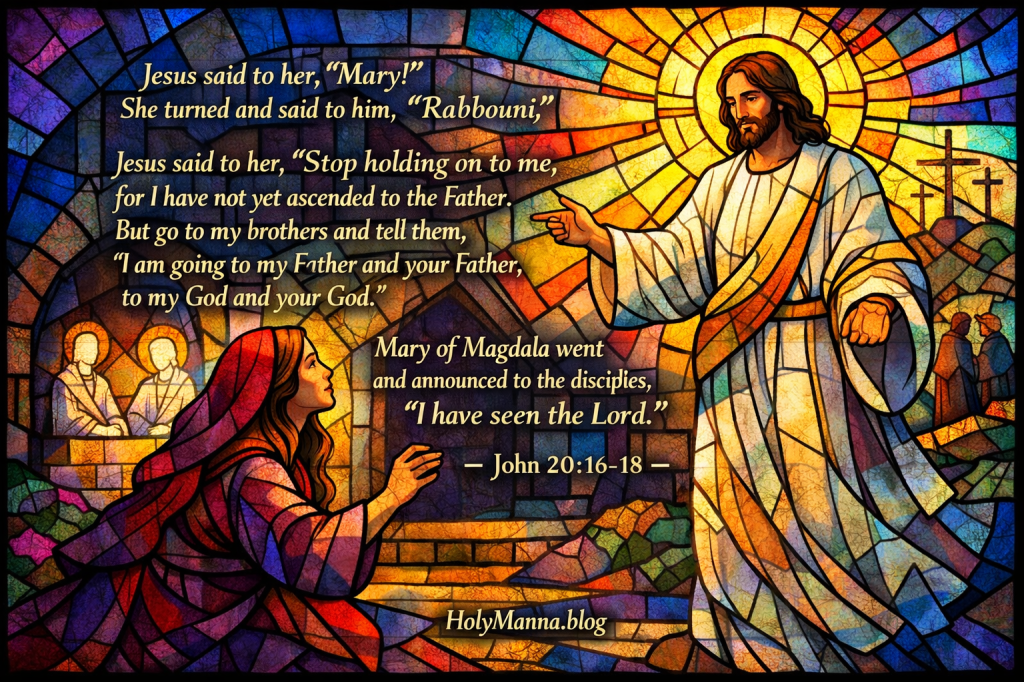
11 But Mary stayed outside the tomb weeping. And as she wept, she bent over into the tomb 12 and saw two angels in white sitting there, one at the head and one at the feet where the body of Jesus had been. 13 And they said to her, “Woman, why are you weeping?” She said to them, “They have taken my Lord, and I don’t know where they laid him.” 14 When she had said this, she turned around and saw Jesus there, but did not know it was Jesus. 15 Jesus said to her, “Woman, why are you weeping? Whom are you looking for?” She thought it was the gardener and said to him, “Sir, if you carried him away, tell me where you laid him, and I will take him.” 16 Jesus said to her, “Mary!” She turned and said to him in Hebrew, “Rabbouni,” which means Teacher. 17 Jesus said to her, “Stop holding on to me, for I have not yet ascended to the Father. But go to my brothers and tell them, ‘I am going to my Father and your Father, to my God and your God.’” 18 Mary of Magdala went and announced to the disciples, “I have seen the Lord,” and what he told her.
Detailed Exegesis
Verse 11 – “But Mary stayed outside the tomb weeping. And as she wept, she bent over into the tomb”
Mary remains when others have already moved on. Her grief keeps her close to the place of loss. This detail matters spiritually. Love often lingers where the heart has been wounded. Mary’s tears are not signs of weak faith, but signs of real love that has not yet been illuminated by the full truth of the Resurrection. Her bending over into the tomb shows that she is still searching among the dead for the One who now lives. Many souls do the same. They look for Christ only within old categories of sorrow, memory, or absence.
Verse 12 – “and saw two angels in white sitting there, one at the head and one at the feet where the body of Jesus had been.”
The angels testify that heaven is already interpreting what earth does not yet understand. Their position, one at the head and one at the feet, draws attention to the place where the body had rested. The empty place speaks. The Lord is not there because death no longer holds Him. Some Christian readers have also seen in this image a faint echo of the mercy seat in the Old Testament, where heavenly figures overshadowed the place of divine presence. Now the true mercy of God has passed through death and transformed the tomb into a sign of victory.
Verse 13 – “And they said to her, ‘Woman, why are you weeping?’ She said to them, ‘They have taken my Lord, and I don’t know where they laid him.’”
The angels do not ask because they lack knowledge. Their question begins to draw Mary out of her sorrow and toward revelation. Her reply is simple and moving. “My Lord” shows that her love is personal and faithful. Yet she still speaks as one who believes Jesus remains subject to death. Her pain is real, but her understanding is incomplete. This is often the condition of the disciple before the risen Christ fully reveals Himself. The heart loves truly, but sees only partially.
Verse 14 – “When she had said this, she turned around and saw Jesus there, but did not know it was Jesus.”
This turn is outwardly small, but spiritually immense. Mary turns from the tomb toward the living Christ, though she does not yet recognize Him. Saint Augustine and other Fathers often saw in such moments the mystery of the human soul, which can stand before truth itself and still fail to perceive it without grace. Recognition is not merely a matter of eyesight. It requires divine illumination. Jesus is already present before Mary understands what that presence means.
Verse 15 – “Jesus said to her, ‘Woman, why are you weeping? Whom are you looking for?’ She thought it was the gardener and said to him, ‘Sir, if you carried him away, tell me where you laid him, and I will take him.’”
Jesus repeats the question asked by the angels, but adds a second and deeper one: “Whom are you looking for?” That question reaches far beyond Mary. It reaches every human heart. It asks what kind of savior is being sought, and where the soul expects to find Him. Mary mistakes Jesus for the gardener. On one level, this is a simple misunderstanding. On another level, it carries rich meaning. In a garden, near a tomb that has become the place of new creation, the risen Christ appears as the One who tends life. The Church has long seen here an echo of Eden. Christ, the new Adam, stands in the garden of the Resurrection, beginning the restoration of what sin had ruined.
Verse 16 – “Jesus said to her, ‘Mary!’ She turned and said to him in Hebrew, ‘Rabbouni,’ which means Teacher.”
Everything changes in one word. Jesus speaks her name, and Mary recognizes Him. This is one of the most tender moments in all the Gospels. The Shepherd calls His sheep by name, and the sheep knows His voice. Recognition comes not through argument, but through personal encounter. Mary’s response, “Rabbouni”, is more than a polite title. It expresses reverence, affection, and discipleship. She has found not merely a teacher from the past, but the living Master who has conquered death. The moment is deeply personal, yet it is never meant to remain private.
Verse 17 – “Jesus said to her, ‘Stop holding on to me, for I have not yet ascended to the Father. But go to my brothers and tell them, “I am going to my Father and your Father, to my God and your God.”’”
These words are often misunderstood. Jesus is not rejecting Mary’s love. He is elevating it. She cannot relate to Him now as though He has simply returned to ordinary earthly life. He is risen and glorified, and His relationship with His disciples is entering a new stage that will be completed in the Ascension and the sending of the Holy Spirit. Mary must not cling to the old way. She must receive the new way of communion that comes through faith, grace, and the life of the Church.
Then Jesus gives her a mission: “go to my brothers.” This is astonishing. The disciples who fled and failed are still claimed by Christ. Through His Resurrection, He gathers them again. When He says “my Father and your Father”, He reveals the new filial relationship opened by His saving work. The disciples are not sons by nature as He is, but by grace they are drawn into His relationship with the Father. Easter does not merely restore what was lost. It raises human life into divine adoption.
Verse 18 – “Mary of Magdala went and announced to the disciples, ‘I have seen the Lord,’ and what he told her.”
Mary obeys. That is the final proof that her love has become mature Easter faith. She does not remain lost in private emotion, and she does not keep the encounter to herself. She goes and announces. Her message is brief, clear, and unforgettable: “I have seen the Lord.” This is the birth of Christian witness. The Church is built not on vague inspiration, but on real encounter with the risen Christ, received and then proclaimed. Mary Magdalene becomes the first herald of the Resurrection to the apostles, and her tears give way to testimony.
Teachings
This Gospel reveals several pillars of Catholic faith at once: the historicity of the Resurrection, the personal love of Christ for His disciples, the new relationship opened between God and humanity, and the missionary nature of Christian life. The Church teaches that the Resurrection was not an inner feeling in the hearts of the disciples, but a real event that took place in history and was encountered by witnesses. The Catechism states, “Mary Magdalene and the holy women, who came to finish anointing the body of Jesus, which had been buried in haste because the Sabbath began on the evening of Good Friday, were the first to encounter the Risen One. Thus the women were the first messengers of Christ’s Resurrection for the apostles themselves.” CCC 641
That teaching matters because it protects the Gospel from being reduced to symbolism. Mary did not merely have a comforting memory. She encountered the risen Lord. The Church also teaches that the disciples’ contact with Jesus after the Resurrection was real and bodily, yet transformed. The Catechism says, “Jesus’ risen body is the same body that had been tortured and crucified, for it still bears the traces of his Passion, yet at the same time it possesses the new properties of a glorious body.” CCC 645 This helps explain why Jesus can be seen and heard, yet not immediately recognized, and why Mary must learn not to cling to Him according to the old earthly mode.
The line “my Father and your Father” opens a profound teaching on adoption. Through Christ, believers are brought into a real filial relationship with God. The Catechism says, “By his Resurrection, Jesus Christ opens for us the way to a new life. This new life is above all justification that reinstates us in God’s grace, ‘so that as Christ was raised from the dead by the glory of the Father, we too might walk in newness of life.’ Justification consists in both victory over the death caused by sin and a new participation in grace.” CCC 654 Mary’s encounter is therefore not an isolated miracle story. It reveals what Easter accomplishes for the whole Church.
The Fathers loved this Gospel. Saint Gregory the Great preached on Mary Magdalene with unforgettable tenderness. He said, “She sought him whom she had not found, and while seeking she wept; and burning with the fire of love, she was inflamed with longing for him whom she thought had been taken away.” Gregory saw in Mary a model of persevering love. She remains, she seeks, she weeps, and because she perseveres she becomes the one who hears her name spoken by the Lord.
Saint Augustine reflected on the movement from clinging to mission. He saw in Christ’s words an invitation to rise from merely earthly affection into deeper faith. The point is not that love must lessen, but that love must be purified. The risen Christ is not possessed on human terms. He is received in faith and followed in obedience.
Historically, the Church has long honored Mary Magdalene in a special way because of this passage. Her witness became so important in the Christian imagination that later tradition often called her the apostle to the apostles. That title does not place her among the Twelve, but it recognizes the unique dignity of the mission given to her by Christ Himself. The Lord chose a weeping woman at the tomb to become the first herald of Easter morning. That is exactly the kind of thing God does. He lifts up the lowly, confounds worldly expectations, and lets grace speak through those who love Him.
Reflection
This Gospel speaks directly to daily life because it understands the heart so well. There are seasons when even faithful souls stand outside the tomb weeping. The Lord may be closer than imagined, but grief, confusion, disappointment, or spiritual exhaustion can make Him hard to recognize. Mary Magdalene shows that love does not have to be perfect in order to be real. She comes with tears, not triumph. She comes searching, not understanding. And that is enough for Christ to meet her.
One practical lesson from this Gospel is the importance of remaining near the Lord even in confusion. Mary stayed. She did not yet understand the Resurrection, but she did not walk away. In daily life, that can mean remaining faithful to prayer, Mass, confession, Scripture, and the duties of one’s vocation even when consolation is absent. The soul often wants to leave the tomb in frustration. Mary teaches the grace of holy perseverance.
Another lesson is the need to let Christ define the relationship. Jesus tells Mary not to hold on to Him in the old way. Many people try to relate to God on their own terms. They want a Jesus who fits personal expectations, supports personal plans, and remains easy to manage. The risen Lord does not permit that. He calls the disciple into deeper faith, deeper surrender, and deeper obedience. Love becomes mature when it stops trying to control God and starts receiving Him as He truly is.
This Gospel also challenges the Christian to move from encounter to witness. Mary does not stay alone with her experience. She is sent. Every Catholic is meant to echo her words in some real way: “I have seen the Lord.” That witness may happen in a family conversation, a faithful marriage, a confession made after years away, a quiet act of courage at work, or a life lived with unmistakable hope. Easter faith is not meant to remain hidden in the heart. It becomes proclamation.
Where has grief made it difficult to recognize the nearness of Christ? What old ways of relating to God need to be surrendered so that faith can mature? Has personal prayer become an attempt to cling to a preferred image of Jesus, or a readiness to receive the living Lord as He truly comes? Who in daily life needs to hear, by word or example, the simple witness: “I have seen the Lord”?
The beauty of this Gospel is that it begins in tears and ends in mission. That is often how grace works. Christ meets the soul in the place of sorrow, speaks a name with divine tenderness, and then sends that once-weeping soul out with good news. Easter is not abstract. It is personal. The risen Jesus still calls His own by name, and those who hear Him are never meant to remain the same.
From Pierced Hearts to Living Witnesses
Today’s readings move like one beautiful Easter story. In Acts 2:36-41, Peter stands before the crowd and speaks the truth so clearly that hearts are cut open and souls begin to ask the right question: “What are we to do?” In Psalm 33:4-5, 18-20, 22, the Church answers that trembling moment with trust, teaching the heart to rest beneath the mercy of a God whose word is upright and whose works are trustworthy. Then in John 20:11-18, the Gospel brings everything into a deeply personal light, as the risen Jesus calls Mary Magdalene by name and turns her tears into testimony.
That is the great message of the day. The risen Christ does not leave people trapped in guilt, fear, confusion, or grief. He comes close. He tells the truth. He offers mercy. He gives the Holy Spirit. He calls each soul personally, and then He sends that soul out to bear witness. Easter is not only the announcement that Jesus rose from the dead. Easter is the beginning of a new life in which sin can be repented of, sorrow can be transformed, and hope can become stronger than fear.
There is also a quiet challenge running through all three readings. Peter shows that the heart must be willing to repent. The psalm shows that the soul must learn to wait and trust. Mary Magdalene shows that love must become witness. These are not separate lessons. They belong together. A heart pierced by grace becomes a heart that hopes. A heart that hopes becomes a heart that recognizes the Lord. A heart that recognizes the Lord becomes a heart that cannot stay silent.
So the call today is simple and serious. Let the truth of Christ reach the places that have been guarded too tightly. Let His mercy steady the parts of life that feel uncertain. Let His voice be heard above grief, distraction, and fear. Then go forward like Mary Magdalene, with the quiet courage of someone who has truly encountered the living Lord.
What would change if this Easter season were lived as though Christ were truly present, truly speaking, and truly sending His people each day? What part of the heart still needs repentance, trust, or renewed courage? The Lord is still calling. The Lord is still raising up witnesses. This is a good day to listen more closely, trust more deeply, and follow Him more completely.
Engage with Us!
Readers are invited to share their reflections in the comments below. What stood out most in today’s readings? What words, images, or moments seemed to linger in the heart long after the reading was finished?
- In the First Reading from Acts 2:36-41, what does it mean to be truly “cut to the heart” by the truth of Christ, and where might repentance still be needed in daily life?
- In the Responsorial Psalm, Psalm 33:4-5, 18-20, 22, what helps the soul trust that the Lord’s mercy is still present even in seasons of uncertainty, grief, or waiting?
- In the Holy Gospel from John 20:11-18, how does Mary Magdalene’s encounter with the risen Jesus speak to moments of sorrow, confusion, or longing, and what might it look like to hear Him call your name today?
- Looking at all of today’s readings together, where is the Lord inviting a deeper response of repentance, trust, and witness in this season of Easter?
May today’s readings lead every heart to greater faith, deeper trust, and more generous love. May life be lived with courage, with mercy, and with the kind of steady devotion that reflects the heart of Jesus in all things.
Sacred Heart of Jesus, we trust in You!
Immaculate Heart of Mary, pray for us!
Saint Michael the Archangel, defend us in battle!
Follow us on YouTube, Instagram and Facebook for more insights and reflections on living a faith-filled life.

 Holy Manna!
Leave a comment