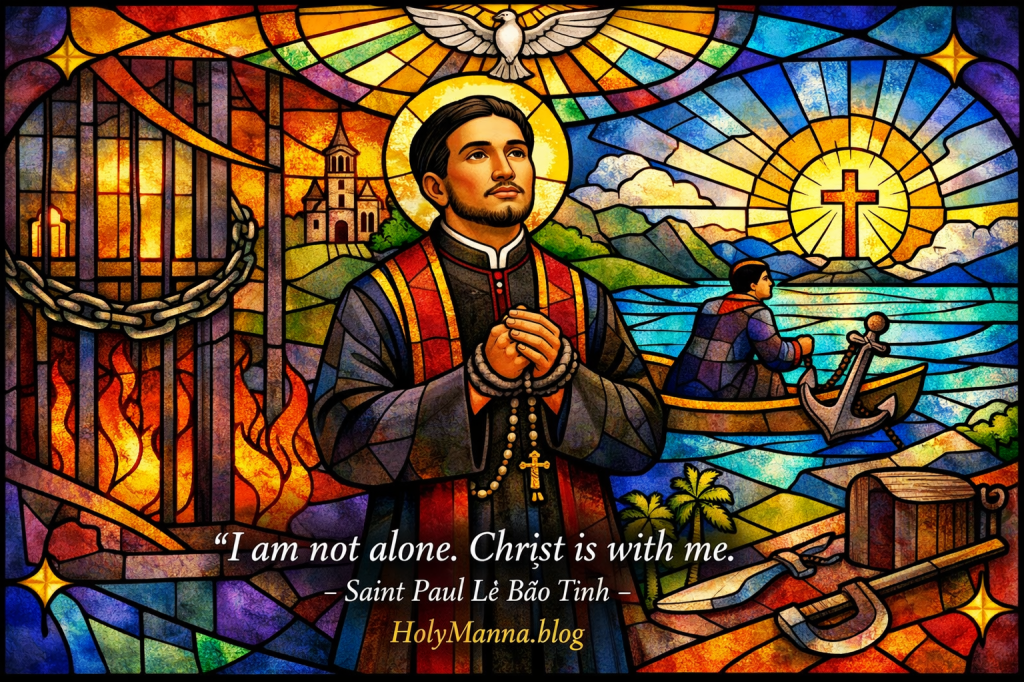
A Priest Whose Chains Became a Sermon
Saint Paul Lê Bảo Tịnh stands among the great Vietnamese martyrs of the Church, not because he held earthly power, but because he loved Christ more than comfort, freedom, or even life itself. He was a priest, a teacher, a seminary rector, a confessor, and finally a martyr. The Church reveres him because his life shines with the kind of fidelity that the world cannot manufacture. In him, the truth of CCC 2473 becomes visible: martyrdom is the supreme witness given to the truth of the faith.
What makes Saint Paul Lê Bảo Tịnh especially unforgettable is the way he suffered. He did not simply endure persecution. He transformed prison into a place of testimony. He turned suffering into encouragement for others. He became known for words that still move the heart today: “I am not alone. Christ is with me.” He also wrote, “In the midst of this storm I cast my anchor towards the throne of God.” Those are not polished lines from a quiet study. Those are words born in chains. That is why he is remembered not only as one who died for Christ, but as one who taught others how to hope in Christ when everything earthly was being stripped away.
A Boy from Thanh Hóa, A Soul Drawn to God
Saint Paul Lê Bảo Tịnh was born in Trinh Hà, in Thanh Hóa, in either 1792 or 1793, according to differing Catholic records. He came from a Catholic family and was raised in the faith from an early age. As a boy, he was sent to live with a priest and later entered Vĩnh Trị Seminary. Even in youth, his life showed signs of seriousness, discipline, and a heart drawn toward God.
One of the most surprising moments in his early life reveals a great deal about his soul. Before priesthood, he tried to disappear into the forest and live as a hermit. He brought provisions, found a cave, and spent about a year living in prayer and austerity. That detail alone says much about him. This was not a man casually drifting through religion. This was a man who wanted God completely. Yet holiness did not come to him through private escape. His bishop called him back, and he obeyed. That obedience mattered. The saint who desired solitude learned that God was calling him not only to prayer, but to service, formation, teaching, and one day martyrdom.
After returning, he continued his studies and taught Latin. He also served the mission in practical ways, including difficult errands connected with the needs of the Church. Later he was sent on missionary labor to Laos. Long before his arrest, long before the prison cell, and long before the execution ground, his life had already become a steady offering.
A Teacher of Souls and a Prisoner of Hope
Saint Paul Lê Bảo Tịnh is most known for three things: his priestly service, his prison letter, and his martyrdom. These three belong together.
He was arrested in the winter of 1841 while teaching catechumens. That detail matters because it shows what the persecutors feared. They were not merely hunting a man. They were trying to wound the growth of the Church. He was imprisoned for years in Hanoi, and during that time he wrote the letter that made his voice echo across generations of Catholics.
In that letter, he described the horrors of prison and the cruelty of the persecution, yet he did not sound like a broken man. He sounded like a man anchored in heaven. He wrote not to spread despair, but to strengthen priests and seminarians. He wanted them to love God more boldly, not more cautiously. That is one reason he remains so important for the Church today. He shows that Christian courage is not loud self-confidence. It is supernatural trust.
His first death sentence was eventually reduced to exile, but God’s providence opened another path. After a change in the political situation, he was freed. He then returned to the work of the Church, was ordained deacon in 1848, and priest in 1849, already late in life. He later served as director of Vĩnh Trị Seminary. That part of his story is easy to overlook, but it should not be missed. He was not only a victim of persecution. He was a builder of the Church. He formed future priests, heard confessions, taught, and served the faithful with zeal.
Signs of Charity More Than Wonders
Catholic sources do not preserve clear verified miracle stories worked by Saint Paul Lê Bảo Tịnh during his lifetime in the way some saints are remembered for healings or extraordinary wonders. His greatness does not depend on spectacular public miracles. His holiness is seen more clearly in his endurance, obedience, and priestly charity.
There is, however, one memorable tradition from his life. A governor reportedly tried to warn him before his final arrest because Saint Paul had once cured him of an illness. That story is remembered in Catholic accounts, but it is better understood as an example of his compassion and practical care than as a formally verified miracle. It reveals a priest whose charity reached beyond the boundaries of comfort and convenience.
In truth, his greatest visible wonder may have been the interior miracle of hope. There is something almost more startling about a man who, after years of prison and persecution, still speaks of Christ’s presence with peace and strength. In a world that loves outward spectacle, saints like Paul Lê Bảo Tịnh remind the faithful that grace often appears most powerfully in perseverance.
The Road to the Sword
His final arrest came in 1857. By then he was already a priest and seminary leader, which made him an especially visible target. Before being taken away, he reportedly entered the church to pray and say farewell to his seminarians. That image lingers. A spiritual father, facing death, turns first to prayer and then to his sons.
During his final imprisonment, he continued to strengthen other Christians. Even in suffering, he remained a shepherd. Twelve days before his execution, he wrote again in Latin to encourage his seminarians. That detail says everything about his heart. He was not consumed with self-pity. He was still thinking like a priest.
When sentence was finally carried out on April 6, 1857, at Bảy Mẫu, he was beheaded for the faith. A final statement attributed to him in Catholic memory captures his spirit with great clarity: “My body is in the hands of the mandarin, but my soul belongs to God.” That is the language of martyrdom. Earthly authority could wound the body, but it could not possess the soul. This is why the Church honors him. He did not merely die bravely. He died belonging entirely to Christ.
The Memory That Kept Growing
After his death, Saint Paul Lê Bảo Tịnh’s witness did not fade. His body was first buried beneath Vĩnh Trị Church, and later his remains were transferred to Sở Kiện. His memory continued to live in the Church not because a political movement preserved it, but because the faithful recognized holiness in him.
He was beatified in 1909 and canonized in 1988 by Pope Saint John Paul II among the 117 Vietnamese Martyrs. This gave his witness a place not only in Vietnamese Catholic memory, but in the life of the universal Church. His feast is honored with the Vietnamese Martyrs on November 24 in the Roman calendar, and he is also remembered individually in connection with the date of his martyrdom.
His impact after death has been especially strong in Vietnamese Catholic life. His name has been given to seminaries and institutions of priestly formation. His prison words continue to be quoted by Church leaders. His legacy is not built on sensational legends, but on something deeper and more durable: he became a father in faith to later generations. His voice still strengthens priests, seminarians, and ordinary Catholics who are trying to remain faithful in a hostile world.
As for miracles after death, the research used for this post did not uncover specific well-attested miracle stories tied directly to his intercession. No particular healing account or shrine miracle could be responsibly presented as established fact from the material reviewed. For that reason, it is better to be honest than dramatic. His enduring impact after death is unquestionably real, but it is seen most clearly in his veneration, his relics, his canonization, and the spiritual power of his witness rather than in specific verified miracle narratives.
What This Martyr Teaches the Church Today
Saint Paul Lê Bảo Tịnh speaks powerfully to modern Catholics because his life cuts through excuses. He wanted God deeply. He obeyed when obedience was hard. He served the Church patiently. He suffered without surrendering to bitterness. He died without handing over his soul to fear.
That matters now more than ever. Many people will never face a prison cell for the faith, but they do face mockery, compromise, discouragement, temptation, and the slow pressure to water down Catholic conviction. Saint Paul Lê Bảo Tịnh shows that fidelity is not built in one dramatic moment. It is built in daily surrender. It is built in prayer, obedience, study, sacramental life, and the decision to remain with Christ when comfort would be easier.
His life also reminds the faithful that suffering is not proof that God has abandoned them. Sometimes suffering is the very place where Christ becomes most present. That is why his words still strike the heart so deeply. “I am not alone. Christ is with me.” That sentence can carry a soul through far more than a prison.
What storms need to be anchored at the throne of God right now? What fears lose their power when the soul remembers that it belongs to Christ? What would daily life look like if faith were lived with the same seriousness, tenderness, and courage that marked this martyr?
A practical way to imitate him is simple. Pray with honesty. Stay close to the sacraments. Do not treat Catholic truth like a hobby. Love the Church enough to remain faithful when faith becomes costly. Encourage others when suffering arrives, because that is exactly what he did. Even in chains, he strengthened the brethren.
Engage with Us!
Share thoughts and reflections in the comments below. Saint Paul Lê Bảo Tịnh has a way of speaking directly to anyone trying to stay faithful in a world that does not always welcome holiness.
- What part of Saint Paul Lê Bảo Tịnh’s story speaks most strongly to the heart today?
- How does his prison witness challenge the way suffering and inconvenience are usually viewed?
- What can be learned from his obedience, especially when he gave up the hidden life he originally desired?
- How can his words about casting his anchor toward God shape prayer during trials?
- What would it look like to live with the same conviction that the body belongs to the world’s circumstances, but the soul belongs to God?
May Saint Paul Lê Bảo Tịnh inspire deeper courage, steadier hope, and a more serious love for Jesus Christ. May his witness help every soul remember that holiness is possible even in suffering, and that true freedom is found in belonging completely to God. Live with faith, endure with hope, and do everything with the love and mercy Jesus taught us.
Saint Paul Lê Bảo Tịnh, pray for us!
Follow us on YouTube, Instagram and Facebook for more insights and reflections on living a faith-filled life.

 Holy Manna!
Leave a comment