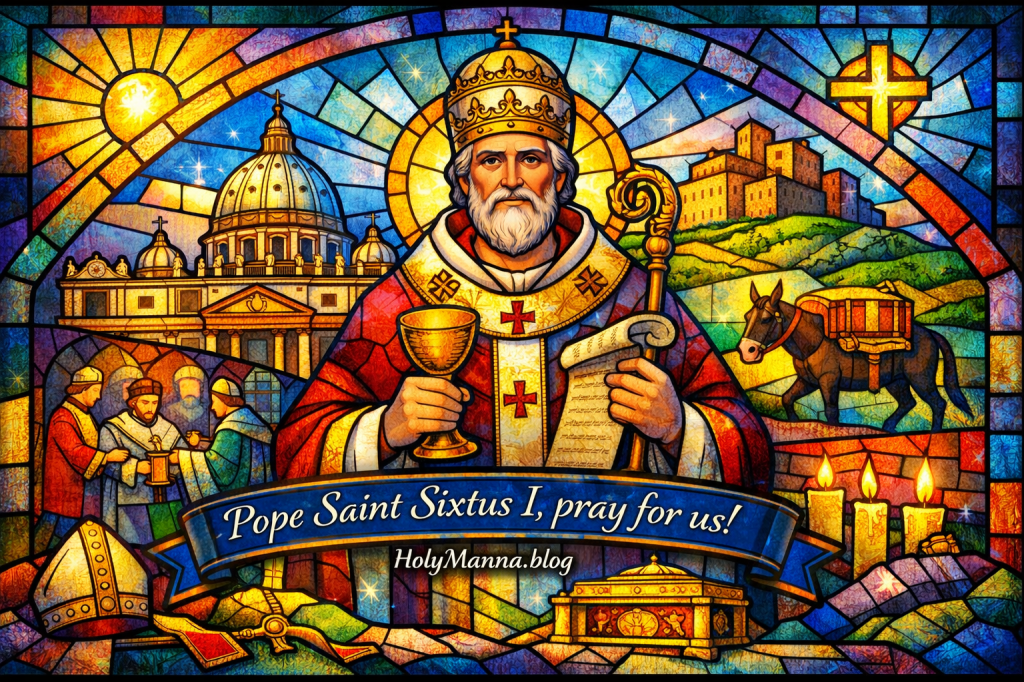
The Quiet Strength of an Early Shepherd
Among the earliest successors of Saint Peter, Pope Saint Sixtus I stands as one of those holy men whose greatness is seen less in dramatic surviving detail and more in the steady witness of the Church’s memory. He was the seventh Pope of the Catholic Church, governing the Church of Rome in the second century during the age of Emperor Hadrian. His life comes down through history with many gaps, but what remains is still beautiful. The Church remembers him as a faithful shepherd, a guardian of sacred order, and a saint whose legacy endured long after his earthly life ended.
Pope Saint Sixtus I is revered because he belongs to that fragile, heroic generation of early bishops of Rome who helped preserve the unity and worship of the Church while Christianity was still young. In a time when the Church was still finding her visible structure in the world, men like Sixtus helped hand on what had been received from the Apostles. That matters deeply in Catholic life, because the Church teaches that the faith is transmitted through apostolic succession and faithfully preserved in the Church under the successors of the Apostles and the successor of Peter, as taught in The Catechism, CCC 77, CCC 861, and CCC 882.
Roots in Ancient Rome
Catholic tradition holds that Sixtus was born in Rome and that his father’s name was Pastor. Beyond that, very little can be known with certainty about his childhood, family life, or early formation. This is one of the humbling things about many of the earliest saints. The Church remembers them first for their holiness and fidelity, not because historians were able to preserve every earthly detail.
There is no dramatic conversion story attached to Pope Saint Sixtus I. He was not remembered like Saint Paul, struck down on the road to Damascus, or like Saint Augustine, converted after a long struggle. Instead, his life seems to reflect something quieter and no less powerful. His path appears to have been one of steady formation, deepening faith, and faithful service within the life of the Church. There is something deeply Catholic in that. Not every saint is remembered for one great emotional turning point. Some saints become holy through years of obedience, reverence, and perseverance.
He is most known for serving as an early Bishop of Rome and for the traditions that connect him with strengthening liturgical discipline and reverence. Ancient Catholic sources attribute to him regulations concerning sacred vessels and the proper relationship of bishops to the Apostolic See. Some later traditions also connect him with the use of the Sanctus in the liturgy. Historians caution that not every detail can be proven with certainty, but the memory itself reveals how the Church came to see him: as a pope associated with order, worship, and fidelity to the sacred.
A Shepherd of Reverence and Communion
The life of Pope Saint Sixtus I is important precisely because it reminds the faithful that the Church did not survive by accident. She was guarded by real men, real bishops, and real saints who preserved what they had received. Sixtus lived in a world where the Christian faith was still vulnerable, still often misunderstood, and still exposed to pressure from the surrounding pagan culture. In that setting, to defend the dignity of worship and the unity of the Church was no small thing.
Catholic tradition remembers him as especially concerned with reverence for the holy mysteries. He is associated with the tradition that only sacred ministers were to handle the sacred vessels used for the Eucharist. Whether every detail of that attribution can be historically verified, the association is fitting. The Eucharist is not ordinary bread and wine, but the Body, Blood, Soul, and Divinity of Jesus Christ, as the Church teaches in CCC 1374. A pope remembered for reverence toward the sacred mysteries is a pope worth remembering well.
He is also associated with the Church’s visible unity. Traditions about bishops returning from Rome with letters from the Apostolic See reflect the early Church’s awareness that communion with Rome mattered. That may seem like a small administrative detail, but in Catholic life it points to something much larger. Christ did not leave behind a vague spiritual movement. He founded a Church. He gave that Church shepherds. He entrusted Peter with a visible role of strengthening his brethren, as seen in The Gospel of Luke, Lk 22:32. Pope Saint Sixtus I stands within that living line.
When it comes to miracles during his lifetime, the honest answer is simple. No specific miracle from his earthly life has been securely preserved in the major Catholic historical sources. That is not a weakness in his story. It is a lesson. The Church does not honor saints only because of spectacular wonders. She also honors saints because of fidelity, leadership, holiness, and endurance. Sometimes the miracle is not a dramatic event. Sometimes the miracle is that the faith was preserved at all.
Trials, Suffering, and the Question of Martyrdom
Like many early popes, Saint Sixtus I lived close to the shadow of persecution. The Christian world of the second century was not yet enjoying peace or public security. To lead the Church in Rome was to carry a burden that could at any moment become dangerous. Even when a specific account of his sufferings is not fully preserved, the office itself placed him in the path of hardship.
Older Catholic traditions describe him as a martyr, and for many centuries he was venerated in that way. Some martyrologies and traditional accounts gave him that title. Local devotion in places that later received his relics still speaks of him as pope and martyr. At the same time, modern Catholic scholarship is more cautious. The Church still venerates him as a saint, but the exact details of his death and whether he died by martyrdom cannot be stated with certainty.
That uncertainty does not diminish him. If anything, it makes his witness more human. He belonged to that age when holiness often required readiness for sacrifice, whether or not historians managed to preserve the exact final scene. His life teaches that sanctity is not measured by how much documentation survives. It is measured by fidelity to Christ.
Relics, Local Wonders, and a Legacy That Traveled
The strongest miracle traditions associated with Pope Saint Sixtus I come after his death. Catholic tradition holds that he was originally buried near Saint Peter in the Vatican area. Centuries later, stories of the translation of his relics gave rise to lasting devotion, especially in Alatri and Alife in Italy.
One of the most famous local traditions comes from Alatri. According to this Catholic story, when his relics were being transported, the mule carrying them came to a fork in the road and turned toward Alatri in a way the people understood as providential. The arrival of the relics was treated as miraculous, and devotion to Saint Sixtus grew strongly in the city. This story belongs to local Catholic tradition and cannot be historically verified with certainty, but it has been cherished for centuries.
Another important part of his legacy is the rediscovery and veneration of his relics. In times of danger, relics associated with Saint Sixtus were hidden for protection and later rediscovered, which only deepened local devotion. Churches, chapels, artwork, and civic celebrations grew up around his memory. In Alatri, he became a powerful patronal figure. In Alife, too, he is honored as patron of the city and diocese, and his feast is still celebrated with solemnity and affection.
This is where the saint’s cultural impact becomes especially striking. Pope Saint Sixtus I may not have left behind a body of writings or a famous personal saying, but he left something else. He left a living cult. He left processions, feast days, patronage, relic devotion, sacred art, and a memory strong enough to shape the identity of whole communities. That kind of legacy should not be underestimated. It shows how the communion of saints continues to bear fruit across the centuries.
What This Early Pope Still Teaches the Church
Pope Saint Sixtus I teaches that quiet faithfulness matters. In a culture that loves spectacle, his life is a reminder that holiness is often built through reverence, steadiness, and the humble guarding of what is sacred. He did not become memorable because history preserved endless details about him. He became memorable because the Church never forgot that he served faithfully.
There is also a lesson here about the beauty of structure in Catholic life. Modern people sometimes act as though reverence, order, and obedience are dry things. The saints teach otherwise. In the Church, holy order protects holy love. Reverence protects mystery. Apostolic succession protects the truth handed down from Christ. Pope Saint Sixtus I stands as an early witness to that reality.
His life invites every Catholic to ask hard and fruitful questions. Is there real reverence for the things of God? Is the Eucharist approached with awe? Is there love for the Church not only in her spiritual beauty but also in her visible structure and authority? These are not abstract questions. They shape the soul.
A practical way to imitate Saint Sixtus I is to recover seriousness about holy things. Genuflect with intention. Prepare well for Mass. Go to Confession regularly. Speak about the Eucharist with love and reverence. Pray for the Pope and the bishops. Defend the Church when the world mocks her. Stay faithful even when the work seems unnoticed. That is how saints are formed.
Engage With Us!
Share your thoughts and reflections in the comments below. The life of Pope Saint Sixtus I may seem quiet at first glance, but it carries a powerful lesson about faithfulness, reverence, and the strength of the early Church.
- What stands out most about a saint whose legacy is remembered more through faithfulness than through dramatic recorded events?
- How can greater reverence for the Eucharist change daily Catholic life?
- What does Pope Saint Sixtus I teach about loving the Church as both spiritual family and visible institution?
- Are there areas of life where quiet fidelity is needed more than recognition or applause?
- How can the example of the early popes strengthen trust in Christ’s promise to remain with His Church?
May the witness of Pope Saint Sixtus I encourage a life of steady faith, deep reverence, and loving obedience to Christ and His Church. May everything be done with the love and mercy Jesus taught, and may that love shape every prayer, every duty, and every step on the road to holiness.
Pope Saint Sixtus I, pray for us!
Follow us on YouTube, Instagram and Facebook for more insights and reflections on living a faith-filled life.

 Holy Manna!
Leave a comment