Monday in the Octave of Easter – Lectionary: 261
When Easter Truth Breaks Open the Heart
There are days in the Church’s year when everything feels newly lit from within, and Easter Monday is one of them. The empty tomb is still fresh, the shock of the Resurrection still hangs in the air, and today’s readings invite the soul to stand in that first bright morning when sorrow had not yet fully caught up with joy. The central theme tying these readings together is simple and powerful: the Resurrection of Jesus turns fear into witness, fulfills the promises of God, and exposes every lie that tries to silence the truth.
That is what makes this day so important in the life of the Church. The Monday in the Octave of Easter is not treated as an ordinary weekday with a passing nod to yesterday’s feast. The Church lingers in Easter joy as though it were one long sacred day. That is why the readings move with such urgency. In Acts of the Apostles, Peter stands before the people no longer as the man who hid during the Passion, but as a witness transformed by the Risen Christ and the outpouring of the Holy Spirit. In Psalm 16, the Church hears the ancient hope of Israel find its true fulfillment in Jesus, the Holy One whose body would not know corruption. In The Gospel of Matthew, the women run from the tomb fearful yet overjoyed, and while heaven announces the truth, earthly powers scramble to cover it with money and deception.
There is also a deep religious background holding these readings together. The first Christians did not believe the Resurrection was a beautiful metaphor or a comforting spiritual idea. They proclaimed it as a real event in history, the fulfillment of God’s covenant with Israel and the turning point of the world. Peter preaches as a son of Israel, drawing from David and the psalms to show that Jesus is the promised Messiah. Matthew shows that even from the first Easter morning, the Gospel was met with both worship and resistance, faith and denial. That tension still remains. Every age must decide whether it will fall at the feet of the Risen Christ in reverence, or accept a more convenient story. Today’s readings prepare the heart to choose Easter truth, to trust the promises of God, and to see that once Christ has risen, nothing can remain the same.
First Reading – Acts 2:14, 22-33
From the Upper Room to the Public Square
This reading comes from Saint Peter’s great proclamation at Pentecost, but the Church places it before us in the radiant days of Easter because it shows what the Resurrection does to a man. The same Peter who once trembled in the courtyard now stands in Jerusalem and raises his voice before the crowds. That change is not the result of personality, confidence, or religious enthusiasm. It is the fruit of the Risen Jesus and the power of the Holy Spirit. In this passage, Peter speaks to devout Jews gathered in the holy city, many of whom knew of Jesus’ mighty works, many of whom had heard the rumors, and some of whom may even have stood near the Cross. He preaches to Israel from within Israel’s own history, drawing from King David and the Psalms to show that the Resurrection of Christ was not an afterthought, but the fulfillment of God’s ancient promise.
This is why the reading fits today’s Easter theme so beautifully. The Resurrection turns fear into witness, fulfills what God had spoken beforehand, and opens the path of life where death once seemed to have the final word. Peter does not present Easter as a private spiritual comfort. He presents it as a public, world-changing fact. Christ was truly crucified, truly raised, and truly exalted. That truth becomes the heart of the Church’s preaching.
Acts 2:14, 22-33 – New American Bible (Revised Edition)
Peter’s Speech at Pentecost. 14 Then Peter stood up with the Eleven, raised his voice, and proclaimed to them, “You who are Jews, indeed all of you staying in Jerusalem. Let this be known to you, and listen to my words.
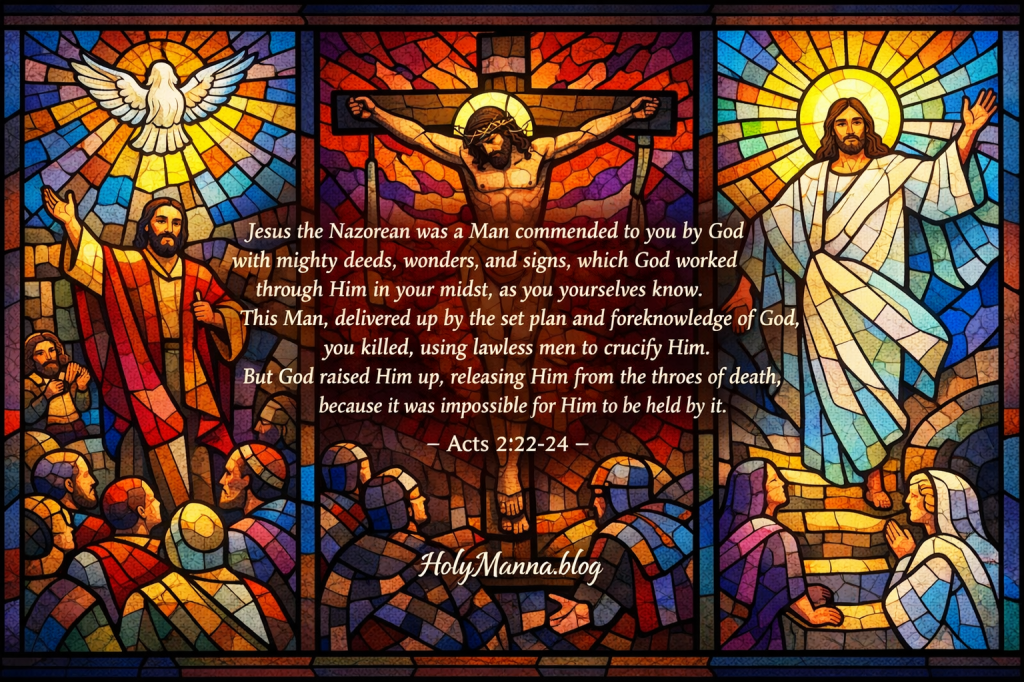
22 You who are Israelites, hear these words. Jesus the Nazorean was a man commended to you by God with mighty deeds, wonders, and signs, which God worked through him in your midst, as you yourselves know. 23 This man, delivered up by the set plan and foreknowledge of God, you killed, using lawless men to crucify him. 24 But God raised him up, releasing him from the throes of death, because it was impossible for him to be held by it. 25 For David says of him:
‘I saw the Lord ever before me,
with him at my right hand I shall not be disturbed.
26 Therefore my heart has been glad and my tongue has exulted;
my flesh, too, will dwell in hope,
27 because you will not abandon my soul to the netherworld,
nor will you suffer your holy one to see corruption.
28 You have made known to me the paths of life;
you will fill me with joy in your presence.’29 My brothers, one can confidently say to you about the patriarch David that he died and was buried, and his tomb is in our midst to this day. 30 But since he was a prophet and knew that God had sworn an oath to him that he would set one of his descendants upon his throne, 31 he foresaw and spoke of the resurrection of the Messiah, that neither was he abandoned to the netherworld nor did his flesh see corruption. 32 God raised this Jesus; of this we are all witnesses. 33 Exalted at the right hand of God, he received the promise of the holy Spirit from the Father and poured it forth, as you [both] see and hear.
Detailed Exegesis
Verse 14: “Then Peter stood up with the Eleven, raised his voice, and proclaimed to them, ‘You who are Jews, indeed all of you staying in Jerusalem. Let this be known to you, and listen to my words.’”
Peter stands not alone, but with the Eleven. This matters. He speaks as the head of the apostolic band, not as an isolated believer with a private opinion. The Church is already visible here in seed form: apostolic, public, united, and sent. Peter’s boldness also reveals the healing power of grace. Easter has changed him. The man who once denied Christ now publicly proclaims him. There is also a solemn tone in his words. He is not making conversation. He is summoning Israel to hear the saving truth.
Verse 22: “You who are Israelites, hear these words. Jesus the Nazorean was a man commended to you by God with mighty deeds, wonders, and signs, which God worked through him in your midst, as you yourselves know.”
Peter begins with what his hearers can recognize. Jesus was not hidden from history. His miracles were public signs worked by God. Peter does not treat Jesus as a legend or a symbol, but as a real man in a real place, known in the midst of the people. Yet the verse says more than that. Jesus is “commended” by God. His works reveal divine approval and divine mission. In Catholic understanding, miracles are not stage effects. They are signs that reveal the Kingdom and authenticate Christ’s mission.
Verse 23: “This man, delivered up by the set plan and foreknowledge of God, you killed, using lawless men to crucify him.”
This is one of the most important lines in the New Testament for understanding the Passion. Peter holds together two truths that must never be separated. First, Christ’s Passion took place according to the saving plan of God. Second, those who acted unjustly were still morally responsible. God’s providence does not erase human freedom. The Cross was not an accident, and it was not fate. It was the mystery of divine love working through human history without excusing human sin. The Church is careful here. This verse is not permission for hatred toward the Jewish people. Rather, it reveals that all sinners stand in need of the mercy won by Christ’s sacrifice.
Verse 24: “But God raised him up, releasing him from the throes of death, because it was impossible for him to be held by it.”
Everything turns on this verse. The Resurrection is the Father’s answer to the Cross. Death had real power, but it did not have ultimate power. Peter says it was impossible for death to hold Christ. Why? Because Jesus is not merely one more man caught in the cycle of mortality. He is the Holy One, the Son, the Author of Life. Death can wound, but it cannot reign forever over the one who is Life itself. Easter is not a reversal of bad luck. It is the triumph of divine life over the grave.
Verse 25: “For David says of him:”
Peter now interprets the Resurrection through Scripture. This is how the apostolic Church reads the Old Testament. Israel’s sacred history finds its fulfillment in Christ. Peter does not quote David as a decorative reference. He reads David prophetically. The Psalm becomes a window into the mystery of Christ.
Verse 26: “I saw the Lord ever before me, with him at my right hand I shall not be disturbed.”
This line expresses steady trust in God’s presence. In its deepest fulfillment, it belongs perfectly to Christ, who lives in unbroken communion with the Father. The Risen Lord is never abandoned. The phrase “at my right hand” suggests stability, help, and victory. For the Christian, this verse also becomes a pattern of discipleship. The soul that keeps the Lord always before it is not spared every trial, but it is anchored in the midst of trial.
Verse 27: “Therefore my heart has been glad and my tongue has exulted; my flesh, too, will dwell in hope,”
Joy flows from trust. Peter reads this not merely as David’s personal confidence, but as a deeper prophecy of Christ, whose body would rest in hope even in death. This verse matters because Christianity does not despise the body. The flesh is not discarded as meaningless. The body of Christ matters, and because of him, the body of the believer matters too. Easter is bodily. Salvation is not escape from creation, but its renewal.
Verse 28: “because you will not abandon my soul to the netherworld, nor will you suffer your holy one to see corruption.”
This is the heart of Peter’s scriptural argument. David’s body did see corruption. Therefore David was speaking beyond himself. The “holy one” is Christ, whose body did not decay in the tomb. This verse points directly to the mystery of Holy Saturday and Easter morning. Christ truly entered death, but death could not claim him permanently. The Church sees here a prophecy of the Resurrection in which the Holy One passes through the grave without being conquered by it.
Verse 29: “You have made known to me the paths of life; you will fill me with joy in your presence.”
The Resurrection is not only victory over death. It is entrance into fullness of life and joy in the presence of God. In Christ, the path of life is opened for all who belong to him. Peter is showing that the Psalm reaches its fullest meaning in the glorified Messiah. The destiny of Jesus is not annihilation, but eternal communion and joy. That same path is now held out to the Church.
Verse 29: “My brothers, one can confidently say to you about the patriarch David that he died and was buried, and his tomb is in our midst to this day.”
Peter becomes strikingly concrete. He appeals to what can be seen and known. David is dead. His tomb remains. Therefore the Psalm cannot find its final meaning in David himself. This is a classic apostolic move. Peter does not ask for blind sentiment. He argues from history, Scripture, and witness. The Resurrection proclamation is not detached from the real world.
Verse 30: “But since he was a prophet and knew that God had sworn an oath to him that he would set one of his descendants upon his throne,”
Here Peter brings in the covenant with David. God had promised David a royal descendant whose throne would endure. The Church understands this promise as fulfilled in Christ, the Son of David and eternal King. David speaks as prophet because the Spirit lets him glimpse the coming Messiah. The Resurrection is therefore not isolated from the whole history of salvation. It is the flowering of the Davidic promise.
Verse 31: “he foresaw and spoke of the resurrection of the Messiah, that neither was he abandoned to the netherworld nor did his flesh see corruption.”
Peter gives the inspired interpretation plainly. David foresaw the Resurrection of the Messiah. The Church reads this verse with gratitude because it shows how the apostles themselves taught Christians to interpret Scripture. Christ is the key that unlocks the Old Testament. The Messiah truly died, yet he was not abandoned. His body truly lay in the tomb, yet it did not decay. The Resurrection is both continuity and victory. The crucified Jesus is the risen Jesus.
Verse 32: “God raised this Jesus; of this we are all witnesses.”
This verse is the center of apostolic preaching. Christianity is built on witness. Peter and the apostles are not offering a theory. They are testifying to what God has done. The Church remains apostolic because she continues to proclaim the faith handed on by those witnesses. Easter faith is not a vague feeling that goodness wins in the end. It is the confession that God raised Jesus from the dead.
Verse 33: “Exalted at the right hand of God, he received the promise of the holy Spirit from the Father and poured it forth, as you both see and hear.”
Peter closes by linking Resurrection, Ascension, and Pentecost. The risen Christ is exalted, and from his exalted glory he pours out the Holy Spirit. This means Easter never remains locked in the tomb scene. It becomes mission, sacramental life, preaching, and the birth of the Church. The Spirit poured out upon the apostles is the living sign that Jesus reigns. What the crowd sees and hears is proof that the crucified Jesus is alive and glorified.
Teachings
This reading stands at the very center of Catholic faith because it proclaims the Paschal Mystery in apostolic form. The Catechism teaches this mystery with clarity. In CCC 599, the Church says, “Jesus’ violent death was not the result of chance in an unfortunate coincidence of circumstances, but is part of the mystery of God’s plan, as St. Peter explains to the Jews of Jerusalem in his first sermon on Pentecost: ‘This Jesus [was] delivered up according to the definite plan and foreknowledge of God.’” This is crucial. God did not lose control on Good Friday. The Cross belongs to the plan of redemption.
At the same time, the Church refuses to let providence become an excuse for sin. In CCC 600, she teaches, “To God, all moments of time are present in their immediacy. When therefore he establishes his eternal plan of ‘predestination’, he includes in it each person’s free response to his grace.” Peter’s sermon reflects exactly that balance. Men acted freely and wickedly, yet God brought forth salvation from the very crime of the Cross.
The Resurrection itself is the crowning truth of the Gospel. In CCC 638, the Church declares, “The Resurrection of Jesus is the crowning truth of our faith in Christ, a faith believed and lived as the central truth by the first Christian community.” That is what this reading sounds like. It sounds like the first Christian community staking everything on the Risen Lord. This is not an ornament added to the faith. It is the blazing center of the faith.
The bodily character of the Resurrection also shines through Peter’s use of Psalm 16. In CCC 627, the Church teaches, “Christ’s death was a real death in that it put an end to his earthly human existence. But because of the union which the person of the Son retained with his body, his body was not a mortal corpse like others, for ‘it was not possible for death to hold him’ and therefore ‘divine power preserved Christ’s body from corruption.’” This directly illuminates Peter’s words about the Holy One not seeing corruption. Christ truly died, yet his sacred body remained united to his divine Person.
Saint Augustine saw in the Psalms the voice of Christ speaking before the Incarnation was fully revealed. In commenting on passages like this, he loved to show that the Head speaks in the Psalms, and sometimes the Body speaks with him. That insight helps today’s reading land more deeply. Peter hears David’s words and knows that the true speaker is Christ in mystery. The Psalm becomes both prophecy and prayer.
Saint John Chrysostom also praised Peter’s preaching because Peter does not rely on lofty rhetoric, but on facts, Scripture, and bold witness. He preaches Christ crucified and risen without trying to flatter the crowd. That remains a lesson for the Church. The Gospel grows not through manipulation, but through truth plainly spoken in the power of the Spirit.
Historically, this speech marks a turning point in salvation history. Before Easter and Pentecost, the apostles are often confused, fearful, and hidden. After Easter and Pentecost, they become heralds to the nations. Peter’s sermon is one of the first great public proclamations of the Church. It is the beginning of the Church’s open witness in the world, and it still sets the pattern for every homily, every catechetical lesson, and every faithful act of evangelization. Christ died, Christ rose, Christ reigns, and the Spirit has been poured out.
Reflection
This reading reaches into ordinary life with surprising force because Peter’s story is also the story of every Christian soul. Fear, failure, and shame do not have to be the final chapter. Peter had denied Jesus, yet he was not discarded. Grace rebuilt him. The Resurrection did not simply console Peter. It commissioned him. That matters for daily life. God does not only forgive. He also sends.
There is also a hard but beautiful truth here about suffering and providence. Peter says that Jesus was handed over according to God’s plan, yet human beings acted unjustly. That means the Christian can face pain without despairing and face sin without pretending it is good. God is so powerful and so merciful that he can draw redemption from even the darkest moment. That does not make evil less evil, but it does make hope stronger than evil.
The reading also calls for a more serious confidence in the Resurrection. It is easy to speak of Easter in a soft and sentimental way. Peter does not do that. He proclaims a risen Lord who changes history, fulfills Scripture, judges falsehood, and sends forth the Spirit. Daily life begins to change when that truth is treated as real. Prayer becomes less mechanical because the Lord is alive. Suffering becomes less crushing because death does not have the last word. Witness becomes less optional because the Church still stands in Peter’s line, called to tell the world what God has done.
A few practical steps rise naturally from this reading. Spend time each day placing the Lord consciously before the mind and heart, as Psalm 16 teaches. Read the Scriptures with Christ at the center, asking how the Old Testament points toward him. Speak openly and simply about the faith when the moment is given, without aggression and without embarrassment. Bring past failures to the mercy of Christ instead of letting them become excuses for silence. Let the Resurrection shape not only Easter devotion, but ordinary speech, work, and endurance.
What fear has kept the soul quiet when it should have spoken of Christ? What part of life still acts as though death, shame, or failure has the last word? What would change if the Resurrection were believed not as a distant doctrine, but as the living truth around which every day is built?
Peter once stood in the shadow of fear. Now he stands in the light of Easter and speaks. That is the invitation hidden in this reading. Stand up. Raise the voice. Keep Christ before the heart. Walk the path of life.
Responsorial Psalm – Psalm 16:1-2, 5, 7-11
The Song of the Heart That Refuses to Let Death Have the Last Word
The Church gives Psalm 16 to Easter Monday because it sounds like the prayer of a soul that has learned to rest entirely in God. In its original setting, this is a psalm of trust attributed to David, a sacred song born from the covenant life of Israel, where the faithful learned to speak to God not as a distant force but as Lord, refuge, inheritance, and joy. In the life of ancient Israel, the psalms were not private poems tucked away for quiet reading. They were prayed, sung, remembered, and carried into worship. They shaped the heart of the people of God.
But on this day, the Church hears more than David’s personal trust. She hears a prophetic song that finds its fullest meaning in the Risen Christ. Saint Peter has already quoted this psalm in the First Reading to show that David was speaking beyond himself, toward the Messiah whose flesh would not see corruption. That is why this psalm fits today’s theme so beautifully. Easter is not only the announcement that Christ rose. It is also the revelation that those who belong to him may live in trust, hope, and joy, even in the shadow of death. What begins as David’s prayer becomes the Church’s Easter song.
Psalm 16:1-2, 5, 7-11 – New American Bible (Revised Edition)
God the Supreme Good
1 A miktam of David.
Keep me safe, O God;
in you I take refuge.
2 I say to the Lord,
you are my Lord,
you are my only good.5 Lord, my allotted portion and my cup,
you have made my destiny secure.7 I bless the Lord who counsels me;
even at night my heart exhorts me.
8 I keep the Lord always before me;
with him at my right hand, I shall never be shaken.
9 Therefore my heart is glad, my soul rejoices;
my body also dwells secure,
10 For you will not abandon my soul to Sheol,
nor let your devout one see the pit.
11 You will show me the path to life,
abounding joy in your presence,
the delights at your right hand forever.
Detailed Exegesis
Verse 1: “Keep me safe, O God; in you I take refuge.”
The psalm begins with dependence. This is not the voice of a man pretending to be strong. It is the voice of one who knows that safety is found in God alone. In the spiritual life, refuge means more than protection from earthly trouble. It means entrusting the whole self to the Lord. Read in the light of Easter, this verse becomes even richer. Christ entered the suffering of human life completely, yet remained perfectly abandoned to the Father. The Christian, united to Christ, learns that refuge in God does not always remove the storm, but it does keep the soul from being lost in it.
Verse 2: “I say to the Lord, you are my Lord, you are my only good.”
This verse reaches to the center of biblical faith. God is not one good among many. He is the highest good, the source of every other good. In a world that constantly offers substitutes for peace, identity, and fulfillment, this line cuts through illusion. The heart was made for God, and it remains restless until it rests in him. In the Easter context, this verse becomes a confession that the Risen Christ is not simply a help added onto life. He is life’s true center, the one in whom every lesser good finds its proper place.
Verse 5: “Lord, my allotted portion and my cup, you have made my destiny secure.”
In ancient Israel, the language of portion and cup carried covenant meaning. A portion was an inheritance. A cup could signify one’s lot in life, whether joy or suffering. To say that the Lord is one’s portion is to say that communion with God is better than any earthly possession. This is deeply important in the Easter season. The Resurrection does not promise worldly control, wealth, or comfort. It promises a secure destiny in God. For the believer, life is no longer measured only by visible outcomes. The soul’s inheritance is the Lord himself.
Verse 7: “I bless the Lord who counsels me; even at night my heart exhorts me.”
The psalmist blesses God for divine counsel, which means guidance, wisdom, and inward instruction. Even at night, when darkness, uncertainty, or loneliness press in, the heart remains addressed by God. There is something beautifully realistic here. Night often represents confusion, grief, temptation, or waiting. Yet God does not stop teaching in the dark. In Easter light, this verse reminds the Christian that even the long night of Holy Saturday was not empty. God was still at work. The soul that listens in darkness often learns trust more deeply than the soul that only listens in comfort.
Verse 8: “I keep the Lord always before me; with him at my right hand, I shall never be shaken.”
This verse expresses the steady gaze of faith. To keep the Lord always before oneself is to live with a heart oriented toward God, not merely visiting him in moments of emergency. The image of God at one’s right hand suggests strength, help, and protection. This does not mean the believer never suffers. It means suffering cannot uproot the soul that stands near God. In the fullest sense, this belongs to Christ, who remained perfectly united to the Father. But it also becomes the pattern of Christian discipleship. Stability comes not from controlling life, but from staying close to the Lord.
Verse 9: “Therefore my heart is glad, my soul rejoices; my body also dwells secure,”
Trust gives birth to joy. The gladness here is not shallow cheerfulness. It is the peace that comes from belonging to God. Notice that the verse includes the body as well as the soul. Biblical faith never treats the body as disposable. The body matters because the human person is not a trapped spirit but a unity of body and soul. This becomes especially powerful in Easter. Christ rose bodily. Therefore the believer’s hope is not only spiritual survival, but the promise that redemption reaches the whole person.
Verse 10: “For you will not abandon my soul to Sheol, nor let your devout one see the pit.”
This is the great Easter verse. In its deepest fulfillment, the Church hears here the voice of Christ, the Holy One who truly entered death and yet was not abandoned to it. Saint Peter reads this verse as a prophecy of the Resurrection because David’s own tomb remained, while Christ rose victorious. The verse also teaches something essential about Christian hope. Death is real, but abandonment is not the final truth for those who belong to God. The grave is not master. God is master.
Verse 11: “You will show me the path to life, abounding joy in your presence, the delights at your right hand forever.”
The psalm ends not in fear, but in fulfillment. God reveals the path to life, and that life is described as joy in his presence. This is not merely escape from death. It is communion, delight, and everlasting nearness to God. Easter does not only announce that Jesus is no longer in the tomb. It announces that the path to life has been opened for the world. In Christ, the faithful are not just pulled away from destruction. They are drawn into divine friendship.
Teachings
The Church has always treasured the psalms as living prayer. The Catechism teaches in CCC 2585, “From the beginning, God’s Revelation was inseparable from the ‘call to mind’ of his wondrous works. These were handed on from generation to generation, and were actualized in liturgical celebrations. Israel’s inspired prayer opens and closes the economy of salvation. The psalms are the masterwork of prayer in the Old Testament.” That truth helps explain why Psalm 16 matters so much. It is not simply religious poetry. It is inspired prayer given by God to teach his people how to remember, trust, and hope.
The Church also teaches in CCC 2586, “The Psalms both nourished and expressed the prayer of the People of God as they were gathered in assembly on the great feasts at Jerusalem and each Sabbath in the synagogues. This prayer is inseparably personal and communal; it concerns those praying and all men.” That line fits this Responsorial Psalm beautifully. David speaks in a personal voice, yet the Church receives the psalm as the prayer of Christ and his Body. It is intimate, but never private. It belongs to the whole people of God.
This psalm also sits at the center of apostolic preaching. Saint Peter uses it in Acts 2, and Saint Paul uses it again in Acts 13, because the early Church saw clearly that the line about the Holy One not seeing corruption reaches its fullest meaning in Christ. The Resurrection did not force Christians to invent a new religion detached from Israel. It taught them how to read Israel’s Scriptures rightly. What had been sung in hope was fulfilled in Jesus.
Saint Augustine loved to read the psalms as the voice of Christ speaking in mystery. That approach helps this psalm shine with Easter meaning. Christ prays it as the Head, and the Church prays it as his Body. The words about refuge, joy, incorruption, and the path to life belong first to the Risen Lord, then to all who are united to him. Saint Augustine’s great instinct was that the psalms teach the Church not only what to say, but who she is in Christ.
There is also a deep sacramental echo here. When the psalm says, “Lord, my allotted portion and my cup,” the Christian ear naturally hears a Eucharistic resonance. The Lord who is our portion now gives himself under the appearance of bread and wine. Easter joy does not remain an idea in the mind. It becomes communion. The Risen Christ gives himself to his people and becomes their inheritance even now.
Historically, this psalm has long held an important place in Christian prayer around death and hope. The Church prays the psalms not because she is sentimental about ancient texts, but because she knows these words continue to interpret human life. Fear, darkness, mortality, and longing all remain familiar. So do trust, praise, and hope. Psalm 16 gives language to the soul that wants to stand before death without surrendering to despair.
Reflection
This psalm speaks gently, but it speaks straight to the deepest anxieties of daily life. Many people live as though security comes from control, money, reputation, success, or the approval of others. Psalm 16 tears through that illusion with remarkable simplicity. The soul is safest when it takes refuge in God. The heart is healthiest when it can say, “You are my only good.” That kind of faith does not make a person less human. It makes a person more free.
There is also a beautiful realism in this psalm. It does not pretend that nights are easy. It does not pretend that death is imaginary. It does not pretend that joy comes from a trouble-free life. Instead, it teaches the soul how to stand in the middle of real life with trust intact. That is one of the clearest Easter lessons. The Resurrection does not erase the memory of the Cross. It reveals that the Cross is not the end of the story.
In daily life, this psalm can be lived in very practical ways. It invites a slower, more deliberate prayer at the beginning and end of the day. It invites the habit of placing the Lord consciously before the mind before work, conversations, decisions, and trials. It invites the Christian to examine what is really being treated as an inheritance or portion. If peace collapses every time comfort is threatened, then perhaps something other than God has been made supreme. This psalm gently calls the heart back into order.
It also teaches how to face death and suffering with Christian hope. The body matters. The soul matters. Eternity matters. The Risen Christ has opened the path to life, and that changes how grief, fear, and uncertainty are carried. It does not remove tears, but it purifies them. It does not eliminate struggle, but it anchors the struggler.
What has been treated as a refuge besides God? What restless desire keeps trying to take the place of the Lord as the soul’s portion? What would daily life look like if this psalm were prayed as though Easter were completely true?
This Responsorial Psalm does not rush. It teaches the soul to breathe again in the presence of God. It leads from refuge to trust, from trust to joy, from joy to hope, and from hope to the path of life. That is why the Church places it on Easter Monday. It is the kind of song that can only be fully understood when the tomb is empty.
Holy Gospel – Matthew 28:8-15
When the Risen Lord Meets the Faithful and Falsehood Starts to Panic
This Gospel unfolds in the trembling brightness of the first Easter morning. The tomb has already been found empty. The angel has already shattered the silence of death with heaven’s announcement. Now Saint Matthew shows what happens next. The holy women leave the tomb carrying both fear and joy, and while they run in obedience, Jesus himself meets them on the road. At the very same time, the guards carry a different message into the city, and the chief priests begin constructing a lie. That contrast gives this passage its power. One road leads to worship, witness, and mission. The other leads to fear, manipulation, and denial. That is why this Gospel fits today’s theme so perfectly. The Resurrection turns fearful hearts into witnesses, and the truth of Easter cannot be buried, bribed, or silenced.
There is also an important historical and religious setting behind this passage. Saint Matthew writes with a clear concern for the truth of the Resurrection as a real event in history, not a vague spiritual symbol. He includes the report of the guards because false explanations of the empty tomb were already circulating. The Catechism teaches that the Resurrection is a real event, historically attested, and that the empty tomb was an essential sign, even if it was not by itself the full proof of Easter. Matthew’s Gospel therefore does something deeply apostolic. It preserves both the joy of the encounter and the controversy that followed, because Christianity does not fear history. It proclaims that Christ truly rose within history and yet also opened history to something greater than itself.
Matthew 28:8-15 – New American Bible (Revised Edition)
8 Then they went away quickly from the tomb, fearful yet overjoyed, and ran to announce this to his disciples. 9 And behold, Jesus met them on their way and greeted them. They approached, embraced his feet, and did him homage. 10 Then Jesus said to them, “Do not be afraid. Go tell my brothers to go to Galilee, and there they will see me.”
The Report of the Guard. 11 While they were going, some of the guard went into the city and told the chief priests all that had happened. 12 They assembled with the elders and took counsel; then they gave a large sum of money to the soldiers, 13 telling them, “You are to say, ‘His disciples came by night and stole him while we were asleep.’ 14 And if this gets to the ears of the governor, we will satisfy [him] and keep you out of trouble.” 15 The soldiers took the money and did as they were instructed. And this story has circulated among the Jews to the present [day].
Detailed Exegesis
Verse 8: “Then they went away quickly from the tomb, fearful yet overjoyed, and ran to announce this to his disciples.”
This verse captures the honest emotional texture of Easter faith. The women are not presented as calm theorists. They are shaken, awed, and filled with joy all at once. Grace does not flatten the heart into one emotion. It gathers trembling human weakness into obedience. The women do not fully control the moment, but they do obey it. They run. That matters. Faith often begins not with total clarity, but with trustful movement toward the word God has spoken.
Verse 9: “And behold, Jesus met them on their way and greeted them. They approached, embraced his feet, and did him homage.”
This is one of the most tender and decisive moments in the Easter Gospels. Jesus does not send only a message. He comes himself. He meets them on the road of obedience. Their response is intensely physical and deeply reverent. They embrace his feet and worship him. This shows that the Resurrection is not a memory project or an inward sentiment. The one they meet is the same Jesus who was crucified, but now alive in glorified reality. The gesture of grasping his feet also shows that the Risen Lord is not a ghost. He is bodily present, worthy of adoration.
Verse 10: “Then Jesus said to them, ‘Do not be afraid. Go tell my brothers to go to Galilee, and there they will see me.’”
The first words of the Risen Christ in this scene are words of peace. Fear does not have the final say. Then comes mission. The women are entrusted with a command. They must go and tell. This is one of the striking beauties of Easter morning. The first human messengers of the Resurrection are holy women whose love kept them near the tomb. Jesus also calls the disciples his brothers. That is a word full of mercy. The men who fled are not discarded. Easter restores, gathers, and sends.
Verse 11: “While they were going, some of the guard went into the city and told the chief priests all that had happened.”
Matthew now shifts the scene sharply. While the women carry good news to the disciples, the guards carry unsettling truth to the religious authorities. The very men assigned to secure the tomb become unwilling witnesses to what God has done. This is rich with irony. The attempt to seal the grave has only produced more testimony. Human power had tried to control the story, but heaven has already broken through.
Verse 12: “They assembled with the elders and took counsel; then they gave a large sum of money to the soldiers,”
This is organized resistance to truth. The chief priests and elders do not repent when confronted with the report. They strategize. They purchase a narrative. Sin often behaves like this when cornered. Instead of bowing before reality, it tries to manage appearances. Money here becomes an instrument of corruption, just as it had already been in the betrayal of Judas. Matthew lets the reader see that unbelief is not always intellectual difficulty. Sometimes it is moral refusal.
Verse 13: “telling them, ‘You are to say, “His disciples came by night and stole him while we were asleep.”’”
The lie is weak even on its own terms. If the guards were asleep, how could they know who stole the body? Saint John Chrysostom saw the absurdity immediately and exposed the logic of the claim. Matthew’s point is not merely that a bad excuse was offered, but that falsehood becomes clumsy when it struggles against God’s work. The Resurrection is so radiant that its enemies cannot craft a convincing rival explanation.
Verse 14: “And if this gets to the ears of the governor, we will satisfy him and keep you out of trouble.”
Now the conspiracy widens. The religious leaders promise political protection. This shows how falsehood often seeks the shelter of influence and power. Instead of standing in truth, they construct a shield of convenience. The guardians of the people’s worship become protectors of a lie. It is a sobering reminder that religious authority can be corrupted when it fears the loss of control more than it loves the truth.
Verse 15: “The soldiers took the money and did as they were instructed. And this story has circulated among the Jews to the present day.”
Matthew ends the passage with sober realism. Easter joy is real, but resistance to Easter truth is also real. The lie spread. The Gospel acknowledges that. Yet in doing so, it actually strengthens the testimony of the Church. The false story had to be invented because the tomb was empty. The body was gone. Christ had risen. The existence of the counter-story becomes part of the witness to the event itself.
Teachings
This Gospel is deeply important for Catholic faith because it joins together three truths the Church never separates. First, the Resurrection is historical. Second, the women truly were the first messengers. Third, the disciple of Christ must live in the truth. The Catechism states plainly in CCC 639, “The mystery of Christ’s resurrection is a real event, with manifestations that were historically verified, as the New Testament bears witness.” That line fits this passage perfectly. Saint Matthew is not writing religious atmosphere. He is bearing witness to a real event that left behind both worshippers and opponents, proclamation and counter-propaganda.
The Church is equally clear about the women at the tomb. In CCC 641, she teaches, “Mary Magdalene and the holy women who came to finish anointing the body of Jesus, which had been buried in haste because the Sabbath began on the evening of Good Friday, were the first to encounter the Risen One. Thus the women were the first messengers of Christ’s Resurrection for the apostles themselves.” That is one of the most beautiful reversals in the Gospel. The world often looks for prestige, rank, and force. God entrusts Easter’s first human witness to loving fidelity. The women did not arrive at the tomb to win influence. They came because they loved Jesus.
The word Jesus uses in verse 10 also carries enormous theological weight. He tells the women to go to “my brothers.” The Catechism explains this in CCC 654: “By his Resurrection, he opens for us the way to a new life… It brings about filial adoption so that men become Christ’s brethren, as Jesus himself called his disciples after his Resurrection: ‘Go and tell my brethren.’” Easter is not only proof that Jesus lives. It is the beginning of a new relationship. Those joined to him are drawn into grace, sonship, and the household of God.
This passage also reveals the moral seriousness of falsehood. The guards and chief priests do not simply make a mistake. They deliberately construct deception. The Catechism says in CCC 2464, “The eighth commandment forbids misrepresenting the truth in our relations with others.” It also teaches that to follow Jesus is to live in the truth, in simplicity and conformity to his example. Easter therefore is not only something to believe. It is something to live. The Risen Christ is Truth himself, and anyone who belongs to him must increasingly reject hypocrisy, double-mindedness, and convenient lies.
Saint John Chrysostom preached with real force on this very passage. Reflecting on the guards’ report and the priests’ reaction, he wrote, “Truth shines forth, being proclaimed by its adversaries.” He also exposed the weakness of the theft story, asking how frightened, scattered disciples could suddenly overpower guards, break seals, move the stone, and steal the body. His point was simple and sharp. The lie collapses under its own weight, while the truth stands even when enemies try to suppress it. That same pattern remains throughout Christian history. The Gospel may be opposed, distorted, or mocked, but the truth of Christ has a way of breaking through the cracks made by its own adversaries.
Historically, this passage also reminds the Church that from the first morning onward, the Resurrection was contested. There was never a golden age in which everyone found Easter easy to accept. Even in the first generation, some worshipped, some doubted, and some lied. That is why this Gospel feels so familiar. Every age faces the same choice. Will the empty tomb lead to adoration, or will it provoke a search for a more comfortable explanation?
Reflection
This Gospel speaks with unusual clarity to daily life because most souls know both roads that appear in this passage. One road belongs to the women. It is the road of love, trembling obedience, encounter, and witness. The other belongs to the priests and the guards. It is the road of fear, self-protection, image management, and falsehood. Easter does not allow a comfortable neutrality between the two.
There is something especially moving about the women in this Gospel. They do not begin the day strong and polished. They begin it afraid. Yet they keep moving toward the Lord, and while they are on the way, he meets them. That is still how grace often works. Many people wait to obey until every fear is gone. The Gospel suggests something better. Obey while trembling. Run while still sorting through the tears. The Risen Christ often meets the soul in the middle of that faithful movement.
This passage also forces an examination of truthfulness. The lie in the Gospel was public, organized, and purchased, but smaller lies can still poison ordinary life. There are polite falsehoods, strategic silences, edited stories, excuses dressed up as prudence, and habits of saying what protects the ego rather than what serves the truth. Easter calls the Christian out of all of that. Christ rose in truth, and the baptized are not meant to live by managed appearances. They are meant to live in the light.
A practical way to live this Gospel is to begin by asking whether the heart resembles the women or the conspirators more closely in moments of pressure. Stay near Jesus in prayer, especially when confused. Speak truthfully even when it costs something. Refuse the temptation to manipulate the story of one’s life in order to preserve comfort. Remember that the Lord still says, “Do not be afraid.” And when he gives a mission, even a small one, carry it quickly.
Where has fear kept the soul from obeying Christ promptly? What truth has been softened, hidden, or edited in order to stay comfortable? What would it look like to run with Easter joy instead of negotiating with anxiety?
The beauty of this Gospel is that it does not leave the reader staring only at the empty tomb. It places the reader on the road. The women are running. The guards are reporting. The priests are scheming. And Jesus is meeting his own. That is where the Christian life is lived. On the road, with a choice to make, under the gaze of the Risen Lord.
When Easter Truth Becomes a Way of Life
Today’s readings move like one living story. Saint Peter stands in Jerusalem and proclaims that Jesus, who was crucified according to the mysterious plan of God, has truly been raised and exalted. Psalm 16 teaches the heart how to pray in the light of that victory, trusting that God does not abandon his faithful one to death but leads him on the path of life. Then The Gospel of Matthew brings the reader to the road outside the tomb, where holy women run with fear and joy, meet the Risen Lord, and become the first bearers of Easter news, while others try to bury the truth beneath money and lies.
Together, these readings reveal a central message that is both simple and world changing: the Resurrection of Jesus Christ is not only something to believe, but something to live. It turns frightened disciples into witnesses. It turns ancient promises into fulfilled glory. It turns prayer into hope. It turns the road of sorrow into the road of encounter. Easter is not a decoration placed on the edge of Christian life. It is the beating heart of it.
There is also a challenge hidden inside the beauty of this day. Every soul must choose which road to walk. One road clings to Christ, even while trembling, and discovers joy. The other clings to control, appearances, and convenient stories. One road leads to worship and witness. The other leads to spiritual dullness and self-protection. The empty tomb does not leave anyone untouched. It asks for a response.
That is why today is a good day to begin again with deliberate faith. Speak to the Risen Jesus with honesty. Bring him fear, confusion, old failures, and the quiet burdens that have been carried too long. Pray with the confidence of Psalm 16. Stand with the boldness of Peter. Run with the love of the holy women. Refuse the falsehoods that keep the heart stuck in darkness. Let Easter become more than a holy season on the calendar. Let it become the pattern of daily life.
What would change if the Resurrection were treated as the truest fact of every ordinary day? What fear needs to be surrendered so that faith can become witness? What part of the heart still needs to hear Christ say, “Do not be afraid”?
The Church lingers in Easter because the world desperately needs Easter truth. Christ is risen. Death is defeated. Hope is no fantasy. The path to life has been opened. So walk it with courage. Stay close to the Lord. Tell the truth about what he has done. And let the joy of the Risen Christ become something visible in the way life is prayed, endured, and loved.
Engage with Us!
Share your reflections in the comments below. Today’s readings are too rich to rush past, and sometimes the heart understands more clearly when it slows down, prays, and speaks. Whether one line stood out, one truth brought comfort, or one challenge hit close to home, this is a beautiful day to let Easter faith become something personal and lived.
- In the First Reading from Acts 2:14, 22-33, what stands out most in Saint Peter’s transformation from a fearful disciple into a bold witness? What part of life needs that same kind of Easter courage right now?
- In the Responsorial Psalm, Psalm 16:1-2, 5, 7-11, what does it mean to truly say to the Lord, “You are my only good”? What has been competing with God for trust, security, or peace?
- In the Holy Gospel from Matthew 28:8-15, which road feels more familiar right now: the road of the women who ran to Christ in fear and joy, or the road of those who tried to hide the truth? What would it look like to live more honestly, more boldly, and more faithfully in the light of the Resurrection?
Let this Easter day not remain only a beautiful reading on a page. Let it become a way of living. Walk in faith, speak with truth, love with mercy, and do everything with the same charity and compassion that Jesus taught by his life, his Cross, and his Resurrection.
Sacred Heart of Jesus, we trust in You!
Immaculate Heart of Mary, pray for us!
Saint Michael the Archangel, defend us in battle!
Follow us on YouTube, Instagram and Facebook for more insights and reflections on living a faith-filled life.

 Holy Manna!
Leave a comment