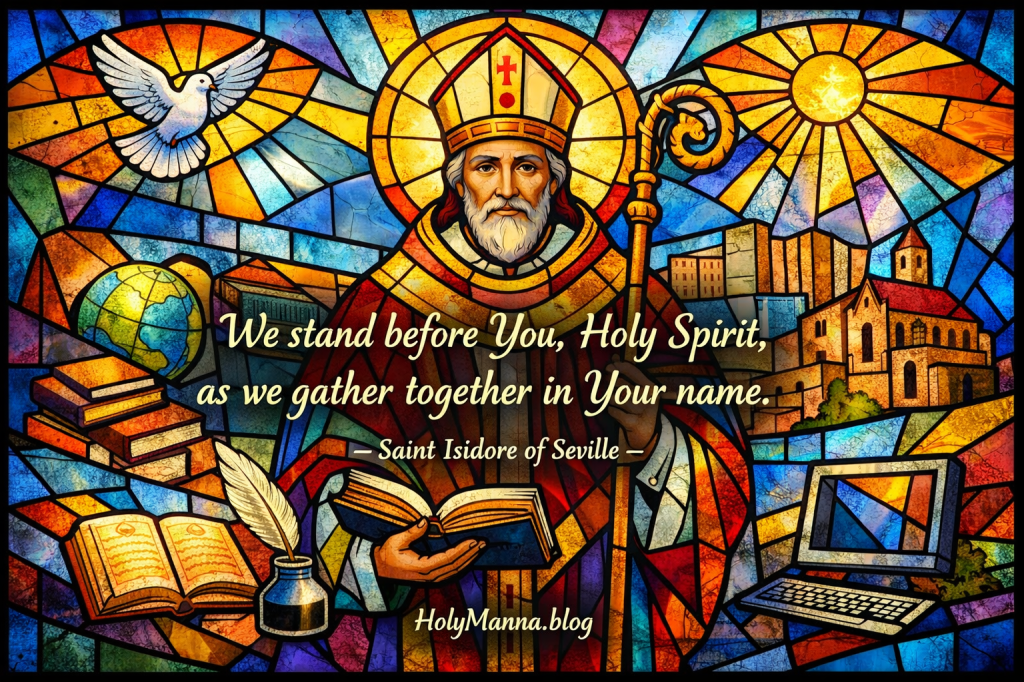
The Saint Who Kept the Lamps Burning
Saint Isidore of Seville stands in Christian history like a great lamp set in a dark and uncertain age. He was a bishop, teacher, scholar, pastor, and eventually a Doctor of the Church, but those titles only begin to explain why Catholics still revere him. He lived at a time when the old Roman world was fading, kingdoms were shifting, heresies still wounded the Church, and much of the learning of the ancient world could easily have been lost. In that fragile moment, God raised up a man who loved truth, loved the Church, and understood that wisdom must be handed on.
That is why Saint Isidore is remembered not merely as a clever writer, but as one of the great guardians of Catholic civilization. He helped defend orthodoxy in Spain, strengthened Christian education, cared for the poor, and gathered an astonishing amount of knowledge into works that shaped the Church for centuries. He is often remembered as the last of the great Latin Fathers, a man who stood like a bridge between the ancient Church and the medieval world.
For Catholics today, his life matters because he shows that holiness and intelligence are not enemies. Study can be prayer. Order can be charity. Teaching can be an act of mercy. Saint Isidore reminds the Church that the mind is not meant to wander away from God, but to bow before Him and serve His people.
A House Full of Saints
Saint Isidore was born around the year 560 in Cartagena, in what is now Spain. He came from a remarkable family, one that almost seems to have been built by Providence for the service of the Church. His brother Saint Leander became Archbishop of Seville. His brother Saint Fulgentius became a bishop. His sister Saint Florentina was a holy consecrated woman honored among the saints. Even before Isidore entered public life, he had been formed in a household where holiness was not an abstraction. It was the atmosphere.
After the death of his father, much of his formation appears to have fallen especially under the care of Saint Leander. He was educated in the cathedral school at Seville, where he absorbed Scripture, theology, and the classical disciplines. Catholic tradition also preserves the memory that he may not have been a naturally eager student at first, and that discipline and perseverance became part of his spiritual growth. Whether every detail of that tradition can be historically demonstrated or not, it fits the kind of saint he became. He was not formed by brilliance alone. He was formed by labor, obedience, and grace.
What deepened his faith was not a dramatic conversion from paganism, as happened with some saints, but the steady shaping of a Christian soul inside the life of the Church. He was raised in a Catholic world of prayer, learning, and duty. His conversion was the kind many faithful souls know well. It was the gradual surrender of the whole person to God. It was the choice to let truth govern life.
In time, after the death of Saint Leander, Isidore succeeded him as bishop of Seville. That moment was more than a promotion. It was the beginning of a long and demanding pastoral mission. He would spend roughly thirty-six years governing the Church, teaching the faith, fighting error, and forming Christian culture in a land that desperately needed stability.
He is most known for his monumental work Etymologiae, a vast encyclopedia that gathered together theology, language, history, law, science, and much more. In many ways, it preserved treasures from the ancient world that might otherwise have disappeared. Yet if that were all he had done, the Church would remember him as an impressive scholar. The Church remembers him as a saint because he placed learning at the feet of Christ.
The Bishop Who Taught a Civilization
Saint Isidore’s life as bishop was full, demanding, and enormously fruitful. He was not tucked away in a library while the world burned around him. He was in the middle of real pastoral battles. Spain was still healing from division, especially from the long shadow of Arianism, which denied the full divinity of Christ. Isidore worked to strengthen Catholic doctrine and unify the faithful around the truth handed down by the Apostles.
He also played a leading role in important Church councils, especially the Fourth Council of Toledo in 633. There he helped shape laws and practices that would influence Catholic life in Spain for generations. One of his lasting contributions was his strong support for cathedral schools. He understood that ignorance weakens the Church, while sound formation strengthens her. Bishops needed learning. Priests needed learning. Christian society needed learning. He promoted the study of grammar, rhetoric, law, medicine, Greek, and Hebrew, not because he worshiped human knowledge, but because he knew that truth belongs to God and can be put to holy use.
This is one reason his legacy became so great. He did not treat the Christian faith as something cut off from the mind. He knew that Christ is Lord of all. So he preserved what was valuable in ancient learning and ordered it toward the service of the Church. Through works like Etymologiae, Sentences, On Ecclesiastical Offices, and historical and biblical writings, he helped preserve both doctrine and culture.
He also left lines that show the heart beneath the scholarship. In his monastic rule appears a striking Christian conviction: “God has made no difference between the soul of the slave and that of the freedman.” That is not the language of a cold academic. That is the language of a bishop who understood the dignity of the human person under God.
Another ancient prayer traditionally attributed to him begins with words still deeply loved in the Church: “We stand before You, Holy Spirit, as we gather together in Your name.” Those words have endured because they sound like the soul of a true pastor. He knew that wisdom without the Holy Spirit becomes pride, but wisdom under the Holy Spirit becomes light.
Sweetness on the Lips and Charity in the Hands
When Catholics speak about the miracles of Saint Isidore, the first thing to say honestly is that he is not remembered in the same way as saints who left behind long records of spectacular healings or dramatic wonders. His greatness shines above all through doctrine, charity, discipline, and the preservation of learning. Still, Catholic tradition does preserve a few stories associated with him.
The best known is the story of the bees. According to an old tradition, when Isidore was still an infant, a swarm of bees settled over his cradle and left honey on his lips. The image is unforgettable. It suggested that the words he would later speak and write would be sweet, nourishing, and filled with wisdom. The symbolism is beautiful, and generations of Catholics have loved it. At the same time, this story belongs to pious tradition and cannot be historically verified.
There is also the larger and more important “miracle” of his life, though it is not the kind that makes for dramatic legend. God used this bishop to preserve an immense inheritance of knowledge in a time when so much was being forgotten. He became a vessel through which ancient learning, Christian teaching, and pastoral wisdom were gathered and passed onward. That kind of work can feel quiet compared to a healing or an apparition, but it is no less astonishing. Entire generations benefited because one saint understood that love of God includes love of truth.
His life also displayed the miracle of pastoral charity. Toward the end of his life, Catholic tradition remembers him giving alms generously, caring for the poor, and preparing for death with humility and penance. He did not cling to rank or possessions. He sought mercy. He distributed what he had. He asked forgiveness. He received the Holy Eucharist with devotion. In that final witness, the great scholar looked exactly like what he had always been meant to be: a Christian sinner trusting completely in Christ.
That is why he should still be remembered and imitated. He teaches that holiness does not always arrive with noise. Sometimes holiness looks like faithful study, careful teaching, patient reform, generous charity, and perseverance over decades. Sometimes the saint changes the world by keeping the truth alive.
The Burden of a Shepherd
Saint Isidore was not a martyr in the strict sense. He did not die by execution for the faith. Yet that does not mean his life was easy or free from suffering. His hardships were the burdens of a shepherd living in an unstable world.
He inherited a Church that needed doctrinal clarity, moral discipline, and wise leadership. He lived after the collapse of the Roman order in the West, when much had been disrupted politically, socially, and intellectually. He had to teach in confusion, govern amid instability, and oppose heresy without losing pastoral charity. That kind of labor wears on a man. It demands not a passing burst of courage, but years of endurance.
He also knew the hardship of responsibility. A bishop is not free to think only of himself. He must answer for souls. He must preserve unity. He must correct error. He must encourage the weak. He must plan for the future of the Church. Isidore bore all of that while also writing and teaching at a level few men in Christian history have matched.
His final days reveal the soul of a man who understood suffering in the Catholic way. As death approached, he did not present himself as a hero. He took the posture of a penitent. He humbled himself publicly, clothed himself in sackcloth, asked pardon for his sins, gave to the poor, and received the sacraments. In that moment, all earthly honors fell away. What remained was the truth every saint knows: salvation is pure mercy.
That witness matters. It reminds the faithful that the goal of learning is not applause. The goal is holiness. The goal is not being remembered as brilliant. The goal is dying in the friendship of Christ.
A Legacy That Outlived Kingdoms
After Saint Isidore’s death on April 4, 636, his influence did not fade. In some ways, it only grew. Church councils soon praised him as a great teacher and glory of the Catholic Church. Centuries later, Pope Innocent XIII formally declared him a Doctor of the Church, recognizing what the faithful had long understood. His teaching served not only Spain, but the universal Church.
His relics were eventually translated to León, where devotion to him continued to flourish. The Basilica of San Isidoro in León became one of the most important sites connected with his memory. Pilgrims and the faithful honored him there, and his name continued to carry weight far beyond his own century.
As for miracles after death, Catholic devotion has long associated saints’ relics and intercession with favors, healings, and answers to prayer, and Saint Isidore was certainly venerated as a powerful intercessor. However, the major Catholic summaries of his life do not preserve a large, clearly documented collection of individual posthumous miracle stories in the way that later canonization records sometimes do. Many favors were surely attributed to his intercession by the faithful over time, but specific stories are not always securely preserved, and many cannot be verified.
His impact after death was enormous in other ways that are easier to trace. He shaped medieval education through his writings. He influenced liturgical life in Spain. He helped preserve the Mozarabic tradition. He became one of the Church’s great authorities on Christian learning. His books were copied, studied, and loved for centuries.
There are also a few surprising parts of his later legacy. One is that Saint Isidore the Farmer was named after him, which says a great deal about how beloved the bishop of Seville had already become in Spanish Catholic life. Another is that in modern times he has often been associated with the internet and digital communications because of his encyclopedic gathering of knowledge. That association is popular and understandable, though it is best stated carefully, since the formal details of that patronage are not always presented consistently.
His cultural impact remains strong because he speaks to a temptation every age faces. Every generation is tempted either to worship knowledge or to despise it. Saint Isidore did neither. He baptized learning. He taught that truth must serve Christ, and that when it does, it becomes a blessing for the whole Church.
A Mind Ordered to God
Saint Isidore of Seville has a timely lesson for modern Catholics. The world today is flooded with information, yet starved for wisdom. People know many things and understand very little. Saint Isidore lived in a different age, but the spiritual problem is familiar. Knowledge without humility becomes vanity. Knowledge without truth becomes confusion. Knowledge without God becomes dangerous.
He shows a better way. He teaches that the Catholic mind should be curious, disciplined, and reverent. It should not fear truth. It should seek truth with all its strength and then place that truth at the service of Christ and His Church. He also shows that prayer and study belong together. A faithful Catholic does not have to choose between loving God with the heart and loving Him with the mind. The saint loved both.
There is also something deeply consoling in his life. He did not become holy by escaping the burdens of his age. He became holy by serving God in the middle of them. He worked through confusion, instability, and weakness. That should encourage any believer who feels overwhelmed by the state of the world. Grace is not limited by bad times. Sometimes grace shines most clearly there.
Does the mind seek truth in order to grow closer to God, or only to feel clever? Does daily work become an offering, or just another way of chasing control? Is there room in the spiritual life for both prayer and serious formation? Saint Isidore invites the faithful to ask those questions honestly.
A practical way to imitate him is simple. Read good Catholic books. Learn the faith carefully. Study Scripture with reverence. Teach the truth kindly when the chance arises. Support Catholic education. Refuse laziness of mind and laziness of soul. Give generously to those in need. And above all, remember that every gift, even intelligence, must kneel before Jesus Christ.
Engage with Us!
Share thoughts and reflections in the comments below. Saint Isidore of Seville has a way of stirring both the mind and the heart, and it would be beautiful to hear how his life speaks into ordinary Catholic life today.
- What stands out most in Saint Isidore’s life: his learning, his pastoral charity, or his defense of the faith?
- How can the gifts of study, reading, and teaching become acts of love for God rather than tools of pride?
- Where is the Lord asking for greater discipline right now: in prayer, in learning the faith, or in serving others?
- What does Saint Isidore’s example teach about living faithfully in a confused and unstable age?
- How can Catholic families do more to form children not only in information, but in wisdom and holiness?
Saint Isidore reminds the faithful that truth matters, learning matters, and holiness matters. He shows that the Church does not preserve wisdom for the sake of nostalgia, but for the salvation of souls. May his example encourage a life of faith, steady discipline, generous charity, and humble devotion. May everything be done with the love and mercy Jesus taught us.
Saint Isidore of Seville, pray for us!
Follow us on YouTube, Instagram and Facebook for more insights and reflections on living a faith-filled life.

 Holy Manna!
Leave a comment