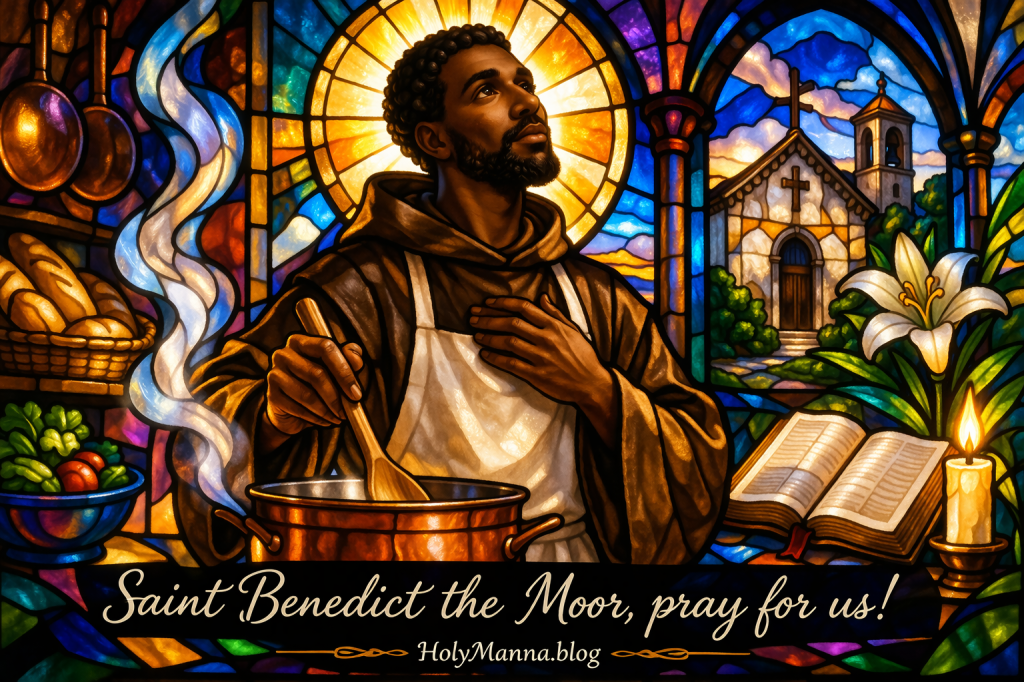
The Humble Brother Who Taught Palermo How to Love
Saint Benedict the Moor, also known as Saint Benedict the African, Saint Benedict the Black, and Saint Benedict of Palermo, is one of those saints whose life quietly overturns the world’s idea of greatness. He was not a bishop, not a scholar, and not a famous preacher. He could not even read or write. Yet the Church remembers him as a man of remarkable holiness, deep prayer, tender charity, and extraordinary wisdom. In a society that looked down on him because of his race and humble station, God raised him up as a radiant witness to the dignity of every human person.
He is revered because his life shows that sanctity does not depend on status, education, or worldly honor. It depends on surrender to grace. Saint Benedict became known for humility, love for the poor, spiritual counsel, and miracles. He is especially beloved among Black Catholics and in places like Sicily, Brazil, and parts of the Americas, where his witness has endured for centuries. His life gives flesh and blood to what The Catechism teaches about the equal dignity of all people and the works of mercy, especially the call to feed the hungry, bear wrongs patiently, and serve Christ in the poor, as taught in CCC 1935 and CCC 2447.
From the Margins of Sicily to the Heart of God
Saint Benedict was born in Sicily in the sixteenth century, most commonly associated with San Fratello and later Palermo. Catholic sources differ on some of the finer details of his birth, but they agree on the heart of the story. He was born to African parents who had been enslaved and brought to Sicily. His father and mother are commonly identified as Giuseppe Cristoforo and Diana Larcari. They were poor, hardworking, and faithful, and they passed on to their son something the world could not take away: reverence for God.
From an early age, Benedict lived close to hardship. He grew up in a culture where his African ancestry and family background exposed him to mockery and contempt. Yet that suffering did not harden him. It purified him. He worked as a shepherd and laborer, and even in those hidden years people noticed something unusual in him. He was patient when insulted, gentle when provoked, and prayerful in a way that seemed deeper than his years. Long before he entered religious life, people were already beginning to see in him the marks of a holy man.
His life changed when he encountered a group of Franciscan hermits led by Girolamo Lanza. Benedict was drawn to their life of prayer, poverty, and penance. He sold what he had, gave the proceeds to the poor, and joined them. That moment was not a dramatic conversion from unbelief to faith. It was something quieter and, in many ways, more beautiful. It was the deepening of a heart already turned toward God. The call was not away from faith, but deeper into it.
This is one of the reasons Saint Benedict matters so much. He reminds curious souls, new believers, cradle Catholics, and those returning to the faith that holiness is not always built on dramatic public moments. Sometimes it grows in hidden obedience, daily sacrifice, and the long work of becoming more docile to grace.
The Kitchen, the Cloister, and the Miracles of Everyday Holiness
After years among the hermits, Benedict eventually entered the Franciscan friary of Santa Maria di Gesù in Palermo as a lay brother. He took on simple work, especially in the kitchen. To the world, that might have looked small. To heaven, it was the place where love became visible. Benedict served in ordinary tasks with extraordinary devotion. He cooked, cleaned, prayed, and quietly gave himself away.
He became known for something that never stops surprising people: although he was illiterate, priests, religious, and laypeople sought him out for spiritual counsel. His understanding of divine things was not the fruit of academic training, but of intimacy with God. Catholic tradition remembers him as having a kind of infused wisdom. He understood Scripture, the spiritual life, and the human heart in a way that could only be explained by grace. In time, this humble lay brother was appointed guardian of the friary and later master of novices. That alone is astonishing. In a rigid social world, an unlettered Black lay brother was entrusted with leadership and the formation of others.
During his lifetime, many miracles and wonders were associated with him. Catholic tradition speaks of healings worked through his prayers and of remarkable acts of providence surrounding his service to the poor. One of the most loved stories says that when food was scarce, Benedict prayed and what had seemed insufficient became enough for those in need. Another tradition tells of water in tubs being found changed into fish after his prayer, providing food when the community had almost nothing left. This story has been passed down in Franciscan memory, but it cannot be independently verified.
There are also stories that angels helped him in the kitchen while he served the brothers, and that food did not run out when he gave generously to the poor. Another tradition says he could perceive what was in a person’s heart, not in the spirit of curiosity, but in order to guide them toward repentance and peace. These stories belong to the hagiographical tradition surrounding his life and cannot all be verified individually, but together they show how strongly the faithful experienced his presence as one filled with God.
One of the most moving stories connected to Benedict concerns bread and the poor. A devotional tradition says that when someone was about to discard bread, Benedict stopped him and warned that this bread carried the blood of the poor. In some retellings, drops like blood were seen upon it. Whether taken as miracle story or sacred memory, the lesson is unmistakably Catholic. The poor are not an inconvenience. They are a living claim upon Christian love. This particular story is widely repeated in Catholic devotion, but it cannot be fully verified.
That is what made Benedict unforgettable. He did not merely perform acts of charity. He saw Christ where others failed to look.
The Weight of Contempt and the Triumph of Patient Endurance
Saint Benedict was not a martyr in the strict sense. He did not shed his blood in a public execution for the faith. Yet his life was marked by a different kind of suffering, one that deserves serious attention. He endured prejudice, social humiliation, and racial contempt in a Christian world that often failed to live up to the Gospel it professed. That matters. His holiness was forged in a setting where he had every human reason to become bitter, resentful, or withdrawn. Instead, he became gentle, joyful, and steadfast.
That patient endurance is one of the most powerful parts of his witness. In him, the Church sees a living example of what it means to bear injuries with mercy and to answer hatred with holiness. Benedict’s life reveals the difference between weakness and meekness. Weakness gives up. Meekness places strength under the rule of love.
His ascetic life also shows how serious he was about belonging fully to God. Catholic sources describe him as a man of penance, fasting, and disciplined prayer. He was not comfortable, soft, or careless about the spiritual life. He fought for holiness in the hidden places. He denied himself so that he might be freer to love. That kind of witness is easy to admire from a distance, but much harder to imitate. Still, the saint’s life makes clear that the road to joy passes through self-denial, trust, and fidelity.
Wonders After Death and a Legacy That Crossed Oceans
Saint Benedict died on April 4, 1589, after a brief illness. Catholic tradition says that he knew his death was approaching and foretold the hour. This detail appears frequently in devotional accounts, but it cannot be fully verified in the modern historical sense.
After his death, devotion to him grew quickly. The people of Palermo already regarded him as a saint. His reputation for holiness did not need to be manufactured. It had been witnessed in kitchens, corridors, prayer, service, and mercy. Over time, his cult spread far beyond Sicily into Spain, Portugal, Latin America, and beyond. The Church eventually confirmed what the faithful had long believed. His cult was officially recognized, and he was canonized by Pope Pius VII in 1807.
Miracles were attributed to his intercession after death, especially healings. Catholic sources state that numerous prodigious healings were examined in connection with his cause. Pilgrims visited his shrine in Palermo, and devotion to him became deeply rooted in the lives of ordinary Catholics. His relics were long venerated at Santa Maria di Gesù in Palermo, making the friary an important place of memory and pilgrimage.
His impact after death has been immense. In Brazil, Saint Benedict the Moor became one of the most beloved saints among the people. Churches, confraternities, local festivals, and devotional traditions grew around his name. He became a symbol of humility, service, hope, and spiritual dignity. In many places, popular celebrations in his honor united faith, culture, and memory in a way that showed just how deeply he had entered Catholic life.
He also became an especially powerful figure for Black Catholics. His life stands as a witness that sanctity is not the possession of one race, nation, or class. He is living proof that grace flourishes wherever a soul says yes to God. In that sense, his cultural impact is not secondary to his story. It is part of his story. He became a saint whose life speaks to those who have been ignored, underestimated, or treated as less than they are. He tells them, by the shape of his life, that holiness belongs to them too.
Some later traditions also speak of the condition of his body after death in ways that suggested incorruption or unusual preservation. These accounts became part of his posthumous veneration, though the precise details vary and cannot all be verified in a strict historical sense.
What Saint Benedict Still Teaches the Church
Saint Benedict the Moor speaks powerfully to the modern world because the temptations around him are still with us. Pride is still praised. Status is still worshiped. The poor are still forgotten. People are still judged by appearances, race, class, and education. Benedict cuts through all of that by the sheer witness of a holy life.
He teaches that the hidden life matters. A kitchen can become a sanctuary. A broom can become an instrument of love. A poor brother with no formal education can become a teacher of priests and nobles if he belongs wholly to Christ.
He teaches that suffering does not have to poison the soul. It can become the place where mercy takes root. He teaches that humility is not pretending to be small. It is being so grounded in God that there is no need to prove anything to anyone. He teaches that the poor must never be treated as burdens, because Christ has bound Himself to them in a mysterious and fearsome way, as seen so clearly in The Gospel of Matthew when the Lord identifies Himself with the hungry, the thirsty, and the forgotten.
For daily life, his example is deeply practical. Pray when no one sees it. Serve even when no one praises it. Refuse bitterness. Honor the dignity of every person. Look for Christ in the inconvenient, the poor, and the overlooked. Speak gently. Live simply. Trust that grace can make a hidden life radiant.
What would change if the ordinary work of the day were treated as a place of encounter with God?
What bitterness needs to be surrendered before it becomes part of the heart?
Who is being overlooked nearby that Christ may be asking to love more seriously?
Saint Benedict does not call people to a flashy spirituality. He calls them to something stronger. He calls them to become holy in the real world, with real wounds, real duties, and real love.
Engage With Us!
Readers are invited to share their thoughts and reflections in the comments below. Saint Benedict the Moor’s life has a way of reaching people in quiet but lasting ways, especially those who know what it feels like to be overlooked, underestimated, or tested by suffering.
- What part of Saint Benedict the Moor’s life speaks most deeply to the heart right now?
- How can greater humility and charity be practiced in the hidden duties of daily life?
- Where might Christ be asking for a deeper love for the poor, the forgotten, or the person who seems easiest to ignore?
- What does Saint Benedict’s patient endurance teach about responding to insult, injustice, or misunderstanding?
- How can his example help shape a more serious commitment to prayer, penance, and mercy this week?
May Saint Benedict inspire a life of steady faith, patient endurance, and joyful humility. May every task be done with love, every wound be offered to Christ, and every neighbor be met with the mercy Jesus taught and lived.
Saint Benedict the Moor, pray for us!
Follow us on YouTube, Instagram and Facebook for more insights and reflections on living a faith-filled life.

 Holy Manna!
Leave a comment