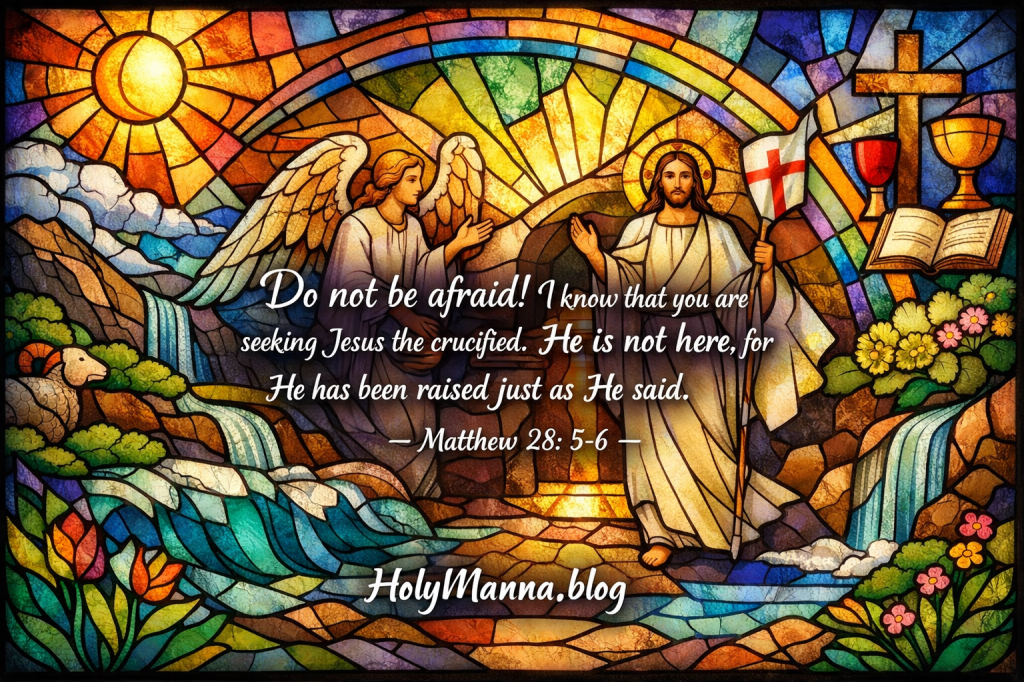
Holy Saturday At the Easter Vigil in the Holy Night of Easter – Lectionary: 41
From First Light to the Empty Tomb
There is something fitting about how the Church begins Easter in the dark. Before the Alleluia returns, before the candles fill the sanctuary with light, the faithful are asked to listen. And what they hear tonight is not one isolated message, but the whole sweep of salvation history. The central theme uniting these readings is this: God does not abandon what He creates. From Genesis to The Gospel of Matthew, the Lord is shown as the One who creates, tests, delivers, instructs, purifies, and finally raises His people into new life. Holy Saturday at the Easter Vigil is the night when the Church proclaims that all of history has been moving toward this victory, and that every promise of God finds its fulfillment in the Resurrection of Jesus Christ.
That is why the readings are so many, and why the Church does not shorten the story too quickly. This liturgy is meant to feel immense. It begins with creation itself, when God speaks light into darkness. It passes through Abraham’s obedience, Israel’s deliverance through the sea, the prophets’ promises of mercy, wisdom, cleansing, and a new heart, and then arrives at Saint Paul’s teaching that in Baptism Christians are buried with Christ so as to rise with Him. By the time the women come to the tomb in The Gospel of Matthew and hear “He is not here, for he has been raised”, the reader is meant to understand that the Resurrection is not a surprising ending added onto the Bible. It is the moment toward which everything has been pointing.
The religious background of this night matters. The Easter Vigil stands at the heart of the Church’s year because it is the great liturgy of the Paschal Mystery, Christ’s Passion, Death, and Resurrection. In the early Church, this was the night when catechumens were baptized and received into the life of grace. That is why water, covenant, deliverance, and new creation echo through nearly every reading. The crossing of the Red Sea is not only Israel’s escape from Pharaoh. It also foreshadows Baptism. The promises of clean water and a new heart in Ezekiel are not only words of comfort to exiled Israel. They point toward the sacramental life Christ gives His Church. Even the first creation in Genesis prepares for the new creation that bursts forth from the tomb on Easter morning.
There is also a deep emotional rhythm to these readings. They move from darkness to light, from testing to trust, from slavery to freedom, from exile to homecoming, from thirst to satisfaction, and from death to life. That is why this liturgy speaks so powerfully to every soul. It reminds the faithful that God’s way is not hurried, but it is sure. He leads His people through long nights, through impossible waters, through wilderness and silence, and still He remains faithful. Tonight’s readings prepare the heart to see Easter not merely as a feast day, but as the turning point of the world and the rebirth of everyone who belongs to Christ.
This is the holy night when the Church remembers who God is and who His people are. He is the Creator who brings order out of chaos, the Father who provides the Lamb, the Deliverer who opens the sea, the Bridegroom who calls back His beloved, the Giver of Wisdom, the One who sprinkles clean water and places His own Spirit within His people, and the Lord who raises Jesus from the dead. The faithful are invited to hear these readings as one great symphony of redemption, and to step into them with awe, gratitude, and hope. How could the heart not be moved on a night like this, when all of Scripture seems to hold its breath and then burst into life?
First Reading – Genesis 1:1-2:2
The First Dawn of Creation and the Promise of the New Creation
The Easter Vigil begins exactly where it should begin: at the beginning. Before the empty tomb, before the crossing of the sea, before Abraham lifts his eyes to the mountain, the Church takes the faithful back to the first act of God’s saving work. This reading from Genesis is not placed here merely to tell how the world began. It is proclaimed on this holy night because Easter is about a new beginning. The God who once said “Let there be light” is the same God who, through the Resurrection of Jesus Christ, speaks light again into a world darkened by sin and death.
The Church has always heard this reading with reverence, not as a cold scientific outline, but as a sacred proclamation of who God is and who man is. In the ancient world, many nations told stories of creation as the result of chaos, violence, or rival gods battling for power. Genesis stands apart. Israel receives the truth that there is one God, and He creates freely, wisely, and lovingly by His word. Creation is not an accident. It is not a prison. It is not evil. It is good, and when man and woman are made in His image, it is declared very good.
This reading fits today’s theme beautifully because the Easter Vigil is the story of God making all things new. The first creation prepares the heart for the new creation in Christ. The light of day one points toward the light of the Paschal candle. The ordering of the world points toward the restoration of a fallen world. The creation of man in God’s image points toward that image being renewed by grace. And the seventh day of divine rest points toward the deep rest won by Christ, who after passing through death opens eternal life to His people.
Genesis 1:1-2:2 – New American Bible (Revised Edition)
Chapter 1
The Story of Creation. 1 In the beginning, when God created the heavens and the earth— 2 and the earth was without form or shape, with darkness over the abyss and a mighty wind sweeping over the waters—
3 Then God said: Let there be light, and there was light. 4 God saw that the light was good. God then separated the light from the darkness. 5 God called the light “day,” and the darkness he called “night.” Evening came, and morning followed—the first day.
6 Then God said: Let there be a dome in the middle of the waters, to separate one body of water from the other. 7 God made the dome, and it separated the water below the dome from the water above the dome. And so it happened. 8 God called the dome “sky.” Evening came, and morning followed—the second day.
9 Then God said: Let the water under the sky be gathered into a single basin, so that the dry land may appear. And so it happened: the water under the sky was gathered into its basin, and the dry land appeared. 10 God called the dry land “earth,” and the basin of water he called “sea.” God saw that it was good. 11 Then God said: Let the earth bring forth vegetation: every kind of plant that bears seed and every kind of fruit tree on earth that bears fruit with its seed in it. And so it happened: 12 the earth brought forth vegetation: every kind of plant that bears seed and every kind of fruit tree that bears fruit with its seed in it. God saw that it was good. 13 Evening came, and morning followed—the third day.
14 Then God said: Let there be lights in the dome of the sky, to separate day from night. Let them mark the seasons, the days and the years, 15 and serve as lights in the dome of the sky, to illuminate the earth. And so it happened: 16 God made the two great lights, the greater one to govern the day, and the lesser one to govern the night, and the stars. 17 God set them in the dome of the sky, to illuminate the earth, 18 to govern the day and the night, and to separate the light from the darkness. God saw that it was good. 19 Evening came, and morning followed—the fourth day.
20 Then God said: Let the water teem with an abundance of living creatures, and on the earth let birds fly beneath the dome of the sky. 21 God created the great sea monsters and all kinds of crawling living creatures with which the water teems, and all kinds of winged birds. God saw that it was good, 22 and God blessed them, saying: Be fertile, multiply, and fill the water of the seas; and let the birds multiply on the earth. 23 Evening came, and morning followed—the fifth day.
24 Then God said: Let the earth bring forth every kind of living creature: tame animals, crawling things, and every kind of wild animal. And so it happened: 25 God made every kind of wild animal, every kind of tame animal, and every kind of thing that crawls on the ground. God saw that it was good. 26 Then God said: Let us make human beings in our image, after our likeness. Let them have dominion over the fish of the sea, the birds of the air, the tame animals, all the wild animals, and all the creatures that crawl on the earth.
27 God created mankind in his image;
in the image of God he created them;
male and female he created them.28 God blessed them and God said to them: Be fertile and multiply; fill the earth and subdue it. Have dominion over the fish of the sea, the birds of the air, and all the living things that crawl on the earth. 29 God also said: See, I give you every seed-bearing plant on all the earth and every tree that has seed-bearing fruit on it to be your food; 30 and to all the wild animals, all the birds of the air, and all the living creatures that crawl on the earth, I give all the green plants for food. And so it happened. 31 God looked at everything he had made, and found it very good. Evening came, and morning followed—the sixth day.
Chapter 2
1 Thus the heavens and the earth and all their array were completed. 2 On the seventh day God completed the work he had been doing; he rested on the seventh day from all the work he had undertaken.
Detailed Exegesis
Verse 1. “In the beginning, when God created the heavens and the earth”
This opening line tells the whole human race that everything begins in God. The universe is not eternal, and it does not explain itself. The heavens and the earth, which is a way of saying all that exists, come from the free will of the Creator. On Easter night, this matters deeply, because the God who can create the world can also re-create the human heart.
Verse 2. “And the earth was without form or shape, with darkness over the abyss and a mighty wind sweeping over the waters”
Before God speaks order, there is formlessness and darkness. The sacred text is not presenting evil as equal to God, but showing that creation awaits His commanding word. The mighty wind recalls the breath or Spirit of God hovering over the waters. The Church hears in this an early hint of the Holy Spirit, especially fitting on a night when water and Spirit will become central in the life of the baptized.
Verse 3. “Then God said: Let there be light, and there was light.”
God creates by speaking. His word is powerful, effective, and sovereign. Light comes before the sun and stars, showing that light itself first comes from God. At the Easter Vigil, this verse resonates with tremendous force, because the Resurrection is the triumph of divine light over the darkness of the tomb.
Verse 4. “God saw that the light was good. God then separated the light from the darkness.”
God judges His own work as good. Creation is not morally neutral or corrupt by nature. The separation of light from darkness shows God bringing order, distinction, and meaning into what was unformed. He is not a God of confusion, but of wisdom and purpose.
Verse 5. “God called the light ‘day,’ and the darkness he called ‘night.’ Evening came, and morning followed, the first day.”
To name something is to exercise authority over it. God names day and night because they belong to Him. The rhythm of evening and morning begins here, and the Church hears in this first day the beginning of sacred time, which will reach its fulfillment in the first day of the week, the day Christ rises from the dead.
Verse 6. “Then God said: Let there be a dome in the middle of the waters, to separate one body of water from the other.”
The Lord continues shaping creation by establishing boundaries and order. The ancient imagery reflects how the world appeared to the human eye, but the theological truth is clear: the cosmos is arranged by divine wisdom, not chance.
Verse 7. “God made the dome, and it separated the water below the dome from the water above the dome. And so it happened.”
What God wills is accomplished. His speech is not empty. That same truth will later echo in the prophets and culminate in Christ, the eternal Word through whom all things were made. God’s command brings structure and stability.
Verse 8. “God called the dome ‘sky.’ Evening came, and morning followed, the second day.”
Again, God names what He has made. The sky is not a divine being to be worshiped, as some pagan cultures imagined, but part of creation under the authority of the Lord. This is a quiet but decisive rejection of idolatry.
Verse 9. “Then God said: Let the water under the sky be gathered into a single basin, so that the dry land may appear. And so it happened.”
Land emerges at God’s command. What seemed unstable now becomes a place fit for life. The Easter Vigil often returns to water as both danger and deliverance. Here, even the waters are under God’s rule.
Verse 10. “God called the dry land ‘earth,’ and the basin of water he called ‘sea.’ God saw that it was good.”
The sea, which in ancient thought often symbolized mystery and danger, is also named and bounded by God. Nothing in creation lies outside His dominion. The goodness of creation is repeated because the inspired text wants no confusion about the Lord’s work.
Verse 11. “Then God said: Let the earth bring forth vegetation: every kind of plant that bears seed and every kind of fruit tree on earth that bears fruit with its seed in it. And so it happened.”
The earth becomes fruitful by God’s blessing. Life is not sterile or self-enclosed. It is ordered toward abundance, nourishment, and growth. This fruitfulness already hints at God’s desire that creation overflow with life.
Verse 12. “The earth brought forth vegetation: every kind of plant that bears seed and every kind of fruit tree that bears fruit with its seed in it. God saw that it was good.”
Creation responds to the Creator. The seed-bearing plants and fruit trees show continuity, order, and providence. God does not merely create a moment. He creates a world capable of sustaining life through time.
Verse 13. “Evening came, and morning followed, the third day.”
The repeated rhythm teaches that creation unfolds according to divine order. God is not hurried, and His wisdom is steady. The reader is invited to contemplate, not rush.
Verse 14. “Then God said: Let there be lights in the dome of the sky, to separate day from night. Let them mark the seasons, the days and the years”
The heavenly bodies are appointed to serve. They govern time, seasons, and rhythm, but they are not gods. This is especially important in a world where sun, moon, and stars were often worshiped. Genesis strips them of false divinity and places them under the true God.
Verse 15. “And serve as lights in the dome of the sky, to illuminate the earth. And so it happened.”
The lights exist for service, not self-glory. They illuminate the earth at God’s command. Even the great lights of heaven are creatures, not masters.
Verse 16. “God made the two great lights, the greater one to govern the day, and the lesser one to govern the night, and the stars.”
The inspired author avoids naming the sun and moon directly in a way that might echo pagan reverence. Their role is functional, not divine. They govern only because God appoints them.
Verse 17. “God set them in the dome of the sky, to illuminate the earth”
This is a world meant to be inhabited, seen, and lived in. God’s care is practical as well as majestic. He creates with man in mind.
Verse 18. “To govern the day and the night, and to separate the light from the darkness. God saw that it was good.”
Light and darkness remain distinct. The goodness of this order is affirmed again. The world is not random. It is wisely arranged for life, worship, and meaning.
Verse 19. “Evening came, and morning followed, the fourth day.”
The repeated refrain gives the reading a solemn, liturgical quality. The Church hears in this pattern a kind of sacred procession toward the fullness of creation.
Verse 20. “Then God said: Let the water teem with an abundance of living creatures, and on the earth let birds fly beneath the dome of the sky.”
Life now fills the spaces God has formed. The seas teem, and the skies become alive with birds. Divine generosity is becoming more visible. God does not create sparingly.
Verse 21. “God created the great sea monsters and all kinds of crawling living creatures with which the water teems, and all kinds of winged birds. God saw that it was good”
Even the great sea creatures, which could evoke fear or mythic chaos, are created by God and declared good. The Lord is not threatened by what man finds overwhelming. All creatures remain under His authority.
Verse 22. “And God blessed them, saying: Be fertile, multiply, and fill the water of the seas; and let the birds multiply on the earth.”
This is the first explicit blessing in the chapter. Fruitfulness is a gift. Life is meant to increase under God’s blessing. The God of Scripture is not hostile to life, but its generous source.
Verse 23. “Evening came, and morning followed, the fifth day.”
The liturgical rhythm continues, almost like a chant of divine order and abundance.
Verse 24. “Then God said: Let the earth bring forth every kind of living creature: tame animals, crawling things, and every kind of wild animal. And so it happened.”
The land now receives its living inhabitants. Creation is reaching its fullness. The distinction among creatures shows diversity within order.
Verse 25. “God made every kind of wild animal, every kind of tame animal, and every kind of thing that crawls on the ground. God saw that it was good.”
The goodness of animal life is affirmed clearly. The material world is not beneath God’s concern. Everything He makes has value according to His wise design.
Verse 26. “Then God said: Let us make human beings in our image, after our likeness. Let them have dominion over the fish of the sea, the birds of the air, the tame animals, all the wild animals, and all the creatures that crawl on the earth.”
Here the reading reaches a summit. Human beings are distinct from the rest of visible creation because they are made in the image and likeness of God. The plural expression, “Let us make”, has often been read by the Fathers as mysteriously opening toward the fullness of divine life later revealed in the Trinity. Human dominion is not permission to exploit, but a call to govern creation under God as wise stewards.
Verse 27. “God created mankind in his image; in the image of God he created them; male and female he created them.”
This verse is one of the most foundational in all of Scripture. Man and woman share equal dignity because both are created in God’s image. Sexual difference is not accidental or embarrassing. It belongs to the goodness of creation. Human dignity begins here, in God’s creative will, not in social usefulness or worldly power.
Verse 28. “God blessed them and God said to them: Be fertile and multiply; fill the earth and subdue it. Have dominion over the fish of the sea, the birds of the air, and all the living things that crawl on the earth.”
The blessing given to man and woman includes fruitfulness and responsibility. To subdue the earth is not to abuse it, but to cultivate and govern it under God’s law. Humanity receives a royal vocation, but always as creatures under the Creator.
Verse 29. “God also said: See, I give you every seed-bearing plant on all the earth and every tree that has seed-bearing fruit on it to be your food”
God provides for human need. Life is sustained by His gift. Food itself is a sign of providence, and in the light of the whole Bible, it prepares the way for the deeper mystery of divine nourishment.
Verse 30. “And to all the wild animals, all the birds of the air, and all the living creatures that crawl on the earth, I give all the green plants for food. And so it happened.”
God’s providence extends beyond man to all living things. Creation is not held together by brute force, but by divine care. This verse reveals a harmony in the original order of creation.
Verse 31. “God looked at everything he had made, and found it very good. Evening came, and morning followed, the sixth day.”
At the end of the six days, the verdict deepens from good to very good. The presence of man and woman, made in God’s image, brings visible creation to its earthly completion. This is one of the clearest biblical rejections of the idea that matter is evil. Creation is very good because it comes from God.
Verse 2:1. “Thus the heavens and the earth and all their array were completed.”
The work of creation is complete. The universe is not unfinished chaos. It is a finished work, ordered and whole, flowing from divine wisdom.
Verse 2:2. “On the seventh day God completed the work he had been doing; he rested on the seventh day from all the work he had undertaken.”
God’s rest does not mean fatigue. It signifies divine completion, sovereignty, and delight in what He has made. This seventh day becomes the foundation for Sabbath, worship, and holy rest. On Easter night, it also points forward. Christ rests in the tomb on Holy Saturday, and then rises to begin the new creation.
Teachings
This reading teaches first that creation is the work of one wise and loving God. The world is neither divine nor meaningless. It is a gift. The Catechism states in CCC 337, “God himself created the visible world in all its richness, diversity and order.” That line matters because it answers so many modern confusions at once. The world has richness because God is generous. It has diversity because God delights in fullness. It has order because He creates through wisdom, not whim.
The reading also teaches that every part of creation has its own goodness. The repeated phrase “God saw that it was good” is not decorative language. It is theological truth. The Catechism says in CCC 339, “Each creature possesses its own particular goodness and perfection.” That means the Christian does not look at the world with contempt. The believer is called to reverence the Creator by receiving creation rightly, neither worshiping it nor abusing it.
The high point of the reading is the creation of man and woman. Human dignity does not come from achievement, wealth, attractiveness, or influence. It comes from God. The Catechism says in CCC 355, “God created man in his own image, in the image of God he created him, male and female he created them.” The Church has always defended this truth because once it is lost, everything else begins to unravel. If man is not made in God’s image, then human life can be measured by utility. If man is made in God’s image, then every human person has an inviolable dignity.
This reading also teaches that male and female belong to God’s good design. The distinction is not a problem to overcome, but a gift to receive. It is tied to fruitfulness, communion, and vocation. The Church sees here the beginning of the truth that will later unfold in the theology of marriage, family, and the complementarity of man and woman.
Human dominion must also be understood correctly. The text does not grant permission for selfish domination. It gives man a stewardship under God. Man is placed in creation almost as a king, but only as a king who answers to the true King. When dominion is detached from worship, it becomes exploitation. When it is lived in obedience to God, it becomes care, cultivation, and gratitude.
The seventh day teaches that man is made not only for work, but for worship and rest in God. Saint Augustine saw this pattern deeply when he wrote in Confessions 1.1, “You have made us for yourself, O Lord, and our heart is restless until it rests in you.” That insight fits this reading beautifully. The Sabbath is not merely a pause in labor. It is a sign that human life finds its deepest meaning in communion with God. On the Easter Vigil, that truth becomes even richer. The first creation ends in rest, and the new creation begins when Christ rises from the tomb after resting in death.
Historically, this reading also carried great weight for Israel because it set the people of God apart from surrounding cultures. The sun, moon, stars, sea, and animals were not objects of worship. They were creatures. This was a bold proclamation in a world full of idols. The Church still needs that lesson. Modern idolatry may look different, but it remains the same temptation. Anything created can become an idol when it is treated as ultimate.
Finally, this reading belongs at the Easter Vigil because Christ is the fulfillment of it. The first creation begins with light breaking into darkness. The new creation begins with Christ rising in glory from the tomb. The first Adam is made in God’s image. Christ is the perfect image of the Father. The first creation ends in rest. The Resurrection opens the eternal rest for which every human heart longs. This is why the Church begins Easter here. She wants the faithful to see that the God who made the world is the same God who has come to save it.
Reflection
This first reading invites the heart to slow down and look again at reality. It reminds the Christian that the world is not random and that life is not an accident. Everything begins in God, and everything finds its meaning in Him. That truth can steady a soul living in a noisy, restless age. When the world feels chaotic, this reading says that God still brings order out of darkness. When a person feels empty or shapeless within, this reading says that the Creator has not lost His power to form, renew, and restore.
It also challenges the way human life is viewed. The world often teaches people to measure themselves by success, beauty, status, or productivity. Genesis says something far deeper. Every human being carries a dignity that comes from being made in God’s image. That changes how a Christian should look at others, especially the weak, the elderly, the forgotten, and the difficult. It also changes how a Christian should look at himself. The soul was not made for self-contempt, but for reverence, humility, and grateful obedience.
This reading also calls for a better way of living in the world. Creation is not meant to be used carelessly. It is a gift placed in human hands. A faithful life includes gratitude for daily bread, respect for the body, honest work, ordered use of time, and reverence for the created world without turning it into an idol. It also includes remembering that work is not the whole story. God built rest into creation itself. A soul that never prays, never worships, and never rests in God becomes spiritually starved, even while remaining outwardly busy.
There is also a very personal Easter lesson here. The same God who once said “Let there be light” still speaks light into dark places. He can bring order to confusion, truth to deception, dignity to shame, and hope to what seems lifeless. This reading prepares the heart to meet the Risen Christ by first remembering who the Creator is.
Where has darkness begun to feel normal, and where is God asking for trust in His light? Has the dignity of being made in God’s image been forgotten in daily habits, relationships, or self-perception? Is work crowding out worship, or has the heart truly learned to rest in God? What would it look like to live this week as someone who belongs to the Creator and is being renewed for the new creation in Christ?
First Responsorial Psalm – Psalm 104:1-2, 5-6, 10, 12-14, 24, 30, 35
When the Soul Learns to See the World as God’s Handiwork
After the Church proclaims the creation account from Genesis, she immediately places this psalm on the lips of the faithful, almost as if teaching the heart how to answer what it has just heard. Psalm 104 is a great hymn of praise to God the Creator. It rises out of Israel’s worship and contemplates the world not as a collection of random forces, but as a living sign of divine wisdom, power, and generosity. Mountains, waters, birds, grass, animals, and the breath of life all become part of one great act of praise. This is the proper response to the first reading. The soul hears that God made the heavens and the earth, and then the soul begins to bless Him.
Within the Easter Vigil, this psalm does more than admire the beauty of the first creation. It prepares the faithful to see that the God who created the world is also the God who renews it. That is why one of the most important lines in the psalm is “Send forth your spirit, they are created and you renew the face of the earth.” On this holy night, that verse carries enormous weight. The Church is not only remembering the world’s first beginning. She is standing on the threshold of the new creation brought about by the Resurrection of Jesus Christ. This psalm teaches the faithful to look at all things with wonder, gratitude, and hope.
Psalm 104:1-2, 5-6, 10, 12-14, 24, 30, 35 – New American Bible (Revised Edition)
Praise of God the Creator
1 Bless the Lord, my soul!
Lord, my God, you are great indeed!
You are clothed with majesty and splendor,
2 robed in light as with a cloak.
You spread out the heavens like a tent;5 You fixed the earth on its foundation,
so it can never be shaken.
6 The deeps covered it like a garment;
above the mountains stood the waters.10 You made springs flow in wadies
that wind among the mountains.12 Beside them the birds of heaven nest;
among the branches they sing.
13 You water the mountains from your chambers;
from the fruit of your labor the earth abounds.
14 You make the grass grow for the cattle
and plants for people’s work
to bring forth food from the earth,24 How varied are your works, Lord!
In wisdom you have made them all;
the earth is full of your creatures.30 Send forth your spirit, they are created
and you renew the face of the earth.35 May sinners vanish from the earth,
and the wicked be no more.
Bless the Lord, my soul! Hallelujah!
Detailed Exegesis
Verse 1. “Bless the Lord, my soul! Lord, my God, you are great indeed! You are clothed with majesty and splendor”
The psalm begins in the most personal place possible, the soul. This is not dry theology. This is worship rising from within. The psalmist does not begin by praising creation, but by praising the Creator. God’s majesty and splendor are not borrowed from the world. The world reflects His glory because it comes from Him. In the context of the Vigil, this verse reminds the faithful that Easter begins in adoration. Before explaining anything, the Church blesses the Lord.
Verse 2. “Robed in light as with a cloak. You spread out the heavens like a tent”
Light here becomes one of the most beautiful images of God’s glory. The Lord is not merely associated with light. He is described as robed in it. This fits perfectly with the first reading, where light appears at God’s word, and it also points toward the Resurrection, when Christ rises in uncreated glory. The image of the heavens stretched out like a tent also speaks to divine sovereignty. God fashions the cosmos with ease. What overwhelms man is as simple as a garment in the hands of the Creator.
Verse 5. “You fixed the earth on its foundation, so it can never be shaken.”
This verse expresses stability, order, and divine providence. The world is not hanging in uncertainty. It rests upon the wise will of God. The sacred author is not offering a modern scientific statement, but a theological one. Creation is secure because God sustains it. That truth steadies the soul. In a world that often feels unstable, the believer is reminded that the deepest foundation of all things is the Lord Himself.
Verse 6. “The deeps covered it like a garment; above the mountains stood the waters.”
The psalm recalls the primordial waters, drawing the mind back to the mystery of creation in Genesis. The waters represent the untamed deep, yet even they are under God’s command. He is not threatened by them. This becomes especially meaningful in the Easter Vigil, where water keeps returning as a sign of both danger and salvation. The God who rules the deep is the God who parts the sea, cleanses the sinner, and gives rebirth through Baptism.
Verse 10. “You made springs flow in wadies that wind among the mountains.”
God is not only Creator in a distant, first moment. He is actively sustaining life. Springs do not flow apart from His providence. Water becomes a sign of His generosity, refreshment, and care for creation. This verse also begins to prepare the heart for later Vigil readings about thirst, cleansing, and the gift of living water.
Verse 12. “Beside them the birds of heaven nest; among the branches they sing.”
The psalmist notices what hurried souls often overlook. Birds nesting and singing are not treated as background detail. They are evidence of God’s care. This verse reveals something profoundly biblical. The smallest patterns of life matter because they exist within God’s providence. Creation is not only vast. It is intimate.
Verse 13. “You water the mountains from your chambers; from the fruit of your labor the earth abounds.”
The abundance of the earth is attributed directly to God. Fertility, growth, and provision are not ultimately human achievements. They are gifts. This verse also reveals the generosity of God’s governance. He does not create a barren world. He creates one meant to overflow with life.
Verse 14. “You make the grass grow for the cattle and plants for people’s work to bring forth food from the earth.”
God’s providence includes the ordinary needs of life. He provides for animals and for human beings. Food, labor, and the fruit of the earth are all wrapped in divine blessing. This verse helps the faithful recover a sacramental vision of ordinary life. Even daily bread has a theological meaning. It is a sign that the Lord sustains His creatures.
Verse 24. “How varied are your works, Lord! In wisdom you have made them all; the earth is full of your creatures.”
This is one of the clearest summary statements of biblical creation theology. The variety of creation is not accidental confusion. It is the fruit of divine wisdom. The world is full, rich, layered, and alive because God is wise. On Easter night, this verse helps the faithful understand that salvation does not erase creation. It heals and fulfills it.
Verse 30. “Send forth your spirit, they are created and you renew the face of the earth.”
This is the verse that opens the psalm fully toward the mystery of the Vigil. God’s Spirit is not absent from creation. The Spirit gives life, and the Spirit renews. The Church hears in this line both the first creation and the new creation. It points toward the Holy Spirit’s work in Baptism, in sanctification, and in the renewal of all things through Christ’s Resurrection. The face of the earth can be renewed because God has not abandoned His creation.
Verse 35. “May sinners vanish from the earth, and the wicked be no more. Bless the Lord, my soul! Hallelujah!”
This verse can sound severe at first, but it must be read rightly. The psalmist is longing for a world fully set right, a world freed from the rebellion that wounds creation. It is not a cry of personal hatred, but of holy desire for justice and restoration. On Easter night, this verse takes on deeper meaning. Christ does not renew the world by ignoring sin. He conquers it. The final cry of “Bless the Lord, my soul! Hallelujah!” is fitting, because praise is the proper response to a God who creates, sustains, and redeems.
Teachings
This psalm teaches that creation is a revelation of God’s wisdom and goodness. The world is not divine, but it is full of signs that point toward the One who made it. The Church teaches this clearly in The Catechism. CCC 299 says, “Because God creates through wisdom, his creation is ordered: ‘You have arranged all things by measure and number and weight.’ The universe, created in and by the eternal Word, the ‘image of the invisible God,’ is destined for and addressed to man, himself created in the ‘image of God’ and called to a personal relationship with God.” That teaching helps explain the psalm’s tone. The created world is not chaos. It is intelligible, meaningful, and ordered toward communion with God.
The psalm also teaches divine providence. God does not wind up the universe and walk away from it. He continues to sustain what He has made. CCC 301 states, “With creation, God does not abandon his creatures to themselves. He not only gives them being and existence, but also, and at every moment, upholds and sustains them in being, enables them to act and brings them to their final end.” That is exactly the vision of Psalm 104. God gives water, growth, food, shelter, breath, and renewal. He is not distant from the world. He is lovingly active within it.
Verse 30 has special importance because it reveals the life-giving work of the Holy Spirit. The Church sees the Spirit at work from the very beginning and throughout salvation history. CCC 703 says, “The Word of God and his Breath are at the origin of the being and life of every creature.” That line illuminates this psalm beautifully. Creation is not merely the act of a remote power. It is the work of the Father through the Word in the Holy Spirit. On the Easter Vigil, this becomes even more radiant, because the Spirit who gave life in the beginning is the same Spirit who renews the Church and the baptized.
The saints also read creation with wonder. Saint Basil the Great, reflecting on the opening of Scripture, wrote in Hexaemeron 1.2, “I want creation to penetrate you with so much admiration that wherever you go, the least plant may bring to you the clear remembrance of the Creator.” That is very close to the spirit of Psalm 104. The psalm trains the believer to see the world sacramentally, not as if creation were itself divine, but as something that constantly whispers of the Creator’s wisdom and care.
Historically, this psalm has always fit the Church’s praise because it gives language to both reverence and trust. In the Easter Vigil, it follows the creation reading to help the faithful move from hearing about God’s work to blessing Him for it. It also quietly prepares the soul for the great truth of Easter itself. If God made the world in wisdom, then the Resurrection is not a violation of His design. It is the beginning of its restoration.
Reflection
This psalm teaches the soul how to look again. It calls modern Christians out of distraction and back into wonder. Too often the world is treated either as a machine to use or as a problem to escape. Psalm 104 invites a different posture. It teaches reverence, gratitude, and trust. The grass, the springs, the birds, the mountains, and the breath of life are all signs that God has not stopped caring for what He has made.
That matters in daily life more than many people realize. A grateful soul is harder for bitterness to conquer. A soul trained to notice God’s goodness in creation is less likely to drift into practical atheism. This psalm encourages simple but powerful habits: beginning the day with praise, thanking God for ordinary provisions, stepping outside long enough to notice beauty, and remembering that the created world is not meaningless noise. It is a gift that points beyond itself.
It also speaks to tired hearts. Verse 30 reminds the faithful that renewal is possible. The face of the earth can be renewed, and so can the human heart. When a person feels spiritually worn down, burdened by old patterns, or dulled by routine, this psalm quietly insists that God still sends forth His Spirit. The Lord who sustains the world can also restore a soul that has grown dry.
There is also a moral challenge here. If the world is filled with God’s creatures and sustained by His wisdom, then life cannot be treated casually. A Christian should live with reverence, not recklessness. Speech, work, food, rest, and stewardship all become places where gratitude should take flesh. The believer is called not only to admire God’s works, but to live in a way that honors the Creator.
Has the heart learned to bless the Lord for ordinary things, or only to cry out when something is missing? When was the last time creation stirred real gratitude rather than passing attention? Is daily life marked by reverence for God’s gifts, or by a restless habit of consuming them without thanksgiving? What might change this week if the soul truly believed that God still sends forth His Spirit to renew what has grown tired, dull, or wounded?
Second Reading – Genesis 22:1-18
On the Mountain of Trust, the Father Learns the Shape of Sacrifice
The Easter Vigil does not move from creation to the empty tomb in a straight line. It pauses on a mountain. After the beauty of the first creation and the praise that rises in Psalm 104, the Church now leads the faithful into one of the most solemn and mysterious moments in all of the Old Testament: the testing of Abraham. This reading comes from the life of the patriarch to whom God had already promised descendants, land, and blessing. In the ancient world, a son was not merely a beloved child. He represented the future, the family line, the fulfillment of hope, and in Abraham’s case, the very promise of God. That is what makes this scene so severe. God is not asking Abraham to give up something small. He is asking him to surrender the very gift through which the promise seemed destined to come.
From a Roman Catholic perspective, this reading is not a strange interruption in the story of salvation. It stands near the center of it. The Church has always read this passage both as a revelation of Abraham’s faith and as a foreshadowing of Christ’s Passion. Isaac is the beloved son. He carries the wood up the mountain. He is offered by his father. Yet in the end, God provides a ram in his place. The reading fits tonight’s theme with profound precision. Holy Saturday and the Easter Vigil proclaim that God does not abandon what He has promised. On Mount Moriah, Abraham learns that the Lord provides. At Calvary, the world learns how far that provision truly goes. What was foreshadowed in Isaac is fulfilled in Jesus Christ, the true beloved Son, who is not spared, but offered for the salvation of the world.
Genesis 22:1-18 – New American Bible (Revised Edition)
The Testing of Abraham. 1 Some time afterward, God put Abraham to the test and said to him: Abraham! “Here I am!” he replied. 2 Then God said: Take your son Isaac, your only one, whom you love, and go to the land of Moriah. There offer him up as a burnt offering on one of the heights that I will point out to you. 3 Early the next morning Abraham saddled his donkey, took with him two of his servants and his son Isaac, and after cutting the wood for the burnt offering, set out for the place of which God had told him.
4 On the third day Abraham caught sight of the place from a distance. 5 Abraham said to his servants: “Stay here with the donkey, while the boy and I go on over there. We will worship and then come back to you.” 6 So Abraham took the wood for the burnt offering and laid it on his son Isaac, while he himself carried the fire and the knife. As the two walked on together, 7 Isaac spoke to his father Abraham. “Father!” he said. “Here I am,” he replied. Isaac continued, “Here are the fire and the wood, but where is the sheep for the burnt offering?” 8 “My son,” Abraham answered, “God will provide the sheep for the burnt offering.” Then the two walked on together.
9 When they came to the place of which God had told him, Abraham built an altar there and arranged the wood on it. Next he bound his son Isaac, and put him on top of the wood on the altar. 10 Then Abraham reached out and took the knife to slaughter his son. 11 But the angel of the Lord called to him from heaven, “Abraham, Abraham!” “Here I am,” he answered. 12 “Do not lay your hand on the boy,” said the angel. “Do not do the least thing to him. For now I know that you fear God, since you did not withhold from me your son, your only one.” 13 Abraham looked up and saw a single ram caught by its horns in the thicket. So Abraham went and took the ram and offered it up as a burnt offering in place of his son. 14 Abraham named that place Yahweh-yireh; hence people today say, “On the mountain the Lord will provide.”
15 A second time the angel of the Lord called to Abraham from heaven 16 and said: “I swear by my very self—oracle of the Lord—that because you acted as you did in not withholding from me your son, your only one, 17 I will bless you and make your descendants as countless as the stars of the sky and the sands of the seashore; your descendants will take possession of the gates of their enemies, 18 and in your descendants all the nations of the earth will find blessing, because you obeyed my command.”
Detailed Exegesis
Verse 1. “Some time afterward, God put Abraham to the test and said to him: Abraham! ‘Here I am!’ he replied.”
The reading begins by naming this event as a test. That matters. God is not tempting Abraham to evil. He is proving and purifying his faith. Abraham’s answer, “Here I am”, reveals readiness, attentiveness, and trust. It is the language of obedience, the kind of response that opens the soul to God even before the full meaning of the command is understood.
Verse 2. “Then God said: Take your son Isaac, your only one, whom you love, and go to the land of Moriah. There offer him up as a burnt offering on one of the heights that I will point out to you.”
The wording grows heavier with each phrase: your son, your only one, whom you love. Scripture wants the wound to be felt. Isaac is not a possession. He is beloved. The command is devastating precisely because it touches Abraham’s heart at its deepest point. The Church sees here a distant but unmistakable echo of the Father’s love for the Son. This verse also places the event in Moriah, a location long associated in Jewish and Christian tradition with the place where God’s redemptive purposes will be revealed.
Verse 3. “Early the next morning Abraham saddled his donkey, took with him two of his servants and his son Isaac, and after cutting the wood for the burnt offering, set out for the place of which God had told him.”
There is no recorded argument, no delay, no negotiation. Abraham rises early. His obedience is immediate, not because the command is easy, but because faith has already been formed through years of walking with God. He even prepares the wood himself. The scene moves with quiet grief and determined trust.
Verse 4. “On the third day Abraham caught sight of the place from a distance.”
The mention of the third day gives the journey a deeper biblical resonance. In salvation history, the third day often becomes the day of divine intervention, revelation, or life after trial. The Church hears this verse with Easter ears. What seems like a road toward death is already being drawn into the mystery of life.
Verse 5. “Abraham said to his servants: ‘Stay here with the donkey, while the boy and I go on over there. We will worship and then come back to you.’”
Abraham’s words are striking. He says, “We will worship and then come back to you.” This is not mere politeness. It reveals a faith deeper than understanding. The Letter to the Hebrews later interprets Abraham’s confidence in light of resurrection faith. Abraham trusts that even if he does not see how, God will remain faithful.
Verse 6. “So Abraham took the wood for the burnt offering and laid it on his son Isaac, while he himself carried the fire and the knife. As the two walked on together”
This is one of the most powerful lines in the reading. Isaac carries the wood of his own sacrifice. The Church cannot hear this without thinking of Christ carrying the Cross. The detail that the two walk on together also matters. There is communion in this sorrowful ascent. The father and the son move toward the mountain in shared silence.
Verse 7. “Isaac spoke to his father Abraham. ‘Father!’ he said. ‘Here I am,’ he replied. Isaac continued, ‘Here are the fire and the wood, but where is the sheep for the burnt offering?’”
Isaac’s question pierces the heart. It is innocent, trusting, and devastating. The tenderness of “Father” and “Here I am” deepens the emotional weight of the scene. The reading does not hide the human cost of obedience.
Verse 8. “‘My son,’ Abraham answered, ‘God will provide the sheep for the burnt offering.’ Then the two walked on together.”
This is one of the key lines of the entire passage. Abraham speaks more truly than he fully knows. God will provide. In the immediate context, the words refer to the ram that will appear. In the larger mystery of salvation, they point toward Christ, the Lamb of God. Abraham’s faith is not built on visible solutions, but on confidence in the Lord’s provision.
Verse 9. “When they came to the place of which God had told him, Abraham built an altar there and arranged the wood on it. Next he bound his son Isaac, and put him on top of the wood on the altar.”
The action now reaches its most painful point. Abraham binds Isaac. The tradition has long reflected on Isaac’s own obedience here, since the text gives no sign of resistance. This makes Isaac not only a beloved son, but also a willing figure in the sacrifice, another foreshadowing of Christ, who lays down His life in obedience to the Father.
Verse 10. “Then Abraham reached out and took the knife to slaughter his son.”
The test reaches its climax. Abraham has withheld nothing. His faith is no longer abstract. It has become total surrender. The scene forces the reader to confront the costliness of trust when God’s will passes through darkness.
Verse 11. “But the angel of the Lord called to him from heaven, ‘Abraham, Abraham!’ ‘Here I am,’ he answered.”
The repetition of Abraham’s name shows urgency and mercy. Heaven intervenes. The same obedience that prepared Abraham to act also prepares him to stop. Faith listens to God at every stage, not only when the command is difficult, but also when the mercy is revealed.
Verse 12. “Do not lay your hand on the boy, said the angel. Do not do the least thing to him. For now I know that you fear God, since you did not withhold from me your son, your only one.”
The purpose of the test is made clear. Abraham’s fear of the Lord is not terror, but reverent obedience. He has shown that he trusts God above even the dearest earthly gift. The language of “your son, your only one” returns to underline the completeness of his surrender.
Verse 13. “Abraham looked up and saw a single ram caught by its horns in the thicket. So Abraham went and took the ram and offered it up as a burnt offering in place of his son.”
At last comes the substitution. The ram dies in Isaac’s place. This is a crucial moment for Catholic exegesis, because it reveals a pattern that reaches its fulfillment in Christ. God provides the victim. The son is spared here, but the logic of substitution and provision points forward. On Calvary, the true Lamb will be offered, not merely in place of one son, but for the life of the world.
Verse 14. “Abraham named that place Yahweh-yireh; hence people today say, ‘On the mountain the Lord will provide.’”
The place receives its meaning from what God has done. Abraham memorializes not the terror of the test, but the faithfulness of the Lord. The mountain becomes a place of revelation. This line is one of the great summary statements of biblical faith: the Lord will provide.
Verse 15. “A second time the angel of the Lord called to Abraham from heaven”
The narrative does not end with relief. It moves into covenant confirmation. Once Abraham’s obedience has been revealed, God speaks again with solemn authority.
Verse 16. “And said: ‘I swear by my very self, oracle of the Lord, that because you acted as you did in not withholding from me your son, your only one’”
God swears by Himself because there is no greater authority by which He could swear. The repetition of “your son, your only one” emphasizes the magnitude of Abraham’s surrender. This verse also prepares the reader for the New Testament, where the Father truly does not spare His own Son.
Verse 17. “I will bless you and make your descendants as countless as the stars of the sky and the sands of the seashore; your descendants will take possession of the gates of their enemies”
The promise widens again. Abraham’s obedience becomes connected to fruitfulness, victory, and a future beyond what he could imagine. The descendants promised are not merely biological. In the fullness of revelation, they include all who share the faith of Abraham.
Verse 18. “And in your descendants all the nations of the earth will find blessing, because you obeyed my command.”
The reading ends not in private reward, but in universal blessing. Abraham’s obedience is caught up into God’s plan for the nations. The Church sees this fulfilled in Christ, descendant of Abraham according to the flesh, through whom all peoples receive the blessing of salvation.
Teachings
This reading teaches first that faith is not merely belief in ideas. It is obedience rooted in trust. Abraham does not understand everything, but he entrusts himself to the God who called him. The Catechism speaks of Abraham with extraordinary reverence. In CCC 145 it says, “The Letter to the Hebrews, in its great praise of the faith of Israel’s ancestors, lays special emphasis on Abraham’s faith: ‘By faith, Abraham obeyed when he was called to go out to a place which he was to receive as an inheritance; and he went out, not knowing where he was to go.’ By faith, he lived as a stranger and pilgrim in the promised land. By faith, Sarah was given to conceive the son of the promise. And by faith Abraham offered his only son in sacrifice.” That teaching places Genesis 22 at the heart of biblical faith. Abraham trusts not because the path is clear, but because God is faithful.
The Church also sees this reading as a profound type of the Passion of Christ. The Catechism says in CCC 2572, “As a final stage in the purification of his faith, Abraham, ‘who had received the promises,’ is asked to sacrifice the son God had given him. Abraham’s faith does not weaken, for he ‘considered that God was able to raise men even from the dead’; and so the father of believers is conformed to the likeness of the Father who will not spare his own Son but will deliver him up for us all.” This is one of the clearest Catholic interpretations of the passage. Abraham is not just a heroic father. He becomes a living sign of the Father’s mystery, though only in shadow. Isaac is spared. Jesus is not.
This reading also teaches that God rejects human sacrifice. That truth must not be missed. In a world where some pagan religions included child sacrifice, this passage reveals the God of Israel as utterly different. He tests Abraham, but He stops the sacrifice and provides the offering Himself. This is not the sanctification of brutality. It is the revelation that the Lord alone determines true worship, and that He Himself provides what is needed.
Saint Augustine saw in Isaac a figure of Christ. Reflecting on this mystery, he wrote in The City of God 16.32, “Isaac, bearing the wood for his sacrifice, was a figure of Christ bearing His own cross.” That is exactly how the Church has long read the passage. The son climbs the mountain carrying the wood. The father offers him. The sacrifice points beyond itself.
Saint John Chrysostom also admired Abraham’s interior strength in this trial. He saw in Abraham a man who loved God above all things, not because he loved Isaac less, but because he loved God rightly. That is always the test of discipleship. The Lord does not teach contempt for His gifts. He teaches that no gift can replace the Giver.
Historically, this passage became one of the foundational texts for both Jewish and Christian reflection on covenant, obedience, and sacrificial faith. In the Easter Vigil, it stands as a turning point. It teaches that salvation will not come through human ingenuity or through man grasping at divine favor. It will come through God’s own provision. The line “On the mountain the Lord will provide” stretches forward until it reaches Golgotha.
Reflection
This reading speaks with unusual force to any soul that has ever had to trust God in the dark. Abraham is not asked to surrender something trivial. He is asked to place even his most beloved hope into the hands of God. That is why this reading can feel so close to home. Every serious Christian eventually reaches a mountain where faith stops being sentimental and becomes costly. Sometimes it is a long prayer that seems unanswered. Sometimes it is a vocation that requires sacrifice. Sometimes it is the surrender of plans, control, comfort, or reputation. The lesson of Abraham is not that the road will always make sense. The lesson is that God remains faithful even when the road becomes unbearable.
This reading also invites the Christian to examine what has become too absolute in the heart. Isaac was a gift, but even a holy gift can never take the place of God. A family, a dream, a career, a relationship, a ministry, even good things can quietly begin to rule the soul. Abraham’s test reveals that authentic worship means holding every gift with open hands. God does not ask this because He delights in loss. He asks it because only when He is first can everything else be loved rightly.
There is also deep comfort here. Abraham says, “God will provide.” That line has carried believers through generations of sorrow, uncertainty, and sacrifice. The Lord’s provision may not always come in the way expected, but it does come. On the mountain, the ram appears. At Calvary, the true Lamb is given. In daily life, this means that trust must become concrete. It means praying before panicking. It means obeying before everything feels resolved. It means refusing to believe that God has forgotten His promises simply because the path is painful.
A faithful response to this reading might begin with small but serious acts of surrender. A Christian can place one anxiety before God each morning. A family can begin naming blessings instead of only fears. A wounded heart can choose to say, with Abraham, that the Lord will provide even before the answer is visible. This is how trust grows. It is purified not by ease, but by surrender.
What “Isaac” has become so central that the heart fears placing it fully in God’s hands? Is obedience to God still steady when His will becomes costly or unclear? Has the soul learned to say, with real conviction, that the Lord will provide? What would it look like this week to trust God not only with what is easy to give, but with what is most deeply loved?
Second Responsorial Psalm – Psalm 16:1, 5, 8-11
The Quiet Confidence of a Heart That Trusts God Even at the Edge of Death
After the wrenching mystery of Abraham and Isaac on Mount Moriah, the Church places this psalm on the lips of the faithful like a steady hand on a trembling shoulder. Psalm 16 is a song of confidence, a prayer born from trust in the Lord’s protection, providence, and promise of life. In the life of Israel, psalms like this were not abstract poetry. They were the prayer language of a people who knew what it meant to live under threat, to wait for deliverance, and to place their future in the hands of God. That is why this responsorial psalm fits the second reading so beautifully. Abraham has just walked into the darkness of a test that seemed to threaten the promise itself, and now the Church answers with a prayer that says, in effect, the Lord is enough, the Lord is near, and the Lord does not abandon His faithful one to the grave.
On the Easter Vigil, this psalm carries even greater depth. The Church hears it not only as the prayer of David or of the faithful Israelite, but also as a psalm fulfilled in Christ. The line “For you will not abandon my soul to Sheol, nor let your devout one see the pit” has long been heard in the light of the Resurrection. What is prayed in hope in the psalm is accomplished in glory in Jesus Christ. This is why the psalm belongs here. The mountain of sacrifice has pointed toward the beloved Son. Now the psalm gives voice to the trust that rests in the Father even before the victory is seen.
Psalm 16:1, 5, 8-11 – New American Bible (Revised Edition)
God the Supreme Good
1 A miktam of David.
Keep me safe, O God;
in you I take refuge.5 Lord, my allotted portion and my cup,
you have made my destiny secure.8 I keep the Lord always before me;
with him at my right hand, I shall never be shaken.
9 Therefore my heart is glad, my soul rejoices;
my body also dwells secure,
10 For you will not abandon my soul to Sheol,
nor let your devout one see the pit.
11 You will show me the path to life,
abounding joy in your presence,
the delights at your right hand forever.
Detailed Exegesis
Verse 1. “Keep me safe, O God; in you I take refuge.”
The psalm begins with a direct, urgent prayer. There is no pretense here. The soul knows it needs protection. But the most important part of the verse is not the fear. It is the refuge. The psalmist does not merely ask to be kept safe in a vague sense. He places himself in God. This is the language of covenant trust. In the context of the Vigil, this verse becomes deeply fitting after Abraham’s test. True faith does not deny danger. It runs toward God in the midst of it.
Verse 5. “Lord, my allotted portion and my cup, you have made my destiny secure.”
This is one of the richest lines in the psalm. In ancient Israel, an allotted portion could refer to an inheritance, a share of blessing, or what belongs to someone as his lot in life. Here the psalmist says something astonishing: the Lord Himself is the portion. God is not simply the giver of gifts. He is the gift. The cup also suggests what one receives to drink, whether in blessing or trial. To say that the Lord is both portion and cup is to say that life finds its meaning, security, and satisfaction in Him. This verse fits Abraham’s story powerfully, because Abraham is being taught that not even Isaac can take the place of God as the heart’s ultimate inheritance.
Verse 8. “I keep the Lord always before me; with him at my right hand, I shall never be shaken.”
This verse expresses deliberate fidelity. The psalmist keeps the Lord before him. This is not accidental holiness. It is a chosen way of living. To have the Lord at one’s right hand is to have Him as defender, strength, and constant presence. The result is stability. The soul rooted in God is not easily shattered, even when circumstances are severe. On the night of Easter, this line points beyond David and Abraham toward Christ Himself, whose trust in the Father remains unbroken through suffering and death.
Verse 9. “Therefore my heart is glad, my soul rejoices; my body also dwells secure,”
Because the Lord is near, the whole person is affected. Heart, soul, and body all rest in confidence. Biblical faith is never merely emotional or merely intellectual. It involves the whole person. The security described here is not naive optimism. It is the deep steadiness that comes from belonging to God. In the light of the Resurrection, this verse takes on even more force, because the body itself is not forgotten by God. Easter proclaims that salvation is not escape from the body, but the redemption of the body.
Verse 10. “For you will not abandon my soul to Sheol, nor let your devout one see the pit.”
This is the central verse of the psalm in the context of the Easter Vigil. In its original setting, it expresses confidence that God will not simply hand over His faithful one to the power of death. Sheol is the realm of the dead, the place of darkness and separation. The psalmist trusts that the Lord’s covenant fidelity reaches even there. The Church, reading this in the light of Christ, hears more than a general hope. She hears a prophecy fulfilled in the Resurrection. Christ enters death, but death cannot hold Him. The Father does not abandon His Holy One to the pit.
Verse 11. “You will show me the path to life, abounding joy in your presence, the delights at your right hand forever.”
The psalm ends not in fear, but in life, joy, and communion. The path to life is not merely survival. It is entrance into God’s presence. Joy here is not shallow happiness. It is fullness. The delights at God’s right hand forever point toward eternal communion with Him. In the context of the Vigil, this verse becomes radiant with resurrection hope. The path to life runs through sacrifice, obedience, and trust, but it ends in the presence of God.
Teachings
This psalm teaches that God Himself is the soul’s true inheritance. That truth is both simple and demanding. A great many people want God as a helper, but not necessarily as their portion. Yet the psalm insists that security is found not in created things, but in the Creator. The Catechism speaks to this deepest hunger of the human heart in CCC 1718: “The Beatitudes respond to the natural desire for happiness. This desire is of divine origin: God has placed it in the human heart in order to draw man to the One who alone can fulfill it.” That teaching fits Psalm 16 perfectly. The psalmist finds stability because he has discovered that the Lord Himself is the portion that satisfies.
This psalm also teaches radical trust in divine providence. To say “with him at my right hand, I shall never be shaken” does not mean a believer will never suffer. Abraham suffered. David suffered. The saints suffered. It means that nothing can overthrow the soul that clings to God. The Catechism teaches in CCC 301: “With creation, God does not abandon his creatures to themselves. He not only gives them being and existence, but also, and at every moment, upholds and sustains them in being, enables them to act and brings them to their final end.” That is the confidence underneath this psalm. God does not step away from those who trust Him.
Verse 10 has a distinct place in Catholic tradition because the apostles themselves use it in reference to Christ’s Resurrection. The Church has always understood that this psalm reaches its fullest truth in Jesus. The Catechism says in CCC 627: “Christ’s death was a real death in that it put an end to his earthly human existence. But because of the union which the Person of the Son retained with his body, Christ’s body was not a mortal corpse like others, for ‘it was not possible for death to hold him’ and therefore ‘divine power preserved Christ’s body from corruption.’” This is the Easter fulfillment of the psalm. What David prayed in hope, Christ lived in reality.
The psalm also speaks to the Christian understanding of joy. Joy is not treated as something opposed to reverence or sacrifice. It flows from God’s presence. Saint Augustine wrote in Confessions 1.1, “You have made us for yourself, O Lord, and our heart is restless until it rests in you.” That line captures the inner movement of Psalm 16. The restless heart finds its rest not in circumstances, but in communion with God.
Saint Thomas Aquinas also speaks beautifully about the soul’s final happiness. In the Summa Theologiae I-II, q. 3, a. 8, he writes, “Man’s happiness consists in the vision of the Divine Essence.” That truth is already hinted at in the psalm’s closing verse. The path to life reaches its fullness in the presence of God. The delights at His right hand are not passing pleasures. They are the everlasting joy of heaven.
Historically, this psalm has often been prayed in times of danger, mourning, and uncertainty because it gives voice to a faith that refuses to let death have the final word. On the Easter Vigil, it becomes especially fitting after the reading about Isaac. Abraham trusted that God would remain faithful even when the promise seemed on the verge of death. This psalm lets the Church stand beside him and pray with that same trust.
Reflection
This psalm speaks quietly, but it speaks with tremendous strength. It does not roar like the crossing of the Red Sea. It does not shake the mountain like Abraham’s test. Instead, it teaches the kind of interior steadiness every Christian needs. It reminds the soul that refuge is not found in control, money, comfort, reputation, or human approval. Refuge is found in God. The modern world trains people to brace themselves against anxiety with distraction, noise, and constant activity. Psalm 16 offers a better way. It says that safety begins by taking shelter in the Lord.
It also asks a deeper question about what the heart treats as its portion. Many people would say they believe in God, but daily life reveals what really holds first place. When pressure comes, what does the soul reach for first? When disappointment comes, what seems impossible to lose? This psalm invites a kind of holy honesty. If the Lord is truly the portion and the cup, then even blessings are received with freedom, not clutched with desperation.
This psalm is also a medicine for fear of death and fear of loss. Verse 10 does not eliminate sorrow, but it destroys despair. The Christian does not pretend death is natural in the deepest sense. Death is an enemy. But it is a defeated enemy. Because Christ has passed through the grave and risen, the believer can pray this psalm with new confidence. God does not abandon His faithful ones. Even the grave is no longer beyond His reach.
In daily life, this psalm can be lived in concrete ways. A Christian can begin the day by consciously placing the Lord before his eyes before looking at news, emails, or distractions. A father or mother can teach children to name God as their refuge in moments of fear. A tired soul can return to prayer not with polished words, but with the simple plea, “Keep me safe, O God.” A believer can examine whether joy depends too heavily on circumstances and begin asking for the deeper joy that comes from God’s presence.
What has been treated as a refuge that cannot actually save? Has the Lord truly become the heart’s portion, or is He still being asked to serve some lesser treasure? When fear rises, does the soul run toward God or away from Him? What might change if each day began with the decision to keep the Lord always before the eyes and to trust that He will show the path to life?
Third Reading – Exodus 14:15-15:1
The Night God Opened a Road Where There Was No Road
The Easter Vigil now moves from creation and covenant to deliverance. This reading from Exodus stands at the very heart of Israel’s memory because it tells of the moment when the Lord shattered the power of Egypt and led His people through the sea into freedom. Historically, this takes place during the Exodus, after the Passover, when the Israelites have fled slavery but find themselves trapped between Pharaoh’s army and the waters. Humanly speaking, there is no escape. Religiously, this is the decisive hour when Israel learns that salvation belongs to the Lord. Culturally, the memory of this deliverance shaped Israel’s identity for generations. They were not simply a people with laws and ancestors. They were a people rescued by God.
Within the Easter Vigil, this reading is especially significant because the Church has always seen the crossing of the Red Sea as a great figure of Baptism. Israel passes through the waters from slavery into freedom. Pharaoh’s power is broken behind them. The old life is left behind, and a new life begins under God’s saving hand. That is why this reading fits tonight’s theme so perfectly. The God who created light, who provided for Abraham, and who keeps covenant with His people is now revealed as the God who saves. On this holy night, the Church hears in the Red Sea not only the memory of Israel’s liberation, but also the foreshadowing of Christ’s victory over sin and death.
Exodus 14:15-15:1 – New American Bible (Revised Edition)
15 Then the Lord said to Moses: Why are you crying out to me? Tell the Israelites to set out. 16 And you, lift up your staff and stretch out your hand over the sea, and split it in two, that the Israelites may pass through the sea on dry land. 17 But I will harden the hearts of the Egyptians so that they will go in after them, and I will receive glory through Pharaoh and all his army, his chariots and his horsemen. 18 The Egyptians will know that I am the Lord, when I receive glory through Pharaoh, his chariots, and his horsemen.
19 The angel of God, who had been leading Israel’s army, now moved and went around behind them. And the column of cloud, moving from in front of them, took up its place behind them, 20 so that it came between the Egyptian army and that of Israel. And when it became dark, the cloud illumined the night; and so the rival camps did not come any closer together all night long. 21 Then Moses stretched out his hand over the sea; and the Lord drove back the sea with a strong east wind all night long and turned the sea into dry ground. The waters were split, 22 so that the Israelites entered into the midst of the sea on dry land, with the water as a wall to their right and to their left.
Rout of the Egyptians. 23 The Egyptians followed in pursuit after them—all Pharaoh’s horses and chariots and horsemen—into the midst of the sea. 24 But during the watch just before dawn, the Lord looked down from a column of fiery cloud upon the Egyptian army and threw it into a panic; 25 and he so clogged their chariot wheels that they could drive only with difficulty. With that the Egyptians said, “Let us flee from Israel, because the Lord is fighting for them against Egypt.”
26 Then the Lord spoke to Moses: Stretch out your hand over the sea, that the water may flow back upon the Egyptians, upon their chariots and their horsemen. 27 So Moses stretched out his hand over the sea, and at daybreak the sea returned to its normal flow. The Egyptians were fleeing head on toward it when the Lord cast the Egyptians into the midst of the sea. 28 As the water flowed back, it covered the chariots and the horsemen. Of all Pharaoh’s army which had followed the Israelites into the sea, not even one escaped. 29 But the Israelites had walked on dry land through the midst of the sea, with the water as a wall to their right and to their left. 30 Thus the Lord saved Israel on that day from the power of Egypt. When Israel saw the Egyptians lying dead on the seashore 31 and saw the great power that the Lord had shown against Egypt, the people feared the Lord. They believed in the Lord and in Moses his servant.
Chapter 15
1 Then Moses and the Israelites sang this song to the Lord:
I will sing to the Lord, for he is gloriously triumphant;
horse and chariot he has cast into the sea.
Detailed Exegesis
Verse 15. “Then the Lord said to Moses: Why are you crying out to me? Tell the Israelites to set out.”
The Lord’s words are urgent. There is a time for pleading, and there is a time for moving in obedience. Israel is being taught that faith does not remain frozen in fear. When God speaks, His people must step forward, even when the path ahead looks impossible.
Verse 16. “And you, lift up your staff and stretch out your hand over the sea, and split it in two, that the Israelites may pass through the sea on dry land.”
God chooses to work through Moses, His servant, showing that divine power often acts through appointed instruments. The staff becomes a sign of authority, but the real power is the Lord’s. The dry land in the middle of the sea is a reversal of chaos and a new act of creation.
Verse 17. “But I will harden the hearts of the Egyptians so that they will go in after them, and I will receive glory through Pharaoh and all his army, his chariots and his horsemen.”
The hardening of Egypt reveals not that God creates evil in Pharaoh, but that He permits the proud to follow the path they have chosen. In the end, even rebellion becomes the occasion for God’s justice and glory to be revealed. Pharaoh’s false power is about to be exposed.
Verse 18. “The Egyptians will know that I am the Lord, when I receive glory through Pharaoh, his chariots, and his horsemen.”
This deliverance is not only for Israel’s sake. It is also a revelation of who the Lord is. God’s saving acts are never merely practical. They are theological. He saves in a way that makes His name known.
Verse 19. “The angel of God, who had been leading Israel’s army, now moved and went around behind them. And the column of cloud, moving from in front of them, took up its place behind them.”
The Lord does not abandon His people when danger closes in. He moves between them and their enemies. The angel and the cloud signify God’s personal presence, guidance, and protection. What had led them now also shields them.
Verse 20. “So that it came between the Egyptian army and that of Israel. And when it became dark, the cloud illumined the night; and so the rival camps did not come any closer together all night long.”
This verse captures the mystery of God’s presence. For one side there is darkness, and for the other there is light. The Lord creates a separation between His people and their oppressors. On the Easter Vigil, this has deep resonance, because the Paschal mystery always separates light from darkness and life from death.
Verse 21. “Then Moses stretched out his hand over the sea; and the Lord drove back the sea with a strong east wind all night long and turned the sea into dry ground. The waters were split.”
The miracle unfolds through the night, which makes the scene even more fitting for this holy liturgy. God turns the place of terror into a path of salvation. The sea, often a symbol of chaos and death, becomes the road by which the Lord rescues His people.
Verse 22. “So that the Israelites entered into the midst of the sea on dry land, with the water as a wall to their right and to their left.”
Israel walks where no human wisdom could have made a way. This is not merely escape. It is salvation by divine intervention. The image of the waters standing like walls shows that creation itself obeys the Lord for the sake of His people.
Verse 23. “The Egyptians followed in pursuit after them, all Pharaoh’s horses and chariots and horsemen, into the midst of the sea.”
Sinful power rarely surrenders quietly. Egypt rushes after Israel, still determined to reclaim what God has set free. The scene reveals how oppressive powers overreach in their pride and run headlong into judgment.
Verse 24. “But during the watch just before dawn, the Lord looked down from a column of fiery cloud upon the Egyptian army and threw it into a panic.”
The timing is striking. Just before dawn, God acts decisively. The Church cannot miss the symbolism. Darkness does not last forever. Dawn becomes the hour when the Lord reveals His saving power.
Verse 25. “So clogged their chariot wheels that they could drive only with difficulty. With that the Egyptians said, ‘Let us flee from Israel, because the Lord is fighting for them against Egypt.’”
What looked unstoppable suddenly becomes helpless. The mighty war machine breaks down before the Lord. Even Egypt is forced to confess that God is fighting for Israel. This is a critical spiritual lesson. Deliverance does not come because the weak become strong on their own. It comes because the Lord fights for His people.
Verse 26. “Then the Lord spoke to Moses: Stretch out your hand over the sea, that the water may flow back upon the Egyptians, upon their chariots and their horsemen.”
The same sea that opened for salvation now becomes the instrument of judgment. God’s saving work includes the overthrow of what enslaves. Freedom is not complete until the oppressor’s claim is broken.
Verse 27. “So Moses stretched out his hand over the sea, and at daybreak the sea returned to its normal flow. The Egyptians were fleeing head on toward it when the Lord cast the Egyptians into the midst of the sea.”
At daybreak the old order collapses. What had seemed like a path for Egypt becomes its ruin. There is a solemn finality here. The Lord is bringing an end to Pharaoh’s dominion.
Verse 28. “As the water flowed back, it covered the chariots and the horsemen. Of all Pharaoh’s army which had followed the Israelites into the sea, not even one escaped.”
The text leaves no room for ambiguity. Egypt’s power is decisively judged. This is the complete overthrow of the force that had enslaved God’s people. In the light of Easter, it becomes a figure of Christ’s total victory over sin and death.
Verse 29. “But the Israelites had walked on dry land through the midst of the sea, with the water as a wall to their right and to their left.”
The sacred author repeats this truth to stress the miracle and the mercy. What destroys Egypt does not destroy Israel. The same waters that mean judgment for the oppressor mean liberation for the people of God.
Verse 30. “Thus the Lord saved Israel on that day from the power of Egypt. When Israel saw the Egyptians lying dead on the seashore”
This verse gives the event its name: salvation. Israel is saved from a real enemy and a real bondage. The dead Egyptians on the shore mark the visible end of a tyranny that had dominated their lives.
Verse 31. “And saw the great power that the Lord had shown against Egypt, the people feared the Lord. They believed in the Lord and in Moses his servant.”
The result of this deliverance is holy fear and faith. Israel learns that reverence and trust belong together. The miracle is meant to produce belief, not mere amazement. God’s mighty acts call forth worship.
Verse 15:1. “Then Moses and the Israelites sang this song to the Lord: I will sing to the Lord, for he is gloriously triumphant; horse and chariot he has cast into the sea.”
The reading ends in song because salvation rightly leads to praise. Israel does not leave the sea merely relieved. They leave worshiping. This is the proper end of deliverance. God saves so that His people may glorify Him.
Teachings
This reading is one of the clearest Old Testament foundations for the Church’s understanding of Baptism. The crossing of the Red Sea is not only a past event. It is also a divinely given pattern. The Catechism says in CCC 1221, “But above all the crossing of the Red Sea, true liberation from the slavery of Egypt, announced the liberation brought by Baptism.” That one sentence explains why this reading is so central to the Easter Vigil. Israel leaves behind visible slavery. The baptized leave behind the slavery of sin. The sea is not the end of the journey, but it is the decisive break with the old master.
The Church also reads this passage in the light of Christ’s Passover. The Catechism teaches in CCC 571, “The Paschal mystery of Christ’s cross and Resurrection stands at the center of the Good News that the apostles, and the Church following them, are to proclaim to the world. God’s saving plan was accomplished ‘once for all’ by the redemptive death of his Son Jesus Christ.” The Exodus was a real deliverance, but it was also a shadow of the greater deliverance to come. Pharaoh is overthrown in the sea. Sin and death are overthrown in the Death and Resurrection of Christ.
This passage also teaches that salvation is God’s work before it becomes the people’s song. Israel does walk through the sea, but they do not create the path. The Lord opens it. That is always the pattern of grace. God acts first. Man responds in faith. The Catechism says in CCC 1094, “It is on this harmony of the two Testaments that the Paschal catechesis of the Lord is built, and then, of the Apostles and Fathers of the Church. This catechesis unveils what lay hidden under the letter of the Old Testament: the mystery of Christ.” The mystery hidden here is the mystery of Christ leading His people through the waters into freedom.
The Fathers of the Church loved this reading. Saint Ambrose, instructing the newly baptized, explicitly connected the Red Sea to the sacrament. In On the Mysteries 3.14 he wrote, “You have read that our fathers were under the cloud, and all passed through the sea, and were all baptized into Moses in the cloud and in the sea.” He was drawing on Saint Paul’s own sacramental reading of the Exodus and showing Christians that the waters of salvation had already been prefigured in Israel’s deliverance.
Saint Gregory of Nyssa also reflected on the Exodus as a pattern for the spiritual life. He saw Egypt as the realm of sin and Pharaoh as a figure of the tyrannical passions that seek to enslave the soul. The crossing, then, is not only historical memory. It is the pattern of conversion. God leads His people out, breaks the power of the enemy, and begins the long journey toward communion with Him.
Historically, this reading became one of the foundational memories of Israel. The Passover was celebrated year after year so that each generation would remember that the Lord had brought them out with a mighty hand. In the Church, the Easter Vigil takes up that same memory and reveals its fullness. The God who led Israel through the sea now leads His people through the waters of Baptism into the life of the Risen Christ.
Reflection
This reading reaches straight into the heart of daily Christian life because almost every believer knows what it feels like to stand trapped. There are moments when the road behind is closed, the enemy seems too strong, and the future feels impossible. The Red Sea speaks to exactly that moment. It reminds the soul that God does some of His greatest work when human strength has run out. The sea does not part because Israel becomes brave enough. It parts because the Lord is faithful.
This reading also asks an uncomfortable but necessary question. What is Egypt now? For some, it is a visible sin that keeps returning. For others, it is fear, resentment, addiction, shame, bitterness, or the approval of others. Egypt is whatever enslaves the heart and resists the freedom God desires to give. Pharaoh always wants his slaves back. That is why Christian freedom must be guarded. The Lord truly saves, but the believer must still keep walking when He says, “Set out.”
There is also a strong lesson here about trust in the middle of confusion. Israel walks between walls of water before seeing the whole story completed. That is often how obedience works. God rarely explains everything in advance. He gives enough light for the next step. In daily life that can look like going to Confession after a long absence, ending a sinful habit, repairing a damaged relationship, returning to prayer when the heart feels dry, or choosing obedience before emotions have caught up.
The reading ends in song, and that matters too. Gratitude is part of freedom. A soul that forgets what God has done becomes vulnerable to returning to old chains. Remembering grace, naming past deliverances, and thanking God for concrete mercies are not sentimental habits. They are ways of staying spiritually awake.
What “Egypt” has held too much power over the heart? Is there a place where God has already said, in effect, “Set out,” but hesitation has kept the soul standing still? When fear rises, does the heart believe that the Lord truly fights for His people? What would it look like this week to walk forward in obedience, trusting that God can still make a path where none seems possible?
Third Responsorial Psalm – Exodus 15:1-6, 17-18
The Song That Rose from the Shore After the Waters Closed
After the Lord opens the sea and leads Israel through on dry land, the story does not end in stunned silence. It bursts into song. This canticle from Exodus 15 is one of the oldest and most triumphant hymns in all of Sacred Scripture. It rises from the far shore of deliverance, from the lips of a people who have just watched the power of Pharaoh collapse beneath the judgment of God. Historically, this song belongs to the foundational memory of Israel. It is not just poetry. It is the prayer of a rescued people. Culturally and religiously, it became one of the great songs of identity for the covenant nation, reminding each generation that they existed because the Lord had saved them.
Within the Easter Vigil, this responsorial canticle fits the night perfectly. The Church has just proclaimed the crossing of the Red Sea, and now she teaches the faithful how to answer that saving act. The answer is praise. Yet this song does more than celebrate a past military deliverance. In the light of Christ, the Church hears here the victory of God over every enemy that enslaves His people, especially sin and death. This is why the canticle belongs on this holy night. Easter is not only the announcement that Christ is risen. It is also the song of the redeemed, the cry of those who have passed from bondage into freedom and now know that the Lord reigns forever.
Exodus 15:1-6 – New American Bible (Revised Edition)
1 Then Moses and the Israelites sang this song to the Lord:
I will sing to the Lord, for he is gloriously triumphant;
horse and chariot he has cast into the sea.
2 My strength and my refuge is the Lord,
and he has become my savior.
This is my God, I praise him;
the God of my father, I extol him.
3 The Lord is a warrior,
Lord is his name!
4 Pharaoh’s chariots and army he hurled into the sea;
the elite of his officers were drowned in the Red Sea.[b]
5 The flood waters covered them,
they sank into the depths like a stone.
6 Your right hand, O Lord, magnificent in power,
your right hand, O Lord, shattered the enemy.
Detailed Exegesis
Verse 1. “I will sing to the Lord, for he is gloriously triumphant; horse and chariot he has cast into the sea.”
The song begins with a deliberate act of praise: “I will sing.” Israel does not merely acknowledge what happened. She worships. The triumph belongs entirely to the Lord. Pharaoh’s horses and chariots represented military strength, royal prestige, and worldly domination. To say that the Lord has cast them into the sea is to confess that no earthly power can withstand Him. In the Easter light, this becomes a figure of Christ’s victory over the powers of sin, Satan, and death.
Verse 2. “My strength and my refuge is the Lord, and he has become my savior. This is my God, I praise him; the God of my father, I extol him.”
This verse moves from public victory to personal confession. The Lord is not only strong in the abstract. He is “my strength” and “my refuge.” Salvation is not distant. It is received. The line “the God of my father” also matters deeply. Israel’s present deliverance is linked to the God of Abraham, Isaac, and Jacob. This is covenant faithfulness unfolding in history. The God who promised has now acted. The believer is taught to praise not only for what God has done in general, but for what He has done personally.
Verse 3. “The Lord is a warrior, Lord is his name!”
This can sound jarring to modern ears, but it must be heard correctly. Scripture is not presenting God as violent in a fallen human sense. It is revealing Him as the divine champion of His people, the One who fights against oppression, injustice, and those powers that enslave. The title “warrior” here means that the Lord is not passive before evil. He acts. He defends. He delivers. On the Easter Vigil, this verse shines with new force because Christ conquers not by cruelty, but by the power of His Cross and Resurrection.
Verse 4. “Pharaoh’s chariots and army he hurled into the sea; the elite of his officers were drowned in the Red Sea.”
The song becomes concrete. Specific power structures are named and shown to be powerless before God. Pharaoh’s army was not merely an inconvenience. It was the visible machinery of oppression. The Lord’s judgment falls not only on vague evil, but on real instruments of tyranny. This verse teaches that divine salvation is not sentimental. It is decisive.
Verse 5. “The flood waters covered them, they sank into the depths like a stone.”
The image is strong and final. Egypt’s power does not slowly fade. It sinks. What once looked imposing becomes helpless before the Lord. In biblical symbolism, the depths often evoke chaos and danger. Here, the enemy is swallowed by the very place over which God rules. The Church hears in this a sign that evil may look strong for a time, but it cannot stand before the saving judgment of God.
Verse 6. “Your right hand, O Lord, magnificent in power, your right hand, O Lord, shattered the enemy.”
The right hand of the Lord signifies His power in action. This is not a literal description of God’s body, but a sacred image of His might, authority, and saving presence. The verse repeats the phrase to heighten the force of the confession. God’s power is not hidden. It is magnificent. The enemy is shattered not by Israel’s genius or force, but by the Lord’s hand. In the light of Easter, the Church sees the supreme revelation of that mighty hand in Christ’s triumph over the grave.
Verse 17. “You brought them in, you planted them on the mountain that is your own, the place you made the base of your throne, Lord, the sanctuary, Lord, your hands established.”
The song now looks beyond rescue to destination. Salvation is not only being brought out. It is being brought in. God does not free Israel merely to wander forever. He leads His people toward His holy dwelling. The language of planting suggests stability, belonging, and covenant settlement. The mountain and sanctuary point toward worship. In the Christian reading of Scripture, this verse opens toward the Church, toward the heavenly sanctuary, and toward the final communion for which God saves His people.
Verse 18. “May the Lord reign forever and ever!”
The canticle ends exactly where it should end: in the kingship of God. Pharaoh claimed dominion, but the sea has exposed the truth. The Lord alone reigns forever. This verse lifts the whole song out of one historical moment and turns it into a perpetual confession of faith. Every generation can sing it because God’s kingship does not pass away.
Teachings
This canticle teaches that salvation leads naturally to worship. God does not rescue His people merely so they can feel relieved. He rescues them so they may know Him, praise Him, and belong to Him. The Catechism speaks to this dynamic in CCC 1066: “In the Creed the Church confesses the mystery of the Holy Trinity and of his ‘plan of his good pleasure’ for all creation: the Father accomplishes the ‘mystery of his will’ by giving his beloved Son and his Holy Spirit for the salvation of the world and for the glory of his name.” That is exactly the movement of this song. The Lord saves, and His name is glorified.
This canticle also teaches that God truly fights for His people. He is not indifferent to oppression or neutral before evil. He is the just and holy Lord who overthrows what enslaves. The Catechism says in CCC 1221, “But above all the crossing of the Red Sea, true liberation from the slavery of Egypt, announced the liberation brought by Baptism.” If the crossing announces Baptism, then this song also announces the praise of the baptized, who have been freed from a deeper slavery than Pharaoh’s rule.
The line about the Lord bringing His people in and planting them on His mountain reveals another key Catholic truth: redemption is ordered toward worship and communion. God does not simply remove His people from danger. He gathers them to Himself. The Catechism says in CCC 1074, “The liturgy is the summit toward which the activity of the Church is directed; it is also the font from which all her power flows.” That truth is already foreshadowed here. Israel is delivered from Egypt so that she may become a worshiping people in covenant with God.
The Fathers of the Church loved this canticle because they saw in it the pattern of Christian life. Origen read the crossing and the song as the passage from sin to grace, where the spiritual Pharaoh is overthrown and the soul learns to sing to God with freedom. Saint Ambrose, reflecting on Baptism, saw the sea as the figure of sacramental liberation and the song of Moses as the fitting voice of those newly delivered. The Church has never read this canticle as a relic. She has always heard it as a living song of the redeemed.
Historically, this hymn shaped Israel’s self-understanding. The people were not defined first by political strength or cultural brilliance, but by divine rescue. That remains true for the Church. Christians are not fundamentally self-made. They are saved people. On Easter night, that truth becomes luminous. The Resurrection is the final and glorious victory toward which all earlier deliverances were pointing.
Reflection
This canticle speaks to a part of the spiritual life that is easy to neglect: the duty of praise after deliverance. Many souls know how to cry out in fear. Fewer know how to sing in gratitude. Yet the shore of the Red Sea teaches that remembering what God has done is essential to remaining free. A grateful heart resists the temptation to go back to Egypt in the imagination. It remembers who saved it.
This song also helps the Christian understand that God’s power is not abstract. He acts in history, in families, in wounded hearts, in moments of conversion, in the hidden battles no one else sees. The Lord still shatters enemies, though often the enemies now are pride, lust, despair, resentment, addiction, cowardice, and unbelief. The Christian life is not passive. It is a life lived under the reign of the victorious Lord.
There is also a needed correction here for the modern habit of treating faith as private comfort only. This song is public, bold, and full of conviction. It names the enemy. It names the Savior. It declares the kingship of God. Christians today need that kind of clarity. The world does not need softer believers who are embarrassed by divine power. It needs faithful men and women who know that the Lord reigns forever and ever.
In daily life, this canticle can be lived through deliberate remembrance. It is worth recalling specific moments when God has delivered the soul from sin, fear, confusion, or danger. It is worth thanking Him out loud in prayer. It is worth resisting the temptation to glorify problems and instead learning to glorify the Lord. Praise is not denial of struggle. It is the confession that God is greater than it.
Has the heart learned to praise God after deliverance, or only to beg Him during distress? What enemies has the Lord already begun to shatter in the spiritual life? Is salvation being treated merely as escape from trouble, or as a call into worship and deeper belonging to God? What would change this week if the soul made a habit of singing, at least interiorly, that the Lord reigns forever and ever?
Fourth Reading – Isaiah 54:5-14
The Bridegroom Who Refuses to Leave His Bride in the Ruins
By the time the Easter Vigil reaches this reading from Isaiah, the Church has already walked through creation, sacrifice, and deliverance. Now the voice of prophecy begins to speak with a different kind of power. It speaks to a wounded people. Historically, this passage comes from the part of Isaiah addressed to Israel in the shadow of exile and restoration. Jerusalem had known devastation, humiliation, and the bitter consequences of sin. The people had seen what covenant infidelity could do. They knew what it felt like to be storm-battered, scattered, and ashamed. Into that sorrow, the Lord speaks not merely as ruler or judge, but as husband, redeemer, and restorer.
That is what makes this reading so beautiful on the Easter Vigil. The central theme of tonight has been that God does not abandon what He has made and loved. Here that truth becomes intensely personal. The Lord speaks to His people as a bridegroom calling back a wounded bride. He acknowledges the pain of judgment, but He insists that mercy will have the final word. The reading fits the Paschal mystery perfectly because Easter is the definitive revelation that divine love is stronger than sin, stronger than exile, and stronger than death. What Isaiah promises in poetry, Christ fulfills in His Passion and Resurrection. The rejected stone becomes the cornerstone, and the forsaken bride is gathered back into covenant peace.
Isaiah 54:5-14 – New American Bible (Revised Edition)
5 For your husband is your Maker;
the Lord of hosts is his name,
Your redeemer, the Holy One of Israel,
called God of all the earth.6 The Lord calls you back,
like a wife forsaken and grieved in spirit,
A wife married in youth and then cast off,
says your God.
7 For a brief moment I abandoned you,
but with great tenderness I will take you back.
8 In an outburst of wrath, for a moment
I hid my face from you;
But with enduring love I take pity on you,
says the Lord, your redeemer.9 This is for me like the days of Noah:
As I swore then that the waters of Noah
should never again flood the earth,
So I have sworn now not to be angry with you,
or to rebuke you.
10 Though the mountains fall away
and the hills be shaken,
My love shall never fall away from you
nor my covenant of peace be shaken,
says the Lord, who has mercy on you.11 O afflicted one, storm-battered and unconsoled,
I lay your pavements in carnelians,
your foundations in sapphires;
12 I will make your battlements of rubies,
your gates of jewels,
and all your walls of precious stones.
13 All your children shall be taught by the Lord;
great shall be the peace of your children.
14 In justice shall you be established,
far from oppression, you shall not fear,
from destruction, it cannot come near.
Detailed Exegesis
Verse 5. “For your husband is your Maker; the Lord of hosts is his name, Your redeemer, the Holy One of Israel, called God of all the earth.”
This opening verse is astonishing in its tenderness and authority. The One who speaks is not a weak or wounded lover trying to win back affection. He is the Maker, the Lord of hosts, the Holy One of Israel, the God of all the earth. And yet He identifies Himself as husband. This means covenant is not merely legal. It is personal, relational, and marked by fidelity. The same God who made His people also binds Himself to them in love.
Verse 6. “The Lord calls you back, like a wife forsaken and grieved in spirit, A wife married in youth and then cast off, says your God.”
The Lord does not speak as though the pain were imaginary. He names the grief. Zion is portrayed as a wife abandoned and crushed in spirit. This is covenant language that allows the people to understand both the ache of exile and the intimacy of God’s concern. He is not calling back a stranger. He is calling back one who belongs to Him.
Verse 7. “For a brief moment I abandoned you, but with great tenderness I will take you back.”
This verse holds justice and mercy together. The abandonment was real, but it was not ultimate. The Lord describes it as brief compared with the greatness of the mercy that follows. The phrase “great tenderness” reveals the heart of God. His correction is not His deepest identity. Mercy is.
Verse 8. “In an outburst of wrath, for a moment I hid my face from you; But with enduring love I take pity on you, says the Lord, your redeemer.”
The contrast sharpens here. Wrath lasts for a moment, but love endures. The phrase “enduring love” echoes the covenant fidelity of God, the kind of steadfast mercy that does not disappear when His people fail. He is still called redeemer, because He does not merely pity from a distance. He acts to rescue and restore.
Verse 9. “This is for me like the days of Noah: As I swore then that the waters of Noah should never again flood the earth, So I have sworn now not to be angry with you, or to rebuke you.”
The Lord now anchors His promise in salvation history. He reaches back to Noah, to another moment when judgment and mercy met, and reminds His people that His covenant word stands. The comparison is deeply fitting for the Easter Vigil, because the liturgy has already moved through the language of waters and deliverance. The Lord’s mercy is now presented as oath-bound, solemn, and enduring.
Verse 10. “Though the mountains fall away and the hills be shaken, My love shall never fall away from you nor my covenant of peace be shaken, says the Lord, who has mercy on you.”
This is one of the great promises of the Old Testament. Even if creation itself seems unstable, the Lord’s love remains. Mountains and hills may appear permanent, yet even they are not as secure as God’s covenant mercy. The phrase “covenant of peace” points beyond political calm. It speaks of restored communion with God, the peace that comes when the relationship is healed.
Verse 11. “O afflicted one, storm-battered and unconsoled, I lay your pavements in carnelians, your foundations in sapphires.”
The Lord addresses Zion with immense compassion. He sees her affliction. He sees the storm damage. He sees that she is unconsoled. Then He speaks of rebuilding her with precious stones. This is not merely about architecture. It is a vision of restoration, beauty, dignity, and glory after devastation. God does not simply patch up the ruins. He rebuilds magnificently.
Verse 12. “I will make your battlements of rubies, your gates of jewels, and all your walls of precious stones.”
The image expands. Every part of the restored city gleams with splendor. The symbolism matters. What had been a site of shame becomes radiant. The Lord’s restoration is not minimal. It is lavish. The Church has often seen in this imagery a foreshadowing of the glorified people of God and even of the heavenly Jerusalem.
Verse 13. “All your children shall be taught by the Lord; great shall be the peace of your children.”
This verse shifts from stones to sons and daughters. The deepest restoration is not external beauty, but a people formed by God Himself. To be taught by the Lord is to live under divine wisdom and instruction. Peace here is not mere quiet. It is the fruit of living in right covenant relationship. This verse later echoes in the teaching of Christ, showing its enduring importance.
Verse 14. “In justice shall you be established, far from oppression, you shall not fear, from destruction, it cannot come near.”
The reading ends with stability, justice, and freedom from fear. The restored people are not left fragile and uncertain. They are established. Oppression no longer defines them. Destruction no longer hangs over them. This is the language of covenant security, and on Easter night it points toward the definitive safety Christ wins for His people through His victory over sin and death.
Teachings
This reading teaches that God’s covenant love is both faithful and personal. He is not only Creator and Judge. He is Bridegroom and Redeemer. The prophets used the language of marriage because they understood that Israel’s bond with God was not a cold arrangement, but a living covenant of love. The Catechism says in CCC 1611, “Seeing God’s covenant with Israel in the image of exclusive and faithful married love, the prophets prepared the Chosen People’s conscience for a deepened understanding of the unity and indissolubility of marriage.” That teaching helps explain this entire passage. God reveals Himself as the faithful spouse whose mercy outlasts His people’s infidelity.
This reading also teaches that divine justice never cancels divine mercy. There is real chastisement in Israel’s history, including exile, but punishment is not the final word. Restoration is. That is why the line “with enduring love I take pity on you” stands near the center of the passage. The Lord disciplines, but He does not discard His people. This prepares the way for the Gospel, where Christ bears judgment in order to restore communion.
The theme of peace is also central. The Lord speaks of a “covenant of peace” and promises that His people will be established in justice and freed from fear. In Catholic theology, peace is not simply the absence of conflict. It is the fruit of right order under God. Sin disorders the soul, relationships, and society. Grace restores them. This is why the prophecy belongs so naturally to Easter. The Risen Christ is the One who gives peace because He has reconciled humanity to the Father.
The imagery of jewels, foundations, and a restored city also has deep resonance in the Church’s tradition. The Fathers often saw in these verses a foreshadowing of the Church adorned by grace and of the heavenly Jerusalem described in The Book of Revelation. Saint Augustine loved to reflect on the city God builds, not with earthly pride, but with redeemed souls joined in charity. This reading reminds the faithful that God does not merely rescue individuals one by one. He builds a holy people.
The promise that “All your children shall be taught by the Lord” also points toward the new covenant. God’s people are not meant to remain ignorant, unstable, or spiritually orphaned. They are formed by divine truth. This reaches its fullness in Christ, who teaches with authority, gives the Spirit, and establishes His Church to hand on the truth faithfully.
Historically, this prophecy would have carried enormous weight for a people emerging from exile, rebuilding life amid ruins, and wondering whether the covenant bond had been broken for good. The answer from God is clear. The covenant mercy stands. On the Easter Vigil, the Church hears that answer at an even deeper level. In Christ, God gathers back not only exiled Israel, but all humanity wounded by sin.
Reflection
This reading speaks powerfully to anyone who has ever felt spiritually battered. There are seasons when the soul feels a lot like the city described here, afflicted, storm-tossed, and unconsoled. There are moments when shame settles in, when past sins seem louder than present grace, and when it feels easier to imagine God as disappointed than as tender. Isaiah does not deny the reality of sin or suffering, but it refuses to let them define the last chapter. The Lord calls His people back.
That matters in ordinary daily life. A Christian can drift into thinking that repeated weakness has exhausted God’s patience. This reading says otherwise. It does not say sin is unimportant. It says mercy is stronger. It does not say the ruins are imaginary. It says God can rebuild them. The believer who has fallen, grown cold, or wandered far is not invited to despair. He is invited to return.
This passage also teaches that God’s restoration is deeper than surface repair. The Lord does not only fix appearances. He lays foundations. He teaches children. He establishes justice. He removes fear. In practical terms, that means real spiritual restoration includes more than emotional relief. It may mean returning to Confession, repairing patterns of prayer, learning the faith more seriously, ending compromises that have become normal, and allowing God to rebuild not just the exterior life, but the heart itself.
There is also a challenge here for relationships. If God speaks to His people with such covenant fidelity, then Christians are called to live with greater faithfulness, patience, and mercy in marriage, family life, friendships, and parish life. The culture often treats brokenness as a reason to walk away quickly. God’s example in this reading is not permissiveness, but redemptive fidelity. He tells the truth about the wound and then moves toward restoration.
Has the heart quietly begun to believe that God is more eager to reject than to restore? Where does life feel storm-battered or unconsoled right now? What foundations need to be rebuilt with honesty, prayer, and grace? What would it look like this week to live as someone who truly believes that the Lord’s covenant of peace will not be shaken?
Fourth Responsorial Psalm – Psalm 30:2, 4-6, 11-13
When Mourning Gives Way to Morning
After the promise of restoration in Isaiah, the Church answers with a psalm that feels like it has passed through the same fire and come out singing. Psalm 30 is a song of thanksgiving from someone who has known distress, cried out for help, and then experienced the saving mercy of God. In the life of Israel, this kind of psalm belonged to the worship of a people who knew both affliction and deliverance. It gave language to those who had stood near the edge of death, shame, or ruin and found that the Lord had not let them fall for good. That is why this psalm fits the fourth reading so beautifully. Isaiah speaks of the Lord calling back His wounded bride with enduring love. Psalm 30 becomes the voice of that restored people, praising the God who raises up, heals, and turns grief into joy.
Within the Easter Vigil, this responsorial psalm carries even more depth. The whole night has been moving from darkness to light, from loss to promise, from slavery to freedom. Now the Church sings words that seem almost to summarize the entire Paschal Mystery: “At dusk weeping comes for the night; but at dawn there is rejoicing.” That line belongs to every level of the Vigil. It belongs to Israel after exile. It belongs to Christ in the mystery of His Passion and Resurrection. It belongs to the Church waiting through Holy Saturday for Easter dawn. And it belongs to every Christian heart that has learned, sometimes painfully, that God’s mercy can turn mourning into dancing.
Psalm 30:2, 4-6, 11-13 – New American Bible (Revised Edition)
2 I praise you, Lord, for you raised me up
and did not let my enemies rejoice over me.4 Lord, you brought my soul up from Sheol;
you let me live, from going down to the pit.5 Sing praise to the Lord, you faithful;
give thanks to his holy memory.
6 For his anger lasts but a moment;
his favor a lifetime.
At dusk weeping comes for the night;
but at dawn there is rejoicing.11 Hear, O Lord, have mercy on me;
Lord, be my helper.”12 You changed my mourning into dancing;
you took off my sackcloth
and clothed me with gladness.
13 So that my glory may praise you
and not be silent.
O Lord, my God,
forever will I give you thanks.
Detailed Exegesis
Verse 2. “I praise you, Lord, for you raised me up and did not let my enemies rejoice over me.”
The psalm begins with gratitude directed entirely toward the Lord. The speaker does not congratulate himself for surviving. He praises God for lifting him up. The image is one of rescue from being cast down, whether by illness, danger, humiliation, or enemy attack. The enemies here can be literal adversaries, but in the fuller spiritual sense they also suggest whatever seeks to drag the soul away from life in God. In the Easter light, the Church hears here the voice of the redeemed praising God for victory over the deepest enemies of all, sin and death.
Verse 4. “Lord, you brought my soul up from Sheol; you let me live, from going down to the pit.”
This verse deepens the drama. The psalmist is not speaking of minor inconvenience. He speaks as one who has come near death itself. Sheol, in the Old Testament, is the realm of the dead, the place of shadow and separation. To be brought up from Sheol is to be rescued from utter collapse. The Church reads this verse on the Easter Vigil with special intensity because Christ has entered the realm of death and emerged victorious. What the psalm expresses in thanksgiving becomes, in Christ, the definitive triumph over the grave.
Verse 5. “Sing praise to the Lord, you faithful; give thanks to his holy memory.”
The voice now widens from individual thanksgiving to communal praise. The faithful are invited to join in. That is important because deliverance is never meant to remain a private possession. God’s saving acts build the worship of His people. The phrase about giving thanks to His holy memory points to remembrance, not in a vague sentimental way, but in a covenantal way. The people remember who God has shown Himself to be, and they answer with praise.
Verse 6. “For his anger lasts but a moment; his favor a lifetime. At dusk weeping comes for the night; but at dawn there is rejoicing.”
This verse is the heart of the psalm. It holds together justice, mercy, sorrow, and hope. God’s anger is not denied, but it is shown to be brief compared with His favor. The image of night weeping and morning rejoicing is one of the most beautiful patterns in all of Scripture. It does not pretend the night is unreal. It says the night is not final. This is one of the clearest psalm verses for the Easter Vigil because the whole Triduum moves through exactly this pattern. Good Friday weeps. Holy Saturday waits. Easter dawn rejoices.
Verse 11. “Hear, O Lord, have mercy on me; Lord, be my helper.”
The psalm recalls the cry that rose from affliction. This is the prayer of helplessness, but also of faith. The one who asks for mercy still believes the Lord listens. This verse reminds the faithful that thanksgiving often begins as desperation. Before there is dancing, there is pleading. Before there is song, there is the cry for help.
Verse 12. “You changed my mourning into dancing; you took off my sackcloth and clothed me with gladness.”
This is one of the most vivid images in the psalm. Mourning is not merely reduced. It is changed. Sackcloth, the garment of grief and repentance, is removed, and gladness becomes a new garment. The Lord does not simply tell the sufferer to cheer up. He acts to transform the condition itself. In the light of Easter, this verse becomes a striking image of the Resurrection. The sorrow of the tomb does not have the final word. God clothes His people with joy.
Verse 13. “So that my glory may praise you and not be silent. O Lord, my God, forever will I give you thanks.”
The psalm ends where salvation always leads, to enduring thanksgiving. The phrase “my glory” can be understood as the deepest self, the soul alive and ordered toward praise. Silence would be a kind of failure after such mercy. The psalmist understands that a life rescued by God should become a life that gives thanks. On the Easter Vigil, this ending feels especially right. The Church does not watch the Resurrection in silence. She answers with Alleluia.
Teachings
This psalm teaches that God’s mercy is stronger than human ruin. That truth is at the center of the fourth reading from Isaiah, and it is echoed here in a more personal key. The Lord may permit chastisement, but chastisement is not His final word over His people. The Catechism captures this biblical pattern in CCC 210: “After Israel’s sin, when the people had turned away from God to worship the golden calf, God heard Moses’ prayer of intercession and agreed to walk in the midst of an unfaithful people, thus demonstrating his love.” The Lord’s mercy does not erase justice, but it reveals that His love is deeper than the punishment sin deserves.
This psalm also teaches the Christian meaning of hope. Biblical hope is not optimism or emotional brightness. It is confidence grounded in the character of God. The line “At dusk weeping comes for the night; but at dawn there is rejoicing” reflects the whole logic of salvation history. The Catechism says in CCC 1818: “The virtue of hope responds to the aspiration to happiness which God has placed in the heart of every man; it takes up the hopes that inspire men’s activities and purifies them so as to order them to the Kingdom of heaven.” That is what the psalm does. It takes the human longing to be lifted out of sorrow and roots it in the saving mercy of God.
This psalm also has a deeply Paschal shape. The movement from near death to restored life, from weeping to joy, from sackcloth to gladness, all prepares the heart for the Resurrection. The Church reads the Old Testament in the light of Christ, and this psalm clearly leans in that direction. The Catechism says in CCC 601: “The Scriptures had foretold this divine plan of salvation through the putting to death of ‘the righteous one, my Servant’ as a mystery of universal redemption, that is, as the ransom that would free men from the slavery of sin.” Because Christ has fulfilled that saving plan, the sorrow spoken of in the psalm is no longer a closed room. It has a door. Easter has opened it.
The saints often reflected on this pattern of sorrow transformed by grace. Saint Augustine, preaching on the psalms, constantly returned to the truth that the trials of the present life must be read in the light of eternal joy. He understood that Christian tears are real, but they are not hopeless. They are tears that can be brought before God and changed by Him. The line about mourning turned into dancing speaks directly to that Augustinian insight that grace does not merely console. It transforms.
Historically, psalms of thanksgiving like this shaped Israel’s worship because they taught the people to remember deliverance publicly. That remains important for Christians. The Church is not a community that hides pain, but neither is she a community that forgets mercy. She learns to sing after rescue. On the Easter Vigil, that lesson is especially important. The Resurrection is not only something to believe. It is something to celebrate, proclaim, and let reshape the whole life of the believer.
Reflection
This psalm reaches into one of the most human experiences of all, the fear that sorrow will last forever. Everyone knows some version of that fear. There are nights when grief feels permanent, when prayer feels dry, when shame feels sticky, and when joy feels like it belongs to someone else. Psalm 30 speaks directly into that darkness. It does not mock pain or rush past it. It admits the tears. It names the pit. It remembers the cry for mercy. But then it dares to say that dawn comes. That is one of the most important truths of the Easter Vigil.
This matters in daily life because many Christians quietly live as if God’s anger is longer than His favor. They may believe in mercy in theory, but in practice they expect disappointment, distance, or rejection. This psalm corrects that. It does not deny the seriousness of sin, but it insists that God’s favor lasts longer than the night of chastisement. That can change the way a person approaches Confession, prayer, suffering, and even personal failure. The soul can stop hiding and start returning.
The psalm also teaches the importance of remembering how God has already carried the heart through earlier sorrows. Thanksgiving is not just a polite response to blessings. It is a form of spiritual strength. A believer who remembers past mercies is less likely to panic in present darkness. That can take practical shape in simple habits, writing down answered prayers, naming concrete deliverances, thanking God aloud with family, or praying this psalm in times of discouragement.
There is also a challenge here. If God has changed mourning into dancing, then gratitude should become visible. A Christian should not live as though he has never been rescued. That does not mean forced cheerfulness or superficial positivity. It means a deeper steadiness, a refusal to let bitterness define the soul, and a willingness to praise God even after hard seasons.
Where has the heart begun to believe that the night will never end? Has God’s mercy been remembered more than personal failures, or have failures been allowed to dominate the imagination? What sackcloth is the Lord asking the soul to lay down so that it can receive gladness from Him? What would it look like this week to live as someone who truly believes that weeping may last through the night, but rejoicing comes with the dawn?
Fifth Reading – Isaiah 55:1-11
The Feast No One Can Afford, Yet Everyone Is Invited To Receive
By the time the Easter Vigil reaches this reading from Isaiah, the night has already led the faithful through creation, sacrifice, deliverance, and restoration. Now the tone changes again. It becomes an invitation. Historically, this passage comes from the later chapters of Isaiah that speak into the horizon of exile and return, when Israel needed to hear not only that God would rescue His people, but that He would satisfy them, renew His covenant with them, and gather even the nations into His saving plan. The imagery is rich and deeply biblical: water for the thirsty, bread for the hungry, mercy for the sinner, and a word from God that never fails in its purpose.
This reading fits the theme of the Easter Vigil with remarkable beauty. All night long, the Church has been proclaiming that God does not abandon what He has made. Here that truth becomes intensely personal. The Lord calls the thirsty to come, the poor to receive, the wicked to return, and the listener to trust that His word is never empty. On Easter night, those images open naturally toward Baptism, grace, conversion, and the new creation. Easter is the feast of the new creation because Christ has opened the door to a new life. This reading helps the heart understand what that new life feels like from within: it is a life received as gift, not bought by human strength.
Isaiah 55:1-11 – New American Bible (Revised Edition)
An Invitation to Grace
1 All you who are thirsty,
come to the water!
You who have no money,
come, buy grain and eat;
Come, buy grain without money,
wine and milk without cost!
2 Why spend your money for what is not bread;
your wages for what does not satisfy?
Only listen to me, and you shall eat well,
you shall delight in rich fare.
3 Pay attention and come to me;
listen, that you may have life.
I will make with you an everlasting covenant,
the steadfast loyalty promised to David.
4 As I made him a witness to peoples,
a leader and commander of peoples,
5 So shall you summon a nation you knew not,
and a nation that knew you not shall run to you,
Because of the Lord, your God,
the Holy One of Israel, who has glorified you.6 Seek the Lord while he may be found,
call upon him while he is near.
7 Let the wicked forsake their way,
and sinners their thoughts;
Let them turn to the Lord to find mercy;
to our God, who is generous in forgiving.
8 For my thoughts are not your thoughts,
nor are your ways my ways—oracle of the Lord.
9 For as the heavens are higher than the earth,
so are my ways higher than your ways,
my thoughts higher than your thoughts.10 Yet just as from the heavens
the rain and snow come down
And do not return there
till they have watered the earth,
making it fertile and fruitful,
Giving seed to the one who sows
and bread to the one who eats,
11 So shall my word be
that goes forth from my mouth;
It shall not return to me empty,
but shall do what pleases me,
achieving the end for which I sent it.
Detailed Exegesis
Verse 1. “All you who are thirsty, come to the water! You who have no money, come, buy grain and eat; Come, buy grain without money, wine and milk without cost!”
The reading begins with a summons, not to the strong or the worthy, but to the thirsty and the poor. That is the first great lesson. God addresses need directly. Water, grain, wine, and milk all suggest life, nourishment, joy, and abundance. Yet the most striking part is that all of it is offered without cost. Grace is not a commodity. It cannot be purchased, negotiated, or earned. On the Easter Vigil, this language naturally opens toward Baptism and the divine life given freely by God.
Verse 2. “Why spend your money for what is not bread; your wages for what does not satisfy? Only listen to me, and you shall eat well, you shall delight in rich fare.”
The prophet now exposes the tragedy of misplaced desire. Human beings waste themselves on what cannot sustain them. This verse speaks directly to the heart’s false bargains. Sin always promises satisfaction, but never truly feeds. God alone can give what satisfies the soul. The call to “listen” is crucial. Fulfillment begins not with self-invention, but with receptive obedience.
Verse 3. “Pay attention and come to me; listen, that you may have life. I will make with you an everlasting covenant, the steadfast loyalty promised to David.”
The Lord deepens the invitation. To come to Him is to receive life. The reading then links this promise to the covenant with David, which means that the invitation is not random generosity detached from history. It is covenant faithfulness unfolding. What God promised is being renewed and extended. On this holy night, the Church hears this with Christ in view, because He is the Son of David in whom the everlasting covenant reaches its fulfillment.
Verse 4. “As I made him a witness to peoples, a leader and commander of peoples,”
David is remembered not merely as a king for Israel, but as one whose role points outward. He becomes a witness before the peoples. This prepares for the widening horizon of salvation. The covenant is not shrinking inward. It is moving outward toward the nations.
Verse 5. “So shall you summon a nation you knew not, and a nation that knew you not shall run to you, Because of the Lord, your God, the Holy One of Israel, who has glorified you.”
The promise now becomes openly universal. Peoples once outside the covenant horizon are drawn in by the glory of God. The Church naturally hears here a foreshadowing of the Gentiles being called into the people of God through Christ. This is fitting for Easter because the Resurrection is never a private triumph. It is a saving event for the whole world.
Verse 6. “Seek the Lord while he may be found, call upon him while he is near.”
This verse introduces urgency. Grace is free, but it is not to be treated casually. The Lord offers Himself, and the proper response is prompt seeking. Easter joy never eliminates conversion. It intensifies it.
Verse 7. “Let the wicked forsake their way, and sinners their thoughts; Let them turn to the Lord to find mercy; to our God, who is generous in forgiving.”
The invitation reaches its moral center here. God’s mercy is lavish, but it is not permission to remain unchanged. The wicked must forsake their way. The sinner must turn. Conversion is not punishment tacked onto grace. It is the doorway through which mercy is received. The beautiful phrase “generous in forgiving” reveals the heart of God. He is not stingy with mercy.
Verse 8. “For my thoughts are not your thoughts, nor are your ways my ways, oracle of the Lord.”
This verse humbles the human heart. God is not made in man’s image. His judgments, plans, and mercies exceed human calculations. That is both a warning and a consolation. It means God will not conform to human pride, but it also means that His mercy may be greater than the sinner expected.
Verse 9. “For as the heavens are higher than the earth, so are my ways higher than your ways, my thoughts higher than your thoughts.”
The Lord now expands the comparison. The distance between heaven and earth expresses the immeasurable superiority of divine wisdom. This verse is not meant to discourage thought. It is meant to call the soul into reverence and trust. The Christian does not understand God by shrinking Him. He receives God by worshiping Him.
Verse 10. “Yet just as from the heavens the rain and snow come down And do not return there till they have watered the earth, making it fertile and fruitful, Giving seed to the one who sows and bread to the one who eats,”
Here the reading turns from transcendence to tenderness. The God whose thoughts are above ours is also the God who waters the earth. Rain and snow descend quietly, fruitfully, and effectively. They nourish life and make the earth fruitful. The image is beautiful on the Easter Vigil because it joins heaven and earth, divine initiative and human fruitfulness, grace and response.
Verse 11. “So shall my word be that goes forth from my mouth; It shall not return to me empty, but shall do what pleases me, achieving the end for which I sent it.”
This is the reading’s great conclusion. God’s word is living, active, and effective. It is not mere information. It accomplishes what God intends. On this holy night, the Church hears that line with the entire history of salvation behind it and the Resurrection before it. Every promise, every prophecy, every covenant word has been moving toward fulfillment in Christ.
Teachings
This reading teaches first that the human heart is thirsty, and that God Himself is the One who answers that thirst. The Catechism says in CCC 2560, “If you knew the gift of God! The wonder of prayer is revealed beside the well where we come seeking water: there, Christ comes to meet every human being. It is he who first seeks us and asks us for a drink. Jesus thirsts; his asking arises from the depths of God’s desire for us. Whether we realize it or not, prayer is the encounter of God’s thirst with ours. God thirsts that we may thirst for him.” Then CCC 2561 continues: “‘You would have asked him, and he would have given you living water.’ Paradoxically our prayer of petition is a response to the plea of the living God: ‘They have forsaken me, the fountain of living waters, and hewn out cisterns for themselves, broken cisterns that can hold no water!’ Prayer is the response of faith to the free promise of salvation and also a response of love to the thirst of the only Son of God.” These teachings illuminate Isaiah 55 almost perfectly. The thirsty are invited because God has already desired to satisfy them.
This reading also opens naturally toward Baptism and the life of the Holy Spirit. The Catechism teaches in CCC 694: “Water. the symbolism of water signifies the Holy Spirit’s action in Baptism, since after the invocation of the Holy Spirit it becomes the efficacious sacramental sign of new birth: just as the gestation of our first birth took place in water, so the water of Baptism truly signifies that our birth into the divine life is given to us in the Holy Spirit.” On the Easter Vigil, that is especially important. The invitation to “come to the water” is not exhausted by metaphor. It points toward the sacramental life through which Christ gives rebirth.
The passage also teaches the power and reliability of divine revelation. God’s word is not weak speech. It is effective, nourishing, and unfailing. The Catechism says in CCC 104: “In Sacred Scripture, the Church constantly finds her nourishment and her strength, for she welcomes it not as a human word, ‘but as what it really is, the word of God’. ‘In the sacred books, the Father who is in heaven comes lovingly to meet his children, and talks with them.’” That is exactly the spirit of Isaiah 55. The Lord speaks, and His word accomplishes life.
Saint Augustine’s famous line also belongs here with real force: “You have made us for yourself, and our heart is restless until it rests in you.” That sentence captures the hunger beneath the prophet’s invitation. The soul spends itself on what cannot satisfy until it finally learns to come to God as its true bread, drink, and rest.
Reflection
This reading is painfully relevant because it names one of the deepest habits of fallen humanity: spending everything on what does not satisfy. That is not just an ancient problem. It is a modern one too. People pour time, money, energy, attention, and affection into things that cannot feed the soul. They reach for distraction, comfort, lust, ambition, status, noise, and control, and then wonder why the inner life still feels hungry. Isaiah 55 cuts through that illusion with honesty and mercy. The Lord does not merely expose the emptiness. He offers the feast.
That means this reading is both comforting and demanding. It comforts because God calls the thirsty, not the self-sufficient. It demands because the thirsty must actually come. The sinner must turn. The listener must listen. The soul must stop bargaining with substitutes and return to the Lord. In practical daily life, that can mean setting aside time for serious prayer instead of endless distraction, returning to Confession instead of excusing a habitual sin, reading Scripture with reverence, receiving the sacraments with greater hunger, and honestly naming the places where false satisfactions have taken too much room in the heart.
This reading also teaches trust. God’s thoughts are higher than ours, which means His mercy may reach farther than expected, His timing may be wiser than preferred, and His word may be doing more in a soul than can be seen at the moment. A Christian does not always feel immediate fruit, but Isaiah 55 insists that God’s word never returns empty. That is a powerful encouragement for anyone praying for conversion, raising children in the faith, fighting old sins, or trying to remain faithful through dryness.
The deepest comfort of this reading is that God is not reluctant. He is inviting. He is near. He is generous in forgiving. He is still speaking. On Easter night, that invitation becomes even more radiant, because the Risen Christ is the living proof that the feast is real, the covenant stands, and the word of God has achieved exactly what the Father sent it to do.
What has the heart been spending itself on that cannot truly satisfy? Where is God inviting a more honest return, not tomorrow, but now? Has the soul treated God’s word like background noise, or like the voice that gives life? What would it look like this week to come to the water with real hunger and to trust that the Lord is still generous in forgiving?
Fifth Responsorial Psalm – Isaiah 12:2-6
Drawing Water with Joy from the Wells of Salvation
After the sweeping invitation of the fifth reading from Isaiah, the Church answers not with argument, but with song. This responsorial canticle comes from a section of Isaiah filled with praise after deliverance, and it sounds like the voice of a people who have finally stopped trembling and started rejoicing. Historically, these verses rise from the prophetic hope that the Lord will save His people, remove fear, and dwell in their midst once again. Culturally and religiously, this kind of hymn taught Israel to remember that salvation was never merely escape from danger. It was communion with the living God, who alone is strength, joy, and security.
That is why this canticle fits the Easter Vigil so perfectly. The reading before it invited the thirsty to come to the water and promised that God’s word would not return empty. Now the Church sings as though that invitation has already begun to be fulfilled. The thirsty do not merely approach the fountain with uncertainty. They draw water “with joy.” The central theme of tonight continues to unfold with beautiful clarity: God saves, God satisfies, and God comes near. On this holy night, those waters call to mind not only the mercy of God in general, but also the living waters of grace, the joy of Baptism, and the new life Christ opens through His Resurrection.
Isaiah 12:2-6 – New American Bible (Revised Edition)
2 God indeed is my salvation;
I am confident and unafraid.
For the Lord is my strength and my might,
and he has been my salvation.
3 With joy you will draw water
from the fountains of salvation,
4 And you will say on that day:
give thanks to the Lord, acclaim his name;
Among the nations make known his deeds,
proclaim how exalted is his name.
5 Sing praise to the Lord for he has done glorious things;
let this be known throughout all the earth.
6 Shout with exultation, City of Zion,
for great in your midst
is the Holy One of Israel!
Detailed Exegesis
Verse 2. “God indeed is my salvation; I am confident and unafraid. For the Lord is my strength and my might, and he has been my salvation.”
This opening verse is a confession of trust. The singer does not say merely that God gives salvation. He says that God Himself “is my salvation.” That is much deeper. Salvation is not treated as a detached gift handed over from a distance. It is bound up with the presence and action of God Himself. The result is confidence without fear. This does not mean the believer never faces danger or suffering. It means fear no longer rules the heart when the Lord is known as strength and might. On the Easter Vigil, this line sounds almost like the voice of the Church standing before the empty tomb, no longer ruled by death because Christ has become salvation for His people.
Verse 3. “With joy you will draw water from the fountains of salvation,”
This is the central image of the canticle, and it is one of the most beautiful in the whole Vigil. Water in Scripture often signifies life, cleansing, refreshment, and divine grace. Here the water is not drawn with anxiety or reluctance, but with joy. The plural phrase “fountains of salvation” suggests abundance, not scarcity. God does not save sparingly. He gives life generously. In the context of the Easter Vigil, the Church cannot hear this verse without thinking of Baptism, of the grace flowing from Christ’s pierced side, and of the soul finally finding what truly satisfies.
Verse 4. “And you will say on that day: give thanks to the Lord, acclaim his name; Among the nations make known his deeds, proclaim how exalted is his name.”
The canticle now moves outward. Salvation leads to proclamation. The one who has received mercy does not keep silent. Thanksgiving, praise, and witness all belong together. The phrase “among the nations” is especially important. God’s saving work is not meant to remain hidden within one people. His deeds are to be made known. In the light of Easter, this opens naturally toward the Church’s mission. The Resurrection is not a private consolation. It is good news meant for the world.
Verse 5. “Sing praise to the Lord for he has done glorious things; let this be known throughout all the earth.”
This verse intensifies the missionary note. The glorious deeds of God must be sung and made known. Praise is not merely emotional overflow. It is a form of truth-telling. To sing of what God has done is to resist forgetfulness and to teach the world where real glory belongs. On this holy night, the Church knows the most glorious of God’s deeds has now been fully revealed in Christ’s victory over sin and death.
Verse 6. “Shout with exultation, City of Zion, for great in your midst is the Holy One of Israel!”
The canticle ends in exultation because God is not distant. He is “in your midst.” That is the deepest reason for joy. The title “Holy One of Israel” holds together transcendence and intimacy. God is holy, utterly above all created things, yet He chooses to dwell among His people. This verse reaches forward beautifully into the mystery of the Church and the Paschal feast, because the Risen Christ is truly present among His people, and His presence is the source of their joy.
Teachings
This canticle teaches that joy is not an optional decoration of the spiritual life. It is one of the proper fruits of salvation. The soul that knows it has been rescued by God begins to sing. The Catechism speaks of this interior transformation in CCC 733: “God is Love and love is his first gift, containing all others. ‘God’s love has been poured into our hearts through the Holy Spirit who has been given to us.’” Then CCC 736 adds: “By this power of the Spirit, God’s children can bear much fruit. He who has grafted us onto the true vine will make us bear ‘the fruit of the Spirit: … love, joy, peace, patience, kindness, goodness, faithfulness, gentleness, self-control.’” That teaching helps explain why this canticle is so full of joy. Joy is not superficial cheerfulness. It is the fruit of God’s saving presence in the heart.
The image of water also carries unmistakable sacramental meaning in Catholic tradition. The Catechism teaches in CCC 694: “Water. the symbolism of water signifies the Holy Spirit’s action in Baptism, since after the invocation of the Holy Spirit it becomes the efficacious sacramental sign of new birth: just as the gestation of our first birth took place in water, so the water of Baptism truly signifies that our birth into the divine life is given to us in the Holy Spirit.” On the Easter Vigil, this verse about drawing water with joy becomes almost impossible to separate from the font. The Church hears it as a song of those whom God has washed, refreshed, and reborn.
This canticle also teaches that salvation leads to mission. The one who has seen God’s deeds must make them known among the nations. The Catechism says in CCC 849: “The missionary mandate. ‘Having been divinely sent to the nations that she might be “the universal sacrament of salvation,” the Church, in obedience to the command of her founder and because it is demanded by her own essential universality, strives to preach the Gospel to all men.’” That is already anticipated here in Isaiah. The joy of salvation is not meant to be hoarded. It becomes proclamation.
The saints understood this well. Saint Augustine’s words fit this canticle beautifully: “You have made us for yourself, O Lord, and our heart is restless until it rests in you.” Restlessness gives way to praise when the soul finally drinks from the true fountain. Saint Cyril of Jerusalem, instructing the newly baptized, also spoke of the sacraments as the place where the promises of Scripture come alive, where what was once prophecy becomes personal reality. This responsorial canticle sounds very much like the song of the newly illumined, those who have passed through the waters and found the Lord in their midst.
Historically, this hymn also belongs to the prophetic hope that God would once again dwell among His people after judgment and exile. The Easter Vigil reveals the fullness of that promise. The Holy One of Israel is not only near in symbol. In Christ, He has entered human history, conquered death, and remains with His Church.
Reflection
This canticle speaks to a world full of tired souls trying to quench deep thirst with shallow things. It reminds the Christian that salvation is not grim survival. It is joy. Not the cheap joy of distraction or comfort, but the deep joy of knowing that God is near, that sin does not get the final word, and that life can begin again by grace.
There is something especially important here for daily life. Many believers live as though faith were mostly duty, mostly endurance, mostly trying not to fail. This canticle insists that faith also includes delight. The Christian is meant to draw from God, not merely talk about Him from a distance. That means prayer cannot remain a dry obligation only. It must become, more and more, a return to the fountain. Scripture cannot remain unopened. The sacraments cannot remain occasional. Gratitude cannot remain unspoken.
This reading also challenges the tendency to keep faith hidden. The one who has drawn water from the fountains of salvation is meant to give thanks, acclaim the Lord’s name, and make His deeds known. That can happen in ordinary ways: speaking honestly about answered prayer, raising children to know the faith, singing at Mass with conviction, encouraging someone who has drifted from the Church, or living with enough hope and steadiness that others begin to wonder where that peace comes from.
Most of all, this canticle reminds the soul that joy becomes possible when God is no longer treated as an idea but received as Savior. Fear begins to loosen its grip. Prayer becomes more trusting. Worship becomes more alive. The heart begins to believe, maybe for the first time in a long while, that the Holy One of Israel is truly in the midst of His people.
What wells has the heart been drawing from lately, and have they truly given life? Has faith become mostly burden, or is there still room for joy in God’s presence? What would it look like to return more deliberately to the fountains of salvation through prayer, Scripture, and the sacraments? How is God asking for His deeds to be made known, not only in words, but in the way daily life is lived?
Sixth Reading – Baruch 3:9-15, 32-4:4
When a Lost People Are Shown the Road Back to Light
As the Easter Vigil continues, the tone shifts once again. The Church has already walked through creation, covenant, sacrifice, deliverance, restoration, and invitation. Now she pauses to listen to wisdom speak. This reading from Baruch comes from a people who know what it means to live far from home, burdened by sin, scattered among the nations, and painfully aware that they have not simply suffered misfortune, but have wandered from the way of God. Historically, Baruch stands in the world of exile and its aftermath, where Israel had to reckon with the consequences of infidelity and ask why peace had been lost. The answer given here is direct and sobering: the people have “forsaken the fountain of wisdom.”
That is exactly why this reading belongs in the Easter Vigil. Tonight is not only about what God has done for His people. It is also about what the human heart does when it turns away from Him. Sin is not merely rule-breaking. It is the abandonment of wisdom, the rejection of light, the refusal of the path that leads to life and peace. Yet the reading does not stop with accusation. It becomes a call to return. Wisdom is not lost forever. God has revealed the way again. In the Catholic reading of Scripture, this passage fits tonight’s theme because it shows that salvation is not only rescue from external enemies, but rescue from blindness, folly, and the spiritual exile caused by sin. The God who brings His people through the sea also teaches them how to walk in His light.
Baruch 3:9-15, 32-4:4 – New American Bible (Revised Edition)
Importance of Wisdom
9 Hear, Israel, the commandments of life:
listen, and know prudence!
10 How is it, Israel,
that you are in the land of your foes,
grown old in a foreign land,
11 Defiled with the dead,
counted among those destined for Hades?
12 You have forsaken the fountain of wisdom!
13 Had you walked in the way of God,
you would have dwelt in enduring peace.14 Learn where prudence is,
where strength, where understanding;
That you may know also
where are length of days, and life,
where light of the eyes, and peace.
15 Who has found the place of wisdom?
Who has entered into her treasuries?32 But the one who knows all things knows her;
he has probed her by his knowledge—
The one who established the earth for all time,
and filled it with four-footed animals,
33 Who sends out the lightning, and it goes,
calls it, and trembling it obeys him;
34 Before whom the stars at their posts
shine and rejoice.
35 When he calls them, they answer, “Here we are!”
shining with joy for their Maker.
36 Such is our God;
no other is to be compared to him:Wisdom Contained in the Law
37 He has uncovered the whole way of understanding,
and has given her to Jacob, his servant,
to Israel, his beloved.38 Thus she has appeared on earth,
is at home with mortals.Chapter 4
1 She is the book of the precepts of God,
the law that endures forever;
All who cling to her will live,
but those will die who forsake her.
2 Turn, O Jacob, and receive her:
walk by her light toward splendor.
3 Do not give your glory to another,
your privileges to an alien nation.
4 Blessed are we, O Israel;
for what pleases God is known to us!
Detailed Exegesis
Verse 9. “Hear, Israel, the commandments of life: listen, and know prudence!”
The reading opens like a father calling his child back to attention. Israel is commanded first to hear. That matters, because wisdom begins not with self-assertion, but with receptivity. The commandments are called “the commandments of life” because God’s law is not a burden opposed to human flourishing. It is the path by which life is preserved and peace is found. Prudence here is not mere caution. It is the God-given wisdom to see reality rightly and live accordingly.
Verse 10. “How is it, Israel, that you are in the land of your foes, grown old in a foreign land,”
This verse forces the people to face their condition. They are not where they belong. Exile is not treated as a political accident alone, but as a spiritual sign. The sorrow of being in a foreign land reflects the deeper sorrow of having drifted from covenant fidelity. The question “How is it?” is meant to awaken conscience.
Verse 11. “Defiled with the dead, counted among those destined for Hades?”
The language grows sharper. To be defiled with the dead is to live in a state of spiritual contamination, cut off from the vitality of covenant life. Hades evokes the realm of death, the place where communion and hope seem swallowed up. The reading is showing that sin is not harmless. It draws the soul into deathliness even before bodily death arrives.
Verse 12. “You have forsaken the fountain of wisdom!”
This is the great diagnosis of the passage. Israel’s misery is traced back to one terrible choice: abandoning the source. Wisdom is called a fountain because it is living, flowing, refreshing, and essential. To forsake it is to become spiritually dry. This line reaches far beyond ancient Israel. Every age knows what it means to turn away from what truly gives life.
Verse 13. “Had you walked in the way of God, you would have dwelt in enduring peace.”
The way of God leads to peace, not because it removes every trial, but because it places the soul in right relationship with the Lord. The verse does not flatter. It names a lost possibility. Yet it also reveals what is still being offered. Enduring peace is not an illusion. It is the fruit of walking in God’s way.
Verse 14. “Learn where prudence is, where strength, where understanding; That you may know also where are length of days, and life, where light of the eyes, and peace.”
This verse widens the invitation. Wisdom is tied to prudence, strength, understanding, life, light, and peace. The world often separates these things, but Scripture holds them together. True strength is not found apart from wisdom. Real light is not found apart from God. The soul that learns wisdom learns how to live.
Verse 15. “Who has found the place of wisdom? Who has entered into her treasuries?”
The question humbles human pride. Wisdom is not something man simply digs up by his own cleverness. It must be revealed. The treasures of wisdom are beyond the reach of fallen humanity unless God Himself opens the way. This prepares the reader for the verses that follow, where God alone is shown as the One who knows wisdom fully.
Verse 32. “But the one who knows all things knows her; he has probed her by his knowledge, The one who established the earth for all time, and filled it with four-footed animals,”
The answer now comes. God knows wisdom because He is the Creator and Lord of all. The One who established the earth is not guessing at truth. He is its source. Wisdom is not independent of God. It belongs to His own knowledge and order.
Verse 33. “Who sends out the lightning, and it goes, calls it, and trembling it obeys him;”
Creation itself obeys the Lord. Lightning responds to His command. This poetic image reinforces the same point: wisdom belongs to the God whose authority extends through the whole created order. The soul should trust the One whom even creation obeys.
Verse 34. “Before whom the stars at their posts shine and rejoice.”
The stars are portrayed almost like a heavenly host serving joyfully before their Maker. The image is beautiful and humbling. What men often idolize is here shown as obedient creation. Wisdom is found not in worshiping the world, but in worshiping the Creator.
Verse 35. “When he calls them, they answer, ‘Here we are!’ shining with joy for their Maker.”
This verse adds tenderness to majesty. The stars answer joyfully. Creation itself is presented as responsive to God. It is man, not the stars, who has rebelled. This contrast quietly exposes the tragedy of sin while also revealing the beauty of obedient joy.
Verse 36. “Such is our God; no other is to be compared to him:”
The reading now arrives at a confession of monotheistic faith. Israel’s God is incomparable. Exile among pagan nations would have surrounded the people with false gods and false claims. This verse cuts through all of it. There is no rival to the Lord.
Verse 37. “He has uncovered the whole way of understanding, and has given her to Jacob, his servant, to Israel, his beloved.”
God not only possesses wisdom. He shares it. This is pure gift. Israel is called “his beloved,” which means the giving of wisdom is a covenant act of love. The way of understanding is not hidden because God is distant. It is revealed because God desires His people to live.
Verse 38. “Thus she has appeared on earth, is at home with mortals.”
This verse is one of the most striking in the reading. Wisdom is no longer treated as unreachable. She appears on earth and dwells among men. In its immediate context, this speaks of wisdom made accessible in God’s revealed law. In the broader Catholic reading of salvation history, the verse also opens beautifully toward the fullness of revelation in Christ, the eternal Word who truly comes to dwell among men.
Verse 4:1. “She is the book of the precepts of God, the law that endures forever; All who cling to her will live, but those will die who forsake her.”
The reading now identifies wisdom concretely with the revealed law of God. The law is not opposed to life. It is its guide. To cling to wisdom is to live. To forsake her is to die. Scripture is not shy about moral consequences. The path chosen by the soul matters.
Verse 4:2. “Turn, O Jacob, and receive her: walk by her light toward splendor.”
This is a call to conversion. The people must turn and receive. Wisdom is light, and that light leads not into drab moralism, but toward splendor. Holiness is radiant. The life of obedience is not a shrinking of the soul, but its purification and elevation.
Verse 4:3. “Do not give your glory to another, your privileges to an alien nation.”
Israel is warned against surrendering what belongs to covenant life. Glory here points to the dignity and calling God has given His people. To hand that over is to trade something sacred for something lesser. Spiritually, this is a warning against idolatry and compromise.
Verse 4:4. “Blessed are we, O Israel; for what pleases God is known to us!”
The reading ends in gratitude. Blessedness lies not in power, wealth, or worldly security, but in knowing what pleases God. That is true wisdom. The people who have been corrected are invited to recognize the immense privilege of divine revelation.
Teachings
This reading teaches that the deepest human problem is not ignorance in a merely academic sense, but the rejection of divine wisdom. Sin darkens the mind and wounds the heart. The Catechism teaches in CCC 397: “Man, tempted by the devil, let his trust in his Creator die in his heart and, abusing his freedom, disobeyed God’s command. This is what man’s first sin consisted of. All subsequent sin would be disobedience toward God and lack of trust in his goodness.” That is exactly the drama beneath Baruch. The people have forsaken the fountain because they stopped trusting the One who gave it.
The passage also teaches that God’s law is life-giving. In a culture that often treats commandments as oppressive, Scripture insists otherwise. The Catechism says in CCC 1950: “The moral law is the work of divine Wisdom. Its biblical meaning can be defined as fatherly instruction, God’s pedagogy. It prescribes for man the ways, the rules of conduct that lead to the promised beatitude; it proscribes the ways of evil which turn him away from God and his love. It is at once firm in its precepts and, in its promises, worthy of love.” That teaching could almost serve as a commentary on this reading. The commandments of God are not arbitrary restrictions. They are the wise path to life, peace, and blessedness.
This reading also opens toward Christ, who is the fullness of divine Wisdom. While Baruch speaks directly of wisdom revealed in the law, the Church reads all of Scripture in the light of Christ. The Catechism teaches in CCC 65: “In many and various ways God spoke of old to our fathers by the prophets; but in these last days he has spoken to us by a Son.” Then CCC 102 says, “Through all the words of Sacred Scripture, God speaks only one single Word, his one Utterance in whom he expresses himself completely.” For that reason, the Church can hear in “Thus she has appeared on earth, is at home with mortals” a beautiful anticipation of the Word made flesh, without denying the original sense rooted in divine wisdom and law.
The saints also reflect this understanding. Saint Augustine repeatedly taught that the law is good when rightly understood because it reveals the need for grace and directs the soul toward God. Saint Thomas Aquinas, in speaking of wisdom, saw it as the gift by which man judges rightly according to divine truth. The spiritual life is not only about avoiding obvious sins. It is about learning to see with God’s light.
Historically, this reading would have struck exiled or post-exilic Israel with painful clarity. They had lived among foreign nations, watched the effects of disobedience, and needed to be reminded that what made them blessed was not national success but revealed truth. The Easter Vigil preserves this reading because Christians need the same reminder. Freedom from sin is not enough unless the soul also learns to walk in wisdom. The Resurrection does not merely open the tomb. It also opens the way of life.
Reflection
This reading speaks directly to the modern habit of trying to build a life on intelligence without wisdom. There is more information available now than at almost any time in history, yet there is still confusion, anxiety, loneliness, addiction, moral compromise, and spiritual exhaustion everywhere. Baruch explains why. A soul can know many things and still forsake the fountain. Real wisdom is not merely being informed. It is knowing what pleases God and walking in it.
That makes this reading deeply personal. It asks whether life has slowly become a kind of exile, not necessarily outwardly, but inwardly. A person can still go to work, pay bills, smile at people, and keep functioning while quietly living in a foreign land of thought and habit, far from prayer, far from Scripture, far from the commandments, far from peace. This passage does not leave the soul there. It says, “Turn, O Jacob, and receive her.” The way back is still open.
In daily life, that return to wisdom may need to become very concrete. It may mean taking the commandments seriously again instead of treating them as optional ideals. It may mean reading Scripture daily with attention, going to Confession after a long avoidance, seeking solid Catholic teaching instead of letting the culture form the conscience, or ending a compromise that has slowly become normal. Wisdom does not usually return through vague good intentions. It returns through humble obedience.
There is also real encouragement here. The reading ends by calling God’s people blessed because what pleases Him is known to them. That means the Christian does not have to invent the good life from scratch. God has spoken. He has revealed the path. He has shown the light. In a confused age, that is not a burden. It is a mercy.
Where has life begun to feel like a foreign land because the soul has drifted from the way of God? Has the heart been seeking information more than wisdom, or approval more than truth? What concrete step would show a real turning back toward the fountain of wisdom? What would it look like this week to walk by God’s light toward splendor instead of settling for lesser lights?
Sixth Responsorial Psalm – Psalm 19:8-11
The Sweetness of God’s Law and the Light It Gives the Soul
After the reading from Baruch reminds Israel that she has “forsaken the fountain of wisdom”, the Church responds with a psalm that sounds like the grateful voice of someone who has found that fountain again. Psalm 19 is one of Scripture’s most beautiful songs about the law of the Lord. In ancient Israel, the law was never meant to be seen as a dead legal code or a cold burden laid on unwilling shoulders. It was God’s revealed wisdom, His fatherly instruction, the path that preserved His people from ruin and guided them toward covenant life. That is why this responsorial psalm fits the sixth reading so naturally. Baruch diagnoses the wound of exile as a turning away from wisdom. Psalm 19 answers by praising the commandments as the very gift that refreshes, enlightens, and sweetens life.
Within the Easter Vigil, this psalm also deepens tonight’s central theme. The God who created the world, provided the lamb, split the sea, restored the forsaken bride, and invited the thirsty to come, is also the God who teaches His people how to live. Salvation is not only rescue from danger. It is instruction in holiness. The Risen Christ does not merely pull souls out of darkness. He leads them in truth. So this psalm becomes a kind of quiet but joyful confession: the law of the Lord is not the enemy of life. It is the lamp by which the redeemed learn to walk.
Psalm 19:8-11 – New American Bible (Revised Edition)
8 The law of the Lord is perfect,
refreshing the soul.
The decree of the Lord is trustworthy,
giving wisdom to the simple.
9 The precepts of the Lord are right,
rejoicing the heart.
The command of the Lord is clear,
enlightening the eye.
10 The fear of the Lord is pure,
enduring forever.
The statutes of the Lord are true,
all of them just;
11 More desirable than gold,
than a hoard of purest gold,
Sweeter also than honey
or drippings from the comb.
Detailed Exegesis
Verse 8. “The law of the Lord is perfect, refreshing the soul. The decree of the Lord is trustworthy, giving wisdom to the simple.”
This verse opens with a bold claim. The law of the Lord is “perfect.” That does not mean every human response to the law is perfect, but that what comes from God is whole, sound, and without defect. It refreshes the soul because divine truth does not dry out the inner life. It restores it. The decree of the Lord is also called trustworthy, which means the believer can stand on it without fear of being deceived. It gives wisdom to the simple, not because God flatters ignorance, but because He delights in teaching those humble enough to receive His word.
Verse 9. “The precepts of the Lord are right, rejoicing the heart. The command of the Lord is clear, enlightening the eye.”
Here the psalm moves from soul to heart and eye. God’s precepts are right because they align with reality as He made it. They do not twist the human person. They straighten him. Because of that, they rejoice the heart. Real joy comes not from rebellion, but from living in harmony with truth. The command of the Lord is also clear. God is not playing games with His people. He enlightens the eye, meaning He gives moral and spiritual vision. The soul begins to see what once looked confused or hidden.
Verse 10. “The fear of the Lord is pure, enduring forever. The statutes of the Lord are true, all of them just;”
The fear of the Lord here means reverence, awe, and obedient love before God’s majesty. It is called pure because it is not servile panic or manipulation. It is the clean, steady posture of the soul before the Holy One. It endures forever because it belongs not only to one season of conversion, but to the whole life of wisdom. The statutes of the Lord are true and just. They are not built on passing opinion, changing cultural moods, or human convenience. They rest in the truth of God Himself.
Verse 11. “More desirable than gold, than a hoard of purest gold, Sweeter also than honey or drippings from the comb.”
The psalm ends with two striking comparisons, wealth and sweetness. The law of the Lord is more desirable than gold because it gives what money cannot buy: wisdom, peace, light, and communion with God. It is sweeter than honey because divine truth is not merely correct. It is delightful to the soul properly ordered by grace. This verse corrects the false idea that holiness is grim. God’s word is not only right. It is good.
Teachings
This psalm teaches that God’s law is a gift of wisdom, not an obstacle to freedom. That truth is desperately needed in every age, especially one that tends to treat commandments as restraints on authenticity. The Catechism teaches in CCC 1950: “The moral law is the work of divine Wisdom. Its biblical meaning can be defined as fatherly instruction, God’s pedagogy. It prescribes for man the ways, the rules of conduct that lead to the promised beatitude; it proscribes the ways of evil which turn him away from God and his love. It is at once firm in its precepts and, in its promises, worthy of love.” That paragraph could almost be placed directly beside this psalm. The law refreshes, enlightens, and rejoices because it comes from divine wisdom and is meant for human beatitude.
The psalm also teaches that truth clarifies the inner life. God’s command enlightens the eye. That means revelation does not merely add information. It heals vision. The Catechism says in CCC 1965: “The New Law or the Law of the Gospel is the perfection here on earth of the divine law, natural and revealed. It is the work of Christ and is expressed particularly in the Sermon on the Mount. It is also the work of the Holy Spirit and through him it becomes the interior law of charity.” The Easter Vigil prepares the soul to hear even the Old Testament law in this fuller light. What was revealed in Israel reaches its fulfillment in Christ, who writes the law more deeply into the heart.
This psalm also bears on the Catholic understanding of holy fear. In modern speech, fear is often treated as something purely negative. Scripture is more precise. The fear of the Lord is pure because it is reverent love before God’s holiness. The Catechism teaches in CCC 1831: “The seven gifts of the Holy Spirit are wisdom, understanding, counsel, fortitude, knowledge, piety, and fear of the Lord.” So the fear of the Lord is not a defect to outgrow. It is a gift to receive, because it keeps the soul anchored in humility and worship.
The saints speak the same way. Saint Augustine wrote with deep love for the sweetness of divine truth, and Saint Thomas Aquinas explained that wisdom gives a kind of savor for the things of God. That is exactly what this psalm expresses. The commandments are not only externally binding. They become inwardly sweet when the heart is healed by grace. The law that once seemed restrictive begins to taste like freedom because the soul is finally learning what it was made for.
Historically, this psalm stood within Israel’s worship as a reminder that covenant life depended not merely on memory of past miracles, but on present obedience. That is why it fits so well after Baruch. The people had gone into exile not because God’s law failed them, but because they abandoned it. The Church keeps this psalm in the Vigil because the same lesson remains true. Easter joy must become Easter obedience.
Reflection
This psalm reaches right into the modern confusion about freedom. Many people today have been taught to think that freedom means having no law above the self, no command that interrupts desire, no truth that demands surrender. But that kind of freedom usually ends in exhaustion, confusion, and spiritual hunger. Psalm 19 says something better. The law of the Lord refreshes the soul. The command of the Lord enlightens the eye. In other words, truth does not shrink the person. It heals him.
That matters in daily life more than many people realize. A Christian who stops treating God’s commandments as annoying interruptions will begin to experience them as protection and light. Honesty, chastity, reverence, fidelity, Sabbath rest, and love of neighbor are not random religious rules. They are part of the architecture of a life that can actually hold peace. To ignore them is not liberation. It is self-inflicted darkness.
This psalm also invites a serious examination of what the heart finds sweet. Verse 11 is especially revealing. If the word of God is sweeter than honey, then the soul should ask whether it has started craving lesser sweetness more than divine truth. That can happen slowly. Entertainment becomes sweeter than prayer. approval becomes sweeter than honesty. lust becomes sweeter than purity. distraction becomes sweeter than Scripture. The psalm gently but firmly calls the heart back to better desire.
In practical terms, this can mean returning to daily Scripture reading with real attention, not as a checkbox, but as nourishment. It can mean examining conscience in the light of God’s commands instead of modern excuses. It can mean asking the Holy Spirit for the gift of fear of the Lord so that reverence begins to deepen. It can also mean trusting that obedience will eventually bring joy, even when it first feels costly.
Has the law of the Lord been treated as a burden, or as a gift meant to refresh the soul? What voices have been shaping the conscience more than God’s word lately? What has become sweeter than truth in daily habits or desires? What would change this week if the heart began to receive God’s commands not as obstacles, but as light for the road home?
Seventh Reading – Ezekiel 36:16-28
The God Who Washes the Defiled Heart and Breathes Life Into Stone
As the Easter Vigil nears its great turning point, the Church gives one more prophetic promise, and it is one of the most piercing and hopeful in all of Sacred Scripture. This reading from Ezekiel comes from the painful world of exile, when Israel had lost land, security, dignity, and clarity. The people had not merely suffered politically. They had sinned spiritually. They had defiled the land by idolatry and bloodshed, and their exile had become a public wound, making the nations mock the holy name of the Lord. That is the historical and religious background of this passage. Israel is not simply broken by bad luck. Israel is broken by sin. Yet into that ruin, God speaks a promise so deep that only Easter can fully unveil it.
This reading fits tonight’s theme with extraordinary force because it reveals that God’s salvation goes deeper than rescue from danger or return from exile. He does not only bring His people back geographically. He cleanses them interiorly. He does not only repair circumstances. He changes hearts. He does not merely command obedience from the outside. He places His own Spirit within His people so that they can walk in His ways. On the Easter Vigil, this prophecy shines with baptismal light. The promise of clean water, a new heart, and a new spirit leads naturally into the sacramental mystery by which Christ washes, renews, and raises His people into new life.
Ezekiel 36:16-28 – New American Bible (Revised Edition)
Regeneration of the People. 16 The word of the Lord came to me: 17 Son of man, when the house of Israel lived in its land, they defiled it with their behavior and their deeds. In my sight their behavior was like the impurity of a woman in menstruation. 18 So I poured out my fury upon them for the blood they poured out on the ground and for the idols with which they defiled it. 19 I scattered them among the nations, and they were dispersed through other lands; according to their behavior and their deeds I carried out judgment against them. 20 But when they came to the nations, where they went, they desecrated my holy name, for people said of them: “These are the people of the Lord, yet they had to leave their land.” 21 So I relented because of my holy name which the house of Israel desecrated among the nations to which they came. 22 Therefore say to the house of Israel: Thus says the Lord God: Not for your sake do I act, house of Israel, but for the sake of my holy name, which you desecrated among the nations to which you came. 23 But I will show the holiness of my great name, desecrated among the nations, in whose midst you desecrated it. Then the nations shall know that I am the Lord—oracle of the Lord God—when through you I show my holiness before their very eyes. 24 I will take you away from among the nations, gather you from all the lands, and bring you back to your own soil. 25 I will sprinkle clean water over you to make you clean; from all your impurities and from all your idols I will cleanse you. 26 I will give you a new heart, and a new spirit I will put within you. I will remove the heart of stone from your flesh and give you a heart of flesh. 27 I will put my spirit within you so that you walk in my statutes, observe my ordinances, and keep them. 28 You will live in the land I gave to your ancestors; you will be my people, and I will be your God.
Detailed Exegesis
Verse 16. “The word of the Lord came to me:”
The reading begins in the prophetic pattern, with God taking the initiative. Ezekiel does not invent this message. He receives it. That matters because the hope about to be proclaimed is not human optimism. It is divine revelation.
Verse 17. “Son of man, when the house of Israel lived in its land, they defiled it with their behavior and their deeds. In my sight their behavior was like the impurity of a woman in menstruation.”
The Lord names the problem plainly. Israel defiled the land, not merely by ritual failure, but by sinful behavior and deeds. The strong imagery emphasizes moral pollution and covenant unfaithfulness. The land given by God was meant to be a place of holiness, but sin turned it into a place of desecration. The text forces the reader to see that sin is never private. It stains what it touches.
Verse 18. “So I poured out my fury upon them for the blood they poured out on the ground and for the idols with which they defiled it.”
Here the causes of judgment are made explicit: violence and idolatry. Bloodshed and false worship go together because once God is displaced, human life is eventually degraded as well. Divine fury is not irrational rage. It is the just response of the Holy One to grave evil.
Verse 19. “I scattered them among the nations, and they were dispersed through other lands; according to their behavior and their deeds I carried out judgment against them.”
Exile is shown as judgment corresponding to conduct. Israel is scattered because Israel has not lived as God’s holy people. The reading does not allow the people to romanticize their suffering. It calls them to moral honesty.
Verse 20. “But when they came to the nations, where they went, they desecrated my holy name, for people said of them: ‘These are the people of the Lord, yet they had to leave their land.’”
The tragedy deepens here. Israel’s condition causes the nations to dishonor the Lord’s name. The people who were meant to reveal God’s holiness now become a scandal to it. This verse reveals how closely bound God’s people are to His name. Their sin has public consequences.
Verse 21. “So I relented because of my holy name which the house of Israel desecrated among the nations to which they came.”
This is a stunning turn. God acts for the sake of His holy name. His mercy arises not from Israel’s merit, but from His own holiness and fidelity. This is a crucial biblical truth. Salvation begins in God’s initiative, not in man’s worthiness.
Verse 22. “Therefore say to the house of Israel: Thus says the Lord God: Not for your sake do I act, house of Israel, but for the sake of my holy name, which you desecrated among the nations to which you came.”
The Lord repeats the point to make sure it is heard. Grace is not self-congratulation. Israel cannot boast. The restoration that is coming will reveal God’s holiness and mercy, not human achievement. This humbles pride and magnifies grace.
Verse 23. “But I will show the holiness of my great name, desecrated among the nations, in whose midst you desecrated it. Then the nations shall know that I am the Lord, oracle of the Lord God, when through you I show my holiness before their very eyes.”
God’s plan is now made clear. He will sanctify His name through the restoration of His people. The nations will come to know the Lord by witnessing His transforming action. This is not only about Israel’s recovery. It is about divine revelation through redeemed lives.
Verse 24. “I will take you away from among the nations, gather you from all the lands, and bring you back to your own soil.”
The promise begins outwardly with gathering and return. God is the One who reassembles what sin has scattered. He brings His people home. Yet this return, as the next verses show, is only the beginning of what He intends to do.
Verse 25. “I will sprinkle clean water over you to make you clean; from all your impurities and from all your idols I will cleanse you.”
This is one of the great baptismal verses of the Old Testament. The Lord promises cleansing, not symbolic improvement, but real purification. The cleansing reaches both impurity and idolatry, meaning both moral stain and false worship. The people need more than relocation. They need to be washed.
Verse 26. “I will give you a new heart, and a new spirit I will put within you. I will remove the heart of stone from your flesh and give you a heart of flesh.”
The promise now becomes intensely interior. The heart of stone suggests stubbornness, insensibility, resistance, and spiritual deadness. The heart of flesh signifies responsiveness, tenderness, and life. God does not simply command His people to change. He promises to transform them from within.
Verse 27. “I will put my spirit within you so that you walk in my statutes, observe my ordinances, and keep them.”
This is the climax of the reading. God’s own Spirit will dwell within His people, enabling obedience. The law is not abolished. It is empowered from within. What Israel could not sustain by its own strength, God now promises to make possible by His Spirit.
Verse 28. “You will live in the land I gave to your ancestors; you will be my people, and I will be your God.”
The reading ends with the covenant formula. This is the final goal of cleansing and renewal: restored communion. The promise is not merely improved behavior or national recovery. It is relationship. God’s people will belong to Him again.
Teachings
This reading teaches with extraordinary clarity that sin defiles and scatters, but grace cleanses and restores. The human problem is not merely external oppression. It is inner corruption. That is why the Lord promises clean water, a new heart, and the gift of His Spirit. The Catechism expresses this baptismal mystery beautifully in CCC 1227: “According to the Apostle Paul, the believer enters through Baptism into communion with Christ’s death, is buried with him, and rises with him.” Then CCC 1228 says, “Hence Baptism is a bath of water in which the ‘imperishable seed’ of the Word of God produces its life-giving effect.” The Church hears Ezekiel 36 in that same sacramental light. The prophecy is not exhausted by Baptism, but Baptism is one of its great fulfillments.
The reading also teaches that conversion is ultimately God’s work in the soul. Human effort matters, but grace comes first. The Catechism says in CCC 1989: “The first work of the grace of the Holy Spirit is conversion, effecting justification in accordance with Jesus’ proclamation at the beginning of the Gospel: ‘Repent, for the kingdom of heaven is at hand.’ Moved by grace, man turns toward God and away from sin, thus accepting forgiveness and righteousness from on high.” That is exactly the movement of this reading. God gathers, cleanses, renews, and indwells His people so that they may truly live as His own.
The promise of a new heart also speaks directly to the Church’s understanding of interior transformation. God does not settle for outward compliance. He wants the heart. CCC 1965 says, “The New Law or the Law of the Gospel is the perfection here on earth of the divine law, natural and revealed. It is the work of Christ and is expressed particularly in the Sermon on the Mount. It is also the work of the Holy Spirit and through him it becomes the interior law of charity.” Ezekiel’s promise reaches toward that reality. The Spirit writes obedience into the inner life.
The saints loved this passage because it speaks so clearly about grace. Saint Augustine, who knew from experience what a heart of stone feels like, constantly emphasized that God heals the will rather than merely issuing new demands. Saint Cyril of Jerusalem, instructing catechumens preparing for Baptism, treated the waters of the sacrament as the place where prophecy becomes personal, where sin is washed away and the Spirit begins a new life in the believer. This reading belongs naturally in the Easter Vigil because the Church has always heard it at the edge of the font.
Historically, exile had shown Israel the cost of idolatry. Yet this prophecy shows something even greater than judgment: God’s determination to restore His people for the sake of His name. That remains true for the Church. Christian hope does not rest in human consistency. It rests in the holiness and mercy of God.
Reflection
This reading reaches straight into the ordinary struggles of the spiritual life because it names a problem many people know but do not always know how to describe. Sometimes the real danger is not dramatic rebellion, but a slow hardening of the heart. Prayer becomes mechanical. Sin becomes easier to excuse. Conscience grows dull. Worship becomes routine. Compassion shrinks. The soul does not always collapse all at once. Sometimes it turns to stone gradually.
That is why this prophecy is such good news. God does not merely tell hard hearts to soften themselves. He promises to remove the heart of stone and give a heart of flesh. He does not only say, “Do better.” He says, in effect, “Let Me make you new.” That changes everything. It means no Christian should despair over the coldness of his own heart if he is willing to place it before God. The Lord who created the world can also recreate the interior life.
This reading also makes daily conversion concrete. To ask for a new heart means more than wanting better feelings. It means inviting God to cleanse what has become compromised, to expose idols that have taken root, and to train the soul in real obedience. That may mean returning to Confession with honesty, cutting off a sinful pattern that has become familiar, praying with greater reverence, or asking the Holy Spirit each morning to make the heart more responsive and less stubborn.
There is also a profound comfort in the fact that God acts for the sake of His holy name. Salvation is not balanced on human worthiness. If it were, no one would stand. It rests in God’s fidelity. That means the sinner who turns back can do so with real hope. The Lord is not improvising mercy reluctantly. He has already willed to cleanse, gather, and renew His people.
Where has the heart begun to grow hard, numb, or resistant to God? What idols or attachments are quietly competing with the Lord for the soul’s loyalty? Has cleansing been treated as optional while hoping for peace? What would it look like this week to ask with sincerity for a new heart, a right spirit, and the grace to live as one of God’s own people?
Seventh Responsorial Psalm – Psalm 42:3, 5; 43:3-4
The Soul That Thirsts for God and Refuses to Settle for Less
After the mighty promise of Ezekiel, where the Lord vows to sprinkle clean water, give a new heart, and place His Spirit within His people, the Church responds with a psalm that sounds like the cry of that very heart before the promise is fulfilled. Psalm 42 and Psalm 43 belong together in the tradition of Israel’s prayer, and they give voice to a soul living in longing, exile, and holy desire. Historically, these verses rise from a setting of separation from the sanctuary, when the worshiper remembers the joy of going up to the house of God and aches to return. Culturally and religiously, that longing would have been deeply personal for Israel, because the temple was not merely a place of religious gathering. It was the sign of God’s dwelling among His people, the place of sacrifice, praise, and covenant nearness.
That is exactly why this responsorial psalm fits the Easter Vigil so beautifully. The seventh reading has just promised cleansing, renewal, and restored belonging. This psalm reveals the interior side of that promise. Before the new heart rejoices, it thirsts. Before the soul stands in peace, it longs for the face of God. Before the people are fully restored, they cry out to be led back to the holy mountain and the altar of the Lord. The central theme of tonight continues to deepen: God does not only rescue outwardly. He awakens desire inwardly. He creates in His people a holy thirst that can be satisfied only by His presence.
Psalm 42:3, 5; 43:3-4 – New American Bible (Revised Edition)
42:3 My soul thirsts for God, the living God.
When can I enter and see the face of God?5 Those times I recall
as I pour out my soul,
When I would cross over to the shrine of the Mighty One,
to the house of God,
Amid loud cries of thanksgiving,
with the multitude keeping festival.43:3 Send your light and your fidelity,
that they may be my guide;
Let them bring me to your holy mountain,
to the place of your dwelling,
4 That I may come to the altar of God,
to God, my joy, my delight.
Then I will praise you with the harp,
O God, my God.
Detailed Exegesis
Verse 42:3. “My soul thirsts for God, the living God. When can I enter and see the face of God?”
This is one of the great lines of biblical longing. The psalmist does not say merely that the soul thirsts for help, relief, or even blessings. The thirst is for God Himself, and not for a vague divine force, but for “the living God.” That title matters. The Lord is not an idol, not an idea, not a memory. He is alive. The second line intensifies the longing into a question: “When can I enter and see the face of God?” This is temple language, covenant language, worship language. The soul aches not merely for emotional comfort, but for communion. On the Easter Vigil, this verse sounds like the cry of humanity waiting for the doors of life to be opened again.
Verse 5. “Those times I recall as I pour out my soul, When I would cross over to the shrine of the Mighty One, to the house of God, Amid loud cries of thanksgiving, with the multitude keeping festival.”
The longing now becomes memory. The psalmist remembers the joy of going up to the sanctuary with the worshiping multitude. The phrase “I pour out my soul” is beautiful and painful at once. Memory becomes prayer. He remembers procession, thanksgiving, feast, and shared worship. This is not nostalgia for a sentimental past. It is grief over separation from the place where God’s people rejoice before Him. In the context of the Easter Vigil, this verse teaches something important: the heart made for worship suffers when it is far from the house of God. A soul can live outwardly, yet still feel the ache of liturgical exile.
Verse 43:3. “Send your light and your fidelity, that they may be my guide; Let them bring me to your holy mountain, to the place of your dwelling,”
Here the psalm turns from memory to petition. The worshiper asks not first for changed circumstances, but for light and fidelity. Light suggests truth, clarity, and divine guidance. Fidelity points to God’s steadfast covenant love, His reliability, His truthfulness. The psalmist understands that return to God is not achieved by self-direction alone. God must guide. God must lead. The goal of that leading is the holy mountain, the place of God’s dwelling. This is profoundly fitting after Ezekiel 36. The Lord who promises to gather and cleanse His people must also guide them home.
Verse 4. “That I may come to the altar of God, to God, my joy, my delight. Then I will praise you with the harp, O God, my God.”
The prayer reaches its goal here. The psalmist does not stop at the mountain. He wants the altar. He wants worship restored. He wants communion renewed. The phrase “to God, my joy, my delight” is one of the most tender confessions in the Psalter. The soul’s true joy is not self-possession or worldly security. It is God. The verse ends with praise, because the return to God’s presence naturally becomes worship. On the Easter Vigil, this line shines with sacramental significance. The altar is no longer only remembered. It stands before the Church as the place where the Paschal Mystery is made present and the faithful are brought near.
Teachings
This responsorial psalm teaches that the human soul is made for God and remains restless until it returns to Him. That truth runs through all of Scripture and is especially clear here. The thirst in verse 42:3 is not a passing religious mood. It is the deep structure of the human heart. The Catechism says in CCC 27, “The desire for God is written in the human heart, because man is created by God and for God; and God never ceases to draw man to himself. Only in God will he find the truth and happiness he never stops searching for.” That teaching could almost be written as a commentary on this psalm. The soul thirsts because it was made for communion with the living God.
The Church also understands this thirst in connection with prayer. The Catechism says in CCC 2560, “If you knew the gift of God! The wonder of prayer is revealed beside the well where we come seeking water: there, Christ comes to meet every human being. It is he who first seeks us and asks us for a drink. Jesus thirsts; his asking arises from the depths of God’s desire for us. Whether we realize it or not, prayer is the encounter of God’s thirst with ours. God thirsts that we may thirst for him.” That is a profoundly Easter truth. The soul thirsts for God because God has already willed to draw the soul near. The cry of the psalm is already touched by grace.
This psalm also teaches the importance of worship and the sacred place of the altar in the life of God’s people. The longing of the psalmist is not generic spirituality. It is a desire to return to the house of God, the holy mountain, and the altar. In the fullness of Catholic worship, this reaches into the life of the Church. The Catechism says in CCC 1182, “The altar of the New Covenant is the Lord’s Cross, from which the sacraments of the Paschal mystery flow. On the altar, which is the center of the church, the sacrifice of the cross is made present under sacramental signs.” That teaching gives the final verse of this responsorial psalm an even richer depth on the Easter Vigil. To come to the altar is to come near the Paschal Mystery itself.
The saints understood this thirst well. Saint Augustine’s line remains one of the clearest expressions of it: “You have made us for yourself, O Lord, and our heart is restless until it rests in you.” That is not a poetic exaggeration. It is the lived truth of every soul. Saint John of the Cross would later write of the soul’s longing for union with God in language full of holy desire, showing that spiritual maturity does not kill longing. It purifies and intensifies it.
This psalm also stands within the historical memory of Israel’s worship. To be far from the sanctuary was not a small inconvenience. It was a wound in the life of covenant communion. That historical setting matters because it shows that salvation includes restored worship. The Easter Vigil proclaims not only the defeat of sin and death, but also the restoration of access to God. The Christian is not merely saved from something. He is brought to Someone.
Reflection
This psalm reaches into one of the deepest truths about the spiritual life: people become restless, distracted, and spiritually exhausted when they try to live without the presence of God. The soul is thirsty whether it admits it or not. The real question is what it reaches for when the thirst becomes uncomfortable. Some turn to noise. Some to work. Some to entertainment, lust, anger, control, or endless scrolling. But none of those things can answer the cry of Psalm 42. The soul thirsts for God, the living God.
That is why this responsorial psalm is such a needed prayer for modern Christians. It teaches the heart to identify its hunger correctly. The problem is not always that a person lacks activity or stimulation. The problem is often that the soul has drifted from the holy mountain, from the altar, from worship, from silence, from prayer, from the living God who alone is joy and delight. This does not only happen when someone leaves the Church completely. It can also happen quietly, even while still showing up outwardly. A person can be physically present and spiritually thirsty.
This psalm also teaches the importance of asking God to guide the return. “Send your light and your fidelity, that they may be my guide.” That is a deeply practical prayer. It means not trusting blind instinct, wounded emotion, or cultural opinion to lead the soul home. It means asking God for real guidance through Scripture, the sacraments, sound teaching, prayer, and obedience. In daily life, this might mean returning to Eucharistic devotion with more seriousness, preparing better for Mass, making time for prayer before the Blessed Sacrament, or simply admitting before God that the heart is thirsty and needs to be led.
There is also profound hope here. The psalm does not end in despair. It ends at the altar, in joy, with praise. That matters. Longing is not a sign that God is absent in the final sense. Often it is the sign that grace is already at work. A heart that still thirsts for God has not been abandoned. It is being drawn.
What has the soul been thirsting for lately, and has it been naming that thirst honestly? Has worship become routine, or is there still a real hunger to come before the living God? Where does the heart need God’s light and fidelity to guide it back? What would it look like this week to seek not just relief, but God Himself as joy and delight?
Epistle – Romans 6:3-11
Buried With Christ, Raised Into a Life That Cannot Go Back to the Tomb
After the long procession of readings from the Old Testament, the Easter Vigil reaches Saint Paul, and everything suddenly becomes intensely personal. The earlier readings have shown creation, covenant, sacrifice, deliverance, restoration, wisdom, cleansing, and longing. Now the Church hears what all of that has been preparing for. This passage from Romans is not simply an explanation of Easter. It is an explanation of what Easter does to the baptized. Saint Paul is writing to Christians in Rome, many of whom lived in the heart of a pagan world marked by power, ritual, status, and moral confusion. Into that world he proclaims a truth far more radical than self-improvement or religious membership: those baptized into Christ have been joined to His Death and His Resurrection.
That is why this epistle stands at the center of the Easter Vigil with such power. The earlier readings showed water as creation’s beginning, judgment’s instrument, Israel’s path to freedom, and the sign of cleansing and renewal. Now Saint Paul reveals the fullness of that mystery. Baptism is not merely symbolic washing. It is participation in the Paschal Mystery itself. The central theme of tonight reaches its deepest expression here: God does not only rescue His people from the outside. He unites them to His Son so completely that His Death becomes the death of their old life, and His Resurrection becomes the beginning of their new one. Easter is not only something that happened to Jesus. It is a new life into which the Christian has been sacramentally drawn.
Romans 6:3-11 – New American Bible (Revised Edition)
3 Or are you unaware that we who were baptized into Christ Jesus were baptized into his death? 4 We were indeed buried with him through baptism into death, so that, just as Christ was raised from the dead by the glory of the Father, we too might live in newness of life.
5 For if we have grown into union with him through a death like his, we shall also be united with him in the resurrection. 6 We know that our old self was crucified with him, so that our sinful body might be done away with, that we might no longer be in slavery to sin. 7 For a dead person has been absolved from sin. 8 If, then, we have died with Christ, we believe that we shall also live with him. 9 We know that Christ, raised from the dead, dies no more; death no longer has power over him. 10 As to his death, he died to sin once and for all; as to his life, he lives for God. 11 Consequently, you too must think of yourselves as [being] dead to sin and living for God in Christ Jesus.
Detailed Exegesis
Verse 3. “Or are you unaware that we who were baptized into Christ Jesus were baptized into his death?”
Saint Paul begins with a question that sounds almost stunned. How could Christians forget what Baptism truly means? To be baptized into Christ Jesus is to be brought into living union with Him. Paul does not say believers are merely baptized in imitation of Christ or in memory of Christ. He says they are baptized into Him, and therefore into His Death. This means Baptism is not a surface ritual. It is a sacramental incorporation into the saving mystery of the Cross.
Verse 4. “We were indeed buried with him through baptism into death, so that, just as Christ was raised from the dead by the glory of the Father, we too might live in newness of life.”
This verse takes the imagery deeper. Baptism is described as burial with Christ. The old life, ruled by sin, is not patched up. It is buried. But burial is not the end. Just as Christ was raised by the glory of the Father, the baptized are meant to walk in “newness of life.” The goal is not merely forgiveness of past sins. It is a genuinely new existence, one marked by resurrection grace.
Verse 5. “For if we have grown into union with him through a death like his, we shall also be united with him in the resurrection.”
Paul now speaks of union, almost like a grafting or an organic joining. The Christian life is not external moral imitation alone. It is participation in Christ. If the believer is joined to Him in death, then resurrection is not wishful thinking. It is the promised consequence of that union. This includes both present spiritual renewal and the future resurrection of the body.
Verse 6. “We know that our old self was crucified with him, so that our sinful body might be done away with, that we might no longer be in slavery to sin.”
This is one of the strongest lines in the passage. The “old self” is not simply bad habits. It is the fallen man under the dominion of sin. Paul says that old self was crucified with Christ. The purpose of that crucifixion is liberation. The Christian is not meant to remain chained to sin as though nothing decisive had happened. The Cross has broken slavery at its root.
Verse 7. “For a dead person has been absolved from sin.”
Paul states the principle simply and bluntly. Death ends the claims of the old master. If the believer has died with Christ, then sin no longer has the same right to rule. This does not mean the baptized person can no longer be tempted or can never sin again. It means sin has lost its rightful dominion. Its reign has been broken.
Verse 8. “If, then, we have died with Christ, we believe that we shall also live with him.”
This verse unites faith and hope. The Christian does not merely look backward to a death already shared with Christ. He also looks forward and upward to a life shared with Him. This is both present and future. Grace already begins this living with Christ now, and eternal life will bring it to completion.
Verse 9. “We know that Christ, raised from the dead, dies no more; death no longer has power over him.”
Here Paul fixes the eyes of the Church on the permanence of the Resurrection. Christ does not return to mortal life only to die again. His Resurrection is definitive. Death has no more claim on Him. That matters for the baptized because their hope is anchored not in a fragile or temporary victory, but in a Lord whose triumph is final.
Verse 10. “As to his death, he died to sin once and for all; as to his life, he lives for God.”
The Death of Christ is unique and complete. It happened “once and for all.” Nothing needs to be added to its redemptive power. His risen life is wholly ordered to the Father. Paul is showing the pattern of the Christian life here. Just as Christ passed through death into life for God, so too the believer is drawn into that same Paschal movement.
Verse 11. “Consequently, you too must think of yourselves as dead to sin and living for God in Christ Jesus.”
The passage ends with a command to reckon, to consider, to live according to what Baptism has made true. Christian identity is not built on old failures, old cravings, or old chains. The baptized are to think of themselves according to Christ’s victory. Dead to sin. Alive for God. That is not fantasy. It is the sober truth of sacramental life.
Teachings
This epistle teaches with absolute clarity that Baptism is participation in the Death and Resurrection of Christ. The Catechism says in CCC 628, “Baptism, the original and full sign of which is immersion, efficaciously signifies the descent into the tomb by the Christian who dies to sin with Christ so as to live a new life: ‘We were buried therefore with him by baptism into death, so that as Christ was raised from the dead by the glory of the Father, we too might walk in newness of life.’” That teaching sits right at the heart of this passage. The Church does not read Romans 6 as metaphor alone. She reads it sacramentally, as the reality that Baptism truly accomplishes.
The passage also teaches that the Christian life is liberation from slavery to sin. The Catechism says in CCC 1262, “The different effects of Baptism are signified by the perceptible elements of the sacramental rite. Immersion in water symbolizes not only death and purification, but also regeneration and renewal. Thus the two principal effects are purification from sins and new birth in the Holy Spirit.” This means the baptized person is not merely declared forgiven in an external way. He is purified, regenerated, and inwardly renewed.
Saint Paul’s language about the old self being crucified also connects with the Church’s doctrine of justification and sanctification. The Catechism teaches in CCC 1988, “Through the power of the Holy Spirit we take part in Christ’s Passion by dying to sin, and in his Resurrection by being born to a new life.” Then CCC 1989 adds, “The first work of the grace of the Holy Spirit is conversion, effecting justification in accordance with Jesus’ proclamation at the beginning of the Gospel: ‘Repent, for the kingdom of heaven is at hand.’ Moved by grace, man turns toward God and away from sin, thus accepting forgiveness and righteousness from on high.” That is exactly the movement Paul describes. Death to sin. Life for God.
The Fathers of the Church loved to preach on this passage at Easter, especially when catechumens had just been baptized. Saint Cyril of Jerusalem told the newly baptized that when they went down into the water it was an image of Christ’s burial, and when they rose it was an image of His Resurrection, but not merely an image in the weak sense. It was a real participation in grace. Saint John Chrysostom likewise emphasized that the baptized must live in a manner worthy of what had been given to them, because the font was not the end of conversion but the beginning of a new life.
This passage also teaches that Christ’s Resurrection is definitive. The Catechism says in CCC 654, “The Paschal mystery has two aspects: by his death Christ liberates us from sin; by his Resurrection he opens for us the way to a new life. This new life is above all justification that reinstates us in God’s grace, ‘so that as Christ was raised from the dead by the glory of the Father, we too might walk in newness of life.’ Justification consists in both victory over the death caused by sin and a new participation in grace.” That paragraph almost unfolds directly from this epistle. Easter is not only proof that Jesus is victorious. It is the opening of a new life for those united to Him.
Reflection
This epistle speaks right into the modern temptation to think of Christianity as a set of values, habits, or comforting ideas. Saint Paul says something far more serious and far more beautiful. The Christian has died and risen with Christ. That means the old story does not get to rule forever. The old self, with its compulsions, excuses, vanity, lust, cowardice, resentment, and despair, is not the deepest truth about the baptized person. The deepest truth is union with Christ.
That changes daily life in a very practical way. A Christian fighting habitual sin cannot honestly say, “This is just who I am,” as though Baptism never happened. A believer burdened by shame cannot reduce identity to past failure, as though Christ’s Resurrection had not opened a new future. At the same time, this passage does not encourage cheap confidence. It demands a real death. The old self must be crucified. Sin must be resisted. The Christian life is not pretending to be holy. It is living from the grace of a death and resurrection already begun.
There is also real hope here for anyone weary of returning to the same battle. Saint Paul does not say temptation disappears overnight. He says slavery has been broken. That is a different claim, and an important one. The struggle may remain, but the dominion has changed. Sin is no longer the rightful king. Christ is. That means daily Christian living involves remembering Baptism, renouncing what belongs to the tomb, and choosing what belongs to resurrection life.
In practical terms, this can mean beginning the day with a conscious renewal of baptismal identity, perhaps by making the Sign of the Cross slowly and remembering that life now belongs to Christ. It can mean going to Confession not as someone crawling back in defeat, but as someone returning to the grace of the Paschal Mystery. It can mean examining whether daily habits look more like the old self or the new life. It can mean refusing to make peace with sins that Christ died to destroy.
What part of the old self is still being treated as though it has a right to rule? Has Baptism been remembered as a real participation in Christ, or merely as something that happened long ago? Where is Christ asking for a more serious death to sin so that new life can grow? What would change this week if the heart truly believed it was dead to sin and alive for God in Christ Jesus?
Eighth Responsorial Psalm – Psalm 118:1-2, 16-17, 22-23
The Stone Rejected in the Dark Becomes the Cornerstone at Dawn
By the time the Easter Vigil reaches this final responsorial psalm before the Holy Gospel, the Church is no longer only remembering promises. She is standing at their threshold. Psalm 118 was already a beloved hymn of thanksgiving in the worship of Israel, likely sung in festal processions and in moments when the people praised God for deliverance, covenant mercy, and victory over enemies. It is a psalm shaped by gratitude, but not cheap gratitude. It rises from someone who has known rejection, danger, pressure, and rescue. That is why it fits the Easter Vigil with such force. After the Epistle from Romans has declared that the baptized are buried with Christ and raised with Him, this psalm becomes the Church’s answer of triumph.
Its significance on this holy night is immense. The lines chosen for the liturgy gather the whole mystery into a few thunderous phrases: the Lord’s mercy endures, the Lord’s right hand acts, death does not get the final word, and the rejected stone becomes the cornerstone. In the original life of Israel, that image spoke of God exalting what had been dismissed by men. In the fullness of Catholic faith, the Church hears Christ in every line. He is the one rejected by men, crucified outside the city, buried in silence, and raised by the Father in glory. This responsorial psalm fits tonight’s theme because it proclaims with joy what all the readings have been moving toward: God overturns human judgment, defeats death, and establishes His saving work in the very place the world least expected.
Psalm 118:1-2, 16-17, 22-23 – New American Bible (Revised Edition)
Hymn of Thanksgiving
1 Give thanks to the Lord, for he is good,
his mercy endures forever.
2 Let Israel say:
his mercy endures forever.16 the Lord’s right hand is raised;
the Lord’s right hand works valiantly.”
17 I shall not die but live
and declare the deeds of the Lord.22 The stone the builders rejected
has become the cornerstone.
23 By the Lord has this been done;
it is wonderful in our eyes.
Detailed Exegesis
Verse 1. “Give thanks to the Lord, for he is good, his mercy endures forever.”
The psalm begins where true Easter faith always begins, not with human effort, but with the goodness of God. Thanksgiving is the first response because salvation is gift before it is achievement. The mercy of the Lord is described as enduring forever, which means His covenant love is not temporary, not moody, and not exhausted by human weakness. On the Easter Vigil, this verse becomes the foundation for all the rest. Christ is risen because the mercy of God is stronger than sin and stronger than death.
Verse 2. “Let Israel say: his mercy endures forever.”
The praise now widens from the individual to the people. Israel is summoned to confess together what the first verse proclaimed. This matters because redemption is never meant to remain private. God forms a people who remember His mercy aloud. In the light of Easter, the Church takes up Israel’s song as the new people of God, confessing that divine mercy has reached its fullest revelation in the Paschal Mystery.
Verse 16. “The Lord’s right hand is raised; the Lord’s right hand works valiantly.”
The right hand of the Lord signifies divine power in action. This is not the strength of human kings, armies, or worldly systems. It is the saving might of God Himself. The repetition gives the line a triumphant rhythm, almost like a chant of victory. The Lord’s hand is raised not in helplessness, but in power. At Easter, the Church sees this verse fulfilled in the Resurrection, where the Father vindicates the Son and reveals that death has no mastery over Him.
Verse 17. “I shall not die but live and declare the deeds of the Lord.”
This is one of the most striking resurrection lines in the Psalter. In its original setting, it is the cry of one delivered from mortal danger. In the light of Christ, it becomes almost impossible not to hear it as a Paschal proclamation. The speaker does not merely survive. He lives in order to proclaim. Deliverance is ordered toward witness. The one rescued by God does not return to silence. He declares the deeds of the Lord. This is deeply fitting after the Epistle, where the baptized are told to consider themselves alive for God in Christ Jesus.
Verse 22. “The stone the builders rejected has become the cornerstone.”
This verse is the heart of the psalm’s Easter meaning. The builders reject what they consider unfit, useless, or unworthy. Yet God takes that rejected stone and makes it the cornerstone, the stone that holds the structure together. In Catholic tradition, this verse has always been applied to Christ. He is rejected by the religious authorities, cast aside by the world, and crucified in apparent defeat. Yet the Father raises Him and makes Him the cornerstone of the new temple, the Church. The rejection was real, but it was not final.
Verse 23. “By the Lord has this been done; it is wonderful in our eyes.”
The psalm ends in wonder. The exaltation of the rejected stone is not a human turnaround story. It is the work of the Lord. That is why it is wonderful. Easter is not the disciples inventing meaning after a tragedy. It is God acting decisively in history. The proper response is awe, gratitude, and praise.
Teachings
This responsorial psalm teaches first that the Resurrection is the work of God’s enduring mercy. The repeated confession that “his mercy endures forever” is not ornamental. It reveals the deepest reason why death does not win. The Father’s covenant love is stronger than the darkness of Good Friday. The Catechism teaches in CCC 654: “The Paschal mystery has two aspects: by his death Christ liberates us from sin; by his Resurrection he opens for us the way to a new life. This new life is above all justification that reinstates us in God’s grace, ‘so that as Christ was raised from the dead by the glory of the Father, we too might walk in newness of life.’ Justification consists in both victory over the death caused by sin and a new participation in grace.” That truth stands directly behind this psalm. The one who says “I shall not die but live” is no longer speaking only of temporal rescue, but of the new life opened by Christ.
The Church also reads the cornerstone verse explicitly in reference to Jesus. The Catechism says in CCC 756: “Often, too, the Church is called God’s building. The Lord compared himself to the stone which the builders rejected, but which was made into the cornerstone. On this foundation the Church is built by the apostles and from it the Church receives solidity and unity.” This means the verse is not only about Christ’s personal vindication. It is also about the Church built upon Him. What the world rejected becomes the very foundation of salvation.
The psalm also teaches that God overturns human judgment. Men rejected the stone. God chose it. That pattern runs through salvation history. The younger son is chosen, the barren woman conceives, the enslaved people are freed, the crucified Messiah is exalted. Saint Augustine saw this clearly when preaching on the psalms. He understood that Christ was rejected in His Passion but revealed in His Resurrection as the one on whom all hope rests. The logic of God confounds worldly pride.
There is also a deep ecclesial dimension here. The summoned praise, “Let Israel say”, becomes in the Church a liturgical confession. Easter is never merely an individual inspiration. It is the praise of the people of God. The Catechism says in CCC 638: “We bring you the good news that what God promised to the fathers, this day he has fulfilled to us their children by raising Jesus.’ The Resurrection of Jesus is the crowning truth of our faith in Christ, a faith believed and lived as the central truth by the first Christian community.” This psalm gives that community its Easter voice.
Saint John Chrysostom, in the Paschal preaching tradition of the Church, loved to emphasize that Christ’s apparent defeat became the moment of His triumph. That is the very logic of the cornerstone. The rejected one is not merely restored. He becomes central. The Cross is not erased by Easter. It is glorified through Easter.
Reflection
This psalm speaks powerfully to anyone who has ever felt dismissed, overlooked, written off, or trapped under the weight of failure. The image of the rejected stone is not abstract. It touches something painfully human. People know what it is like to be underestimated, misunderstood, or judged by appearances. More deeply still, souls know what it is like to reject themselves after sin, shame, or long disappointment. This psalm reminds the Church that God is not bound by human verdicts. He can raise what looked buried. He can establish what looked ruined. He can make central what the world called worthless.
That truth matters in daily Christian life. It means the believer should be very careful about declaring any life, any struggle, or any soul hopeless. It also means a Christian cannot keep speaking as though sin, sorrow, or rejection has the final word. The Resurrection has changed the grammar of reality. The baptized person may still suffer, still repent, still fight temptation, and still carry wounds, but he does so under a new banner. The Lord’s right hand works valiantly.
This psalm also teaches that gratitude should be stronger than self-absorption. The one who says “I shall not die but live” does not continue with self-congratulation. He says he will “declare the deeds of the Lord.” That is a needed correction. The Christian life is not centered on endlessly narrating personal wounds. It is centered on proclaiming what God has done in the midst of them. In practical terms, that can mean giving thanks more deliberately, speaking about God’s mercy more openly, and resisting the temptation to let bitterness become part of one’s identity.
The cornerstone image also challenges the soul to build correctly. If Christ is the cornerstone, then life cannot be built on status, approval, comfort, lust, money, ideology, or personal control. A house built on those stones will not stand. But a life built on the rejected and risen Christ will endure, even when the world does not understand it.
Where has the heart been tempted to believe that rejection or failure has the final word? Has gratitude for God’s mercy become a real part of daily life, or has it been overshadowed by discouragement? What false cornerstone has life been leaning on instead of Christ? What would change this week if the soul truly believed that the Lord can exalt what has been rejected and make it wonderful in our eyes?
Holy Gospel – Matthew 28:1-10
At the Edge of Dawn, the World Learns That Death Has Lost
The Easter Vigil reaches its summit in the Holy Gospel, and the long night of listening finally opens into the first light of the Resurrection. Saint Matthew places this moment “after the sabbath, as the first day of the week was dawning,” which matters both historically and theologically. The Sabbath has ended. The old week has closed. A new day begins, and with it a new creation. The women come to the tomb not expecting triumph, but carrying grief, loyalty, and love. They are not coming to celebrate. They are coming to mourn. Yet what they find is not a corpse to tend, but a world already changed by the power of God. The Catechism teaches, “The first element we encounter in the framework of the Easter events is the empty tomb… Nonetheless the empty tomb was still an essential sign for all. Its discovery by the disciples was the first step toward recognizing the very fact of the Resurrection.”
This Gospel fits the whole theme of the Easter Vigil with perfect clarity. All night long, the Church has listened to God create light, provide the lamb, part the sea, call back His bride, satisfy the thirsty, teach wisdom, cleanse with water, and promise a new heart. Now all of those promises gather around the empty tomb. Pope Francis reflected on the women at Easter by saying, “The women go to the tomb at daybreak, yet they still feel the darkness of night. They continue to walk, yet their hearts remain at the foot of the cross.” That insight captures this Gospel beautifully. Easter does not begin with people who already understand. It begins with sorrowing disciples met by a victory greater than their grief.
Matthew 28:1-10 – New American Bible (Revised Edition)
The Resurrection of Jesus. 1 After the sabbath, as the first day of the week was dawning, Mary Magdalene and the other Mary came to see the tomb. 2 And behold, there was a great earthquake; for an angel of the Lord descended from heaven, approached, rolled back the stone, and sat upon it. 3 His appearance was like lightning and his clothing was white as snow. 4 The guards were shaken with fear of him and became like dead men. 5 Then the angel said to the women in reply, “Do not be afraid! I know that you are seeking Jesus the crucified. 6 He is not here, for he has been raised just as he said. Come and see the place where he lay. 7 Then go quickly and tell his disciples, ‘He has been raised from the dead, and he is going before you to Galilee; there you will see him.’ Behold, I have told you.” 8 Then they went away quickly from the tomb, fearful yet overjoyed, and ran to announce this to his disciples. 9 And behold, Jesus met them on their way and greeted them. They approached, embraced his feet, and did him homage. 10 Then Jesus said to them, “Do not be afraid. Go tell my brothers to go to Galilee, and there they will see me.”
Detailed Exegesis
Verse 1. “After the sabbath, as the first day of the week was dawning, Mary Magdalene and the other Mary came to see the tomb.”
Matthew begins with the women. That detail is deeply important. The first witnesses of the Resurrection are not the powerful, not the learned, and not the apostles gathered in strength. They are faithful women who remain near Jesus in love even after His Death. The dawn imagery also matters. The darkness has not fully vanished, but light is breaking in. The Church has always heard in this the beginning of the new creation, the first day of the new world opened by Christ’s Resurrection. The Catechism says, “Mary Magdalene and the holy women… were the first to encounter the Risen One. Thus the women were the first messengers of Christ’s Resurrection for the apostles themselves.”
Verse 2. “And behold, there was a great earthquake; for an angel of the Lord descended from heaven, approached, rolled back the stone, and sat upon it.”
The Resurrection is not presented as a private interior feeling. It shakes the created order. The earthquake signals divine intervention, just as earthquakes often accompany moments of revelation in Scripture. The angel descends from heaven because what is happening at the tomb is the work of God, not human ingenuity. The stone is rolled away not so that Jesus can escape, but so that the witnesses can see. Pope Francis said of this moment that the women see “the amazing power of the Easter event.” The stone that looked final is no longer an obstacle.
Verse 3. “His appearance was like lightning and his clothing was white as snow.”
Matthew uses radiant imagery to show that heaven has broken into the scene. Lightning and white garments signify holiness, purity, and divine glory. The angel does not belong to the realm of decay and death. He belongs to the world of God’s triumph. The Resurrection is not merely resuscitation. It is the irruption of heavenly glory into the place of burial.
Verse 4. “The guards were shaken with fear of him and became like dead men.”
This is one of Matthew’s great reversals. The guards, representing earthly authority and human attempts to control the situation, become like dead men, while the crucified Jesus is alive. Those who were meant to secure the tomb are powerless before the act of God. Human strength collapses at the threshold of Resurrection.
Verse 5. “Then the angel said to the women in reply, ‘Do not be afraid! I know that you are seeking Jesus the crucified.’”
The women are addressed with tenderness. Heaven knows their fear, but heaven also knows their love. The angel names Jesus as “the crucified,” which means the Resurrection does not erase the Cross. The risen Jesus is the same Jesus who was crucified. Easter is victory, but it is the victory of the Crucified One. The command “Do not be afraid” is not sentimental reassurance. It is a declaration that the deepest reason for fear has been overcome.
Verse 6. “He is not here, for he has been raised just as he said. Come and see the place where he lay.”
This is the central proclamation of the Gospel. Jesus is not absent because someone stole Him. He is not absent because the story is unfinished. He is absent because He has been raised. The angel also reminds the women that this happened “just as he said.” The Resurrection is not an improvisation. It is the fulfillment of Christ’s own word. The empty tomb becomes a sign that what Jesus promised has come to pass. The Catechism teaches that the empty tomb was “the first step toward recognizing the very fact of the Resurrection.”
Verse 7. “Then go quickly and tell his disciples, ‘He has been raised from the dead, and he is going before you to Galilee; there you will see him.’ Behold, I have told you.”
The women are immediately given a mission. Easter is never meant to remain private consolation. It becomes proclamation. Galilee matters because it is the place where much of the discipleship story began. In Matthew, Galilee is not only geography. It is the place of vocation, mission, and renewed encounter. Pope Francis reflected that going to Galilee means returning to the beginnings and also setting out again toward mission.
Verse 8. “Then they went away quickly from the tomb, fearful yet overjoyed, and ran to announce this to his disciples.”
This is one of the most human lines in the whole Gospel. The women are both fearful and overjoyed. Grace often arrives that way, too large to fit neatly into one emotion. Yet they do not freeze. They run. Their love becomes obedience, and their obedience becomes witness. Pope Francis said of them, “They went away quickly from the tomb, fearful yet overjoyed, and ran to announce this to his disciples… They bring the news that will change life and history forever: Christ is risen!”
Verse 9. “And behold, Jesus met them on their way and greeted them. They approached, embraced his feet, and did him homage.”
Now the message becomes encounter. Jesus does not leave the women only with an angelic announcement. He meets them personally. Their response is profoundly physical and reverent. They embrace His feet and worship Him. This shows that the Resurrection is not a vague spiritual survival. The risen Lord is real, personal, and worthy of adoration. The women do not merely remember Him. They meet Him.
Verse 10. “Then Jesus said to them, ‘Do not be afraid. Go tell my brothers to go to Galilee, and there they will see me.’”
Jesus repeats the command not to fear. His own voice confirms what the angel has said. He also calls the disciples “my brothers,” a word full of mercy after their failures. The Resurrection does not begin with reproach. It begins with restored relationship and renewed mission. The risen Christ gathers, sends, and promises further encounter.
Teachings
This Gospel teaches first that the Resurrection of Jesus is a real event in history, not a metaphor created by grief or hope. The Catechism states, “The mystery of Christ’s resurrection is a real event, with manifestations that were historically verified, as the New Testament bears witness.” It also says, “Given all these testimonies, Christ’s Resurrection cannot be interpreted as something outside the physical order, and it is impossible not to acknowledge it as an historical fact.” That is why Matthew includes the empty tomb, the angel, the terrified guards, the women’s witness, and the appearance of Jesus Himself.
This Gospel also teaches the privileged role of the holy women in the Easter mystery. The Catechism says, “Mary Magdalene and the holy women… were the first to encounter the Risen One. Thus the women were the first messengers of Christ’s Resurrection for the apostles themselves.” That is not a small detail. It shows the Lord’s way of honoring faithful love. The Church has also emphasized Mary Magdalene’s role as “the first witness who saw the risen Christ, and as the first messenger who announced the Lord’s resurrection to the Apostles,” and recalls that Saint Thomas Aquinas called her “apostolorum apostola,” the apostle of the apostles.
The Gospel further teaches that Easter does not erase the Cross, but fulfills it. The angel says, “Jesus the crucified,” and the risen Lord still bears the identity of the one who suffered. The Catechism explains the fruit of this victory by saying, “By his death Christ liberates us from sin; by his Resurrection he opens for us the way to a new life.” That means Easter is not simply proof that Jesus was right. It is the opening of a new life for all who belong to Him.
The Gospel also reveals the pattern of Christian discipleship after the Resurrection: encounter, worship, and mission. The women hear, run, meet Jesus, adore Him, and then are sent. Pope Francis drew out that same rhythm when he reflected that the women do not remain frozen before the tomb, but move forward and carry the news that changes history. Easter faith is never meant to remain locked in private comfort. It becomes witness.
Reflection
This Gospel speaks with unusual tenderness to the human heart because it begins where many souls actually live: not in triumph, but in grief, confusion, and exhausted love. The women come to the tomb carrying sorrow, and yet it is precisely there that the Lord meets them. That is one of the deepest comforts of Easter. Christ does not wait for perfect emotional readiness before revealing His victory. He meets people while they are still trembling.
That matters in daily life. Many people imagine that holiness begins once fear is gone, once sorrow is resolved, or once faith feels strong. But the women in Matthew show something different. They keep walking toward Jesus even in the dark. They go with love before they go with understanding. That is often how grace works. A person may come to prayer tired, to Mass distracted, to Confession ashamed, or to the Lord burdened by wounds that do not yet make sense. Easter says that the Lord can meet the soul there.
This Gospel also challenges the habit of living as though the stone is still shut. Some Christians speak, think, and even pray as though death, sin, shame, or failure still has the final word. But the angel says, “He is not here, for he has been raised.” The whole Christian life has to be re-learned in the light of that sentence. Fear still exists, but it no longer rules. Suffering still exists, but it no longer defines the end. Repentance still matters, but despair no longer makes sense.
There is also a simple but serious practical lesson here. The women did not only hear the message. They obeyed it. They ran to announce it. Easter faith must move. It cannot remain a thought admired from a distance. It has to become worship, witness, courage, and renewed fidelity. That may mean returning to prayer with new seriousness, speaking of Christ more openly, refusing an old sin with greater confidence, or living with the quiet steadiness of someone who knows the tomb is empty.
Where has the heart been standing as though the stone were still in place? What fear needs to hear again the words “Do not be afraid” from the lips of the risen Christ? Has Easter remained mostly an idea, or has it begun to shape the way life is actually lived? What would it look like this week to run, like the holy women, with fearful yet overjoyed hearts toward the Lord and toward the mission He gives?
When the Night Gives Way to Life
By the end of this holy night, the Church has done something astonishing. She has taken the faithful all the way back to the first light of creation and then led them step by step to the empty tomb. She has shown the God who speaks light into darkness, the God who asks for trust on the mountain, the God who opens a road through the sea, the God who calls back His wounded bride, the God who invites the thirsty to drink, the God who teaches wisdom, the God who promises clean water, a new heart, and His own Spirit. And then, at last, she shows the risen Christ standing where death once seemed to have the final word.
That is the great message of the Easter Vigil. God does not abandon what He has made. He does not forget His promises. He does not leave His people in slavery, exile, blindness, thirst, or death. Every reading has been telling the same story from a different angle. Creation was pointing toward new creation. Isaac was pointing toward the beloved Son. The Red Sea was pointing toward Baptism. The prophets were pointing toward cleansing, covenant, and restoration. Saint Paul then said plainly what the whole night had been preparing the heart to hear: through Baptism, the Christian is buried with Christ and raised with Him into a new life. And then the Gospel opened the tomb and revealed that this new life is not a dream. It is real. Christ is risen.
This means Easter is not only a day to admire. It is a life to enter. The Lord who made the world is still making hearts new. The Lord who rolled away the stone is still strong enough to break chains, cleanse sins, soften what has grown hard, and call wandering souls back home. The Vigil does not leave the faithful standing at a distance from these mysteries. It draws them in. It says that the old life does not have to rule forever. Sin does not have to remain master. Fear does not have to stay in command. The tomb is empty, and because it is empty, everything can change.
So the call of this holy night is clear and beautiful. Return to the Lord with the whole heart. Come to the water. Let Him cleanse what is stained. Let Him teach what is confused. Let Him breathe life into what has gone cold. Let Him be the joy and delight the soul has been searching for in lesser places. And then do what the women at the tomb did. Rise, run, worship, and tell the world that Jesus Christ is alive.
What would happen if Easter were received not merely as a memory, but as the beginning of a truly new life? What stone needs to be rolled away, what old self needs to be buried, and what part of the heart is ready to rise with Christ? The night has passed. The dawn has come. The Church is singing again. And the risen Lord is still calling His people to live like death has truly been defeated.
Engage with Us!
Share reflections in the comments below. Which reading stayed with the heart the longest tonight? Which image, promise, or word felt like it was meant personally for this season of life? This holy night is too rich to rush past, and sometimes the grace of Scripture sinks deeper when it is spoken aloud and shared with others who are walking the same road of faith.
- First Reading, Genesis 1:1-2:2: Where is God speaking light into darkness in life right now? What does it mean to remember that the soul was made in the image of God and declared good by the Creator?
- First Responsorial Psalm, Psalm 104: When was the last time the heart truly paused to praise God for creation? Has daily life been lived with gratitude, or has wonder been crowded out by routine?
- Second Reading, Genesis 22:1-18: What “Isaac” has become difficult to place in God’s hands? What would trusting that “the Lord will provide” look like in a concrete way this week?
- Second Responsorial Psalm, Psalm 16: What has been treated like a refuge besides God? How is the Lord inviting the heart to rest more deeply in Him as its true portion and cup?
- Third Reading, Exodus 14:15-15:1: What “Egypt” is God asking the soul to leave behind? Where might He already be making a path forward even if it cannot yet be fully seen?
- Third Responsorial Psalm, Exodus 15:1-6, 17-18: Has there been real thanksgiving for the ways God has already delivered and protected? What victory of grace needs to be remembered and praised instead of forgotten?
- Fourth Reading, Isaiah 54:5-14: Where has life felt storm-battered or unconsoled? Can the heart believe that God’s covenant of peace is stronger than past wounds and failures?
- Fourth Responsorial Psalm, Psalm 30: What sorrow is the Lord being asked to transform? Has the soul allowed the night to define the story, or is it still expecting the dawn?
- Fifth Reading, Isaiah 55:1-11: What has the heart been spending itself on that does not truly satisfy? How is God inviting a deeper return to the water, the bread, and the mercy only He can give?
- Fifth Responsorial Psalm, Isaiah 12:2-6: What would it look like to draw water with joy instead of approaching God with hesitation? How can the joy of salvation be made more visible in daily life?
- Sixth Reading, Baruch 3:9-15, 32-4:4: Has the soul been chasing knowledge without wisdom? What step would show a real turning back toward the fountain of wisdom?
- Sixth Responsorial Psalm, Psalm 19:8-11: Do God’s commandments feel like a burden or a gift right now? What would change if His word were received again as sweeter than honey and brighter than any lesser light?
- Seventh Reading, Ezekiel 36:16-28: Where has the heart grown hard, numb, or resistant to grace? What would it mean to ask sincerely for a new heart and a new spirit?
- Seventh Responsorial Psalm, Psalm 42:3, 5; 43:3-4: What is the soul truly thirsting for? How is God calling it back to the altar, to worship, and to the joy of His presence?
- Epistle, Romans 6:3-11: What part of the old self is still being treated as though it belongs in the new life? How can baptismal identity be remembered more intentionally each day?
- Eighth Responsorial Psalm, Psalm 118:1-2, 16-17, 22-23: Where has the heart believed that rejection, failure, or sorrow has the final word? How is Christ inviting life to be built again on Him as the true cornerstone?
- Holy Gospel, The Gospel of Matthew 28:1-10: What fear needs to hear again the words “Do not be afraid”? What would it look like to run toward the risen Christ with a heart that is still trembling, yet full of hope?
Keep walking in the light of this holy night. Let these readings shape prayer, choices, relationships, and daily habits. Live with courage, worship with gratitude, and do everything with the love, mercy, and truth that Jesus taught and revealed in His Passion, Death, and Resurrection.
Sacred Heart of Jesus, we trust in You!
Immaculate Heart of Mary, pray for us!
Saint Michael the Archangel, defend us in battle!
Follow us on YouTube, Instagram and Facebook for more insights and reflections on living a faith-filled life.

 Holy Manna!
Leave a comment