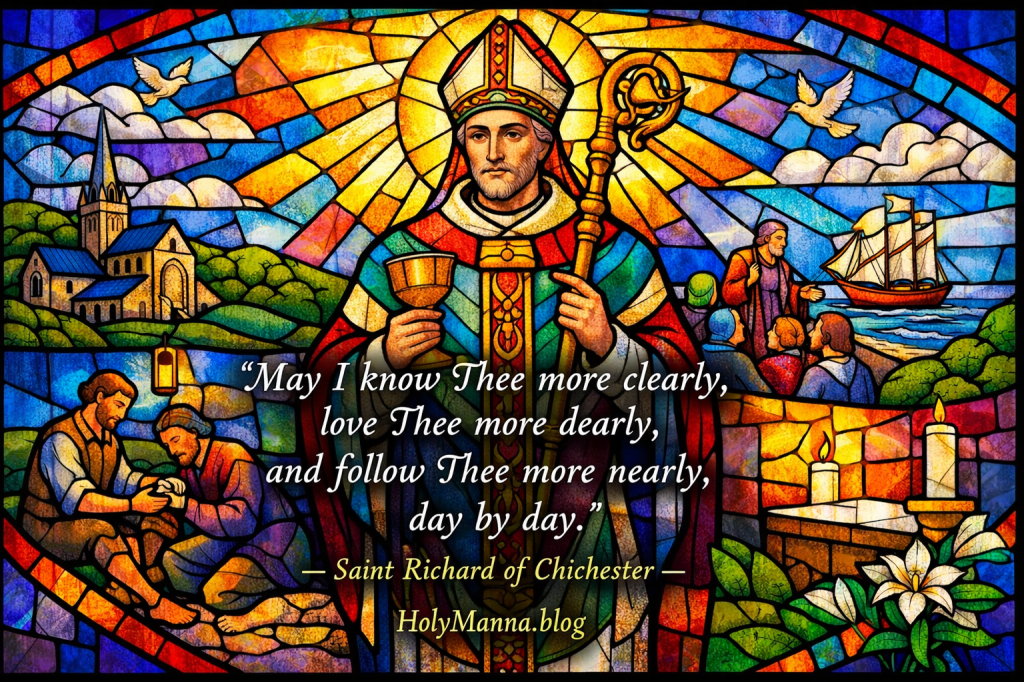
A Shepherd England Could Not Silence
Saint Richard of Chichester stands in Christian memory as a bishop of courage, purity, learning, and mercy. He was not remembered because he chased power, wealth, or praise. He is remembered because he loved Christ enough to live with integrity when compromise would have been easier. In a time of political pressure, church corruption, and personal hardship, Saint Richard remained steady. He defended the freedom of the Church, cared for the poor, corrected the clergy, and gave himself completely to the service of souls.
He is especially revered in Catholic tradition as a holy bishop who united scholarship with sanctity. He knew how to govern, but more importantly, he knew how to suffer faithfully. He knew how to teach, but even more importantly, he knew how to love. Many Catholics know him best through the prayer associated with him, a prayer that has lived for centuries because it expresses the heart of Christian discipleship so beautifully: “May I know Thee more clearly, love Thee more dearly, and follow Thee more nearly, day by day.”
That one line tells the whole story of his life. Saint Richard was a man who wanted nothing less than to know Christ, love Christ, and follow Christ with his whole heart.
From Hardship to Holiness
Saint Richard of Chichester, also known as Richard de Wyche, was born around the year 1197 in Worcestershire, England, near Droitwich. He came from a family of some standing, but his early life was marked by loss and difficulty. After the death of his father, the family estate fell into disorder, and Richard stepped away from academic pursuits for a time to help restore it. That detail matters because it shows something essential about his character. Even as a young man, he was not driven by selfish ambition. He was willing to sacrifice his own plans in order to do what was right.
Once his family responsibilities were settled, he returned to study. He went first to Oxford, then to Paris, and later to Bologna, where he became highly accomplished in canon law. Catholic tradition remembers one striking detail from his years at Oxford. He and two companions were so poor that they shared one tunic and one hooded gown, taking turns attending lectures. That image says a great deal. Richard was brilliant, but he was never cushioned by luxury. He learned early that wisdom often grows in hardship.
His intellect and discipline eventually led him to become Chancellor of Oxford. Yet his life was not merely the story of a successful scholar. His deeper formation came through friendship with holy men, especially Saint Edmund Rich, Archbishop of Canterbury. Richard became Edmund’s close collaborator and followed him even into exile when conflicts with the English crown forced the archbishop to leave England. That loyalty shaped Richard profoundly. It taught him that fidelity to the Church can come at a real cost, and that holiness is not proven in comfort but in obedience.
Later, after Saint Edmund’s death, Richard spent time with the Dominicans in France, studied theology, and was ordained a priest. His faith had deepened through study, prayer, suffering, and service. He had become the kind of man the Church could trust with souls.
A Bishop Formed by Truth and Charity
Richard’s election as Bishop of Chichester led to one of the greatest trials of his life. The English king, Henry III, opposed his appointment and backed another candidate. Although Pope Innocent IV confirmed Richard’s election and personally consecrated him bishop, the king refused to grant him possession of the temporal goods of the diocese. For a time, Richard was a bishop in name, but deprived of the normal means to govern his own flock.
This was no small humiliation. He had to depend on the hospitality of priests and friends. He moved through his own diocese as a poor man, sometimes on foot, while political powers tried to crush his rightful authority. Yet he did not lash out in bitterness. He endured the trial with patience and firmness. Eventually, his rights were restored, and he began the work for which he is most known.
Saint Richard became a reforming bishop in the best Catholic sense of the word. He did not invent a new faith. He called people back to the old one. He insisted that priests live chastely and reverently. He regulated liturgical life carefully. He opposed simony, nepotism, and clerical abuse. He cared deeply that the sacraments be celebrated with dignity and that the people be properly taught. His life reflected the Church’s constant concern that those who serve at the altar must do so with holiness and truth. That concern echoes the Church’s teaching that sacred ministers are called to faithful stewardship in service of Christ and His people, as seen throughout The Catechism, especially in its treatment of Holy Orders and the sacramental life in CCC 1536-1600.
Yet Richard was not stern in a cold or loveless way. He was known just as much for mercy as for discipline. He gave generously to the poor and refused to let fear of scarcity weaken his charity. One of the best-known sayings attributed to him came when his steward complained that too much money was being given away in alms. Richard answered simply, “Sell my plate and my horse.” That is the kind of line that stays with a soul. He did not speak of charity as an idea. He treated it as an obligation of love.
This is why he still matters. He shows that real reform in the Church is never only structural. It is personal. It begins when a man is honest, prayerful, disciplined, and detached enough from comfort to obey Christ above all.
Signs of Grace in His Earthly Life
Saint Richard is remembered first for holiness and pastoral courage, not for a long list of sensational public miracles. Still, Catholic tradition preserves several stories associated with him that point to the reverence surrounding his life.
One of the most frequently repeated traditional accounts says that while he was celebrating Mass, he accidentally dropped the chalice, but the Precious Blood did not spill. Another tradition says that during a procession, when the candles of others were blown out, Richard’s candle remained burning. These stories have been handed on in devotional memory and have helped shape the saint’s iconography and local veneration. They cannot be verified with the same certainty as the major events of his life, but they remain part of the way Catholics have remembered him.
Even without dramatic miracle stories, the strongest miracle of his earthly life may have been the visible holiness with which he governed. He lived austerely. He prayed fervently. He loved the poor. He did not bend before royal pressure. He corrected abuses without becoming cruel. He carried both learning and humility together. In every age, that is a miracle of grace, because it is not natural for fallen men to live that way for long. It is the fruit of sanctity.
This is why Richard deserves to be remembered and imitated. He shows that holiness can live in administration, in study, in suffering, in governance, and in ordinary duties. Not every saint is remembered for dramatic wonders. Some are remembered because the whole shape of their life became a testimony that Christ truly transforms a man.
Trials Without Bitterness
Saint Richard was not a martyr in the technical sense, because he did not shed his blood for the faith. Still, his life included real persecution and hardship. He suffered opposition from one of the most powerful men in England. He was denied the comforts and resources that normally belonged to his office. He had to bear insult, resistance, and uncertainty.
There is something especially instructive in that. Many souls imagine that sanctity would be easier if only suffering came in dramatic, heroic form. But often the harder road is the slower one. It is the road of repeated frustration, patient endurance, misunderstood motives, and quiet fidelity. Richard walked that road well.
He also practiced real detachment. When material losses came, he did not cling harder to possessions. He loosened his grip. When difficulties arose, he did not retreat into self-pity. He leaned further into charity. When authority was resisted, he did not abandon truth, but neither did he become consumed by pride. This is the pattern of a soul deeply conformed to Christ, who teaches His disciples to lose their lives in order to find them, as seen in The Gospel of Matthew 16:25.
Near the end of his life, Richard was engaged in Church business connected with preaching a crusade and the consecration of a church in honor of Saint Edmund. He died at Dover on April 3, 1253. Even in death, his life remained linked to fidelity, duty, and the memory of another holy shepherd he had long served and loved.
Wonders at the Tomb and a Legacy That Survived the Centuries
After Saint Richard’s death, devotion to him spread quickly. His body was brought back to Chichester Cathedral, where he was buried. Reports soon arose of miracles at his tomb, especially healings. Catholic tradition holds that cures of serious illnesses, including paralytics, were attributed to his intercession. Some accounts even speak of three persons being raised to life at his tomb. These posthumous miracles were taken seriously enough to be investigated in the process that led to his canonization.
He was canonized in 1262 by Pope Urban IV, less than ten years after his death. That alone says something powerful about the impression he left on the Church. His shrine at Chichester became an important place of pilgrimage in medieval England, and many sought his prayers there. The shrine itself was later destroyed during the upheavals of the Reformation, and no relics are now known with certainty to remain. That loss is painful, but it also says something about how beloved he had become. Shrines are not destroyed unless they matter.
Alongside the better-attested reports of healings at his tomb, there are also later miracle stories preserved in devotional tradition. These include the stories connected to the chalice and the candle, as well as other local memories of his sanctity. These stories remain part of his legacy, though some cannot be historically verified with certainty.
His cultural impact endured in other ways too. Saint Richard became associated especially with Chichester and Sussex, where he is honored as a patron. His feast is celebrated on April 3, and the translation of his relics on June 16 has also held importance in local observance. Even beyond explicitly devotional settings, his prayer has reached countless Christians through later use in hymnody and popular religious culture. The line “to know Thee more clearly, love Thee more dearly, and follow Thee more nearly” continues to carry his spiritual voice far beyond medieval England.
What he is most known for, then, is not just one isolated achievement. He is known for being a holy bishop who defended the freedom of the Church, reformed the clergy, loved the poor, lived simply, and gave the Church one of its most beloved prayers.
What Saint Richard Teaches the Soul Today
Saint Richard of Chichester speaks powerfully to a world that confuses success with holiness and comfort with peace. His life reminds the faithful that real greatness is not found in being admired, but in being faithful. He had education, influence, and authority, but he did not make those things his god. He used them for Christ.
His example invites a serious examination of conscience. Is faithfulness being measured by convenience, or by obedience? Is charity being practiced only when it costs little, or even when it demands sacrifice? Is Christ being followed clearly and deliberately, or only when the path feels safe?
Richard teaches that reform begins with the heart. It begins when prayer becomes sincere, when possessions stop ruling the soul, when duty is embraced without resentment, and when truth is loved enough to be defended with humility. He also teaches that bishops, priests, and laypeople alike are called to holiness in their state of life. His story fits beautifully with the Church’s teaching on the universal call to holiness found in CCC 2013-2014. Sanctity is not reserved for the dramatic few. It is the vocation of every baptized Christian.
A practical way to live his example is to begin with his prayer. Pray it slowly. Let it shape the day. Ask Christ for clearer knowledge, dearer love, and nearer following. Then live that prayer concretely. Give something away. Fulfill an unpleasant duty without complaining. Approach the sacraments with greater reverence. Speak the truth without pride. Serve the poor without calculation. Love the Church enough to desire her holiness.
Saint Richard did not become a saint by chasing extraordinary experiences. He became a saint by giving ordinary duties entirely to God. That is exactly why his witness still reaches the heart.
Engage with Us!
Share thoughts and reflections in the comments below. Saint Richard of Chichester has a way of challenging comfortable faith and calling the soul back to deeper fidelity.
- What part of Saint Richard’s life stands out most strongly: his poverty, his courage, his reforming spirit, or his charity? Why?
- How can Christ be known more clearly, loved more dearly, and followed more nearly in daily life right now?
- Where is God asking for greater integrity, courage, or sacrifice?
- How can reverence for the sacraments and love for the poor be lived more intentionally this week?
- What does Saint Richard’s life reveal about true success in the Christian life?
May Saint Richard pray for every heart that longs to be faithful. May his example help souls live with courage, serve with humility, and stay close to Jesus in every season. Live a life of faith, and do everything with the love and mercy Jesus taught us.
Saint Richard of Chichester, pray for us!
Follow us on YouTube, Instagram and Facebook for more insights and reflections on living a faith-filled life.

 Holy Manna!
Leave a comment