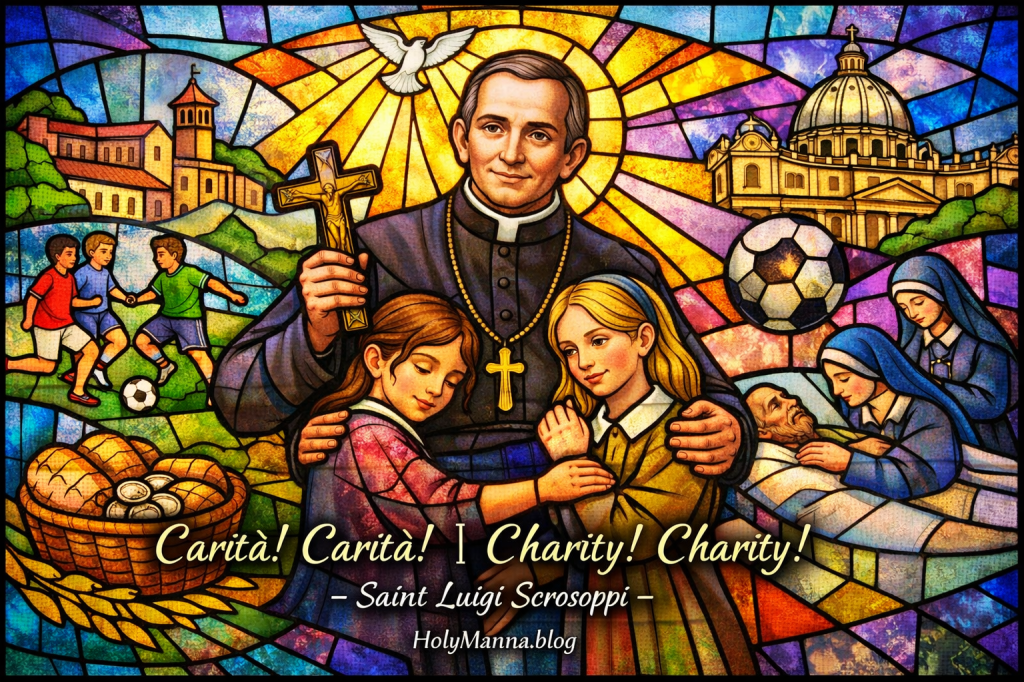
The Priest Who Spent Himself for the Forgotten
Saint Luigi Scrosoppi stands in Catholic memory as a priest of tenderness, courage, and total trust in Divine Providence. He was not a conqueror, a scholar with a towering library, or a missionary crossing oceans. He was something quieter, and in many ways more challenging. He was a man who loved the poor so deeply that he built his whole life around them, especially around abandoned girls whom society was ready to overlook.
The Church reveres him because he made the mercy of Christ visible in ordinary life. He showed that holiness is not always loud. Sometimes holiness looks like a priest begging for bread for hungry children, consoling the forgotten, guiding religious sisters, and trusting that God would provide when human resources ran out. Saint John Paul II saw in him a model of priestly holiness rooted in prayer, charity, and unwavering fidelity to Christ.
Saint Luigi is most known for founding the Sisters of Providence of Saint Cajetan and for giving himself completely to the care, protection, and Christian formation of poor and abandoned girls. His life can be summed up in the words that tradition preserves as his last cry: “Carità! Carità!” That means, “Charity! Charity!” Those words were not a slogan for him. They were the whole shape of his life.
A Heart Formed in Faith
Luigi Scrosoppi was born on August 4, 1804, in Udine, in the Friuli region of northern Italy. He came from a deeply Catholic family, and that mattered. The faith was not a decoration in the home. It was the atmosphere he breathed. Two of his brothers also became priests, and young Luigi grew up surrounded by a living example of Christian devotion, priestly service, and love for the Church.
He entered the seminary at a young age, only twelve years old, and his path toward the priesthood developed steadily. There was no dramatic conversion story in the way some saints have one. Instead, his life shows something equally beautiful. His faith deepened through fidelity, prayer, and daily surrender. That too is part of the Catholic story. Not every saint turns from wild rebellion. Some saints are slowly, patiently shaped by grace until their whole life becomes an offering.
He was ordained a priest on March 31, 1827. Early on, he preached on themes like humility, the mercy of God, and the hope of Heaven. Those were not random sermon topics. They reveal the shape of his soul. He understood that a priest must first be a man conquered by God’s mercy before he can become an instrument of mercy for others.
What deepened his faith most powerfully was not an argument, but the suffering around him. Friuli in his day was marked by poverty, instability, sickness, and social need. Luigi saw real human misery up close. He saw girls with no protection, no future, and no one to defend them. In that suffering, he recognized the face of Christ. His vocation became clearer and sharper. He would belong to God by belonging to the poor.
The Father of the Abandoned
Saint Luigi Scrosoppi became known above all for his care of abandoned girls, often called the derelitte, the forsaken ones. He did not love them from a distance. He gave them everything. He gave them his time, his money, his energy, his tears, and his priestly heart.
The work that became most identified with him was the Casa delle Derelitte, also known as the Institute of Providence. This was not simply a shelter. It was a place where girls could be protected, formed, educated, and treated with dignity. Luigi understood something that the Gospel teaches again and again. The poor do not need pity alone. They need love, stability, truth, and a future.
To sustain this work, he trusted radically in God’s Providence. He begged when he had to. He sacrificed when he had to. He refused to let the poverty of the moment define the future of the children in his care. Out of this mission came the foundation of the Sisters of Providence of Saint Cajetan. On February 1, 1837, the first women who joined this work embraced a life of poverty and service, and a new religious family was born.
Luigi formed these sisters with remarkable tenderness. He told them to care for the girls as the “apple of their eyes.” That expression says everything. He did not want cold efficiency. He wanted maternal, watchful, sacrificial love. He knew these girls needed more than food and shelter. They needed to be taught that they were not forgotten by God.
He later became part of the spiritual family of the Oratory of Saint Philip Neri, and that influence mattered deeply. From that tradition he drew joy, humility, fatherliness, and simplicity. His holiness had warmth in it. He was disciplined and prayerful, but never harsh in spirit. He carried a serious love that made room for gentleness.
One of the most beautiful lines attributed to him expresses the spirit of his life: “I want to be faithful to Him.” In English, that sentence sounds simple. In the life of a saint, it becomes immense. His whole priesthood was an answer to that desire.
Providence in Action
Saint Luigi did not become important because of public influence or institutional power. He became important because he allowed Christ’s compassion to flow through every part of his life. He prayed deeply, loved the Eucharist, meditated faithfully, prayed the Rosary, made the Via Crucis, recited the Divine Office, and spent long hours in prayer, even at night. His works of mercy were not separate from his spiritual life. They were born from it.
This is why Catholics should remember him and imitate him. He shows that active charity without prayer becomes thin, and prayer without charity becomes hollow. In him, the two stayed together.
Several remarkable favors and healings are associated with his intercession and with his reputation for holiness. During his lifetime, the greatest “miracle” most clearly seen in his story was not a dramatic public wonder, but the transformation of lives through Providence. He took girls whom society had cast aside and gave them a future. He built works of mercy with almost nothing. He kept moving forward in trust when logic said there was not enough. That kind of sustained, fruitful charity is itself a sign of grace.
There were also events in his life that people around him regarded as extraordinary. He was said to have foretold that twelve houses would be opened before his death, and this was later believed to have come true. That tradition is preserved in Catholic accounts of his life. It belongs to the memory of his congregation, though it is not the same kind of miracle as one formally judged by the Church.
Even more striking is the way his entire life reflected confidence in God’s care. He spoke of Divine Providence with deep conviction and tenderness. Catholic tradition preserves his trust in what he described as God’s loving Providence, which never abandons those who trust in Him. That trust was not theoretical. It was lived out each time he faced need and kept going anyway.
Trials Without Bitterness
Saint Luigi was not a martyr, but he was no stranger to suffering. His hardships were long, draining, and deeply personal. He had to carry the burden of poverty, uncertainty, and the heavy responsibility of protecting fragile works of mercy in a world that did not always value them.
He also lived through anti-clerical unrest and political upheaval in nineteenth-century Italy. Religious institutions faced pressure, disruption, and suppression. The works he loved were threatened. The Oratory in Udine suffered under these tensions, and Luigi had to fight to preserve what he could. This kind of suffering can be especially painful because it is slow. It is not one dramatic moment of persecution. It is the exhaustion of having to defend holy things over and over again.
Yet he endured these trials without turning bitter. That is part of what makes his witness so compelling. Many people can remain generous while things are going well. Saints remain generous when everything becomes costly.
In his final years, he also carried concern for the future of the congregation he founded. He warned the sisters that they would go through trials after his death, but he also encouraged them not to fear. He believed the God who began the work would continue it.
When death finally came on April 3, 1884, he did not leave behind wealth or worldly prestige. He left behind a spiritual family, a reputation for sanctity, and a life that had been poured out in love. His final cry, “Carità! Carità!”, was not dramatic performance. It was the truest summary of who he was.
Wonders After Death and a Living Legacy
After his death, devotion to Luigi Scrosoppi did not fade. People came in large numbers to ask for his intercession, and his reputation for holiness continued to spread. Over time, the Church carefully examined miracles attributed to him.
For his beatification, healings were reported and accepted in the canonical process, including the healing of an infant suffering from grave encephalitis and the healing of a man whose hand had long been afflicted by severe bone disease and was reportedly cured when amputation seemed imminent. These stories became part of the Church’s formal discernment of his sanctity.
For his canonization, the miracle most widely associated with him concerns Peter Chungu Shitima, a young African man suffering from severe illness related to HIV. After prayers through Blessed Luigi’s intercession, he reportedly recovered in a way the Church recognized as miraculous. This became central in the final step toward his canonization.
Beyond these officially recognized miracles, Catholics devoted to Saint Luigi have spoken of other favors, healings, and answered prayers through his intercession. Many such accounts belong to the lived devotion of the faithful. Not all can be historically or medically verified, and honesty matters here. Still, they reflect the continuing confidence many Catholics place in his intercession.
His body and memory remain especially honored in Udine, where his relics are venerated and where places connected to his life continue to preserve his legacy. His congregation, the Sisters of Providence, carries his spirit into new times and places. His influence has lasted far beyond nineteenth-century Italy.
There is also a surprising cultural side to his legacy. He has come to be regarded in Catholic circles as a patron associated with footballers and football fans, and his name has even appeared in connection with youth and sports apostolates. That may sound unexpected at first, but it fits him better than it first appears. He loved young people, believed in their dignity, and gave his life to forming hearts. A saint of Christian formation and joyful discipline belongs naturally near the world of youth and sport.
He is also remembered locally as a great son of Friuli, and his canonization carried real significance for the Catholic identity of that region. He became a source of pride not in the worldly sense, but in the sense that a local Church could see in one of her own sons the beauty of heroic virtue.
What Saint Luigi Still Teaches the Church
Saint Luigi Scrosoppi teaches a lesson that modern Catholics desperately need. Love is not real because it is loudly declared. Love is real because it is sacrificially lived. He did not merely speak about mercy. He built mercy into structures, habits, homes, and souls.
He also teaches the absolute necessity of trusting Providence. Modern life trains people to think that security comes from control, planning, and visible resources. Saint Luigi reminds the faithful that while prudence matters, everything finally depends on God. He lived as if Divine Providence were not a religious phrase, but a daily reality.
His life also speaks powerfully to priests, religious, parents, teachers, and anyone responsible for caring for the vulnerable. He shows that Christian authority must look like fatherhood or motherhood, not domination. The weak are not interruptions to the mission. They are often the very place where Christ waits.
For ordinary Catholics, his example becomes practical very quickly. Care for the forgotten person in the family. Make time for the lonely. Defend the vulnerable. Give generously even when it costs something. Pray deeply enough that charity flows from grace and not from ego. Stay faithful when the work becomes tiring. Refuse cynicism. Build something that serves Christ and His little ones.
What would it look like to trust Divine Providence more concretely this week? Who are the forgotten people nearby that the world has trained the heart not to see? Is charity still treated as the center of the Christian life, or has it been pushed to the edges?
Saint Luigi’s life says clearly that holiness is not out of reach. It is built through fidelity, mercy, prayer, and patient sacrifice. He did not become a saint by doing spectacular things for attention. He became a saint by doing ordinary works with extraordinary love.
Engage With Us!
Readers are invited to share their thoughts and reflections in the comments below. Saint Luigi Scrosoppi has a way of stirring the conscience gently but deeply, especially for anyone who has ever wondered whether hidden acts of mercy really matter. They do. His whole life proves it.
- What part of Saint Luigi Scrosoppi’s life speaks most strongly to the heart right now?
- How can greater trust in God’s Providence take shape in daily responsibilities, worries, or family life?
- Who are the abandoned, forgotten, or overlooked people that God may be asking the heart to serve more intentionally?
- What does “Carità! Carità!” challenge Catholics to change in the way they love others?
- How can prayer and works of mercy become more united in everyday life, instead of being treated like separate parts of the faith?
May Saint Luigi inspire a life of steady faith, generous love, and total trust in God. May his witness remind every heart that true greatness is found in humble charity. Let everything be done with the love and mercy Jesus taught us.
Saint Luigi Scrosoppi, pray for us!
Follow us on YouTube, Instagram and Facebook for more insights and reflections on living a faith-filled life.

 Holy Manna!
Leave a comment