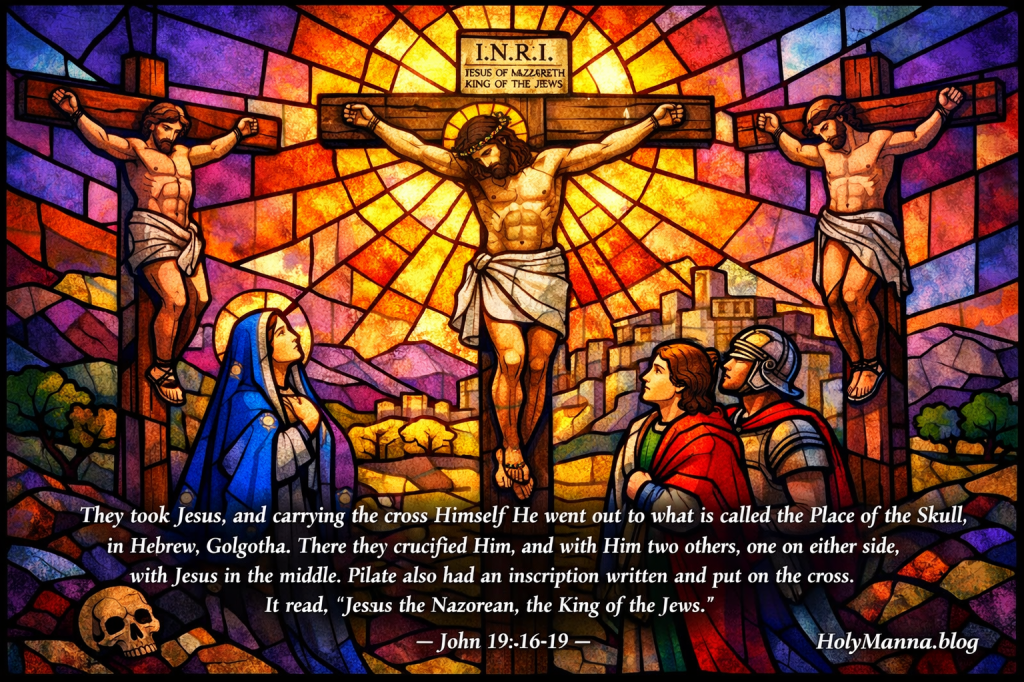
Good Friday of the Lord’s Passion – Lectionary: 40
The Silence of the Lamb, the Triumph of the King
There are days in the Church’s year when heaven seems to speak in thunder, and there are days when it speaks in wounded silence. Good Friday is the day when silence says everything. Today’s readings draw the heart into the mystery of Christ’s Passion and reveal one central theme: the Son of God saves the world through obedient, sacrificial love. The suffering servant in Isaiah, the trusting cry of Psalm 31, the compassionate high priest in Hebrews, and the crucified King in The Gospel of John are not four unrelated images. They are one living portrait of Jesus Christ, who takes the weight of sin upon Himself so that sinners might be healed, forgiven, and brought home to the Father.
The Church places these readings together with great care. Isaiah 52:13-53:12 was heard by the earliest Christians as a prophetic window into the Passion of Christ. Long before Calvary, the prophet described the one who would be rejected, pierced, crushed, and yet somehow victorious. Hebrews gives the key to understanding that suffering rightly. Jesus is not merely a victim of political violence or religious jealousy. He is the true High Priest who offers Himself in perfect obedience. Then Saint John’s Passion brings the mystery into full view. In John’s account, Christ is not swept away by events. He moves toward the Cross with full knowledge and full freedom. Even in humiliation, He reigns.
There is also a deep religious background binding these readings together. Good Friday unfolds in the shadow of Passover, when Israel remembered the blood of the lamb, the saving power of God, and the deliverance from slavery. Now Christ appears as the fulfillment of that entire pattern. He is the innocent one handed over. He is the lamb who does not resist. He is the priest who intercedes. He is the King whose throne is the Cross. The world sees weakness, but the Church sees the hour of divine love. The world sees defeat, but faith hears “It is finished” and knows that the work of redemption has been accomplished.
That is why today’s readings are not meant to be rushed through as though they were only a record of sorrow. They are an invitation to stand at the foot of the Cross and learn what love truly costs. They teach that sin is not a small thing, that mercy is not a cheap thing, and that salvation is not an idea. Salvation has a face, a voice, wounded hands, and a pierced side. Good Friday asks the soul to look steadily at Christ and to understand, perhaps more deeply than before, that “by his wounds we were healed.” How does the heart respond when it sees that the Lord chose to suffer not as a helpless man, but as the faithful Son who loved to the very end?
First Reading – Isaiah 52:13-53:12
The Servant Who Carried the Wound of the World
The First Reading on Good Friday brings the soul into holy ground. Long before Roman soldiers drove nails into Christ’s hands, long before Pilate washed his hands and the crowd cried out for crucifixion, the prophet Isaiah was already speaking about a mysterious Servant who would suffer, be rejected, carry the sins of others, and yet somehow be exalted. This passage comes from what scholars often call the Servant Songs of Isaiah, written in the setting of Israel’s suffering, exile, and longing for deliverance. Israel knew what it meant to feel broken, humiliated, and powerless before the nations. Into that history, God spoke of one faithful Servant whose suffering would not end in defeat, but in redemption.
For the Church, this reading is one of the clearest Old Testament windows into the Passion of Jesus Christ. It belongs to today’s theme because it shows that the Cross was not an accident and not merely the cruelty of men. It was part of the Father’s saving plan, foretold in shadow and fulfilled in Christ. The Servant is innocent, silent, obedient, rejected, and pierced, yet his wounds become healing for others. That is the great mystery of Good Friday. The one the world sees as crushed is the very one through whom God saves the world.
Isaiah 52:13-53:12 – New American Bible (Revised Edition)
Suffering and Triumph of the Servant of the Lord
52:13 See, my servant shall prosper,
he shall be raised high and greatly exalted.
14 Even as many were amazed at him—
so marred were his features,
beyond that of mortals
his appearance, beyond that of human beings—
15 So shall he startle many nations,
kings shall stand speechless;
For those who have not been told shall see,
those who have not heard shall ponder it.53:1 Who would believe what we have heard?
To whom has the arm of the Lord been revealed?
2 He grew up like a sapling before him,
like a shoot from the parched earth;
He had no majestic bearing to catch our eye,
no beauty to draw us to him.
3 He was spurned and avoided by men,
a man of suffering, knowing pain,
Like one from whom you turn your face,
spurned, and we held him in no esteem.4 Yet it was our pain that he bore,
our sufferings he endured.
We thought of him as stricken,
struck down by God and afflicted,
5 But he was pierced for our sins,
crushed for our iniquity.
He bore the punishment that makes us whole,
by his wounds we were healed.
6 We had all gone astray like sheep,
all following our own way;
But the Lord laid upon him
the guilt of us all.7 Though harshly treated, he submitted
and did not open his mouth;
Like a lamb led to slaughter
or a sheep silent before shearers,
he did not open his mouth.
8 Seized and condemned, he was taken away.
Who would have thought any more of his destiny?
For he was cut off from the land of the living,
struck for the sins of his people.
9 He was given a grave among the wicked,
a burial place with evildoers,
Though he had done no wrong,
nor was deceit found in his mouth.
10 But it was the Lord’s will to crush him with pain.
By making his life as a reparation offering,
he shall see his offspring, shall lengthen his days,
and the Lord’s will shall be accomplished through him.
11 Because of his anguish he shall see the light;
because of his knowledge he shall be content;
My servant, the just one, shall justify the many,
their iniquity he shall bear.
12 Therefore I will give him his portion among the many,
and he shall divide the spoils with the mighty,
Because he surrendered himself to death,
was counted among the transgressors,
Bore the sins of many,
and interceded for the transgressors.
Detailed Exegesis
Verse 13. “See, my servant shall prosper, he shall be raised high and greatly exalted.”
The prophecy opens not with defeat, but with victory. Before the suffering is even described, God declares the end of the story. The Servant will prosper, not in the worldly sense of comfort or applause, but in complete fidelity to the will of God. The language of being raised high and greatly exalted points the Church toward Christ’s Resurrection, Ascension, and heavenly glory. Good Friday never stands alone. The Cross already carries within it the promise of triumph.
Verse 14. “Even as many were amazed at him, so marred were his features, beyond that of mortals his appearance, beyond that of human beings.”
Here the prophecy turns toward the horror of suffering. The Servant is so disfigured that people are stunned at the sight of him. The Church hears in this verse the scourging, the crown of thorns, the blows, the blood, and the battered face of Christ. Sin is not abstract. It disfigures. On Good Friday, the face of Jesus shows what sin does to innocence and what love is willing to endure to save the guilty.
Verse 15. “So shall he startle many nations, kings shall stand speechless; for those who have not been told shall see, those who have not heard shall ponder it.”
The humiliation of the Servant becomes the astonishment of the nations. Kings who speak with authority are reduced to silence before the mystery of God’s saving work. What seemed weak becomes world-shaking. The Passion of Christ is not only for one people or one generation. It is for all nations. The Cross reveals a salvation so unexpected that it leaves the powerful speechless and invites the distant nations into wonder.
Verse 1. “Who would believe what we have heard? To whom has the arm of the Lord been revealed?”
This verse captures the scandal of divine revelation. God’s saving power, the arm of the Lord, does not appear in worldly conquest. It appears in the rejected Servant. Many heard the story of Jesus and did not believe because they expected glory without suffering, kingship without sacrifice, and redemption without a cross. The verse exposes how easily the human heart resists God’s way when it does not look impressive by earthly standards.
Verse 2. “He grew up like a sapling before him, like a shoot from the parched earth; he had no majestic bearing to catch our eye, no beauty to draw us to him.”
The Servant appears humble and ordinary. He does not arrive clothed in worldly splendor. This points beautifully to the hidden life of Christ, who came in poverty, grew up in obscurity, and lacked the outward signs that human beings often use to measure greatness. God’s salvation enters history quietly, like life emerging from dry ground. Grace often begins where the world sees little promise.
Verse 3. “He was spurned and avoided by men, a man of suffering, knowing pain, like one from whom you turn your face, spurned, and we held him in no esteem.”
The Servant knows rejection from the inside. He is not merely pained. He is acquainted with pain. The Church sees here the loneliness of Christ in His Passion, abandoned by many, betrayed by one of His own, denied by Peter, mocked by soldiers, and rejected by the crowd. This verse also exposes the human tendency to turn away from suffering instead of standing faithfully beside it. The beloved disciple and the Blessed Mother remained. Many others fled.
Verse 4. “Yet it was our pain that he bore, our sufferings he endured. We thought of him as stricken, struck down by God and afflicted.”
This is the turning point. The suffering of the Servant is not meaningless. He bears what belongs to others. At first, the observers misread his affliction as divine punishment falling upon him personally. In truth, he is carrying the burden of humanity. This is the beginning of substitutionary language that the Church receives in its fullest sense in Christ. Jesus does not merely suffer alongside sinners. He suffers for sinners.
Verse 5. “But he was pierced for our sins, crushed for our iniquity. He bore the punishment that makes us whole, by his wounds we were healed.”
This is one of the clearest prophecies of redemptive suffering in all of Scripture. The Servant is pierced and crushed, not for his own guilt, but for ours. The result is healing and peace. The Church hears in this verse the nails, the lance, and the saving wounds of Christ. His suffering is medicinal for the soul. Humanity is not healed by ignoring sin, but by Christ taking its consequences upon Himself in love.
Verse 6. “We had all gone astray like sheep, all following our own way; but the Lord laid upon him the guilt of us all.”
The prophet does not let anyone hide behind the crowd. All have gone astray. Every sinner is part of the story. The image of wandering sheep recalls the deep biblical theme of lost humanity needing a shepherd. Christ becomes both the Shepherd and the sacrificial Lamb. The guilt of all is laid upon Him, not because the Father delights in suffering, but because divine justice and divine mercy meet in the saving obedience of the Son.
Verse 7. “Though harshly treated, he submitted and did not open his mouth; like a lamb led to slaughter or a sheep silent before shearers, he did not open his mouth.”
The silence of the Servant is not weakness. It is strength governed by obedience. He does not resist because he is helpless, but because he willingly accepts the Father’s will. The image of the lamb is especially important on Good Friday. It ties the Servant to sacrifice, innocence, and Passover. Christ stands before His accusers with divine self-mastery. His silence condemns the noise of sinful humanity and reveals the meekness of perfect love.
Verse 8. “Seized and condemned, he was taken away. Who would have thought any more of his destiny? For he was cut off from the land of the living, struck for the sins of his people.”
The Servant suffers an unjust judgment and a violent removal from life. He is cut off from the living, which points unmistakably toward death. Yet again the reason is made clear. He is struck for the sins of his people. This verse helps the Church see that Christ’s death is both a real historical execution and a saving offering. His destiny looked finished in the eyes of the world, but heaven saw the beginning of redemption.
Verse 9. “He was given a grave among the wicked, a burial place with evildoers, though he had done no wrong, nor was deceit found in his mouth.”
The Servant shares the fate of criminals even though he is innocent. This finds a powerful echo in Jesus being crucified between two criminals and laid in the tomb after a shameful public death. His innocence is emphasized with great force. He had done no wrong. There was no deceit in him. This innocence matters because only a spotless offering can truly atone. Christ is not one more sinner among sinners. He is the sinless one who enters the place of sinners.
Verse 10. “But it was the Lord’s will to crush him with pain. By making his life as a reparation offering, he shall see his offspring, shall lengthen his days, and the Lord’s will shall be accomplished through him.”
This verse must be read with reverence and care. It does not mean the Father delights in cruelty. It means the Passion belongs to God’s saving will. The Servant’s life becomes a reparation offering, a sacrifice that deals with sin and restores communion. Out of what looks like annihilation comes fruitfulness. He shall see his offspring. The Church sees here the spiritual children born from Christ’s sacrifice, the faithful redeemed by His Blood and gathered into His Body.
Verse 11. “Because of his anguish he shall see the light; because of his knowledge he shall be content; my servant, the just one, shall justify the many, their iniquity he shall bear.”
The anguish is not the final word. The Servant sees the light. The Church hears in this the dawn of Easter already glimmering at the edge of Good Friday. He is the just one, and because he is just, he can justify many. This is not only an example of endurance. It is the mystery of salvation. The righteous one carries iniquity so that the guilty may be made righteous before God.
Verse 12. “Therefore I will give him his portion among the many, and he shall divide the spoils with the mighty, because he surrendered himself to death, was counted among the transgressors, bore the sins of many, and interceded for the transgressors.”
The passage ends in triumph, but it is a triumph won through surrender. The Servant is counted among sinners, yet he remains the one who bears sin and intercedes for sinners. This is fulfilled in Christ, who is crucified among the lawless and yet prays for those who put Him to death. His victory is not seized by violence. It is received through obedient sacrifice. He conquers by loving to the end.
Teachings
This reading stands near the very center of Catholic understanding of the Passion. The Church does not treat Isaiah 52:13-53:12 as a vague poem about human suffering in general. She reads it in the light of Christ. The innocence of the Servant, the silence before accusers, the bearing of sin, the language of sacrifice, and the final exaltation all find their fullest meaning in Jesus.
The Catechism of the Catholic Church speaks with remarkable clarity here. CCC 601 teaches: “The Scriptures had foretold this divine plan of salvation through the putting to death of ‘the righteous one, my Servant’ as a mystery of universal redemption, that is, as the ransom that would free men from the slavery of sin.” That is exactly what this passage reveals. The death of Christ is not a tragic interruption of His mission. It is the heart of His mission.
CCC 608 also connects Christ directly to this prophecy: “After agreeing to baptize him along with the sinners, John the Baptist looked at Jesus and pointed him out as the ‘Lamb of God, who takes away the sin of the world’. By doing so, he revealed that Jesus is at the same time the suffering Servant who silently allows himself to be led to the slaughter and who bears the sin of the multitudes, and also the Paschal Lamb symbolizing Israel’s redemption at the first Passover. Christ’s whole life expresses his mission: ‘to serve, and to give his life as a ransom for many.’”
That teaching matters because it holds together several Old Testament threads at once. The Servant is not only a sufferer. He is also priestly, sacrificial, and redemptive. He is linked to the Passover lamb, to atonement, and to the hope of Israel’s restoration. On Good Friday, all of those threads are drawn together in the Person of Jesus Christ.
The apostolic Church recognized this very early. In Acts 8, the Ethiopian eunuch is reading this very section of Isaiah and asks whom the prophet is speaking about. Philip begins with that Scripture and proclaims Jesus. That moment is deeply important in Christian history because it shows how the first generation of believers already understood Isaiah 53 as a direct key to the Gospel. This reading was not attached to the Passion later as a devotional flourish. It was present in the Church’s preaching from the beginning.
The Fathers of the Church also loved this prophecy because it defended the truth that Christ truly suffered in the flesh and truly offered Himself for sinners. The Church never saw the Passion as a mere appearance or a symbolic gesture. The wounds were real. The silence was real. The sacrifice was real. Yet through that very reality came real healing, real forgiveness, and real reconciliation with God.
Reflection
This reading reaches into daily life with uncomfortable honesty. It says that sin is real, wandering is real, guilt is real, and suffering is real. It also says that God does not leave His people trapped in any of it. The Servant steps into the wound. Christ does not save from a distance. He enters the darkest place and transforms it through obedience and love.
That changes the way suffering can be understood. Not every suffering is a punishment from God, and not every hardship has a quick explanation. But in Christ, suffering can be united to love, offered to the Father, and filled with purpose. The Cross does not make pain pleasant, but it does make it redeemable. When endured with Christ, even hidden suffering can become prayer, intercession, purification, and witness.
This reading also invites repentance. Where has the heart gone astray like a sheep following its own way? Where has the soul turned its face away from Christ, especially when His will felt costly or uncomfortable? What would change if His wounds were truly believed to be stronger than personal sin, shame, and failure?
A faithful response begins in simple ways. It begins by naming sin honestly in confession instead of excusing it. It begins by accepting small humiliations without bitterness. It begins by learning the silence of Christ rather than the instant self-defense of pride. It begins by staying close to the crucified Lord in prayer, especially when life feels dry, unfair, or confusing. Good Friday teaches that God often does His deepest work where the world sees only loss.
The Servant of Isaiah is not a distant figure trapped in prophecy. He is Jesus Christ, standing in the middle of the Church today with wounded hands and a heart still burning with mercy. He is still healing through His wounds. He is still justifying the many. He is still interceding for transgressors. And He still asks every soul to look upon the Cross and finally understand what love costs.
Responsorial Psalm – Psalm 31:2, 6, 12-13, 15-17, 25
The Prayer of the Heart That Trusts in the Dark
The Responsorial Psalm on Good Friday sounds like the prayer of a man standing at the edge of abandonment, and that is exactly why the Church places it here. Psalm 31 comes from the great prayer tradition of Israel, where the faithful learned to cry out to God not only in joy, but also in danger, humiliation, betrayal, and distress. In the world of ancient Israel, the psalms were not polished religious slogans for easy days. They were the living language of covenant faith, prayed in the Temple, sung in worship, whispered in exile, and clung to in suffering. This particular psalm carries the voice of someone who is mocked, forgotten, hunted, and yet still refuses to let go of God.
On Good Friday, the Church hears this psalm in the voice of Christ. When Jesus says, “Into your hands I commend my spirit,” He is praying with the words of Psalm 31. That gives the whole psalm a tremendous depth. It is no longer only David’s cry or Israel’s prayer. It becomes the prayer of the crucified Son. It fits perfectly within today’s theme because it reveals the inner movement of the Passion. The suffering Servant of Isaiah bears sin. The High Priest of Hebrews offers cries and tears. In Psalm 31, the heart of Christ entrusts everything to the Father. Good Friday teaches that true trust does not begin when life feels safe. It shines most clearly when everything else has been stripped away.
Psalm 31:2, 6, 12-13, 15-17, 25 – New American Bible (Revised Edition)
2 In you, Lord, I take refuge;
let me never be put to shame.
In your righteousness deliver me;6 Into your hands I commend my spirit;
you will redeem me, Lord, God of truth.12 To all my foes I am a thing of scorn,
and especially to my neighbors
a horror to my friends.
When they see me in public,
they quickly shy away.
13 I am forgotten, out of mind like the dead;
I am like a worn-out tool.15 But I trust in you, Lord;
I say, “You are my God.”
16 My destiny is in your hands;
rescue me from my enemies,
from the hands of my pursuers.
17 Let your face shine on your servant;
save me in your mercy.25 Be strong and take heart,
all who hope in the Lord.
Detailed Exegesis
Verse 2. “In you, Lord, I take refuge; let me never be put to shame. In your righteousness deliver me.”
The psalm opens with an act of trust. Refuge is the language of someone under threat, someone who knows that danger is real and safety cannot be found in human strength alone. The psalmist does not appeal to his own innocence or his own power. He appeals to the righteousness of God. On Good Friday, this verse prepares the soul to see Jesus entrusting Himself fully to the Father even while injustice closes in around Him. The world heaps shame upon Him, but He takes refuge in the Father’s faithfulness.
Verse 6. “Into your hands I commend my spirit; you will redeem me, Lord, God of truth.”
This is the beating heart of the psalm and one of the most sacred lines in all of Scripture. To commend one’s spirit into God’s hands is to surrender life itself, not with despair, but with confidence. Jesus takes these words upon His lips at the moment of death, showing that His final breath is an offering of trust. The verse joins surrender and redemption together. The soul is not thrown into darkness blindly. It is entrusted into the hands of the God of truth. This is why Christian death, when united to Christ, is no longer meaningless loss, but an act of filial trust.
Verse 12. “To all my foes I am a thing of scorn, and especially to my neighbors a horror to my friends. When they see me in public, they quickly shy away.”
Here the prayer becomes painfully human. The psalmist is not only attacked by enemies. He is avoided by neighbors and treated as a horror by friends. This is the loneliness of suffering. It exposes how easily people withdraw from the afflicted, especially when standing near them becomes uncomfortable or costly. The Church hears in this verse the abandonment surrounding Christ’s Passion, when many who had once listened to Him, followed Him, or admired Him now keep their distance. Sin isolates. Suffering reveals who is willing to remain.
Verse 13. “I am forgotten, out of mind like the dead; I am like a worn-out tool.”
This verse captures the feeling of being discarded. The psalmist speaks as one already erased from the memory of others, as though his life has lost value. The image of a worn-out tool is striking because it suggests something used up and cast aside. On Good Friday, the world treats Jesus exactly this way. Once acclaimed, now rejected. Once sought out, now despised. Yet this discarded one is the cornerstone of salvation. God takes what the world throws away and reveals its eternal worth.
Verse 15. “But I trust in you, Lord; I say, ‘You are my God.’”
The word “But” changes everything. After scorn, abandonment, and forgetfulness, the psalmist makes a personal confession of faith. Trust is not a mood here. It is a decision. He does not say that circumstances have improved. He says that the Lord is still his God. This is the heart of biblical faith. Trust does not require immediate relief. It rests in the relationship itself. On Good Friday, Christ shows this perfectly. Surrounded by hatred and violence, He remains turned toward the Father.
Verse 16. “My destiny is in your hands; rescue me from my enemies, from the hands of my pursuers.”
This verse deepens the surrender. The psalmist does not merely place his current problem into God’s hands. He places his destiny there. That means the whole of life, the whole path, the whole outcome belongs to the Lord. This is one of the most profound acts of trust in the psalms. For Christ, it is fulfilled in the Passion. His arrest, trial, suffering, and death are not outside the Father’s providence. Evil men act freely and sinfully, yet even then the Son remains within the loving will of the Father.
Verse 17. “Let your face shine on your servant; save me in your mercy.”
The request for God’s face to shine recalls the biblical language of blessing, favor, and covenant closeness. The psalmist is asking not only for rescue, but for communion. To see the shining face of God is to know that one has not been abandoned. Mercy is the ground of the plea. This matters greatly on Good Friday because the Cross reveals that salvation comes not as a reward earned by sinners, but as mercy poured out by God. The servant asks for mercy. Christ wins mercy for the world.
Verse 25. “Be strong and take heart, all who hope in the Lord.”
The psalm that began in personal distress ends by strengthening the whole community. Suffering, endured in faith, becomes witness. The one who has cried out to God now exhorts others to courage and hope. This ending is deeply fitting for Good Friday. The Cross is terrible, but it is not hopeless. The faithful are called to take heart, not because pain is small, but because the Lord is faithful. Christian hope does not grow from easy circumstances. It grows from the certainty that God remains trustworthy even in death.
Teachings
This psalm teaches that trust in God reaches its purest form when everything visible seems to fail. It is one thing to praise God when blessings are obvious. It is another thing to cling to Him when friends disappear, enemies close in, and the soul feels forgotten. Psalm 31 belongs to that second kind of faith. That is why it belongs so deeply to Good Friday.
The Church sees in this psalm a window into the prayer of Christ. The Catechism teaches in CCC 2605: “When the hour had come for him to fulfill the Father’s plan of love, Jesus allowed the depth of his filial prayer to be seen, not only before he freely delivered himself up (‘Abba . . . not my will, but yours’), but even in his last words on the Cross, where prayer and the gift of self are but one: ‘Father, forgive them, for they know not what they do’; ‘Truly, I say to you, today you will be with me in Paradise’; ‘Woman, behold your son’ ‘Behold your mother’; ‘I thirst.’ ‘My God, My God, why have you forsaken me?’; ‘It is finished’; ‘Father, into your hands I commit my spirit!’ until the ‘loud cry’ as he expires, giving up his spirit.”
That passage from The Catechism is especially beautiful here because it shows that Christ’s last words are not random fragments of pain. They are the prayer of the Son who offers Himself to the Father. When Jesus prays the line from Psalm 31, He reveals that even death is being transformed into an act of loving surrender.
The Church also teaches that the psalms are fulfilled in Christ. CCC 2586 says: “The Psalms both nourished and expressed the prayer of the People of God as they were gathered in assembly on the great feasts at Jerusalem and each sabbath in the synagogues. These prayers are inseparably personal and communal; they concern both those who pray and all men. They arose from the Holy Land and from the communities of the Diaspora, but embrace the whole of creation. They recall the saving events of the past, but extend into the future, even to the consummation of history. As they make present the mighty deeds of God accomplished in history, they await the fulfillment of God’s promises. Prayed and fulfilled in Christ, the Psalms are an essential and permanent element of the prayer of the Church.”
That is exactly what happens on Good Friday. The prayer of ancient Israel becomes the prayer of Christ, and in Christ it becomes the prayer of the Church. The faithful do not merely admire Psalm 31 from a distance. They inherit it. They learn to pray it in union with Jesus.
Saint Augustine also saw the psalms as the voice of Christ and His Body, the Church. In that light, this psalm is not only about the Lord’s Passion, but also about the sufferings of Christians united to Him. The mocked believer, the abandoned widow, the faithful priest under trial, the soul fighting despair, the sinner returning in tears, all can find a home in this prayer because Christ has already prayed it first.
Historically, the Church has always returned to the psalms in times of persecution, plague, exile, and death. Monks have sung them in the night. Martyrs have prayed them in prison. The dying have whispered them in their final hours. This is not accidental. The psalms form the heart to speak honestly before God, and Psalm 31 teaches that honest prayer and unwavering trust belong together.
Reflection
This psalm reaches right into ordinary life because almost everyone knows something of scorn, loneliness, fear, or being misunderstood. Not every soul faces public persecution, but many know what it feels like to be overlooked, mocked, dismissed, or emotionally abandoned. Psalm 31 teaches that the answer to that pain is not bitterness, self-protection, or despair. The answer is trust placed deliberately into the hands of God.
That trust has to become practical. It means praying honestly instead of pretending strength. It means giving fear a voice before God rather than letting fear silently rule the heart. It means bringing humiliation, grief, betrayal, and uncertainty into prayer and saying, like the psalmist, “You are my God.” It means learning to hand over not only a crisis, but one’s whole destiny to the Lord.
There is also a challenge here for the way others are treated. The psalm describes the pain of being shunned by neighbors and forgotten by friends. That should make the conscience stop for a moment. Has there been a habit of avoiding the suffering of others because it felt inconvenient or emotionally heavy? Has there been a tendency to keep a safe distance from the wounded, the ashamed, or the grieving? Good Friday invites the faithful not only to pray with the abandoned Christ, but also to remain near those whom the world avoids.
A simple path forward begins with small acts of surrender. Start the day by placing it consciously into God’s hands. In moments of anxiety, repeat the words of the psalm slowly and reverently. When suffering cannot be fixed, offer it instead of wasting it. When someone nearby is carrying sorrow, choose presence over distance. That is one of the quiet ways the Cross begins to shape a life.
What would change if the soul truly believed that its destiny is in God’s hands and not in the hands of fear, opinion, or circumstance? What grief has been held too tightly instead of being commended to the Father? Where is the Lord asking for stronger hope, steadier trust, and a braver heart?
On Good Friday, Psalm 31 becomes more than a response. It becomes a school of trust. It teaches the soul how to pray when everything hurts. It teaches the heart how to remain turned toward the Father in darkness. And because Christ Himself prayed these words, no Christian ever prays them alone.
Second Reading – Hebrews 4:14-16; 5:7-9
The High Priest Who Entered Our Suffering and Opened Heaven
The Second Reading on Good Friday takes the soul deeper into the mystery of Christ’s Passion by showing not only what Jesus suffered, but who He is while He suffers. The Letter to the Hebrews was written to Christians who knew the language of priesthood, sacrifice, covenant, and the holy places of Israel’s worship. They understood what it meant for a priest to stand before God on behalf of the people. They knew the weight of sin, the need for atonement, and the sacred distance between sinful man and the all-holy Lord. Into that world, Hebrews proclaims something astonishing. Jesus is the true and final High Priest, not one more priest among many, but the Son who passes through the heavens and offers not the blood of animals, but His very self.
That is why this reading belongs so powerfully on Good Friday. Isaiah showed the suffering Servant. Psalm 31 gave words to the trust of the afflicted heart. Now Hebrews explains the inner meaning of the Cross. Christ is not only the victim who suffers. He is also the priest who offers. His tears are priestly. His obedience is priestly. His death is priestly. On Calvary, heaven and earth meet, not because man climbs upward by his own effort, but because the Son descends into human weakness and carries that weakness into the presence of the Father.
Hebrews 4:14-16; 5:7-9 – New American Bible (Revised Edition)
Jesus, Compassionate High Priest. 4:14 Therefore, since we have a great high priest who has passed through the heavens, Jesus, the Son of God, let us hold fast to our confession. 15 For we do not have a high priest who is unable to sympathize with our weaknesses, but one who has similarly been tested in every way, yet without sin. 16 So let us confidently approach the throne of grace to receive mercy and to find grace for timely help.
5:7 In the days when he was in the flesh, he offered prayers and supplications with loud cries and tears to the one who was able to save him from death, and he was heard because of his reverence. 8 Son though he was, he learned obedience from what he suffered; 9 and when he was made perfect, he became the source of eternal salvation for all who obey him,
Detailed Exegesis
Verse 14. “Therefore, since we have a great high priest who has passed through the heavens, Jesus, the Son of God, let us hold fast to our confession.”
The verse begins with confidence, not fear. Christians do not stand before God without an advocate. They have a great high priest, and His greatness comes not from rank, ritual garments, or temple lineage alone, but from His divine identity. He is Jesus, fully human, and He is the Son of God, fully divine. The phrase “passed through the heavens” points beyond the old priesthood. The high priest of the Old Covenant entered an earthly sanctuary. Christ enters the heavenly sanctuary itself. He does not merely go into a sacred room built by human hands. He goes into the very presence of the Father.
Because of that, the faithful are told to hold fast to their confession. In a world of suffering, persecution, compromise, and fear, believers are tempted to loosen their grip on the faith. Hebrews says the opposite. Hold fast. Do not let go. The priest who intercedes is not weak, absent, or defeated. He reigns in heaven even as the Cross unfolds on earth.
Verse 15. “For we do not have a high priest who is unable to sympathize with our weaknesses, but one who has similarly been tested in every way, yet without sin.”
This verse is one of the tenderest in the whole New Testament. Christ does not save from a safe distance. He sympathizes with weakness because He has entered the full reality of human life, temptation, sorrow, fatigue, anguish, and suffering. The Son of God did not merely put on the appearance of humanity. He truly assumed it. He knows what hunger feels like. He knows what betrayal feels like. He knows what it is to weep, to be abandoned, and to endure the pressure of suffering.
Yet the verse adds something essential: “yet without sin.” Jesus is like us in all things except sin. That means His sympathy is perfect. He is not dragged down by weakness into rebellion or selfishness. He feels the weight of trial without ever yielding to evil. Because He is sinless, He can heal sinners. Because He truly suffered, He can console sufferers. His compassion is not sentimental softness. It is holy, strong, redemptive mercy.
Verse 16. “So let us confidently approach the throne of grace to receive mercy and to find grace for timely help.”
This is one of the most beautiful consequences of Christ’s priesthood. The faithful are not told to stay at a distance. They are told to approach. And they are told to do so confidently. Not arrogantly, not casually, but with filial boldness. The throne that once inspired trembling is now called the throne of grace because Christ has opened access to the Father.
The purpose of approaching is also important. The soul comes to receive mercy and to find grace for timely help. That means the Christian life is not sustained by self-reliance. It is sustained by a continual return to divine mercy. Good Friday reveals the cost of that mercy. The throne of grace stands open because the High Priest has passed through suffering and offered Himself. Every prayer uttered in weakness, every confession made in humility, every plea for strength in temptation is already anticipated by this verse.
Verse 7. “In the days when he was in the flesh, he offered prayers and supplications with loud cries and tears to the one who was able to save him from death, and he was heard because of his reverence.”
This verse brings the reader very close to Gethsemane and to the Passion. It strips away any false image of Jesus as emotionally untouched by suffering. He offered prayers with loud cries and tears. The Son truly entered human agony. There is no cold theatrical distance here. There is sweat like blood, sorrow unto death, pleading, surrender, and reverence.
This also shows that prayer is not canceled by anguish. In fact, anguish becomes prayer in Christ. His cries are not signs of a failed mission. They are part of His priestly offering. He turns suffering into supplication. He places anguish inside obedience. The verse says He was heard because of His reverence. That does not mean He was spared the Cross. It means the Father received His prayer fully and answered it in the deepest way, through Resurrection, victory, and eternal salvation.
Verse 8. “Son though he was, he learned obedience from what he suffered.”
This verse can sound surprising at first, but it reveals something profound. Jesus did not need to move from disobedience to obedience, because He was never sinful. Rather, in His humanity, He lived obedience all the way through suffering. He learned obedience in the sense that He experienced it fully in the concrete reality of pain, rejection, and death. The eternal Son, in the flesh, obeyed not only in hidden Nazareth or in public preaching, but in agony, betrayal, and crucifixion.
This is one of the deepest lessons of Good Friday. Obedience is proven when it costs something. It is easy to say yes to God when the path is pleasant. It is harder when obedience passes through loss, misunderstanding, and sacrifice. Christ shows what faithful obedience looks like when it is tested to the end.
Verse 9. “And when he was made perfect, he became the source of eternal salvation for all who obey him.”
The phrase “made perfect” does not mean Jesus was morally imperfect before. It means His mission reached its full completion through the Passion. The priestly work was brought to fulfillment. The sacrifice was offered. The path of obedient love was completed. Through that completion, He became the source of eternal salvation.
That salvation is not temporary relief or passing comfort. It is eternal. It reaches beyond earthly trouble into restored communion with God. The verse also says it is for “all who obey him.” Faith in Christ is never mere admiration. It calls forth obedience. The believer is not saved by personal effort apart from grace, but neither is grace received by a heart determined to remain closed. The obedience of Christ becomes the pattern and source of the obedience of the Christian.
Teachings
This reading is one of the clearest summaries in Scripture of Christ’s priesthood, compassion, and saving obedience. The old covenant priest stood between God and the people, offering sacrifice on behalf of others. Hebrews reveals that all of this was pointing forward to Jesus. He is the priest and the sacrifice. He is the mediator and the offering. He does not merely bring something to God. He brings Himself.
The Catechism teaches this with striking clarity in CCC 1544: “Everything that the priesthood of the Old Covenant prefigured finds its fulfillment in Christ Jesus, the ‘one mediator between God and men.’ The Christian tradition considers Melchizedek, ‘priest of God Most High,’ as a prefiguration of the priesthood of Christ, the unique ‘high priest after the order of Melchizedek’; ‘holy, blameless, unstained,’ ‘by a single offering he has perfected for all time those who are sanctified,’ that is, by the unique sacrifice of the cross.”
That single paragraph helps explain why Hebrews is so fitting for Good Friday. The Cross is not merely an execution. It is the unique sacrifice of Christ the High Priest. He fulfills what every earlier priesthood only foreshadowed. That is why the Church does not speak of Calvary as one tragic scene among many in salvation history. She speaks of it as the decisive act of redemption.
The compassion of Christ in this reading also rests on the truth of the Incarnation. CCC 469 teaches: “The Church thus confesses that Jesus is inseparably true God and true man. He is truly the Son of God who, without ceasing to be God and Lord, became a man and our brother.” This matters because Hebrews insists that Jesus can sympathize with weakness. He can do that because He truly became man. His priesthood is not distant and abstract. It is personal, embodied, and marked by tears.
The love within His priesthood is equally important. CCC 478 says: “Jesus knew and loved us each and all during his life, his agony, and his Passion, and gave himself up for each one of us: ‘The Son of God loved me and gave himself for me.’ He has loved us all with a human heart.” That line brings immense warmth to this reading. Christ’s loud cries and tears are not only signs of suffering. They are signs of love. The High Priest is not carrying out a cold ritual. He is loving sinners through every moment of His Passion.
A beautiful insight from Saint Gregory Nazianzen also belongs here: “For that which He has not assumed He has not healed; but that which is united to His Godhead is also saved.” That ancient teaching helps explain why Christ’s full humanity matters so much in Hebrews. He assumed human weakness, suffering, and mortality, though never sin, so that human nature could be healed from within. His solidarity with man is not symbolic. It is salvific.
Historically, this reading also sheds light on the Church’s understanding of the Mass. Catholics do not believe that Christ is sacrificed again and again as though Calvary were unfinished. Rather, the one sacrifice of the Cross is made sacramentally present. The priesthood described in Hebrews is not replaced by the Church’s worship. It is the very foundation of it. Christ remains the true priest, and His sacrifice remains the source of mercy for every age.
Reflection
This reading speaks directly to anyone who has ever felt weak, ashamed, exhausted, or afraid to come before God. It says that weakness does not have to become distance. In fact, weakness can become the very place where grace is found. The soul does not need to arrive polished and impressive before the Lord. It needs to come honestly. Hebrews invites the weary, the struggling, the tempted, and the wounded to approach the throne of grace with confidence because the One seated there knows the full weight of human sorrow.
That changes the way prayer should be understood. Prayer does not have to sound tidy to be real. Christ Himself prayed with loud cries and tears. There are seasons when the most faithful prayer is not elegant language, but persevering surrender. A trembling plea for help, an act of trust made through grief, a whispered prayer in the middle of temptation, all of this belongs within the priestly mercy of Christ.
This reading also teaches something hard but necessary about obedience. The modern world often treats obedience as weakness or loss of individuality. Scripture treats it as love made steadfast. Jesus learned obedience through suffering, and His disciples should not expect a softer road than their Master. Daily obedience often appears in hidden forms. It appears in fidelity to marriage when feelings run cold. It appears in honesty when dishonesty would be easier. It appears in chastity when desire rebels. It appears in prayer when the soul feels dry. It appears in forgiveness when pride wants revenge.
A practical response begins by approaching mercy more often. Go to confession with greater confidence in Christ’s priestly compassion. Bring temptation to prayer earlier instead of later. Stop pretending before God. Tell Him the truth. Ask for timely help before the soul is already collapsing. Learn to see suffering not as proof of abandonment, but as a place where obedience can deepen and grace can work.
Where has weakness become an excuse to hide from God instead of a reason to run toward Him? What trial is the Lord using right now to teach deeper obedience? What would change if Christ were truly believed to be not only holy and exalted, but also near, compassionate, and personally attentive?
On Good Friday, Hebrews takes the faithful by the hand and leads them straight into the heart of the mystery. The One hanging on the Cross is not simply a victim beneath the weight of suffering. He is the great High Priest, the Son of God, the brother who knows tears, and the Savior whose obedience opens heaven. That is why the Christian can still come boldly. The throne of grace has been opened by the wounds of Christ.
Holy Gospel – John 18:1-40; 19:1-42
The King Enthroned on the Cross
The Passion according to Saint John is not told like a courtroom tragedy that slips out of control. It is told like a revelation. Good Friday reaches its deepest point here, because Saint John shows Jesus not simply as a suffering man, but as the eternal Son who walks knowingly into His hour. The setting matters. Jerusalem is crowded for Passover. Roman power is watching. The priestly leadership is tense. The memory of Israel’s deliverance from Egypt hangs over everything. Lambs are being prepared, and at the same time the true Lamb is being handed over. In Saint John’s Gospel, every detail carries theological weight. The garden recalls Eden. The cup recalls obedience. The inscription on the Cross proclaims a kingship the world mocks but heaven confirms. The blood and water flowing from Christ’s side reveal that even in death He is giving life to the Church.
This Gospel fits today’s theme perfectly because it gathers everything the earlier readings prepared. The suffering Servant of Isaiah stands silent before violence. The trusting heart of Psalm 31 surrenders itself into the Father’s hands. The High Priest of Hebrews offers Himself with tears and obedience. In Saint John’s Passion, all of that becomes visible. Jesus is betrayed, bound, judged, crowned with thorns, crucified, pierced, and buried. Yet at every moment He remains the Lord. He is not dragged unwillingly to Calvary. He gives Himself. That is why Good Friday is not merely the story of human cruelty. It is the story of divine love brought all the way to the end.
John 18-19 – New American Bible (Revised Edition)
Chapter 18
Jesus Arrested. 1 When he had said this, Jesus went out with his disciples across the Kidron valley to where there was a garden, into which he and his disciples entered. 2 Judas his betrayer also knew the place, because Jesus had often met there with his disciples. 3 So Judas got a band of soldiers and guards from the chief priests and the Pharisees and went there with lanterns, torches, and weapons. 4 Jesus, knowing everything that was going to happen to him, went out and said to them, “Whom are you looking for?” 5 They answered him, “Jesus the Nazorean.” He said to them, “I AM.” Judas his betrayer was also with them. 6 When he said to them, “I AM,” they turned away and fell to the ground. 7 So he again asked them, “Whom are you looking for?” They said, “Jesus the Nazorean.” 8 Jesus answered, “I told you that I AM. So if you are looking for me, let these men go.” 9 This was to fulfill what he had said, “I have not lost any of those you gave me.” 10 Then Simon Peter, who had a sword, drew it, struck the high priest’s slave, and cut off his right ear. The slave’s name was Malchus. 11 Jesus said to Peter, “Put your sword into its scabbard. Shall I not drink the cup that the Father gave me?”
12 So the band of soldiers, the tribune, and the Jewish guards seized Jesus, bound him, 13 and brought him to Annas first. He was the father-in-law of Caiaphas, who was high priest that year. 14 It was Caiaphas who had counseled the Jews that it was better that one man should die rather than the people.
Peter’s First Denial. 15 Simon Peter and another disciple followed Jesus. Now the other disciple was known to the high priest, and he entered the courtyard of the high priest with Jesus. 16 But Peter stood at the gate outside. So the other disciple, the acquaintance of the high priest, went out and spoke to the gatekeeper and brought Peter in. 17 Then the maid who was the gatekeeper said to Peter, “You are not one of this man’s disciples, are you?” He said, “I am not.” 18 Now the slaves and the guards were standing around a charcoal fire that they had made, because it was cold, and were warming themselves. Peter was also standing there keeping warm.
The Inquiry Before Annas. 19 The high priest questioned Jesus about his disciples and about his doctrine. 20 Jesus answered him, “I have spoken publicly to the world. I have always taught in a synagogue or in the temple area where all the Jews gather, and in secret I have said nothing. 21 Why ask me? Ask those who heard me what I said to them. They know what I said.” 22 When he had said this, one of the temple guards standing there struck Jesus and said, “Is this the way you answer the high priest?” 23 Jesus answered him, “If I have spoken wrongly, testify to the wrong; but if I have spoken rightly, why do you strike me?” 24 Then Annas sent him bound to Caiaphas the high priest.
Peter Denies Jesus Again. 25 Now Simon Peter was standing there keeping warm. And they said to him, “You are not one of his disciples, are you?” He denied it and said, “I am not.” 26 One of the slaves of the high priest, a relative of the one whose ear Peter had cut off, said, “Didn’t I see you in the garden with him?” 27 Again Peter denied it. And immediately the cock crowed.[l]
The Trial Before Pilate. 28 Then they brought Jesus from Caiaphas to the praetorium. It was morning. And they themselves did not enter the praetorium, in order not to be defiled so that they could eat the Passover. 29 So Pilate came out to them and said, “What charge do you bring [against] this man?” 30 They answered and said to him, “If he were not a criminal, we would not have handed him over to you.” 31 At this, Pilate said to them, “Take him yourselves, and judge him according to your law.” The Jews answered him, “We do not have the right to execute anyone,” 32 in order that the word of Jesus might be fulfilled that he said indicating the kind of death he would die. 33 So Pilate went back into the praetorium and summoned Jesus and said to him, “Are you the King of the Jews?” 34 Jesus answered, “Do you say this on your own or have others told you about me?” 35 Pilate answered, “I am not a Jew, am I? Your own nation and the chief priests handed you over to me. What have you done?” 36 Jesus answered, “My kingdom does not belong to this world. If my kingdom did belong to this world, my attendants [would] be fighting to keep me from being handed over to the Jews. But as it is, my kingdom is not here.” 37 So Pilate said to him, “Then you are a king?” Jesus answered, “You say I am a king. For this I was born and for this I came into the world, to testify to the truth. Everyone who belongs to the truth listens to my voice.” 38 Pilate said to him, “What is truth?”
When he had said this, he again went out to the Jews and said to them, “I find no guilt in him. 39 But you have a custom that I release one prisoner to you at Passover. Do you want me to release to you the King of the Jews?” 40 They cried out again, “Not this one but Barabbas!” Now Barabbas was a revolutionary.
Chapter 19
1 Then Pilate took Jesus and had him scourged. 2 And the soldiers wove a crown out of thorns and placed it on his head, and clothed him in a purple cloak, 3 and they came to him and said, “Hail, King of the Jews!” And they struck him repeatedly. 4 Once more Pilate went out and said to them, “Look, I am bringing him out to you, so that you may know that I find no guilt in him.” 5 So Jesus came out, wearing the crown of thorns and the purple cloak. And he said to them, “Behold, the man!” 6 When the chief priests and the guards saw him they cried out, “Crucify him, crucify him!” Pilate said to them, “Take him yourselves and crucify him. I find no guilt in him.” 7 The Jews answered, “We have a law, and according to that law he ought to die, because he made himself the Son of God.” 8 Now when Pilate heard this statement, he became even more afraid, 9 and went back into the praetorium and said to Jesus, “Where are you from?” Jesus did not answer him. 10 So Pilate said to him, “Do you not speak to me? Do you not know that I have power to release you and I have power to crucify you?” 11 Jesus answered [him], “You would have no power over me if it had not been given to you from above. For this reason the one who handed me over to you has the greater sin.” 12 Consequently, Pilate tried to release him; but the Jews cried out, “If you release him, you are not a Friend of Caesar. Everyone who makes himself a king opposes Caesar.”
13 When Pilate heard these words he brought Jesus out and seated him on the judge’s bench in the place called Stone Pavement, in Hebrew, Gabbatha. 14 It was preparation day for Passover, and it was about noon. And he said to the Jews, “Behold, your king!” 15 They cried out, “Take him away, take him away! Crucify him!” Pilate said to them, “Shall I crucify your king?” The chief priests answered, “We have no king but Caesar.” 16 Then he handed him over to them to be crucified.
The Crucifixion of Jesus. So they took Jesus, 17 and carrying the cross himself he went out to what is called the Place of the Skull, in Hebrew, Golgotha. 18 There they crucified him, and with him two others, one on either side, with Jesus in the middle. 19 Pilate also had an inscription written and put on the cross. It read, “Jesus the Nazorean, the King of the Jews.” 20 Now many of the Jews read this inscription, because the place where Jesus was crucified was near the city; and it was written in Hebrew, Latin, and Greek. 21 So the chief priests of the Jews said to Pilate, “Do not write ‘The King of the Jews,’ but that he said, ‘I am the King of the Jews.’” 22 Pilate answered, “What I have written, I have written.”
23 When the soldiers had crucified Jesus, they took his clothes and divided them into four shares, a share for each soldier. They also took his tunic, but the tunic was seamless, woven in one piece from the top down. 24 So they said to one another, “Let’s not tear it, but cast lots for it to see whose it will be,” in order that the passage of scripture might be fulfilled [that says]:
“They divided my garments among them,
and for my vesture they cast lots.”This is what the soldiers did. 25 Standing by the cross of Jesus were his mother and his mother’s sister, Mary the wife of Clopas, and Mary of Magdala. 26 When Jesus saw his mother and the disciple there whom he loved, he said to his mother, “Woman, behold, your son.” 27 Then he said to the disciple, “Behold, your mother.” And from that hour the disciple took her into his home.
28 After this, aware that everything was now finished, in order that the scripture might be fulfilled, Jesus said, “I thirst.” 29 There was a vessel filled with common wine. So they put a sponge soaked in wine on a sprig of hyssop and put it up to his mouth. 30 When Jesus had taken the wine, he said, “It is finished.” And bowing his head, he handed over the spirit.
The Blood and Water. 31 Now since it was preparation day, in order that the bodies might not remain on the cross on the sabbath, for the sabbath day of that week was a solemn one, the Jews asked Pilate that their legs be broken and they be taken down. 32 So the soldiers came and broke the legs of the first and then of the other one who was crucified with Jesus. 33 But when they came to Jesus and saw that he was already dead, they did not break his legs, 34 but one soldier thrust his lance into his side, and immediately blood and water flowed out. 35 An eyewitness has testified, and his testimony is true; he knows that he is speaking the truth, so that you also may [come to] believe. 36 For this happened so that the scripture passage might be fulfilled:
“Not a bone of it will be broken.”
37 And again another passage says:
“They will look upon him whom they have pierced.”
The Burial of Jesus. 38 After this, Joseph of Arimathea, secretly a disciple of Jesus for fear of the Jews, asked Pilate if he could remove the body of Jesus. And Pilate permitted it. So he came and took his body. 39 Nicodemus, the one who had first come to him at night, also came bringing a mixture of myrrh and aloes weighing about one hundred pounds. 40 They took the body of Jesus and bound it with burial cloths along with the spices, according to the Jewish burial custom. 41 Now in the place where he had been crucified there was a garden, and in the garden a new tomb, in which no one had yet been buried. 42 So they laid Jesus there because of the Jewish preparation day; for the tomb was close by.
Detailed Exegesis
Verse 1. “When he had said this, Jesus went out with his disciples across the Kidron valley to where there was a garden, into which he and his disciples entered.”
Saint John begins with movement into a garden, and that is no small detail. Humanity fell in a garden, and now the new Adam enters a garden to begin the work of restoration. The Kidron valley also carries royal and priestly echoes from Israel’s history, making this a solemn crossing into the hour of sacrifice.
Verse 2. “Judas his betrayer also knew the place, because Jesus had often met there with his disciples.”
Judas betrays Jesus in a place once marked by intimacy and prayer. Sin often twists what was meant for communion into a place of rupture. Even so, Christ allows the betrayal to unfold where He had often gathered His own, showing that His love remained open even toward the traitor.
Verse 3. “So Judas got a band of soldiers and guards from the chief priests and the Pharisees and went there with lanterns, torches, and weapons.”
The irony is striking. Men come with lights to arrest the Light of the world. They bring weapons against the one whose kingdom is not established by force, revealing how blind worldly power is before divine truth.
Verse 4. “Jesus, knowing everything that was going to happen to him, went out and said to them, ‘Whom are you looking for?’”
Jesus is not cornered or surprised. Saint John makes it clear that He knows everything and steps forward freely. This is the sovereignty of Christ in the Passion. He gives Himself before He is seized.
Verse 5. “They answered him, ‘Jesus the Nazorean.’ He said to them, ‘I AM.’ Judas his betrayer was also with them.”
The words “I AM” echo the divine name revealed to Moses. Saint John is showing that the one standing before the armed crowd is not merely a rabbi from Nazareth, but the Lord who bears the divine identity. Judas stands among the enemies, a painful image of how betrayal can come from within the circle of discipleship.
Verse 6. “When he said to them, ‘I AM,’ they turned away and fell to the ground.”
The soldiers fall backward before the power of His word. Even in apparent weakness, the majesty of Christ flashes forth. The Passion is not the collapse of divinity under pressure. It is divinity veiled within obedient suffering.
Verse 7. “So he again asked them, ‘Whom are you looking for?’ They said, ‘Jesus the Nazorean.’”
Jesus repeats the question, showing calm authority. The scene unfolds according to His word, not theirs. Saint John wants the reader to see that the Lord remains in command of the moment.
Verse 8. “Jesus answered, ‘I told you that I AM. So if you are looking for me, let these men go.’”
Here Christ reveals the shepherd’s heart. He gives Himself so that His disciples may go free. Good Friday already shows the logic of substitution. The innocent one steps forward for others.
Verse 9. “This was to fulfill what he had said, ‘I have not lost any of those you gave me.’”
The Passion fulfills Christ’s earlier promises. Even amid betrayal and violence, His mission of preserving those entrusted to Him remains intact. The Cross is not a failure of His care, but its deepest expression.
Verse 10. “Then Simon Peter, who had a sword, drew it, struck the high priest’s slave, and cut off his right ear. The slave’s name was Malchus.”
Peter acts with zeal, but not with understanding. He still imagines the kingdom can be defended by the sword. Saint John even names Malchus, grounding the event in historical concreteness and highlighting the personal cost of human confusion.
Verse 11. “Jesus said to Peter, ‘Put your sword into its scabbard. Shall I not drink the cup that the Father gave me?’”
The cup is the cup of the Passion, the will of the Father received in loving obedience. Jesus rejects violent resistance because redemption will come through sacrifice, not retaliation. The Son embraces the cup rather than escape it.
Verse 12. “So the band of soldiers, the tribune, and the Jewish guards seized Jesus, bound him.”
The Lord who set Israel free is now bound. Yet the chains do not expose His weakness as much as they expose the blindness of sinners. The one who binds the strong man allows Himself to be bound for the salvation of the bound.
Verse 13. “And brought him to Annas first. He was the father-in-law of Caiaphas, who was high priest that year.”
Annas still carries influence, even if Caiaphas officially holds the office. The Passion moves through the machinery of religious and political power. Saint John shows how human institutions, even sacred ones, can be corrupted when they resist the truth.
Verse 14. “It was Caiaphas who had counseled the Jews that it was better that one man should die rather than the people.”
Caiaphas spoke politically, but unknowingly uttered a prophecy. One man will indeed die for the people, but not in the cynical sense he intended. God can bring truth even through the speech of those plotting injustice.
Verse 15. “Simon Peter and another disciple followed Jesus. Now the other disciple was known to the high priest, and he entered the courtyard of the high priest with Jesus.”
Peter follows, which shows love, but his courage is still unsteady. The other disciple’s access allows the story to continue inside the courtyard. The faithful often draw near to Christ in mixed ways, brave in one moment and fearful in the next.
Verse 16. “But Peter stood at the gate outside. So the other disciple, the acquaintance of the high priest, went out and spoke to the gatekeeper and brought Peter in.”
Peter stands at the threshold, an image of spiritual hesitation. He wants to be near Jesus, yet fear is already at work in him. The Passion often reveals not only who Christ is, but who the disciples really are.
Verse 17. “Then the maid who was the gatekeeper said to Peter, ‘You are not one of this man’s disciples, are you?’ He said, ‘I am not.’”
The first denial is brief and painful. Peter denies with the very opposite of Christ’s “I AM.” The contrast is sharp. Jesus reveals Himself. Peter conceals himself.
Verse 18. “Now the slaves and the guards were standing around a charcoal fire that they had made, because it was cold, and were warming themselves. Peter was also standing there keeping warm.”
The charcoal fire is more than a physical detail. Peter warms himself in the company of those opposing Jesus. Later, another charcoal fire will become the place of his restoration. Saint John remembers such details because grace often returns to heal the very places of failure.
Verse 19. “The high priest questioned Jesus about his disciples and about his doctrine.”
The questioning is official in tone but unjust in spirit. Jesus is treated as though truth must be dragged out of Him, even though He has preached openly. The blindness of authority stands exposed.
Verse 20. “Jesus answered him, ‘I have spoken publicly to the world. I have always taught in a synagogue or in the temple area where all the Jews gather, and in secret I have said nothing.’”
Jesus insists on the openness of His teaching. Christianity is not born from hidden manipulation or private conspiracy. The truth of Christ is public, proclaimed, and available to be heard.
Verse 21. “Why ask me? Ask those who heard me what I said to them. They know what I said.”
This is a call for justice and proper witness. Jesus does not resist truthfully structured inquiry, but He exposes the disorder of a process already bent against Him. Truth does not fear examination, but false judgment resents it.
Verse 22. “When he had said this, one of the temple guards standing there struck Jesus and said, ‘Is this the way you answer the high priest?’”
Violence appears when truth is unwelcome. The blow is not merely physical. It is symbolic of sinful humanity rejecting the Word made flesh. The Holy Face is struck by a creature He Himself made.
Verse 23. “Jesus answered him, ‘If I have spoken wrongly, testify to the wrong; but if I have spoken rightly, why do you strike me?’”
Christ answers with serene justice. He does not rage, but He does expose the irrationality of violence. His response reveals the dignity of truth under assault.
Verse 24. “Then Annas sent him bound to Caiaphas the high priest.”
The transfer continues the momentum toward condemnation. Jesus remains bound, and the reader is meant to feel the injustice deepening. The true High Priest is handed from one earthly court to another.
Verse 25. “Now Simon Peter was standing there keeping warm. And they said to him, ‘You are not one of his disciples, are you?’ He denied it and said, ‘I am not.’”
The second denial deepens the fracture in Peter’s heart. Fear hardens into repetition. Sin often becomes easier the second time when the conscience has already been compromised.
Verse 26. “One of the slaves of the high priest, a relative of the one whose ear Peter had cut off, said, ‘Didn’t I see you in the garden with him?’”
The accusation becomes more personal and more specific. Peter cannot hide behind vagueness now. The consequences of his earlier impulsive violence return to confront him.
Verse 27. “Again Peter denied it. And immediately the cock crowed.”
The cockcrow marks both failure and mercy. It confirms Jesus’ prophecy and pierces Peter’s illusion. This is the sound of collapse, but it is also the beginning of repentance.
Verse 28. “Then they brought Jesus from Caiaphas to the praetorium. It was morning. And they themselves did not enter the praetorium, in order not to be defiled so that they could eat the Passover.”
Saint John exposes a terrible irony. Those seeking ritual purity are at the same time plotting the death of the Holy One. Outward observance without inner justice becomes hypocrisy.
Verse 29. “So Pilate came out to them and said, ‘What charge do you bring against this man?’”
Pilate enters as the representative of Roman power and legal procedure. He asks the formal question, but the entire scene already shows the instability of justice under pressure.
Verse 30. “They answered and said to him, ‘If he were not a criminal, we would not have handed him over to you.’”
This is not evidence. It is pressure. The accusers lean on assumption and authority rather than truth. Lies often prefer urgency to proof.
Verse 31. “At this, Pilate said to them, ‘Take him yourselves, and judge him according to your law.’ The Jews answered him, ‘We do not have the right to execute anyone.’”
The matter is pushed into Roman hands because crucifixion belongs to imperial power. The Passion now takes the form that Christ Himself had foretold. Human politics are serving a divine plan they do not understand.
Verse 32. “In order that the word of Jesus might be fulfilled that he said indicating the kind of death he would die.”
Saint John pauses to remind the reader that prophecy and providence are at work. The Cross is foreknown. Jesus is not trapped in a merely human chain of events.
Verse 33. “So Pilate went back into the praetorium and summoned Jesus and said to him, ‘Are you the King of the Jews?’”
The central issue now emerges as kingship. Pilate thinks politically, but Jesus’ kingship will prove deeper than Roman categories. Good Friday is about who truly reigns.
Verse 34. “Jesus answered, ‘Do you say this on your own or have others told you about me?’”
Jesus probes Pilate’s heart. The trial is not one-sided. Pilate is being judged by his response to truth. Every hearer of the Gospel stands in that place.
Verse 35. “Pilate answered, ‘I am not a Jew, am I? Your own nation and the chief priests handed you over to me. What have you done?’”
Pilate distances himself and treats the matter as someone else’s religious conflict. Yet indifference does not remove responsibility. The refusal to seek truth wholeheartedly becomes its own moral failure.
Verse 36. “Jesus answered, ‘My kingdom does not belong to this world. If my kingdom did belong to this world, my attendants would be fighting to keep me from being handed over to the Jews. But as it is, my kingdom is not here.’”
Jesus clarifies that His kingship is not built by worldly force. He is not less than a king. He is more than an earthly king. His reign comes from above and transforms hearts rather than conquering territories.
Verse 37. “So Pilate said to him, ‘Then you are a king?’ Jesus answered, ‘You say I am a king. For this I was born and for this I came into the world, to testify to the truth. Everyone who belongs to the truth listens to my voice.’”
Here Jesus openly links His kingship to truth. He came into the world with mission and identity. To belong to the truth is to listen to Him. The Passion becomes the great unveiling of whether people love truth or only convenience.
Verse 38. “Pilate said to him, ‘What is truth?’ When he had said this, he again went out to the Jews and said to them, ‘I find no guilt in him.’”
Pilate asks one of history’s most haunting questions while standing before Truth Himself. Yet he does not stay for the answer. He recognizes Jesus’ innocence, but knowledge without courage will not save him from complicity.
Verse 39. “But you have a custom that I release one prisoner to you at Passover. Do you want me to release to you the King of the Jews?”
Pilate tries maneuver rather than justice. He hopes political custom will solve what moral courage should address. Even here, the title “King of the Jews” keeps sounding through the Passion.
Verse 40. “They cried out again, ‘Not this one but Barabbas!’ Now Barabbas was a revolutionary.”
The crowd chooses a false liberator over the true one. This is one of the great tragedies of sin. Humanity often prefers the familiar violence of the world to the sacrificial love of Christ.
Verse 19:1. “Then Pilate took Jesus and had him scourged.”
The scourging is brutal and humiliating. The body of Christ begins to bear openly what Isaiah foresaw. The innocent flesh is torn for the guilty.
Verse 2. “And the soldiers wove a crown out of thorns and placed it on his head, and clothed him in a purple cloak.”
The mockery is cruel, but its symbolism reveals the truth. Thorns recall the curse after the fall. The purple cloak signals kingship. The mocked king is in fact the one who bears the curse of Adam.
Verse 3. “And they came to him and said, ‘Hail, King of the Jews!’ And they struck him repeatedly.”
The blows and mock homage show the world’s contempt for sacred authority. Yet even their mockery cannot erase reality. Christ is King, though His throne will be the Cross.
Verse 4. “Once more Pilate went out and said to them, ‘Look, I am bringing him out to you, so that you may know that I find no guilt in him.’”
Pilate again declares Jesus innocent, which makes his later surrender even more damning. Knowing the right thing is not enough if one refuses to do it.
Verse 5. “So Jesus came out, wearing the crown of thorns and the purple cloak. And he said to them, ‘Behold, the man!’”
“Behold, the man” reaches far beyond Pilate’s intention. Here stands the new Adam, true man, revealing humanity as it should be and bearing humanity as it has become. In Christ, man is both judged and redeemed.
Verse 6. “When the chief priests and the guards saw him they cried out, ‘Crucify him, crucify him!’ Pilate said to them, ‘Take him yourselves and crucify him. I find no guilt in him.’”
The cries intensify. Innocence is not enough to calm hatred. Pilate keeps naming the truth but refuses to stand firmly in it.
Verse 7. “The Jews answered, ‘We have a law, and according to that law he ought to die, because he made himself the Son of God.’”
The religious heart of the accusation now appears. Jesus is condemned not just as a political threat, but for His divine claim. The Passion is about the rejection of the Son.
Verse 8. “Now when Pilate heard this statement, he became even more afraid.”
Pilate’s fear grows because he senses there is more here than politics. Fear often recognizes mystery without having the courage to submit to it.
Verse 9. “And went back into the praetorium and said to Jesus, ‘Where are you from?’ Jesus did not answer him.”
Pilate asks about origin, perhaps sensing transcendence. Jesus’ silence is itself a judgment. Not every question deserves an answer when the heart asking it resists truth.
Verse 10. “So Pilate said to him, ‘Do you not speak to me? Do you not know that I have power to release you and I have power to crucify you?’”
Pilate clings to the illusion of control. Human authority often overestimates itself. The Passion will reveal that earthly power is limited, contingent, and answerable to God.
Verse 11. “Jesus answered, ‘You would have no power over me if it had not been given to you from above. For this reason the one who handed me over to you has the greater sin.’”
Jesus places all authority beneath divine sovereignty. Pilate has power, but only under heaven’s permission. At the same time, Christ speaks of degrees of guilt, showing the moral seriousness of different forms of participation in evil.
Verse 12. “Consequently, Pilate tried to release him; but the Jews cried out, ‘If you release him, you are not a Friend of Caesar. Everyone who makes himself a king opposes Caesar.’”
Political pressure now reaches its sharpest point. The title “Friend of Caesar” turns justice into a loyalty test. Pilate will choose self-preservation over righteousness.
Verse 13. “When Pilate heard these words he brought Jesus out and seated him on the judge’s bench in the place called Stone Pavement, in Hebrew, Gabbatha.”
The judgment scene reaches its public climax. Yet Saint John allows a deeper irony to shine through. The true judge stands there being judged by sinners.
Verse 14. “It was preparation day for Passover, and it was about noon. And he said to the Jews, ‘Behold, your king!’”
The Passover setting becomes explicit. As lambs are being prepared, the true Lamb is presented. Pilate’s words, meant in mockery, become proclamation.
Verse 15. “They cried out, ‘Take him away, take him away! Crucify him!’ Pilate said to them, ‘Shall I crucify your king?’ The chief priests answered, ‘We have no king but Caesar.’”
This is one of the saddest lines in the Passion. The leaders of God’s people effectively renounce the kingship of the Lord in favor of imperial power. Idolatry takes political form.
Verse 16. “Then he handed him over to them to be crucified.”
Pilate yields. Fear and compromise complete their work. The handing over by Judas, by the authorities, and by Pilate all participate in the larger mystery that Christ is handing Himself over in obedience.
Verse 17. “So they took Jesus, and carrying the cross himself he went out to what is called the Place of the Skull, in Hebrew, Golgotha.”
Jesus carries the Cross Himself in Saint John’s account, emphasizing His royal self-possession. He goes out bearing the instrument of death like a priest carrying the wood of sacrifice.
Verse 18. “There they crucified him, and with him two others, one on either side, with Jesus in the middle.”
Christ is placed between two others, counted among transgressors as Isaiah foretold. Yet even there He stands at the center. The Crucified remains the true focal point of history.
Verse 19. “Pilate also had an inscription written and put on the cross. It read, ‘Jesus the Nazorean, the King of the Jews.’”
The title above the Cross becomes a public confession of kingship. The world means it as accusation, but the Church reads it as truth. The Cross is Christ’s throne.
Verse 20. “Now many of the Jews read this inscription, because the place where Jesus was crucified was near the city; and it was written in Hebrew, Latin, and Greek.”
The three languages signal universality. Christ’s kingship is announced to religion, empire, and culture. What happens on Calvary concerns the whole world.
Verse 21. “So the chief priests of the Jews said to Pilate, ‘Do not write “The King of the Jews,” but that he said, “I am the King of the Jews.”’”
They want the truth reduced to a mere claim. Sin often tries to turn revelation into opinion. The Passion keeps forcing the question of who Jesus really is.
Verse 22. “Pilate answered, ‘What I have written, I have written.’”
Pilate, weak in justice, is strangely firm in wording. Providence uses even his stubbornness to keep the truth visible over the Crucified.
Verse 23. “When the soldiers had crucified Jesus, they took his clothes and divided them into four shares, a share for each soldier. They also took his tunic, but the tunic was seamless, woven in one piece from the top down.”
The dividing of garments fulfills Scripture and underscores Christ’s total dispossession. The seamless tunic has long been seen by the Church as an image of ecclesial unity, a unity that should not be torn.
Verse 24. “So they said to one another, ‘Let’s not tear it, but cast lots for it to see whose it will be,’ in order that the passage of scripture might be fulfilled that says: ‘They divided my garments among them, and for my vesture they cast lots.’ This is what the soldiers did.”
The soldiers act casually while prophecy is fulfilled. Human indifference cannot prevent divine purpose. Even the smallest details of the Passion belong to the scriptural pattern of the suffering righteous one.
Verse 25. “Standing by the cross of Jesus were his mother and his mother’s sister, Mary the wife of Clopas, and Mary of Magdala.”
While many fled, these women remain. Fidelity stands near the Cross when bravado has vanished. Mary especially embodies steadfast love and faith in the darkest hour.
Verse 26. “When Jesus saw his mother and the disciple there whom he loved, he said to his mother, ‘Woman, behold, your son.’”
Jesus addresses Mary as “Woman,” recalling earlier moments in Saint John and evoking Eve and the new creation. At the Cross, her motherhood is widened. She is given a new relationship within the order of grace.
Verse 27. “Then he said to the disciple, ‘Behold, your mother.’ And from that hour the disciple took her into his home.”
The beloved disciple receives Mary, and in him the Church sees every disciple invited to do the same. This is not merely domestic provision. It is a profound revelation of Mary’s spiritual motherhood.
Verse 28. “After this, aware that everything was now finished, in order that the scripture might be fulfilled, Jesus said, ‘I thirst.’”
Jesus’ thirst is real bodily suffering, but it also reveals a deeper longing. The one who offers living water now thirsts. The thirst of Christ has been read by the Church as the thirst of divine love for souls.
Verse 29. “There was a vessel filled with common wine. So they put a sponge soaked in wine on a sprig of hyssop and put it up to his mouth.”
The hyssop is significant. It recalls the Passover and the application of the lamb’s blood. Saint John quietly links Jesus ever more clearly to the Passover Lamb whose blood brings deliverance.
Verse 30. “When Jesus had taken the wine, he said, ‘It is finished.’ And bowing his head, he handed over the spirit.”
These words announce fulfillment, not resignation. The mission entrusted by the Father has reached completion. Jesus does not simply die. He hands over the spirit with sovereign intentionality.
Verse 31. “Now since it was preparation day, in order that the bodies might not remain on the cross on the sabbath, for the sabbath day of that week was a solemn one, the Jews asked Pilate that their legs be broken and they be taken down.”
The concern for Sabbath observance remains, even in the aftermath of judicial murder. Saint John again reveals the tragic disconnect between ritual concern and moral blindness.
Verse 32. “So the soldiers came and broke the legs of the first and then of the other one who was crucified with Jesus.”
The two others receive the customary final brutality of crucifixion. The scene builds anticipation for what will happen, and not happen, to Jesus.
Verse 33. “But when they came to Jesus and saw that he was already dead, they did not break his legs.”
Jesus is already dead, and this detail fulfills the Passover imagery. The true Lamb’s bones remain unbroken. Providence marks His death with sacrificial precision.
Verse 34. “But one soldier thrust his lance into his side, and immediately blood and water flowed out.”
This is one of the most important verses in Saint John’s Passion. The opened side of Christ reveals the outpouring of life for the Church. The Fathers and the Church have long seen in the blood and water the sacraments, especially the Eucharist and Baptism, flowing from the side of the new Adam.
Verse 35. “An eyewitness has testified, and his testimony is true; he knows that he is speaking the truth, so that you also may come to believe.”
Saint John underlines the reliability of the witness. This is not mythic embellishment. It is testimony meant to awaken faith. The Gospel invites belief grounded in witnessed reality.
Verse 36. “For this happened so that the scripture passage might be fulfilled: ‘Not a bone of it will be broken.’”
The reference deepens the Passover connection. Jesus is the Lamb whose integrity remains intact even in death. The old covenant signs are reaching completion in Him.
Verse 37. “And again another passage says: ‘They will look upon him whom they have pierced.’”
To look upon the pierced one is both prophecy and invitation. Good Friday calls the faithful to contemplation. Salvation begins not with self-assertion, but with gazing upon the Crucified in faith.
Verse 38. “After this, Joseph of Arimathea, secretly a disciple of Jesus for fear of the Jews, asked Pilate if he could remove the body of Jesus. And Pilate permitted it. So he came and took his body.”
Hidden discipleship begins to come into the light. Fear is still present, but love moves Joseph forward. The Passion often draws from secrecy the courage that had been delayed.
Verse 39. “Nicodemus, the one who had first come to him at night, also came bringing a mixture of myrrh and aloes weighing about one hundred pounds.”
Nicodemus, once associated with night, now appears openly in costly devotion. Grace matures slowly in some souls, but it does mature. The abundance of spices shows reverence and love.
Verse 40. “They took the body of Jesus and bound it with burial cloths along with the spices, according to the Jewish burial custom.”
The body of Jesus is treated with honor. Even in death He is not abandoned by all. Love now tends the body that had been given for the life of the world.
Verse 41. “Now in the place where he had been crucified there was a garden, and in the garden a new tomb, in which no one had yet been buried.”
The garden returns. The Passion began in a garden and now moves into another. New creation is quietly being prepared. The new tomb suggests untouched beginnings and points toward Resurrection.
Verse 42. “So they laid Jesus there because of the Jewish preparation day; for the tomb was close by.”
The burial is hurried by circumstance, yet governed by providence. The body is laid in the tomb, and the silence of Holy Saturday draws near. The story pauses, but it is not over.
Teachings
This Gospel stands at the center of Catholic life because it reveals in one sweeping narrative who Jesus is and what His death accomplishes. He is the Son who lays down His life freely. He is the King whose throne is the Cross. He is the true Passover Lamb. He is the new Adam whose side is opened so that new life may flow into the world.
The Catechism teaches this in CCC 609: “By embracing in his human heart the Father’s love for men, Jesus ‘loved them to the end,’ for ‘greater love has no man than this, that a man lay down his life for his friends.’” That line fits Saint John’s Passion perfectly. Everything in these chapters is moving toward that end. Christ is not simply enduring suffering. He is loving through suffering.
The Church also sees the birth of sacramental life in the pierced side of Christ. CCC 766 says: “The Church is born primarily of Christ’s total self-giving for our salvation, anticipated in the institution of the Eucharist and fulfilled on the cross. ‘The origin and growth of the Church are symbolized by the blood and water which flowed from the open side of the crucified Jesus.’” This is why John 19:34 matters so much. The blood and water are not decorative details. They are a revelation that the life of the Church comes from the crucified Christ.
Mary’s place at the Cross is also essential. CCC 964 teaches: “Thus the Blessed Virgin advanced in her pilgrimage of faith, and faithfully persevered in her union with her Son unto the cross. There she stood, in keeping with the divine plan, enduring with her only begotten Son the intensity of his suffering, associating herself with his sacrifice in her mother’s heart, and lovingly consenting to the immolation of this victim, born of her.” That is why the words “Behold, your mother” have always mattered so deeply to Catholics. At Calvary, Mary is not pushed to the margins. She is standing where the Church learns how to remain with Christ in suffering.
The unique sacrifice of Calvary is likewise central. CCC 618 says: “The cross is the unique sacrifice of Christ, the ‘one mediator between God and men’; but because in his incarnate divine person he has in some way united himself to every man, ‘the possibility of being made partners, in a way known to God, in the paschal mystery’ is offered to all men. He calls his disciples to ‘take up [their] cross and follow [him],’ for ‘Christ also suffered for [us], leaving [us] an example so that [we] should follow in his steps.’ In fact Jesus desires to associate with his redeeming sacrifice those who were to be its first beneficiaries.”
Historically, the Church has always returned to Saint John’s Passion on Good Friday because it shows the mystery in its fullest theological brightness. Early Christians saw in the unbroken bones the Passover Lamb. They saw in the opened side the birth of the Church. They saw in the inscription on the Cross the proclamation of Christ’s kingship to the nations. They saw in the beloved disciple receiving Mary the pattern of Christian discipleship. Good Friday is not only remembered. It is contemplated. The Church stands beneath the Cross generation after generation because everything flows from there.
Reflection
Saint John’s Passion does not allow the soul to remain neutral. It asks where a person stands in the story. There is Judas, close to Jesus yet turned inward by sin. There is Peter, sincere but fearful. There is Pilate, who sees innocence yet caves under pressure. There are the chief priests, who prefer control to truth. There is the beloved disciple, who remains. There is Mary, who stands. There are Joseph and Nicodemus, who finally step into the light. Good Friday presses gently but firmly on the conscience. Every heart must ask which face in the Passion looks most familiar.
This Gospel also teaches that Christ’s kingship does not look like the world’s version of power. He reigns through truth, self-mastery, sacrifice, and love. That means Christian life cannot be measured only by influence, comfort, or public success. Real strength is seen in fidelity. Real authority is seen in holiness. Real victory is seen in the soul that remains with Christ when the road becomes costly.
There are practical ways to live this Gospel. Stand closer to the Cross in prayer rather than distracting the soul when suffering appears. Bring fear to confession the way Peter eventually had to face his own. Receive Mary as mother, especially in seasons of grief or uncertainty. Approach Baptism and the Eucharist with greater reverence, remembering that the blood and water from Christ’s side are not abstractions. They are the signs of a life poured out for salvation. Learn to love truth enough to obey it, even when obedience is inconvenient.
Where has there been a habit of asking Pilate’s question, “What is truth?” while quietly avoiding the answer Christ gives? Where has fear made discipleship hesitant, hidden, or compromised? What would it look like to stand at the foot of the Cross with Mary instead of keeping a safer distance?
Good Friday is the day the Church looks upon the pierced one and finally sees what love really is. It is not sentimental. It is not shallow. It is not self-protective. It is crucified. Yet from that very Cross comes kingship, mercy, motherhood, sacramental life, and hope for the world. Saint John tells the story so that the faithful may believe, and believing, may never look at the Cross the same way again.
Stay at the Foot of the Cross
Good Friday gathers every reading into one breathtaking truth: Jesus Christ saves the world through obedient, sacrificial love. In Isaiah, the suffering Servant carries what does not belong to Him so that sinners may receive what they do not deserve. In Psalm 31, the wounded heart refuses despair and places everything into the hands of the Father. In Hebrews, Christ is revealed as the compassionate High Priest who knows human weakness from the inside and opens the throne of grace to the weary and the broken. In The Gospel of John, all of it comes into full view. The Servant, the Priest, the Lamb, and the King are one and the same. Jesus is lifted up on the Cross, and from that place of agony He reigns, forgives, gives His Mother to the Church, and pours out blood and water for the life of the world.
That is the great lesson of this day. Love is not proven when it costs nothing. Love is proven when it remains faithful through pain, humiliation, silence, and surrender. Good Friday shows what sin really does, but even more, it shows what mercy really is. Mercy is not a soft excuse. Mercy is the Son of God accepting the Cross to rescue those who wandered. Mercy is Christ looking at a wounded world and loving it to the very end.
The invitation now is simple, but it is not small. Do not rush past the Cross. Stay there. Let the heart be humbled there. Let pride die there. Let fear be handed over there. Let old sins be brought there. Let grief, confusion, disappointment, and hidden shame be placed there. The Cross is not only something to admire from a distance. It is where the soul learns trust, repentance, endurance, and love.
What part of life still resists surrender to God? What wound still needs to be placed into the pierced hands of Christ? What would change if the heart truly believed that the Cross was not only a moment in history, but the place where mercy still flows today?
Walk away from these readings with a deeper reverence for Jesus, a greater love for confession, a firmer trust in prayer, and a steadier desire to remain close to the Lord even when discipleship becomes costly. Stand with Mary. Return with Peter. Trust like the psalmist. Obey like the Son. And keep looking upon the Crucified until the soul can finally say, with faith and gratitude, that this is what love looks like.
Engage with Us!
Readers are warmly invited to share their reflections in the comments below. Good Friday is not a day to rush through. It is a day to stand still, look upon Christ crucified, and let His love speak into the deepest places of the heart. These questions are meant to help prayer become more personal and to encourage a richer conversation about what the Lord may be revealing through today’s readings.
- In the First Reading from Isaiah 52:13-53:12, what stands out most about the suffering Servant who bears the sins of many? How does this passage deepen the understanding of what Jesus willingly suffered for the salvation of the world?
- In the Responsorial Psalm, Psalm 31, what does it mean to truly pray, “Into your hands I commend my spirit”? Where might the Lord be asking for deeper trust, especially in moments of fear, grief, or uncertainty?
- In the Second Reading from Hebrews 4:14-16; 5:7-9, how does it change the way Christ is seen to know that He is a High Priest who sympathizes with human weakness? What part of life most needs His mercy and timely help right now?
- In the Holy Gospel from John 18:1-40; 19:1-42, which person or moment feels closest to the present spiritual life: Peter’s weakness, Pilate’s compromise, Mary’s steadfastness, the beloved disciple’s fidelity, or the pierced side of Christ pouring out blood and water? What is the Lord saying through that part of the Passion?
May these readings remain in the heart long after the day has ended. Stay close to Jesus. Walk in faith. Speak with truth. Forgive with generosity. Suffer with trust. And do everything with the love and mercy Christ revealed from the Cross.
Sacred Heart of Jesus, we trust in You!
Immaculate Heart of Mary, pray for us!
Saint Michael the Archangel, defend us in battle!
Follow us on YouTube, Instagram and Facebook for more insights and reflections on living a faith-filled life.

 Holy Manna!
Leave a comment