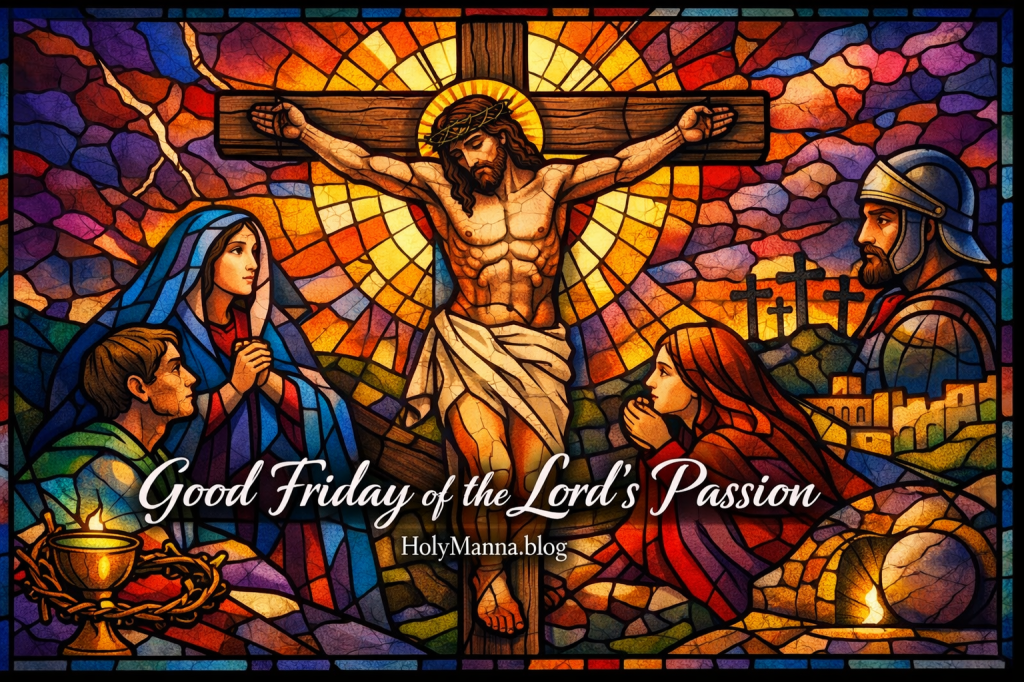
Beneath the Cross, the World Was Changed
When the Church Falls Silent
Good Friday of the Lord’s Passion is one of the holiest and most sobering days in the whole Catholic year. Strictly speaking, it is not a feast in the ordinary celebratory sense. It is a solemn day of remembrance, adoration, repentance, and love. On this day, the Church stands at Calvary and contemplates the death of Jesus Christ, the Son of God, who gave Himself for the salvation of the world.
This day matters because it reveals the cost of redemption. Good Friday is not simply about suffering. It is about the saving love of Christ. It is about the Lamb of God who takes away the sins of the world. It is about the Bridegroom who lays down His life for His Bride. It is about the High Priest who offers not the blood of animals, but His own Blood for the life of the world.
In Catholic tradition, Good Friday belongs to the Easter Triduum, the sacred span of days that begins with Holy Thursday, passes through the Passion and death of the Lord, and opens into the glory of Easter. The Church does not rush through this mystery. She slows down. She strips the altar. She enters silence. She reads the Passion. She prays for the whole world. She kneels before the Cross. Everything about the day teaches the same truth: love has gone to the very end.
The Hill Outside the City
The story behind Good Friday is the story at the center of Christianity itself. It unfolds in Jerusalem during Passover, the great Jewish feast that remembered God’s saving action in the Exodus. At precisely that moment, when Israel recalled the blood of the lamb and the deliverance of God’s people, Christ entered His Passion as the true Paschal Lamb.
The setting was tense and painful. Jerusalem was under Roman occupation. Religious authorities feared unrest. Crowds could shift quickly. Political pressure and spiritual blindness collided in a terrible way. Jesus, who had healed the sick, raised the dead, preached repentance, and revealed the mercy of the Father, was betrayed by Judas, abandoned by many of His followers, condemned by the Sanhedrin, and handed over to Pontius Pilate. Though Pilate found no true guilt in Him, he yielded to pressure and ordered Him to be crucified.
From there the story moves with heartbreaking force. Jesus was scourged, mocked, crowned with thorns, and led out to Golgotha, the Place of the Skull. There He was nailed to the Cross. The Gospels show the depth of the mystery. Human cruelty appears in full view, but so does divine mercy. Christ does not die as a helpless victim trapped by events. He offers Himself freely. As The Gospel of John makes clear, this is the hour for which He came.
The Church has always seen in these events the fulfillment of the Old Testament, especially the Suffering Servant in The Book of Isaiah. The One who was despised and rejected bore the sins of many. The One who was pierced and crushed became the source of healing. On Good Friday, the Church hears those prophecies not as distant poetry, but as the living truth of Calvary.
This is also why the Church keeps returning to the Blessed Virgin Mary on this day. She stood at the foot of the Cross in faith, sorrow, and love. Catholic tradition sees her there not as a passive bystander, but as the faithful Mother who remained united to her Son in His suffering. Good Friday is never only about the cruelty of men. It is also about the fidelity of Christ and the faithfulness of those who remain with Him.
The Cross as the Throne of Love
The theological significance of Good Friday is immense. This is the day the Church contemplates the sacrifice of Christ in its saving power. The Catechism of the Catholic Church teaches that Christ’s death is the unique and definitive sacrifice that reconciles man with God. He is priest, victim, and altar. He is the Son who obeys the Father in perfect love. He is the Redeemer who takes upon Himself the burden of sin and opens the gates of heaven.
That is why Catholics do not see the Cross as mere tragedy. Good Friday is sorrowful, but it is not hopeless. The Church does not look at Calvary and say that evil won. She looks at Calvary and sees that love endured everything and conquered from within. Christ transforms the place of execution into the place of redemption. He turns the instrument of shame into the sign of victory.
The Passion also reveals the seriousness of sin. Modern people often prefer to treat sin as weakness, dysfunction, or bad habit. Good Friday tears away those illusions. Sin wounds. Sin blinds. Sin betrays. Sin kills. Yet Good Friday also reveals something even greater. Mercy is stronger. Christ does not answer hatred with hatred. He answers it with self-giving love. He does not come down from the Cross to prove His power. He remains on the Cross to save.
The Church’s liturgy captures this mystery with remarkable depth. On Good Friday there is no Mass. The altar remains bare. The ministers enter in silence. The Passion according to Saint John is proclaimed. The solemn intercessions rise for the Church, the world, civil leaders, unbelievers, and those in need. Then the Cross is unveiled, and the faithful are invited to adore it. In one of the most moving moments in the Roman Rite, the Church sings, “Behold the wood of the Cross, on which hung the salvation of the world.”
Popes and saints have long drawn out the meaning of this day. Catholic preaching on Good Friday returns again and again to the same truth: on the Cross, Christ reveals both the justice of God and the mercy of God. He shows what sin deserves, and He shows what divine love is willing to bear. He fulfills the Father’s will, not as a crushed servant without dignity, but as the beloved Son who freely offers Himself for the life of the world.
Walking the Way of the Cross
Good Friday has inspired some of the most beloved devotions in Catholic life. The most famous is the Via Crucis, or Stations of the Cross. This devotion developed from Christian pilgrimage in the Holy Land, especially the desire to walk prayerfully in the footsteps of Christ along the road to Calvary. Over time, Catholics across the world came to pray the same mystery locally, station by station, meditating on the Passion with sorrow, gratitude, and love.
This devotion matters because it teaches the soul how to stay with Jesus. It does not let the Christian keep the Passion at a safe distance. It invites the faithful to walk, to pause, to pray, to see, and to love. It trains the heart to accompany the Lord, not only in glory, but in suffering.
Pilgrimage also has a special place in Good Friday spirituality. Jerusalem remains the great place of remembrance, especially the Via Dolorosa and the Church of the Holy Sepulchre. Catholics have long desired to pray where the Passion unfolded, to venerate the places touched by Christ’s suffering, and to unite themselves more deeply to the mystery of redemption. Yet even those who never travel to the Holy Land still make a spiritual pilgrimage on Good Friday through prayer, fasting, silence, and adoration.
The Church also encourages devotion to Our Lady of Sorrows, especially on this day. Standing with Mary beneath the Cross teaches perseverance, tenderness, and trust. She does not explain away suffering. She stays with Jesus in it. For many Catholics, this becomes a deeply personal path of prayer on Good Friday. The grieving heart of the Mother helps the faithful remain close to the pierced Heart of the Son.
At the same time, the Church keeps proper order. Popular devotions are beautiful and important, but they do not replace the liturgy of Good Friday. The solemn celebration of the Lord’s Passion remains the heart of the day. Everything else should lead back to that sacred center.
A Day That Has Shaped the World
Good Friday has left a deep mark on Catholic culture across centuries and continents. In Rome, the Pope’s Good Friday observances, especially the Via Crucis, have become a powerful witness for the universal Church. In Jerusalem, the remembrance of the Passion continues with processions and prayer in the very places sanctified by the Lord’s suffering. In Spain, Latin America, the Philippines, Italy, and many other places, Good Friday has been marked by processions, sacred music, public prayer, veiled churches, black vestments, and acts of penance.
Some cultures emphasize silence and mourning. Others emphasize solemn processions with statues of the crucified Christ and the sorrowful Mother. Some communities gather for lengthy Passion readings and ancient hymns. Others pray the Seven Last Words with preaching and reflection. In every place, though the customs may differ, the heart of the day remains the same. Christ crucified is adored as Savior and King.
Good Friday has also shaped Catholic art, preaching, poetry, and music in extraordinary ways. Crucifixes, Passion plays, lamentations, sacred motets, and meditations on the wounds of Christ have helped generations enter the mystery more deeply. The day has formed Catholic imagination. It has taught the faithful to see glory hidden in humility, strength hidden in surrender, and victory hidden in sacrifice.
There is another beautiful expression of Catholic unity tied to this day as well. The Good Friday collection for the Holy Land reminds the faithful that the places of Christ’s Passion are not merely historical memories. They remain living places of Christian witness, prayer, and need. In that way, Good Friday becomes not only a day of remembrance, but also a day of communion with the Church in the land of the Lord.
What Good Friday Means for Daily Life
Good Friday is not meant to stay in church for a few hours and then fade into the background. It asks something of the heart. It asks whether the Christian is willing to love when love is costly. It asks whether the soul will remain faithful when obedience hurts. It asks whether forgiveness will still be chosen when resentment feels easier.
The Cross teaches that suffering is not meaningless when united to Christ. That does not make pain easy. It does make it redeemable. Every hidden sacrifice, every act of patience, every honest repentance, every burden carried in grace can be joined to the Lord’s Passion. Good Friday teaches that love offered to God is never wasted.
It also teaches compassion. The Christian who stands at Calvary learns to notice the suffering of others with greater tenderness. The Lord who thirsted on the Cross is still present in the lonely, the grieving, the sick, the poor, and the forgotten. To love the Crucified Christ is to become more attentive to those who carry crosses in daily life.
Good Friday also teaches resilience. Christ endured betrayal, injustice, pain, and humiliation without turning away from the Father. That witness matters in an age that often treats discomfort as disaster and sacrifice as failure. The Cross reminds the faithful that endurance, obedience, and fidelity are not signs of weakness. In Christ, they become signs of holiness.
Most of all, Good Friday teaches trust. When Jesus cries out and then says, “It is finished,” He is not surrendering to despair. He is fulfilling the mission given to Him by the Father. The Christian life often includes seasons when God seems silent, when prayer feels heavy, and when the road looks dark. Good Friday reminds the soul that silence is not abandonment and that darkness is not the final word.
Engage with Us!
Share thoughts and reflections in the comments below. Good Friday reaches into the deepest places of the human heart, and it often speaks differently in different seasons of life. The Church invites the faithful not only to remember the Passion, but to let it shape the way life is lived every day.
- What part of the Lord’s Passion moves the heart most deeply, and why does that moment stand out?
- How does kneeling before the Cross change the way suffering, sacrifice, and love are understood in daily life?
- Where might Christ be inviting deeper trust, especially in a place of pain, disappointment, or waiting?
- How can more compassion be shown to someone carrying a heavy cross right now?
- What would it look like to live this week with the self-giving love that Jesus revealed on Calvary?
Stay close to the Cross. Remain faithful in prayer. Love with courage. Forgive with generosity. Live a life of faith, and do everything with the love and mercy Jesus taught us.
Jesus Christ, Our God and Lord, have mercy on us!
Follow us on YouTube, Instagram and Facebook for more insights and reflections on living a faith-filled life.

 Holy Manna!
Leave a comment