From the Depths of Sin to the Heights of Sanctity
Saint Mary of Egypt is one of the most unforgettable saints in Christian tradition because her whole life tells a story of radical conversion. She is revered as a great penitent, a desert saint, and a living witness that no one is beyond the mercy of God. When the Church remembers her, it is not because she lived a comfortable or respectable life from the beginning. It is because grace reached into the wreckage of her soul and made something beautiful.
She is especially beloved in Catholic tradition as a model of repentance, chastity restored by grace, and complete surrender to God. Her story has been treasured for centuries in both East and West, and Eastern Catholic Christians hold her up in a special way during Lent as a shining example of what true repentance looks like. Saint Mary of Egypt matters because she speaks to people who feel ashamed of their past, trapped by old sins, or convinced that holiness belongs only to other people. Her life says the exact opposite.
The Long Road to Conversion
Mary was born in Egypt, and the ancient tradition says that she left home around the age of twelve and went to Alexandria. There she fell into a deeply sinful life and remained in it for many years. Catholic sources do not hide that part of her story. In fact, they preserve it because her holiness makes no sense unless the depth of her conversion is understood.
She is most known for having lived in grave sexual sin before becoming one of the Church’s most striking saints of repentance. That alone makes her story powerful. It is not the story of someone who merely cleaned up a few bad habits. It is the story of a soul completely overturned by grace.
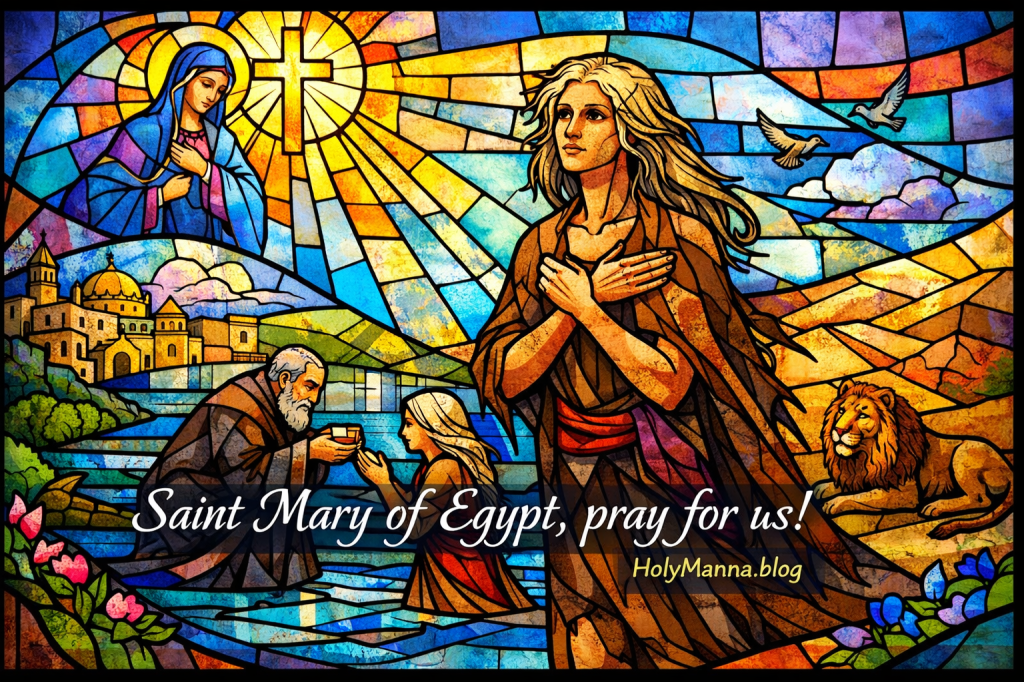
The great turning point came when she traveled to Jerusalem around the feast of the Exaltation of the Holy Cross. She had not gone there out of devotion. But when she tried to enter the church, she found herself unable to cross the threshold. An invisible force seemed to stop her. Again and again she tried, and again and again she was held back. In that moment, she understood that her sins had made her spiritually unfit to enter.
That realization broke her open. She turned in sorrow to the Blessed Virgin Mary and begged for help. After that prayer, she was finally able to enter the church, venerate the Holy Cross, and begin a new life. Tradition preserves a heavenly message connected with that moment: “If you cross the Jordan, you will find glorious rest.”
That single moment changed everything. A woman who had spent years running toward sin now began to run toward God.
Forty-Seven Years in the Desert
After her conversion, Mary went to the Jordan, received Holy Communion at a church dedicated to Saint John the Baptist, crossed the river, and entered the desert. There she remained for forty-seven years in solitude, prayer, fasting, and penance.
This is the part of her life that often stuns people. She did not merely repent for a few days and then return to ordinary routines. She gave herself entirely to God. She embraced a hidden life in the wilderness, stripped of earthly comforts, human applause, and worldly pleasure. The Church remembers her not only because she turned away from sin, but because she turned toward holiness with her whole being.
Saint Mary of Egypt is important because she shows what repentance really means. Repentance is not just feeling bad. It is a total reorientation of life. It is the heart learning to love God more than sin. Her life puts flesh on what The Catechism of the Catholic Church teaches about conversion and penance in CCC 1427 and CCC 1431. True repentance is interior first, but it bears visible fruit in how a person lives.
Several extraordinary signs are associated with her life. The first is the invisible force that kept her from entering the church before her repentance. The second is the guidance she received after praying to the Blessed Virgin Mary. Later, when the monk Zosimas encountered her in the desert, tradition says she knew his name and knew that he was a priest before he told her. That supernatural knowledge revealed the depth of her union with God.
One of the most famous miracles connected to her life happened when Zosimas returned to bring her Holy Communion. She was standing on the far side of the Jordan River, yet she crossed the water after making the sign of the cross in order to receive the Eucharist. That moment has been remembered for centuries because it unites two great truths of the Catholic faith. Grace transforms the sinner, and the Eucharist is the food of the saints.
After receiving Our Lord, she prayed the words of Simeon from Luke 2:29: “Now thou dost dismiss thy servant, O Lord.” These words have stayed with the Church because they show the peace of a soul ready to die in friendship with God.
Her Hardships Were Real, Even Without Martyrdom
Saint Mary of Egypt was not a martyr in the strict sense. She did not die by execution for the faith. But her life was filled with hardship, and her penance was severe. The desert was not romantic. It was harsh, lonely, and unforgiving. She endured deprivation, exposure, hunger, isolation, and the long purification of a soul that had once been deeply attached to sin.
That matters because some people imagine sanctity as something soft and easy. Her life reveals that sanctity often involves struggle. Grace is free, but conversion is costly. The old self must die so that the new self can live in Christ.
Even so, her hardships were not meaningless suffering. They became a path of purification. Her life illustrates what the Church teaches in CCC 1434, that penance can be expressed in fasting, prayer, and works of self-denial. Saint Mary did not punish herself out of despair. She offered her life to God out of love, contrition, and hope.
Her final earthly trial came in silence. When Zosimas returned the next year, he found her dead. Tradition says she had already gone to the Lord. Beside her was the request that he bury her body.
Wonder, Veneration, and the Saint’s Legacy After Death
One of the most memorable stories connected to her death is that a lion came and helped Zosimas dig her grave. The tradition has long preserved this detail as a sign of God’s favor toward her and of creation itself honoring a soul made holy. It cannot be historically verified in a modern documentary sense, but it belongs to the ancient sacred tradition surrounding her death and has remained part of her story in Catholic memory.
After her death, her legacy only grew. Her Life was preserved and passed on through the Christian world, and it became one of the Church’s great stories of repentance. She came to be honored not simply as a former sinner, but as a saint whose life offered hope to generations of penitents.
Her impact after death was spiritual, liturgical, and cultural. Eastern Catholics especially revere her during Lent, and her story is read in connection with the Great Fast as a call to deep conversion. She is held up as the classic model of repentance. In that sense, her life is not just remembered. It is proclaimed to the faithful as a lesson for the soul.
Her story also shaped Christian culture far beyond the desert. It entered medieval tradition and became widely known through saintly literature, including The Golden Legend. Through preaching, liturgical remembrance, iconography, and devotional reading, Saint Mary of Egypt became one of the best-known penitents in all of Christian memory.
Older Catholic sources also note that relics associated with her were venerated in places such as Rome, Naples, Cremona, and Antwerp. Those traditions of relic veneration are part of her posthumous legacy, although the historical details surrounding specific relics are not always easy to verify with certainty.
There are no securely verified personal writings from Saint Mary of Egypt. The words associated with her come through the ancient account of her life. Still, the lines preserved in that tradition have endured because they summarize her whole spiritual journey. The woman who once lived for pleasure became the woman who sought only rest in God.
What Saint Mary of Egypt Teaches the Soul Today
There is something deeply comforting about Saint Mary of Egypt. She destroys the lie that a person is permanently defined by past sin. Her life says that Christ can restore what has been wrecked, purify what has been defiled, and sanctify what once seemed lost.
That lesson matters now just as much as it did in her own age. Many people carry shame. Many quietly fight sins of impurity, habits of self-destruction, or memories they wish they could erase. Saint Mary of Egypt stands as a saint for all of them. She reminds the faithful that repentance is not humiliation before a cruel God. It is the return to a merciful Father.
Her life also teaches that chastity is possible through grace. The Catechism teaches in CCC 2337 and CCC 2340 that chastity is not repression, but the successful integration of sexuality within the person through self-mastery and God’s help. Saint Mary did not heal herself. God healed her, and she cooperated with that grace completely.
Her example invites serious self-examination. What part of life still resists God’s mercy? What old wound or sinful pattern has been quietly excused instead of surrendered? What would it look like to stop merely regretting sin and begin truly repenting of it?
Her story also encourages practical action. Go to confession. Return to prayer. Fast with purpose. Ask for the intercession of the Blessed Virgin Mary. Receive the Eucharist with reverence and hunger. Stop assuming holiness is for someone else. The saint in the desert says otherwise.
Engage with Us!
Share thoughts and reflections in the comments below. Saint Mary of Egypt’s story has moved Christians for centuries, and it is the kind of story that can stir honest conversation about sin, mercy, healing, and hope.
- What part of Saint Mary of Egypt’s conversion speaks most strongly to the heart?
- Why is it important that the Church remembers not only her sins, but even more her repentance?
- How does her story challenge modern ideas about freedom, desire, and happiness?
- What can be learned from her love for penance, prayer, and the Eucharist?
- Where might God be asking for a deeper conversion today?
Saint Mary of Egypt proves that no life is too broken for grace. The same Jesus who called sinners in the Gospel still calls them now. Live with courage, repent with honesty, and do everything with the love and mercy Jesus taught us.
Saint Mary of Egypt, pray for us!
Follow us on YouTube, Instagram and Facebook for more insights and reflections on living a faith-filled life.

 Holy Manna!
Leave a comment