The Saint Who Chose to Be the Least
Saint Francis of Paola is one of those saints who seems to step out of another age and yet speaks with surprising force to the modern soul. He was a hermit, a founder, a miracle worker, a counselor of kings, and a fierce lover of poverty and penance. He is revered in Catholic tradition because his life showed what happens when a man stops trying to be important and starts trying to belong entirely to God.
He is best known as the founder of the Order of Minims, a religious family built on humility, prayer, fasting, and the desire to be the least in the household of Christ. Even the name of the Order says something powerful. “Minims” means the least. That alone tells the story of the man. Francis did not want greatness in the world’s eyes. He wanted littleness before God.
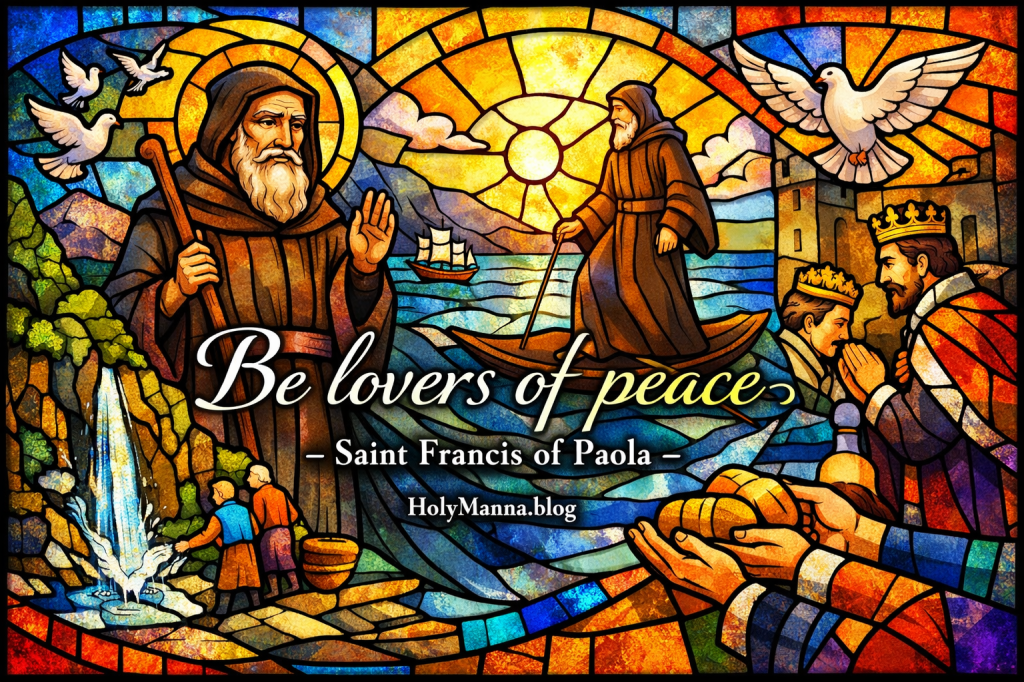
Catholic tradition also remembers him as a wonder worker, especially through stories of healings, prophecy, multiplication of food, and the famous account of his crossing the sea on his cloak. He is honored as a protector of the poor and is especially loved in Calabria, in Italy, where his memory still runs deep. He later became known as the patron of Italian seafarers. His witness remains compelling because it was never built on comfort, applause, or power. It was built on prayer, sacrifice, and love.
From a Promised Child to a Man of Prayer
Francis was born on March 27, 1416, in Paola, in Calabria, in southern Italy. His parents were devout Catholics who had long prayed for a child. According to Catholic tradition, they asked for the intercession of Saint Francis of Assisi, and when their son was born, they named him Francis in gratitude.
As a child, he suffered from a serious eye illness. His parents made a vow that if he were healed, he would spend a year wearing the habit of the Franciscans. He recovered, and later that vow was fulfilled when he was sent to a Franciscan house at San Marco Argentano. That season of life seems to have deepened what was already growing in him. He was drawn to silence, prayer, and self-denial from an early age.
After his time with the Franciscans, he made pilgrimages with his parents to important holy places, including Rome, Assisi, Montecassino, and Loreto. One moment from that journey has remained especially memorable in Catholic tradition. When Francis saw the luxury and excess around him in Rome, he is remembered as saying, “Our Lord was not like that.” That short line reveals something essential about him. Even as a young man, he already knew that Christ is not found in vanity, display, or worldly splendor, but in humility, sacrifice, and truth.
Francis eventually returned to Calabria and withdrew into solitude. He lived as a hermit, first in a hidden place near his family’s land and then in a cave by the sea. This was not the isolation of a bitter man running from the world. It was the withdrawal of a soul seeking God with undivided love. People began to notice his holiness. Soon others came to live near him, desiring to follow the same path of penance and prayer. What began in silence slowly became the seed of a new religious order.
The Least in the House of God
As Francis’s reputation grew, so did the little community around him. In time, a monastery and church were established, and the Church gave recognition to the new way of life forming around him. This would become the Order of Minims.
What made Francis different was not simply that he practiced penance, since many saints did that. It was the depth of his conviction that the Christian life must be rooted in humility, conversion, and self-denial. The Minims embraced a very austere life. Their spirituality was marked by prayer, poverty, simplicity, and a kind of permanent Lenten spirit. Their way of life eventually included a distinctive fourth vow, a commitment to live a perpetual Lenten observance through strict abstinence.
This can sound severe to modern ears, but Francis was not in love with suffering for its own sake. He understood something the Church never stops teaching. The human heart must be turned back to God. The Catechism reminds the faithful that “interior repentance is a radical reorientation of our whole life” CCC 1431. Francis lived that truth in a striking way. His penance was not performance. It was love purified. It was a refusal to let the flesh rule the soul. It was a cry that said God alone is enough.
He became known not just for founding the Minims, but for being a fearless spiritual father. He loved the poor, corrected the powerful, and called people to conversion without softening the Gospel. He was not interested in religious appearance. He wanted holiness.
Wonders Along the Way
Catholic tradition preserves many miracles from the life of Saint Francis of Paola. Some are better rooted in longstanding devotional memory than in strict historical proof, but all of them help show how the faithful came to understand his sanctity.
One of the earliest wonders tied to his life was his healing as a child from the eye illness that had frightened his parents. Later stories tell of his multiplication of bread during a time of need, especially to feed workers and the poor. These stories fit well with the way holy men and women often become instruments of God’s providence. The Lord who fed Israel in the desert and multiplied loaves in The Gospel of Matthew still cares for bodily hunger as well as spiritual hunger.
Another cherished story tells of Francis striking a rock with his staff and bringing forth a spring for those in need. The spring of Cucchiarella became part of his living memory in Calabria. There are also accounts of healings worked through his prayer, along with stories that he could read consciences or foresee future events.
The most famous miracle associated with him is the account that he crossed the Strait of Messina on his cloak after a boatman refused to take him across. Catholic tradition has loved this story for centuries. It is one of the reasons he became so associated with the sea and was later named patron of Italian seafarers. It cannot be verified with modern historical certainty, but it remains one of the best-known miracle stories attached to his name.
There is also a powerful story about his confrontation with corrupt wealth. One tradition says that when a ruler offered him money taken from the suffering of the people, Francis broke open a coin and blood flowed from it, revealing the injustice behind the gift. This story too cannot be verified with certainty, but it captures something deeply true about how the Church remembers him. Francis did not flatter the rich. He defended the poor.
Trials, Opposition, and the Weight of Holiness
Saint Francis of Paola was not a martyr in the formal sense, but he did endure hardship. Any saint who refuses compromise will face resistance, and Francis was no exception. He rebuked abuses, confronted moral corruption, and lived a kind of austerity that made comfortable people uneasy.
His greatest hardship may have been the burden of obedience. When King Louis XI of France, sick and afraid of death, begged for Francis to come to him, Francis did not rush toward the royal court. He resisted. He preferred hiddenness. He preferred his poor life of prayer. But the Pope commanded him to go, and so he obeyed.
This is one of the most beautiful parts of his story. A man who loved solitude was sent into politics, court life, and royal pressure. He did not seek influence, but obedience took him there. When he arrived in France, the king himself knelt before him. Francis did not miraculously cure the king’s body, but he did bring a deeper kind of healing. He helped prepare souls, soften hearts, and strengthen relations between France and the Holy See.
He stayed in France for many years, guiding people from every rank of life. He remained a poor man in spirit even while moving among the powerful. That may be one of the clearest signs of sanctity in his life. He entered places of honor without becoming worldly. He stayed little.
A Death Marked by the Passion of Christ
In his final months, Francis prepared quietly for death. Catholic tradition remembers that on Holy Thursday he exhorted his brothers to love one another and remain faithful to the demanding life they had embraced. On Good Friday, after receiving the sacraments, he asked that the Passion according to Saint John be read.
He died on April 2, 1507, while listening to that sacred reading.
It is hard not to feel the beauty of that moment. The man who had spent his life preaching penance and clinging to Christ died with the Passion in his ears. That kind of death does not happen by accident. It is the fruit of a whole life shaped by grace.
Signs, Relics, and a Legacy That Did Not Fade
Saint Francis of Paola was canonized in 1519 by Pope Leo X, only twelve years after his death. That alone shows how widespread and strong his reputation for holiness had become.
Catholic tradition also records striking events connected to his body after death. During the violence of the sixteenth century, his tomb was opened by Huguenots, and his body was reportedly found incorrupt before it was burned. Some relics were said to have been preserved and later venerated. The report of incorruption is part of his devotional history, though the details cannot now be fully verified.
His memory lived on not only through relics and miracle stories, but through the Order he founded. The Minims spread into France, Spain, Germany, and other lands. Their witness kept alive Francis’s call to humility, penance, and simplicity.
His impact remained especially strong in Calabria. He is loved there not as a distant historical figure, but almost as a father of the people. Processions, local devotions, pilgrimages, and feast celebrations have kept his name alive across centuries. In Paola, where his presence is especially cherished, his liturgical memory is often celebrated with special joy on May 1, the anniversary of his canonization, especially when April 2 falls in Holy Week or Lent.
He has also had a broader cultural impact in Italy. His connection with the sea made him a beloved protector of sailors and seafaring communities. That patronage fits him well. He was a man who trusted God in dangerous waters, whether literally or spiritually.
A few sayings linked to him have endured. Among the most cherished are “Be lovers of peace” and “Turn to Him with a sincere heart.” These lines are simple, but they feel like his whole life in miniature. Peace, sincerity, humility, and God-centeredness were not decorations in his spirituality. They were the core.
What This Saint Still Teaches the Church
Saint Francis of Paola speaks strongly to a culture obsessed with image, comfort, status, and control. He reminds the faithful that holiness does not begin with self-expression. It begins with surrender. It begins with repentance. It begins with letting Christ strip away the false self.
His life also teaches that penance is not gloomy. It is freeing. When rightly understood, it is not hatred of the body, but the ordering of life toward God. The Catechism teaches that the way of perfection passes by way of the Cross CCC 2015. Francis believed that with all his heart. He knew that the soul grows strong when it stops making excuses and starts choosing love through sacrifice.
There is also something deeply consoling in the way he lived humility. He was a miracle worker who called himself little. He advised kings without becoming impressed by kings. He founded an order and still wanted the lowest place. That is the kind of humility the Gospel praises. Not false modesty, but truth.
What would it look like to stop chasing importance and start chasing holiness? What habits of comfort have made the soul spiritually weak? Where is Christ inviting a deeper repentance, a truer simplicity, or a more courageous love for the poor?
His example can be lived in ordinary ways. Choose prayer before distraction. Practice voluntary sacrifice without making a show of it. Speak truth without cruelty. Refuse the lie that success means being admired. Stay close to the Eucharist. Stay close to confession. Make room for silence. Learn to love being hidden.
That is the road Saint Francis of Paola walked. It is still open.
Engage With Us!
Share your thoughts and reflections in the comments below. Saint Francis of Paola has a way of challenging comfortable Christianity, and that kind of witness can stir something deep in the heart.
- What stands out most in Saint Francis of Paola’s life: his humility, his penance, his miracles, or his courage before the powerful? Why?
- How can a spirit of holy simplicity be practiced in daily life without becoming harsh or prideful?
- What is one concrete act of prayer, sacrifice, or charity that could help deepen faith this week?
- Does Saint Francis’s desire to be “the least” challenge the way success or importance is usually measured? In what way?
- How does his life help show that real reform in the Church begins with personal holiness?
Saint Francis reminds the faithful that the strongest souls are often the humblest ones. May his witness encourage a life of prayer, sacrifice, mercy, and courage. Live with faith, love with sincerity, and do everything with the love and mercy Jesus taught us.
Saint Francis of Paola, pray for us!
Follow us on YouTube, Instagram and Facebook for more insights and reflections on living a faith-filled life.

 Holy Manna!
Leave a comment