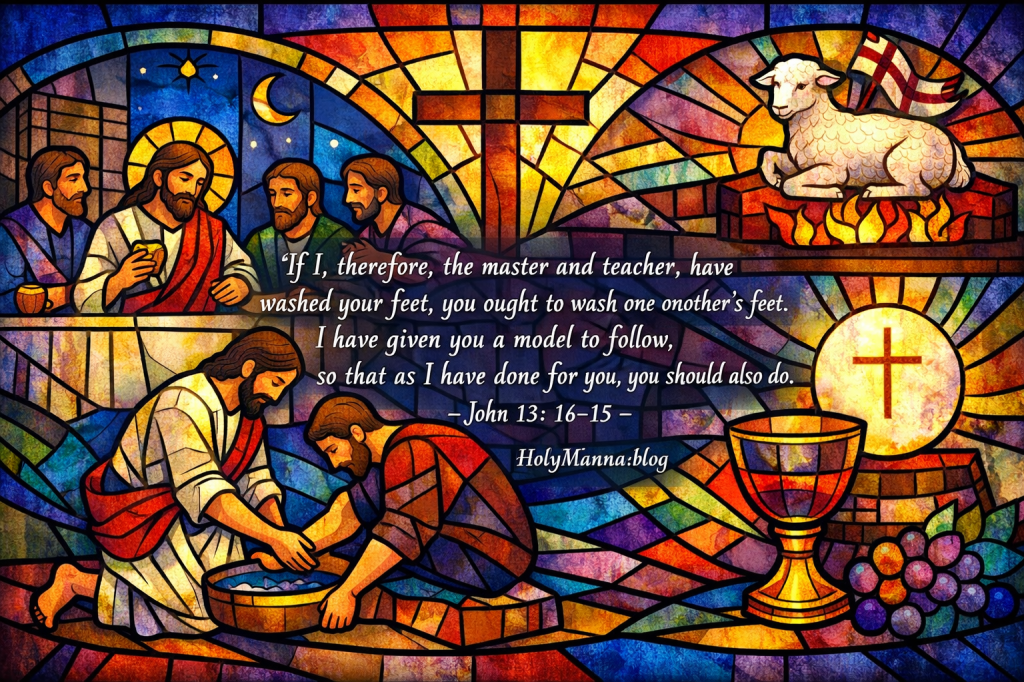
Holy Thursday – Mass of the Lord’s Supper – Lectionary: 39
Love to the End at the Table of the New Passover
There is something deeply moving about Holy Thursday because the Church invites every soul into the upper room, where love begins to speak in signs that are impossible to forget. Tonight’s readings are bound together by one radiant theme: Christ gives Himself completely so His people may be delivered, nourished, and taught how to love. The Passover lamb in Exodus 12 points forward to Jesus. The cup of thanksgiving in Psalm 116 begins to glow with Eucharistic meaning. Saint Paul in 1 Corinthians 11 hands on the mystery of the Lord’s Supper, and in John 13 the same Lord kneels to wash feet. Everything converges in one truth: “He loved them to the end.”
This night carries the weight of memory and fulfillment. For Israel, Passover was the night of rescue, when the blood of the lamb marked God’s people and the Lord led them out of slavery. It was not only a historical event, but a sacred memorial that shaped the identity of the covenant people for generations. On Holy Thursday, the Church sees that ancient feast brought to completion in Jesus Christ. He is the true Lamb without blemish. He gives not the blood of another creature, but His own. He does not merely free His people from Pharaoh, but from sin and death. That is why this Mass is so rich and solemn. It is the night when the Church remembers the institution of the Eucharist, the priesthood, and the commandment of humble charity, all flowing from the Heart of Christ.
These readings prepare the soul to see that the altar and the towel belong together. The Body given and the feet washed reveal the same divine love. Jesus does not feed His disciples from a distance. He draws near, serves, stoops, and gives Himself as food. Holy Thursday reminds the Church that worship is never separated from sacrifice, and communion is never separated from charity. The Lord who says “This is my body” is the same Lord who says, in action, that His disciples must learn to pour themselves out for one another. How is the Lord teaching the heart to receive His love and then become a servant of that same love for others?
First Reading – Exodus 12:1-8, 11-14
Marked by the Blood, Fed for the Journey
The first reading opens in the tense darkness of Egypt, on the very edge of judgment and deliverance. Israel is still enslaved. Pharaoh still resists. The Lord has already shown His power through mighty signs, yet the decisive night has now arrived. In this moment, God does not merely announce that He will save His people. He gives them a ritual to live, a meal to eat, and a memorial to keep. That matters because biblical salvation is never reduced to ideas alone. It comes through covenant, sacrifice, obedience, and worship.
For ancient Israel, Passover became the defining event of national and religious identity. This was the night when the Lord distinguished His people, spared them through the blood of the lamb, and prepared them to leave the house of bondage. For the Church on Holy Thursday, this reading shines with even greater light. The lamb without blemish points toward Christ. The blood on the doorposts points toward the Blood of the Cross. The sacred meal points toward the Eucharist. The command to remember points toward the liturgical memorial by which the Church enters the saving mystery of Christ. Today’s theme comes into focus here: the Lord saves His people not from a distance, but by giving them a sacrifice and a meal that lead them from slavery into communion.
Exodus 12:1-8, 11-14 – New American Bible (Revised Edition)
The Passover Ritual Prescribed. 1 The Lord said to Moses and Aaron in the land of Egypt: 2 This month will stand at the head of your calendar; you will reckon it the first month of the year. 3 Tell the whole community of Israel: On the tenth of this month every family must procure for itself a lamb, one apiece for each household. 4 If a household is too small for a lamb, it along with its nearest neighbor will procure one, and apportion the lamb’s cost in proportion to the number of persons, according to what each household consumes. 5 Your lamb must be a year-old male and without blemish. You may take it from either the sheep or the goats. 6 You will keep it until the fourteenth day of this month, and then, with the whole community of Israel assembled, it will be slaughtered during the evening twilight. 7 They will take some of its blood and apply it to the two doorposts and the lintel of the houses in which they eat it. 8 They will consume its meat that same night, eating it roasted with unleavened bread and bitter herbs.
11 This is how you are to eat it: with your loins girt, sandals on your feet and your staff in hand, you will eat it in a hurry. It is the Lord’s Passover. 12 For on this same night I will go through Egypt, striking down every firstborn in the land, human being and beast alike, and executing judgment on all the gods of Egypt—I, the Lord! 13 But for you the blood will mark the houses where you are. Seeing the blood, I will pass over you; thereby, when I strike the land of Egypt, no destructive blow will come upon you.
14 This day will be a day of remembrance for you, which your future generations will celebrate with pilgrimage to the Lord; you will celebrate it as a statute forever.
Detailed Exegesis
The reading unfolds with a holy precision. Every command matters. Every image prepares the soul for the mystery fulfilled in Christ.
Verse 1. “The Lord said to Moses and Aaron in the land of Egypt:”
The reading begins with divine initiative. Israel’s liberation starts not with human strategy, but with God’s word. Moses and Aaron receive revelation in the very place of oppression. That is already a consolation for the faithful. God does not wait until His people have escaped before speaking. He speaks in the middle of affliction. In Catholic reading, this verse reminds the soul that grace always begins with God. The covenant is not invented from below. It is received from above.
Verse 2. “This month will stand at the head of your calendar; you will reckon it the first month of the year.”
God is not only rescuing individuals. He is reshaping time itself for His people. Their calendar will now revolve around redemption. Passover becomes the beginning of a new existence. This is deeply important for Holy Thursday. In Christ, the Church also receives a new center for time and life. The Paschal Mystery becomes the axis around which Christian worship turns. Redemption is so decisive that it becomes a new beginning.
Verse 3. “Tell the whole community of Israel: On the tenth of this month every family must procure for itself a lamb, one apiece for each household.”
Passover is communal, not private. The whole people must take part. Each household receives a lamb, because salvation enters the home, the family, the concrete life of the people. The lamb is not an abstract symbol. It is chosen, held, and prepared. This helps reveal why the Church sees Christ here. The Lord does not save humanity in a vague spiritual way. He enters the household of the human family and gives Himself concretely.
Verse 4. “If a household is too small for a lamb, it along with its nearest neighbor will procure one, and apportion the lamb’s cost in proportion to the number of persons, according to what each household consumes.”
This verse reveals both realism and communion. No family is meant to stand alone. If one household is too small, it joins with another. Salvation is not lived in isolation. God’s covenant gathers people together. There is also a subtle tenderness here. The Lord provides in a way fitted to the people’s actual need. This anticipates the ecclesial shape of redemption. The faithful are saved into a people. Holy Thursday will likewise show that the Eucharist forms communion, not religious individualism.
Verse 5. “Your lamb must be a year-old male and without blemish. You may take it from either the sheep or the goats.”
The lamb must be without blemish because the offering belongs to God. In the Old Covenant, this expressed wholeness, purity, and fitness for sacrifice. In the New Covenant, the Church sees the perfection of Christ. He alone is the spotless Lamb, wholly innocent, wholly offered, wholly pleasing to the Father. This verse also teaches that true worship is not casual. God is not given leftovers. He is given what is whole.
Verse 6. “You will keep it until the fourteenth day of this month, and then, with the whole community of Israel assembled, it will be slaughtered during the evening twilight.”
The lamb is not taken and immediately consumed. It is kept, watched, then sacrificed at the appointed time. There is solemn preparation before immolation. The whole community is involved, because covenant sacrifice concerns the whole people. In the light of Christ, this verse grows more profound. Jesus enters Jerusalem, is seen, examined, and then offered at the appointed hour. Redemption unfolds according to divine timing, not human accident.
Verse 7. “They will take some of its blood and apply it to the two doorposts and the lintel of the houses in which they eat it.”
The blood marks the place of belonging. It is not magic. It is a covenant sign of trustful obedience. The Israelites do what God commands, and the blood becomes the visible sign that they are under His protection. Catholic tradition sees here a powerful image of the Blood of Christ. The faithful are not spared because they are naturally better than others. They are spared because they are covered by the saving blood of the true Lamb. The home marked by blood becomes a place of mercy.
Verse 8. “They will consume its meat that same night, eating it roasted with unleavened bread and bitter herbs.”
The lamb must not only be slain. It must be eaten. This is one of the most important details in the passage. Passover is both sacrifice and meal. God’s people do not merely witness deliverance. They partake in it. The unleavened bread recalls haste and readiness. The bitter herbs keep memory honest by recalling the bitterness of slavery. This is why Holy Thursday reads this text so powerfully. Christ is not only sacrificed. He is given as food. The new Passover is likewise sacrificial and Eucharistic.
Verse 11. “This is how you are to eat it: with your loins girt, sandals on your feet and your staff in hand, you will eat it in a hurry. It is the Lord’s Passover.”
Passover is a meal for pilgrims. The people must be ready to move because God is about to act. Their posture teaches watchfulness, detachment, and trust. Salvation is not a comfortable arrangement with Egypt. It is an exodus out of bondage. The Christian life has the same structure. The faithful cannot receive the mysteries of Christ and then settle back into slavery to sin. Holy Thursday prepares the Church not for complacency, but for a journey through Cross, tomb, and Resurrection.
Verse 12. “For on this same night I will go through Egypt, striking down every firstborn in the land, human being and beast alike, and executing judgment on all the gods of Egypt, I, the Lord!”
This verse reveals the seriousness of the moment. God’s judgment falls not only on Egypt’s people but on Egypt’s false gods. The plagues expose the emptiness of idols and the sovereignty of the true God. Passover is therefore not merely political liberation. It is a theological victory. The Lord proves that no earthly power, no false worship, and no tyrant can withstand Him. In the Christian fulfillment, Christ’s Pasch likewise judges the idols of every age, including pride, pleasure, self-sufficiency, and the false freedoms that keep souls enslaved.
Verse 13. “But for you the blood will mark the houses where you are. Seeing the blood, I will pass over you; thereby, when I strike the land of Egypt, no destructive blow will come upon you.”
This is the heart of the passage. The blood marks out a people for mercy. The Lord does not say He will pass over because Israel is strong. He says He will pass over when He sees the blood. This is a stunning anticipation of salvation in Christ. The Church lives under the Blood of the Lamb. The faithful are saved because the Son gives Himself for them. The Passover sign becomes a prophecy of the Cross.
Verse 14. “This day will be a day of remembrance for you, which your future generations will celebrate with pilgrimage to the Lord; you will celebrate it as a statute forever.”
Passover must be remembered, celebrated, and handed on. Israel is not told simply to think back fondly on what once happened. The people are commanded to keep the feast so that each generation may live within the memory of God’s saving action. This lays the groundwork for Catholic understanding of memorial. In Scripture, remembrance is living, liturgical, and transformative. The Church hears in this verse an echo that will resound in the Upper Room when Christ says, “Do this in remembrance of me.”
Teachings
This reading is one of the great foundation stones of salvation history. It shows that God rescues His people through a sacrificial lamb, through blood, through a sacred meal, and through a memorial that must be kept across generations. That is exactly why the Church proclaims it on Holy Thursday. The old Passover was real, holy, and powerful, but it was also prophetic. It was preparing the world for Jesus Christ.
The Catechism makes that connection beautifully in CCC 608: “After agreeing to baptize him along with the sinners, John the Baptist looked at Jesus and pointed him out as the ‘Lamb of God, who takes away the sin of the world’. By doing so, he reveals that Jesus is at the same time the suffering Servant who silently allows himself to be led to the slaughter and who bears the sin of the multitudes, and also the Paschal Lamb, the symbol of Israel’s redemption at the first Passover. Christ’s whole life expresses his mission: ‘to serve, and to give his life as a ransom for many.’” The lamb in Exodus is therefore not the final answer. It is a divinely given sign that reaches its full meaning in Christ.
That same truth appears again in CCC 1340: “By celebrating the Last Supper with his apostles in the course of the Passover meal, Jesus gave the Jewish Passover its definitive meaning. Jesus’ passing over to his father by his death and Resurrection, the new Passover, is anticipated in the Supper and celebrated in the Eucharist, which fulfills the Jewish Passover and anticipates the final Passover of the Church in the glory of the kingdom.” Holy Thursday is the night when the old and new meet. The ancient memorial is not discarded. It is fulfilled.
The Church also teaches in CCC 1363: “In the sense of Sacred Scripture the memorial is not merely the recollection of past events but the proclamation of the mighty works wrought by God for men. In the liturgical celebration of these events, they become in a certain way present and real. This is how Israel understands its liberation from Egypt: every time Passover is celebrated, the Exodus events are made present to the memory of believers so that they may conform their lives to them.” That helps explain why Exodus 12 matters so much tonight. The Passover was always meant to shape the life of God’s people, not simply sit in the past.
The early Church Fathers loved this reading because they saw Christ everywhere in it. Saint Melito of Sardis preached with remarkable clarity: “He freed us from the slavery of the devil, just as he had freed Israel from the hand of Pharaoh; and he has marked our souls with the signs of his own blood. He has brought us from slavery to freedom, from darkness to light, from death to life, from tyranny to an eternal kingdom. He is the Passover of our salvation.” That is not poetic exaggeration. It is the Catholic reading of the Old Testament. Christ is the fulfillment hidden within the figure.
Pope Benedict XVI expressed the same truth with great force when he said: “Jesus celebrated the Passover without a lamb and without a temple; yet, not without a lamb and not without a temple. He himself was the awaited Lamb, the true Lamb.” He went on to say, “Only in this way did the ancient Passover acquire its true meaning.” That is exactly what this reading invites the faithful to see. The lamb in Egypt was real, but Christ is the reality to which it pointed.
Historically, this reading also belongs to a people under oppression, a people being formed into a covenant nation by divine worship. The Lord does not free Israel first and worship later. He forms them through worship as He frees them. That remains a deeply Catholic lesson. Right worship is not decoration added after salvation. It is part of the way God draws His people into covenant life.
Reflection
This reading still speaks with surprising force because many souls know what slavery feels like, even if Egypt now looks different. For some, Egypt is habitual sin. For others, it is fear, compromise, bitterness, impurity, envy, or the quiet despair of trying to live without real hope. Exodus 12 reminds the heart that God does not negotiate with slavery forever. He comes to deliver, and His deliverance is not vague. He gives His people a lamb, a meal, a sign, and a way forward.
The first lesson is to take sin seriously. Egypt was not a minor inconvenience for Israel. It was bondage. In the same way, the Christian life cannot treat sin as a personality quirk or a manageable side issue. Holy Thursday begins with the reminder that redemption costs blood. That alone should restore reverence and holy fear.
The second lesson is to live under the Blood of the Lamb. The Israelites were spared because they trusted God enough to do what He commanded. The Christian must also live in obedient trust. This means clinging to Christ, returning to confession when stained by sin, approaching the Eucharist with faith, and refusing the lie that self-salvation is possible.
The third lesson is to eat like a pilgrim. God told Israel to eat ready for the road. The faithful today must receive grace in the same spirit. The Christian is not meant to settle comfortably in the old life. There must be movement away from what enslaves and toward what is holy. This often begins with concrete decisions. A soul may need to forgive someone at last. A family may need to restore prayer at home. A man may need to cut off a sinful habit. A woman may need to stop living under fear and begin trusting the Lord’s providence.
The fourth lesson is to remember rightly. Passover was a memorial meant to shape generations. Catholic life also depends on holy memory. The faithful forget too easily. That is why the Church keeps feasts, celebrates the sacred liturgy, and returns again and again to the mysteries of Christ. The soul is strengthened by remembering what God has done and allowing that remembrance to become obedience.
What Egypt is the Lord asking the heart to leave behind tonight?
Is there real trust in the Blood of Christ, or only admiration from a distance?
Is the life of faith being lived like a pilgrim on the move, or like someone trying to stay comfortable in the land of bondage?
What would it look like this week to live as someone truly marked by the Lamb?
Holy Thursday begins here, with a lamb, a door marked in blood, and a people standing ready in the night. The reading prepares the soul to recognize Jesus more clearly. He is not one more religious teacher offering advice. He is the true Passover. He is the Lamb without blemish. He is the One who leads His people out, feeds them for the journey, and teaches them to remember until the night of slavery gives way to the dawn of freedom.
Responsorial Psalm – Psalm 116:12-13, 15-18
The Cup Lifted in Gratitude Before the God Who Saves
There is something quietly beautiful about this psalm on Holy Thursday. After the solemn weight of the Passover in Exodus 12, the Church places on the lips of her children a prayer of gratitude, reverence, and covenant fidelity. Psalm 116 is a song of thanksgiving from someone who knows he has been rescued by the Lord and now asks the only fitting question: “How can I repay the Lord for all the great good done for me?” That question sits right at the heart of tonight’s mystery.
In the religious life of Israel, this psalm belonged to the language of grateful worship. It carries the atmosphere of sacrifice, public praise, vows made before the community, and confidence that the Lord sees the lives of His faithful ones with tenderness. Jewish tradition also associates Psalms 113 to 118 with the Hallel, the psalms of praise sung at Passover and other great feasts. That gives this passage a deep Holy Thursday resonance. On the night when Jesus institutes the Eucharist, the Church hears Israel’s ancient thanksgiving psalm and recognizes that its words now shine with greater meaning. The “cup of salvation” is no longer only an image of gratitude. In the light of the Upper Room, it points toward the chalice of the new covenant. This fits beautifully into today’s central theme. Christ loves His own to the end, and the proper answer of the redeemed heart is gratitude, worship, fidelity, and self-offering.
Psalm 116:12-13, 15-18 – New American Bible (Revised Edition)
12 How can I repay the Lord
for all the great good done for me?
13 I will raise the cup of salvation
and call on the name of the Lord.15 Dear in the eyes of the Lord
is the death of his devoted.
16 Lord, I am your servant,
your servant, the child of your maidservant;
you have loosed my bonds.
17 I will offer a sacrifice of praise
and call on the name of the Lord.
18 I will pay my vows to the Lord
in the presence of all his people
Detailed Exegesis
Verse 12. “How can I repay the Lord for all the great good done for me?”
This verse opens with holy astonishment. The psalmist is not calculating a debt in a cold or commercial way. He is overwhelmed by grace. The question rises from a heart that knows it has received more than it could ever deserve. That is the proper spiritual posture for Holy Thursday. The soul stands before the mystery of the Eucharist and realizes that no human effort can match what God has given. Christ gives His Body, His Blood, His love, and His very self. The only possible response is grateful surrender.
This verse also exposes a problem in modern spiritual life. It is easy to become casual about grace, to treat God’s gifts as background blessings instead of life-changing mercies. The psalm corrects that attitude. It teaches the soul to stop, remember, and ask what kind of life should follow such generosity from God.
Verse 13. “I will raise the cup of salvation and call on the name of the Lord.”
Here the psalmist answers his own question, not by boasting in personal strength, but by turning to worship. He lifts the cup and invokes the Lord’s name. In the original setting, this line expresses thanksgiving offered in a liturgical context. It belongs to sacrifice, praise, and covenant relationship. On Holy Thursday, however, these words seem to burn with Eucharistic light. The Church hears in them a providential foreshadowing of the chalice of Christ.
The phrase “cup of salvation” matters deeply because salvation is received, not manufactured. The cup is lifted, received, and offered in praise. So too with the Eucharist. The faithful do not create salvation by effort. They receive the gift of Christ and bless the Father through Him. This verse also reminds the heart that true thanksgiving is always God-centered. Gratitude that does not turn into prayer and worship remains incomplete.
Verse 15. “Dear in the eyes of the Lord is the death of his devoted.”
This verse introduces a sobering and tender truth. God is not indifferent to the suffering, dying, or sacrifice of His faithful ones. Their lives are not wasted. Their death is not invisible. The Lord sees, values, and remembers. In the context of Holy Thursday, this verse takes on even greater depth. The Passion is near. The death of Christ is about to unfold, and it is infinitely precious in the Father’s sight. The faithful also hear in this verse the dignity of every life united to God, including the lives of martyrs, saints, and ordinary believers who endure suffering with trust.
This line also helps correct worldly thinking. The world often measures worth by success, pleasure, influence, or control. Scripture reminds the soul that the Lord sees more deeply. Fidelity matters. Sacrifice matters. A life poured out in love is precious to Him.
Verse 16. “Lord, I am your servant, your servant, the child of your maidservant; you have loosed my bonds.”
The psalmist now speaks with humility and belonging. He does not call himself self-made or self-possessed. He belongs to the Lord. The repetition of “your servant” gives the line a tone of loving surrender. It is the language of covenant identity. The mention of being the child of the maidservant also suggests a life formed within the people of God, a servant born into the household of faith.
Then comes the great reversal: “you have loosed my bonds.” That phrase reaches back toward the Exodus and forward toward every grace of deliverance. God is the One who frees. On Holy Thursday, this becomes intensely personal. Christ does not merely speak about freedom. He gives Himself to break the deeper bondage of sin and death. This verse prepares the heart to understand Christian service correctly. The believer serves not as a slave trapped in fear, but as one liberated by love.
Verse 17. “I will offer a sacrifice of praise and call on the name of the Lord.”
Once again the psalmist responds to grace with worship. He does not treat praise as a passing emotion. He treats it as sacrifice. That is a very biblical and very Catholic instinct. True worship costs something. It requires the heart, the voice, the will, and the whole life. Praise is not decorative. It is sacrificial.
This verse speaks directly to the mystery of the Mass. The Eucharist is the Church’s supreme sacrifice of praise because in it the faithful are joined to Christ’s perfect offering to the Father. The Christian does not merely admire redemption. The Christian is drawn into a life of praise, thanksgiving, and oblation. That is why Holy Thursday is never just sentimental. It is liturgical, sacrificial, and transforming.
Verse 18. “I will pay my vows to the Lord in the presence of all his people.”
The psalm ends this portion with public fidelity. Gratitude is not meant to stay private. The vows made to God are to be fulfilled openly among His people. This reminds the soul that covenant life is ecclesial. Faith is personal, but never merely private. Worship happens in the assembly. Promises are lived in communion. Thanksgiving becomes witness.
This verse is especially fitting on Holy Thursday because the mysteries celebrated tonight belong to the Church as a people. The Eucharist is not a hidden self-help ritual for isolated individuals. It is the worship of the Body of Christ. The faithful gather, give thanks, adore, and renew their lives before God together.
Teachings
This psalm gives the Church a language of gratitude that reaches its fullest meaning in the Eucharist. The very word Eucharist means thanksgiving. That is why The Catechism speaks so simply and powerfully in CCC 1324: “The Eucharist is ‘the source and summit of the Christian life.’” Everything in this psalm rises toward that summit. The question of how to repay the Lord, the lifting of the cup, the sacrifice of praise, and the vows fulfilled in the assembly all find their deepest fulfillment at the altar.
The Church also teaches in CCC 1334: “The ‘cup of blessing’ at the end of the Jewish Passover meal adds to the festive joy of wine an eschatological dimension: the messianic expectation of the rebuilding of Jerusalem. When Jesus instituted the Eucharist, he gave a new and definitive meaning to the blessing of the bread and the cup.” That teaching is especially important for Holy Thursday. The psalm’s “cup of salvation” is not a random poetic image floating in isolation. It belongs to the liturgical and covenant world that Christ fulfills in the Upper Room. What Israel prayed in shadow, the Church receives in fullness.
Another luminous teaching appears in CCC 1360: “The Eucharist is a sacrifice of thanksgiving to the Father, a blessing by which the Church expresses her gratitude to God for all his benefits, for all that he has accomplished through creation, redemption, and sanctification.” That line could almost serve as a commentary on this whole psalm. The psalmist asks how he can respond to God’s goodness. The Church answers with the Eucharist, the perfect thanksgiving of Christ made present sacramentally in the worship of His people.
Saint Augustine also saw this psalm through the lens of Christ and the Church. Speaking of the line about the “cup of salvation,” he connected it to the Passion and to the life of the faithful who are united to Christ in suffering and praise. He understood that no one truly lifts this cup without also entering the mystery of self-giving love. Gratitude in biblical faith is never shallow. It leads toward offering.
There is also a historical beauty here worth noticing. On the night of the Last Supper, Jesus stands within the Passover tradition of Israel, yet He transforms it from within. The ancient songs of deliverance are not discarded. They are fulfilled. The Church on Holy Thursday therefore prays this psalm not as a relic of the past, but as living speech that now belongs to the new covenant. The old song has found its full voice in Christ.
Reflection
This psalm reaches into daily life because it teaches the heart how to answer grace. Too often, the spiritual life becomes centered on problems, anxieties, frustrations, or endless striving. This psalm gently but firmly turns the soul back to gratitude. It asks the question that many believers forget to ask: after all the Lord has done, what kind of response is worthy of Him?
The first step is to remember concretely. Gratitude grows weak when memory grows shallow. It helps to recall specific mercies. The Lord has forgiven sins, carried burdens, sustained faith through dry seasons, protected the soul from greater ruin, and fed His people with the sacraments. A grateful Christian is rarely a Christian who has had an easy life. More often, it is a Christian who has learned to notice grace.
The second step is to let gratitude become worship. It is not enough to feel thankful in a vague way. The psalmist lifts the cup, calls on the Lord, and offers praise. In daily life, this means praying with intention, attending Mass with attention instead of routine, making time for adoration, and speaking to God with reverence and affection. Gratitude that never reaches prayer easily becomes sentimental and thin.
The third step is to live as one whose bonds have been loosed. Many Catholics speak as though they are still chained to the same old sins, the same old excuses, and the same defeated patterns. This psalm says otherwise. The Lord frees. That does not mean there is no struggle, but it does mean the struggle is no longer hopeless. A Christian can begin again. A Christian can repent seriously. A Christian can choose fidelity one day at a time.
The fourth step is to make praise public through faithfulness. The psalmist promises to pay his vows in the presence of God’s people. In ordinary life, that means letting faith take visible form. It means keeping Sunday holy, remaining faithful in marriage, speaking truth with charity, serving the needy, and refusing to live as though religion were a private hobby hidden from the rest of life.
Does the heart still stop in wonder and ask how to respond to all the good the Lord has done?
Is gratitude being turned into prayer, worship, and sacrifice, or does it remain only a passing feeling?
What bonds has the Lord already loosened that should no longer be treated as permanent chains?
How can thanksgiving become more visible in daily Catholic life this week?
On Holy Thursday, this psalm sounds like the voice of a redeemed people standing at the threshold of the Eucharist. The cup is lifted. The Lord’s name is called upon. Praise rises in the assembly. The faithful remember that salvation is gift before it is duty, mercy before it is response. And once that truth really sinks in, the soul begins to understand that the only fitting answer to such love is a life shaped by gratitude, worship, and joyful fidelity.
Second Reading – 1 Corinthians 11:23-26
The Night the Lord Gave the Church His Body, His Blood, and His Memorial
The second reading brings the Church straight into the Upper Room, but it does so through the voice of Saint Paul, who speaks with remarkable solemnity. This is not casual recollection. This is apostolic tradition being handed on with reverence. Paul is writing to a real Christian community, one that needed correction, healing, and deeper reverence, and at the center of that correction stands the mystery of the Eucharist. He reminds the Corinthians that what they have received is not theirs to reinvent. It comes from the Lord Himself, through the Apostles, and belongs to the very heart of the Church’s life. On Holy Thursday, this reading fits perfectly into today’s theme because it shows that Jesus loved His own to the end not only by dying for them, but by giving them a way to remain in His sacrifice and share in His life until He comes again. The Eucharist is not a side devotion. It is the Lord’s own gift of Himself to His Bride.
There is also a beautiful tension in this passage. The words are intimate, spoken on the night of betrayal, yet they are also liturgical and enduring. The setting is dark, but the gift is radiant. Jesus knows what is coming. He knows the Cross is near. He knows Judas has set his course. He knows the Apostles will falter. And still, He takes bread. He gives thanks. He gives His Body. He gives the chalice. He commands remembrance. Holy Thursday never allows the faithful to separate the Last Supper from Calvary. The Supper anticipates the Cross, and the Cross reveals what the Supper means. That is why the Church reads this passage tonight with such awe. It is the moment when Christ places into the hands of the Church the sacramental memorial of His Passion, the sacred banquet of His love, and the mystery by which His sacrifice remains present through the ages.
1 Corinthians 11:23-26 – New American Bible (Revised Edition)
Tradition of the Institution. 23 For I received from the Lord what I also handed on to you, that the Lord Jesus, on the night he was handed over, took bread, 24 and, after he had given thanks, broke it and said, “This is my body that is for you. Do this in remembrance of me.” 25 In the same way also the cup, after supper, saying, “This cup is the new covenant in my blood. Do this, as often as you drink it, in remembrance of me.” 26 For as often as you eat this bread and drink the cup, you proclaim the death of the Lord until he comes.
Detailed Exegesis
Verse 23. “For I received from the Lord what I also handed on to you, that the Lord Jesus, on the night he was handed over, took bread,”
Saint Paul begins by stressing reception and transmission. He does not say that he invented a meaningful ritual or adapted a community custom. He says he received something and handed it on. That language matters because it reveals the Eucharist as sacred tradition, not religious creativity. The Church receives the mystery from Christ through the Apostles and faithfully transmits it across generations. The phrase “on the night he was handed over” also sets a dramatic tone. The Eucharist is born in the shadow of betrayal. Jesus gives Himself while human weakness closes in around Him. That detail reveals the depth of His love. He does not wait for perfect disciples before giving perfect mercy.
Verse 24. “and, after he had given thanks, broke it and said, ‘This is my body that is for you. Do this in remembrance of me.’”
This verse stands at the center of Catholic faith. Jesus does not merely say that the bread represents His body in a loose or emotional sense. He says, “This is my body that is for you.” The gift is personal, sacrificial, and direct. The Body given in the Upper Room is the same Body that will be given on the Cross. The Lord’s words also show that the Eucharist is an act of thanksgiving, since He gives thanks before He gives Himself. That is why the Church calls this sacrament the Eucharist. Then comes the command: “Do this in remembrance of me.” In biblical language, remembrance is not a thin mental exercise. It is a liturgical memorial in which God’s saving work is proclaimed and made present for His people. Christ is not asking for a sentimental anniversary. He is entrusting to the Church a sacred action by which His sacrifice will remain present until the end of the age.
Verse 25. “In the same way also the cup, after supper, saying, ‘This cup is the new covenant in my blood. Do this, as often as you drink it, in remembrance of me.’”
Now the language of covenant comes fully into view. Just as the old covenant was sealed with sacrificial blood, the new covenant is sealed in the Blood of Christ. This is why Holy Thursday is inseparable from Exodus 12. The old Passover pointed forward to this moment. Jesus does not offer the blood of an animal. He offers His own. The chalice is therefore not a devotional symbol detached from sacrifice. It is the sacramental participation in the Blood of the new and eternal covenant. Once again, the command to “do this” shows that Christ intends an enduring ecclesial act, not a one-time farewell gesture. The Church is to celebrate this mystery continually because the faithful of every age must be drawn into the one sacrifice of the Lord.
Verse 26. “For as often as you eat this bread and drink the cup, you proclaim the death of the Lord until he comes.”
This final verse joins past, present, and future in one sacred sentence. The Church proclaims the Lord’s death, which means the Eucharist is inseparable from Calvary. Yet she does so as often as she eats and drinks, which means this proclamation is liturgical and ongoing in the present. And she continues until He comes, which means the Eucharist also points forward to the Lord’s return and the heavenly banquet. The Mass therefore lives in the tension of memory, presence, and hope. It remembers the Passion, makes present the sacrifice of Christ sacramentally, and stretches the soul toward the final coming of the Lord. The Eucharist is never trapped in the past. It places the Church inside the living mystery of redemption while she waits in hope.
Teachings
This reading is one of the clearest New Testament witnesses to what the Church believes about the Eucharist. The Catechism teaches in CCC 1323: “At the Last Supper, on the night he was betrayed, our Savior instituted the Eucharistic sacrifice of his Body and Blood. This he did in order to perpetuate the sacrifice of the cross throughout the ages until he should come again, and so to entrust to his beloved Spouse, the Church, a memorial of his death and resurrection: a sacrament of love, a sign of unity, a bond of charity, a Paschal banquet ‘in which Christ is consumed, the mind is filled with grace, and a pledge of future glory is given to us.’” That paragraph reads almost like a meditation on this very passage. Holy Thursday is the night when Christ gives the Church not merely a teaching about love, but the sacrament of love itself.
The Church also teaches in CCC 1363: “In the sense of Sacred Scripture the memorial is not merely the recollection of past events but the proclamation of the mighty works wrought by God for men. In the liturgical celebration of these events, they become in a certain way present and real.” That is essential for understanding Saint Paul. When Jesus says, “Do this in remembrance of me,” He is not asking the Church to think affectionately about Him from a distance. He is establishing the memorial by which His Passover becomes sacramentally present to His people. The Mass is not a repetition of Calvary, but it is truly the sacramental making present of the one sacrifice of Christ.
That sacrificial truth becomes even clearer in CCC 1365: “Because it is the memorial of Christ’s Passover, the Eucharist is also a sacrifice. the sacrificial character of the Eucharist is manifested in the very words of institution: ‘This is my body which is given for you’ and ‘This cup which is poured out for you is the New Covenant in my blood.’ In the Eucharist Christ gives us the very body which he gave up for us on the cross, the very blood which he ‘poured out for many for the forgiveness of sins.’” The Church therefore refuses to reduce the Eucharist to symbolism alone. The words of institution themselves speak the language of sacrifice. Christ gives what He will offer. He offers what He gives. Holy Thursday reveals that the altar and the Cross belong together.
This reading also sheds light on the priesthood. Christ’s command, “Do this in remembrance of me,” is not a vague instruction to preserve a memory in any manner whatsoever. The Church has always understood these words as entrusting a sacred action to the Apostles and, through them, to the ordained ministry of the Church. The Catechism says in CCC 1356: “If from the beginning Christians have celebrated the Eucharist and in a form whose substance has not changed despite the great diversity of times and liturgies, it is because we know ourselves to be bound by the command the Lord gave on the eve of his Passion: ‘Do this in remembrance of me.’” And in CCC 1548 the Church teaches: “In the ecclesial service of the ordained minister, it is Christ himself who is present to his Church as Head of his Body, Shepherd of his flock, high priest of the redemptive sacrifice, Teacher of Truth. This is what the Church means by saying that the priest, by virtue of the sacrament of Holy Orders, acts in persona Christi Capitis.” Holy Thursday is therefore also the night when the Church remembers that Christ willed His Eucharistic gift to remain living and concrete in the ministry He established.
Saint John Paul II spoke with great clarity about this mystery in his Holy Thursday homily of 2004: “The Eucharist is therefore the memorial in the full sense: the bread and the wine, through the action of the Holy Spirit, truly become the Body and Blood of Christ, who gives himself to be the food of men and women on their earthly pilgrimage.” He also said in that same homily: “In telling the Apostles: ‘Do this in memory of me,’ the Lord bound the Church to the living memorial of his Passover. Although he was the only Priest of the New Covenant, he wanted and needed to have human beings who, consecrated by the Holy Spirit, would act in intimate union with him by distributing the food of life.” That is a powerful Catholic reading of this passage. The Eucharist is not only doctrine to be defended. It is food for pilgrims, love made edible, sacrifice made present, and grace given for the journey.
Saint John Chrysostom expressed the same truth in language that still stirs the heart. As quoted by Saint John Paul II: “We always offer the same Lamb, not one today and another tomorrow, but always the same one. For this reason the sacrifice is always only one… Even now we offer that victim who was once offered and who will never be consumed.” This is classic Catholic faith. The Mass is not another sacrifice added beside Calvary. It is the same Christ, the same Lord, the same Lamb, sacramentally offered in an unbloody manner. The Church lives from this mystery because Christ has not left His people with mere memory. He has left them with Himself.
Historically, this reading also shows how early and firmly Eucharistic faith stood at the center of Christian life. Saint Paul’s words prove that from the beginning, the Church gathered around the Lord’s Supper as a sacred reality received from Christ and bound to His Passion. This was never a late invention. It belonged to the Church’s life from the start. That historical continuity matters because Holy Thursday is not about nostalgia for a vanished meal. It is about the living gift that has nourished the Church in every century, through persecution, councils, missionary expansion, martyrdom, and renewal.
Reflection
This reading reaches into daily life with surprising force because it confronts the modern heart with a hard and beautiful question. Does the soul really believe that the Eucharist is Christ’s gift of Himself, or has it become familiar, rushed, and emotionally flattened? Saint Paul does not speak like a man discussing a helpful religious symbol. He speaks like a man handling holy fire. The Church needs that seriousness again. A Catholic life that grows casual about the Eucharist will eventually grow casual about grace, sin, worship, and sacrifice.
The first practical lesson is reverence. If Christ truly gives His Body and Blood, then Mass cannot be treated like background noise. Preparation matters. Silence matters. Attention matters. The way one dresses, listens, kneels, responds, and receives all begin to say something about what one believes. Holy Thursday gently asks whether outward habits reflect inward faith, or whether routine has dulled wonder.
The second lesson is gratitude. Jesus gives thanks before giving Himself. That means the Eucharist teaches the faithful not only what to receive, but how to live. A Catholic who receives the Lord and remains habitually bitter, entitled, or spiritually numb is resisting the shape of the sacrament. Thanksgiving should begin to spill into ordinary life. It should change the way burdens are carried, meals are prayed over, trials are endured, and blessings are recognized.
The third lesson is sacrifice. The Eucharist is not only comfort. It is participation in the self-offering of Christ. That means daily life must also take on a Eucharistic shape. A father’s hidden labor for his family, a mother’s patient fidelity, a priest’s costly service, a young adult’s decision to choose chastity over impulse, an elderly believer’s quiet endurance of suffering in union with Christ, all of this can be joined to the Lord’s offering. The Mass teaches the soul how to say with Christ, in real life, that the body is for you.
The fourth lesson is hope. Saint Paul says the Church proclaims the Lord’s death until he comes. That means the Eucharist forms a people who live between memory and glory. The faithful do not drift through history without direction. They eat and drink in hope, waiting for the return of the Bridegroom. In a culture addicted to the immediate and the temporary, the Eucharist teaches endurance. It keeps the soul fixed on the final coming of Christ.
Is the Eucharist being approached with the reverence due to the Lord Himself?
Has familiarity with the Mass made the heart colder, or has it deepened amazement at what Christ still gives?
What would it look like to let daily work, suffering, and love become more consciously united to the sacrifice of Christ?
Does life reflect the hope of someone who is proclaiming the Lord’s death until He comes?
On Holy Thursday, Saint Paul takes the Church by the hand and leads her back into the room where everything changed. Bread is taken. Thanks are given. The Body is offered. The chalice is lifted. The command is spoken. And from that night onward, the Church never ceases to live from this gift. Christ knew betrayal was near. He knew the Cross was coming. He knew His own would need strength for the long road ahead. So He gave them not merely words to remember, but His very self to receive. That is why this reading still feels so alive. It is the voice of the Church remembering the night when love chose to remain.
Holy Gospel – John 13:1-15
The Lord Who Kneels So His People May Learn How to Love
The Holy Gospel for Holy Thursday does something unexpected. Instead of repeating the words of institution over the bread and wine, Saint John takes the reader into the upper room and fixes the eyes on a basin, a towel, and the hands of Jesus. That is not because the Eucharist is absent. It is because Saint John is revealing its inner shape. The One who gives His Body and Blood is the same One who rises from supper, removes His outer garment, and kneels before His disciples. In the culture of the ancient world, washing feet was the work of a servant. Roads were dusty, sandals were open, and the task was lowly. Yet here the Master takes the servant’s place.
That is why this Gospel belongs so perfectly to Holy Thursday. Tonight the Church remembers the Eucharist, the priesthood, and the commandment of charity, and this passage gathers all three into one living image. Jesus knows His hour has come. He knows He came from the Father and is returning to the Father. He knows betrayal is already moving in the room. And in that very moment, He chooses to love “to the end.” This Gospel shows that divine love is not sentimental, distant, or merely verbal. It stoops. It serves. It cleanses. It teaches by action. The Passover Lamb of Exodus 12 becomes the Lord who humbles Himself, and the Church begins to understand that the Eucharist can never be separated from sacrificial love and humble service.
John 13:1-15 – New American Bible (Revised Edition)
The Washing of the Disciples’ Feet. 1 Before the feast of Passover, Jesus knew that his hour had come to pass from this world to the Father. He loved his own in the world and he loved them to the end. 2 The devil had already induced Judas, son of Simon the Iscariot, to hand him over. So, during supper, 3 fully aware that the Father had put everything into his power and that he had come from God and was returning to God, 4 he rose from supper and took off his outer garments. He took a towel and tied it around his waist. 5 Then he poured water into a basin and began to wash the disciples’ feet and dry them with the towel around his waist. 6 He came to Simon Peter, who said to him, “Master, are you going to wash my feet?” 7 Jesus answered and said to him, “What I am doing, you do not understand now, but you will understand later.” 8 Peter said to him, “You will never wash my feet.” Jesus answered him, “Unless I wash you, you will have no inheritance with me.” 9 Simon Peter said to him, “Master, then not only my feet, but my hands and head as well.” 10 Jesus said to him, “Whoever has bathed has no need except to have his feet washed, for he is clean all over; so you are clean, but not all.” 11 For he knew who would betray him; for this reason, he said, “Not all of you are clean.”
12 So when he had washed their feet [and] put his garments back on and reclined at table again, he said to them, “Do you realize what I have done for you? 13 You call me ‘teacher’ and ‘master,’ and rightly so, for indeed I am. 14 If I, therefore, the master and teacher, have washed your feet, you ought to wash one another’s feet. 15 I have given you a model to follow, so that as I have done for you, you should also do.
Detailed Exegesis
Verse 1. “Before the feast of Passover, Jesus knew that his hour had come to pass from this world to the Father. He loved his own in the world and he loved them to the end.”
This opening verse sets the whole Gospel in a sacred light. Jesus is not being dragged blindly into events. He knows His hour has come. In Saint John’s Gospel, the “hour” is the hour of His Passion, Death, Resurrection, and glorification. This means the washing of feet is not a side gesture before the important part begins. It belongs to the very revelation of His saving love. The line “he loved them to the end” does not mean merely that He loved them until His final breath. It also means He loved them to the fullest measure. The whole scene must be read through that lens.
Verse 2. “The devil had already induced Judas, son of Simon the Iscariot, to hand him over. So, during supper,”
Saint John places betrayal right beside love. That detail is painful and important. Jesus is not serving in an atmosphere of innocence. He knows evil is present at the table. Yet He still loves, still serves, still gives. This shows the astonishing strength of divine charity. Human love often withdraws when wounded or threatened. Christ’s love remains active even in the presence of treachery. Holy Thursday is therefore not the celebration of ideal friendships. It is the revelation of love that remains faithful in the face of sin.
Verse 3. “fully aware that the Father had put everything into his power and that he had come from God and was returning to God,”
This verse is one of the most important in the passage because it explains why Jesus stoops. He does not wash feet because He has forgotten who He is. He does so because He knows exactly who He is. He has all things in His hands, and precisely from that divine authority He chooses humble service. In the world, power usually grasps upward. In Christ, power pours itself downward in love. This is a profound revelation of God’s heart. Divine majesty is not diminished by humility. It is revealed through it.
Verse 4. “he rose from supper and took off his outer garments. He took a towel and tied it around his waist.”
Jesus deliberately takes the posture of a servant. Saint John describes the actions slowly because every movement matters. The removal of the outer garment has long been read by the Fathers as a sign pointing toward the greater self-emptying of the Passion. The Lord lays aside visible dignity in order to serve. The towel around His waist shows that His love is active, embodied, and deliberate. This is not symbolic theater. It is a real act of condescending mercy.
Verse 5. “Then he poured water into a basin and began to wash the disciples’ feet and dry them with the towel around his waist.”
Now the scene reaches its startling center. The hands that formed the seas pour water into a basin. The Lord bends before the feet of His own disciples. In practical terms, this was a task often assigned to the lowliest household servant. Spiritually, it reveals the cleansing mission of Christ. He has come not merely to instruct from above, but to wash humanity from defilement. This gesture also has sacramental overtones. The Fathers often connected it with baptismal cleansing and with the ongoing purification needed even after one belongs to Christ.
Verse 6. “He came to Simon Peter, who said to him, ‘Master, are you going to wash my feet?’”
Peter speaks from honest shock. His instinct is understandable. He knows enough to feel that something is out of order. The Master should not be in the place of the servant. Yet Peter still does not understand that God’s glory appears precisely in this humbling love. His protest captures the discomfort many souls feel before mercy. It is easier to admire Christ from a distance than to let Him come close enough to cleanse what is dirty.
Verse 7. “Jesus answered and said to him, ‘What I am doing, you do not understand now, but you will understand later.’”
Jesus tells Peter that understanding will come later, meaning after the Cross, Resurrection, and gift of the Spirit. The washing of feet can only be fully understood in the light of the Paschal Mystery. This is true for much of Christian life. God’s actions often precede human understanding. The disciple is invited first to trust, then to see more clearly in time. Holy Thursday teaches the soul that divine love sometimes appears in forms that initially confuse or humble it.
Verse 8. “Peter said to him, ‘You will never wash my feet.’ Jesus answered him, ‘Unless I wash you, you will have no inheritance with me.’”
Peter’s refusal becomes serious because it resists not merely a gesture, but the saving action of Christ. Jesus’ answer is strong. To refuse His cleansing is to refuse communion with Him. This moves the scene far beyond etiquette. The issue is spiritual participation in the life of Christ. No one can save himself. No one can enter the inheritance of the saints by pride or self-sufficiency. Christ must wash. Christ must purify. Christ must serve the sinner first.
Verse 9. “Simon Peter said to him, ‘Master, then not only my feet, but my hands and head as well.’”
Peter swings from refusal to generous excess. This is very Peter. Once he understands that being washed is necessary for communion with Christ, he wants the whole thing at once. His eagerness is sincere, though still not perfectly formed. The verse shows both his love and his impulsiveness. It also reveals something beautiful about the spiritual life. When the soul begins to glimpse the necessity of grace, it starts to desire cleansing more fully.
Verse 10. “Jesus said to him, ‘Whoever has bathed has no need except to have his feet washed, for he is clean all over; so you are clean, but not all.’”
Jesus distinguishes between a deeper cleansing already received and the washing still needed along the way. The Church has often seen here an echo of baptism and the ongoing purification of the disciple. The one who has been bathed belongs to Christ, yet still walks through a dusty world and still needs cleansing from the stains of daily weakness. This verse also contains the first shadow of Judas within Jesus’ words. Not all at table are clean, because not all have yielded their hearts to grace.
Verse 11. “For he knew who would betray him; for this reason, he said, ‘Not all of you are clean.’”
Saint John makes the meaning explicit. Jesus knows Judas. This knowledge does not stop the act of washing, which makes the scene even more sobering. Divine love is offered, yet it can still be resisted. Grace is real, but so is human freedom. Judas stands as a warning that outward nearness to holy things is not enough. A man can be in the room, hear the words, witness the love of Christ, and still betray the Lord if the heart clings to darkness.
Verse 12. “So when he had washed their feet [and] put his garments back on and reclined at table again, he said to them, ‘Do you realize what I have done for you?’”
Jesus now interprets His own action. The question is direct and searching. It is not enough for the disciples to watch. They must understand. The Gospel continually asks the same thing of the Church. It is possible to attend the liturgy, hear the reading, and miss the meaning. Jesus draws attention to the fact that the act was done “for you.” His service is personal and intentional. This is not generic moral instruction. It is a gift directed toward His own.
Verse 13. “You call me ‘teacher’ and ‘master,’ and rightly so, for indeed I am.”
Jesus does not deny His authority. He confirms it. He is truly Teacher and Lord. That makes the scene even more striking. The washing of feet is not a denial of hierarchy or truth. It is the revelation of how divine authority behaves. Christ remains Lord even while kneeling. This matters for the Church, especially on Holy Thursday. Priesthood, leadership, and spiritual authority are not abolished by service. They are purified and given their proper form in service.
Verse 14. “If I, therefore, the master and teacher, have washed your feet, you ought to wash one another’s feet.”
Now the command emerges. What Jesus has done becomes the pattern for His disciples. This does not reduce the act to a mere social lesson. Rather, it means that those who have been cleansed by Christ must become people shaped by His humility and charity. The Church cannot adore the Lord who kneels and then refuse lowly love. Foot washing becomes the image of concrete service, especially toward those who are difficult, inconvenient, weak, or overlooked.
Verse 15. “I have given you a model to follow, so that as I have done for you, you should also do.”
The passage closes with imitation. Jesus gives a model, not merely admiration material. The Christian life is meant to resemble the Lord’s own manner of loving. That does not mean each person literally repeats every external gesture in the same form. It means the inner pattern of Christ’s humility, generosity, and self-emptying love must become visible in the life of His disciples. The Gospel moves from revelation to vocation. The Lord who serves now forms a people who must serve in His name.
Teachings
This Gospel reveals the heart of Christian charity. The Catechism teaches in CCC 1823: “Jesus makes charity the new commandment. By loving his own ‘to the end,’ he makes manifest the Father’s love which he receives. By loving one another, the disciples imitate the love of Jesus which they themselves receive. Whence Jesus says: ‘As the Father has loved me, so have I loved you; abide in my love.’ And again: ‘This is my commandment, that you love one another as I have loved you.’” That teaching fits this passage exactly. The washing of feet is the visible form of the new commandment. Jesus does not simply tell the disciples to love. He shows them what love looks like when it bends low for another.
This Gospel also belongs deeply to the mystery of Christ’s self-offering. The Catechism teaches in CCC 610: “Jesus gave the supreme expression of his free offering of himself at the meal shared with the twelve Apostles ‘on the night he was betrayed.’ On the eve of his Passion, while still free, Jesus transformed this Last Supper with the Apostles into the memorial of his voluntary offering to the Father for the salvation of men: ‘This is my body which is given for you.’ ‘This is my blood of the covenant, which is poured out for many for the forgiveness of sins.’” Saint John does not repeat the institution narrative here, yet he reveals its soul. The One who gives His Body and Blood is the One who kneels with the towel. Eucharistic love and humble service are inseparable.
The Church also teaches in CCC 1397: “The Eucharist commits us to the poor. To receive in truth the Body and Blood of Christ given up for us, we must recognize Christ in the poorest, his brethren.” That line gives a very practical Catholic reading of this Gospel. The foot washing is not sentimental pageantry. It is a demand. Anyone who receives Christ at the altar must learn to recognize Him in those who are burdensome, forgotten, or wounded. Holy Thursday therefore joins adoration and charity with great force.
Saint Augustine preached movingly on Peter’s resistance. He saw in Peter both reverence and confusion, and in Christ the necessity of grace. Augustine wrote: “Man’s humility would be at a loss what to do, if God’s mercy had not gone before. For what wonder is it if servants do humbly serve one another, when the Lord so humbly served His servants?” That insight goes to the center of the passage. Human humility is not self-generated heroism. It is learned by receiving the mercy of Christ first.
Pope Benedict XVI drew out the mystery of Jesus’ identity in this scene with great beauty: “Jesus’ gesture of washing feet shows the full depth of his love for us. In it the whole mystery of Jesus Christ is expressed. God descends, and becomes our slave. He washes our dirty feet so that he can admit us to God’s banquet.” That is Holy Thursday in one line. The descent of Christ is not a denial of His glory. It is the way His glory reaches sinners.
Saint John Paul II also connected this passage directly to the Eucharist and priesthood. He taught: “The institution of the Eucharist and that of the ministerial priesthood, together with the commandment of love, form one single mystery. The Eucharist is the sacrament of charity, and the washing of the feet is an exemplary expression of it.” That is exactly why the Church reads this Gospel tonight. The upper room is the school where the Apostles learn what priesthood, sacrament, and charity must always look like in the Church.
Historically, this passage also lies behind the Holy Thursday rite often called the Mandatum, from the Latin word for command. The Church’s liturgical tradition preserved the memory of Christ’s action not as a religious drama alone, but as a sign that the whole Christian life must be shaped by humble love. The rite developed in different ways across the centuries, yet its meaning remains constant. The Lord who stooped in the upper room still commands His Church to be recognizable by love that serves.
Reflection
This Gospel reaches deeply into daily life because it exposes how easily pride hides under respectable forms. Many people do not mind serving when the service is noticed, appreciated, or emotionally rewarding. Jesus shows something very different. He serves in a way that is low, costly, and humbling. He washes feet. He enters the uncomfortable place. He does good in the shadow of betrayal. That kind of love is not natural to fallen man. It has to be learned from Christ.
The first lesson is to let the Lord wash what pride wants to hide. Peter struggled because it felt wrong to be served by the Master in such a lowly way. Many souls still react like that. They prefer control, competence, and self-protection. Yet Jesus says plainly that without His cleansing there is no share with Him. This means the Christian life begins not with performing goodness, but with receiving mercy. A serious examination of conscience, frequent confession, and honest prayer are all ways of letting Christ wash the feet of the soul.
The second lesson is to reject false ideas of greatness. Jesus knows the Father has put all things into His power, and then He kneels. That is the opposite of worldly ambition. In ordinary life, this can reshape everything. A husband leads by sacrificial love, not domination. A wife’s strength shines through patient generosity, not bitterness. A priest becomes more himself when he serves more like Christ. Parents, teachers, and leaders of every kind begin to reflect Jesus more clearly when authority becomes a form of charity rather than self-importance.
The third lesson is to love even when the room is not pure. Judas is still there. That is one of the hardest parts of the passage. Jesus does not wait for perfect conditions before serving. In daily life, that means charity cannot depend entirely on being surrounded by pleasant people. Christians must often love in messy families, tense workplaces, strained friendships, and wounded parishes. That does not mean pretending evil is good. It means refusing to let the presence of sin cancel the call to charity.
The fourth lesson is that worship must become imitation. Holy Thursday makes this unavoidable. The faithful cannot kneel before Christ in the Eucharist and then refuse humble service in real life. Love must become concrete. It may look like caring for an aging parent with patience, forgiving a spouse after an argument, listening to a struggling friend without making the conversation about oneself, visiting the sick, serving quietly in the parish, or helping someone who cannot repay the favor. The basin and towel still belong in Christian life.
Is there resistance, like Peter’s, to letting Christ cleanse what feels shameful or vulnerable?
Where has pride made service harder than it should be?
Who in daily life feels hardest to love with Christlike humility right now?
What would it look like this week to wash another person’s feet in the spiritual sense, through hidden, generous, and concrete love?
This Gospel leaves the reader in the upper room, watching the Lord of glory kneel before dusty feet. It is one of the most tender and disarming scenes in all of Scripture. The One who came from God and returns to God does not cling to distance. He comes close. He cleanses. He teaches. He loves to the end. And in doing so, He shows the Church that the road to holiness always passes through humility, Eucharistic love, and the kind of charity that is willing to bend low so another may be lifted up.
Stay at the Table and Learn to Love
Holy Thursday gathers the whole heart of the Gospel into one sacred evening. In Exodus 12, the Lord marks His people for deliverance through the blood of the lamb and feeds them for the journey out of slavery. In Psalm 116, the redeemed soul responds with gratitude and lifts up the cup of salvation. In 1 Corinthians 11, Saint Paul hands on the mystery of the Eucharist, where Christ gives His Body and Blood and commands the Church to remember Him in a living memorial. In John 13, that same Lord kneels to wash feet, showing that the Eucharist is never separated from humility, service, and sacrificial love.
Taken together, these readings reveal one radiant truth: Jesus loves His own to the end by giving them everything. He is the true Passover Lamb. He is the cup of salvation. He is the Body given and the Blood poured out. He is the Master who stoops low to cleanse His disciples and teach them how to live. Holy Thursday reminds the Church that salvation is not an idea to admire from a distance. It is a mystery to enter. It is a meal to receive, a sacrifice to adore, and a love to imitate.
That is the invitation of this holy night. Come close to the altar with reverence. Let the Lord wash what pride has tried to hide. Receive His love with gratitude. Then carry that love into ordinary life with a humble and generous heart. The world does not need more religious noise. It needs Catholics who have truly been changed by the Upper Room, Catholics who know how to adore, how to repent, how to serve, and how to remain near Christ when the night grows dark.
Will the soul remain at the table with Jesus, or drift back toward comfort, distraction, and fear? Holy Thursday gently calls every heart to stay close. Stay with the Lamb. Stay with the Eucharist. Stay with the Church. Stay with the love that kneels, serves, and saves. And from that place, walk into the Triduum with deeper faith, deeper gratitude, and a renewed desire to love as Christ has loved.
Engage with Us!
Readers are warmly invited to share their reflections in the comments below. Holy Thursday has a way of reaching into the deepest places of the heart, and the wisdom, questions, and experiences of fellow believers can help others see the beauty of these readings more clearly.
- In the First Reading from Exodus 12:1-8, 11-14, what stands out most about the Passover lamb, the blood on the doorposts, or the call to be ready for deliverance? What “Egypt” might the Lord be asking the soul to leave behind?
- In the Responsorial Psalm from Psalm 116:12-13, 15-18, how does the question “How can I repay the Lord for all the great good done for me?” speak to life right now? What would it look like to lift up the “cup of salvation” with greater gratitude and trust?
- In the Second Reading from 1 Corinthians 11:23-26, what does Jesus’ gift of His Body and Blood reveal about His love? How can reverence for the Eucharist become more visible in daily habits, prayer, and worship?
- In the Holy Gospel from John 13:1-15, what does the washing of the disciples’ feet reveal about true greatness, true love, and true discipleship? Where might Jesus be calling the heart to greater humility, service, or mercy?
- After praying with all of today’s readings together, what central message of Holy Thursday feels most personal and urgent: deliverance, gratitude, Eucharistic love, humble service, or faithful remembrance? Why does that theme matter so much right now?
May this Holy Thursday draw every heart closer to Jesus in the Eucharist, deeper into His mercy, and more fully into the kind of love that kneels to serve. May daily life be shaped by reverence, gratitude, humility, and courage, so that everything is done with the love and mercy Christ taught His disciples in the Upper Room.
Sacred Heart of Jesus, we trust in You!
Immaculate Heart of Mary, pray for us!
Saint Michael the Archangel, defend us in battle!
Follow us on YouTube, Instagram and Facebook for more insights and reflections on living a faith-filled life.

 Holy Manna!
Leave a comment