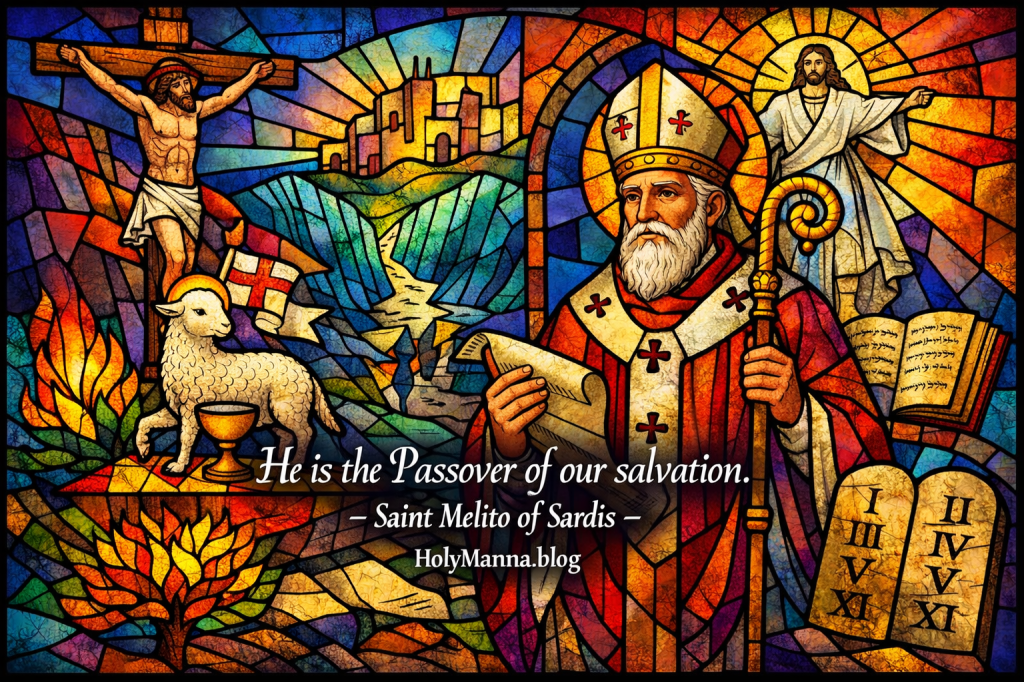
The Bishop Who Taught the Church to See Christ in the Passover
Saint Melito of Sardis was one of the great bishops of the second century, a pastor and writer from Asia Minor whose voice still reaches the Church today. He served as bishop of Sardis, one of the ancient cities connected with the world of the Book of Revelation, and he became known for holiness, learning, courage, and a burning love for Jesus Christ. Ancient Christian memory honored him as a man whose whole life was marked by the Holy Spirit, and later Catholic tradition remembered him as one of the Church’s great early witnesses to the mystery of Easter.
What makes Saint Melito especially important is not simply that he lived long ago, but that he helped the Church speak clearly about who Christ is and what Christ accomplished. He preached Jesus as the true Passover Lamb, defended Christians during a time of pressure and suspicion, and gave one of the earliest known Christian lists of the books of the Old Testament. In him, the Church sees an early bishop who united doctrine, worship, Scripture, and pastoral courage.
Roots Hidden in Ancient Sardis
Very little is known with certainty about Saint Melito’s early life, family background, or childhood. Catholic sources are honest about that. They do not give a detailed biography in the way they do for many later saints. What is known is that he lived in the latter half of the second century, served as bishop of Sardis in Lydia, and was buried there. A letter preserved by Eusebius places him among the great lights of the churches of Asia, which means he was already held in high esteem by the generation that followed the Apostles.
There is also no dramatic conversion story preserved about him. Instead, Saint Melito seems to belong to that beautiful class of early saints whose faith was not marked by one sudden turning point that history recorded, but by a life steadily given over to God. Some ancient testimony described him in a way later Catholic writers understood as suggesting virginity or an ascetical life. Whether that detail is pressed strongly or cautiously, the picture that remains is the same. He was remembered as a bishop set apart for the Lord, disciplined in holiness, and deeply formed by the Scriptures.
Saint Melito is most known for his preaching on the Paschal mystery. He saw with striking clarity that the Passover of the Old Covenant reached its fulfillment in Jesus Christ. For Melito, the lamb of Exodus, the saving blood, the deliverance from slavery, and the passage into life all pointed to the Lord’s Passion, Death, and Resurrection. That is why his preaching still sounds so Catholic. It harmonizes beautifully with what The Catechism teaches about Christ as the new Passover and about the Church’s liturgy celebrating above all the Paschal mystery. CCC 571, 1340.
The Shepherd Who Read All of Scripture Through Christ
Saint Melito was not only a bishop. He was also a serious student of the Bible. In one ancient testimony, he explained that he had gone east to investigate carefully the books of the Old Testament so that he could report their order accurately. That little detail is easy to miss, but it reveals something beautiful about him. He was not content with vague religious feeling. He wanted to know the sacred books rightly, hand them on faithfully, and help the Church read them in the light of Christ. Catholic scholarship has long recognized him as one of the earliest Christians to provide a list of Old Testament books, and even as one of the earliest writers associated with the expression “Old Testament.”
His surviving Easter homily remains his most famous work. In that sermon, he speaks with a confidence and splendor that still stirs the heart. He proclaims Christ as the Lamb who was slain and the Lord who conquered death. One of the lines most treasured in Catholic tradition declares: “He is the Passover of our salvation.” Another climactic passage, later quoted by Pope Benedict XVI, places on the lips of Christ these astonishing words: “I am your life, I am your resurrection, I am your light, I am your Saviour, I am your King.” These are not just poetic lines. They are a window into the early Church’s faith in the full divinity, saving power, and victorious love of Jesus.
Saint Melito also defended the Church publicly. He wrote an apology to Emperor Marcus Aurelius on behalf of Christians who were being mistreated and falsely accused. That matters because it shows a shepherd willing to stand between his flock and the wolves. He did not hide behind silence. He answered injustice with truth, calm reasoning, and fidelity to Christ. That kind of courage is worth remembering, especially in an age when many believers feel pressure to stay quiet about the faith.
When it comes to miracles during his lifetime, the historical record is very sparse. The principal Catholic sources do not preserve a clear collection of miracle stories worked by Saint Melito in the way that later saints often have. No specific lifetime miracle account can be stated with confidence from the major Catholic sources consulted. That does not make his life any less powerful. Sometimes the miracle is the clarity of a saint’s witness, the holiness of his teaching, and the way his words keep feeding the Church many centuries later.
Faithful Under Pressure
Saint Melito lived in a Church that knew hardship. Christians in his day were vulnerable to suspicion, false accusations, legal harassment, and bursts of persecution. His apology to the emperor makes clear that believers in Asia were suffering unjust treatment. Melito answered that suffering as a bishop should. He defended the innocent, appealed to justice, and remained rooted in the truth of Christ.
There is also an important note of caution here. Some later devotional material can give the impression that Saint Melito certainly died a martyr, but the strongest early testimony does not clearly establish martyrdom. Catholic honesty requires saying only what can be supported. He absolutely lived in a persecuted Church and bore witness with courage, but his martyrdom is not firmly verified by the principal ancient sources. He is best remembered with certainty as a holy bishop, apologist, and early Father of the Church.
He was also connected to the early Easter controversy in Asia Minor, where some churches observed the Christian Pasch according to an ancient local custom tied to the fourteenth day. That detail may sound technical, but it reveals how seriously the early Church took the mystery of the Lord’s Passion and Resurrection. Melito stood in the middle of those early debates, not as a rebel against the faith, but as a witness from a period when the Church was still working through questions of common discipline while remaining centered on Christ.
A Legacy Stronger Than Time
When speaking about miracles after Saint Melito’s death, the same honesty is needed. The major Catholic sources do not preserve a stable body of posthumous miracle stories, healing accounts, or relic traditions attached to him in the way that developed around many later saints. No major verified posthumous miracle tradition survives in the principal Catholic sources consulted. There are also no well-established pilgrimage traditions tied to his cult that can be stated confidently from those same sources.
Yet his impact after death has been immense. The Church still reads from his Easter homily in the Office of Readings during Holy Week, which means Catholics continue to pray with his words in the sacred liturgy. That is not a small legacy. It means this second-century bishop still helps form Catholic hearts during the holiest days of the year. His theology of Christ as the true Passover remains deeply woven into the Church’s prayer, preaching, and understanding of Easter as the feast of feasts. CCC 1169.
Even recent popes have drawn from his words. Pope Benedict XVI quoted Melito’s Easter proclamation to show the triumph of the risen Christ, and Pope Francis also used his language to celebrate the passage from slavery to freedom, from mourning to joy, and from darkness to light. That is part of Saint Melito’s cultural and ecclesial impact. His words still help the Church announce Easter to the world.
His feast is commonly observed on April 1 in Catholic devotional calendars. He may not be one of the most popularly known saints in ordinary parish life, but his influence is larger than his public recognition. Many Catholics have heard his theology without realizing it. Every time the Church proclaims Christ as the Lamb, the Passover, the One who conquered death and opened heaven, the spirit of Melito’s preaching feels very close.
What Saint Melito Still Teaches the Church
Saint Melito teaches that Scripture is one great story fulfilled in Jesus Christ. He teaches that the Old Covenant is not discarded but brought to completion in the Lord. He teaches that Easter is not a sentimental spring celebration, but the center of history, the victory of the Lamb, and the passage from death into life. He teaches that bishops and believers alike must defend the faith with courage when the world treats Christians unjustly. Above all, he teaches that the Church must never stop marveling at who Jesus is.
His example invites a practical examination of life. Do the eyes still read the Bible as a single story that leads to Christ. Does the heart still believe that Jesus truly transforms sorrow into joy and slavery into freedom. Is there still enough courage to speak clearly about the faith when silence would be easier. How often does daily life reflect the joy of the Resurrection, and not just the burdens of the cross? These are the kinds of questions Saint Melito quietly places before the soul.
His life also reminds Catholics that holiness is not measured only by how much of a biography survives. Some saints leave behind dramatic adventures, miracle stories, and vivid legends. Others leave behind something quieter and just as enduring. They leave behind clear doctrine, burning love for Christ, and words that keep feeding the Church long after their earthly life has ended. Saint Melito belongs to that company. His voice still sounds like a bell in Holy Week, calling the faithful to look again at the Lamb who was slain and who now lives forever.
Engage with Us!
Share your thoughts and reflections in the comments below. Saint Melito of Sardis may not be the most famous saint on the calendar, but his love for Christ and his deep vision of the Paschal mystery have so much to teach the Church today.
- What stands out most in Saint Melito’s way of seeing Christ as the fulfillment of the Passover?
- How can daily life become more centered on the Passion, Death, and Resurrection of Jesus?
- What does Saint Melito’s courage in defending Christians teach about living the faith publicly with charity and conviction?
- How can Scripture be read more intentionally as a unified story that leads to Christ?
- What area of life most needs the grace of Easter right now, from darkness to light, from sorrow to joy, or from fear to freedom?
May Saint Melito pray for every heart that longs to know Christ more deeply. May his witness help the faithful live with courage, love the Scriptures, cherish the Church’s worship, and do everything with the love and mercy Jesus taught us.
Saint Melito of Sardis, pray for us!
Follow us on YouTube, Instagram and Facebook for more insights and reflections on living a faith-filled life.

 Holy Manna!
Leave a comment