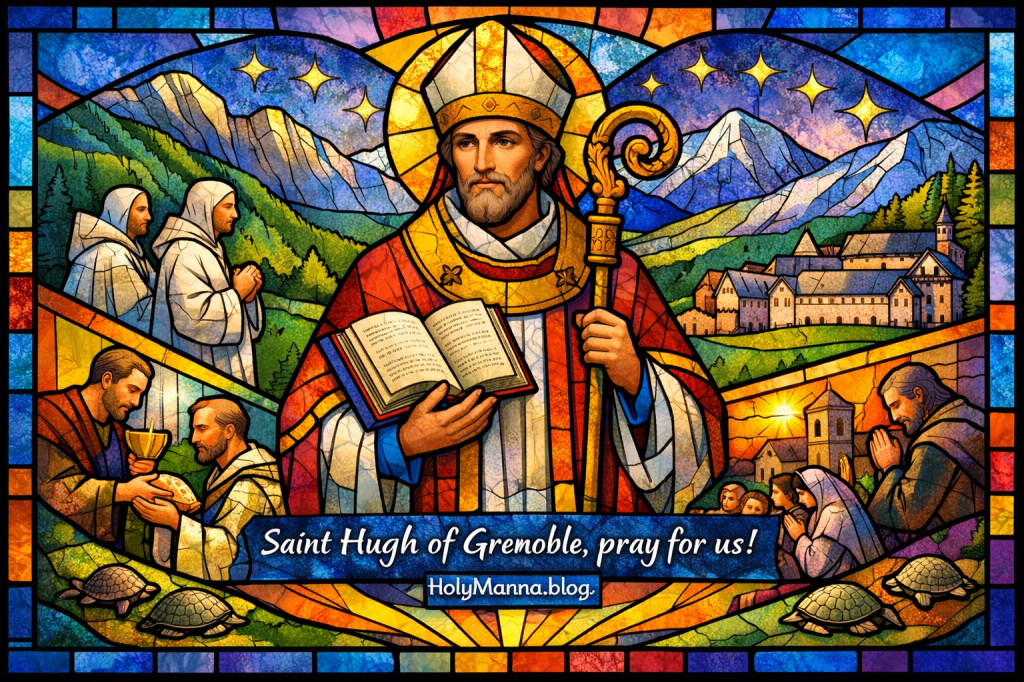
The Bishop Who Longed for Silence
Some saints are remembered because they died in dramatic martyrdom. Some are remembered because they preached to crowds, founded great movements, or worked wonders that spread quickly from town to town. Saint Hugh of Grenoble is remembered for something quieter, and in many ways harder. He was a bishop who loved silence, a shepherd who longed for solitude, and a holy man who kept choosing obedience when his own heart wanted to disappear into prayer.
Saint Hugh of Grenoble is revered in Christian tradition as a reforming bishop, a fatherly protector of the Church, and one of the great supporters of the Carthusian Order. He is especially remembered for helping Saint Bruno establish the Grande Chartreuse, the motherhouse of the Carthusians, and for restoring a troubled diocese with patience, penance, courage, and tears. His life shows that holiness is not always loud. Sometimes holiness looks like carrying a burden for decades because God has placed it there.
He is honored because he loved the Church enough to suffer for her, loved the poor enough to sacrifice for them, and loved God enough to accept a life he would not have chosen for himself.
A Noble Beginning and a Heart Drawn to God
Saint Hugh of Grenoble, also called Hugh of Châteauneuf, was born in 1052 or 1053 near Valence in southeastern France. He came from a noble and devout family. From an early age he was formed in the life of faith, and the atmosphere around him seems to have helped awaken a serious love for God. Catholic tradition remembers him as intelligent, disciplined, and deeply inclined toward prayer even in youth.
He eventually became a canon at Valence, where his wisdom and holiness began to stand out. There is also Catholic tradition indicating that he may have known Saint Bruno earlier in life through the school at Reims, where Bruno taught and where Hugh likely studied. That detail matters, because it helps explain the deep trust and spiritual friendship that later marked their relationship.
Hugh did not experience a dramatic conversion from paganism or unbelief. His story is the story of a soul who kept going deeper. His faith matured through prayer, ecclesial service, interior struggle, and the steady grace of God. In that sense, his life feels very Catholic. It was not built around one emotional turning point alone. It was built around fidelity.
What he became most known for was twofold. He became known as the bishop who reformed Grenoble when corruption had wounded the diocese. He also became known as the holy bishop who welcomed Saint Bruno and the first Carthusians into the mountains of Chartreuse.
A Shepherd for a Wounded Diocese
In 1080, while still young, Hugh was chosen bishop of Grenoble at the Synod of Avignon. He had not even yet been ordained. Pope Gregory VII consecrated him and sent him to a diocese that was in terrible shape. Grenoble had been damaged by simony, usury, clerical laxity, confusion, and the wrongful seizure of church property. Hugh stepped into that disorder not as a politician but as a spiritual father.
He preached. He corrected abuses. He restored discipline. He defended the rights of the Church. He helped revive faith among clergy and laity alike. He did not treat reform as a matter of cold administration. He approached it like a man who believed souls were at stake.
Catholic tradition remembers him as a bishop of tears. He wept while reading Scripture. He wept during prayer. He wept while hearing confessions and preaching repentance. These were not tears of weakness. They were signs of a heart pierced by the love of God and by sorrow for sin.
He was also a man of practical charity. During famine, he sold a gold chalice and episcopal ornaments to help the poor. That kind of sacrifice reflects the spirit of The Catechism, which teaches that love for the poor is part of the Church’s constant tradition, especially in works of mercy such as feeding the hungry and caring for those in need, as seen in CCC 2447. Hugh did not merely speak about charity. He stripped himself of comfort so others might live.
The most famous miracle-like event associated with his life came when Saint Bruno and six companions came seeking a place of solitude. Carthusian tradition tells that Hugh had already seen in a dream the place where God wished to build a house in the desert, marked by seven stars. When Bruno arrived with six others, Hugh recognized in them the sign he had been shown. He led them into the wilderness of Chartreuse and helped establish the foundation that would become the Grande Chartreuse. Whether one sees this as prophecy, providence, or both, the Church remembers it as one of the most remarkable moments of his life.
This was no small act of hospitality. Hugh helped make space for one of the most austere and contemplative orders in the history of the Church. Because of that, he is remembered not only as a diocesan bishop, but also as a guardian of contemplative life.
Trials, Weariness, and the Cross He Did Not Choose
Saint Hugh’s life was not easy, and his suffering was not brief. Catholic accounts say that he experienced serious interior trials, including blasphemous thoughts that tormented him. Pope Gregory VII reportedly counseled him that these trials were permitted for his purification. Later, Hugh suffered for many years from severe headaches and stomach pain. These afflictions followed him for much of his life.
He also suffered from the burden of office itself. Hugh did not crave power. In fact, he repeatedly tried to leave his episcopal post so he could become a monk and live in silence before God. After a short time as bishop, he even withdrew to La Chaise-Dieu, but Pope Gregory VII ordered him back to Grenoble. Later he again sought permission to resign, and again he was refused.
That struggle says something beautiful and painful about his sanctity. Hugh was not clinging to position. He wanted hiddenness. He wanted prayer. He wanted the monastery. Yet obedience kept sending him back to the flock. In this way his life reflects Christ’s own words in The Gospel of John: “A good shepherd lays down his life for the sheep” Jn 10:11.
Saint Hugh was not a martyr in the technical sense. He was not killed for the faith. But he lived a kind of white martyrdom. He died daily to his own desires so that he could serve the Church where God had placed him. That is one of the reasons his example still hits the heart. Many people are asked to serve in ways they would not have chosen. Hugh shows how obedience can become a path to sanctity.
Signs, Wonders, and the Saint’s Living Legacy
During his lifetime, the most enduring miraculous tradition linked to Hugh is the dream of the seven stars connected with the founding of the Carthusians. Catholic sources also affirm that miracles surrounded his reputation for sanctity, especially around the time of his death and canonization, though the strongest early sources do not preserve a long catalog of named wonders.
After his death on April 1, 1132, devotion to Saint Hugh grew quickly. Pope Innocent II canonized him in 1134. Catholic tradition holds that miracles confirmed his sanctity after death, even if many individual stories were not carefully preserved in the earliest surviving accounts. That means the Church remembered him as a saint whose holiness did not end at the grave, even when later generations did not always record the details as fully as modern readers might wish.
There is also a later devotional story that Hugh made the sign of the cross over certain birds and they became turtles so that Carthusians could eat them. This story has circulated in Catholic tradition, but it cannot be firmly verified from the strongest early sources.
His impact after death is easier to verify than some individual miracle stories. His memory remained strong in Grenoble. Churches and institutions there still bear his name. He continues to be honored in connection with the cathedral complex and local diocesan life. His feast is kept on April 1 in the Roman tradition, and the Carthusians give him special honor on April 22, the date of his canonization.
His cultural and spiritual impact is also tied to the Carthusian Order. Every time the Church remembers the hidden lives of the monks of Chartreuse, the memory of Saint Hugh stands nearby. He helped shelter a charism of silence, penance, and contemplation that still nourishes the Church centuries later.
A few sayings are traditionally attributed to him and capture the spirit of his life. One of the best known is “By prayer I always find myself stronger.” Another is “This life is all given us for weeping and penance, not for idle discourses.” These words sound severe to modern ears, but they come from a heart that knew the gravity of sin, the nearness of death, and the mercy of God.
The Bishop Who Teaches the Soul to Listen
Saint Hugh of Grenoble has a lot to teach the modern Catholic. He teaches that reform begins in holiness, not in noise. He teaches that love for the Church sometimes means enduring frustration, misunderstanding, and fatigue without walking away. He teaches that prayer is not an escape from responsibility, but the strength needed to carry it. He teaches that charity must cost something if it is going to look like Christ.
His life also speaks to anyone who feels torn between contemplation and duty. There are seasons when the heart wants quiet, healing, and hiddenness, while God asks for service, sacrifice, and perseverance. Hugh knew that tension very well. He did not always get the life he wanted, but he became a saint through the life God gave him.
There is something deeply comforting in that. Not every holy person gets a dramatic story. Not every saint gets visible success. Some saints become holy by staying where obedience has placed them, by praying through the pain, by serving through the exhaustion, and by loving through disappointment.
Is there a responsibility in life that has felt too heavy, too hidden, or too long? Saint Hugh reminds the soul that God is not absent in those places. Very often, those are the places where sanctity is being quietly formed.
A practical way to imitate him is to build a life of steady prayer instead of depending on passing feelings. Another is to practice charity that costs something real, whether that means time, attention, money, patience, or forgiveness. Another is to examine whether there are small attachments, comforts, or vanities that have taken up too much space in the heart. Hugh wept over sin because he knew that even small compromises can slowly cool love for God.
His life invites every Christian to ask a hard and beautiful question. Is holiness being imagined only as something dramatic, or is there a willingness to become holy through obedience in ordinary responsibilities?
Engage with Us!
Share your thoughts and reflections in the comments below. Saint Hugh of Grenoble is not the kind of saint the world would naturally celebrate, and that is exactly what makes his witness so powerful. His life shows that holiness can be hidden, patient, and deeply fruitful.
- What stands out most in Saint Hugh’s life: his reform of Grenoble, his friendship with Saint Bruno, or his perseverance in suffering?
- Have there been moments when God seemed to ask for faithfulness in a path that was not the one originally desired?
- How can prayer become a real source of strength in daily responsibilities instead of something squeezed into spare moments?
- What is one concrete act of sacrifice or charity that could be offered this week in imitation of Saint Hugh?
- What does Saint Hugh’s life reveal about the difference between worldly success and true holiness?
May Saint Hugh inspire a life of steady prayer, courageous obedience, and real charity. May his example help hearts remain faithful in hidden duties, patient in suffering, and generous toward the poor. May everything be done with the love and mercy Jesus taught us, so that every ordinary day becomes another chance to belong more fully to God.
Saint Hugh of Grenoble, pray for us!
Follow us on YouTube, Instagram and Facebook for more insights and reflections on living a faith-filled life.

 Holy Manna!
Leave a comment