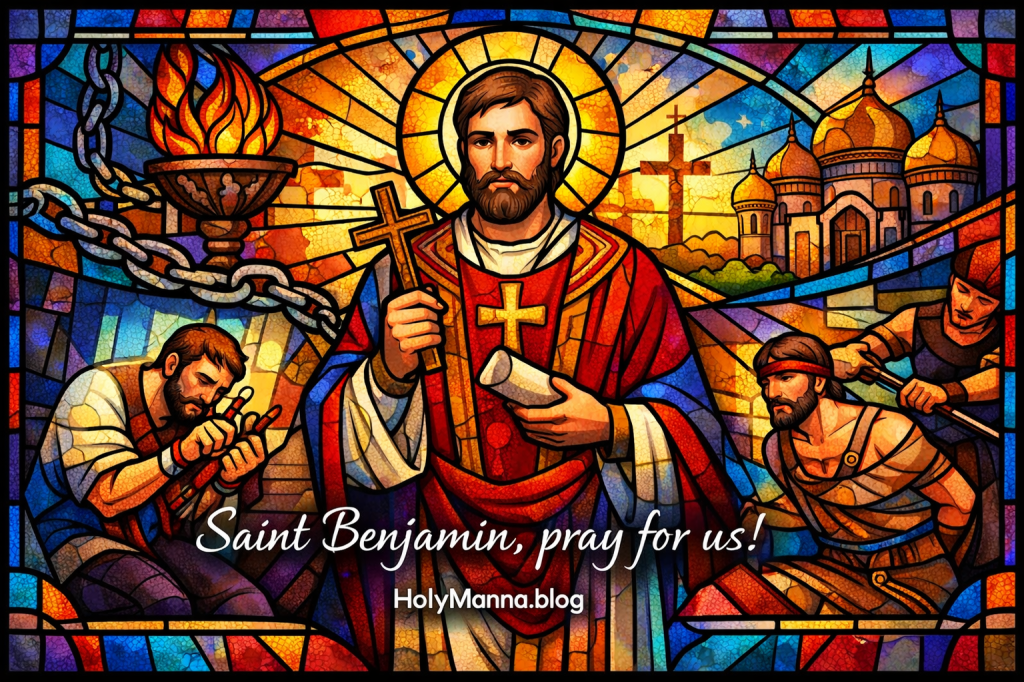
The Deacon Who Would Not Let the Gospel Be Chained
Saint Benjamin is remembered by the Church as a deacon and martyr of Persia, honored on March 31. He is not one of those saints whose life comes down through the centuries in long biographies full of family details, travels, and speeches. Instead, the Church remembers him for something simpler and more piercing. He was a servant of Christ who would not stop proclaiming the faith, even when silence might have saved his life. That is why he still matters. He stands in Christian memory as a man whose love for the truth was stronger than fear, stronger than pain, and stronger than death itself.
From a Catholic point of view, Saint Benjamin is revered not merely because he suffered, but because he suffered as a witness. The Catechism teaches that martyrdom is “the supreme witness given to the truth of the faith”. Saint Benjamin lived exactly that kind of witness. He did not die for stubbornness, pride, or politics. He died because he belonged to Christ and would not hide that belonging. CCC 2473 helps explain why the Church continues to honor him with such reverence.
The Hidden Beginnings of a Persian Servant
Very little is preserved in Catholic sources about Saint Benjamin’s childhood, birthplace, or family background. That silence is part of his story. The Church does not pretend to know what has not been handed down. What is known is that he was a deacon in the Persian Church. In the early Church, the diaconate was not a small or decorative office. Catholic tradition describes deacons as ministers of service, charity, and the word, men who assisted the Church’s life in practical and spiritual ways. To call Benjamin a deacon is to say that he had already given his life to serving Christ and His people before he ever shed his blood for the faith.
His public story emerges only when persecution begins to close in. The Church in Persia had enjoyed a period of relative peace. Then a crisis broke open after Bishop Abdas destroyed a Persian fire temple. Catholic sources speak about this with moral seriousness and unusual balance. They do not praise the destruction of the temple. In fact, they describe it as misguided zeal. At the same time, they defend Abdas for refusing to rebuild it, since helping restore a pagan shrine would have meant cooperating with idolatry. That distinction matters. The Church does not bless rashness, but she does honor fidelity when the test arrives. Saint Benjamin lived and died inside that hard and sobering moment of history.
The Deacon Who Refused to Be Silent
Saint Benjamin is best known for one thing above all others. He would not stop speaking about Christ.
Catholic tradition says he was arrested, beaten, and cast into prison during the Persian persecution. After a long confinement, an ambassador obtained his release on one condition: he was not to speak about religion to the king’s court. This was the sort of compromise that must have sounded reasonable to the world. Stay alive. Keep quiet. Protect yourself. Make faith private. But Saint Benjamin would not do it. Catholic tradition preserves the memory that he continued announcing Christ whenever he found the opportunity. That is the center of his legacy. He was a deacon who believed the Gospel was not something to be tucked away for safer times.
This is why his memory lands with such force even now. The temptation facing many believers is not usually torture. It is softer than that. It is the temptation to make the faith invisible, polite, and silent. Saint Benjamin exposes that temptation simply by the shape of his life. He reminds the Church that the truth is not ours to lock away. He reminds ordinary Catholics that courage often begins in speech, in witness, in refusing to act as though Christ is only welcome in private. His story belongs to every age because every age tries to convince believers that silence is safer than fidelity.
What Catholic Sources Do and Do Not Say About Miracles
Some saints are remembered through a long chain of miracles, visions, wonders, or healings. Saint Benjamin is not preserved that way in the Catholic sources. The sources do not present a developed tradition of miracles worked during his lifetime. That does not diminish him. It simply means the Church remembers him first and foremost as a martyr and confessor of the faith.
That absence is actually revealing. It shows what the Church thought mattered most in his memory. Saint Benjamin’s sanctity was not attached to dramatic public signs, but to perseverance. There is something beautiful about that. Some saints astonish by miracles. Others astonish by fidelity. Saint Benjamin belongs to the second kind, and the Church has never considered that witness a lesser glory. In fact, martyrdom itself is the brightest kind of testimony because it seals the truth of a life with the final gift of the body.
No verified famous quotations from Saint Benjamin have been preserved in the Catholic tradition. Some accounts report words attributed to him during his trial and witness, but there is no firmly authenticated saying handed down with certainty in the way some other saints are remembered.
The Road of Suffering and the Crown of Martyrdom
The end of Saint Benjamin’s earthly life was horrifying. Catholic sources describe the Persian persecutions in language that still shocks the heart. Christians were tortured in cruel and inventive ways. Saint Benjamin himself suffered a particularly brutal martyrdom. According to the traditional account preserved in Catholic sources, reeds were driven between the nails and the flesh of his hands and feet and thrust into other tender parts of his body. Finally, a knotted stake was forced into his bowels, and he died in torment.
This is not easy reading, and it should not be. The Church never tells martyr stories to entertain. She tells them so the faithful may see what grace can do in a human soul. His martyrdom also clarifies what the Church means by courage. Christian courage is not loud self-assertion. It is not theatrical defiance. It is patient fidelity under pressure. Saint Benjamin had already suffered prison. He had already been given a possible path to survival. He had already seen what rulers could do to believers. Yet he continued. In that sense, his martyrdom was not a sudden burst of heroism detached from the rest of his life. It was the final flowering of a vocation already shaped by service, obedience, and love for Christ.
What Remained After His Death
Catholic sources do not preserve for Saint Benjamin a large posthumous cycle of miracles, healings, or famous pilgrimage traditions. No major shrine stands out in the sources reviewed, and no broad relic tradition is strongly emphasized in the same way it is for some other martyrs. The honest Catholic approach is to say that clearly. His legacy after death is liturgical, spiritual, and moral more than devotional in a popular or miraculous sense.
The Roman Martyrology remembers him on March 31, and Catholic calendars continue to honor him there. That is no small thing. To remain in the Church’s memory across the centuries is itself a kind of witness that death did not erase him. His cultural impact is quieter than that of saints with famous shrines or worldwide devotions, but his witness has endured wherever the Church honors her martyrs. He remains part of the great cloud of witnesses who teach Christians that faith is not merely interior conviction. It is lived loyalty. His name survives not because he built an institution or wrote a masterpiece, but because he stayed true. The Church did not forget him because the Church does not forget those who poured out their blood in union with Christ.
Why Saint Benjamin Still Matters
Saint Benjamin’s story presses on the conscience in a very direct way. He was not remembered for prestige. He was not remembered for comfort. He was remembered because he would not surrender the truth. In a culture that often encourages believers to reduce faith to something private, sentimental, or socially acceptable, Saint Benjamin feels startlingly fresh. He calls Catholics back to the conviction that the Gospel is not a hobby. It is not a weekend preference. It is the truth by which a human life stands or falls.
His life also teaches something deeper about holiness. Holiness is not always accompanied by visible success. Sometimes holiness looks like obscurity, service, imprisonment, and death. Yet in God’s sight, that hidden fidelity becomes radiant. Saint Benjamin did not leave behind a large body of writings or a list of public accomplishments. He left behind witness. And witness is one of the greatest gifts a saint can leave the Church.
A Reflection for the Heart
There is something especially challenging about Saint Benjamin because his story is so stripped down. There are no distractions. There is no way to hide behind admiration for his personality, talents, or achievements. His life asks a more uncomfortable question. How much is a Catholic willing to risk in order to remain faithful to Christ?
For most people, that question will not be answered in a prison cell. It will be answered in daily life. It will be answered in whether the faith is spoken openly and lived consistently. It will be answered in whether prayer is treated as a necessity instead of an accessory. It will be answered in whether truth is softened to avoid disapproval. Saint Benjamin urges the soul toward a more courageous Christianity. He teaches that fidelity begins long before martyrdom. It begins in the ordinary habit of belonging to Christ without apology.
A practical way to imitate him is to recover boldness in small, faithful acts. Speak about the faith naturally and without embarrassment. Defend the truth with charity and steadiness. Refuse the lie that religion must remain hidden to be respectable. Pray for persecuted Christians. Read the martyr stories of the Church. Stay close to the sacraments. Ask for the grace not merely to admire brave saints, but to become one of those believers who would rather suffer than betray the Lord.
Where has fear made the faith quieter than it should be?
What would it look like to speak about Christ with more simplicity and more conviction?
How can daily life become a more visible act of loyalty to Jesus?
Engage With Us!
Share your thoughts and reflections in the comments below. Saint Benjamin’s witness is simple, fierce, and unforgettable, and it speaks powerfully to anyone trying to live the Catholic faith with courage in a hesitant world.
- What part of Saint Benjamin’s story strikes the heart most deeply?
- Is there an area of life where silence has replaced faithful witness?
- How can courage in the faith be practiced in ordinary daily life?
- What does Saint Benjamin teach about the cost and beauty of loyalty to Christ?
- How can prayer for persecuted Christians become a more intentional part of spiritual life?
May Saint Benjamin inspire a life that is steady in truth, generous in charity, and brave in witness. May every act be done with the love and mercy Jesus taught, and may that love remain stronger than fear.
Saint Benjamin, pray for us!
Follow us on YouTube, Instagram and Facebook for more insights and reflections on living a faith-filled life.

 Holy Manna!
Leave a comment