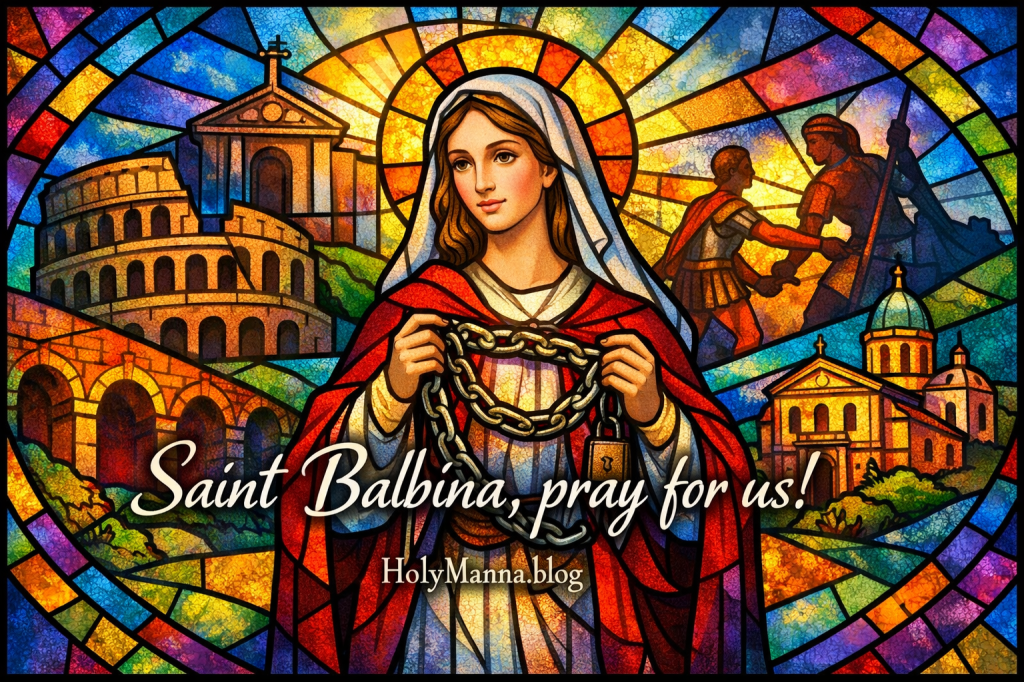
The Hidden Virgin of Rome
Saint Balbina is one of those ancient Roman saints whose life comes down through the Church like a candle still burning in a quiet chapel. She may not be as widely known as Saints Agnes, Cecilia, or Lucy, but the Church has remembered her for centuries with real affection and reverence. Her feast is celebrated on March 31, and her name has endured in the heart of Rome through the ancient Basilica of Santa Balbina on the Aventine Hill.
What makes Saint Balbina especially moving is that her memory has outlasted the uncertainties of history. Some parts of her story are preserved more clearly in tradition than in hard historical documents, yet the Church has never forgotten her. She is honored as an early Roman virgin saint, associated with holiness, purity, courage, and devotion to Christ. In the Roman Catholic tradition, she is also linked to Saint Quirinus, to Pope Saint Alexander, and to a healing connected with the chains of Saint Peter.
Saint Balbina matters because she reminds the faithful that even saints whose earthly stories are partly hidden can still shine with the glory of God. The Church does not revere her because every detail of her biography is perfectly documented. The Church reveres her because her witness belongs to that great cloud of holy ones who kept the faith in the earliest days of Christianity. As Hebrews 12:1 says, “Since we are surrounded by so great a cloud of witnesses, let us rid ourselves of every burden and sin that clings to us and persevere in running the race that lies before us.”
The Daughter of a Roman House
According to ancient Catholic tradition, Balbina was born in Rome and was the daughter of Saint Quirinus, who is remembered as a Roman tribune. That detail places her in a world of rank, order, discipline, and imperial power. Yet the grace of God often enters places the world would least expect. In Balbina’s story, the household of a Roman official becomes a place where the Gospel quietly takes root.
The historical details of her childhood are not preserved with certainty. There is no complete biography describing her early years, her mother, or the small events that shaped her personality. Still, Catholic tradition remembers her as a young woman of noble birth who came into contact with the Christian faith through the witness of those already suffering for Christ.
In the traditional account, Pope Saint Alexander was imprisoned in the house of Quirinus. Through this encounter, Balbina and her father were brought close to the Christian faith. The tradition says that both were moved by grace and received baptism. For Balbina, this was not simply a change of religious identity. It was the beginning of a life wholly turned toward Jesus Christ. She came to be remembered as a virgin saint, which means the Church saw in her a woman who belonged to Christ with an undivided heart.
That matters deeply in Catholic tradition. Virginity offered to God has always been honored as a sign that Christ is enough, that heaven is real, and that the soul can be given fully to divine love. The Church teaches that the saints show forth in their lives the holiness of God and the beauty of grace. The Catechism says in CCC 828 that by canonizing saints, the Church recognizes “the power of the Spirit of holiness within her.” Saint Balbina’s life fits into that mystery. Even through the fog of ancient history, the Church saw in her a soul marked by holiness.
A Life Marked by Purity and Quiet Courage
Saint Balbina is most known for her ancient veneration in Rome and for the tradition that she was a holy virgin closely connected to the early martyrs of the Church. She is also known for the story that ties her to the chains of Saint Peter, one of the most memorable features of her legend.
In the traditional account, Balbina suffered from an illness of the throat. Wanting healing, she came to Pope Saint Alexander. He directed her not to place her hope merely in earthly remedies, but in a holy act of devotion. The tradition says that she was told to seek the chains of Saint Peter and venerate them with faith. After doing so, she was healed. This healing became one of the most famous stories associated with Saint Balbina and helped connect her memory to the apostolic witness of Saint Peter himself. This story belongs to ancient devotional tradition and cannot be historically verified with certainty.
That story matters because it reveals something deeply Catholic. God often works through matter. He uses water in Baptism, oil in Anointing, bread and wine in the Holy Eucharist, and even relics and sacred objects as signs that point to grace. The healing of Balbina, whether received as strict history or pious tradition, fits naturally into the sacramental imagination of the Church. God is not distant. He chooses to touch human weakness through visible signs.
Balbina is also remembered for the purity of her life. The Church has treasured the witness of virgin martyrs and virgin saints because they show a kind of spiritual strength that the world often fails to understand. They testify that human dignity is not found in power, pleasure, or status, but in belonging to Christ. In a culture that constantly confuses freedom with self-indulgence, Saint Balbina still speaks by her silence. Her life says that holiness is not repression. Holiness is love rightly ordered.
Grace in the Midst of Suffering
The hardships of Saint Balbina’s life come down mostly through tradition. In the ancient account, her father Quirinus and Pope Alexander suffered persecution under imperial authority, and Balbina herself shared in the trials that came with confessing Christ in pagan Rome. For the early Christians, to believe in Jesus was not a private lifestyle choice. It could cost reputation, security, family peace, and life itself.
Tradition says that Balbina remained steadfast in faith through danger and suffering. In some versions of her story, she is remembered as a martyr who died under Emperor Hadrian, even by beheading. In older Catholic memory, she is often linked with her father’s martyrdom and burial on the Via Appia. These details belong to the traditional account and cannot all be historically verified with certainty.
Even where the evidence is thinner, the spiritual truth remains powerful. Balbina belonged to that generation of Christians who lived close to the age of the martyrs. Whether her witness ended in formal martyrdom or in a holy death after a life of fidelity, the Church has remembered her as one who endured hardship for the name of Christ.
That witness should not be taken lightly. Modern believers may not face Roman executioners, but they do face ridicule, compromise, temptation, and the pressure to keep faith private. Saint Balbina reminds the faithful that holiness has always required courage. Christ never promised a comfortable road. He promised a cross, grace for the journey, and eternal life at the end.
Wonders Remembered After Her Death
The legacy of Saint Balbina after death is stronger and clearer than many details of her earthly biography. Her name became rooted in the sacred geography of Rome. Ancient memorials associated with her were linked to the catacombs and to the Basilica of Santa Balbina on the Aventine. That alone says something beautiful. The Church did not allow her memory to disappear. She remained part of Rome’s devotional life, prayer, and liturgical remembrance.
The most important sign of her lasting impact is that basilica. For centuries, pilgrims, clergy, and ordinary faithful have known her name through that church. The very existence of a basilica bearing her name shows that her cult was not accidental or marginal. She belonged to the living memory of Catholic Rome.
Her connection to the Lenten station church tradition also gives her a quiet but meaningful place in the spiritual rhythm of the Church. Rome has long preserved the memory of the martyrs and saints through these station churches, where the faithful gather in prayer and penance. Saint Balbina’s place in that tradition means that her witness is not just historical. It remains liturgical and devotional.
The healing story involving the chains of Saint Peter also continued to shape her legacy. Later devotion associated her with relief from illnesses of the throat and neck. This tradition flows naturally from the ancient account of her healing, though those later devotional associations cannot be historically verified with certainty.
There are no well-attested famous sayings from Saint Balbina herself preserved in Catholic tradition. Her legacy is not carried by memorable one-liners. It is carried by sanctity, memory, and place. Some saints preach with many words. Others preach by the Church’s refusal to forget them.
Why Saint Balbina Still Matters Today
Saint Balbina’s life offers a very practical lesson for Catholics today. She shows that holiness does not depend on fame, a full biography, or public recognition. Some saints tower over history with long writings and dramatic deeds. Others remain hidden, and yet the Church continues to honor them because grace truly flourished in them.
That is a needed reminder. So much of modern life is built on being seen, praised, and validated. Saint Balbina stands for something very different. She points to the beauty of a soul known by God. She shows that a hidden life can still leave a real mark on the Church.
She also speaks to those who feel that suffering has made their life small. In her story, illness, persecution, and obscurity do not cancel holiness. They become the very place where God’s grace shines. The Christian life is not about appearing impressive. It is about remaining faithful.
There is also something deeply consoling in the way the Church holds Saint Balbina. The Church does not pretend to know more than she knows. She preserves the tradition, honors the saint, and leaves room for mystery. That honesty is deeply Catholic. Faith is not fantasy. It is trust in the God who works in real history, even when some parts of that history remain hidden from human eyes.
For daily life, Saint Balbina encourages a few simple and serious practices. Stay close to Christ in prayer. Honor the saints. Reverence the holy things of God. Do not be ashamed of purity. Do not think hidden fidelity is wasted. Do not assume that only the loud and famous can change the world. In the Kingdom of God, many of the greatest lights are the ones that burned quietly.
Where in life is God asking for hidden faithfulness instead of public recognition? What would it look like to love purity, prayer, and courage in an age that often mocks all three? How might devotion to the saints help strengthen perseverance in ordinary life?
Engage with Us!
Share your thoughts and reflections in the comments below. Saint Balbina may be a quieter saint in the Church’s memory, but her witness still has the power to speak to the heart.
- What stands out most about Saint Balbina’s story and why?
- How does her hidden and quiet witness challenge the way holiness is often imagined today?
- What can be learned from the Church’s faithful remembrance of saints whose biographies are not fully known?
- In what area of life is there a need for more courage, purity, or perseverance?
- How can devotion to early Roman saints deepen love for the communion of saints and the life of the Church?
Saint Balbina reminds the faithful that no life given to Christ is ever forgotten. Even when history grows quiet, grace still speaks. May her witness encourage a life of steady faith, humble courage, and love for the truth. May every step be taken with the love and mercy Jesus taught, and may that love shape every thought, word, and action.
Saint Balbina, pray for us!
Follow us on YouTube, Instagram and Facebook for more insights and reflections on living a faith-filled life.

 Holy Manna!
Leave a comment