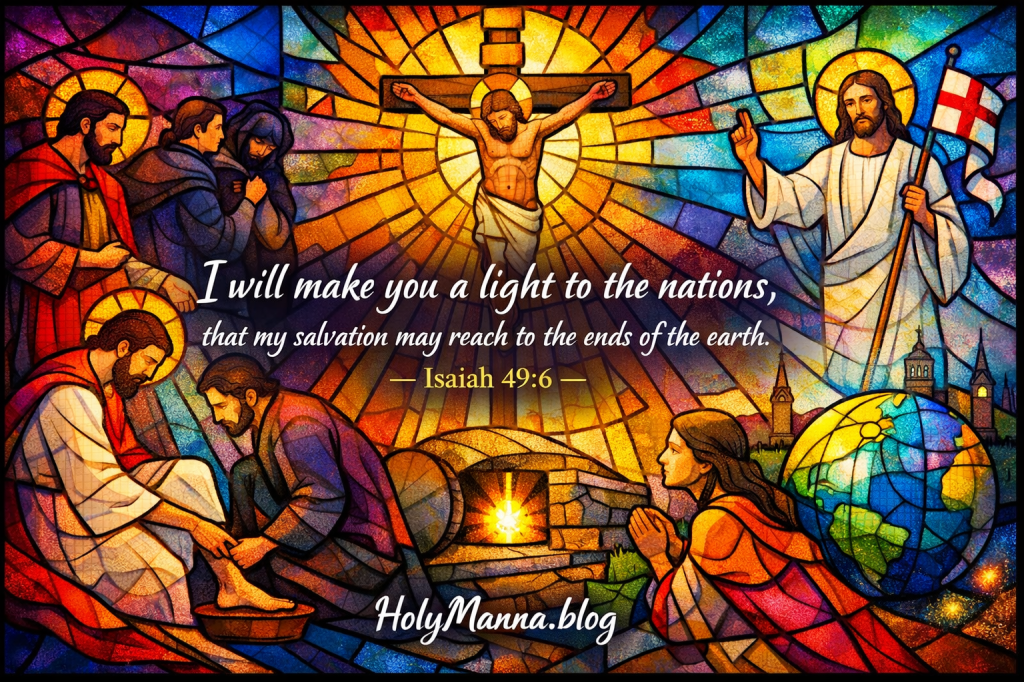
Tuesday of Holy Week – Lectionary: 258
When Light Walks Into the Night
Holy Week has a way of slowing everything down and making the heart pay attention. On this Tuesday of Holy Week, the Church places three readings side by side that seem to breathe the same air: a servant chosen from the womb, a soul that has trusted God since birth, and Christ at table on the night betrayal begins. The central theme tying them together is this: God’s chosen Servant remains faithful in the hour of darkness, and through that faithfulness he becomes light and salvation for others.
That theme matters because Holy Week is not only about sorrow. It is about revelation. These days uncover what has always been true about Jesus. In Isaiah 49:1-6, the servant is called, formed, and hidden by God for a mission larger than anyone first imagines. In Psalm 71, the believer clings to the Lord as refuge and strength from the womb onward. In John 13:21-33, 36-38, Jesus enters the terrible intimacy of betrayal and Peter’s coming denial, yet he speaks not of defeat but of glory. The Church reads these passages together because they show that Christ is the true Servant of the Lord, the one who does not run from suffering, does not lose sight of the Father, and does not abandon his mission when the night closes in.
There is also an important religious backdrop to this day’s liturgy. The first reading comes from one of the great Servant Songs of Isaiah, texts the Church has long understood in the light of Christ’s Passion. The Gospel takes place during the Last Supper, in the charged and sacred atmosphere of Passover, when Israel remembered the Lord’s saving action. That setting is not accidental. As the memory of the old covenant fills the room, Jesus is already offering himself as the one who will bring the new and eternal covenant to fulfillment. Even Judas’s departure into the dark and Peter’s fragile promises are not outside God’s providence. The mystery of redemption is unfolding right in the middle of human weakness.
What makes these readings so piercing is that they speak to anyone who has ever felt hidden, tested, or disappointed. The servant says, in effect, that the labor seemed fruitless. The psalmist cries out for rescue. Peter is confident, but not yet converted deeply enough to carry the cross. Judas walks out into the night. And still, Christ remains steady. He is the light promised to the nations, even when surrounded by confusion, fear, and betrayal. That is why today’s readings prepare the soul so well for the Triduum. They remind the faithful that God’s saving work often moves forward precisely when everything appears to be unraveling.
What if the very place that feels most painful or uncertain is the place where God is asking for deeper trust? This is the invitation of today’s liturgy. The readings ask the faithful to look at Jesus closely, not only as a victim of human sin, but as the obedient Servant who walks into the dark carrying divine light.
First Reading – Isaiah 49:1-6
Called Before Birth, Sent Into the Darkness as Light
The first reading for this Tuesday of Holy Week comes from one of the great Servant Songs in Isaiah, a part of the prophet’s message spoken into the pain, confusion, and longing of Israel. Historically, these chapters were addressed to a people marked by exile, humiliation, and the aching hope that God had not forgotten them. Culturally and religiously, Israel knew what it meant to feel small before the nations, wounded by sin, and desperate for restoration. Into that wounded world, the prophet speaks of a Servant chosen by God, formed with purpose, hidden for a mission, and destined not only to restore Israel but to become light for all nations.
That is exactly why this reading stands so powerfully at the edge of the Passion. The Church hears in this Servant the voice and mission of Christ himself. On a day when the Gospel will show betrayal growing in the darkness, Isaiah 49 reminds the faithful that Jesus did not stumble into suffering by accident. He was sent. He was prepared. He was hidden in the Father’s hand for this very hour. Today’s theme comes into view with striking clarity: God’s chosen Servant remains faithful in the hour of darkness, and through that faithfulness salvation begins to reach the ends of the earth.
Isaiah 49:1-6 – New American Bible (Revised Edition)
The Servant of the Lord
1 Hear me, coastlands,
listen, distant peoples.
Before birth the Lord called me,
from my mother’s womb he gave me my name.
2 He made my mouth like a sharp-edged sword,
concealed me, shielded by his hand.
He made me a sharpened arrow,
in his quiver he hid me.
3 He said to me, You are my servant,
in you, Israel, I show my glory.4 Though I thought I had toiled in vain,
for nothing and for naught spent my strength,
Yet my right is with the Lord,
my recompense is with my God.
5 For now the Lord has spoken
who formed me as his servant from the womb,
That Jacob may be brought back to him
and Israel gathered to him;
I am honored in the sight of the Lord,
and my God is now my strength!
6 It is too little, he says, for you to be my servant,
to raise up the tribes of Jacob,
and restore the survivors of Israel;
I will make you a light to the nations,
that my salvation may reach to the ends of the earth.
Detailed Exegesis
Verse 1: “Hear me, coastlands, listen, distant peoples. Before birth the Lord called me, from my mother’s womb he gave me my name.”
The Servant begins by summoning not only Israel, but the far-off coastlands and distant peoples. This already hints that his mission will not remain local or tribal. In biblical language, the nations at the edge of the earth are being called to listen because God is about to reveal something meant for the whole world. Then comes the striking claim that the Servant was called before birth and named from the womb. In Scripture, naming is never casual. It points to identity, purpose, and divine claim. This is not a man improvising a mission. This is one chosen by God from the beginning. In the light of Holy Week, the Church sees here a profound image of Christ, whose humanity was never detached from the Father’s saving plan.
Verse 2: “He made my mouth like a sharp-edged sword, concealed me, shielded by his hand. He made me a sharpened arrow, in his quiver he hid me.”
The imagery becomes vivid and intense. The mouth of the Servant is like a sword, which means his mission includes speaking the truth with piercing power. God’s word cuts, exposes, heals, and judges. Yet the Servant is not only a weapon in motion. He is also hidden, sheltered, and reserved. The sharpened arrow remains in the quiver until the appointed moment. This verse shows both power and patience. God prepares his chosen one in silence before revealing him in history. Christ lived thirty hidden years before the public ministry, and even during the ministry there was always a sense that his hour had not yet come. Holy Week is the moment when the arrow leaves the quiver. The hidden mission becomes visible.
Verse 3: “He said to me, You are my servant, in you, Israel, I show my glory.”
Here the Servant is called “Israel,” which has led to much reflection in the Church. The Servant is somehow identified with Israel, yet he also has a mission to restore Israel. This means the Servant embodies in himself what Israel was meant to be. He stands as the faithful one, the obedient one, the one through whom God’s glory truly shines. The nation often failed in covenant fidelity, but the Servant will succeed. This reaches its fullness in Christ, who recapitulates the history of Israel in his own person and lives it without sin. He is the true and faithful Israel, the one in whom the Father’s glory is perfectly revealed.
Verse 4: “Though I thought I had toiled in vain, for nothing and for naught spent my strength, Yet my right is with the Lord, my recompense is with my God.”
This is one of the most human lines in the passage. The Servant knows the feeling of exhaustion, apparent failure, and fruitless labor. He does not speak like a distant hero untouched by sorrow. He speaks like one who has poured himself out and sees little visible reward. That makes this verse especially fitting during Holy Week. Christ came to his own, and many did not receive him. He preached, healed, warned, loved, and still encountered rejection, betrayal, and hardness of heart. Yet the Servant does not collapse into despair. He places his cause before God. This is the spirituality of trust. The measure of faithfulness is not immediate success, but obedience before the Lord.
Verse 5: “For now the Lord has spoken who formed me as his servant from the womb, That Jacob may be brought back to him and Israel gathered to him; I am honored in the sight of the Lord, and my God is now my strength!”
The Servant returns to the language of being formed from the womb, reinforcing that this mission is not accidental but willed by God from the beginning. His first stated task is to bring Jacob back and gather Israel. This is the language of restoration, covenant renewal, and reunion. Sin scatters, but God gathers. The Servant exists to reverse the effects of rebellion and exile. Then comes a line of deep spiritual beauty: “my God is now my strength.” The Servant’s strength is not self-generated. He is sustained by the very God who sends him. This becomes a model for Christian discipleship. No one carries out God’s mission by grit alone. Grace is the strength of the faithful.
Verse 6: “It is too little, he says, for you to be my servant, to raise up the tribes of Jacob, and restore the survivors of Israel; I will make you a light to the nations, that my salvation may reach to the ends of the earth.”
This is the summit of the reading. The mission expands dramatically. It is not enough that the Servant restore Israel. He must become light for the nations. God’s saving plan was always larger than one people alone. Israel was chosen so that through her the nations might be blessed. Now, in the Servant, that universal mission comes into full view. The Church reads this verse as fulfilled in Christ, who is not simply a teacher for one culture or one moment of history, but the Savior of the world. In Holy Week, this verse shines with even greater force. The road to Calvary is not a private tragedy. It is the path by which salvation begins to reach the ends of the earth.
Teachings
This reading opens a deep window into the Church’s understanding of Jesus as the Servant sent by the Father. The Catechism teaches: “Jesus’ redemptive death fulfills Isaiah’s prophecy of the suffering Servant. Indeed Jesus himself explained the meaning of his life and death in the light of God’s suffering Servant.” CCC 601. The Church does not treat the Servant Songs as poetic background material. She sees in them a Spirit-inspired unveiling of Christ’s identity and mission.
The line about laboring in vain also becomes clearer in light of the mystery of the Cross. The outward appearance of Christ’s Passion looks like collapse. Friends scatter. Judas betrays. Peter will deny. The leaders mock. Yet the Father’s plan is unfolding exactly there. The Catechism says: “The Scriptures had foretold this divine plan of salvation through the putting to death of ‘the righteous one, my Servant’ as a mystery of universal redemption, that is, as the ransom that would free men from the slavery of sin.” CCC 601. That phrase “universal redemption” echoes the last line of the reading, where salvation reaches to the ends of the earth.
The Fathers of the Church also saw Christ in this text. St. Cyril of Alexandria, reflecting on the mission of Christ to Israel and the nations, taught that the Only-Begotten came first to the lost sheep of the house of Israel, yet his saving work overflowed to the whole world, gathering Jew and Gentile into one people of God. That pattern is already present in Isaiah 49. First comes the restoration of Jacob, then the widening of mercy to all peoples.
This passage also resonates with the Church’s understanding of Christ as the true fulfillment of Israel. What Israel was called to be, Christ is perfectly. What Israel could not accomplish through repeated infidelity, Christ accomplishes through perfect obedience. In him, the vocation of God’s people is not abolished, but brought to completion. The Servant stands in solidarity with his people, embodies their calling, and carries their mission into its fullness.
Historically, this reading has been cherished in the liturgy of Holy Week because it reveals that the Passion is not a failure of God’s plan, but its revelation. The same Christ who will be betrayed in the upper room is the Servant hidden in the Father’s hand. The same Christ who will be rejected by many is the light of the nations. The same Christ who seems defeated is the one through whom God’s glory is shown.
Reflection
There is something deeply personal in this reading because it speaks to anyone who has ever felt hidden, overlooked, or worn down by the effort to stay faithful. The Servant knows what it is to pour out strength and wonder whether it mattered. That makes this reading a companion for parents trying to raise children in the faith, for Catholics trying to remain faithful in a confused culture, for anyone praying for a loved one who seems far from God, and for anyone carrying a cross that has not yet made sense.
One lesson stands out clearly. God often prepares souls in hiddenness before using them in ways they never expected. The world tends to celebrate visibility, applause, and immediate results. God often works differently. He forms, conceals, sharpens, and sends in his own time. That means hidden seasons are not wasted seasons. Silence is not abandonment. Delay is not absence.
Another lesson is that visible results are not the measure of fidelity. The Servant says he felt as though he had labored in vain, yet he placed his cause in God’s hands. That is a needed word for daily Christian life. The call is not to control outcomes. The call is to remain faithful. God sees what the world misses. God blesses what the world ignores. God can bear fruit long after a soul thinks the work has failed.
This reading also calls the faithful to remember that Christianity is never meant to be closed in on itself. Christ is the light to the nations, and those united to him are called to reflect that light. The faith is not a private hobby or a cultural decoration. It is meant to shine. That may happen through words, through charity, through moral courage, through prayer, or through quiet endurance that reveals trust in God.
A few practical steps rise naturally from this passage. Spend time in prayer asking where God may be working in hidden ways. Bring discouragement honestly to the Lord instead of burying it. Read this passage slowly and place every feeling of uselessness beside the Servant’s trust. Ask for the grace to serve without demanding immediate results. And remember that the mission of Christ always includes others. Someone nearby may be waiting for light.
Where has there been a temptation to believe that faithful effort has been wasted? What hidden work may God be doing that has not yet come to light? How might Christ be asking for trust, patience, and courage in this season of life?
On this Tuesday of Holy Week, Isaiah 49:1-6 invites the heart to look at Jesus with renewed wonder. He is the Servant formed by the Father, sharpened for truth, steady in discouragement, and sent as light for the world. In a week filled with darkness, that is not a small comfort. It is the beginning of hope.
Responsorial Psalm: Psalm 71:1-6, 15, 17
A Soul That Refuses to Let Go of God
The responsorial psalm for this Tuesday of Holy Week sounds like the prayer of someone who has lived long enough to know both danger and mercy. Psalm 71 belongs to that rich biblical tradition of lament and trust in which the believer cries out from the middle of trouble, not from a safe distance. In Israel’s religious life, the psalms were not private poems tucked away for quiet reading. They were prayed, sung, remembered, and handed on as the language of covenant faith. They gave voice to fear, gratitude, repentance, hope, and praise. This particular psalm is often associated with a righteous sufferer who looks back over a lifetime of God’s faithfulness and, because of that memory, is able to trust God in the present trial.
That makes this psalm especially fitting for Holy Week. The first reading from Isaiah 49 reveals the Servant formed by God from the womb and sent on mission. The Gospel from John 13 leads into the sorrowful hour of betrayal and denial. Right in the middle stands this psalm, teaching the heart how to pray when darkness gathers. Its significance is hard to miss. The servant of the Lord is not sustained by self-confidence, but by trust in the Father. The faithful soul is not asked to pretend that evil is unreal. It is asked to cling to God as refuge, rock, and fortress. Today’s theme comes into sharper focus here: God’s chosen one remains faithful in the hour of darkness, and the faithful disciple learns to do the same by taking shelter in the Lord.
Psalm 71:1-6, 15, 17 – New American Bible (Revised Edition)
Prayer in Time of Old Age
1 In you, Lord, I take refuge;
let me never be put to shame.
2 In your justice rescue and deliver me;
listen to me and save me!
3 Be my rock of refuge,
my stronghold to give me safety;
for you are my rock and fortress.
4 My God, rescue me from the hand of the wicked,
from the clutches of the evil and violent.
5 You are my hope, Lord;
my trust, God, from my youth.
6 On you I have depended since birth;
from my mother’s womb you are my strength;
my hope in you never wavers.15 My mouth shall proclaim your just deeds,
day after day your acts of deliverance,
though I cannot number them all.17 God, you have taught me from my youth;
to this day I proclaim your wondrous deeds.
Detailed Exegesis
Verse 1: “In you, Lord, I take refuge; let me never be put to shame.”
The psalm opens with an act of surrender. Refuge is the language of someone who knows he cannot save himself. This is not the posture of a man who has everything under control. It is the posture of a soul that runs toward God because there is nowhere else to go. In Scripture, shame often refers not only to embarrassment, but to the collapse of false hopes before enemies and accusations. The psalmist is asking that trust in God not end in disappointment. In Holy Week, this line carries special weight, because Christ himself enters the deepest human vulnerability and yet entrusts himself fully to the Father.
Verse 2: “In your justice rescue and deliver me; listen to me and save me!”
The plea becomes more urgent. The psalmist appeals to God’s justice, not as cold punishment, but as God’s faithful action on behalf of the one in covenant with him. Divine justice in the biblical sense is not merely retribution. It is God’s rightness, his fidelity, his determination to set things in order. The cry for rescue and deliverance echoes the whole history of Israel, a people who knew that salvation belongs to the Lord. This verse teaches that prayer can be bold. The believer is allowed to ask plainly for help.
Verse 3: “Be my rock of refuge, my stronghold to give me safety; for you are my rock and fortress.”
Here the psalm deepens the images of stability and protection. A rock is not shifting or fragile. A fortress is not easily breached. In a world where human supports collapse, God is presented as solid, enduring, and secure. The psalmist does not invent a comforting image out of thin air. He names God according to covenant memory. The Lord has been faithful before, and therefore he can be trusted now. The repetition also matters. When fear rises, prayer often repeats what the heart most needs to remember.
Verse 4: “My God, rescue me from the hand of the wicked, from the clutches of the evil and violent.”
This verse refuses vagueness. Evil is not abstract here. It has hands, clutches, and force. The psalmist knows the pressure of hostile powers. Scripture is realistic about danger. It does not tell the believer to deny opposition, cruelty, or injustice. Instead, it teaches him to name them before God. During Holy Week, this realism becomes especially important. Betrayal, weakness, and violence are not imagined threats. They are already pressing in around Christ. The psalm therefore becomes the prayer of the righteous sufferer who places himself entirely in the Father’s care.
Verse 5: “You are my hope, Lord; my trust, God, from my youth.”
The prayer now turns from present danger to remembered relationship. Hope is not treated as vague optimism. It is rooted in the Lord himself. The psalmist does not say merely that God gives hope. He says that God is his hope. Then he traces that trust back to youth. This is covenant memory again. The soul survives present trial by remembering the long history of God’s fidelity. The line also connects beautifully with today’s first reading, where the Servant is called from the womb. God’s claim on a life begins before that life can comprehend it.
Verse 6: “On you I have depended since birth; from my mother’s womb you are my strength; my hope in you never wavers.”
This verse gives the psalm extraordinary tenderness. The relationship with God is so deep that the psalmist describes it as extending back to birth itself. The womb imagery links this psalm to the Servant Song in Isaiah 49 and reinforces the sense that vocation and trust are rooted in divine initiative. God is not an afterthought added onto life once maturity arrives. He is the source, support, and strength of life from its beginning. The final line is not self-congratulation. It is testimony. The psalmist is saying that God has proven worthy of trust again and again.
Verse 15: “My mouth shall proclaim your just deeds, day after day your acts of deliverance, though I cannot number them all.”
After the cries for rescue comes a vow of proclamation. The mouth that prayed in distress will also speak in praise. This is one of the great movements in the psalms. Prayer does not end with survival. It leads to witness. The “just deeds” of God are his saving actions, his interventions, his fidelity to the covenant. They are so many that the psalmist cannot number them all. Gratitude expands into wonder. In the context of Holy Week, this line points forward. The Church will proclaim the saving deeds of God above all in the Passion, Death, and Resurrection of Christ.
Verse 17: “God, you have taught me from my youth; to this day I proclaim your wondrous deeds.”
The psalm closes this excerpt with the language of lifelong formation. God has not only rescued the psalmist. He has taught him. This is the story of discipleship. The faithful soul is shaped over time through instruction, correction, mercy, and grace. The result is proclamation. What God has done inwardly becomes something that must be spoken outwardly. The believer who has been taught by God cannot remain silent forever. Even in weakness, he bears witness to the wondrous deeds of the Lord.
Teachings
This psalm opens a beautiful path into the Church’s understanding of prayer. The Catechism teaches, “Prayer is the raising of one’s mind and heart to God or the requesting of good things from God.” CCC 2559. That definition fits Psalm 71 perfectly. The psalmist raises both heart and voice to God, and he does so with confidence that God hears, rescues, teaches, and sustains.
The Church also gives the psalms a unique place in the life of prayer. The Catechism says, “The Psalms constitute the masterwork of prayer in the Old Testament.” CCC 2585. That is exactly what appears here. Psalm 71 becomes a school of trust. It teaches how to speak when the soul feels threatened, how to remember God’s faithfulness, and how to move from pleading to praise. It forms the inner life of the believer by giving him words that are both deeply human and fully turned toward God.
There is also a Christological depth to the psalms that the saints loved to explore. St. Augustine repeatedly taught that in the psalms the voice of Christ and the voice of his Body, the Church, are mysteriously joined. In one of his reflections on the psalms, he says, “Let us hear the voice of Christ, and in Christ the voice of the Church.” That insight matters here because Holy Week allows this psalm to be heard not only as Israel’s prayer or the prayer of an individual believer, but also as a prayer fulfilled in Christ, the righteous sufferer who entrusts himself completely to the Father.
The womb imagery in this psalm also resonates with the Church’s profound sense of God’s providence. The soul is not self-created, self-sustained, or self-explained. Life begins under the gaze of God. Vocation begins under the gaze of God. Trust grows under the gaze of God. That is why the psalm can move so naturally from birth to proclamation. The same God who formed, carried, and taught the soul is the God whom the soul must now praise.
Historically, the psalms have been central to Catholic worship through the liturgy, the Divine Office, monastic prayer, and the Mass itself. For centuries, the Church has put these ancient prayers on the lips of priests, religious, and lay faithful because they do not belong to one era alone. They remain alive in every age. In times of persecution, sorrow, old age, illness, confusion, and hope, the psalms continue to teach the faithful how to speak to God without pretense.
Reflection
There is something deeply comforting about this psalm because it does not present trust as a feeling that appears effortlessly. It presents trust as something learned across a lifetime. The psalmist remembers youth, birth, danger, deliverance, and the patient teaching of God. That is a needed reminder for daily life. Faith is not built in a moment. It is formed slowly, often through trials that seemed unbearable at the time.
This reading speaks especially well to anyone walking through uncertainty, temptation, grief, or fatigue. The soul can be tempted to think that prayer should become simpler when life becomes harder, but often the opposite happens. When life grows dark, prayer may become more urgent, more honest, and more dependent. Psalm 71 shows that this is not weakness. This is maturity. The believer learns to stop pretending he is his own fortress and begins to say with deeper conviction that God alone is rock and refuge.
There is also a quiet challenge here. The psalmist does not only ask God for help. He promises to proclaim God’s deeds. That means prayer should change the way life is lived. A Catholic who has seen God’s mercy should become more grateful, more peaceful, and more ready to speak of what God has done. The witness may not always be dramatic. Sometimes it looks like calm endurance, patient charity, daily fidelity, and the refusal to despair.
A few simple practices rise naturally from this psalm. Pray slowly with one image from the passage, perhaps “rock,” “fortress,” or “refuge,” and let it settle into the heart. Spend time remembering particular moments of deliverance, even small ones, because memory strengthens trust. Bring present fears into prayer by naming them honestly before God. Then make an act of praise, even before circumstances change, because gratitude enlarges faith.
Where has there been a temptation to lean more on personal strength than on God as refuge? What past mercies should be remembered more often? How might the Lord be teaching deeper trust through the very trial that seems hardest to understand?
On this Tuesday of Holy Week, Psalm 71 becomes more than a response between readings. It becomes a guide for the heart. When betrayal, confusion, and sorrow begin to gather, the faithful soul does not have to invent its own prayer. The Church places these words on its lips and teaches it to say, with steady hope, that the Lord has been faithful from the womb until now, and that his wondrous deeds are still worth proclaiming.
Holy Gospel – John 13:21-33, 36-38
When the Night Entered the Room, Love Did Not Retreat
The Holy Gospel for this Tuesday of Holy Week brings the soul into one of the most intimate and painful moments in all of salvation history. The setting is the Last Supper, during the sacred atmosphere of Passover, when Israel remembered the Lord’s mighty deliverance from Egypt and the blood of the lamb that marked God’s saving mercy. In that upper room, however, something even greater is unfolding. Jesus is not only remembering an old deliverance. He is preparing to become the true Paschal Lamb who will take away the sins of the world. The room is filled with sacred memory, but also with growing tension. Love is at table, and betrayal is already moving in the shadows.
This passage fits today’s theme with startling force. The Servant in Isaiah 49 is chosen, formed, and sent for a mission that will bring light to the nations. In Psalm 71, the faithful soul clings to God as refuge in the hour of trial. Now, in John 13, Jesus enters the darkness without losing his peace, his purpose, or his obedience to the Father. Judas moves toward betrayal. Peter moves toward denial. Yet Christ remains the faithful Servant. He does not flee the night. He walks straight into it, knowing that through his suffering the glory of God will be revealed and salvation will be offered to the world.
John 13:21-33, 36-38 – New American Bible (Revised Edition)
21 When he had said this, Jesus was deeply troubled and testified, “Amen, amen, I say to you, one of you will betray me.” 22 The disciples looked at one another, at a loss as to whom he meant. 23 One of his disciples, the one whom Jesus loved, was reclining at Jesus’ side. 24 So Simon Peter nodded to him to find out whom he meant. 25 He leaned back against Jesus’ chest and said to him, “Master, who is it?” 26 Jesus answered, “It is the one to whom I hand the morsel after I have dipped it.” So he dipped the morsel and [took it and] handed it to Judas, son of Simon the Iscariot. 27 After he took the morsel, Satan entered him. So Jesus said to him, “What you are going to do, do quickly.” 28 [Now] none of those reclining at table realized why he said this to him. 29 Some thought that since Judas kept the money bag, Jesus had told him, “Buy what we need for the feast,” or to give something to the poor. 30 So he took the morsel and left at once. And it was night.
The New Commandment. 31 When he had left, Jesus said, “Now is the Son of Man glorified, and God is glorified in him. 32 [If God is glorified in him,] God will also glorify him in himself, and he will glorify him at once. 33 My children, I will be with you only a little while longer. You will look for me, and as I told the Jews, ‘Where I go you cannot come,’ so now I say it to you.
Peter’s Denial Predicted. 36 Simon Peter said to him, “Master, where are you going?” Jesus answered [him], “Where I am going, you cannot follow me now, though you will follow later.” 37 Peter said to him, “Master, why can’t I follow you now? I will lay down my life for you.” 38 Jesus answered, “Will you lay down your life for me? Amen, amen, I say to you, the cock will not crow before you deny me three times.”
Detailed Exegesis
Verse 21: “When he had said this, Jesus was deeply troubled and testified, ‘Amen, amen, I say to you, one of you will betray me.’”
This verse reveals both the humanity and the divine awareness of Christ. Jesus is deeply troubled, which means his heart is not cold, detached, or untouched by what is coming. The betrayal is real, personal, and painful. Yet he also knows exactly what is happening. His use of “Amen, amen” gives solemn authority to what he says. The Lord is not surprised by evil, even though he truly suffers under its weight. This is the beginning of the Passion’s emotional intensity. Love sees what is coming and still remains.
Verse 22: “The disciples looked at one another, at a loss as to whom he meant.”
The disciples are confused because betrayal does not always look obvious from the outside. Evil often hides behind familiarity. This detail also shows how close Judas still appears to the community. He has not yet been exposed in a public way. Spiritually, this verse reminds the faithful that sin can dwell close to holy things, and that outward nearness to Christ does not always mean inward fidelity.
Verse 23: “One of his disciples, the one whom Jesus loved, was reclining at Jesus’ side.”
This disciple, traditionally understood to be John, is presented in a posture of closeness and trust. In the ancient meal setting, reclining near the chest of the host signified intimacy. St. John’s Gospel places great emphasis on this closeness because discipleship is not first about information, but communion. The beloved disciple is close enough to hear the heartbeat of Christ, and that closeness becomes a symbol of contemplative love. The faithful learn here that holiness grows through nearness to Jesus.
Verse 24: “So Simon Peter nodded to him to find out whom he meant.”
Peter acts with his usual urgency. He wants clarity and action. Yet even here Peter depends on the beloved disciple’s closeness to Jesus. This creates a beautiful contrast in the Gospel. Peter represents bold love and future pastoral leadership, while John represents intimacy and contemplative attentiveness. The Church needs both. Strength and tenderness, courage and contemplation, belong together in discipleship.
Verse 25: “He leaned back against Jesus’ chest and said to him, ‘Master, who is it?’”
The question arises not from curiosity alone, but from the pain of uncertainty. John’s physical closeness to Christ highlights a spiritual lesson. The deepest understanding of Jesus comes not only from public miracles or grand speeches, but from resting close to him in love. The one nearest to the Lord is the one who receives a deeper insight into the mystery unfolding at table.
Verse 26: “Jesus answered, ‘It is the one to whom I hand the morsel after I have dipped it.’ So he dipped the morsel and handed it to Judas, son of Simon the Iscariot.”
This is a deeply charged moment. In that culture, offering a morsel to someone at table could be a gesture of friendship or honor. Jesus identifies the betrayer through an act that still carries the tenderness of fellowship. Even here, Christ does not cease to love Judas. The tragedy is not that Jesus withheld grace, but that Judas did not receive love with a repentant heart. The verse also reveals how close betrayal can come to the signs of friendship.
Verse 27: “After he took the morsel, Satan entered him. So Jesus said to him, ‘What you are going to do, do quickly.’”
This is one of the most chilling lines in the Gospel. Judas has now moved beyond wavering into full cooperation with evil. The phrase about Satan entering him shows the spiritual seriousness of hardened sin. At the same time, Jesus remains sovereign. He is not cornered by Judas. He commands the moment with terrible calm. The Passion is not the triumph of darkness over a helpless victim. It is the hour in which Christ freely gives himself over according to the Father’s will.
Verse 28: “Now none of those reclining at table realized why he said this to him.”
The disciples still do not understand the full meaning of what is happening. This reflects a constant pattern in the Gospel. The mystery of Jesus often unfolds beyond immediate human understanding. The faithful are reminded that God’s saving work may be taking place even when those closest to the event cannot yet interpret it clearly.
Verse 29: “Some thought that since Judas kept the money bag, Jesus had told him, ‘Buy what we need for the feast,’ or to give something to the poor.”
This verse adds historical and practical detail, but it also intensifies the sorrow. Judas holds a place of trust in the group, connected to their material needs and even to almsgiving. The fact that the others assume an innocent purpose shows how hidden his interior corruption still is. Sin often grows beneath ordinary responsibilities when the heart stops living in truth.
Verse 30: “So he took the morsel and left at once. And it was night.”
These final words carry tremendous spiritual weight. St. John is certainly describing the time of day, but he is doing more than that. Night in this Gospel often signals spiritual darkness, alienation, and the rejection of light. Judas leaves the presence of Christ, and the outer darkness mirrors the darkness that has already formed within him. Yet even this night cannot extinguish the glory that is about to shine through the Cross.
Verse 31: “When he had left, Jesus said, ‘Now is the Son of Man glorified, and God is glorified in him.’”
This is one of the great paradoxes of Holy Week. The moment betrayal fully begins is the moment Jesus speaks of glory. In the world’s logic, glory looks like victory, applause, or public triumph. In the logic of the Gospel, glory is revealed in obedient love poured out to the end. The Son glorifies the Father by freely embracing the mission of redemption, and the Father glorifies the Son through that same obedience.
Verse 32: “If God is glorified in him, God will also glorify him in himself, and he will glorify him at once.”
Jesus speaks with certainty because the Cross, Resurrection, and Ascension are one saving mystery. The humiliation of the Passion is not separate from glory, but the road into it. The glorification is already underway because the Son has fully surrendered himself to the Father’s will. This verse teaches the faithful to see beyond appearances. What seems like defeat may be the place where divine glory is being revealed most powerfully.
Verse 33: “My children, I will be with you only a little while longer. You will look for me, and as I told the Jews, ‘Where I go you cannot come,’ so now I say it to you.”
Jesus addresses them with extraordinary tenderness. “My children” reveals the warmth of his heart even as the hour grows darker. He is preparing them for separation, but not abandoning them. They cannot follow him yet because the path he is taking is uniquely his at this moment. He must go first into death and into the Father’s presence. The disciples will follow later, but only through grace.
Verse 36: “Simon Peter said to him, ‘Master, where are you going?’ Jesus answered him, ‘Where I am going, you cannot follow me now, though you will follow later.’”
Peter’s question is honest and full of affection. He wants to stay close to Jesus, but he does not yet understand the depth of what lies ahead. Christ’s answer contains both limitation and promise. Peter cannot follow now because he is not yet ready. But he will follow later, a clear foreshadowing of Peter’s later fidelity, suffering, and martyrdom. Grace will mature what zeal alone cannot accomplish.
Verse 37: “Peter said to him, ‘Master, why can’t I follow you now? I will lay down my life for you.’”
Peter is sincere, but sincerity is not the same as strength. His love is real, but still untested. This verse captures the danger of self-confidence in the spiritual life. Peter believes he knows his limits, but he does not yet know his weakness. Many souls fail not because they do not love Christ at all, but because they trust too much in their own courage and too little in grace.
Verse 38: “Jesus answered, ‘Will you lay down your life for me? Amen, amen, I say to you, the cock will not crow before you deny me three times.’”
Jesus speaks the painful truth. Peter will deny him three times before dawn. This is not cruelty. It is mercy speaking honestly. Christ reveals Peter’s coming fall so that Peter may later recognize that even his collapse was known and permitted within the mystery of redeeming love. The verse ends in sorrow, but not in hopelessness. Peter’s denial will not be the end of his story. Christ will raise him after he falls.
Teachings
This Gospel reveals with great clarity that Christ enters the Passion freely and lovingly. The Catechism teaches, “By embracing in his human heart the Father’s love for men, Jesus ‘loved them to the end,’ for ‘greater love has no man than this, that a man lay down his life for his friends.’” CCC 609. This is the key to the whole passage. Betrayal does not define the deepest meaning of the scene. Love does. Jesus is not merely enduring evil. He is transforming the hour of evil into the hour of redemptive self-gift.
The Church also teaches that Jesus’ obedience in the Passion fulfills the mission given him by the Father. The Catechism says, **“Jesus’ desire to embrace his Father’s plan of redeeming love inspired his whole life, for his redemptive passion was the very reason for his Incarnation.” CCC 607. That is why Jesus can speak of glory in the very moment when Judas goes out into the night. The Cross is not an interruption of his mission. It is its fulfillment.
The contrast between Judas and Peter has been especially important in Catholic reflection. Pope Benedict XVI once spoke with remarkable clarity about the difference between them: “Peter repented and thus found pardon and grace. Judas too repented, but his repentance degenerated into desperation and thus became self-destruction.” That distinction is spiritually decisive. Both men sinned gravely. Only one allowed his sorrow to become repentance. Peter’s tears opened him to mercy. Judas closed in upon himself.
St. Augustine also gave a piercing reflection on Judas’s departure. Commenting on the words “And it was night,” he wrote, “He went out, and it was night. And he that went out was himself the night.” Augustine saw in Judas not merely a man leaving a room, but a soul choosing darkness over the Light standing before him. This is one of the most sobering insights in Holy Week. A man can be near Christ outwardly and yet drift inwardly into darkness if he refuses conversion.
At the same time, Peter’s failure reveals another Catholic truth: weakness is not the end when it is surrendered to grace. The Catechism teaches, “Jesus’ look of infinite mercy drew Peter to tears of repentance and, after the Lord’s resurrection, to the threefold affirmation of love for him. The second conversion also has a communitarian dimension, as is clear in the Lord’s call to a whole Church: ‘Repent!’” CCC 1429. Peter’s fall becomes the place of deeper humility, deeper love, and deeper dependence on Christ. That is one of the great consolations of this Gospel.
Historically, the Church has long proclaimed this passage during Holy Week because it exposes the human heart in all its fragility while revealing the steadfastness of Christ. In the upper room, one disciple betrays, another will deny, and the others will scatter. Yet the Lord remains faithful. The story of redemption does not rest on the strength of men, but on the obedience of the Son of God.
Reflection
This Gospel reaches into ordinary life with uncomfortable honesty because it shows how close love and betrayal, zeal and weakness, devotion and fear can exist within the same human story. Judas is not a stranger from far away. He is one of the Twelve. Peter is not a cold unbeliever. He is the one eager to die for Jesus, at least in words. This passage warns against pride, but it also offers immense hope. Human weakness is real, but Christ’s love is deeper still.
There are at least two dangers here that still touch daily life. The first is the slow hardening of the heart. Judas did not fall in a single dramatic instant detached from all that came before. Sin usually grows through compromises, hidden attachments, and refusals to return to the truth. The second danger is spiritual self-confidence. Peter truly loves Jesus, but he overestimates himself. That is a temptation for every disciple who assumes that good intentions alone will be enough in the hour of trial.
The Gospel also offers two remedies. The first is closeness to Christ, like the beloved disciple resting near his heart. A soul that remains close to Jesus in prayer, Scripture, confession, and the Eucharist is not guaranteed to avoid every struggle, but it is being formed in intimacy and truth. The second remedy is repentance without despair. Peter will fall, but Peter will weep and return. That is the path of saints. Not perfection without wounds, but love that runs back to mercy.
A few practical steps arise naturally from this passage. Examine where there may be hidden compromises that are being tolerated too casually. Bring them into the light before they grow stronger. Resist the temptation to build spiritual life on emotion or self-assurance alone. Ask daily for humility and perseverance. Stay close to Christ in prayer, especially when the heart feels confused or weak. And after any fall, run quickly to repentance instead of sinking into shame.
Is there any area of life where darkness is being excused instead of brought into the light of Christ? Has confidence in personal strength begun to replace dependence on grace? When failure comes, will the heart turn toward mercy like Peter, or away from it like Judas?
On this Tuesday of Holy Week, the Gospel does not merely describe an ancient supper in Jerusalem. It uncovers the drama of every soul. Christ still sits at table offering love. The night still presses at the door. Some hearts still resist him. Others still make promises they cannot keep on their own. And still, Jesus remains the faithful Servant, walking toward the Cross with steady love, ready to turn even human weakness into the beginning of redemption.
When Faithfulness Leads Through the Night
Today’s readings come together like a single story told in three movements. In Isaiah 49:1-6, the faithful see the Servant chosen from the womb, hidden in God’s hand, and sent to bring light to the nations. In Psalm 71:1-6, 15, 17, the soul learns how to live inside that mission by clinging to the Lord as rock, refuge, and strength from the very beginning of life. Then, in John 13:21-33, 36-38, the Gospel brings the heart into the upper room, where betrayal, confusion, and denial begin to unfold, yet Christ remains steady, obedient, and full of love.
That is the great message of this Tuesday of Holy Week. God’s plan does not collapse in the presence of darkness. It moves straight through it. Jesus is the true Servant who does not turn back when suffering comes close. He is the light promised in Isaiah, the refuge toward whom the psalmist cries, and the Lord who remains faithful even when those closest to him begin to fail. Judas enters the night. Peter stumbles in weakness. But Christ does not waver. He walks forward in obedience so that sinners may still have a path back to the Father.
There is something deeply personal in that truth. These readings remind the faithful that weakness, disappointment, and spiritual struggle do not have to end in despair. The soul may feel hidden. It may feel tired. It may even feel ashamed of its own inconsistency. But the Lord still calls, still strengthens, and still leads. The answer is not greater self-reliance. The answer is deeper trust. The answer is to stay close to Christ, to bring darkness into his light, and to let repentance become the doorway back to grace.
Holy Week invites more than admiration. It asks for a response. This is the time to pray more honestly, to examine the heart more seriously, and to follow Jesus more closely. This is the time to stop making peace with hidden sin, to stop leaning so heavily on personal strength, and to begin resting more fully in the mercy of God. The faithful do not walk into these sacred days pretending to be strong. They walk into them asking to be made faithful.
Where is Christ asking for deeper trust right now? What needs to be brought out of the night and into his light? What would change if this Holy Week were lived with greater honesty, prayer, and surrender?
The Church places these readings before the faithful so that the heart may be ready for what is coming. The Cross is near. The sorrow will deepen. But so will the revelation of love. Stay with Christ. Stay near his heart. Let this Holy Week become a real turning point, not just a date on the calendar. The Servant still shines in the darkness, and the darkness has not overcome him.
Engage with Us!
Readers are warmly invited to share their reflections in the comments below. Holy Week has a way of bringing hidden things to the surface, and today’s readings speak deeply to anyone trying to remain faithful in the middle of weakness, fear, or uncertainty. The conversation matters, because sometimes the witness of another believer helps shine light on what God may be doing in the heart.
- In the First Reading from Isaiah 49:1-6, where might God be asking for trust in a season that feels hidden, tiring, or even fruitless? How does the image of the Servant being called from the womb and sent as a light to the nations speak to personal vocation and purpose?
- In the Responsorial Psalm, Psalm 71:1-6, 15, 17, what does it mean in daily life to make the Lord a true rock, refuge, and fortress? Can any moments be remembered when God clearly carried, protected, or taught the soul through a difficult season?
- In the Holy Gospel from John 13:21-33, 36-38, which part of the story strikes the heart most strongly: Judas walking into the night, Peter’s overconfidence, or Jesus remaining faithful and loving through it all? What does this passage reveal about the need for humility, repentance, and closeness to Christ?
May this Holy Week draw every heart closer to Jesus. May daily life be lived with deeper faith, steadier trust, and the kind of love and mercy that Christ showed even in the darkest hour.
Sacred Heart of Jesus, we trust in You!
Immaculate Heart of Mary, pray for us!
Saint Michael the Archangel, defend us in battle!
Follow us on YouTube, Instagram and Facebook for more insights and reflections on living a faith-filled life.

 Holy Manna!
Leave a comment