When Hidden Holiness Set Castile on Fire
Saint Peter Regalado, also known as Peter Regulatus, was one of those saints who did not conquer the world with armies, wealth, or public fame. He conquered it the old Catholic way, through prayer, poverty, penance, and love. Born in Valladolid around 1390 and dead at La Aguilera on March 30, 1456, he became one of the great Franciscan reformers of Spain and is still honored as the patron saint of Valladolid. Catholic tradition remembers him as a priest, preacher, lover of the poor, and a man whose whole life pointed toward Jesus Christ poor and crucified.
What made Saint Peter Regalado so beloved was not only that he lived a holy life, but that he lived it with sincerity. He was not trying to look holy. He simply wanted to belong entirely to God. In him, the Church saw a man shaped by humility, strict penance, Eucharistic love, devotion to the Blessed Virgin Mary, and a heart that never turned cold toward the needy. That is why his memory endured long after his death and why the Church eventually raised him to the altars.
The Boy from Valladolid Who Chose the Narrow Road
Peter was born into a noble and well-off family in Valladolid, the son of Pedro Regalado and María de la Costanilla. He lost his father while still very young and was raised with evident care by his mother, who helped shape his piety from childhood. Catholic sources in Valladolid preserve the memory that he was baptized in Santa Elena, the small church that later became the present parish of Santísimo Salvador, where his baptismal font is still kept. As a boy, he assisted at Mass and grew familiar with Franciscan life long before he formally entered it.
His vocation matured early. He wanted to give himself to God while still a child, and by about age thirteen or fourteen he entered the Franciscans in Valladolid. The deeper turn in his life came when he encountered the reforming friar Pedro de Villacreces. This was no small meeting. Villacreces was trying to call the Franciscan Order back to a more faithful observance at a time when many religious houses had grown lax through the wounds of plague, instability, and the broader troubles of the age. Peter recognized in that reform not a burden, but a path to holiness. He followed Villacreces to La Aguilera and embraced a life of radical simplicity, silence, prayer, and poverty.
He was ordained a priest in the early 1410s, with Catholic sources giving either 1412 or 1413, and soon became deeply involved in the reform houses at La Aguilera and El Abrojo, also called Scala Coeli. After the death of Pedro de Villacreces in 1422, Peter was chosen to carry forward the work. This is what he is most known for. Saint Peter Regalado was not simply a holy friar who kept to himself. He was a reformer who helped renew Franciscan life in Spain by leading communities back to prayer, penance, evangelical poverty, and fidelity to the Rule of Saint Francis.
No verified personal saying from Saint Peter Regalado has been securely preserved in the Catholic sources most commonly cited today. His legacy survives much more through his witness than through recorded words. In a way, that feels fitting. He preached most powerfully with his life.
Bread, Silence, and the Work of Grace
Saint Peter Regalado lived the sort of Franciscan life that makes modern people stop and stare. The reform communities associated with him were known for long hours of prayer, hard manual labor, strict silence, poor cells, dependence on alms, and a refusal to soften the Gospel for convenience. One Catholic source says these houses were marked by twelve hours of prayer distributed through day and night. Another notes that Peter himself observed nine Lents on bread and water. He was not punishing himself for drama. He was training his heart to cling to Christ and not to comfort.
Yet this saint should never be reduced to mere severity. The same sources that speak of his penance also describe his tenderness. He loved the Eucharist, cherished the Blessed Virgin Mary, preached with warmth and persuasion, and cared deeply for the poor and the sick. Spanish Catholic memory called him the Saint of the Duero because he traveled, preached, and did good throughout that region. He mattered because holiness in him was not grim. It was fruitful.
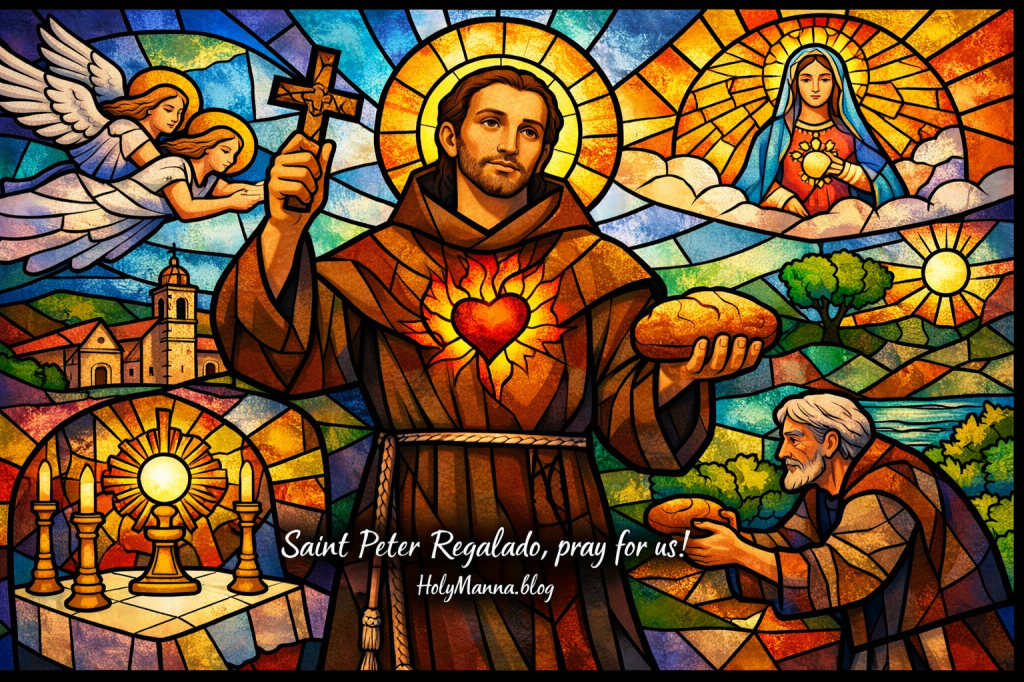
Catholic sources broadly agree that Saint Peter Regalado was believed to possess the gifts of miracles and prophecy. During his lifetime, people already spoke of favors and prodigies surrounding him. One of the best known traditions tells of his generosity to the hungry. Bread was said not to run out while he was feeding the poor. This miracle tradition fits the iconography later associated with him, where he is shown distributing bread and directing souls toward the crucifix. That story belongs to longstanding Catholic tradition surrounding the saint, even if modern historians cannot test it the way they would test an event in a modern archive. It cannot be independently verified.
Another famous tradition comes from the feast of the Annunciation. Catholic accounts say that while praying Matins at El Abrojo on March 25, Peter longed to honor the Blessed Virgin at La Aguilera. Angels were said to have carried him through the air between the two houses and then returned him after his prayer. This story became one of the most memorable miracle traditions connected with him and helps explain why his cult developed such vivid devotional imagery. It cannot be independently verified.
What can be said with confidence is that the people around him experienced him as a man transparent to God. He preached not as a performer, but as a friar whose prayer had become flesh. That is why his reform endured. He did not merely impose discipline. He made others want holiness.
The Hard Road of Reform
Saint Peter Regalado was not a martyr, but he absolutely knew hardship. Reformers in the Church often suffer a kind of hidden martyrdom. They have to battle mediocrity, endure misunderstanding, and resist the temptation to settle into the comfortable routines everyone else accepts. Peter lived in a wounded age. The aftershocks of the Western Schism, the social upheavals of late medieval Europe, and the weakened condition of many religious communities formed the backdrop of his vocation. He stepped into that world and chose the more difficult road.
His penances were real and severe. Catholic tradition recalls him fasting, embracing silence, laboring in poor conditions, and meditating intensely on the Passion of Christ. One devotional source even recounts that he was seen at night following the steps of the Passion with a rope around his neck, a heavy wooden cross on his shoulders, and a crown of thorns on his head. That story reveals how deeply he wanted to unite himself to the suffering Christ. It cannot be independently verified.
The deeper hardship, though, was interior. To live as he lived meant refusing self-will day after day. It meant allowing grace to strip away vanity, comfort, and pride. The Church does not honor him because he was dramatic. The Church honors him because he let Jesus remake him through obedience, prayer, and sacrificial love. In that sense, his life was a long martyrdom of the ego, and that may be harder for most souls than a single heroic moment.
The Saint Who Kept Giving After Death
Saint Peter Regalado died at La Aguilera on March 30, 1456, and almost immediately his grave became a place of pilgrimage. This tells an important truth about Catholic devotion. The faithful do not cling to relics and tombs out of superstition, but because the saints remain alive in Christ and continue to intercede for the Church. Peter’s reputation for holiness only deepened after his death, and miracles were reported at his tomb.
One of the most striking posthumous traditions preserved in Valladolid tells of an elderly poor man who, grieving that Peter was no longer alive to help him, prayed at the saint’s tomb. The story says that Peter miraculously gave him bread from the tomb itself. The image is deeply Catholic and deeply beautiful. The man who fed the poor in life was believed to continue caring for them after death. This story comes from local Catholic tradition and devotional memory. It cannot be independently verified.
A more firmly attested part of his posthumous legacy concerns his body. Catholic sources state that when his body was exhumed thirty-six years after his death at the request of Isabella the Catholic, it was found incorrupt and placed in a more worthy tomb. His cause advanced over time, and he was beatified by Pope Innocent XI in 1684 and canonized by Pope Benedict XIV on June 29, 1746. Later that same year he was declared patron of Valladolid and its diocese. His shrine at La Aguilera and his enduring place in the liturgical memory of Valladolid show that his cult did not fade into legend. It settled into the life of the Church.
His feast is observed on March 30 in some Catholic calendars, while Valladolid keeps his principal celebration on May 13, associated with the translation of his body. He is often depicted in sacred art with flames bursting from his heart, a sign of burning love for God, or with bread in his hands for the poor. Even now, the Church in Valladolid celebrates him not as a museum piece from the past, but as a living patron whose example still speaks to a restless age.
What Saint Peter Regalado Still Teaches the Church
Saint Peter Regalado is a needed saint for this age because he reminds the faithful that reform begins with conversion, not branding. The Church is renewed when souls become holy. The Catechism teaches that “All Christians in any state or walk of life are called to the fullness of Christian life” in CCC 2013. Peter believed that with his whole life. He did not wait for someone else to become faithful first. He let God begin with him.
He also shows that penance is not gloomy self-hatred. It is love learning to say no to selfishness. The Catechism teaches in CCC 1434 that prayer, fasting, and almsgiving are central expressions of conversion. Peter’s life looked exactly like that. He fasted. He prayed. He gave. His example asks a hard but healthy question. What would change if prayer stopped being an accessory and became the structure of daily life?
His charity toward the poor matters just as much as his penance. The Catechism says in CCC 2447 that “The works of mercy are charitable actions” by which believers come to the aid of their neighbor in spiritual and bodily need. Peter did not separate mysticism from mercy. He loved Christ in the Eucharist and Christ in the hungry. That is a lesson worth recovering. Is there someone nearby who needs bread, patience, encouragement, or practical help more than another opinion?
There is also something deeply consoling in his hiddenness. Saint Peter Regalado was not a celebrity saint. He was a disciplined friar in a corner of Spain, faithful to grace, faithful to prayer, faithful to the poor. And yet the Church still remembers him. That is a strong reminder that holiness is never wasted. No hidden act of fidelity is lost in the eyes of God. What hidden sacrifice could be offered to Jesus today with greater love and less complaint?
Engage With Us!
Readers are warmly invited to share their thoughts and reflections in the comments below. Saint Peter Regalado’s life has a way of challenging comfortable habits while also drawing the heart toward peace. There is something in his witness that still speaks to modern souls who are tired of noise and hungry for what is real.
- What part of Saint Peter Regalado’s life stands out most strongly: his poverty, his prayer, his penance, or his love for the poor?
- Does his example make the call to holiness feel more possible, or more demanding, and why?
- Where might Jesus be asking for greater simplicity, discipline, or mercy in daily life right now?
- How can devotion to the Eucharist and care for the poor become more closely united in ordinary Christian life?
- What would it look like to pursue reform in personal life the way Saint Peter Regalado pursued reform in religious life, with patience, humility, and courage?
May Saint Peter Regalado remind every soul that holiness is not reserved for the loud, the famous, or the powerful. It belongs to those who let Christ purify the heart, strengthen the will, and widen charity. Let daily life be lived with faith, and let everything be done with the love and mercy Jesus taught us.
Saint Peter Regalado, pray for us!
Follow us on YouTube, Instagram and Facebook for more insights and reflections on living a faith-filled life.

 Holy Manna!
Leave a comment