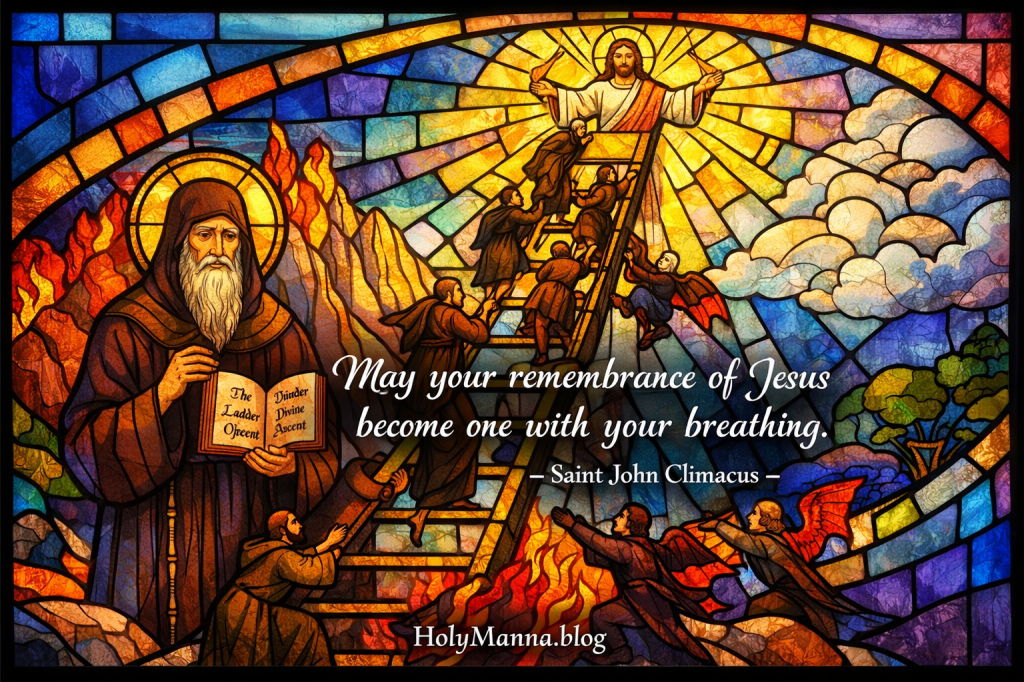
A Saint Who Taught the Soul How to Climb
Saint John Climacus stands in Christian tradition as one of the great teachers of the interior life. He was not a king, a missionary crossing continents, or a martyr in the arena. He was something quieter and, in many ways, just as powerful. He was a monk of Mount Sinai, a spiritual father, and the author of one of the most important works of ascetical theology ever written, The Ladder of Divine Ascent. That book gave him the name “Climacus,” which comes from the word for ladder, because he taught Christians how the soul rises toward God step by step through repentance, humility, prayer, self-denial, and love.
He is revered because he understood something that every serious Christian eventually learns. Holiness is not accidental. Union with God does not happen by drifting. The spiritual life is a climb. It is slow, demanding, and beautiful. Saint John Climacus knew that the road to heaven runs through vigilance, grace, and perseverance. That is why the Church has treasured his witness for centuries, especially during Lent, when believers are called to examine their hearts and begin climbing again.
From Learning to the Desert
The details of Saint John Climacus’s early life are not fully certain, but Catholic tradition places him in the sixth and seventh centuries and connects him closely with the holy world of Mount Sinai. He was known as “Scholasticus,” which suggests that he was educated and intellectually formed before embracing the monastic life. This matters because it shows that he did not flee to the desert out of ignorance or inability. He had gifts, learning, and promise in the eyes of the world, yet he chose something greater.
As a young man, likely around the age of sixteen, he entered monastic life at Mount Sinai. There he came under the guidance of Abba Martyrius, his spiritual father. That relationship shaped him deeply. Like so many saints, he did not become holy through private inspiration alone. He became holy through obedience, discipline, and humble submission to wise guidance. That is already one of the first great lessons of his life. Saints are not self-made. They are formed.
After years of formation, he withdrew to greater solitude near Sinai, living as a hermit in prayer, fasting, study, and spiritual struggle. This was not a dramatic conversion from paganism to Christianity, but it was a profound deepening of faith. His conversion was the kind that many faithful Catholics need to understand better. It was a conversion from good beginnings to total surrender, from religious identity to radical holiness, from knowing about God to living wholly for God.
Saint John Climacus is most known for The Ladder of Divine Ascent, his spiritual masterpiece. In that work, he describes thirty steps by which the soul rises toward God. Those steps move through renunciation, detachment, obedience, repentance, discernment, prayer, humility, and finally love. He became famous not because he sought attention, but because his insight into the human soul was so penetrating that Christians across the centuries recognized the voice of a true spiritual master.
The Desert Father Who Healed Souls
Saint John Climacus spent roughly forty years in solitude, but this did not make him cold or distant. In fact, it sharpened his love. People sought him out because he had become a physician of souls. He understood temptations, discouragement, pride, anger, lust, sadness, vanity, and spiritual laziness. He knew them not as theories but as battles fought in prayer.
Eventually, despite his love of solitude, he was chosen abbot of the Sinai monastery. That alone says much about his reputation. Men who lived lives of sacrifice and prayer trusted him to lead them. He did not become important by worldly standards. He became trustworthy in the one place that mattered most, the struggle for holiness.
One of the most beautiful parts of his legacy is the wisdom he left behind in short sayings that still strike the heart. He wrote, “May your remembrance of Jesus become one with your breathing.” That line alone says so much about his spirituality. Prayer was not meant to be an occasional religious exercise. For Saint John Climacus, the Christian life was meant to become soaked with the presence of Christ.
He also taught, “After God, we ought to follow our conscience as a rule and guide in everything.” This was not an invitation to moral subjectivism. It was a call to form the heart honestly before God, to stop lying to oneself, and to live with integrity. He understood that many sins survive because people refuse to look at themselves truthfully.
Another saying attributed to him is equally piercing: “Your prayer will show you what condition you are in.” That is deeply Catholic and deeply uncomfortable. Prayer reveals the soul. It exposes distraction, pride, self-love, lukewarmness, and longing for God all at once. Saint John Climacus did not flatter the spiritual life. He told the truth about it.
Catholic tradition also preserves miracle stories from his lifetime. One traditional account says that when Palestine and Arabia were suffering from drought and famine, people asked for his prayers, and rain came in abundance after his intercession. This miracle story comes down through hagiographical tradition and cannot be fully verified.
Another story tells of a monk named Isaac who was being tormented by violent temptations and was near despair. Saint John prayed for him and helped him find deliverance. Even if every detail cannot be historically verified, the story fits the deeper truth of his life. He was known as a guide for those caught in interior warfare, and he helped souls find freedom in Christ. This miracle story also cannot be fully verified.
The Hard Road of Hidden Holiness
Saint John Climacus was not a martyr, so there is no account of him shedding his blood for Christ in the way many saints did. Still, he lived a life filled with hardships. The desert is not romantic in the Christian tradition. It is a place of testing. It strips away comforts, illusions, distractions, and excuses. It forces a man to face himself before God.
His hardships included the severe asceticism of monastic life, the spiritual warfare that comes with solitude, and the weight of leadership when he was chosen abbot. For a man who loved silence, even being drawn back into public responsibility was its own kind of suffering. Yet he endured these burdens faithfully. He accepted both solitude and authority as gifts permitted by God.
This is important because many people imagine holiness only in dramatic terms. Saint John Climacus shows something different. Sometimes sanctity looks like perseverance in hidden places. Sometimes the saint is the one who keeps praying, keeps fighting temptation, keeps telling the truth, and keeps leading others without applause.
His life was also marked by the hardship of seeing how difficult the spiritual battle can be for ordinary people. That burden can weigh heavily on a true shepherd. He knew the danger of despair, the exhaustion of temptation, and the subtle poison of pride. Yet he never reduced the Christian life to mere struggle. He kept pointing beyond the fight toward love. He understood that the purpose of spiritual discipline is not self-punishment. It is freedom for charity.
A Legacy That Still Breathes
After his death, Saint John Climacus’s greatest impact was not through an explosion of sensational miracle reports, but through the astonishing power of his teaching. His book traveled far beyond Sinai and became one of the Church’s great spiritual classics. Monks in both East and West read it, copied it, commented on it, and passed it down generation after generation. In that sense, the lasting transformation of souls through his writing became one of the clearest signs of his sanctity.
Catholic tradition especially remembers him during Lent. In the Latin Church, he is honored in the Roman Martyrology on March 30. In Eastern Catholic tradition, he is also commemorated on the Fourth Sunday of the Great Fast. That is fitting, because his whole spiritual vision is about repentance, vigilance, and the slow ascent toward Easter joy.
His cultural impact is also seen in sacred art. One of the most famous Christian images connected to him shows monks climbing a ladder toward Christ while demons try to drag them down. It is unforgettable because it is so honest. The image captures the Christian life exactly as Saint John saw it. Heaven is the goal. The climb is real. Temptation is real. Grace is real. Christ is waiting at the top.
As for posthumous miracles in the narrower sense, the major Catholic sources preserve his enduring veneration, his widespread influence, and the spiritual fruit of his writings more clearly than they preserve detailed miracle stories at his tomb or relics. No widely attested posthumous miracle account emerged in the major Catholic sources consulted for this write-up. What is beyond doubt is that his legacy changed countless lives and shaped Christian spirituality in a lasting way.
Saint John Climacus also left the Church with a language that still helps Catholics make sense of their own struggles. He taught that spiritual growth is gradual. He taught that humility is stronger than pride. He taught that prayer and self-knowledge belong together. He taught that hope opens the heart to love. One line associated with him says, “Hope is the doorway of love.” That sounds simple at first, but it goes very deep. A discouraged soul closes in on itself. A hopeful soul opens itself to God.
Learning to Climb in Daily Life
The life of Saint John Climacus speaks with surprising force to modern Catholics. There is so much noise now. So much distraction. So much shallow advice. So many false promises of peace without repentance, spirituality without discipline, and faith without sacrifice. Saint John cuts through all of that. He reminds the Church that holiness still costs something, and that grace does not remove the need for effort. It transforms effort into love.
His witness invites readers to take the spiritual life seriously. That does not mean becoming harsh, gloomy, or obsessed with self-improvement. It means becoming honest. It means asking where pride still rules, where distraction weakens prayer, where comfort has replaced sacrifice, and where Christ is calling for a deeper yes.
A practical way to live his teaching is to bring more intentionality into prayer. Instead of waiting to feel holy, begin by praying faithfully. Set aside time for silence. Examine the conscience carefully. Go to confession regularly. Receive the Eucharist with reverence. Read Scripture prayerfully. Learn to notice the patterns of temptation. Learn to name the sins that keep returning. Learn to ask for grace before falling instead of only after.
Another lesson from Saint John Climacus is that spiritual maturity takes time. People often want instant peace, instant wisdom, and instant freedom from sin. He reminds the faithful that growth usually comes step by step. A ladder is climbed one rung at a time. That means discouragement must be resisted. Even slow progress matters when the soul is moving toward Christ.
He also teaches the importance of humility. Humility is not self-hatred. It is truth. It is the refusal to pretend. It is the courage to let God be God and to stop trying to build a false self through comparison, vanity, or control. In that sense, his teaching is painfully relevant. So much of modern life rewards image over substance. Saint John Climacus calls believers back to the hidden life where God sees everything and heals what is real.
What would change if prayer became as regular as breathing? What hidden sin keeps pulling the soul off the ladder? What step of repentance, humility, or trust needs to be taken today instead of tomorrow? These are the kinds of questions his life provokes, and they are healthy questions because they lead the heart back to Jesus.
Engage With Us!
Share your thoughts and reflections in the comments below. Saint John Climacus has helped Christians for centuries look honestly at the spiritual life and begin climbing again. The same grace is available now.
- What part of Saint John Climacus’s life speaks most strongly to the heart right now?
- Does the image of the spiritual life as a ladder help make sense of personal struggles in prayer and virtue? Why or why not?
- Which of his teachings feels most needed today: humility, perseverance, self-knowledge, or deeper prayer?
- How can more silence and honesty before God become part of daily life this week?
- What is one concrete step that can be taken today to climb closer to Christ?
Saint John Climacus reminds the Church that holiness is possible, but it must be pursued. The climb is hard, but it is worth everything. Keep climbing. Keep praying. Keep trusting the mercy of Christ. Live a life of faith, and do everything with the love and mercy Jesus taught us.
Saint John Climacus, pray for us!
Follow us on YouTube, Instagram and Facebook for more insights and reflections on living a faith-filled life.

 Holy Manna!
Leave a comment